Our family's active spirit
Discover the sports and recreational adventures that have shaped our family's history. From competitive achievements to tranquil explorations, this is where our active stories come alive.
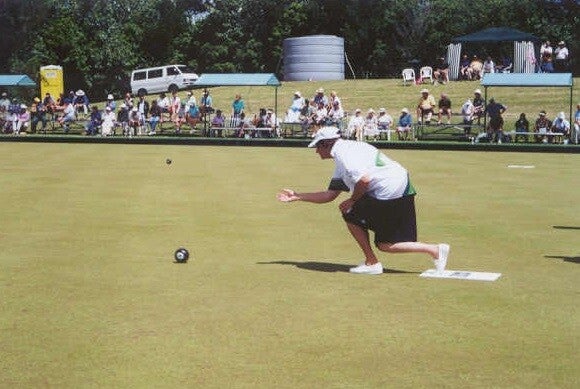
Lawn bowls: A legacy of precision and success.
Lawn bowls has been a significant part of Sharon's sporting life, with her achieving national and international recognition.
She has been the country's most successful international, winning gold in the pairs with Jo Edwards at the 2002 Commonwealth Games in Manchester and three world championship gold medals.
Lawn Bowls
Sharon was making great strides in her bowling career.
In 1986, Helen Whitehead, a family friend asked Sharon if she wanted to accompany her to learn lawn bowls at the Manawatu Bowling Club. Sharon had practically grown up on bowling greens as both her parents were keen bowlers but had always thought that she would take it up later in life. However, she accompanied Helen to the club’s open day - and was instantly hooked. She was also naturally talented and determined to nurture that talent. So much so that when she finished her master’s degree and Tim Brown, her supervisor asked her what she wanted to accomplish next, she thought for a moment and then replied, ‘I want to be New Zealand’s best lawn bowls player.” So began a serious assault on the New Zealand Bowling scene.
Tournament success was almost immediate, first at a club level, then center level, and then at a national level, and within six years she was representing New Zealand in the sport. I also joined the Manawatu Club and played the sport for about 18 months. Whilst I enjoyed the social aspect of the club, I quickly got to the point where I could see that I would have to spend a lot more time practicing and playing to get any better, not that I would ever have been as good as someone as gifted as Sharon. In the end it came down to a simple choice; did I want to play bowls competitively (even at a club level), or did I want to go fishing? I chose to go fishing.
Sharon meanwhile joined the Northern Bowling Club, which back then had a history and a reputation for producing and fostering bowls champions. A resume of her remarkable bowling career to date follows.
SHARON ELMAR SIMS
The Manawatu Legends of Sport was established in 2007 to honour the region's greatest sporting achievers and those who have dedicated many years of service to regional sport. To celebrate 25 years of Sport Manawatu, it is profiling the region's legends.
Sharon Sims began playing bowls in 1986 at the Manawatu Bowling Club and joined the Northern Bowling Club in 1995.
Sims first represented New Zealand in the trans-Tasman series in 1997 and represented New Zealand every year until she retired in 2008, after more than 350 matches.
Sims has been the country's most successful international, winning gold in the pairs with Jo Edwards at the 2002 Commonwealth Games in Manchester and three world championship gold medals.
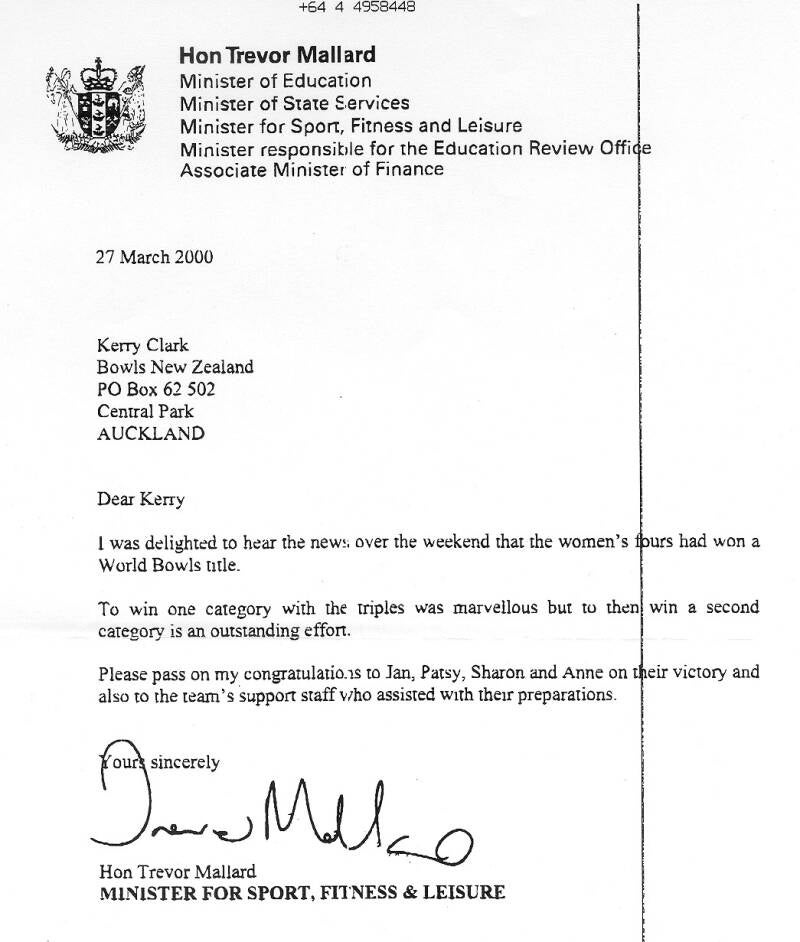
Two came at the 2000 world championships, where she won the triples and fours, with the other in the pairs in 2004. Sims also won six national titles.
Moama 2000
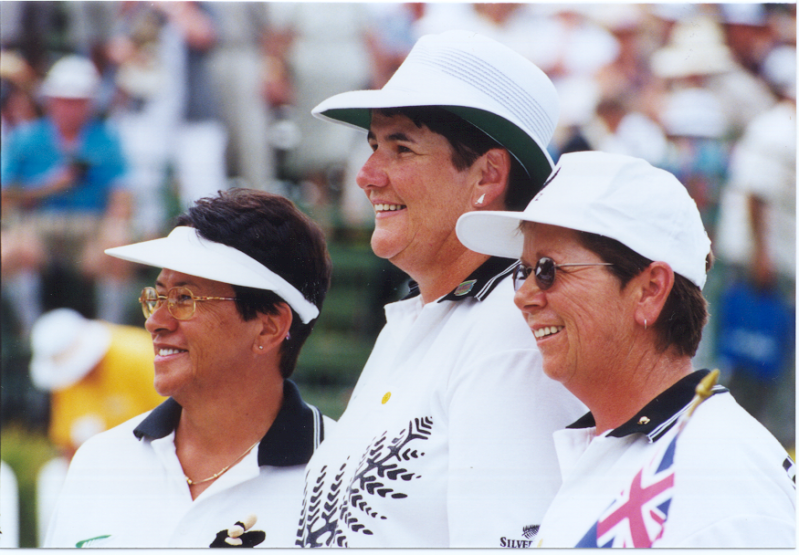
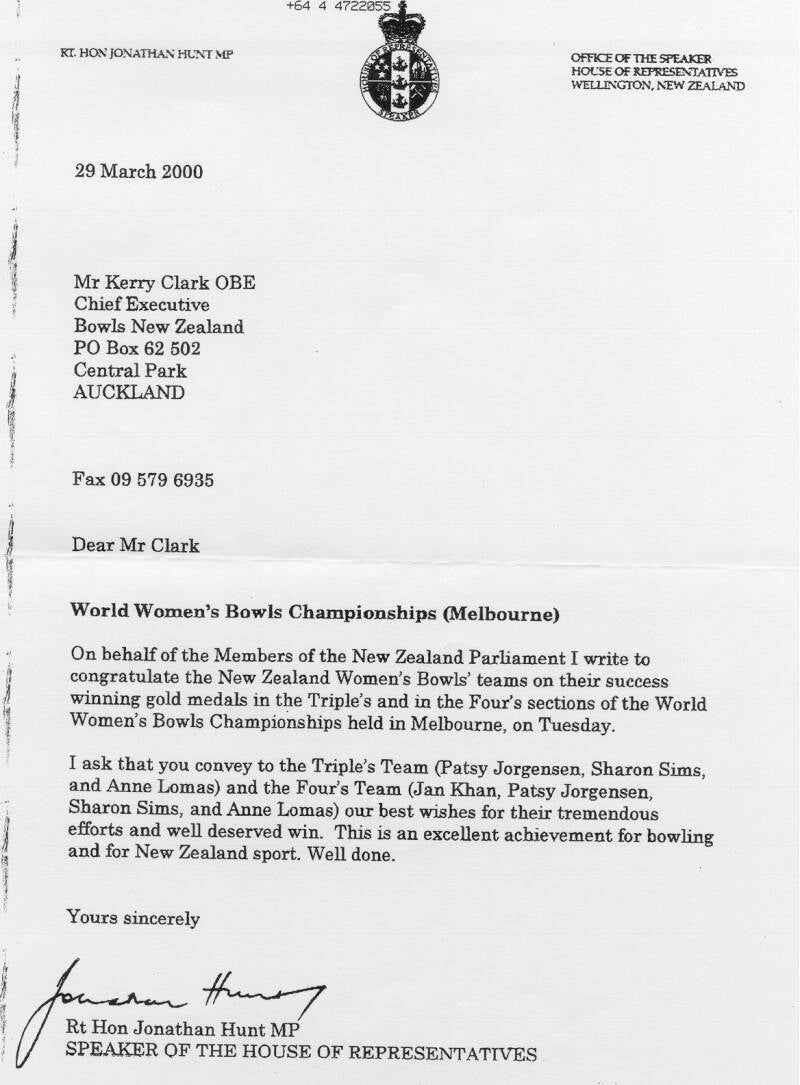
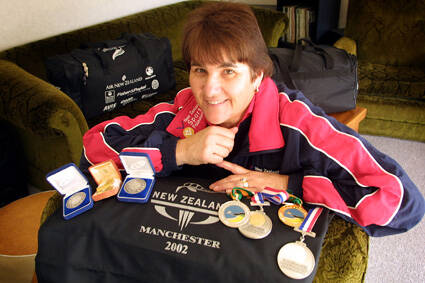
International medals following the 2002 Commonwealth Games at Manchester.
Sims has also coached the New Zealand juniors and worked as a regional development officer and national coaching co-ordinator.
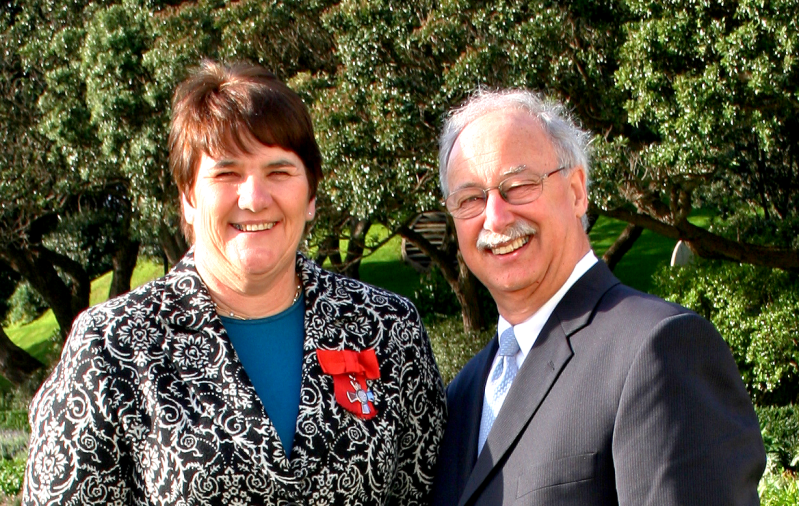
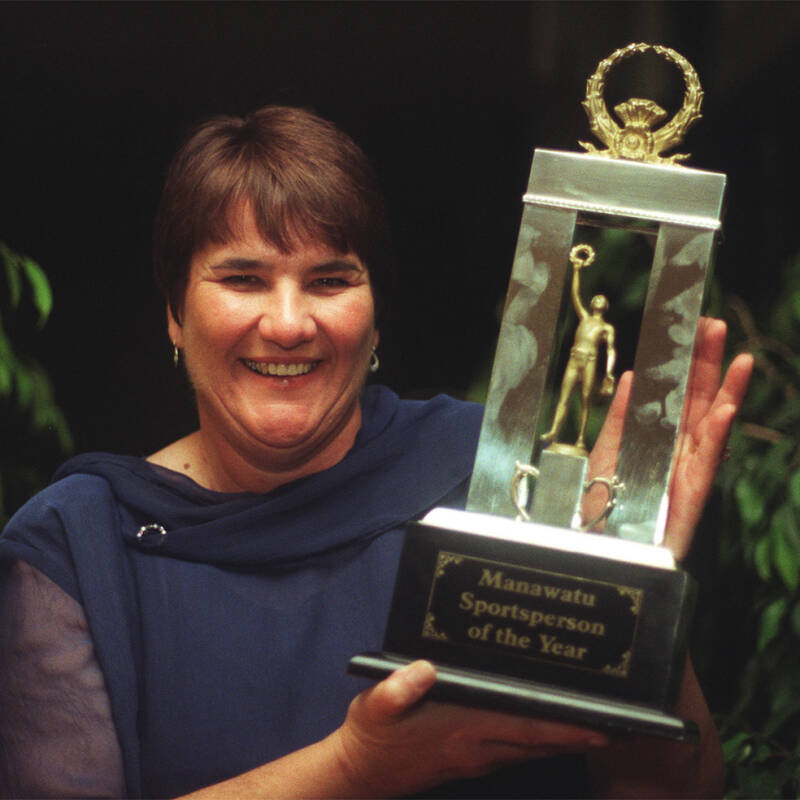
She received many other honours. In 2007 she became a member of the New Zealand Order of Merit for services to bowls. She was Bowls New Zealand player of the year in 2005 and was Manawatu sportsperson of the year in 2000, 2002 and 2004.
She has been a selector and coach for the NZ International Bowls team (The Blackjacks) and in 2022 was appointed Patron of Bowls New Zealand.
NZOM Investiture at Government House
Playing Years: 15 International Medals:
Club Titles: 33 5 Gold, 3 Silver, 1 Bronze.
Centre Titles: 19
National Titles: 2
World Titles: 2
1987-1988
Junior Pairs Champion (Skip)
Junior Triples Champion (Skip)
1988-1989
Junior Singles Champion and Champion of Champions
Junior Pairs Champion and Champion of Champions (Skip)
1989-1990
Club Singles Champion
Club Triples Champion and Champion of Champions (Lead)
Winner Feilding Invitation Singles
Manawatu W.K.W.M.(5yrs and under) Representative (Singles)
1990-1991
Club Singles Champion
Club Pairs Champion (Skip)
Club Triples Champion and Champion of Champions (Two)
Club Fours Champion and Champion of Champions (Three)
Winner Feilding Invitation Singles
Manawatu W.K.W.M. Representative (Singles)
1991-1992
Club Singles Champion and Champion of Champions
Club Pairs Champion (Skip)
Club Triples Champion and Champion of Champions (Two)
Club Fours Champion (Three)
Winner Manawatu Centre Aussie Pairs (Skip)
Third equal National Tournament Singles
Runner-up National Tournament Pairs (Skip)
1992-1993
Club Singles Champion
Club Pairs Champion (Skip)
Manawatu Centre Open Fours Winner (Skip)
Third Equal National Tournament Fours (Skip)
Winner National Tournament Pairs (Skip)
Manawatu Zone Representative (Singles)
NZ Emerging Players Test vs Australia (Skip of Triples and Fours)
1993-1994
Club Pairs Champion and Champion of Champions (Skip)
Winner Wanganui Superbowls Singles
Manawatu Zone Representative (Pairs Skip)
NZ Emerging Players Test vs Australia (Pairs Skip and Fours Third)
Non Travelling Reserve Commonwealth Games Team
1994-1995
Club Singles Champion
Runner-up Wanganui Superbowls Singles
Runner-up Manawatu Superbowls Singles
Manawatu Zone Representative (Fours Third)
NZ Emerging Players Test vs Australia (Pairs Skip and Fours Second)
1995-1996
Club Singles Champion
Club Pairs Champion and Champion of Champions (Skip)
Club Triples Champion (Skip)
Club Fours Champion and Champion of Champions (Skip)
Third equal Manawatu Superbowls Singles
Third equal Manawatu Centre Singles
Manawatu Zone Representative - Winners Zone Two (Fours Second)
NZ Emerging Players Test vs Australia (Pairs Skip and Fours Third)
Non Travelling Reserve Pacific Games Team
1996-1997
Club Singles Champion and Champion of Champions
Club Fours Champion and Champion of Champions (Skip)
Runner up Kapiti Superbowls
Runner up United Invitation Singles (Nelson)
Runners up Wairere Classic
Third equal Hawkes Bay Open Singles
Manawatu Zone Representative (Singles)
Runner up Manawatu Centre Open Singles
Winner Manawatu Abeeco Mixed Pairs (Lead)
NZ Representative Test vs Australia (Triples Lead and Fours Second)
1997-1998
Winner Kapiti Centre Astrograss Mixed Triples (Two)
Runner-up Hawkes Bay Open Singles
Winner Wellington Superbowls
Runner-up National Superbowls Final
Runner-up United Invitation Singles (Nelson)
Club Triples Champion (Skip)
Club Pairs Champion and Champion of Champions (Skip)
Runner-up National Tournament Fours (Skip)
Runner-up Manawatu Open Fours (Skip)
Manawatu Centre representative (Singles) - runners-up National Intercentre Final
NZ Representative Malaysian Test Series (Abandoned)
Silver Medal Fours Asia Pacific Championships (Two)
Silver Medal Triples Asia Pacific Championships (Lead)
Bronze Medal Fours Wira 6 Nations Tournament
NZ Representative Test vs Australia (Triples Measurer and Fours Third)
NZ Commonwealth Games team (Fours Third)
1998-1999
Club Singles Champion and Champion of Champions
Club Pairs Champion (Skip)
Club Triples Champion (Skip)
Club Fours Champion (Skip)
Winner Manawatu Open Singles
Winner Manawatu Open Fours (Skip)
Third equal (and top women’s pair) Hillcrest Invitation Pairs (Lead)
Interclub representative (Fours Skip) – Regional winners – third at National final
Manawatu Centre Representative Octagonal Tournament (Triples Skip)
ManaBay Coast Representative Super 8 (Pairs)
NZ Representative Test vs Australia (Triples Measurer and Fours Second)
Runner-up Kingscliff (NSW) Invitation Classic Pairs (lead).
1999-2000
Gold Medal Asia Pacific Championship Triples (Measurer)
Gold Medal Asia Pacific Championship Fours (Third)
Gold Medal World Bowls Championship Triples (Measurer)
Gold Medal World Bowls Championship Fours (Third)
NZ Representative Test vs Australia (Triples Measurer and Fours Third)
ManaBay Coast Representative Super 8 (Singles)
Interclub representative (Pairs Skip) – Regional winners
2000-2001
Club Pairs Champion and Champion of Champions (skip)
Runner-up Manawatu Open Pairs (Skip)
Manawatu Intercentre representative (Singles unbeaten in national finals)
Super 8 Winners ManaBay Coast (Singles)
NZ Representative Malaysian Millennium Tournament (Triples Measurer and Pairs Skip)
NZ Representative Test vs South Australia (Triples Measurer and Fours Third)
NZ Representative Test vs Ireland (Pairs Skip and Fours Third)
NZ Representative Test vs Australia (Triples Measurer and Fours Third)
NZ Representative Test vs England (Fours Third then singles)
Runner-up Kingscliff (NSW) Invitation Classic Pairs (lead).
2001-2002
Gold Medal Asia Pacific Championship Pairs (Lead)
Silver Medal Asia Pacific Championship Fours (Second)
Club Singles Champion
Club Pairs Champion and Champion of Champions
Runner-up United Invitation Singles (Nelson)
NZ Representative Test vs Australia (Pairs Lead)
National Singles Champion
Interclub representative (Pairs Skip) – Regional winners
Manawatu Intercentre representative (Singles)
Super 8 winners ManaBay Coast (Pairs lead)
Sharon’s success in lawn bowls has resulted in many trips, tournaments, trophies, honours and awards, perhaps culminating in being inducted into the Manawatu Legends of Sport and then being awarded a Member of the NZ Order of Merit for her services to Bowls.
Manawatu Sportsperson of the Year (Multiple Times)
Banner celebrating Manawatu Legends of Sport.
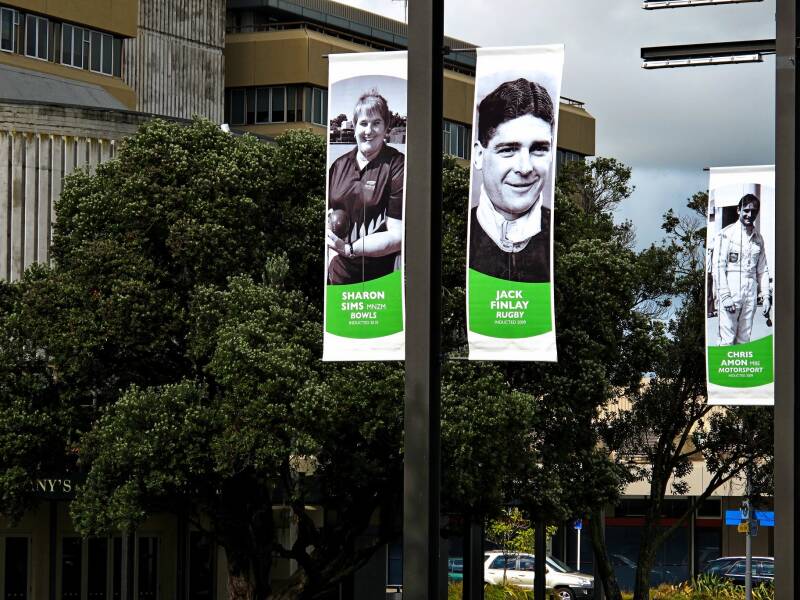
The trip down to Parliament House to be invested was indeed a memorable one.
And of course it didn’t stop there, with ongoing roles as NZ coach and selector, and Patron of Bowls NZ.
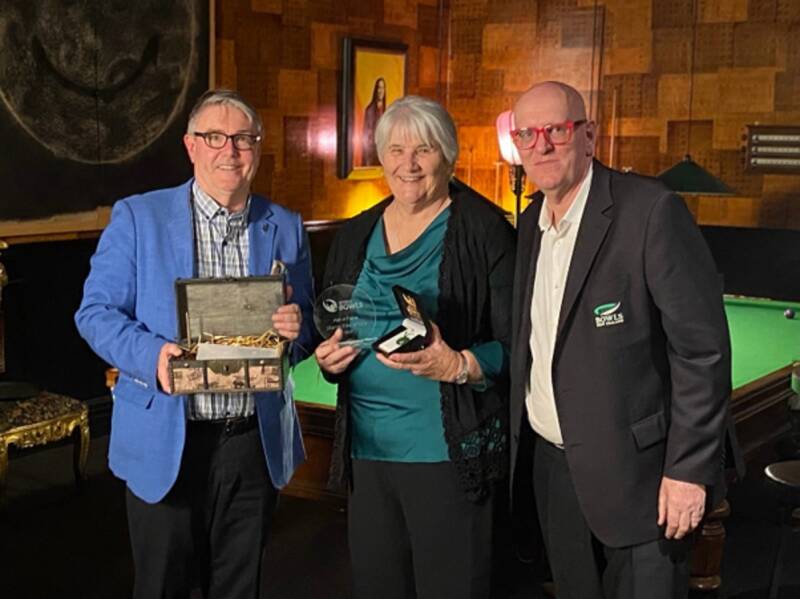
Another trip down to Wellington saw her inducted into the World Bowls Hall of Fame as an inaugural member, and a great night’s celebration with fellow inductees.
Induction into the Inaugural World Bowls Hall of Fame.
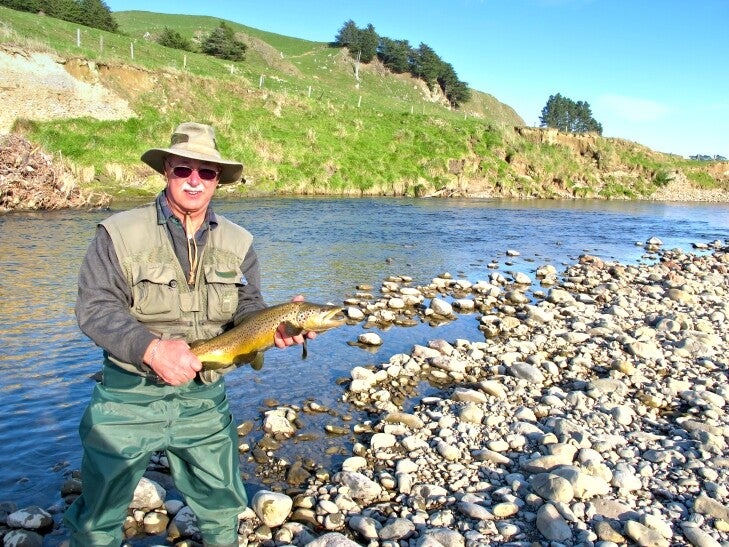
Fishing tales:
From tranquil mornings by the river to exciting sea fishing excursions, fishing has always been a beloved pastime. This section will delve into Ken's fishing adventures, sharing anecdotes of trips, adventures, and the beautiful New Zealand waters I have explored. It's about more than just fish; it's about connection with nature and each other.
Is it time to talk about fishing? It is a story with a start, a middle, and perhaps an end, something that I wouldn’t have believed a few years ago. It is something that has defined my whole life, and something that I used to define myself.
Perhaps it did start as I have suggested earlier, with a small boy lying in the grass beside a stream on a hot summer’s day, watching what seemed to be a huge bow wave disappear upstream. Certainly, I have always been drawn to rivers. And as soon as I was aware that they contained fish, I wanted to catch them.
There wasn’t a great deal of opportunity to do that as a boy. Fishable rivers were a little beyond the reach of my pushbike, and I would have been too self-conscious to try anyway. But I was prepared, with a spinning rod and a Mitchel 304 spinning reel (which I still have) and every opportunity I got, such as family picnics beside the Manawatu River, I put it to use. I knew little and caught less, but I had begun a journey, and I was learning.
Freshwater fishing, especially back then, was exclusively fishing for trout, for which you needed a licence.
I didn’t get a chance to pick up a rod again until I was in Hamilton. Gavin Hoggard was pretty keen and introduced me to some very pretty water in the Waikato. With the rivers holding rainbows, rather than just the brown trout in the Manawatu river systems, I even started catching fish! And I started flirting with a fly rod, gradually becoming proficient enough to not look like a complete fool. Eventually, I realised that if you wanted to go fishing (and I did), company was nice, but you took yourself off fishing anyway.
I fished the Waipa and its tributaries under the Kaimais, I fished the Hydro Lakes, especially Karapiro, Arapuni and Waipapa (a personal favourite), and to the west the Pokaiwhenua, Waihou and Waimakariri Rivers.
I fished the fast-tumbling headwaters and gorges, the slow, deep pools on the plains, and the brooding stillness of the lakes; from limestone country to peat plains and everything in between. Without even realising it, I became absorbed in the countryside and its waterways.
Arapuni Hydro Lake.
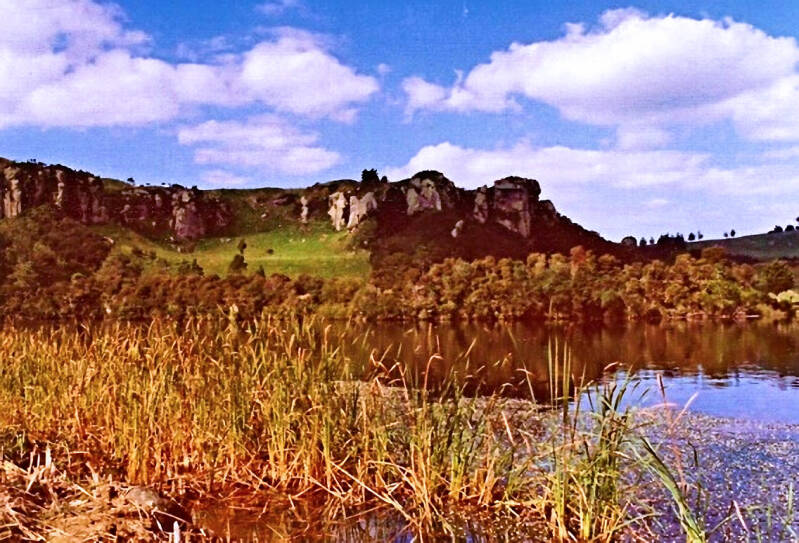
However, it wasn’t until I moved to Palmerston North that I became a fisherman. But it didn’t come quickly, and it didn’t come easy. When we first moved down, the MAF Animal Health Lab. was on the 4th floor of the Veterinary Science Tower at Massey University. It didn’t take me long to meet a very enthusiastic freshwater angler by the name of Colin Potts, who worked in the Large Animal Clinic. Colin was the main driver behind the Massey Anglers Club, and I soon found myself a member. My first memory of those times was getting some tuition in fly casting from a club member from the Scottish Hebrides on the lawn outside of the Vet Tower, and my second memory was of my first club trip.
It is worth describing that trip in a bit of detail, as it typifies what the club and its activities were like. The thing that made this club different to many others was that a lot of its members were anglers on sabbatical from other countries, so not only were their countries of origin varied but they came and went, to be replaced by others. Colin had organised this trip to the upper Mohaka River, which back in those days was only fished by the occasional hunter who carried a telescopic rod in their pack. It was a three-day camping trip over a long weekend, and about 11 of us went. We drove to Sanson, picked up a long wheelbase Land Rover we had hired, somehow squeezed everyone and their gear into it, and took off. It was a long, uncomfortable journey and one of the senior vet lecturers started complaining almost immediately. He didn’t stop until well after we got back.
We stopped off for a fish in one of the rivers on the way there. I can’t remember exactly where or which it was, but it was probably the Esk which was one of Colin’s favourite rivers. I remember Brian Harper-Smith pulled a lovely brown out of a run, which impressed me greatly. Then it was on to the carpark in the Kaweka Forest park, where we shouldered our packs and grabbed our rods, and tramped over the ridge to the river flats and set up camp. Soon the flats were dotted with puptents, and a campfire had been set on a bed of river stones.
The next day was fine but overcast, and everyone set off to fish the pristine headwaters we were beside. One of the team was a visiting Japanese lecturer, and he emerged from his tent in full jungle kit looking like he had just stepped out of a WW2 movie. About midday Colin caught a good-sized rainbow, and as soon as he had landed it, this guy grabbed it and took off back to camp. When we got back to camp later that day, he had exquisitely removed all the flesh from the head and made fish-head soup from it!
Camp beside the Mohaka River – Massey Angling Club
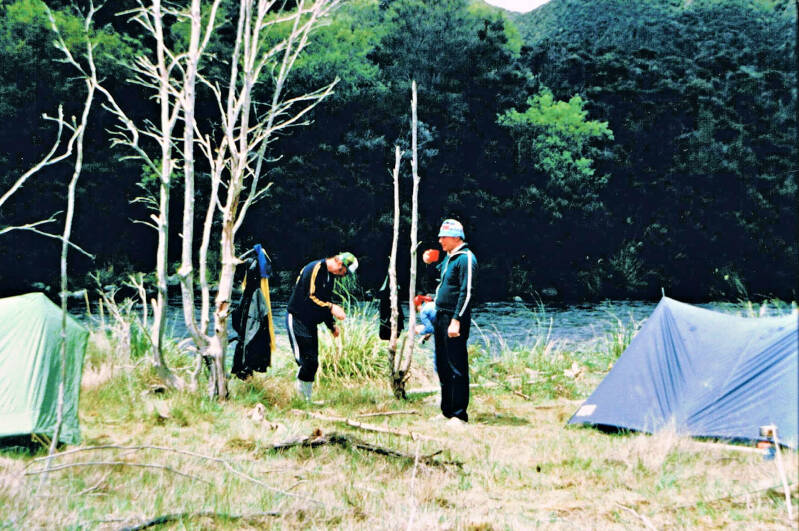
My tent was the blue one.
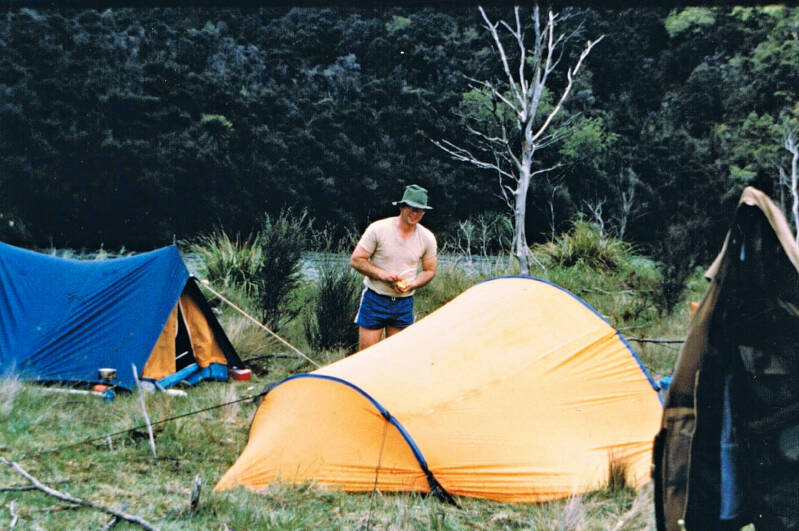
I had little idea of what I was doing, but I was sure getting lots of casting practice in. I was fishing these fairly large black nymphs which we had tied in the previous club night, and I wasn’t confident that they would represent food to any trout they passed. However, about mid-afternoon it started raining and large trout seemed to just appear out of nowhere, feeding voraciously. It was then that I realised that the nymphs were imitating Dobsonfly larvae (or toe bitters) and were being readily accepted.
Unfortunately, the rain set in and didn’t stop until we left. It was a good test of our tents, wet-weather gear, and resilience, although being part of a large group made that easier. Except for the guy complaining of course, he took it as a personal affront. The next morning, we broke camp early and returned home. But even after all these years, the memory of that wilderness experience and the beauty of the surroundings at that time, and in that company, remains strong.
While fishing trips away were a feature of the club, so to was fishing local waters. At that time, the fisheries in the Manawatu and Tararua’s were exclusively brown trout, there were no rainbow trout, despite the best efforts of Fish & Game to introduce them. But you didn’t have to go far to find the browns, as the Massey University dairy farms backed on to the river as it ran through the town on the opposite bank, and there were many an early evening trip down to these beaches to fish the evening rise.
For anglers used to keeping fish for the table that site presented just one problem, the proximity of the city’s sewage outlet. I remember a new young club member called Nigel from Hawkes Bay, who was already an accomplished angler. Having caught a respectable fish in the urban Manawatu river, he had taken it back to his flat for food when he was suddenly struck by the uncertainty of just how safe it was. Being an intelligent lad, his solution was to wipe the fillets down with Janola, smoke them, then feed then to his flatmates first before trying them himself.
There were many other trips made with the club, including regular visits to Turangi in winter, where we were able to hire a house not far from the Tongariro river. A couple of the members were keen home-made wine enthusiasts and would regularly arrive on a Friday night with a couple of flagons labelled Electro-Vet, which contained anything but large animal fluid replacements! But on cold frosty nights in an uninsulated Turangi house, they sure kept us all warm.
Fishing the winter spawning runs was very productive and back then you had a daily limit of 8 fish per person. We used to pool the fish caught among the members present, so everyone came back with some fish, sometimes with a substantial amount. But it could be fickle. I remember one weekend away when the club secretary, Roy Sparkman, spent a lot of time instructing newer members on how to catch fish, but just couldn’t hook into one of his own. Roy’s mood got darker and quieter as the weekend wore on, until on the Sunday afternoon on the Never Fail pool he finally hooked into a fish. You could just about hear a collective cheer and sigh of relief up and down the river. Roy finally bought the fish to the bank, and Brian Harper-Smith moved in to net it for him. As he scooped it up, the bottom of his net broke open, the fish threw the hook, fell though the net and swam away! The look on Roy’s face is something that I shall never forget.
As club secretary, Roy was responsible for the monthly club newsletter. This contained vital information about upcoming club nights, fly-tying to be demonstrated and club trips. As it was long before the days of computers or even photocopiers, the newsletters were typed out (on a typewriter) copied on a gestetner machine, and the copies sent out in the internal mail to club members. One month the newsletter arrived, and it didn’t make much sense at all. It turned out that Roy, feeling bored and well lubricated with Electro-Vet on the night he wrote it, had decided to type it out with his toes.
I have many great memories of those trips to Turangi. Of fishing frosty mornings when it was so cold the line froze to the rod while you were trying to cast, and once so cold there were lumps of ice floating down the river. Of walking home on fine frosty evenings when the last light turned the sky and the snow on the hills purple and mist started to shroud the river. I remember having a great day fishing the Kamahi pool when I had caught my limit of 8 fish by lunchtime. Carrying that number of trout back out to the car just about broke my arm, and my back!
The largest fish I ever caught was on the long Kamahi pool. I hooked it about midway up the pool, and it took off upstream. It was so large it created a bow wave all the way upstream until I stopped its run. When I finally managed to wrestle it back it took me all the way down to the Blue pool. After what seemed an age, I got it to the bank at the top of the Blue pool, and it was so big that I momentarily lost concentration. It tuned on its side in the shallow water, grubbed the nymph from its jaw, and disappeared into the depths of the pool. It would have been well over 10 lb, and I didn’t know whether to laugh or to cry. But I did learn a valuable lesson.
I also remember once, having gone back to the house for a lunch break with some other club members, seeing Roy and a friend of his arrive back in their car. They had been up the Tongariro-Taupo River, and the car had a brown line around it about halfway up the car. They opened the car doors, and this torrent of muddy water poured out of the car on to the lawn. It seems that they had driven up the forestry road (now closed), seen a large puddle in the road and thought ‘we can drive through this’. Wrong! The car sank to halfway up the doors, stalled, and they had to get towed back out.
Club Trip to the Tongariro May 1993
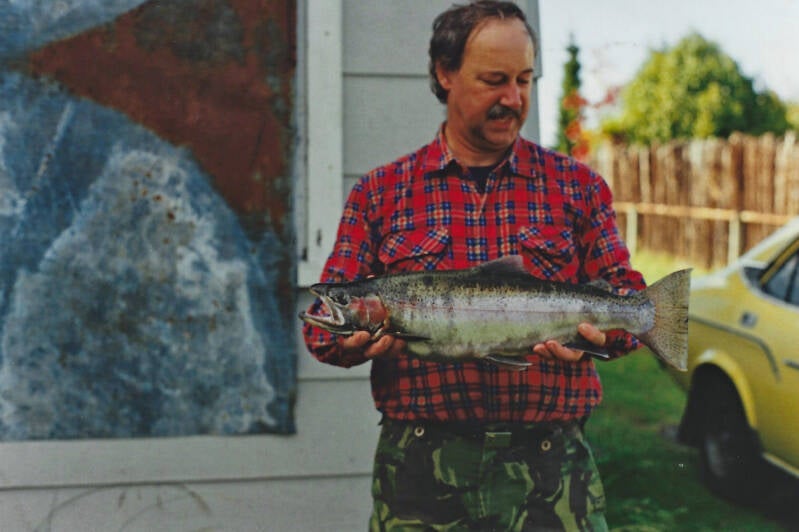
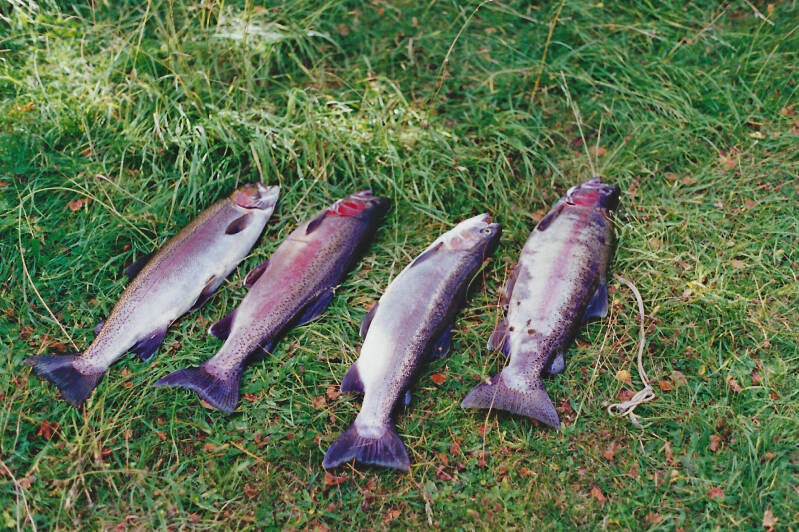
A good morning's haul.
One of the more poignant aspects of river fishing, even on rivers as big as the Tongariro, is that nothing is permanent. The Kamahi Pool was a long, boulder-strewn run after it ran in from the Stag Pool, making ideal holding water for trout moving up the river. It even had a side stream entering it to attract the occasional brown trout. Later, huge winter floods completely changed the rivers course, and the pool completely disappeared. It wasn’t the only victim of those floods either. The breakaway pool was legendary, a long highly productive pool that could hold up to eight rods at a time, and often did. That too completely disappeared during some winter floods when the river completely changed its course.
The Breakaway Pool, before the river changed course and it disappeared. Taken back before digital cameras and panoramic views.
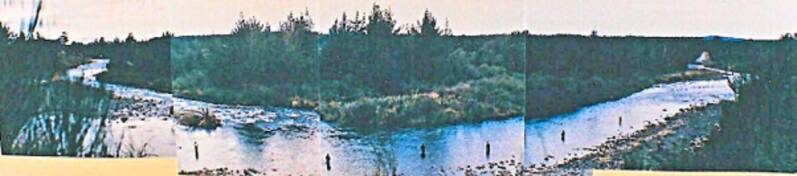
My love of fishing continued, and there were a few areas that kept drawing me back, both for the fish I caught and for the beauty of the surroundings.
The first was a return to my roots, on the Manawatu River above Dannevirke. The river above the Mangatewainui tributary was closed over winter to protect the spawning grounds, so this was a summer fishery. This far up, the river and the valley that contained it were smaller and more personal, but that didn’t mean the fish were. A favorite haunt of mine was off Rakaiatai Road, an area that I had been introduced to by Conrad Black back with the Massey Angling Club. Upstream from the bridge beside the stockyards the river was relatively straight and open, ideal for summer dry fly fishing beneath the willows with either cicada or willow grub patterns. Downstream, the river was much more convoluted and more heavily wooded with poplars, willows, and natives such as kowhai and manuka.
There were miles and miles of runs, riffles, and willow-sheltered pools, some of which were quite large and deep, to wander along wet wading on summer days. Which I did frequently and with enthusiasm, usually nymphing, although in autumn spinning or small streamers were deadly. If you walked down far enough, the river went through a small gorge before emerging into more open country above the next access point at Maunga Road. I only made it down there a couple of times, but the shoals of trout I saw in some of the pools in the gorge would suggest that few others had either.
As can be seen below, the river is enclosed in some fairly high walls in places, and while it was shallow and placid in summer, it can be subject to really high flows in winter floods. I remember fishing up there once, trying to hook a fish that was feeding off the surface under some willows. The obvious fly, a willow grub, was steadfastly ignored. Eventually I looked up, and there wedged in the willows some 12-14 feet above the river was a dead sheep, a victim of the last floods. It was dropping maggots down to the trout eagerly waiting below. I always carried some small, white grub patterns with black heads in my fly box after that.
Because the river valley and terraces were quite narrow this far up the river, a visual bonus to the tranquil summer days spent in this location was the proximity of the eastern hills, rising up as a backdrop, their western faces smooth and rounded, while their eastern flanks fell away into jagged valleys. In early autumn, there was the sound of deer roaring in the local deer farms. To the west, the nearby Ruahine Ranges framed the horizon from the top of the river terraces and were often still topped with snow in early spring.
All of which is not to say that the river further downstream was ignored, it wasn’t. Both the stretch between Maunga Road and Dannevirke, and between Dannevirke and the Gorge by Woodville were great fisheries, especially in winter when not in flood. They were also frequently visited.
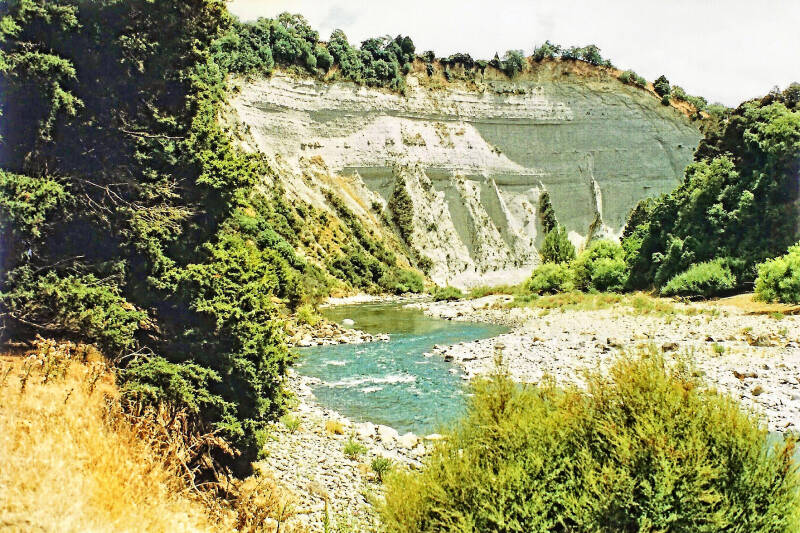
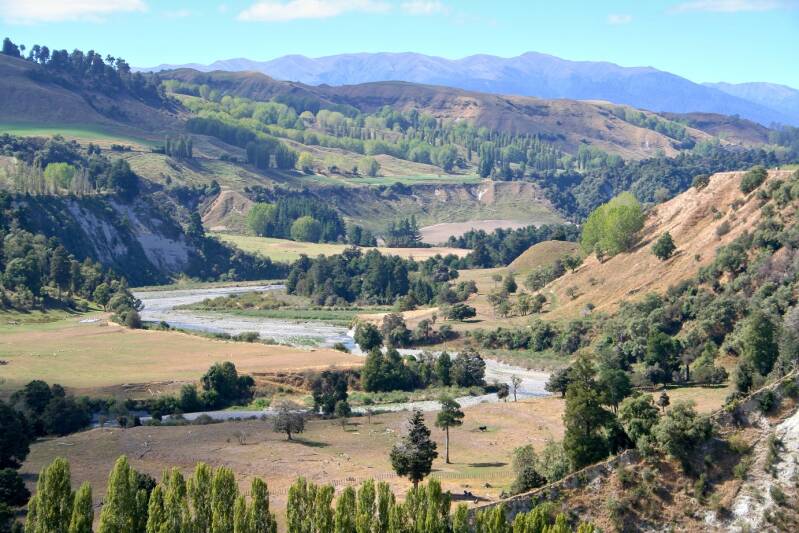
The other site that kept pulling me back was quite different. It was on the Rangitikei River north-east of Marton. This was a vastly different landscape, and a vastly different river. The Rangitikei is a large, long river that starts in the rugged Kaimanawa Ranges southeast of Lake Taupō and flows south-east to the Taranaki Bight at Tangimoana. North-east of Marton the soft clay and sandstone rolling hill country and flat river terraces are deeply transected by the river in places, creating high cliffs. Unlike the upper Manawatu, where despite some ferocious winter floods, the bed remains stable; the bed of the Rangitikei, which also has some significant winter floods, tends to cover a wider area and move around a fair bit.
The Kowhai in flower in spring signaled it was time to fish the upper Manawatu River
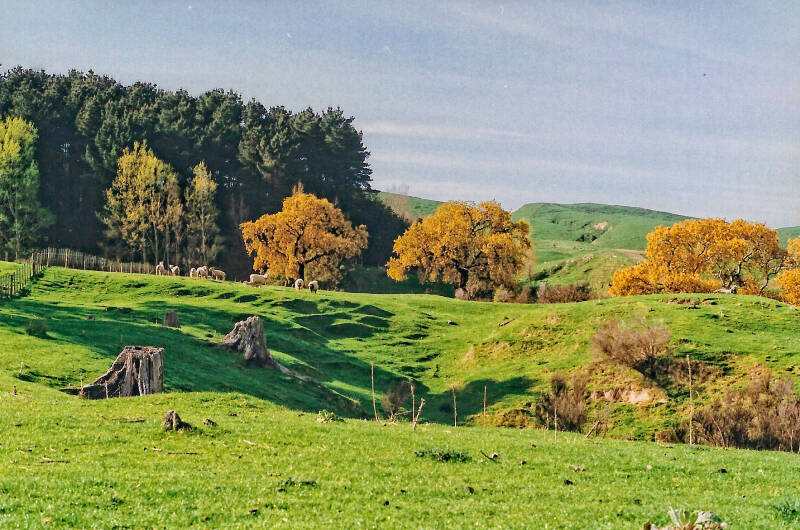
The upper Manawatu River in late summer. Small, sheltered, personal, productive, perfect.
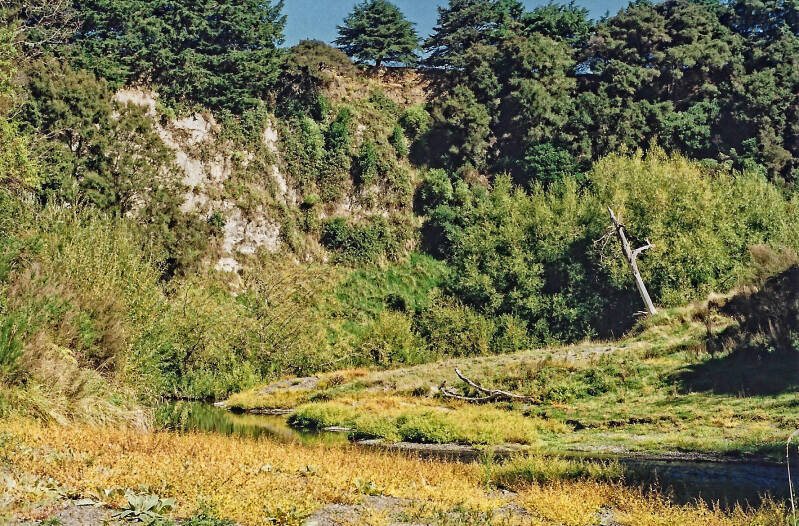
In fact, there used to be an access point at Rata, where you could drive down to the river and a riffle that ran into a small pool on a corner of the water. It was a pretty nondescript looking piece of water, but you could drift a yellow Malibu streamer across the rifle and through the pool and were almost certain to hook a fish. It got so that I used to brag about it. Then, one morning in early summer when I returned to the pool after a particularly wet winter, I found the bed had moved about 200 yards east, and my honey hole was no more.
The Rangitikei was a tricky river to fish in. I fished it a lot from around Rata and Rewa. You had to wait until the water levels dropped enough to safely wade across it, and by the end of summer the nutrients flowing off the farmland upstream caused an algal bloom that made fishing practically impossible. But within that window, if you were prepared to wade deep and walk far, it was a magical fishery with a lovely mixture of rainbow and brown trout. And back then I was young and fit. I would describe myself as a cautious wader compared to some, but looking back now I was really pushing my own limits on some of those crossings, especially as I was usually alone. But I never completely lost my balance once, and I caught a lot of fish.
The Rangitikei is a long river, and there were a couple of other spots that deserve a mention. I also used to fish it off Toe Toe Road, south of Taihape, quite a lot. Flowing beneath towering limestone cliffs and accessed where the Hautapu River joined the Rangitikei, it is a picturesque and popular site. It could also be tricky to fish, but it held good numbers of fish, especially in late summer and early autumn, when the fish were starting to move upstream towards the headwaters for spawning. And if you followed Toe Toe Road up over the river terrace it dropped back down to the Kawhatau River, another great fishery running through a beautiful valley into the Ranges.
Much further upstream and eastward inland from Taihape was the Mangaohane Bridge, another beautiful stretch of water much easier accessed all the way up to the gorge below Springvale, and again another lovely fishery.
The Rangitikei River, north-east of Marton. A glorious summer day in 1996.
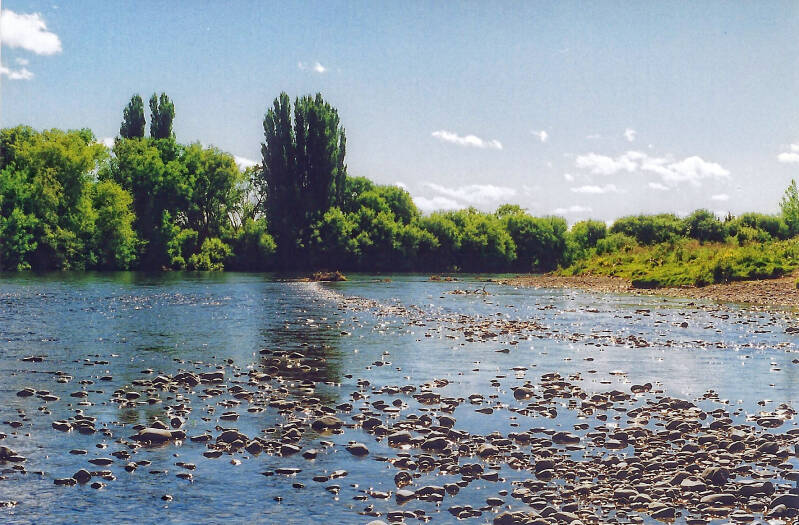
The Rangitikei River at Toe Toe Road.
On the 21st anniversary of our marriage, my truelove gave to me, a headwater’s fishing trip. Being flown into the Boyd Hut at the top of the Ngaruroro River by a Manawatu Districts Aero Club charter flight! The Cesena we chartered was a four-seater, so I invited a couple of friends from the Massey Club, Conrad Black, and James Milner, along for the trip. Conrad and I used to fish the upper Manawatu together, and James seemed like a good idea as he was also a keen deer stalker and bought his rifle with him. We pared down our packs to the bare minimum to keep within the weight restrictions, and on a beautiful fine morning on January 23rd, 1993, we took off and flew up to Boyd Hut, about as close to the centre of the North Island as you can get. Having secured the plane just off the airstrip, the four of us walked down to the Gold Stream Hut (which was locked). We decided to camp there anyway, while our pilot walked down river a bit to camp by himself.
I’m not sure what I can say about the experience, except that it was rugged, it was isolated, it was amazing, it was beautiful, and it was unforgettable. The crystal-clear river was full of the biggest fish I had ever seen, and most were in inaccessible locations, and almost all proved to be totally uncatchable – by us. But we had great fun trying. And when we tied of that, we could just kick back and appreciate the amazing landscape, the river, the bush, the tussock, and the quiet stillness. At night, the clear skies contained more stars than I have ever seen at one time, while the air was full of the cries of kiwi and wekas. There was a price to pay for that of course, the frosts were colder than anything I have experienced either before or since. It was so cold that Conrad got out his survival blanket and slept in it beside the fire.
The Rangitikei River at Mangaohane.
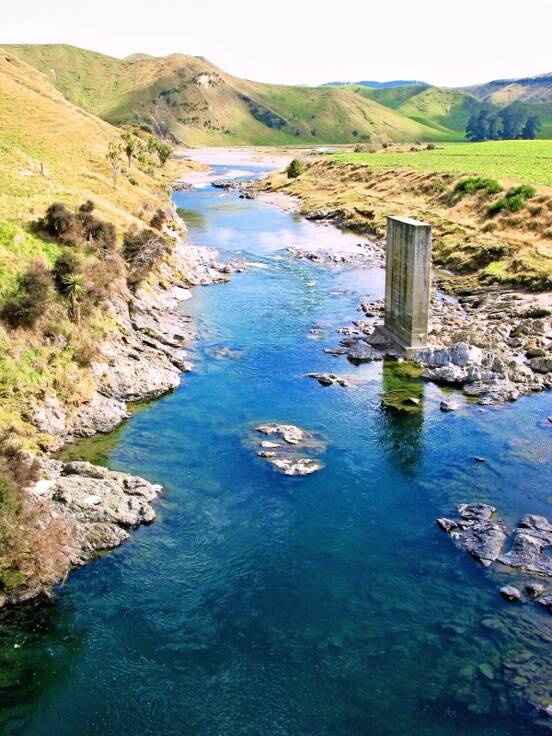
Ngaruroro River between Boyd Hut and Gold Stream Hut.
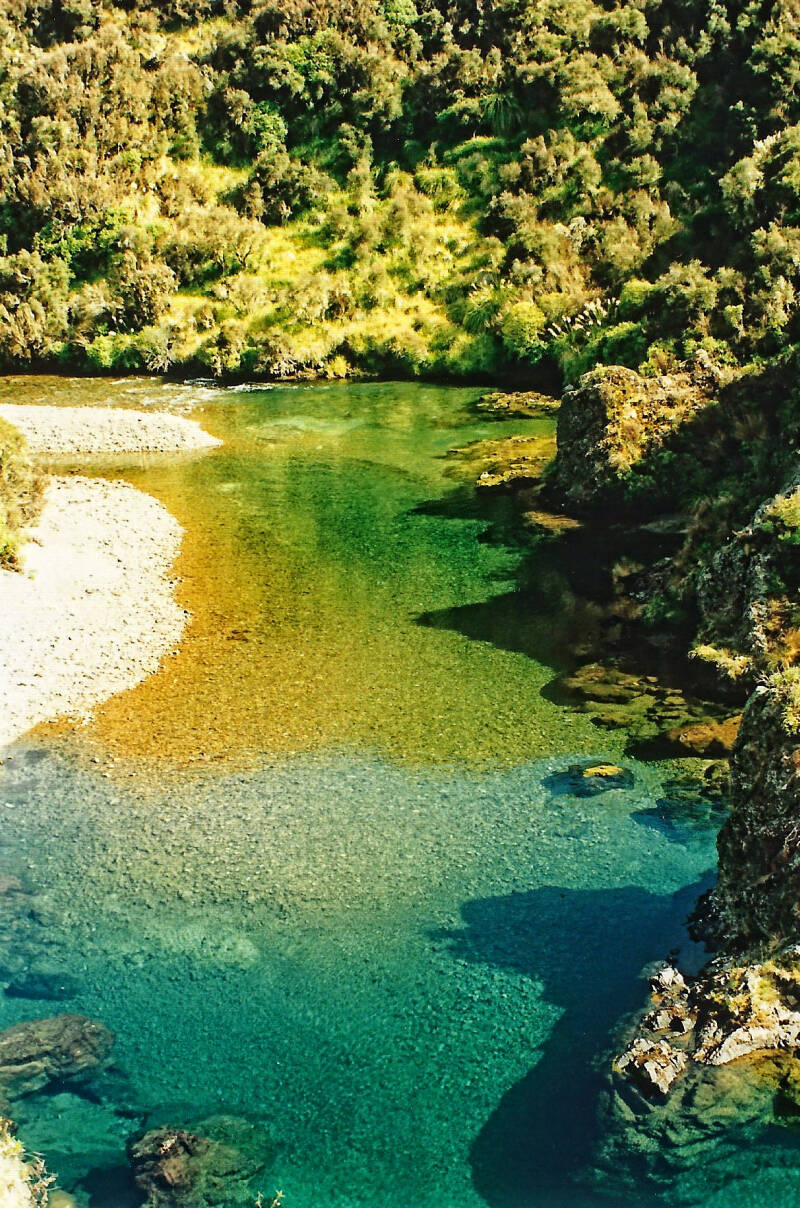
But despite what success I had fishing for rainbows at Turangi, I had a real struggle catching fish back home. It took me about 18 months before I finally figured out why and broke my duck. Back then, the Manawatu River system was exclusively a brown trout fishery, and brown trout behave very differently to the rainbows I was used to in the Waikato or at Turangi. Once I realised that and adapted my techniques and where abouts in the river I fished, I was away.
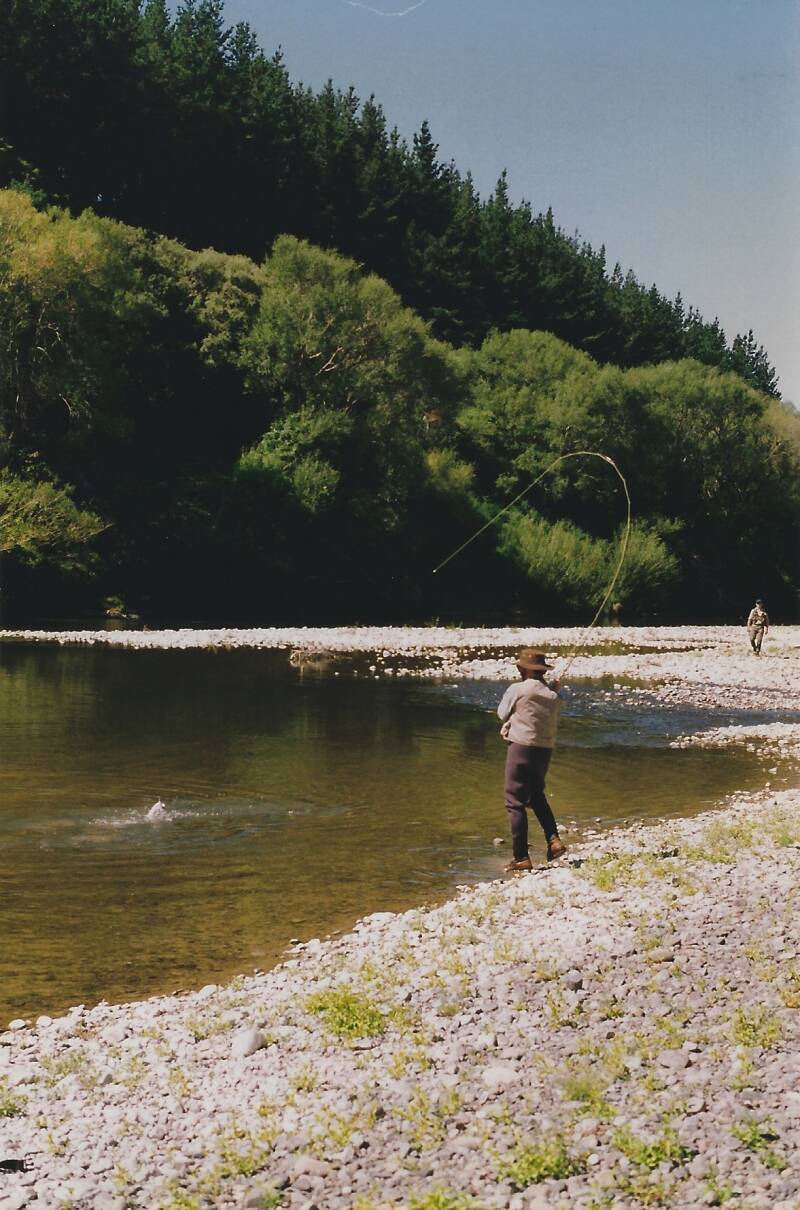
I have a photo of an early club trip to the pool above the Hopelands Bridge. Many people think it is of me playing a good brown trout, but it was actually a guy from the USA who was on sabbatical at Massey. There were a couple of good browns swimming around over at the far bank, - well out of casting range for even the best of us. This guy tied on a leech pattern, the first time I had seen one fished. It looked like a large, dirty green, floppy toilet brush and my initial reaction was “mate, you have to be joking!” But he waded out as far as he could, and cast it out as far as he could, and it ended up floating down the pool about halfway across. Again, it seemed that success was pretty improbable. But those browns took one look at it and charged across the pool in a race to get to it first. The winner was in fact the looser, hooked, played, and landed. That made a lasting impression on me. Never dismiss anything out of hand just because it isn’t what you think is right, it is what the trout think is right that counts.
One evening I was fishing on the Manawatu down at the end of Sherrif’s Road, just south of town, when I came across another angler doing the same, and we got talking. His name was Clark Reid, and he was also secretary of the New Zealand Federation of Freshwater Anglers (Inc.) Clark was another natural enthusiast (about everything) and a very skilled fisherman and fly-tyer. In a very short space of time, I found myself not just part of the NZFFA, but part of its executive.
The NZFFA was formed by anglers in Turangi in 1974, as a federation of angling clubs that were dissatisfied with the way the Government was treating fisheries and the Acclimatisation Societies that were the forerunner to Fish & Game. It has been advocating for Clubs, freshwater fisheries, and the environmental effects of land use ever since. And ever since about 1980, I have been a part of that. That lead on to the Council of Outdoor Recreation Associations of New Zealand, a broader group of outdoors organizations involved in and advocating for outdoor recreation, which I eventually became Co-Chairman of, and am now Patron of.
Through the Federation and CORANZ I have met some amazing people, the likes of the late John Henderson, Alan McMillan, John Morton, Norman Marsh, Ted Bason and Bill Benfield, and made firm friendships with others such as Tony Orman. People who not only had an incredible amount of both research and experience-based knowledge, but who were passionate and articulate in vocalising their advocacy.
Back in the Manawatu I roamed the rivers of Tararua, Hawkes Bay, Wairarapa, and the Rangitikei, as well as local waters. Always learning, always improving. I fished the Hawkes Bay rivers with Colin Potts, the upper Manawatu with Conrad Black, the Wairarapa with Brian Harper-Smith, the Rangitikei with Jim Hale, and the upper Whanganui and Whakapapa with Jim and Ian Rodger. There were club trips to all of them and beyond. I fished a lot with Phil Henderson, who used to work at MAF with me and became a fishing buddy. Phil could be a bit annoying to fish with, as he always seemed to want to fish the water you were fishing, but despite that we became firm friends. Phil was a very handy person to know, as besides being the Animal Health Lab storeman, he was in charge of the two large incinerators. Being an Animal Health Lab, there was often some fairly exotic birds and animals that were autopsied and then incinerated. Quite a bit of remarkably interesting fly-tying material got intercepted on its journey to the incinerators, diverted through the Microbiology autoclaves, and ended up on our fly-tying vices tied to hooks!
Camping at Kuripapango with Colin Potts, Easter, 1989.
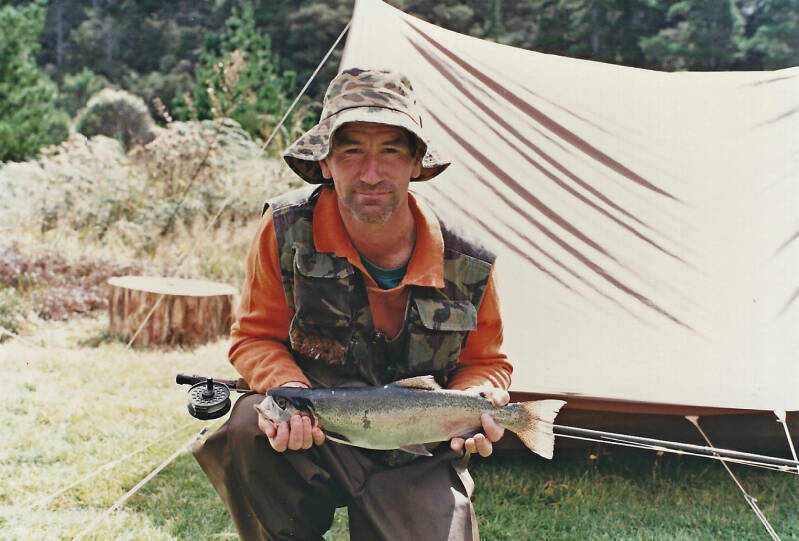
Phil with a Rangitikei Rainbow when we camped at the cabins at Springvale.
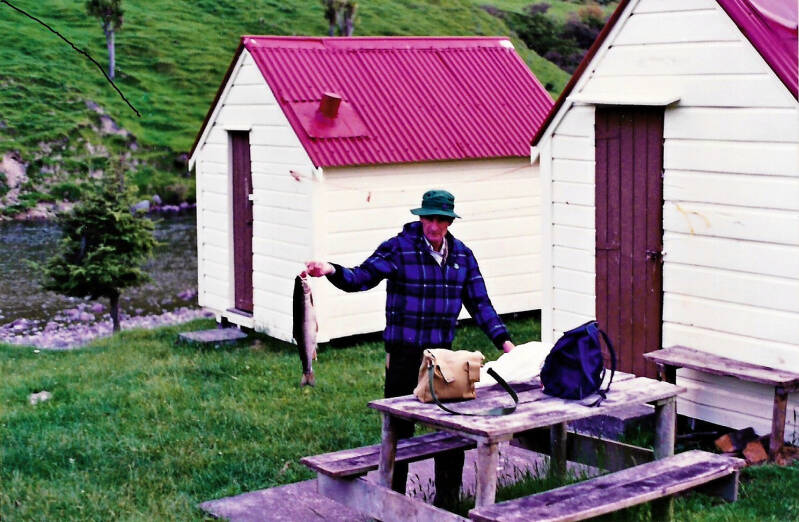
I had started out with an interest in entomology, which I built upon. But I also learnt about the subtlety and the strength of water moving through a landscape. How it shaped it, and how it was shaped by it. I learn about its food chains and how they varied between waterways and between seasons. And everywhere, I found beauty. The beauty of the fish and insects that trout fed on. The beauty of the trout themselves and how they moved through water or held station in a current. The beauty of the varied landscapes they lived in and which those rivers flowed through.
Phil and I fished the Manawatu River a lot, from Palmerston North to Ormondville. We used to go down to a stretch just below the Gorge in the late afternoon and fish the evening rise. It was a lot of fun, and quite productive. Back in those days, you would get a caddis hatch just on dusk, with the insects crawling up your legs, down your neck and in your eyes and mouth. The hatches were so thick that driving back through them at night was like driving through fog, and the car windscreen became covered in them. Alas, such days are long gone, along with the insects that fed the trout so well.
A lot of the time I fished alone, particularly on the upper Manawatu and mid-Rangitikei rivers. As I became more competent, my confidence grew to the stage where I would expect to catch fish. I knew where to fish, when, why and what for. I knew where the fish were. I was not often disappointed. There was a favourite spot of mine on the Rangitikei River just behind Hunterville where the river ran through a riffle before turning into a deep pool, almost beside the road. As I have previously described I was almost guaranteed to catch a fish, usually on the first cast. Then one spring day, after a particularly wet winter storm, I arrived to find the river channel had moved about 100 yards east, and the riffle and pool were completely gone.
But changes to the rivers and the fish were becoming harder and harder to ignore. Just as an example, let’s take two local rivers. First the Makuri. The Makuri rises in the limestone hills of the Puketoi Range east of Dannevirke, actually flows underground through a cave system in the hills at Conoor and drops down through a valley and a gorge before joining the Tiraumea River just southeast of Pahiatua. The first time I saw the Makuri was on a club trip with the Massey Anglers. At that stage I had more theoretical knowledge than experience or expertise, but my eyes nearly popped out of my head. There was every type of mayfly, caddisfly and even stonefly nymph you could imagine there (plus a few you couldn’t), along with dragonfly nymphs and lots of terrestrial insects overhead to give a smorgasbord of trout food. Trout as fat as pigs popped out of the weed beds and lazily swam upstream across the fine shingle beds. It was like a lightbulb going off inside my head. This is what a river was supposed to look like.
A few years later, I returned to the Makuri with Jim Hale from the Manawatu Anglers club. Jim was a dairy farmer from Kairanga, and I probably gave him an undeservedly hard time about that. But in the intervening years since that first trip the bottom had fallen out of the sheep and wool market that traditionally cloaked those eastern hills, and with active encouragement from the Government, the only thing that was profitable to farm was beef and dairy. So, we found new fences (and even a stockyard) built along the river and a mob of angus beef cattle being run with free access up and down it. The once sparkling crystal-clear water was opaque. The fine shingle beds were smothered in a layer of dirt and sediment (and worse). The weed beds were gone, the insect life had vanished, and the trout had moved away. The river had been decimated. I gave one of the local regional council staff (who turned up at a club night sometime later to tell us how they were improving our waterways) a really hard time about that. All he could say was that he wished he could do something about it – but he couldn’t. I guess that is what happens when your bosses’ boss is one of those farmers.
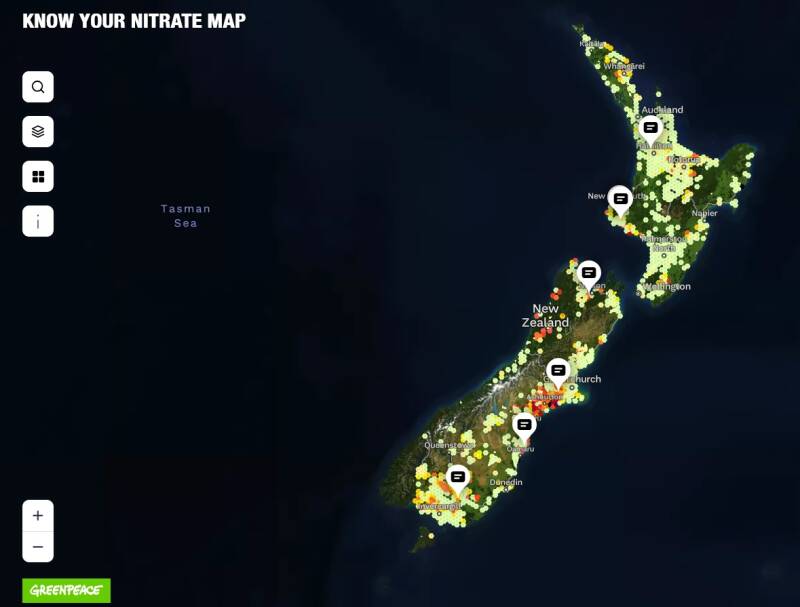
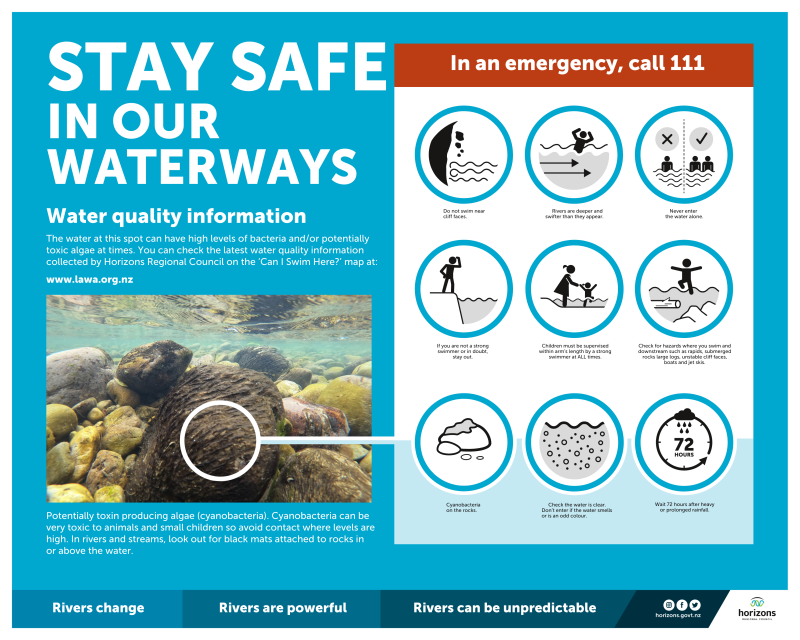
Unfortunately, that situation was being mirrored everywhere you looked. The Mangatainoka, once another nationally famous fishery, has been straightened by 17 kilometres. This serves to speed up the flow, which washes more sediment into the river, which clogs up the bed and destroys the insect life. No food = no trout. Coupled with intensive dairy farming in the top to middle reaches that is extracting water to grow winter feed and returning it polluted with nitrates and phosphates; plus Pahiatua’s sewage and a dairy factory and brewery pumping waste into it; means where there was once a hotel famous for hosting anglers from around the country and the world, there is now a permanent sign warning people not to touch the waters because of the toxic algal growth. Once again, the Regional Council (70% of whom have farming interests) wring their hands and claim the problem, (of their making), is too big to fix. I could go on, but you get the picture. Except to say that the Regional Council has the gall to run an extensive ongoing publicity campaign (ratepayer funded of course) extolling people to ‘love their awa’. You would have to be deeply cynical or extremely stupid to do that, and I still haven’t decided which.
Now since I like fishing and I like photography, you would think that it would be a sinch to combine the two, wouldn’t you? I did and was quite surprised to find that it just didn’t happen. It took me a while to figure out why. Basically, when you are fishing, you need to ‘zone in’. The ‘zen’ of fishing is widely recognised and is a sort of concentrated relaxation (or relaxed concentration) where you are strongly focused on a single object, such as a fish or the end of your line, while being acutely but more subtly aware of your other surroundings like what the water, wind, sun and weather is doing. Not to mention the banks, the trees, the birds and the view. It has been compared to a meditative state.
I find exactly the same thing applies to photography, particularly the sort of landscape photography I enjoy. You have to ‘zone in’ to understand what the landscape or view is telling you, so you can visualise how best to portray it. Then you can start to compose your picture. It seems that I can do one or the other, but not both at the same time.
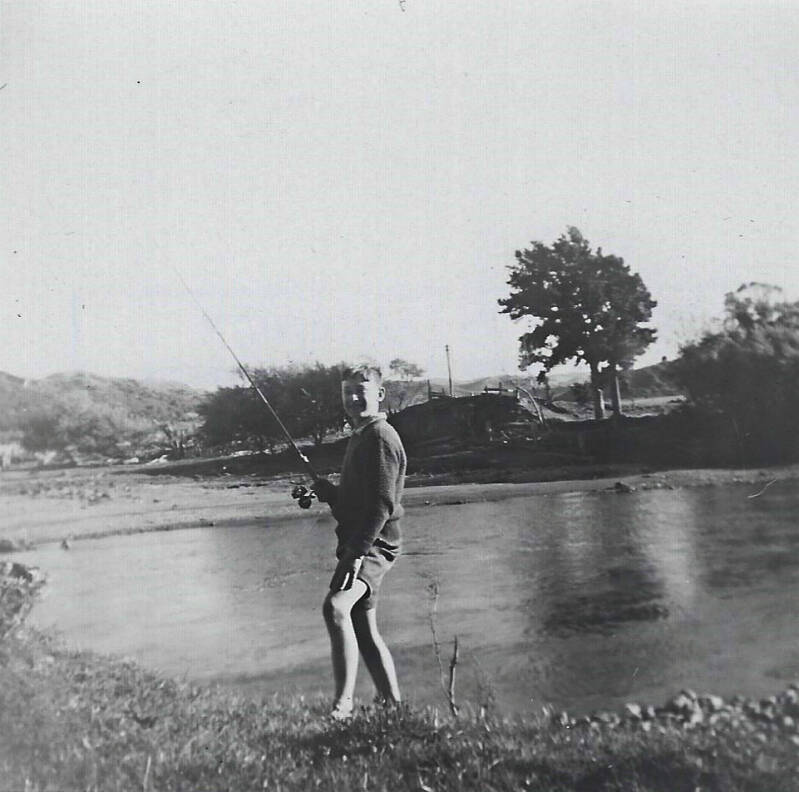
This, and the health benefits of doing this in the natural environment is covered in a recent book by Catherine Knight, called ‘Nature and Wellbeing in Aotearoa New Zealand: Exploring the Connection’. Indeed, among the testimonies of individuals within the book, you will find a story with a picture of a young boy with a fishing rod, standing beside the Manawatu River. Guess who?
Early Days on the Manawatu River at Dannevirke.
Around 2010, I started going fishing with Geoff Haworth. I had known Geoff from MAF, where he used to run the IT Dept. Geoff and his wife Penny have a small holding just out of town at Linton. He used to run it as a commercial orchard, growing apples, pears and apricots, but now he just runs sheep on it. Geoff has always been a boat fisherman and had a small boat which we used to take out from Foxton and fish the sea outside of the river mouth. This was quite new experience for me, and it took me quite a while to get my head around fishing in such a vast expanse of water. While putting out a set line didn’t seem very exciting, having the occasional feed of fresh snapper and gurnard was very welcome. Fishing soft baits from rods off the boat was much more fun and bought in snapper, cod and even the occasional terakihi and John Dorey.
A few years later Geoff and Penny built a holiday home on a section that they owned at Motuopa and bought another boat that they kept up there. Geoff and I had a number of winter trips up there while Penny was still working, and boat fishing on Lake Taupo was another skill I mastered. But while we caught fish, it lacked the intensity, the demands, the discipline, and the delicacy of river fishing. It was relaxing, but in quite a different way. That was illustrated by the ease with which I could take photographs and fish at the same time! But by then, my mobility was starting to suffer, as the venous shunts in my legs deteriorated.
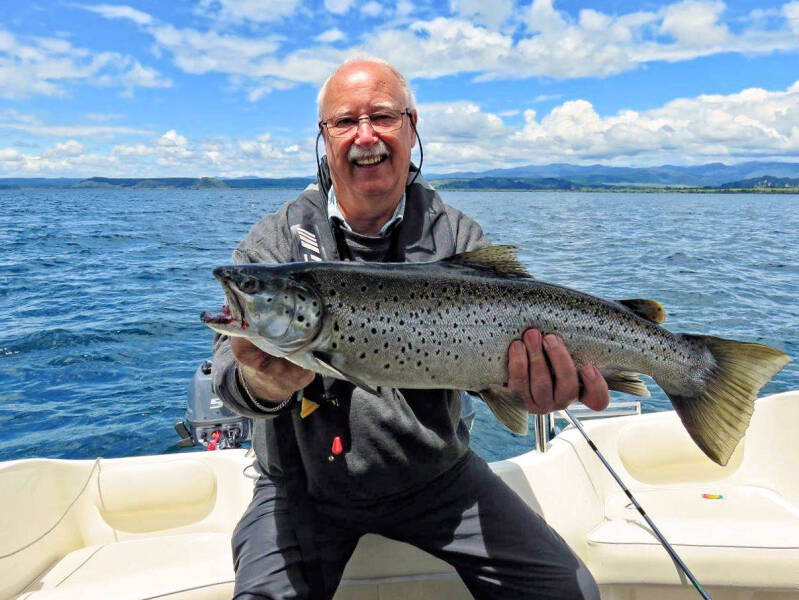
Eventually, we were out on the lake fishing one day, and we had each caught fish. Mid-afternoon I hooked into a decent sized brown trout. It was quite an effort getting it up to the boat, and you could tell it was a brown by it wanting to stay deep and doggo. And you could tell by the weight that it was a good fish. And I suddenly thought to myself “why do I want to land this fish? We don’t need it, and I would actually prefer that it stayed in the lake.” So I dropped the rod tip and let the line go slack, and the fish threw the hook and took off. I looked out over the lake, taking in the view and thought to myself ‘it has always only ever been about being one with the landscape’. And that I didn’t actually care if I never caught another fish.
That was the last fish that I have caught. It is finished, and it feels right. It was a bit unexpected even for me, but as they say – for everything, there is a season and a time for every purpose …
These days, as I buzz past the local likely lads on my electric bike, while they too fish the urban Manawatu River fishery from town (with some success, I might add), I don’t feel the slightest compulsion to join them. Or to try further afield. I have known better fishing in cleaner water than they are ever likely to have, and it is highly unlikely it will ever return.
It is a similar story with the Federation of Freshwaters Anglers, of which I am now Patron, but in which my involvement is minimal. Even back when I was a more active member, I could see that the nature of the politics that governed our waterways (as well as the rest of the country) was changing. That commercial interests were becoming increasingly strident and influential, while the voices of the ordinary public were being ignored and lost.
That came to a head for me back in 2017, when a Labour government was elected and at the time 78% of the population wanted action on cleaning up our polluted waterways. What a mandate! And what happened about it? Absolutely nothing. My faith in representative democracy was already pretty shaky, but a lot of what remained died as a result. It was obvious that any action was being subverted by personal politics and corporate autocracy. Moneyed interests. This was reinforced by the next election when a misinformation campaign paid for by private corporate interests swamped any rational debate and saw one of the most corrupt capitalist coalition governments the country has ever seen elected to power. And the same anglers who bought into their lies at the time and are now complaining about the results seem to think that somehow the old methods of talking and asking politely will make them change direction. They still don’t realise that, as Government representatives can’t personally profit by the activity of angling, they have no interest in it. It will simply disappear as the use of our waterways are purchased by interests with far deeper pockets.
So, I can look back on my angling adventures with fondness and appreciation. And let it go. For such things will not be seen again in my lifetime, perhaps ever.
Lake Taupo trout caught while fishing with Geoff from his boat.
Polluted Waters, a modern plague.
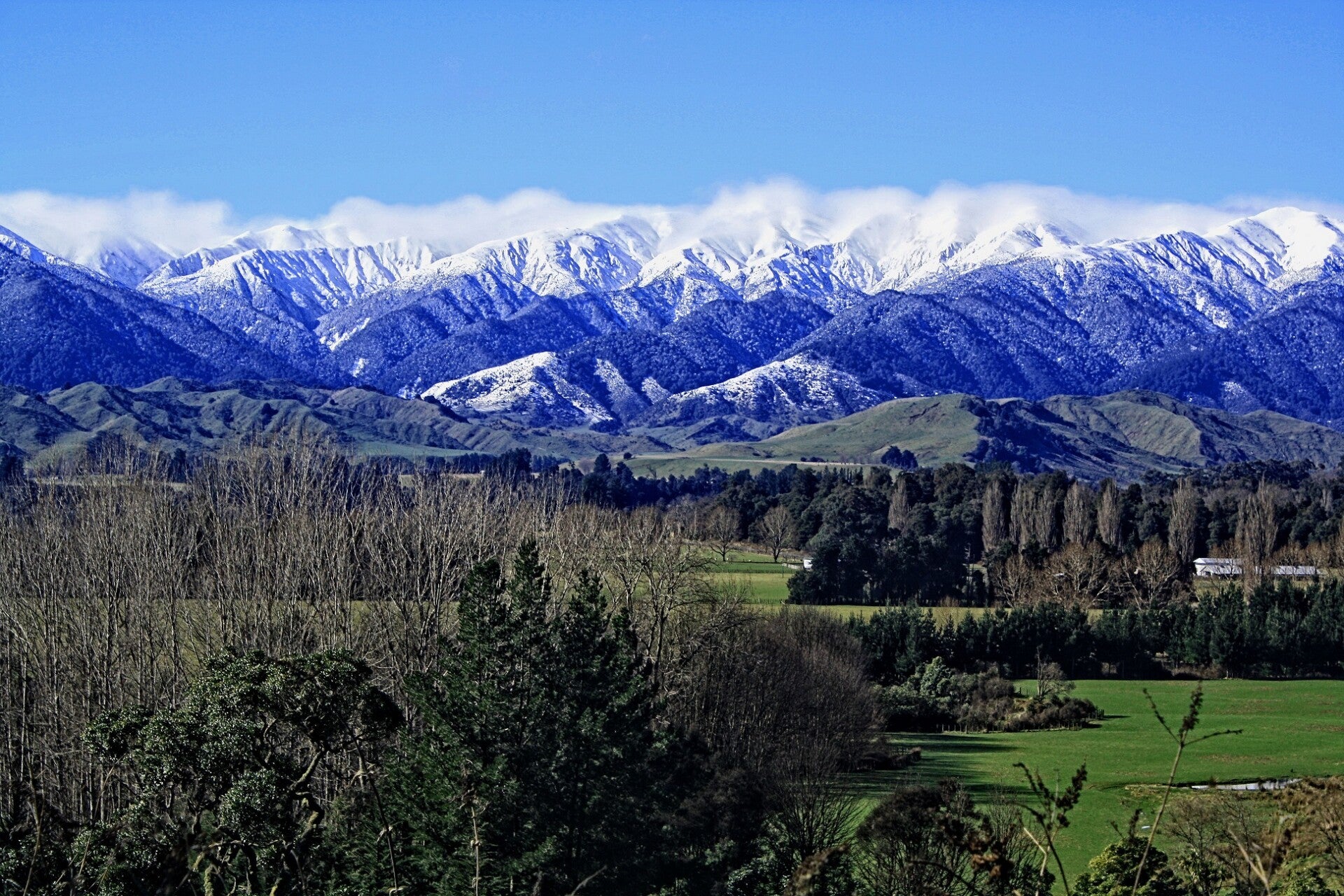
Exploring, tramping and beach walks: Discovering Aotearoa's beauty
I have always cherished the stunning landscapes of New Zealand, particularly the the North Island where I have lived. Through tramping and beach walks, I've explored breathtaking forests, rugged coastlines, and serene shores. This page will take you on a journey through these recreational activities, featuring stories and photos that capture the spirit of adventure and the natural beauty encountered along the way. Get a true feeling for the diverse landscapes we've had the pleasure of visiting.
By the late 1990’s my interests and appreciation of the landscapes around me were beginning to diverge. Leile was becoming quite independent, and Sharon was already heavily involved in national and international bowls events, including overseas campaigns with the New Zealand team in Fiji, Australia, and Malaysia. The arrival of firstly small, lightweight travel cameras, and then digital cameras, made recording my travels and the landscapes I delighted in practical and affordable.
Interestingly, in 2002 I had another health issue, and cardiac arrhythmia saw me fitted with a pacemaker to assist my heartbeat. This was probably an inherent condition, as my father and most of his immediate family also had to have pacemakers fitted. Perhaps perversely, this seemed to spur my excursions into the more remote and wild landscapes around me. I discovered mountains and isolated beaches and loved them both.
The start of the climb up to the Longview Hut from the car park.
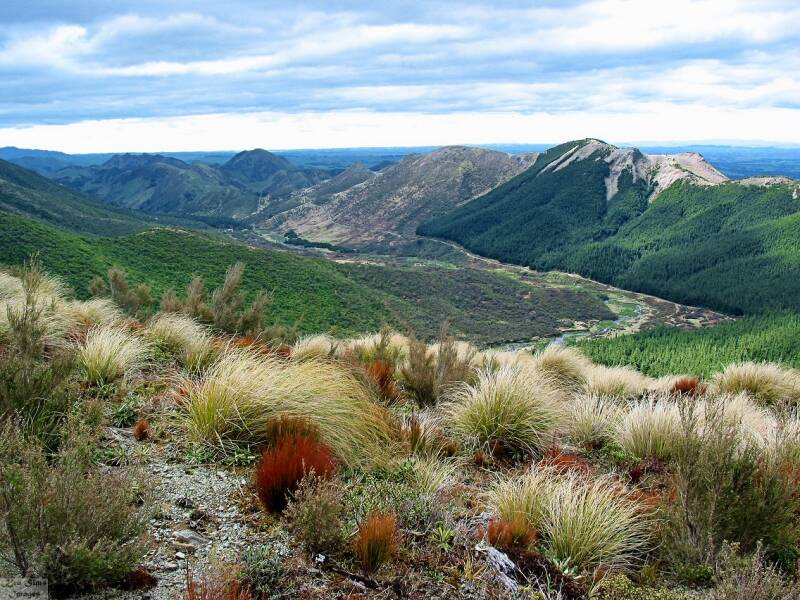
My appreciation of mountains and forests was a gradual progression. It started with walking along the gorge track and grew from there. There is something about the closeness of native forests, coupled with their vastness as they stretch back into the mountains and the vistas from the tops that I found particularly appealing. And there were plenty of choices, aided in part by a book called ‘Hawkes Bay for the Happy Wanderer’, which detailed all the forest park huts and tracks, bush remnants and walks, and beaches from north of Napier down to Woodville.
So, on the eastern flanks of the Ruahines there was the track up to the Sunrise Hut, above the headwaters of the Waipawa River behind Onga Onga, and south of that, the Longview and Awatere Huts to the west of Waipawa. Both basically climb through tussock as the original bush was heavily logged and burnt off. The Longview Hut actually sits above the headwaters of the Pohangina River (which flows south-west and exits on the other side of the Ranges) and the Awatere Hut sits beside the headwaters of the eastward flowing Makeretu River. Further south, west of Norsewood at Ngamoko, the Manawatu and Mangatewainui Rivers emerge from the Ranges as picturesque streams. The tracks into the Ruahine Forest Park west of Dannevirke were already well known to me, particularly the Rokaiwhana and others at the end of Tamaki West Road. And west of Woodville, there were the Coppermine Creek and Wharite Peak tracks, and of course the Manawatu Gorge walks.
South of the Manawatu Gorge, the eastern slopes of the Tararua Ranges also had numerous entrances into the forest park, but favorites of mine were where the Mangatainoka River emerged from the bush west of Eketahuna, and Ruamahanga River from Mount Bruce.
Eastern Ruahine Ranges eroding above the bushline
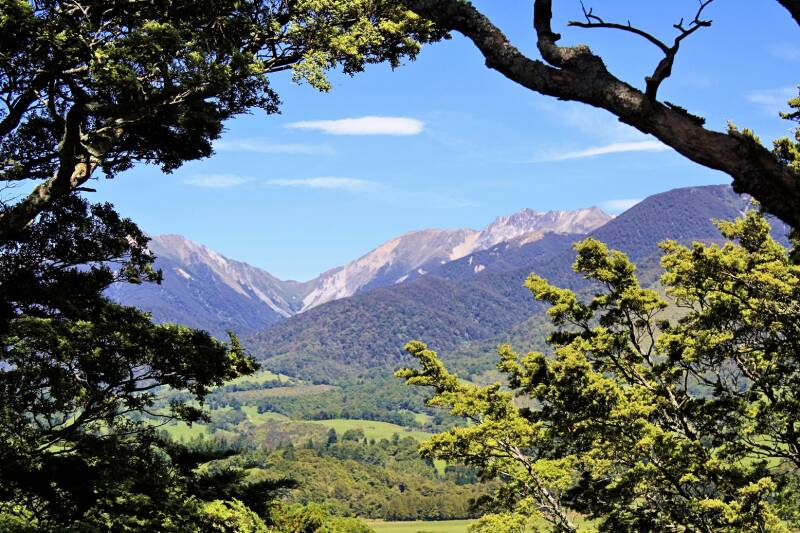
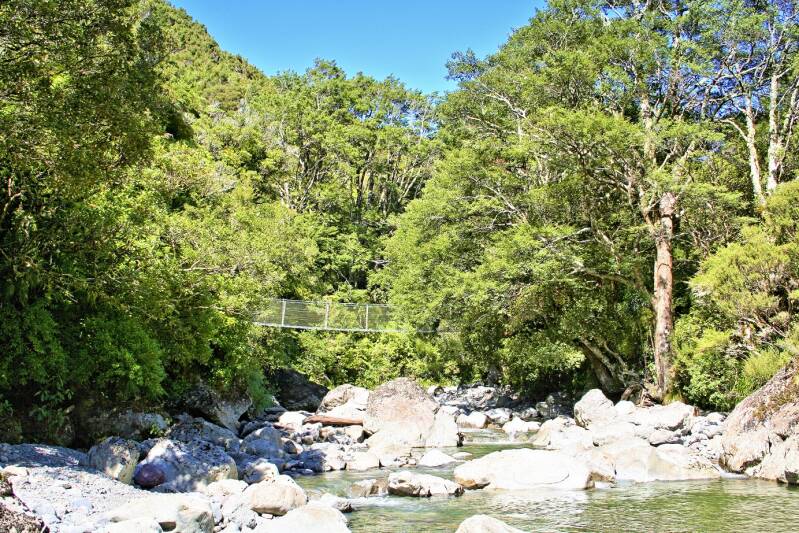
Footbridge on the track across the Mangatainoka River headwaters
While the eastern flanks of the Ruahine and Tararua Ranges opened into river valleys between them and the coastal hill country, the western flanks were quite different landscapes. Here land movement pushed up against the mountains, raising them and creating convoluted rolling hill country beneath them. There was a constant dynamic of pressure pushing the ranges up, while the fractured greywacke that they were comprised of weathered and eroded, streaming down as shingle in riverbeds back towards the South Taranaki Bight. The ranges themselves were predominantly cloaked in Black Beech and mixed podocarp forest which gave way to open tussock in the higher altitudes.
There were numerous tracks I accessed from the west, leading into huts within the forest parks, ranging from Colenso’s crossing in the north all the way down to the Ohau River east of Levin in the Tararua Ranges, but probably my favorites were the Iron Gate track and the Deerford track. It is unfortunate that many of the tracks in both the Ruahine and Tararua Ranges suffered from significant slips and washouts during Cyclone Gabirelle, and much of that access has yet to be restored.
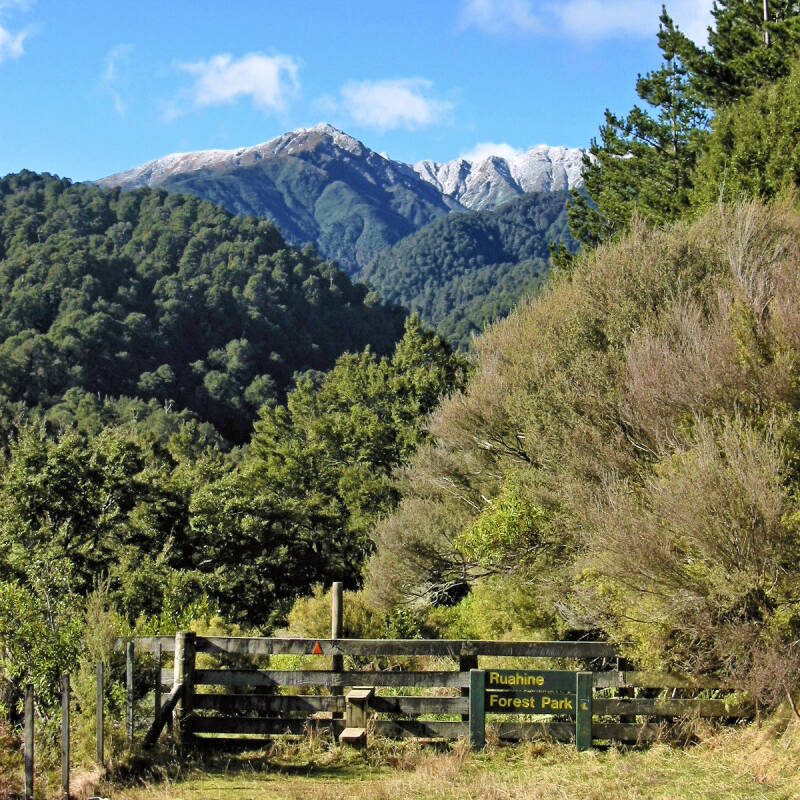
Entrance to the Black Beech forests of the western Ruahine Ranges
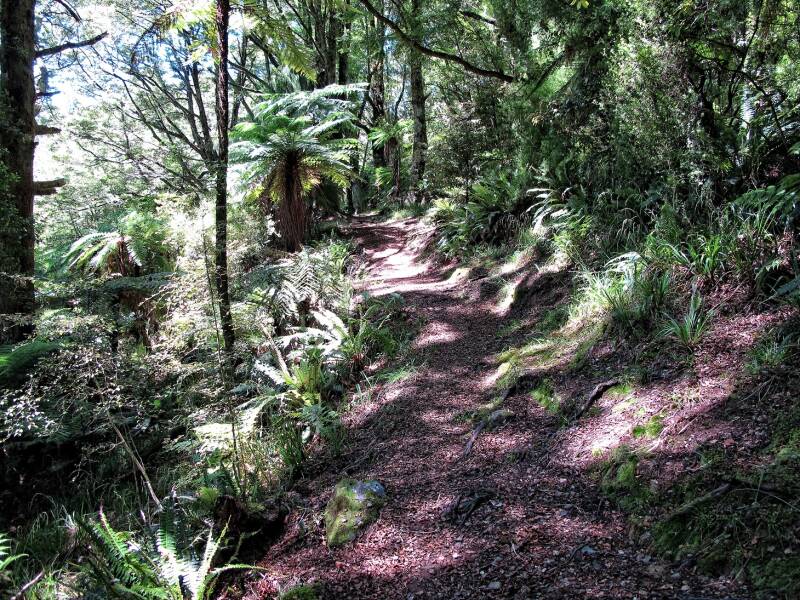
The quiet dappled serenity of the tracks through the western Ruahine beach forests leading back to the tops of the mountains
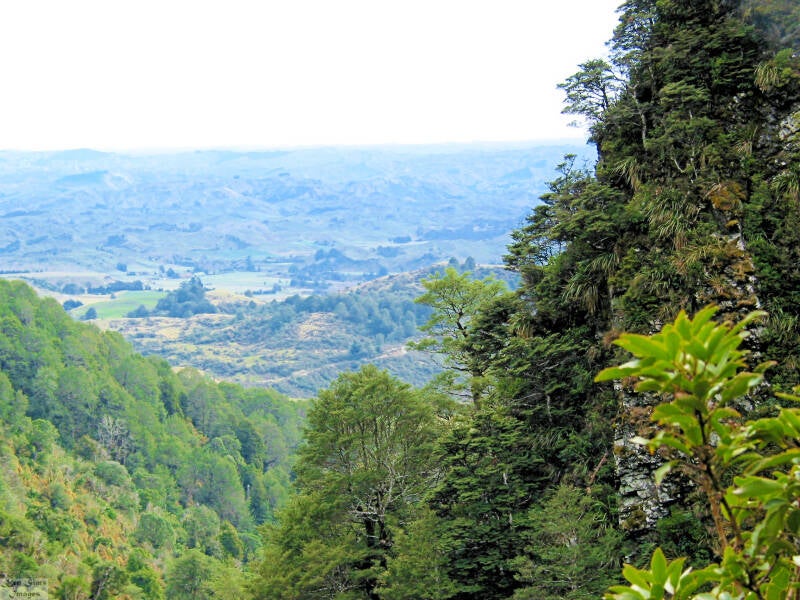
Life clings tenaciously to the rugged western hillsides
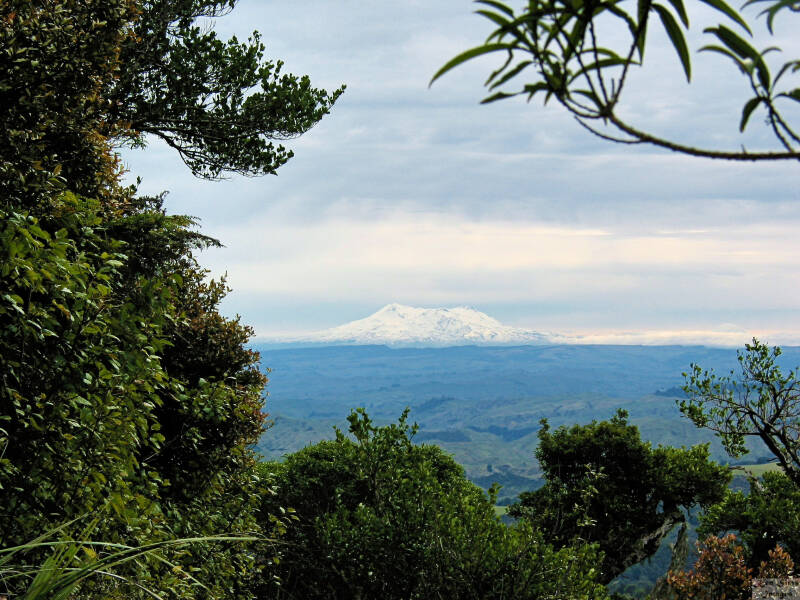
An approaching front slides around Mt Ruapehu
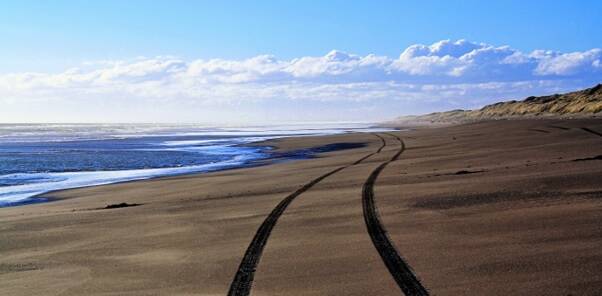
In 2004 and 2005 Sharon had successful but extended 3-month international campaigns with the Blackjacks, in England in 2004 and in Christchurch in 2005. So, in the summer of 2005 I decided to visit every accessible beach on the east coast south of Napier that I could find. I have never been much of a fan of west coast beaches in the North Island; while I can appreciate them as fisheries, they are flat, featureless, desolate, and mostly have black sand from the high iron content. Still, they present an interesting dynamic as landscapes, as the sand blown in from the shallow seas by westerly winter storms marches relentlessly inland as dunes, with little to hinder their progress now that the vast lowland forests and wide swampy floodplains that once were a feature of this land have been felled and drained and turned into pasture. This is being modified by the relatively recent phenomenon of escalating sea level rise, so the low, flat coastal plains may yet succumb to the insistent ocean, and estuaries and harbors may again appear from the flooded landscape.
Local West Coast Beach
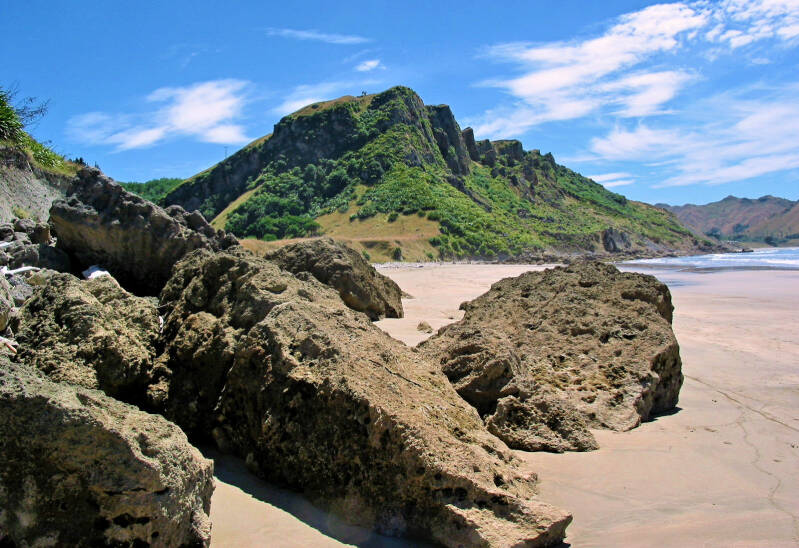
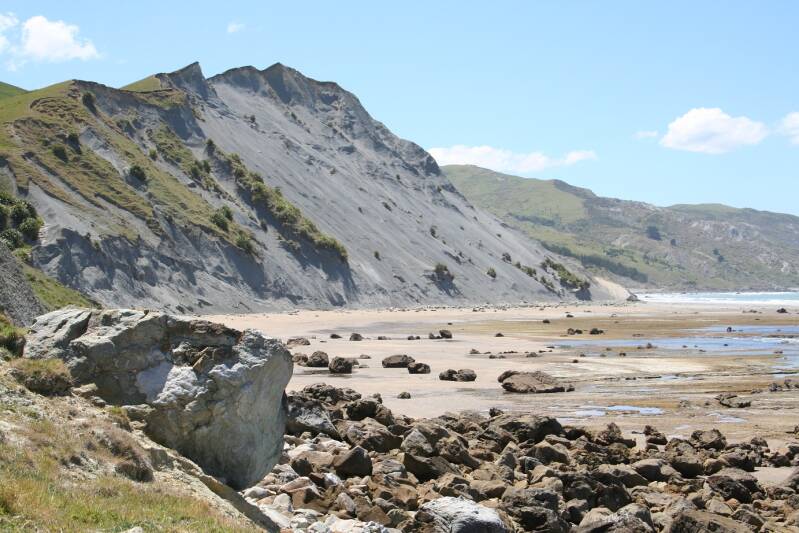
The east coast beaches, however, are quite different. The soft coastal hills are crumbling into the sea, exposing jagged cliffs, but all down the coast there is a pattern of secluded sandy bays and rich coastal reefs separated by rocky outcrops. They are also isolated, but petite, personal, pretty and teeming with life. Again, there is a dynamic shaping them, as just offshore the Hikurangi subduction zone marks where the Pacific tectonic plate slides underneath the Australian plate, creating unstable upward thrusting pressure, relieved by multiple ‘slow slip’ earthquakes and the occasional ‘big one’.
East Coast Beach in summer. Towering cliffs, secluded bays, warm white sand, rocky outcrops, and reefs teeming with life.
I started at the northern end with Ocean Beach, then came down the coast to
- Waimarama,
- Kairakau,
- Mangakuri,
- Pourerere,
- Aramoana,
- Blackhead,
- Porangahau,
- Whangaehu,
- Herbertville,
- Akitio,
- Pongaroa,
- Mataikona,
- Castlepoint, and
- Riversdale.
The only one I didn’t get to was Owahanga, where there were a couple of locals at the turnoff, who made it pretty clear that it wasn’t a good idea, and I wasn’t going to argue.
So many lovely beaches, so many coastal roads, so many reefs and rocky outcrops to explore! And apart from a couple of the more popular and easily accessible ones, the chances were good that you would pretty much have the bays and the beaches to yourself. I guess if I had to pick a favorite it would be Whangaehu. It is interesting that there are two Whangaehu Beaches almost parallel to each other, one on the west coast, and one on the east. But the east coast one is by far the nicer. It is a great example of what I enjoy about these landscapes. It is quite isolated, lying between Porangahau and Cape Turnagain, with the road ending at the beach contained in a small bay with just a couple of houses, a few cabins and a camping ground.
The small sandy beached bay at Whangaehu is bordered in the south by a rocky outcrop whose exposed seaward face reveals an almost vertical syncline. Jutting out from this are twin exposed reefs showing a similar incline. If you cross the base of the reef (best done early in an outgoing tide) and continue south along the beach, there are masses of curiously textured and shaped sandstone and mudstone outcrops between the flatter reef structures that teem with bird and sea life. It is a fascinating ecosystem that takes me straight back to my childhood.
To the north the bay is bordered by a flatter outcrop of large, jumbled rocks that march down into the sea, forming a long loose barricade against which the kelp beds dance and the waves crash with a resounding roar and satisfying spray. Behind them are quieter, shallow tidal pools full of seaweed, shellfish and sea life. Beyond that is another low headland that opens out into another sandy bay and large flat reef system, with a further one beyond that again. It is another magical place on a warm sunny summer’s day, with the scarred coastline stretching away into a shimmering heat haze.
Whangaehu Reef
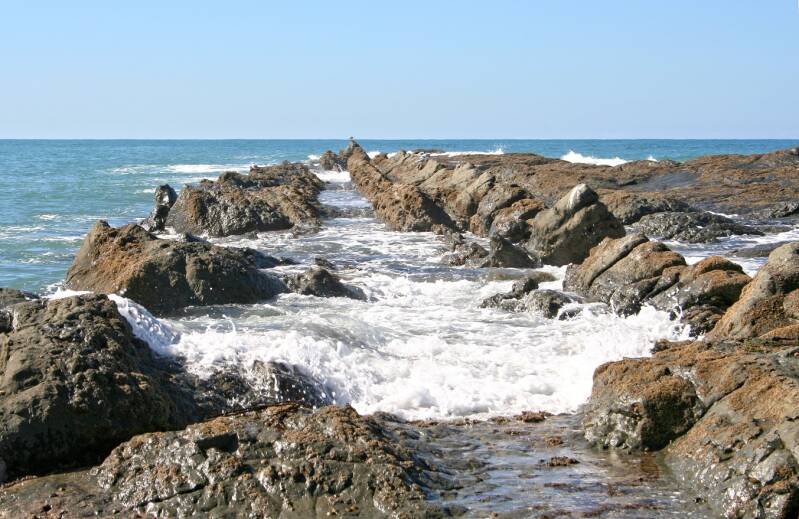
North of Whangaehu Beach
However, the acquisition of a digital camera in 2003 and the subsequent availability of affordable photographs, sparked an interest within me to capture more of the landscapes that surrounded me, resulting in many road trips through the backroads of the lower North Island, sometimes because the road names or the topography intrigued me, sometimes just to see what was there and where it went. Back then the equipment and software were expensive, relatively new, and clunky, requiring much editing to get even small photographs. Today, high quality photographs and videos are simply an expected part of your smart phone. How times change!
These trips still had to compete with the family, going fishing, hiking in the mountains, beaches, and all of life’s other commitments, but there were certain places that resonated, and which I tended to revisit. The closest of these was the Pohangina Valley. This pretty valley runs parallel to the western edge of the Ruahine Ranges between them and the folded hill country further west and follows the Pohangina River from its junction with the Manawatu River at Ashhurst, up to where it turns into the Ranges. On the way it passes a lookout at Raumai, then the Totara Reserve, a small pocket of mixed lowland native forest beside the river, and a popular summer swimming spot. After leaving the river, the road continues on to join the Oroua Valley Road just before a lovely lookout over the Oroua River Valley at the Apiti Reserve, where the road crosses the river and eventually joins up with the Rangiwhahia Road, and the choice of ether turning left to Rangiwhahia and back through Pemberton to Kimbolton; or right on to Ruahine Road and across to the Rangitikei River just east of Mangaweka, and another choice of either joining the main highway, or turning off on to the Kawhatau Valley Road and doing a loop around the Kawhatau River to rejoin the Rangitikei River and the main highway at the popular and highly scenic crossing on Toe Toe Road, south of Taihape. An alternative for the more adventurous would be to turn off Ruahine Rd to Auputa Rd and across to the upper Kawhatau valley, or yet again you could turn off Toe Toe Rd and travel across to Gorge Rd, and a great view of the spectacular cliffs beside the Rangitikei River from the bridge across it.
Pohangina Valley
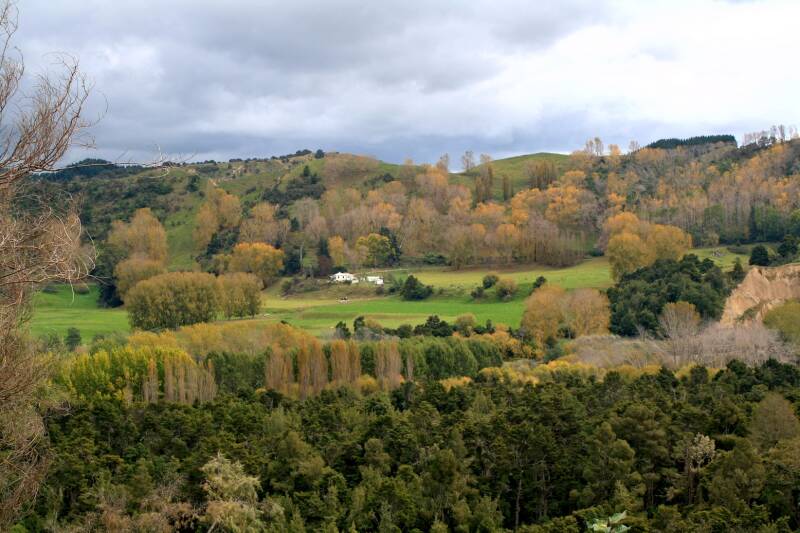
The picturesque Kawhatau Valley in summer.
With its many deciduous trees, the Kawhatau valley is spectacular in autumn, but there are many alternatives. Another local one was to turn off the Vinegar Hill Road at the Beaconsfield valley just north of Feilding and travel past its historic old, abandoned farmhouses and sawmill, through the hills to Pakihikura, and then around Mangamako Road to Otamakapua, where you have the option of turning across the Rangitikei River to the main road at Ohingaiti, or driving across to Pemberton and back to Kimbolton. A shorter version of this is to stay on the Vinegar Hill Road until the Lower Pakihikura Road turns off at the Pakihikura Stream bridge.
Another is to turn east at Hunterville and drive out to the Turakina Valley Road, then follow the Turakina River right up to where the road comes out at Tangiwai, just east of Waiouru. Or you can turn off at Colliers Junction and head east through Mataroa and back to Taihape.
On the eastern side of the Tararua Ranges, I would often turn south off the Pahiatua Track at Makomako, continuing down through Kopikopiko, Hukanui, Kakariki and Nireaha before rejoining State Highway 2 at Kaiparoro. This was on the way to delightful summer bush walks, such as those at Kiriwhakapapa, Atiwhakatu and Mount Holdsworth.
The access points to the native bush on the Ruahine Ranges eastern flanks around Dannevirke were well known to me, and worth revisiting, but exploring further afield was also rewarding. Travelling on to the Ongaonga Road and turning off to Ashley Clinton along the heritage trail gave access to the Longview and Sunrise Huts and tracks, as well as the headwaters of the Makaretu, Tukituki and Waipawa Rivers. Up here, the summer dried Takapau Plains gave way to the often bare or tussock covered, shattered greywacke mountains, denuded by centuries of logging.
To the east of Dannevirke, a drive out along Maunga Road (if you could ignore the trout visible from the bridge across the Manawatu River) would lead you through the soft eastern hills, their thin topsoil scarred by erosion, to the Ormandville Te Uri Road, and the choice of either turning left and proceeding out to Blackhead Beach or turning right and travelling out to Porangahau Beach. Both choices take you through some fairly desolate isolated hill country before arriving at the coast.
The other interesting drive through the eastern hills that I enjoyed was to take the Pongaroa Road from just north of Pahiatua out to Makuri (and again, if you could ignore the great fishing or it was out of season) then continuing through the Puketoi Range to Pongaroa, and up to Weber, then either back to Dannevirke, or out to Herbertville on the coast. Or you could do this in reverse and admire the sight of the escarpment on the eastern side of the Puketoi Ranges as you pass through. The view looking east from the top of the Puketoi’s makes you appreciate just how much seemingly empty land there is between there and the coast, and why the eastern hill country stations were the prodigious size they once were.
A small remnant of coastal lowland native forest, south-east of Pongaroa.
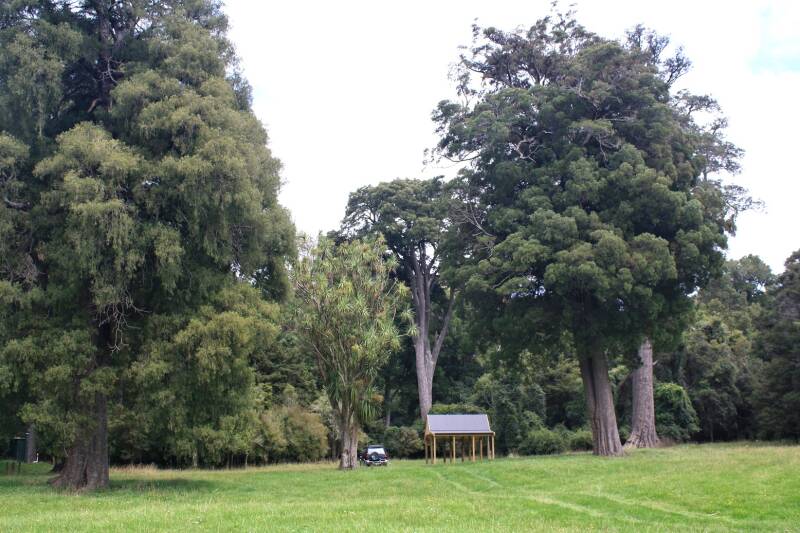
A lifelong love of the outdoors and a passion for freshwater fishing has led to my involvement in and life membership of the NZ Federation of Freshwater Anglers. I have also been a Co - Chairman of the Council of Outdoor Recreation Associations of New Zealand, a broader group of organizations involved in and advocating for outdoor recreation. Through them I have met and befriended some remarkable people that I would not have met otherwise, such as Tony Orman, John Henderson, Alan McMillan, John Morton, Norman Marsh, Ted Bason, Bill Benfield, Ian Rogers, Strato Cotsilinis (who funnily enough was a contemporary of my brother Tony’s from Dannevirke), Norrie Day, Sandy Bull, and Peter Trolove, among others.
The call of such landscapes still reverberates through the stillness of the early mornings (not as early as they used to be, these days). They flash up as photographs on my screensaver during the day. They sing like a soft melody at the stillness of dusk and the rising of a full moon, when the whole world seems to momentarily catch its breath.
- The silent presence of wilderness landscapes when you are hundreds of miles from any human habitation or construction, which seems to wrap around you like the arms of a mother.
- The joyful exuberation of rivers as they alternatively bounce or glide through the landscape. Always on the move to somewhere else. Shifting, shaping, replenishing and transforming the world around them. Cloaking the life that resides below their surfaces, waiting to be discovered.
- The pleasant tiredness of walking back from a day on the river with your expectations and hunger sated by the experience. Sometimes in the purple-pink light of dusk in winter, with a thin mist rising off the water and the cold of an approaching frost settling on your shoulders. Sometimes with the last warmth of a summer sun to burn the memory into your brain. Sometimes with the pleasant weight of caught fish to carry with you.
- The dramatic contrasts of hiking a mountain trail, where huge and magnificent vistas are followed by the small, vivid, intimate experiences of thick forests, ancient trees or small mountain streams.
- The exhilaration of unhurriedly driving up narrow backcountry roads, perhaps for the first time, anticipating what evocative scenes might await around the next bend, to be appreciated and captured by a photograph. Perhaps to revisit those that have impressed you previously, to see how time and seasons have changed them.
- The staggering richness of rocky shorelines, where the seemingly stoic rocks are shaped and shifted by the relentless power of the waves crashing against them. Where amidst this frenzy are periods and pockets of calm and peace where reefs jut out and the tides replenish the rockpools teeming with sea life.
Much of which I am unlikely to ever experience personally again. Some of which pertains to conditions and a time that my grandsons are unlikely to experience. The environmental legacy that our generation will leave them does concern me, almost as much as the fact that it doesn’t seem to concern so many of my peers. And its degradation is something that I have spent a considerable amount of my time fighting against. Seemingly to little avail.
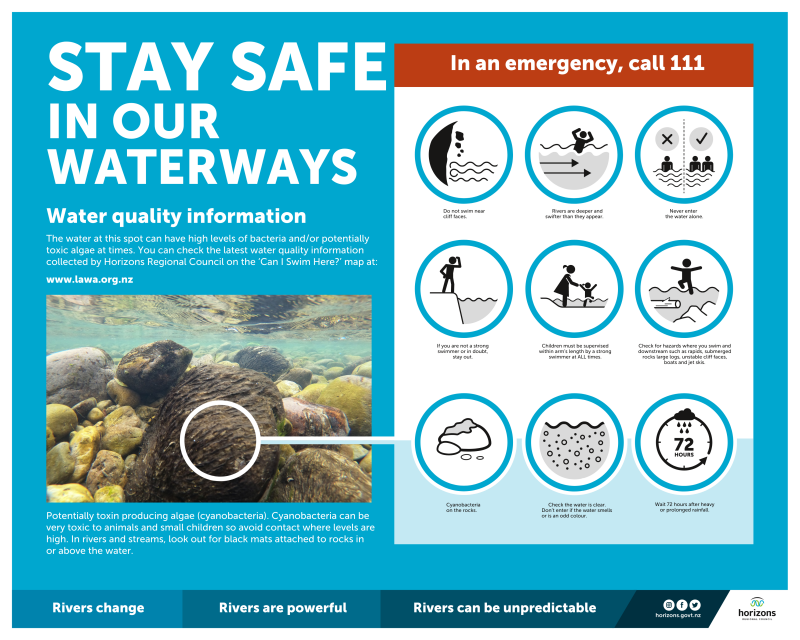
Warnings about River Water Quality
Nitrate pollution of New Zealand waterways