

Our roots in New Zealand soil
Discover the remarkable journeys of our ancestors, their origins, and the compelling reasons that led them to emigrate to the beautiful shores of Aotearoa, New Zealand. Learn about the new lives they built and the legacies they left behind.
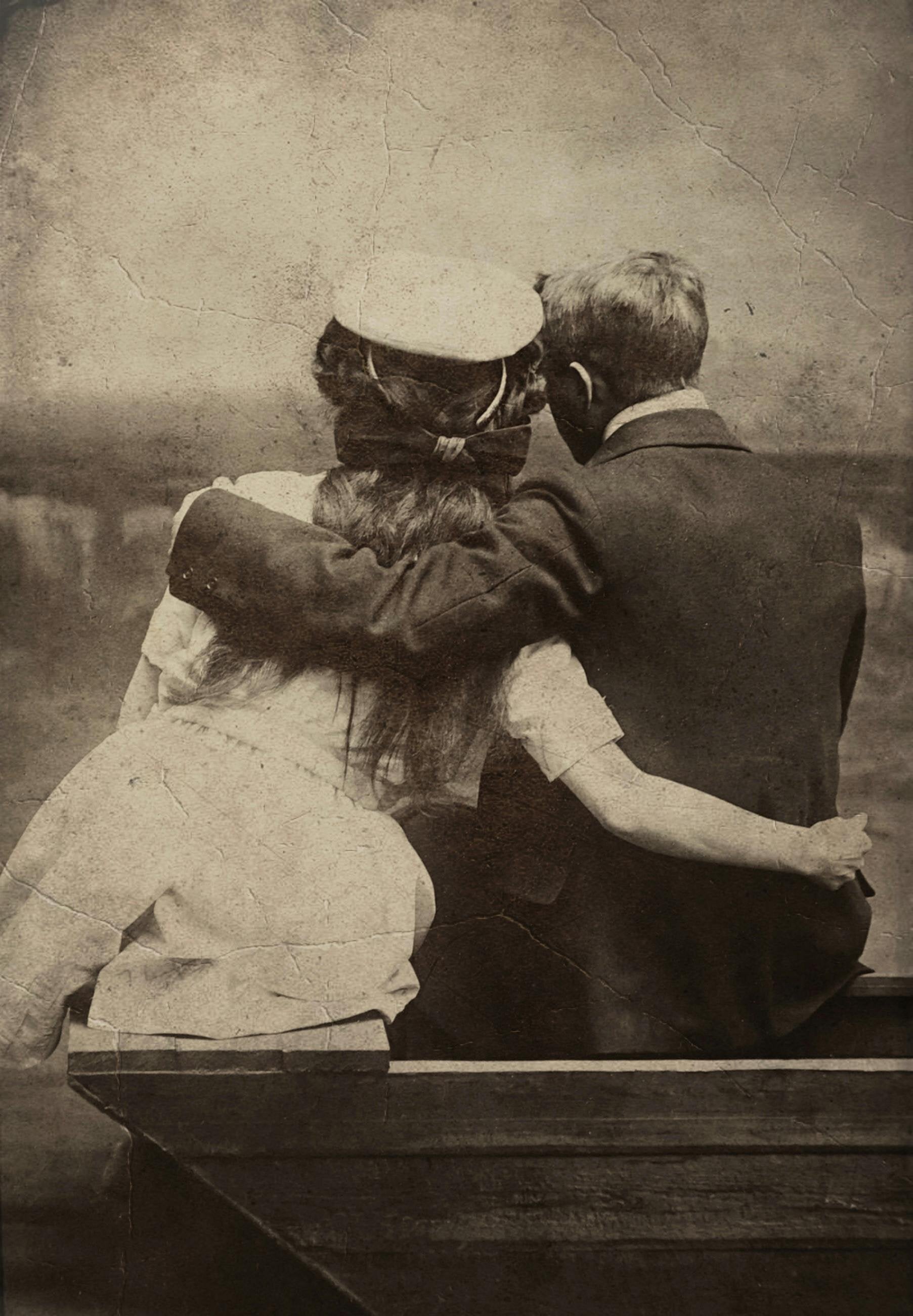
From distant lands to new beginnings
Our family histories are rich with tales of courage and determination. We delve into the lives of those who made the arduous journey to New Zealand, exploring their homelands and the circumstances that shaped their decision to seek a new life far from familiar shores. Each story is a testament to the pioneering spirit that defines our heritage.

Who are we?
This section covers family stories collected from the
- Sims/Watson family
- The Scott family
- The Falleni family
- The Morley family
- The Higgs and Holtham families
- The French Family
- The Stallworthy family
- The Miller family
- The Cromb family
What prompted our ancestors to embark on such life-changing voyages? This section explores the diverse motivations behind their emigration to New Zealand. From economic opportunities and political unrest to the simple desire for a fresh start, understanding their reasons provides a deeper insight into the fabric of our family history.
Oft did the harvest to their sickle yield,
Their furrow oft the stubborn glebe has broke;
How jocund did they drive their team afield!
How bowed the woods beneath their sturdy stroke!
Let not Ambition mock their useful toil,
Their homely joys, and destiny obscure;
Nor Grandeur hear with a disdainful smile,
The short and simple annals of the poor.
The boast of heraldry, the pomp of power,
And all that beauty, all that wealth e'er gave,
Awaits alike the inevitable hour.
The paths of glory lead but to the grave.
Nor you, ye Proud, impute to these the fault,
If Memory o'er their tomb no trophies raise,
Where through the long-drawn aisle and fretted vault
The pealing anthem swells the note of praise.
Can storied urn or animated bust
Back to its mansion call the fleeting breath?
Can Honour's voice provoke the silent dust,
Or Flattery soothe the dull cold ear of Death?
Perhaps in this neglected spot is laid
Some heart once pregnant with celestial fire;
Hands that the rod of empire might have swayed,
Or waked to ecstasy the living lyre.
But Knowledge to their eyes her ample page
Rich with the spoils of time did ne'er unroll;
Chill Penury repressed their noble rage,
And froze the genial current of the soul.
Full many a gem of purest ray serene,
The dark unfathomed caves of ocean bear:
Full many a flower is born to blush unseen,
And waste its sweetness on the desert air.
Thomas Grey 1751.
Introduction
I started researching my family history on February 6th, 2017. So far, it has been one heck of a ride! Among the discoveries and surprises, I have learnt a lot more about the landscapes of where I came from. Scampering through the branches of the family tree there are many such landscapes, and many stories. Some have grabbed or demanded my attention, and I have pursued them further here.
These family history stories have been gathered from ancestors that are mostly further back in time than our immediate families, bridging the gap between them and my ancient ancestors.
A caveat or two is required here. These are stories designed to illustrate the lives and conditions of relatives who lived long ago. Most of them have been tracked down using several large international online databases and information from fellow family tree researchers. While as much as possible is verified by birth, marriage, death, census and other records, it doesn’t automatically mean that they are correct. Adding to the general confusion, the further back in time you go the sketchier the records become and the less standardised the spelling (of things like names) becomes. Plus, there was a common practice of naming children (boys especially) with the same name as their fathers or mothers, so it is easy to get generations confused. But for all of that, these are a fascinating glimpse into the lives of our family ancestors, the people they were, the conditions they lived in and the social changes that often drove them to endure immense hardship while traveling to far off lands and into an unknown and uncertain future.

New Zealand isn’t just a small Island nation, it is one that is geographically isolated, far from major continents and the origins of its people. Its two major islands are still sparsely populated by world standards and were one of the last places on earth that were populated by humans. In terms of family histories, everyone came here from somewhere else.
Regardless of where those origins might be, there are three major themes that define almost all of these family stories. The first is the sheer enormity of the distances people had to travel to get here, which except for very recently, involved long arduous voyages by sea, often under quite primitive conditions. So, they had to be very motivated to make such a journey. That leads into the second theme. Which is that most of the people who came here were fleeing living conditions and potential futures that seemed far worse than packing your entire life belongings into a couple of suitcases and spending months at sea under primitive conditions, sailing to the other side of the world and a land you knew very little or nothing about. And the final theme of course is that even if you made it here safely, for the original settlers anyway, there was nothing here for you, but what you carried on your back and perhaps the promise of some land, which you were expected to clear, drain and sustain yourself on. Little of the housing or social infrastructure that they left behind in their homelands, no matter how threatening, existed here until they built it themself. They were hard times.
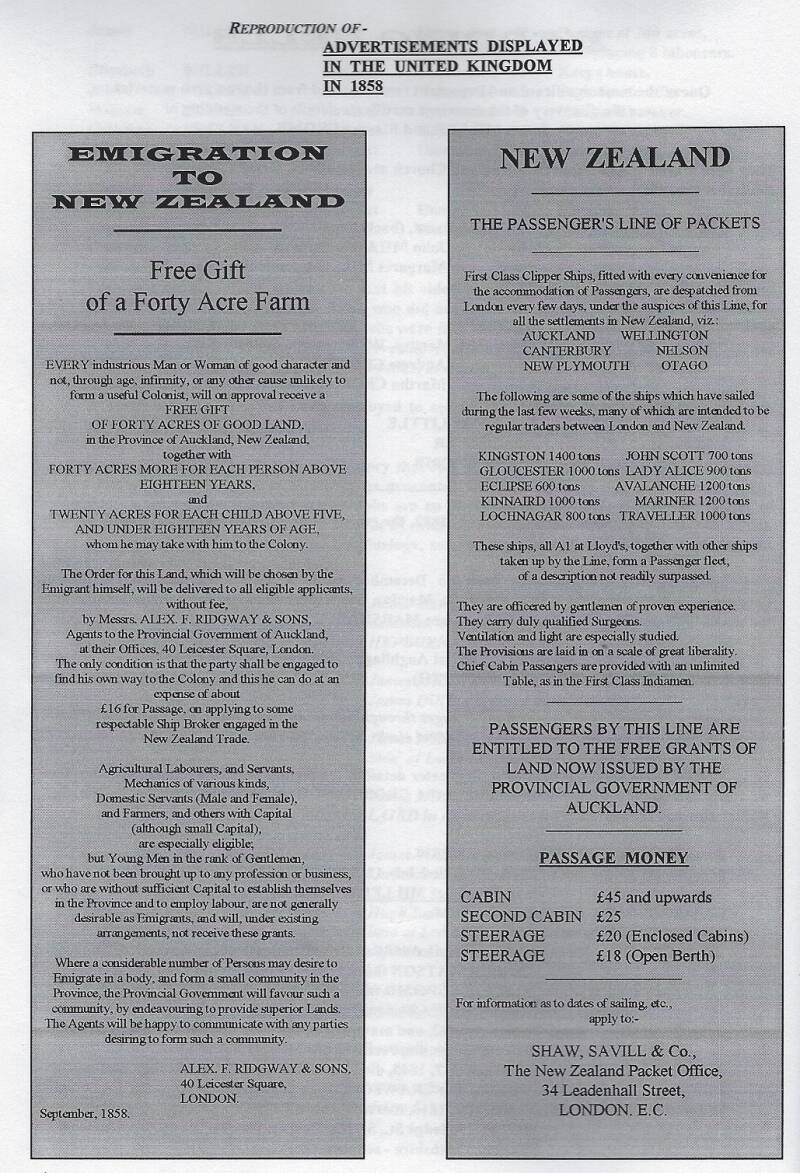
Through following our family trees, I have had to learn about the histories and social conditions of several of the counties that our ancestors came from, in order to understand why they came here. That includes Italy, Scotland, Ireland and England and describes much that I was not previously aware of. However, especially in the case of England, there were also incentives designed specifically to encourage people to make these journeys, in order to populate New Zealand with ‘suitable’ people. An example of such inducements can be seen below.
Many of the advertisements and articles published in England at the time, including by the NZ Company, featured highly romanticised descriptions and drawings of idyllic pastures and farmlands, which were in fact swamps and wetlands, or thickly covered bush or forests. This was just one of the surprises that awaited these intrepid travellers.
For the purposes of this book, I will look at the families and their fortunes that precipitated their emigration to New Zealand, and that ultimately resulted in my family being who they were and are. The stories of the older origins of those families I will save for a book on my origins and ancestral stories.
Even such a restricted portion of our family trees covers a huge span of time, place, history and ancestry. So, of necessity, many of the entries are just short sketches of people’s lives. Often that is all the records there are. Where I have found more comprehensive stories, I have tried to include them.
I started this journey out of curiosity about my own family history, which I knew little about. I guess you can say that it has grown a bit from there. It seems a shame not to share some of what I have found. I hope that it gives you a taste of the very different lives some of our ancestors lived, and the richness of the family history. More than that, I hope that it stimulates you into looking further into your own histories and fill in some of the gaps with your own family stories.
Ken Sims
25 February 2026
Advertisements for Emigrating to New Zealand
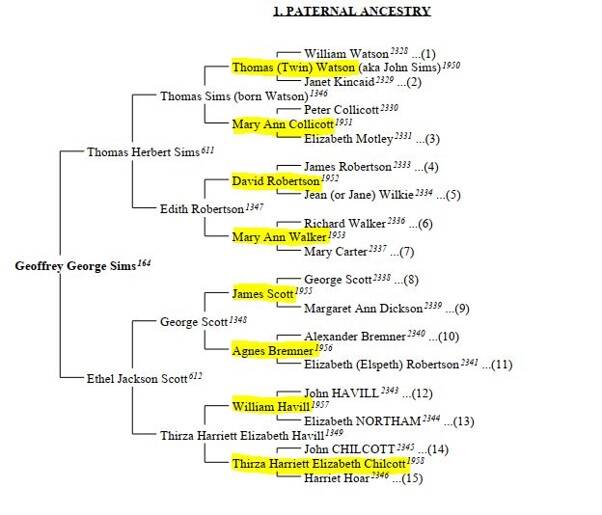
My Paternal Ancestry
Stories of the Sims/Watson Families
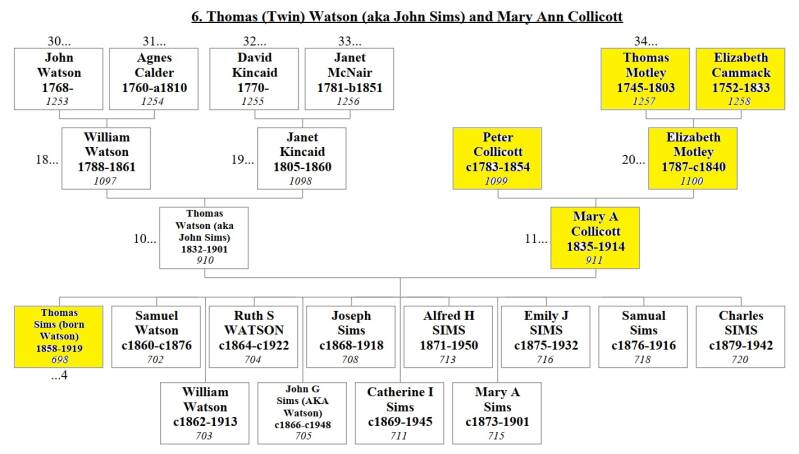
As has been described previously, you only have to go back three generations on my father’s side of the family, to find that the family name changed from Watson to Sims. Why is still pretty much a mystery.
So, who were the Watsons, and where did they come from? Here is a little look:
We will start with the descendants of William Watson, although we can trace this family tree back much further than that.
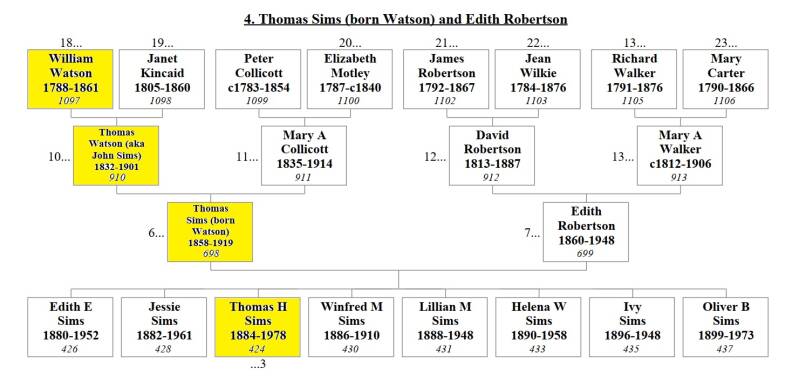
The Descendants of William Watson.
' It was 6am in Glasgow. Sunrise was still an hour away but even that was likely to be a subdued affair. William could hear the rain beating on the roof and his mother moving around downstairs, already preparing breakfast. It was September, and the year was 1821. He swung out of bed, the shock of the 8o C temperature lending urgency to his movements. He glanced over at his brother Robert’s bed, noting that it was already empty. He would have to hurry if he was to be at work on time. And it would be well dark again by the time he got back home.
Outside, the city was already busy. He could hear the shouts of pedestrians and the muffled clopping of horses, carts and carriages moving up and down the street. Although he had been born here and lived his whole life within the city, it was still changing in character and struggling to find its identity. It had changed rapidly over the last few generations from an agricultural support city to an industrial powerhouse based on both its shipbuilding and heavy engineering along the Clyde River, and its numerous cotton mills lining the canals and waterways. Like so many others, his family had moved from the surrounding countryside where they worked as agricultural labourers and small-holding farmers to the opportunities provided by the mills, factories, and businesses of the city.
This rapid urbanization had come at a high price. The exploding population growth led to poor living conditions for many residents. Overcrowding was common, with families often living in cramped tenement buildings that lacked proper sanitation and ventilation. The industrial workforce faced harsh working conditions. Factories and shipyards operated long hours, and labour laws were lax at the time. Workers, including women and children, often worked in dangerous environments with little job security or protections. The wealth generated in Glasgow by these industries and businesses was not evenly distributed. There was a stark divide between the wealthy industrialists and the working-class population. This disparity in wealth led to social tensions and the emergence of labour movements seeking better working conditions and workers' rights.
More than any other Scottish city, Glasgow was a city of contradictions. The deprivation of its slums and those living in them were legendary, yet it boasted many fine buildings, parks and recreational areas. Similarly, its working population had the reputation of being hard working, hard fighting and hard drinking; but at the same time Sunday was a day of silence, broken only by the sound of the church bells, calling the city to religious worship. It was said that “in no town or city in Scotland is the Sabbath more rigidly observed”. Methodist Protestantism was strongly entrenched and dictated that church was attended in your ‘Sunday Best’ clothes, and otherwise everyone stayed indoors.
William Watson had been born in Glasgow, Lanark, Scotland on the 25th of April 1788. He was christened two days later in the imposing old Barony Church, before it was replaced in 1889. The second child of John Watson and Agnes Calder, (both of whom were from Glasgow) his elder brother Robert was born in 1786, and his younger sister Agnes, was born in 1794.
William used a horse-drawn tram to take him to work. He was working in one of the city’s numerous cotton mills as a warper. Although it was relatively skilled work, it was repetitious, the hours were long, and the pay was poor. His only respite, when he wasn’t concentrating on his work, was thinking about the young lass that he had met on a previous Saturday. He had used a little of his savings to take a half-day steamboat excursion on the Clyde River and had met the Kincaid family on board.
The Kincaid family had moved to Glasgow from Linlithgow, West Lothian, Scotland in the early 1800’s, and Janet Kincaid was one of four daughters and two sons. The age gap between her and William was huge, William was 33 and Janet was just 16, so we can only speculate about the attraction between them. Janet was still in the flower of her youth. Was she attracted by William’s maturity and cheeky sense of humour? He was determined to see her as often as possible, for as long as possible. He could afford to take her to the theatre, music halls, seaside resorts and parks on his Saturdays off work as he courted her. Sundays, of course, were reserved for attending church and staying inside.
On September 5th, 1825, at the age of 37 he married Janet Kincaid in Glasgow. She was just 19 years old. Eleven months later, on the 31st of July 1826 their first child was born, a daughter christened Isabella at the church in Barony, Glasgow. Two years later, on the 4th of February 1828 they had a son, again christened in the Barony church on February 24th as William, after his father.
That was followed four years later in 1832 by the birth of twin boys, Thomas and Joseph. Then came Adam (also known as Evan) in 1834, who unfortunately only lived until 1835. He was followed by a daughter Janet in 1836, another son John in 1838, and finally a daughter Jean in 1841.
Apart from that, and the wives of Thomas, Joseph, and John, we know little about the family after the 1820’s. Statutory reporting of births, deaths and marriages wasn’t required in Scotland until 1855, so before then only parish church records existed. Even the census records of the time are silent for the family. And while it would be nice to think that the family existed in harmonious prosperity, I rather think that was not the case. Not only were women still disenfranchised, disempowered, and legally regarded as little more than chattels, but even though the city was prominent at the time in calling for the abolition of slavery; the strict moral codes enforced by both the church and authorities seem to have bred a dour Scottish enthusiasm for imposing them on others.
Certainly, the immediate male descendants of William and Janet in our family seem to have followed suit. What fragments of family correspondence still exist would suggest an enforced moral discipline. Some of them were not particularly nice people. That sort of trauma is learnt at an early age, and usually intergenerational.
William Watson died at 129 Barrack Street, Glasgow on February 7th, 1861. His wife Janet had died a year earlier aged 54 years old, having raised eight children. William died of apoplexy, paralysis of the left side which he had suffered from for 12 weeks, as the result of a stroke. He was 72 years old. His death was reported by his eldest son William Watson '
Thomas Watson Snr.
Thomas and his twin brother Joseph were born on March 1st, 1832, to Janet and William Watson in Glasgow, Lanarkshire, Scotland. He was baptized on March 30th, 1832, presumably in the church in Barony, Glasgow.
We knew very little about his life at that time through official records, and again we must turn to historians to glimpse what his formative years might have been like. We have already seen that Glasgow had a prosperous middle class, dominated by businessmen and many well-paid skilled workers in engineering and shipbuilding. And yet everyday life for the mass of the population was one of poverty and uncertainty. And even those who might be relatively prosperous at one stage of the life cycle could find themselves in circumstances of extreme deprivation in times of sickness, in widowhood and especially in old age.
That everyday life, regardless of income, was shaped by ill-health. Life for the poor in overcrowded, industrialised Glasgow was especially likely to be influenced by sickness and early death. Indeed, by the 1830s the average age of death in Glasgow, fell to about 37 years for men and 40 years for women. That seems ridiculously short by today’s standards.
Poor nutrition led to chronic states of physical inefficiency among the working population. A School Board survey of 1906 revealed that a 14-year-old boy living in a poor area of Glasgow was, on average, 4 inches shorter than a similar-aged child from the city's West End. If you walked through the busy streets of this teeming city, the rich were easily differentiated from the poor because they were tall. Nutrition-related ill-health remained pervasive and visible in such conditions as rickets - causing bone damage to up to a third of Glasgow's children - consumption (Tuberculosis), a chronic and debilitating respiratory condition, and killer diseases such as typhus which were also rampant.
Simply living in the city was damaging to health. The 1830s witnessed major cholera outbreaks in Glasgow as elsewhere, affecting rich and poor alike. Air quality was bad due to industrial pollution and coal fires, which is why the middle classes migrated up-wind to the West End. The young and the old, the vulnerable in society, suffered most from the effects of poor living conditions, severe overcrowding, and a lack of adequate sanitation. Most families, be they rich or poor, experienced tragedy and grief arising from the death of children or the loss of a parent while children were still young. In an age that recognised death through elaborate funerals and complex mourning rituals, the death of a loved one could impose a major financial burden on a family, and the shame of a pauper burial was keenly felt.
It was against this background that a young, single Thomas Watson emigrated, first to Australia then on to New Zealand, leaving from Greenock, Scotland. I would imagine that it wouldn’t have been a hard idea to sell to him, especially if he was on an assisted passage, where even the poor conditions of the voyage would not have been much worse than those he left behind. There is considerable uncertainty over exactly when and how he voyaged.
No permission, passport or application form was necessary, in order to emigrate from Britain or Ireland in the 19th century. Only when financial assistance, from or via the government was required, did application forms have to be completed. There were many assisted emigrants to Australia and New Zealand in the 19th century and early 20th century. Many records of these schemes do not seem to have survived in the National Archives. And even when such records do exist, the name Thomas Watson was a common one in Scotland at the time, so just the name on a ship’s passenger list doesn’t help much.
There is some suggestion that he came out on board the sailing ship Aberfoyle. She was a brand new three masted vessel, built in Glasgow as a cargo ship, but carrying 414 passengers. On her maiden voyage she was bound for Melbourne, Australia, a voyage of some four months. But she wasn’t built or launched until 1885, which doesn’t fit with the timeline for Thomas in other accounts.
A more likely scenario is that he left Glasgow on September 7th, 1852, bound for Melbourne, Australia, and arriving just a month before a certain Mary Ann Collicott, who arrived there from London on board the ship Apoline.
Thomas lived in Melbourne for some four years before taking another ship to New Zealand, this time the Wyvern to Wellington via Nelson, arriving on August 16th, 1856. While in Melbourne it is believed he met the young lass from London who had immigrated as an assisted immigrant and who worked as a domestic servant. It is interesting to think as to what life in London had thrown up for Mary Ann Collicott to make her emigrate at the tender age of 17. It is possible they decided on New Zealand as a new start together, as she came to New Zealand in 1855, and was followed by Thomas in 1856. Or perhaps they just knew of each other and renewed that acquaintance once here.
Glasgow Slums 1860's
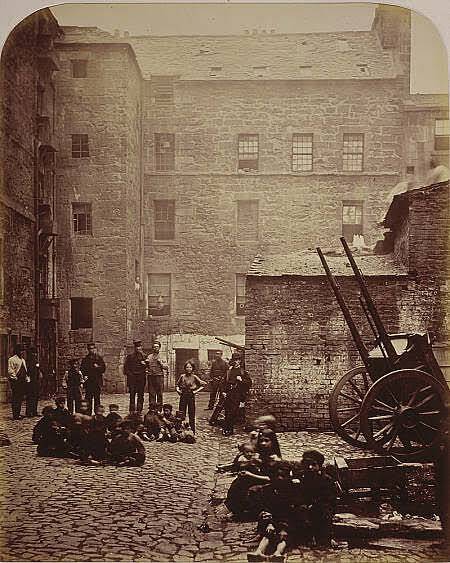
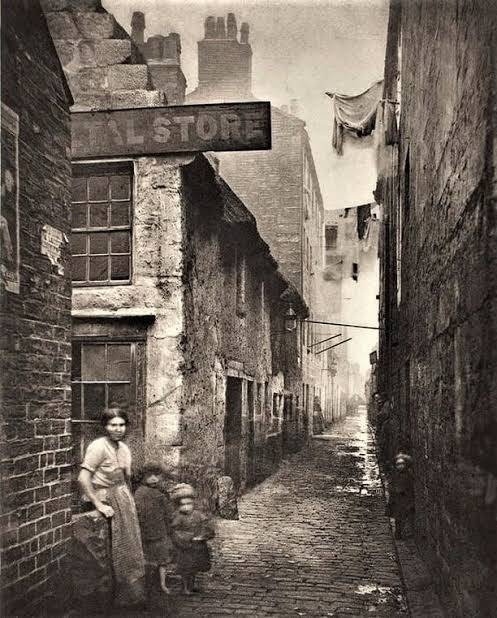
The next we hear of Thomas Snr is five years later, when on January 14th, 1858, he married Mary Ann Collicott in the Hutt Valley, Wellington, New Zealand. Like Thomas, Mary Ann had been born in Great Britian, in her case in Walworth Saint Peter, a district of south London in the borough of Southwark. She had emigrated with her family, leaving Depford, London, England in July 1852, when she was seventeen years old. She was part Quaker, and given Thomas’s strict Protestant Methodist inheritance, it is easy to imagine that such shared values attracted them to each other. But then, perhaps there were other forces involved, because eight months later, on the 10th, August 1858, their first son was born in Lower Hutt, Wellington, New Zealand and named Thomas after his father.
Soon after arriving in Wellington, Thomas had leased land and a house on the Hutt Road, and it was here that they were married, and where their first two sons were born.
Thomas Watson Jnr was followed in 1860 (? February 7th), by a second son named Samuel. He was also born in the Hutt Valley, Wellington. We know little about Samual, except that he drowned at Napier in the Hawkes Bay at the age of eighteen years.
Thomas was a tailor by profession, and the family obviously moved to Kaiapoi in the Waimakariri District of Canterbury, in the South Island. We find him advertising in the local paper as a Tailor and Clothier (next-door to the Northern Hotel in Kaiapoi) in 1861. It was in Kaiapoi that their third son William was born on April 12th, 1861, followed by a daughter Ruth Selina on February 1st, 1864. And it was in Kaiapoi that the wheels obviously fell off his business as a Tailor, and on July 8th, 1864, he was charged under the Debtors and Creditors Act 1862, and his estate and effects seized and held until his debts could be discharged.
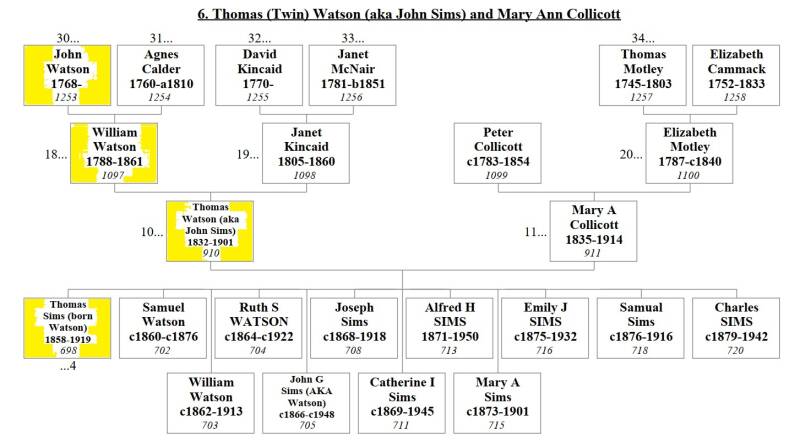
This precipitated one of the enduring mysteries of this branch of the family tree. Thomas and his family moved to Napier, and in 1865 Thomas changed his common name to John Sims. The rest of his family also changed their surnames to Sims as well. It wasn’t until a year later in 1866 that there was any legal obligation to record this officially, so exactly when and why remain conjecture. And why John Sims? There is some suggestion that John Sims was the name of the captain of the boat they arrived in, whom Thomas had befriended, but this is unsubstantiated.
The following year a fourth son, John George Sims was born in Napier on May 3rd, 1866, followed by Joseph Sims, born in Napier on December 9th, 1868. A year later another daughter, Catherine Isabella Sims was born in Napier on October 27th, 1869. (Just to add to the confusion, Catherine married a William Henry Watson!)
On June 1st, 1871, Thomas and Mary had another son Alfred Henry (Harry) Sims, followed by two more daughters; Mary Ann Sims on August 27th, 1873, and Emily Jane Sims on April 5th, 1875.
On April 7th, 1876, their second son Samual died by drowning at Napier, and when on August 5th of that year another son was born, he was also named Samual Sims. Finally, Charles Sims was born in Napier on August 14th, 1879.
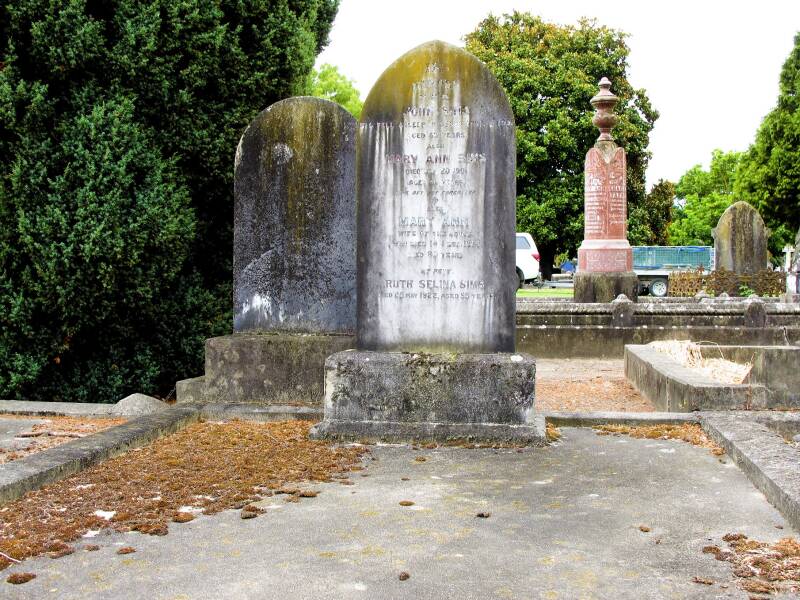
Thomas and Mary were living in Hastings Street, Napier in 1896, and had moved to Heretaunga Road, Hastings, by 1901. Thomas died of cancer on April 4th, 1901, at the age of 69. Mary lived on until she was 79, dying in Hastings on December 11th, 1914. They are buried in the Stortford Lodge Cemetery, Hastings, New Zealand, as John Sims and Mary Ann Sims, along with their daughters Mary Ann and Ruth Selina Sims.
Thomas has been described by family members as a hard, conceited, proud Scotsman, who was a ‘cruel old beggar’, having once made his wife go and serve in their shop in Shakespeare Road, Napier an hour or two after the birth of a baby. He would never allow himself to be photographed. His wife Mary Ann similarly has been described as a sad, dour woman who literally sucked the life out of her son William with her demands.
Of their children, Thomas Jr. is my immediate ancestor, and next to be described. Samual (1st) drowned at Napier when he was eighteen years old. He is buried in Hasting’s cemetery.
William was working as a shepherd for a wealthy farming family in Ongaonga in the central Hawkes Bay, but the combination of too much responsibility while they were absent overseas plus his mother’s incessant demands resulted in him hanging himself in 1913. He is buried in the Forest Gate cemetery at Ongaonga.
Ruth Selina is another whose life is a bit of a mystery. It appears that she never married and died in Hastings in 1922. It is possible that she had an illegitimate child around 1901, as there is an account in the Daily Telegraph of 15th July, 1901 of a John Register being charged with failing to provide maintenance for an illegitimate child born to a Ruth Sims. Although he denied paternity, the Judge disagreed and ordered him to pay £6 10s as expenses connected to the birth, and 7s 6p a week maintenance until the child reached the age of 14 years. Ruth is buried at Stortford Lodge cemetery along with her parents as Ruth Selina Sims.
John George Watson was born in 1866 at Napier. He married Elizabeth Ann Purnell in Wanganui in 1895, and they moved to Sydney, New South Wales, Australia. His obituary describes him as a thoughtful, happy man forever willing to help others. He had a great knowledge of and interest in the inhabitants and early days of the south-east New South Wales.
Joseph was born in Napier in 1868 but left the family at a young age, as he didn’t get on with his father. He was an avid follower of horse racing. He settled in New Plymouth where he married Catherine Brady (an Irish Colleen) and they had four children, a daughter and three sons. Catherine died in 1903, aged thirty-seven, and the following year he married Mary Josephine Bullock, and they had a further four children, two sons and two daughters. Joseph died in New Plymouth in 1918 and is buried in Te Henui cemetery.
Catherine Isabella Sims was born in Napier in 1869 and became a dressmaker by profession. She married a William Henry Watson (no relation) in Napier, and they had three daughters and a son. The eldest daughter was born in Hastings, the second in Nelson and the third in Christchurch. The son was presumably also born in Christchurch, but he died at five months old from a reaction to a smallpox vaccination. Catherine died in Christchurch in 1945 and is buried in Bromley cemetery.
Alfred Henry (Harry), who was the 8th of 12 children born to Thomas Watson and Mary Ann Collicott, was trained as a plumber and plied at this trade until about 1909. He married Marion Griffith in April 1896 and in 1899 Alfred and family moved to Hastings where he became involved in the Methodist Church. Alfred became a trustee, church treasurer, society steward and Sunday School teacher, and on his departure to Wellington in 1909 he was presented with an illuminated address by the church trustees. In Wellington Alfred started a business at Karori - Sims Hardware and later, about 1914, he moved to Levin to start another hardware shop, again called Sims Hardware. The Wellington business of Sims Hardware was later moved to Cuba Street where it was run by his brother, Charles Sims, and it became an established and well-known shop. Whether Alfred had had a 'falling out' with Charles over the running of the business, or just had 'wanderlust', is not known. Interestingly, his sister Catherine disliked ‘Harry’ as well, describing him as sarcastic.
In Levin, Alfred became a staunch member of the Church of Christ and in 1919 he is recorded as being a Deacon, and also the Church Treasurer. He also helped to build the new church, which was opened on September 24th, 1920. In 1926 Alfred, with his wife and daughter Elma, moved to Stratford and he started a grocery business, however the climate proved to be too wet and after about two years he moved back to Hastings to a small farm in Park Road, South. In 1944 he sold the farm and moved to 307 Albert Street, and this house remained the family home until 1987 when his daughter, Elma, moved into a Rest Home. After his return to Hastings, Alfred became a member of the Hastings Baptist Church, and it was quite a sight when son Cecil and family came to stay, and all went to Church. Alfred led the procession up the aisle, followed by his wife and daughter, then came Cecil's family with Cecil in the rear, when the Sims pew was reached Alfred remained in the aisle until all were in the pew and then he took his place, next to the aisle. To Alfred, Sunday was the Lord's Day, therefore one wasn't allowed to work, or even whistle, and had to remain in 'Sunday best' clothing all day. (It is funny how his grandfather’s beliefs repeated themselves).
Alfred enjoyed rugby and he sported a broken nose which was a relic of his playing days. His wife, Marion, was not keen on his playing such a rough sport so he played under an assumed name, however, in one match he broke his nose when he hit a pipe supporting a chain barrier, unfortunately this mishap was reported in the local paper, which his wife read, and so his playing days came to an end. In later years he enjoyed going to Nelson Park, in Karamu Road at the end of Albert St, to watch games of local club rugby. When he was bedridden late in life, he had extension speakers fitted to the radio so he could listen to it from his bed and woe betide anyone who 'fiddled' with the radio. He also enjoyed fishing and often took his grandsons by bus to the mouth of the Ngaruroro River, between Clive and Awatoto, for a day's line fishing to catch herrings or kahawai.
Alfred and Marion celebrated their Golden Wedding in 1946, four years before his death in Hastings in 1950. They are buried at Stortford Lodge cemetery and were survived by a son and a daughter, their first child (a boy) having died when a baby.
Mary Ann Sims, like her older sister Ruth Selina, is also a bit of a mystery. Born in 1873 in Napier, she died suddenly at the age of twenty-seven on January 20th, 1901, at her parents’ house in Heretaunga Road, Hastings. She is buried, along with them and Ruth, at Stratford Lodge cemetery.
Emily Jane Sims was born in Napier in 1875. Apparently, she used to run a tea-room in Wellington, where the old airport at Rongatai used to be. I wonder if she followed Alfred or Charles down there? It also seems that she may have married a Mr Brinson, and they moved to Henderson in Auckland, although I can find no records of that, nor his name.
Samual (the 2nd) was born in Napier in 1876. He was killed at the Somme, Picardy, France in 1916 during the First World War, and is buried at Y Farm Military Cemetery, Bois-Grenier, France.
Finally, Charles Sims was born in Napier in 1879. As seen (above) he followed Harry down to Wellington where he ran Sims Hardware Company in Cuba Street. It was here that he married Harriet Ellinor Bird. They had two daughters and three sons. Charles has been described as a dear and was obviously well liked in the family. He died in Wellington at the age of 62, of cancer of the throat, and is buried in Karori cemetery.
Stortford Lodge cemetery, Hastings, New Zealand, and the headstone for:
- Thomas Watson Snr (buried as John Sims)
- Mary Ann Watson, nee Collicott (buried as Mary Ann Sims)
- Mary Ann Sims (daughter)
- Ruth Selina Sims (daughter)
Thomas Watson Jnr.
As we have seen above, Thomas Jnr was born into a church oriented, orthodox methodist practicing colonial family in Wellington on August 10th, 1858. At that time Wellington was still in its early stages of development and was pretty much a ‘frontier town. Its European settlers were mainly engaged in farming, trade, and commerce, living in simple wooden buildings that would have been vastly different from those they were used to in their ‘homelands’. The port was obviously an important hub for immigration, trade, and transportation. Roading was rudimentary, and people moved around by horse-drawn carriages.
We know little about his early life, but it is assumed that he moved to Kaiapoi and then Napier with his family (he would have been about 8 years old at the time). We don’t know when he moved back to Wellington, or why.
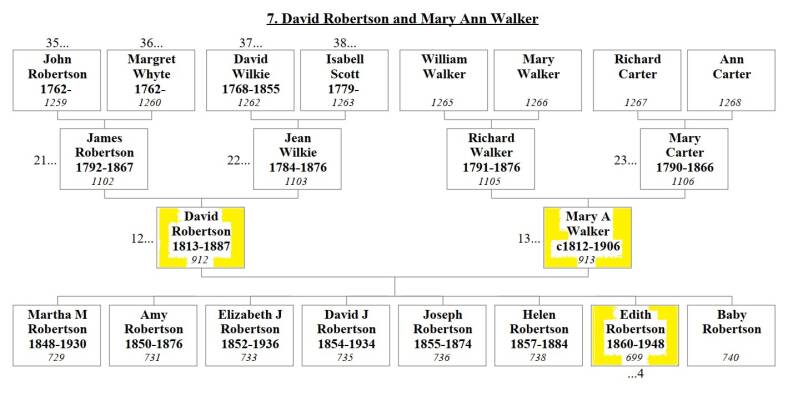
Much like his father, the first time we hear of his new life was when he married Edith Robertson in 1880. Edith came from a very interesting family, worthy of a chapter (if not a book) of its own. She was the youngest daughter of David Robertson and his second wife Mary Ann (nee Walker), who was sexton at the Wellington Public cemetery on Bolton Street for thirty years. He had studied for the Ministry in Edinburgh but eventually turned to Horticulture, working as a gardener at several large estates in England. After being widowed in 1846, he remarried the following year, and he and Mary Ann immigrated to New Zealand on the barque Alma in May 1857. Their daughter Helen was actually born on the beach nine days after their arrival at Plimmers Wharf. Edith was born three years later, by which time the family was living in a cottage on the cemetery grounds, which is where she married Thomas Watson Jnr twenty years later.
Edith was thought to be delicate as a child, she was slight and short like her mother, but she lived to be eighty-eight, had eight children and was a fastidious housekeeper. Like Thomas, she came from a family with a strong protestant church background (Primitive Methodist and Salvation Army) and they both attended the Methodist Church at Thorndon. Thomas was superintendent of Sunday School, walking there every Sunday, wet or fine, for twenty-four years.
After they married, they moved into a house in Shannon Street, Wellington. Thomas’s fortunes as a tailor and clothes maker were obviously more successful than his father’s. For eight years he was cutter for Messrs. W. and G. B. Clark, of Lambton Quay, Wellington. In 1893 he established his own business in Manners Street, Wellington. His connections extended throughout the Wellington provincial district, and orders came from as far away as the West Coast of the South Island. From ten to twelve hands were employed. All kind of tailoring work was performed, with special attention being given to superior hand-sewn work.
On October 4th, 1880, their first child Edith Elsie Sims was born. She died in May 1910, aged twenty-nine. Next followed Jessica (Jessie) Sims, born on September 13th, 1882. She graduated as a nurse in January 1918, and died in Lower Hutt, Wellington on January 20th, 1961, aged seventy-eight.
Then came their first son, Thomas Herbert Sims, born in Wellington on November 6th, 1884. Thomas was my grandfather and will be described in more detail elsewhere. He married Ethyl Jackson Scott on May 23rd, 1910, in Wellington. The Scott’s are also an interesting family, some of whose descendants I have had the pleasure of meeting or corresponding with, through a shared interest in our respective family histories. Thomas and Ethyl had seven children. Ethyl died on December 14th, 1961, aged seventy-five, and Thomas died on February 10th, 1978, aged ninety-three.
Winifred Mary Sims, their next daughter was born in Wellington on August 10th, 1886. She died suddenly at home on April 2nd, 1910, aged twenty-three. She was followed by Lillian Mabel Sims on November 4th, 1888. We know nothing about her life, except that she died in Wellington in 1948, aged about sixty.
Helena Willis Sims was born on August 30th, 1890. She married Allan James Hayhoe, a butcher, and they had a daughter Nancy Helena in 1930. They moved to Masterton, where Allan was a poultry farmer. Helena died on March 23rd, 1958, at Masterton and is buried in the Archer Street cemetery. Allan died on December 15th, 1973, at Masterton and their daughter Nancy also died there on September 8th, 2011, all three being buried in the same plot. Nancy had obviously married, being buried as Nancy Helena Giles.
Ivy Sims was born in Wellington on November 5th, 1896. She followed her sister Helena to Masterton, marrying Allan Hayhoe’s brother, a Harry Wilson Hayhoe. Both Allan and Harry were poultry farmers in Upper Plains, Masterton. I think that Ivy and Harry were probably subsequently divorced, as Harry remarried and Ivy died in Wellington on December 14th, 1948, aged fifty-two. That sort of thing was not talked about much in families back then.
Finally, Oliver Bramwell Sims was born in Wellington on February 24th, 1899. He passed his Public Service Entrance examination in November 1914. In 1926 he married Eileen Elizabeth Cockroft, and they had a son Thomas Edward Sims who was born on 27th September 1929. Thomas was a Pianist, organist and sound engineer. He ran a recording studio in the Stewart Dawson's building, on the corner of Willis St and Lambton Quay. His output included commercial advertisements, as well as musical performances such school and church choirs. Oliver Sims was heavily involved in Catholic church music in Upper Hutt. He travelled in the Pacific in 1916 visiting London Missionary Society missions in Fiji, Tonga, and Samoa. His diary which begins with an entry dated 29 May 1916 when Oliver was in Auckland to embark on the steamer 'Talune' for a journey to visit the London Missionary Society established missions in Fiji, Tonga and Samoa is kept in the National Library. He died on September 22nd, 2009, and is buried in the Akatarewa cemetery, Upper Hutt as a Papal Knight. That must have sent a few of his orthodox Methodist ancestors spinning in their graves!
Thomas Sims Jnr died in Wellington on December 10th, 1919, aged sixty-one and was buried in the Karori cemetery. Edith went on to live until she was eighty-eight, dying in Wellington on November 6th, 1948. She is also buried in the Karori cemetery.
Thomas Watson Jnr, and Edith Robertson with family circa 1916.
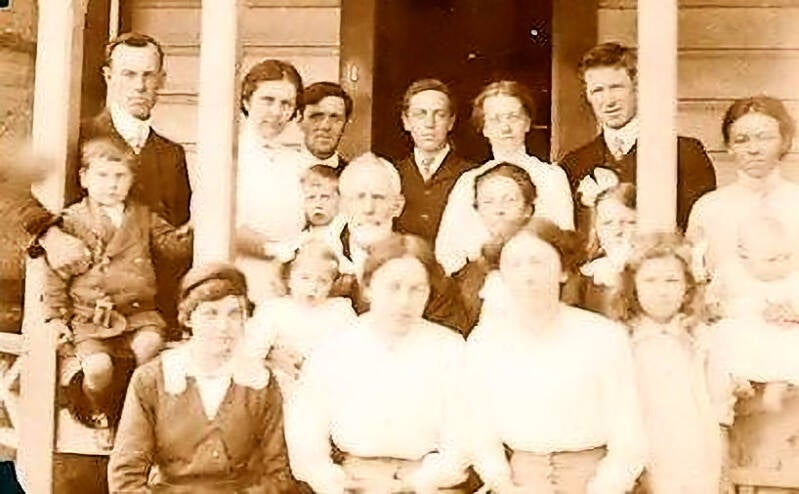
Despite all the name changes and immigration in the Watson family, they are still easier to trace than the Collicott’s. Mary Ann was born in Walworth St Peter, Surrey, England on July 6th, 1835, to Peter Collicott and Elizabeth Bond/Motley.
Peter Collicott is a bit of a mystery, with his birth simply being recorded as around 1783 and from ‘Out of Country (England)’. So, we don’t know where he came from, or from whom.
Elizabeth Motley was born on June 17th, 1787, at Holborn, London, Middlesex, England, and was christened at the Church of Saint Mary, St Marylebone Road, St Marylebone, London, on August 12th. On January 12th, 1812, she married Stephen Bond at St Anne Church, Soho, Westminster, London, Middlesex, and their first son was born June 9th, 1812, at St George Hanover Square, Pimlico, London, Middlesex, England, and named Phillip Thomas Bond. Stephen died in 1830 and on the 9th of December 1832 she married Peter Collicott at Lambeth, Surrey, England. Their daughter, Marry Ann Collicott, was born two years later. Elizabeth died in London in 1840.
Elizabeths mother was Elizabeth Cammack, presumably born in 1752 at Mareham Le Fen, Lincoln, England, as she was baptized there on 12th April 1752. She married Thomas Motley in Coningsby, Lincolnshire, England on July 8th, 1783, and died there in March 1833. Thomas was born in December 1745 in Sheffield, Yorkshire, England and died in Coningsby, Lincolnshire, in November 1803.
This is such a great record of recent Robertson family history; I will post it here in full. It was shared with our family and was one of the few family records I inherited from my parents. It provides a fascinating snapshot of the lives of my Robertson family ancestors in Wellington in the later part of the 1800’s.
Draft of Part of the History of the Bolton Street Cemetery, being prepared for the Ministry of Works by M. H. Alington.
Since so much interest has been aroused within the Robertson Family by the preparation of this history, I decided to write up these notes and circulate them now, out of context, so that the family could see what has come to light so far and perhaps add to (or subtract from) what is written here. This essay in its present form is only a preliminary draft, and obviously much more still has to be done on points of style, etc.
I am indebted to several descendants of David and Mary Robertson for much of the information contained in this essay. As you read it, please feel free to make notes about anything that seems to you to be inaccurate or misrepresented, or about any other incidents that may come to mind as you read; I should like to make this as accurate a record as possible.
As you may be interested in those members of the family who have helped by providing information, photographs and documents, I enclose a list of their names and addresses.
Mary Jane Beaglehole
Professor J.C. Beaglehole (grandson) Wellington 5
Annie Rudman
Mrs. Floris Paudemer (granddaughter) nee Cowdrey, Island Bay, Wellington.
Martha Maria Trim
The Rev. Frank Trim (son), Rangiora.
Mrs. Martha Knauf (granddaughter) Papatoetoe.
Amy Baker
Mr. W.H. Christenson (grandson), Feilding.
Carrie Drake
Mr. Lester Drake (son). Eastbourne.
Elizabeth Macklin
Mr. A.M. Bedkober (grandson) Wellington
Mrs. D.E. Duncan (granddaughter), Wellington
Edith Sims
Mr. Thomas Sims (son) Miramar, Wellington
Mr. Norman Sims (grandson), Wellington
Miss Farmery (granddaughter), Eastbourne.
Margaret H. Alington
For thirty years, the care of the public portion of Wellington’s first cemetery, entered from Sydney Street, was in the hands of David Robertson. He was a Scotsman who, with his family, has made a real contribution to our national character since the day he arrived in May 1857 on the barque Alma, berthing at Plimmer’s Wharf. He soon made the acquaintance of fellow Scotsman William Lyon, who was a member of the Provincial Council for Wellington, and one of the trustees of the recently constituted public portion of the cemetery. At the time, the trustees were looking round for a suitable person to act as sexton and at their August meeting Lyon mentioned that he had in view a very suitable person, namely David Robertson. His recommendation was accepted by the others, and he and Jonas Woodward were asked to get specifications as speedily as possible for a cottage to be built in the cemetery to house the sexton and his family. A loan of £100 was raised for its erection, and until it was ready, the Robertsons, like many other newly arrived immigrants, made do in a mud hut along with their seven children.
David Robertson was a big man, over 6 foot tall and broad shouldered. He was resourceful and conscientious, and dedicated to his horticultural interests. He was forthright in expressing his opinions, which were nicely tempered with an acceptance of men as he found them, and an irrepressible wit. On the long voyage out to New Zealand, he had enlivened many a tense situation with his sense of humour. Before coming to New Zealand, he had been a gardener on several estates. He was brought up in Scotland and assigned by his farming parents to study for the ministry, to which end he attended Edinburgh University for a time. His interest in horticulture, however, was intense, and in his twenties, he took a position as a gardener to Sir Culling Eardley Smith at Bedwell Park in Hertfordshire. A fragment of a diary of garden transactions that he kept at this time survives and reveals a man greatly concerned with the plants under his care, who persevered with problems, who was of a philosophical and analytical turn of mind, yet with a sense of humour, and a happy ability to express himself on paper. Here are some extracts:
30 June (1840?) Mowing, weeding flower beds, sweeping up – hoeing in kitchen garden …. As usual a busy day but still with all my striving, behind my work – when shall I be able to get upsides with it?
7 July Anointed trees in orchard with composition to heal the wounds caused by the biting of the rabbits.
10 July A busy day but little thought of and less valued.
14 July. Hilled out three lights of cucumbers in a new pit in soil composed of vegetable mould and peat soil – leaf mould and a little rough sand – by way of experiment – having reason to believe the soil used for early and successive crops contains something injurious to the health of both melons and cucumbers. This trial will prove to a certainty whether there is or not and then I must endeavour to find out what it is.
After a gap in the entries lasting from 19 July to 4 August, he writes:
A long, long rest, one of the stupors to which I am subject, and which comes over me as it were with a stroke of a magician’s wand – changing my very nature and making me hate all exertion. Time! Time! How irreparable thy loss! How fast thy flight. Put in cuttings of verbena incica for plants next spring – hoeing and raking – fine weather for cleaning – a great deal of watering required.
30 July 1841. Continued cutting box edging and cleaning up. Afternoon spent waiting at the house expecting Her Majesty to pass this way on her return from Lord Melbourne’s.
12 August. Birthday of our young master. Missionary meeting. Subject, “Higher Expedition”, civilization of Africa. Sweeping, cleaning, gravelling and rolling walks. Arranging seats, putting up tents … for audience expected. A busy day.
13 August. Taking down tent in pleasure ground, carrying away seats. Sweeping, tidying up beds trod on by people at the meeting.
15 October. Mending lights – gardeners must be ‘jack of all trades and master of them also’. What matters so long as we can get a living. It is a servant’s duty to economise his master’s property and prevent unnecessary expenditure.
The missionary meeting to which he refers was reported in three full columns of the local newspaper. A fairly distinguished company was addressed by at least five speakers, including the Rev. Robert Moffatt, David Livingstone’s father-in-law. The substance of the talk revolved around the iniquities of the slave trade and the importance of ‘civilizing’ Africa.
About this time Robertson had married and three children were born to him and his wife while they were at Bedwell. He married for a second time in 1848, to Mary Walker of Middlesex. There were seven children of this marriage, the last two being born in Wellington. From Bedwell Park, Robertson moved to Bridgefoot House, near South Mimms in Middlesex. This was owned by Vincent Robert, esquire. After some time at Finchley, Middlesex, he moved to the estate at Waresly in Huntingdonshire owned by the Hon. Octavius Duncombe, M.P., and from there the family came to Wellington.
When their new home was ready, it stood on the crest of the hill above Sydney Street, with a fine view over Thorndon and the harbour to the Hutt Valley and beyond. It was reached by a road winding up from the cemetery gates in Sydney Street. Behind it lay the small Jewish cemetery and the open area of gullies running up to the Botanical Gardens. (These gullies were part of the eighteen acres originally set aside for the cemetery, but they were later submerged in Anderson Park).
The cottage itself was built of horizontal weatherboards, with a shingle roof. The front door opened into the parlour, with the kitchen behind, and two bedrooms lay to the right, one behind the other. Surrounding the cottage was an open space which was to be for the sexton’s use so long as the cottage was occupied. Here David Robertson planted shrubs and an orchard, and box hedging round his garden. In time a rambler rose, and creepers made their way over the walls, framing the front door and the two lace-curtained windows.
It is to be wondered how the family fitted into their small, two-bedroomed cottage. Of the ten children of the two marriages, eight survived to adulthood, and the eldest was eighteen and still at home when the youngest was born. In due course an extra room was built off the kitchen on the south side, and this served as a bedroom for the one surviving son. On the north side, in a corresponding position, David eventually had his workshop. Somehow, they all fitted in, and as Mary Robertson was no muddler, the cottage always presented a well-kept appearance, both inside and out.
She is remembered by her grandchildren as being a lovable little old lady (she was only about five feet tall), very energetic, very determined, and very particular about her house. She always wore a cap on her head indoors, usually this was white, but after Queen Victoria’s death, it was black. She used to sit in a corner of her kitchen in a bentwood rocker, with a ginger cat on the windowsill, and always knitting, even while talking. She knitted socks, with one needle held in a piece of bamboo attached by black tape round her wrist. She was famous for her apple pies, the fruit for which grew in the orchard beside the cottage. Their cow grazed nearby, and her husband always had cream on his bowl of porridge at breakfast.
They kept open house for their Māori friends, and frequently while the family was sitting around the fire, the door would open, and several Maoris would walk in swinging their tomahawks. They would lift the lids from any pots that were near or on the fire and ask for kai. David had quickly learnt the Māori language and was able to converse with them, and they held each other in mutual respect. The Robertsons never locked their doors at night, and they were never molested.
Sir George Grey was another visitor to the cottage. He and David Robertson used to go off into the bush around Wellington, gathering ferns to complete a collection that Grey would then send to England. David’s knowledge of plants was considerable, and at the request of the government he classified and named many of the native plants, ferns, trees and shrubs. This was in the 1860’s during Grey’s second term as Governor. At that time, the Governor’s residence was in the ground of Parliament House, so that he and Robertson were near neighbours. Robertson was also on friendly terms with another governor – Sir William Jervois – who was here in the 1880’s.
The story of the Robertson children and their marriages, and the resulting number of descendants would make a study in itself. The growth of this New Zealand ‘clan’ follows a pattern that has been repeated many times in our history, forming the stuff of which our society is so largely made. The beginnings of this society are recorded up and down the country on the headstones in our early cemeteries, and in following the fortunes of the Robertson children, we are at the same time gaining a glimpse into the backgrounds of so many of those around us. Here was a family, living in a humble little cottage, who grew up sensitive to the needs of others. Their strong social concern is apparent in their religious convictions, which included the Methodist and Primitive Methodist churches, and the Salvation Army.
The eldest child, Mary Jane (1842 – 1915), known as Jane, was born at Bedwell Park and was fifteen when she arrived in Wellington with her father and stepmother. She married William Henry Beaglehole, a brickmaker, and they had set up house in a two-storied cottage at 49 (later re-numbered 51) Hopper Street. They had four children. When their eldest son, David Ernest, married he built a similar cottage on the ‘orchard’ of his parents’ home, leaving only a narrow passage in between. In due course, Jane and William were able to watch their grandsons, Geoffrey, John, Keith and Ernest as they grew up. John, now Professor Beaglehole. O.M., universally recognized for his research into Captain Cook’s voyages, recalls his grandmother as a sweet person, with rosy cheeks and often dressed in purple. He remembers with pleasure the birthday parties she gave her grandchildren, and on Sundays, how his grandfather would give the children a penny and an orange after they had attended Sunday School in the Primitive Methodist chapel down the road in Webb Street, opposite the bottom of Hopper Street. William was a lay preacher of the chapel and would sometimes make the long journey through Karori to Makara to take his turn at preaching at a service there. There were also the Thursday evening prayer meetings and – these were special occasions – there would be revival meetings in the Town Hall, attended by Jane and her daughter Annie, who would be called for and sail grandly away in a cab owned by Mr. Jason Cotterill, who lived nearby in Wallace Street.
Janes’ sister, Annie, (1844 – 1928), was a stout motherly woman, of medium height, and with a marked personality. Just before her twenty-first birthday she was married to Henry Rudman, a tanner, at the cemetery cottage. At the time, she apparently could not write her own name (although later she could both read and write) as her marriage certificate is signed with a cross – her ‘mark’. She was the first soldier on the roll of the Wellington City Corps of the Salvation Army, and all her seven children were good soldiers. During the depression of the 1880’s she and another Wellington Salvationist, Mrs. Hawker, opened their own homes to women who had begun to earn their living by prostitution, the women sometimes occupying the empty beds of Mr. Rudman and Mr. Hawker while they were on shift work. They also gave shelter to unmarried expectant mothers, which service in due course led the Army to establish its hospitals. To commemorate Annie Rudman’s contribution to social work, the Salvation Army in 1964 renamed its men’s hostel at 37 Vivian Street, Rudman House. Annie continued to work for the Army into her eighties and always wore her soldier’s uniform. In her last years, she would be called for o a Sunday morning by a Mr. Lilly in his motorcycle and sidecar and taken to service at the Citadel, seated in this sidecar.
Martha Maria (1848 – 1930) was born at Bridgefoot, Middlesex, and was the first child of David and his second wife, Mary. She was bright and cheerful. In 1869 she married William George Trim, a gardener, who later became head store man for Colonel Edward Pearce and Sons (afterwards Levin & Co.). Like the Beaglehole’s, the Trims were Primitive Methodists, until such time as the Primitive Methodists and Wesleyans united in 1913. They had five sons and five daughters. One of the sons, Frank, worked for a time as a telegraph boy, and later became a Methodist Minister.
Amy (1850 – 76) was also born at Bridgefoot. She married William Baker, a farmer from Sanson, and had three daughters. The youngest, Carrie (1873 – 1943), was three years old when her mother died at the age of 26 and was brought up by her grandparents at the cemetery cottage, latter occupying the back bedroom, which became known as “Carries room”. She remained with her grandmother until her marriage to William Drake, a few years before her grandmother’s death.
Elisabeth (1852 – 1936) was born at Finchley and married Walter Macklin, a baker of Tory Street and later Willis Street. She was a first-rate housekeeper, and her life centred round her eight children and the Terrace Congregational Church. Three of her grandsons are Presbyterian Ministers.
David James (1854 – 1934) was the only son who survived to adulthood. He was born at Waresly, Huntingdonshire, and became a gardener at Government House, which was then in Parliament grounds. When his father died in 1887, he took over his position as sexton at the Sydney Street cemetery – in order that his mother, so the story goes, could continue to live in the cemetery cottage, which she refused to leave. He retired from the cemetery in 1919 (his mother died in 1906) and became gardener to the Kelburn Tramway, remaining in active work until about two years before his death at the age of 80. He was knocked down by a motorcar in Courtenay Place and died in hospital as a result of the injuries he received. He never married, and his address at the time of his death was 37 Vivian Street – the Salvation Army men’s hostel that was later named for his half-sister, Annie Rudman.
Another son, Joseph, was born in 1855 but died in 1873 at the age of 18. He is buried in the family plot in the Sydney Street cemetery.
Of the two children born to the Robertson’s after their arrival in Wellington, Helen (1857 – 84) was born only nine days after the ship berthed. She was married at eighteen to Willian John Warn, a labourer addicted to drink, and they lived in Shannon Street, Oriental Bay. She died at Twenty-seven leaving five children, the youngest of whom, (Willie) was eight days old when his mother died. He was bought up by his aunt, Jane Beaglehole, until he too died as a young man.
The youngest daughter, Edith (1860 – 1948, was thought to be delicate as a child, but she lived to be eighty-eight and had eight children. She was small like her mother and a fastidious housekeeper. She married Thomas Sims, and their home was also in Shannon Street. They were Methodists and attended the Thorndon church. Thomas Sims was superintendent of the Sunday School, walking there every Sunday, wet or fine, for twenty-four years.
David Robertson’s daily work as sexton was mainly concerned with keeping the cemetery grounds in order. There was always fencing to be repaired, gravel to be laid on nearly two miles of paths, planting to be undertaken, graves to be dug, accounts to be kept. He once incurred a mild rebuke from the trustees by raising the charge for interment on his own account, without reference to them. On another occasion he prepared a grave at the request of James Quin, undertaker, for a woman who had died on board an immigrant ship. The burial was to take place at 4:30. “The grave was ready by the time stated”, wrote Robertson, “and after waiting fully half an hour after the time appointed and it was getting dark, I gave up expecting them. Going down to shut the gates, I met Mr. Quin with the body in a conveyance. The body was conveyed to the grave by Mr. Quin and the express driver. I then inquired about the Minister who was to officiate and was told that there would be no Minister – no one having been asked, as I understood. I then asked for the Registrar’s certificate and was told that they had not got it. Under these unseemly circumstances I felt that I would not be justified in proceeding with the internment and said that I would have to report the case to the trustees and wait for their instructions. This I now do”. The case was bought before the appropriate government authorities, and in due course a minister was supplied, and the police, whose duty it was to attend such funerals, were instructed to be more careful in future.
Much planting was undertaken during his years at the cemetery; two hundred plants being given in 1882 by the Botanic Gardens trustees. These included pines, and many beautiful species of native shrubs which, Robertson noted, had been plentiful twenty years before, but which were fast becoming extinct. He hoped that by collecting them and giving them a place in the cemetery, they might be preserved. In spite of all his efforts at planting though, he remarked that the Sydney Street side still remained an eyesore.
It was at Robertson’s suggestion that the water channels down each side of the main cemetery road were laid with bricks. He saw that the cost of the bricks would soon be met by the saving of labour in carting back up the hill the gravel that was washed to the bottom after every heavy fall of rain. He had the usual humble tools to help him in his work – spade, rake, mattock, wheelbarrow. When he once asked the trustees for metal pegs, and suggested they provide him with a ‘garden watering engine’, such innovations were deferred and not heard of again.
“In one way or another”, wrote Robertson in 1885, “the whole of my time has been given to the cemetery – not even excepting the Sundays which have often been the busiest day of the week, owing to the number of people making enquiries and wanting to find out graves. To mitigate this as much as possible I have for several months past adopted the plan of giving to the relatives of the deceased at the time of the burial a card with the date of interment, section and number of the grave on it. This I hope will relieve me, to some extent, from the ‘thousand and one’ enquiries on the Sabbath Day.”
Every few years, cases of stealing flowers from graves in the cemetery would be bought to public notice. Robertson was inclined to think rather too much was sometimes made of these incidents, which often involved children. He gives a delightful account of one such occasion, and while reading this, we cannot help but wonder what impression the very tall, broad-shouldered and bearded figure of the curator was making as he fixe his eye upon his youthful audience. “Some months ago, we buried a little boy over four years of age. Passing his grave some days afterwards, I was astonished to see it literally smothered with flowers – bouquets and glasses of all descriptions. It seemed as if a concentration of all the flowers in the cemetery had taken place in that one grave. After enquiry into the matter, I found out that a whole troop of ‘Willies’ schoolmates and companions had come down from Te Aro, and collecting flowers wherever they could find them, heaped them up on ‘Willies’ grave. I asked one bright little fellow how they dared take flowers from other graves and put them on that one, and he said ‘we thought they had been long enough on the graves, they might be for a bit on ‘Willies’. “
When Robertson had been sexton for nearly thirty years and was growing weary through failing health, he wrote these poignant comments to the trustees: “The close of the year is, I think, to most people a season of deep and serious reflection – more especially when the tear and wear of a lifetime begins to tell upon them, and friends whom they have long known and loved and been indebted to for many kindnesses, begin to drop out of sight, on this side and on that. Amongst other thoughts that presented themselves to my mind at the close of 1885 was this. I have seen the mortal remains of nearly 2000 of my fellow creatures – most women and children – consigned to their last resting place – ‘earth to earth, ashes to ashes, dust to dust’, all of those graves, up to a recent period, I dug with my own hands – and I am ‘still the living’ (I trust) to praise Him who has willed it so.” He goes on to describe these 2000 corpses as “a nice little army to have around one – especially when it is so subject to law and order”. He did not have much sympathy for those who fought in the intra-mural burial controversy on the grounds that germs were floating around the cemetery. The newspapers of the time were filled with extravagant phrases like murky atmosphere, deadly gases, pestiferous air. Robertson recounts how he pulled at least one citizen’s leg – and a fellow Scotchman at that. “At a funeral some short time ago, a man about my own years – an unadulterated Scotchman – tapped me on the back, and put the question ‘D’ye ever see ony o’ them floating gherms (germs) about the cemetery?’ ‘O, yes – plenty!’ ‘What like are they?’ ‘O, very much like a bumble bee and about the same size!’ ‘Dearie, dearie me!’ and the man made his exit with all the speed he was capable of.”
Towards the end of his life illness kept him indoors for several months at a time, and he was not sure how he stood with the cemetery trustees in the manner of wages. In a hesitant, dignified manner he describes how, after he began to move about again, he had gone over all of the interments made in his absence and verified the numbers and other details. “During the past year I have paid in cash over £30 for assistance in grave digging, but I don’t know that I had any right to mention this, as it constitutes no claim and I am not writing a ‘begging letter’. It is good to note that when the trustees received this letter, they resolved that the burial fees received by Robertson for the previous year, amounting to £138.4.0, should be retained by him as his emolument for the year.
His wit remained with him until the last year of his life, and his final report to the trustees lacks none of the punch of his earlier ones – in fact it even surpasses its predecessors in humour. “You will have noticed,” he writes in January 1887, “a considerable increase in burials during the past year. These are owing chiefly to the operation of cases unconnected with the health of the city or neighbourhood. The improved appearance of the cemetery has to my own knowledge helped greatly towards this – just in the same way I suppose that most people prefer going into a shop with a tidy appearance rather than into one with a seamy aspect. The late improvements in the management of the hospital have also in certain ways aided in making up the increase. For the first time in the history of the cemetery, we head the burials in the church ground by over a score.” He concludes with a magnificently scornful view on a current suggestion, that men should be divided in death, as in life. It provides a suitable epitaph for his own life in which he had known various sorts and conditions of men, from his home Scottish background, his brief academic encounter in Edinburgh, noblemen and servants on English estates, shipboard company, and finally the cross-section that made up society in a new colonial town, and that included Māori, two governors, and a daughter in the Salvation Army. “I don’t know that it is worth mentioning, that of late there has been some talk about having a distinct department in the cemetery, so that the porcelain portion of our species might be kept apart from that which is only common doft. Anyhow, it is now too late. There is no eligible ground fit for the purpose. I have told them that perhaps the government might be induced to make a new Westminster Abbey which, with the Bishop’s permission, might be attached to St. Paul’s Cathedral. Please pardon me, but the matter brings to my recollection lines by an old poet.
I dream’t that buried with my fellow clay,
Close by a common beggar’s side I lay,
And as so mean an object shocked by pride
Thus like a corpse of consequence I cried
Scoundrel begone! And henceforth touch me not.
More manners learn and at a distance rot,
Scoundrel! Then with a haughtier tone cried he,
Proud lump of earth I scorn thy words and thee
Here all are equal – now my case is thine
That is thy rotting place, and this is mine.”
Who would dare pursue ‘distinct departments’ after being the subject of such kindly but firm ridicule?
He died on 5 November 1887 at the age of 74. His three-year-old grandson, Thomas Sims, was taken into the front bedroom to view him on his deathbed and had to be restrained by his grandmother as he stretched out his arm to touch his grandfather’s beard. He was buried in the family grave that already held his son Joseph and his daughter Helen, just over the fence from his only home in New Zealand. The grave, being in the upper part of the cemetery, survived the cut made for the motorway. Over the years though, some mishap has befallen the headstone and the iron rail that once surrounded it, leaving only a grassy plot, with no indication of those who lie beneath.
Mary Robertson survived her husband by nineteen years, during which time she continued to live in the cemetery cottage, with her son David and her granddaughter Carrie as companions and receiving frequent visits from her children and grandchildren settled in Wellington, who delighted in visiting her in the somewhat unique surroundings amongst the tombstones. The cottage matured very prettily, with creepers growing over the doorway, herbaceous borders under the windows, and always the magnificent view, through large shrubs, of the harbour and beyond to the hills with their ever-changing colours.
There had been drawbacks though. Not long before her husband’s death, the roof had leaked, and the shingles had to be replaced with iron. Unspoken discomforts can be sensed between the lines of David Robertson’s constrained account: “Years as the come and go,” he had written, “generally bring to the most of us trials and troubles of one sort or another, but amongst then there are also to be found many things to be thankful for, and amongst these latter, we (myself and wife) are very thankful for the repairs to the old house – especially for a watertight roof. It is no small blessing to be able to go to bed without thinking of the probability of having to get up during the night and move our bedsteads from under the drip.” When the end came on 14 June 1906 at the age of 87, three of her own daughters were at hand, and she died in the cottage she loved so well. She was buried nearby in the family grave.
Her last days were not entirely peaceful however, as the Prime Minister, Richard John Seddon, had died in Sydney on 10 June, and the authorities wanted to bury him on the site of the cottage, which they considered a suitably elevated position for so eminent a figure. Discretion prevented them from pursuing the matter, during the last days of an old lady, and Seddon was buried a few paces further up the hill, where his monument now stands, the city’s observatory falling under the axe for the purpose instead of the cemetery cottage. The care of the town cemetery was taken over by the city council in1892, when the new cemetery at Karori was opened. In due course, gardeners were supplied from Karori so there was no further use for the little cottage, which had been the centre of so much life for almost fifty years, and all became quiet on the hill above Sydney Street. It was pulled down in (?)
Today, no directly tangible trace of the Robertson family remains in the cemetery. There are some trees and shrubs that David Robertson must have planted, and no doubt the layout of the graves is largely due to him, but where once there was a cottage surrounded by an orchard and a garden, there is now a lawn. To the side there is an unmarked grave. Some photographs exist in grandchildren’s albums, but the heritage of this family (as of all of us) survives in those less tangible ways that are associated with the human spirit. There may be few physical memorials, but the attitudes and deeds of their lives have become diffused throughout our whole community, and in so far as they lived responsibly in their particular day, we in our times are benefiting accordingly.
Material subsequently used in Unquiet Earth: A History of the Bolton Street Cemetery. Wellington City Council ISBN 978-0-477-06250-3. Margaret Hilda Alington (1978).
The Robertson Family
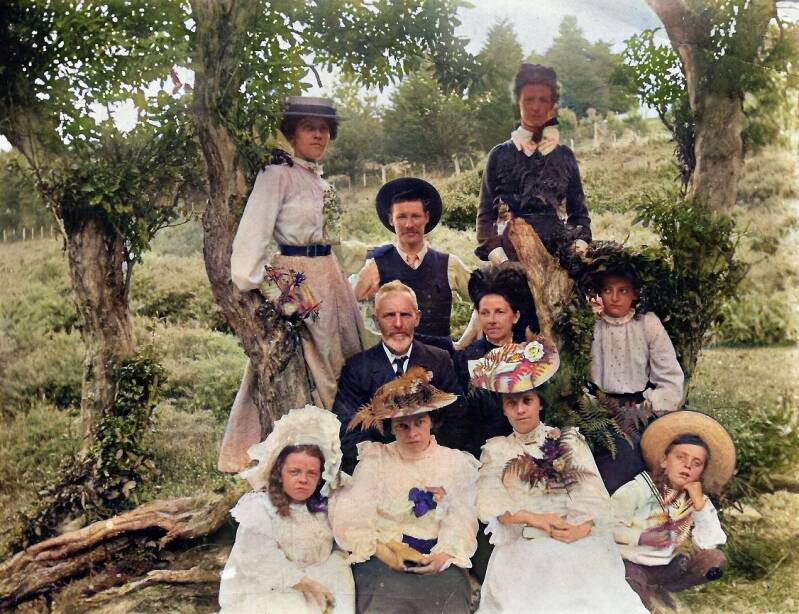
Thomas Sims (born Watson), Edith Robertson and family. Estimated to have been taken in 1903
Mary Ann Walker.
The surname Walker is of English and Germanic origin, derived from the Middle English term 'walkere', which refers to a fuller of cloth. Fullers were textile workers who walked on damp raw cloth in order to thicken it, a process known as 'walking' or 'fulling'. The name was occupational for someone who performed this task, which was an important step in cloth making during medieval times. As such, the surname Walker became associated with individuals or families engaged in this trade.
Mary Ann Walker was born on February 2, 1812, in Edith Weston, Rutland, England. Her father, Richard Walker, a farm labourer, was born in 1791 in Edith Weston, Rutland, England, and her mother, Mary Carter, a dress maker, was born in 1790 in Halaton, Leicestershire, England. Mary Ann had five siblings: Edward, Elizabeth, Ann, Joseph, and Mary.
At the time of her birth Britain was embroiled in the Napoleonic Wars. The industrial revolution was transforming the British landscape and society, with technological advancements beginning to reshape urban areas and trade. Mary Ann's early life, and her father’s employment as an agricultural labourer, would have been marked by the agricultural rhythms of rural England. However, the Enclosure Acts were consolidating and redefining land ownership and usage across the countryside, impacting the Walkers' livelihoods and contributing to rural depopulation as people moved to cities seeking work in new factories. A Bonnet Maker by profession, it was one of the few socially acceptable professions for women at the time, which capitalized on the era's fashion trends.
She married David Robertson at Shoreditch, London, on 30th June 1847. David had lost his previous wife the previous year and had three children. The Robertsons' immigration to Wellington, New Zealand, in May 1857 coincided with a significant period of colonization and settlement encouraged by the New Zealand Company. They joined many Britons seeking better economic prospects and were part of the wider 19th-century trend of European global emigration. Mary Ann Robertson lived to see the turn of the century, passing away in 1906 at age 94. Her lifetime spanned monumental changes from the agrarian society of her youth to an industrialized world. She died in a Wellington that had grown from colonial outpost to a bustling centre of commerce and governance within the British Empire.
The surnames of Sims and Heyhoe are not that common in New Zealand, so when they cropped up in the course of tracing the family tree, I had to check them out. But as can be seen here, it would be wrong to automatically assume that there was a connection.
John Sims.
John Sims (sometimes spelt Symes) was probably born in Wells, Somersetshire, England, in June 1807, although it appears quite a common English name and he may have been the John Sims born in St Margarets, Leicestershire, England, in 1813.
Whatever his parentage, he arrived in New South Wales, Australia in 1829 on board the ship Victoria – as a convict. On the 24th of December 1845 he married Isabella Emerson in Ryde, New South Wales. Isabella had emigrated from Ireland via an assisted passage at the age of 25, arriving on the 12th of February 1842 on the ship Champion, perhaps after the death of her mother.
Later with a small daughter Eleanor, they travelled overland to Melbourne, Victoria, in a tilted dray (a dray with a cover over - a tilt) something of a luxury in those days. Eleanor heard stories of them keeping a fire burning all night for fear of hostile aborigines.
After raising a family of 3 girls and 3 boys in Melbourne, Isabella died on the 12th of March 1866, and John died on the 8th of August 1879, in Carlton, Victoria.
John Emerson Sims.
John Emerson Sims was the second child born to John and Isabella Sims, and the oldest son. According to the family bible, he was born in a house in Swanston Street, Melbourne, Victoria. opposite the site of the old Melbourne Hospital. He told of catching grasshoppers on that land, and of standing on a stump watching Burke and Wills start off on their ill-fated expedition, of sailing a box boat down Elizabeth St., and of seeing chinamen with long pigtails heading for the diggings.
When he was small, he was kidnapped, and the town crier paraded the streets looking for him. He was eventually found in the arms of a man in the pig market, then in the centre of the city, dressed as a girl.
At 16 he began as a teacher at Brighton Park school. Soon afterwards transferring to the Education Department, teaching at many schools in the city and country.
On December 31st, 1875, John Emerson Sims married 25-year-old Eliza Jane Robina Heyhoe, at Castlemaine, Victoria, Australia. Eliza (known as Lidy) had been born in Swaffham, Norfolk, England on June 21st, 1850, and at the age of 17 had emigrated to Australia as a servant, arriving in Melbourne in December 1867.
Together the couple raised nine children, including five boys, ensuring that, along with John’s brothers, the Sims name flourished in Australia.
John Frederick Wilson Heyhoe.
John Frederick Wilson Heyhoe was the younger brother of Eliza Jane Robina Heyhoe, the third child of the family. He was born in Bluetown, Sheerness, Isle of Sheppey, Kent, England on April 8th, 1855. In 1867, a year after his mother had died, he emigrated to Australia, arriving in Victoria on board the ship Canterbury in December. A month later, in January 1868, he immigrated to New Zealand, traveling on board the ship Alhambra.
John probably settled in the Nelson area, as he married a local Nelson girl, Jane Frances Robertson in 1881. She had been born in Nelson on July 1st, 1859, to one of the original Scottish settler families, James and Emma Robertson. The following year their first child, Frederick John was born, followed in 1886 by a daughter, Edith Francis, and finally another son Allan James in 1890.
The extended family moved to the Wairarapa, where Jane died at Masterton in 1930 and John in 1943. Both are buried in the Archer Street cemetery, Masterton.
Allan James Heyhoe.
Allan was born on April 7th, 1890, in Blenheim. He was a butcher by trade and was wounded in the First World War on the 24th of October 1917, while serving in the 3rd Battalion, Wellington Infantry Regiment. In 1928 he married Helena Willis Sims (in Wellington?)
They had one daughter, Nancy Helena Heyhoe. Allan died in Masterton on December 15th, 1973, and is buried there with Helena and Nancy at the Archer Street cemetery.
Helena Willis Sims.
Helena was my great Aunt. She was born in Wellington on August 30th, 1890, and died at Masterton on March 23rd, 1958.
The irony of this coincidental connection between the names Sims and Heyhoe is that her Grandfather was born Thomas Watson, and somewhere around 1865 the whole family changed their names from Watson to Sims whilst living in Napier. In fact, Thomas became known (and is buried as) John Sims. Helena’s father was also named Thomas, born Thomas Watson and subsequently known as Thomas Sims.
Why the whole family changed their names from Watson to Sims remains a mystery. Why Thomas chose the name Sims is also unknown, although there is some suggestion that it was after a sea captain of that name. There is also no known connection between the Watson/Sims families and the Heyhoe/Sims families before Helena met and married Allan.
13 September 2024
Here is a branch of the Sims family tree that I was unaware of before embarking on this project of mapping it out, even though it relates to an aunt I knew well. Like so many of our families’ colonial stories, it provides another snapshot into the lives of those who emigrated from England and settled in New Zealand.
Charles Blomfield was born in London, England, on 5 January 1848 to William Blomfield, a cutler, and his wife Elizabeth Emily Hickman. The Blomfield family was a large one, with Charles being the seventh of nine children. Charles's father died in 1857 leaving Elizabeth a young widow with eight children (the eldest son, William, had died in 1856). She managed for five years, but in 1862 decided to emigrate to New Zealand with the Albertland settlement association which hoped to start a nonconformist community there.
The Albertlanders were a group of about 3000 English immigrants who sailed to New Zealand between 1862 and 1865 with the intention of establishing Albertland, a nonconformist religious settlement on the Kaipara Harbour at Port Albert. They were named after Queen Victoria's consort Prince Albert. We will hear of the Albertlanders again later in this section.
Elizabeth’s second son, Samuel, married by this time with two small children, agreed to bring his own family as well, but the two eldest daughters preferred to remain in London. The Bloomfield’s sailed in the Gertrude, leaving London on November 4th, 1862. They arrived on 9 February 1863 in Auckland where they decided not to proceed to Northland to become farmers, but to pursue urban trades in Auckland. This proved a fortuitous decision as Port Albert on the Kaipara harbour proved to be too isolated from the main centre of settlers in Auckland to be effective commercially. Compounding their isolation was their port situated on the dangerous west coast making coastal traffic difficult at a time when road and rail links were not yet established. Their consequent isolation and the poor quality of the soil contributed to the failure of Port Albert to become a major city as first envisioned.
Settling in Auckland, Elizabeth worked as a midwife, Samuel found work in the building industry, and Charles was employed by a house painter and was taught paint mixing, wood graining and other decorative skills. He was later to set up a business specialising in decorative artwork. Samual built a house at 40 Wood Street in Freeman's Bay, allegedly made out of the timber from one large kauri tree.
By 1867 economic depression and unemployment had come to Auckland. Following the discovery of gold at Thames, Samuel took his family to live there; he soon found employment building houses for the hundreds of people who joined the goldrush. Charles Blomfield, with two of his friends, was among the gold-seekers, but their claim was very poor and after weeks of hard work they had only a meagre amount to show for their efforts.
Charles Blomfield was strongly attracted by the native bush and began to paint pictures of the scenery. Although he had no previous training, he found he had a natural talent and soon mastered the art. From then on, he painted wherever he went. Working in oils, he painted his subject directly rather than recreating it in the studio from sketches. He maintained studios in shops at various times, usually on Karangahape Road, one of which was shared with his daughter who made a living painting floral pieces which she also exhibited at the Auckland Society of Arts.
After his return to Auckland Blomfield fell in love with Ellen Sarah Wild, whom he had met at the Baptist chapel in Wellesley Street. Ellen’s story has a remarkable parallel to Elizabeth Bloomfield’s. Born in Portsmouth, Hampshire, England in 1852, the eldest girl of Alfred Wild and Sarah Lamb, the family sailed out to New Zealand then she was just ten years old. She never forgot the long sea voyage, and could tell fascinating details of life at sea, and in the old home in Portsmouth, and the new home in Auckland.
Soon after they landed in New Zealand another little sister (Anne) was born, and then tragedy struck. Her mother died, and the young Anne, fretting and pinning, did not live long after her. So, Ellen became the little mother of the growing family when she was only eleven years old, cooking, sewing, and cleaning house, with playtime only when her work was done. Bubbling over with fun, healthy and busy, she grew up in a little wooden house in Franklin Road. Upstairs, level with the street, was her father’s shop, where he made and mended shoes. He was a snob, a real snob, as a snob was what a shoemaker was called back in those days.
Among her fathers’ customers one young man, Charles Blomfield, often came to call – on business of course! Ellen knew him well; they had been to Sunday school together. Charles was tall, dark, and handsome, artistic, devoted to music and a lover of nature. They were married at Auckland on 30 January 1874 and set up their home in Ponsonby, near Elizabeth Blomfield's house. In 1879 they bought a section in Wood Street, Ponsonby, for £169; their house was built in time for their third daughter to be born there – they were to have seven children in all. 40 Wood Street, Ponsonby was a happy home, two storied and roomy, with sunny balconies and a lovely view over bush-covered slopes to the harbour. Charles and Ellen Blomfield were both interested in their church work and helped Thomas Spurgeon to build the Auckland Baptist Tabernacle; Charles painted a text behind the pulpit.
Charles Blomfield travelled extensively throughout New Zealand on painting expeditions. He used all types of transport, including stagecoach, packet steamer, train, and rowing boats. He stayed with friends, in boarding houses and sometimes rented cottages. He often walked great distances, camping in the bush, or sleeping in the porch of a Māori chief's whare. He carried all his camping and painting gear and basic foodstuffs, consisting mainly of flour, porridge, bread, and tinned meat, but also learned to catch fish, eels, rabbits and hares to supplement his meals. Blomfield frequently travelled alone but sometimes took a friend and (later) one of his children with him. While Charles was away Ellen had to look after the household and bring up the children on her own.
On 31 December 1875, during one of his camping trips, Blomfield reached Lake Rotomahana and saw the Pink and White Terraces, which he found 'exceedingly beautiful and graceful'. He managed to paint a few pictures without being caught by the Māori, who objected to people finding their own way to the terraces; they would demand £5 for any drawing or photograph, or destroy any sketches made. Some years later Blomfield decided to return to the area, and in 1884 he arranged through a friend, Charles Haszard, to pay a lump sum so that he was allowed to stay as long as he pleased. Accompanied by his eight-year-old daughter, he camped and painted for six weeks, taking home many different aspects of the terraces.
Early on the morning of 10 June 1886, the night their first son Thomas was born, Mt Tarawera erupted, destroying or submerging the terraces. Blomfield was heartbroken and decided to see the devastation for himself. He returned to the area in October and painted several scenes of the terrible destruction. Realising that the paintings he had made of the terraces were a valuable record, he refused to sell them, and made many scale copies for sale instead. The prices for these soon trebled in value. His meticulous sketches and finished paintings are some of the main records of them and have helped establish their current location. For the remainder of his life, he was probably able to rely on new versions of his classic views of them to supplement his income.
Blomfield continued to travel throughout New Zealand painting pictures of mountains, rivers, lakes, and cloud effects, but his greatest love remained the native bush, of which he wrote enthusiastically in his diary. He had received some musical tuition on the voyage from England and supported himself by working as a music teacher and singing inspector in schools, as well as by the sale of paintings. He was a frequent exhibitor with the Auckland Society of Artists from 1873 to 1877 and the Auckland Society of Arts from 1881. He also exhibited at the New Zealand Industrial Exhibitions in Wellington in 1885 and 1889, the New Zealand and South Seas Exhibition in Dunedin in 1889–90, the Melbourne International Exhibition in 1880–81, and the New Zealand International Exhibition in Christchurch in 1906–7. He was represented at the National Centennial Exhibition of New Zealand Art in 1940.
However, he was unable to come to terms with developments in art and remained staunchly conservative and hostile to 'modern art'. In his later years he found himself increasingly sidelined by the artistic circles in Auckland, which he had previously shone in, and was probably embittered by this.
Blomfield was an elder of the Baptist Church and partly responsible for the construction of the Auckland Baptist Tabernacle on the city's main thoroughfare, Queen Street, which when it opened in 1886 was the largest building in the city and also contained the largest room. The ceiling of the auditorium of the Tabernacle is decorated with stencil work carried out by Charles and his brother Samuel. Another brother, William, was a noted newspaper cartoonist.
Blomfield died at his residence in Wood Street in 1926, survived by several children. He was buried at Hillsborough Cemetery. Ellen lived out her long and fruitful life at Wood Street, ‘Aunt Ellen’ to a wide circle of relatives, and ‘Grandma Blom’ to a host of her own grandchildren and great-grandchildren, even to the third and fourth generation, until she died in 1945, at the age of 92.
His paintings are widely regarded as the epitome of 19th century New Zealand landscape art, although his work, like many of his contemporaries, fell out of fashion during the 20th century, only to be re-evaluated in the 1970s. Their daughter, Elizabeth, who had been taught by her father, exhibited as Bessie Blomfield until 1908; following her marriage, she exhibited as Bessie Kendon. She died in 1984 aged 104.
The Family Connections.
William Blomfield (1810 – 1857) and Elizabeth Hickman (1814 – 1911) had nine children. Charles Blomfield (1848 – 1926) was the seventh child, and the nineth was Frederick William Blomfield, born in St Giles, London Borough of Camden, Greater London, England in 1857. In 1884 he married Sarah Rose Cutler, in Auckland, New Zealand. We know nothing about Sarah Rose, other than she was born in London, England in 1862.
Frederick and Sarah Rose had seven children, five daughters and two sons. The first of those sons was Laurence Frederick Blomfield, born in Auckland on November 24th, 1895. In 1920, at the age of 25, he married Mary Edith (Mollie) Alexander, who had been born in Liverpool, England on September 22nd, 1894. Together, they had a son, Gerald Laurence Blomfield, born in Auckland on January 13th, 1921; and a daughter, Barbara Edith Blomfield, born in Ponsonby, Auckland on September 17th, 1922.
Barbara’s spouse was Trevor Herbert Sims, my father’s brother.
Charles Blomfield
The Pink Terraces
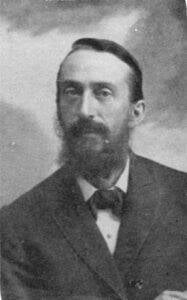
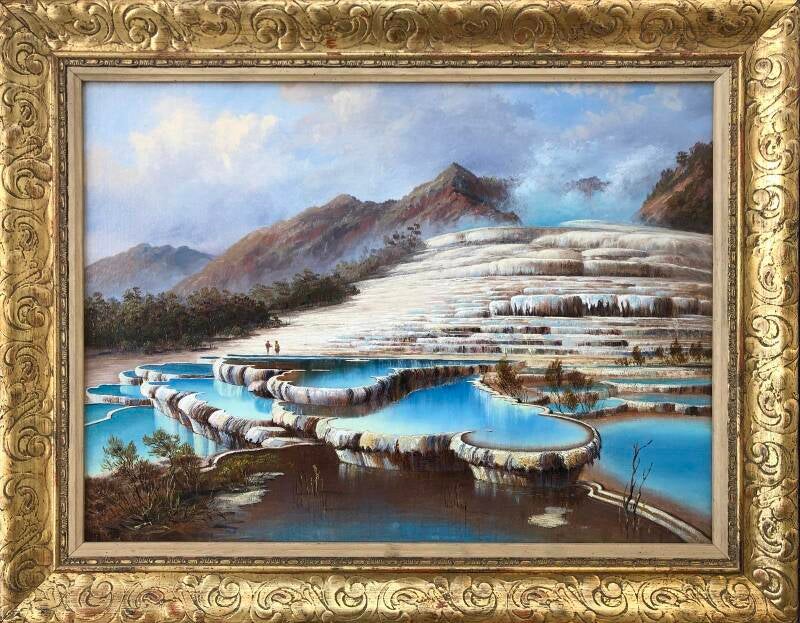
Forgive the fanciful heading, but it was the name of a stage production I was involved in as a schoolboy (I still have an old 78 recording of it somewhere), and it seems fitting to what has turned out to be a quintessential colonial story.
My family tree is large, with many branches. Most delve into families and areas to which my relationship is tenuous, to say the least. Likewise, there are over six and a half thousand people around the world (that I know of) with whom I share snippets of my DNA. I have no idea who most of them are, or how we could possibly be related. But very occasionally the two things come together, and even more rarely, they produce a good story. Here is one of those occasions.
It began with the online database throwing up a connection I was unaware of between myself and the grandchild of a third cousin. With 0.5% shared DNA and a New Zealand location, it was worth looking at further. It turned out to be the descendant of my great grandmother’s sister, Annie Rudman (born Robertson), who was the daughter of David Robertson and Ann Walker. I have written about David Robertson and his family above (another great colonial story).
Annie Robertson was born on 23 March 1844 at Bedwell Park near Essendon, Hertfordshire, England, the second daughter of David Robertson and his wife, Ann. Of Scottish parentage, David Robertson studied briefly for the ministry before turning to horticulture and working as a gardener on a number of estates in England. Bedwell Park was the home of Sir Culling Eardley Eardley, a religious philanthropist, friend of Dr David Livingstone and founder of the Evangelical Alliance, which was designed to promote religious freedom throughout the world. It would have been a congenial position for Robertson, whose surviving letters and gardening diary show a thoughtful man, God-fearing and committed to total abstinence but not without wit. Ann Robertson died on 24 August 1846, a few months after the birth of a son; 10 days later the baby died. The following year David married Mary Walker. There were seven children of this marriage, the two youngest being born in Wellington, New Zealand.
The Robertson family arrived in Wellington in May 1857 on the Alma. Three months later David Robertson was appointed sexton at the Wellington public cemetery in Sydney Street, a position he held for 30 years. The growing family lived in a small cottage in the cemetery. David's botanical knowledge brought him into contact with Sir George Grey and, later, Sir William Jervois.
Annie Robertson was married by the Wesleyan minister at Wellington on 25 January 1865 to Henry Rudman, a tanner, described by a granddaughter as a jack of all trades; they were to have four sons and three daughters. In 1866 Annie's sister, Mary Jane, married William Henry Beaglehole, a brickmaker and lay preacher at the Primitive Methodist chapel in Webb Street; one of their grandsons was J. C. Beaglehole, the historian.
Annie Rudman inherited her father's religious beliefs and social concerns. When the Salvation Army held its first meeting in Wellington on 17 June 1883, she was one of the first converts, and she became the first soldier on the roll of the Army's Wellington corps. A stout, motherly woman, always meticulous about wearing her uniform, she is said to have revelled in the open-air meetings and to have excelled at recruiting others. Annie Rudman and another woman soldier, Mary Hawker, were given the task of caring for women converts. During the depression of the 1880s they are said to have pioneered the Army's social work by opening their own homes to reformed prostitutes, the women sometimes occupying the empty beds of Mr Rudman and Mr Hawker while they were away on shift work. In addition, the assistance they gave to unmarried expectant mothers led the Army to establish its hospitals for this purpose. In her last years, still in uniform, Annie was driven to the citadel for Sunday morning services in the sidecar of a motorcycle. She died, at 84, on 15 August 1928, at the home of one of her daughters. Henry had died in 1916. Annie Rudman was survived by her seven children, all of whom followed her into the Salvation Army. In 1964 the Salvation Army renamed its young men's hostel (later demolished) in Vivian Street, Rudman House.
Annie Rudman (Center) with daughters Eva (Cowdrey) and Alice Annie Maud (Horn)
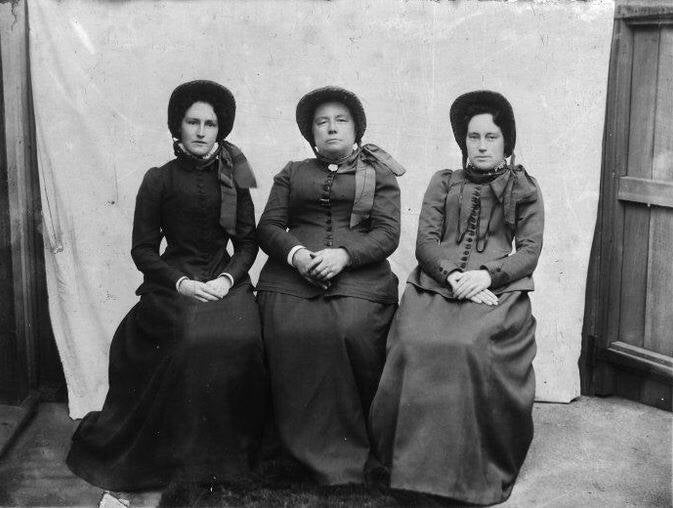
Annie’s daughter Alice Annie Maud Rudman was born in Wellington on August 2nd, 1872. Like her mother, she was heavily involved with Salvation Army work. She married William Hutcheson Horn in 1892 in her hometown. They had seven children in 26 years. She died on 19 May 1942 in Wellington at the age of 69.
Alice and William’s only son, Horace Victor Clarence (Billy) Horn was born on August 30th, 1896, in Featherston. An electrician and later a mechanic by trade, he married Vera Shona Hopwood Hall in Christchurch on September 7th, 1918. Vera had been born in Keighley, Yorkshire, England on March 30th, 1898. They had one son, William Pannett Bruce Horn, who was born in Methven on November 21st, 1919, and one daughter, Rosalie Veronica Horn who was born on January 22nd, 1921, also in Methven. Billy died on September 15th, 1920, at the age of 24, and Vera remarried to Ernest Claud Keenan in 1922, having another 3 sons and a daughter before dying in 1933 at the age of 34.
William Pannett Bruce (Bruce) Horn married Kiri Ngori (Kitty) Tikena in Hamilton on March 4th, 1961, when he was 41 years old, and after all of this, it is actually Kitty’s family that makes this whole chapter more noteworthy and interesting.
Bruce Horn
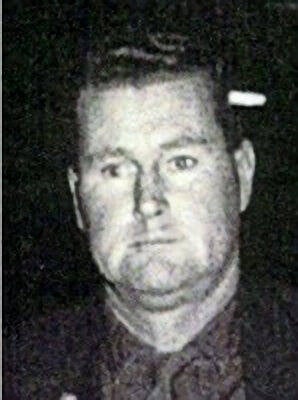
Kitty Tikena
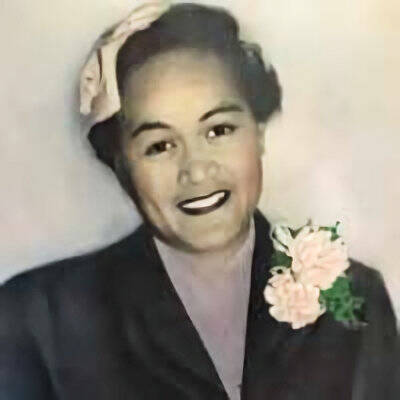
Now Kitty was born in Pakotai, just north of Whangarei, North Island, New Zealand on September 27th, 1922, to Martini Wiremu (Martin) Tikena and Te Mamae Apimaira Rapana (Lucy) Tikena Martin (born Tahukauri). She had divorced her previous husband Tarewau Taniora, before marrying Bruce. Both of her parents came from Mangakahia, which is a river valley in Pakotai, associated with the Te Tārai o Rāhiri marae and the hapū Ngāti Toki and Ngāti Horahia, who form part of Ngāpuhi. The marae takes its name from the local maunga of Te Tārai o Rāhiri.
Martini’s father was Wiremu Tikena Heke (1886 – 1939), also of Pakotai, and his mother was Heeni Riria Heke (born Kingi), born at Poroti, Whangarei, Northland, New Zealand in 1883. Her parents were Hemi Tonoriri Hoori Kingi Whareumu, born at Motatau, Northland in 1856, and Ngaro Akinihi Paipa Iwingaro Kingi Whareumu (born Paraone).
Heeni’s mother (1858 – 1936) immediately attracted my attention because she was born in Te Kopuru, Dargaville, Kaipara, Northland, New Zealand. Now Te Kopuru, just down the Wairoa river from Dargaville, is not a big place but it does have one claim to fame. It is where my wife Sharon was born. Who said that it wasn’t a small world?
Ngaro Paraone’s father was Hone Taura Parāone Kawiti (1833 – 1889) from Waiomio, Kawakawa, Bay of Islands, in Northland and her mother was Riria Heeni Reria Parāone Kawiti (born Shortland). Riria was born in 1837 at Moerewa, Far North District, Northland, New Zealand, and herein lies a tale. Her mother was Tuwahine Waeekamania Shortland (born Kawiti), born in Waiomio, Kawakawa, in Northland somewhere around 1811, and her father was Lieutenant Commander Willoughby Shortland, RN.
Lieutenant Commander Willoughby Shortland. RN.
Willoughby Shortland was born in Courtlands, Plymouth, Devonshire, England on 30th September 1804. He was educated at the Royal Navel College and entered service on 9th January 1818. Gazetted a Lieutenant in August 1828, he served in the Galatea, 42 guns, and in the following year in the Ranger, 28 guns on the Jamaca Station. On 21st March 1831 he took command of the Skipjack, a schooner of 5 guns and remained in the West Indies until June 1833. In 1839 he accompanied Captain William Hobson, the first governor of New Zealand, which had not at that stage been annexed by England. Landing at Auckland on 29th January 1840 the British sovereignty was proclaimed, and Lieutenant Shortland appointed colonial secretary.
He proceeded to Port Nicholson, Wellington and the English living there very willingly acknowledged Queen Victoria’s authority and Shortland’s nomination as their police magistrate. On the death of Captain Hobson on September 10th, 1842, Shortland administered the government of New Zealand until the arrival of Captain Robert Fitzroy on 31st December 1843. During Shortland’s temporary government the massacre of the white men by the Māori took place at Wairau on June 17th, 1843, and in his dispatches to the home government he expressed his disapproval of the conduct of the settlers, to which he attributed the massacre. This action made him unpopular and when a report of his nomination as governor of New Zealand was circulated, a petition was sent from Auckland praying that he might not be appointed.
There is a great deal of uncertainty and mystery surrounding Shortland’s liaison with Tuwahine Waeekamania Shortland, and the birth of Riria and Hohaia Pehiriri Shortland. It isn’t mentioned in any official record of his life that I have found, but perhaps that isn’t surprising given the times and his situation. But there are lots of people (mainly Māori) on two of the world’s largest genealogy databases that are quite adamant about it. And given the importance of Whakapapa to the culture, I know who I am inclined to believe.
On the 19th of April 1842 Willoughby Shortland married Isabella Kate Johnstone in Auckland. He resigned the colonial secretaryship on 31st December 1843 and in 1845 became President of the Island of Nevis in the Leeward Islands. He later became governor of Tobago from 1854 to 1856, before returning to England and his residence at Courtlands, Charlton, Kingsbridge, Devonshire until has death on October 7th, 1869. But on the other side of the world, the consequences of his stay in New Zealand still seem to reverberate through family trees like mine.
Information
Ngaro Akinihi Paipa Iwingaro Kingi Whareumu (born Paraone)
Riria Heeni Reria Parāone Kawiti (born Shortland)
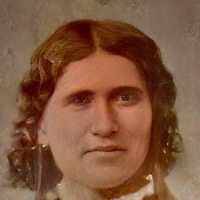
My paternal grandmother was Ethel Jackson Scott, born in Dunedin on 10th March 1886 to George Scott and Thirza Harriett Havill. She died in Wellington on the 14th of December 1961. Her parents came from Great Britain. George Scott was born in Cameron, Fife, Scotland on 10 Dec 1857, to James Scott and Agnes Bremmer. He died in Wellington on the 27th of September 1932. Thirza was born in Torquay St John, Devon, England on 27 Jan 1862 to William Havill and Thirza Chilcott. She died in Wellington on 1st December 1927.
Ethel was one of four daughters and five sons born to George and Thirza, so the Scott family gets pretty large and diverse pretty quickly. And that means that the chances of finding some interesting family stories is also pretty high.
So, we only have to go back to my great grandfather in the Scott family tree to find them emigrating from England to New Zealand. It is a familiar and reoccurring story, particularly from my Scottish ancestors, and especially those from Glasgow, for reasons I have already described.
Ethyl moved up from Dunedin to Wellington with her family sometime between 1905 and 1910, probably earlier in that period rather than later, as she married my grandfather in Wellington on the 23rd of March 1910. I have no idea where her middle name of Jackson came from, as it doesn’t seem to occur elsewhere in the family.
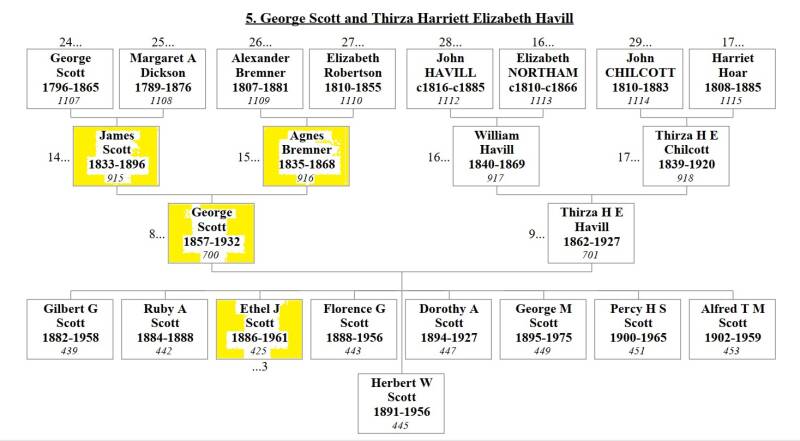
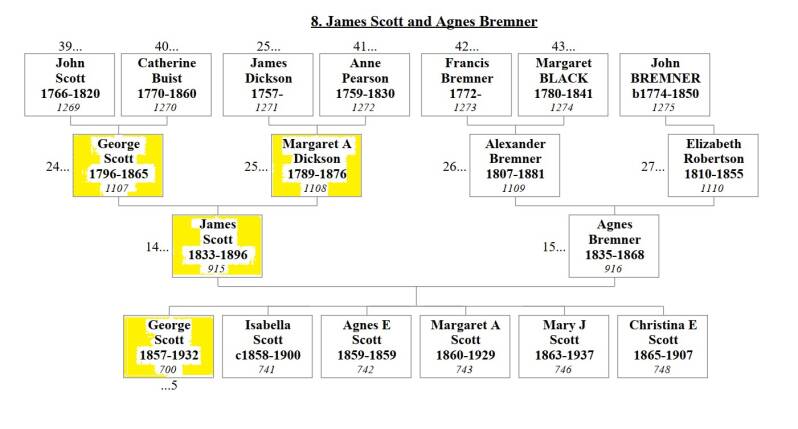
Of Ethel’s siblings, I know the following:
Gilbert George (Bert) Scott was born in Dunedin on August 19th, 1882. After the family moved to Wellington he met and married Marion (May) Fear on 24th December 1903. They had two children.
Leslie George Scott (26/9/1904 – 19/10/1983) was born in Auckland, and married Margaret Catherine Bradley in 1903. They lived at 14 Guthrie Avenue, Lower Hutt where he worked as a colour-matcher. Margaret died in 1978, and Leslie died in Palmerston North in 1983.
Thirza Marion Emma (Dolly) Scott (11/7/1906 – 16/8/1983) was born in Wellington and married Norman Arthur Mills, a storeman in Wellington, in 1932. They had one son, Ian Arthur Mills who was born in Wellington in 1933, and was a Minister of Religion, and died in Palmerston North on March 5th, 2020. Thirza died in Porirua, Wellington, New Zealand, 20 years after her husband.
It appears that Gilbert and May must have separated, as although May lived until 1973, Gilbert remarried to Gwendoline Edith Findlay from Pahiatua in 1926.
Ruby Agnes Scott was born in Dunedin in January 1884 and died there on 21st February 1888 at 4 years old.
Florence Gertrude Scott (13/5/1888 – 4/10/1956) was born in Dunedin and met and married Albert William Baker in Wellington in 1911. They had four daughters and a son before Florence died and was buried in Thames, Coromandel with Albert dying the following year (8/7/1957) in Rotorua. Of their children.
- Florence Thirza Baker (12/2/1912 - 1993) was born in Wellington, married Frederick Henry Barrell in 1932 and they lived in Lower Hutt where he was a furrier, and where she presumably died in 1993
- Margaret Muriel Baker (24/1/1914 – 2002) was born in Wellington and married Frank Herbert Stevenson in 1938. Frank was born in Chorlton, Lancashire, England, in 1913 and was a transport-driver living in Newtown. Margaret died in Tauranga in 2002 and Frank 2 years later.
- Maxwell Earl Baker was born in Wellington in July 1915 and unfortunately only lived until September of that year.
- Iris Coral Baker was born in Wellington in October 1916 and died in Feilding, Manawatu on 30th May 1922 at the age of 5.
- Kathleen Edith Baker was born in Wellington on November 8th, 1921, and died there on September 14th, 2018.
Herbert William Scott (26/4/1891 – 2/3/1956) was born in Dunedin and after the family moved to Wellington he met and married Hilda Muriel Wilton on June 7th, 1916, at the St James Church, Adelaide Rd, Wellington, New Zealand. They lived at 30 Waterloo Road, Lower Hutt and had four sons. He is listed as a clerk. Of their children:
- Basil Herbert Scott was born January 7th, 1918, in Lower Hutt. We find him as a Corporal in the 2NZEF in 1943 during WWII, and presumably he was posted overseas as after the war, in January 1946 he married Jeane Elizabeth Wainwright in Thanet, Kent, England. They returned to New Zealand where he worked as a Chief Clerk and died on the 9th of December, 1982 of complications with diabetes. Jeane died on July 13th, 2000, and they are buried in the Taita Cemetery, Naenae, Wellington,
- Hugh Alan Scott was born in Wellington on the 19th of December 1921 and died in Christchurch on the 5th of April 2014. I know nothing of what happened in between.
- Stuart Wilton Scott was born in Wellington on October 11th, 1924. He married Ulna Joyce Flyger on September 30th, 1950, and they lived in Auckland where they had two sons, Warren and Ralph. Ulna’s sister was Thea Dale Flyger, who married Robert David Muldoon, GCMG CH PC, a Prime Minister of New Zealand. Ulna died on March 21st, 2004, and Stuart died on 21 December 2018. Both are buried in North Shore Memorial Park (Schnapper Rock), Auckland.
- Malcolm George Scott was born in Lower Hutt, Wellington on June 22nd, 1926. The NZ WWII Ballot Lists have him described as a sawmill employee in Burnham in 1945. In 1950 he married Hughla May Hurley in Wellington. (We will hear more about the experiences of Hughla and her family a little bit later.) They moved to Palmerston North and then to Whanganui, where Malcolm worked as a Travel Agent. Hughla died in Whanganui on December 22nd, 2010, and Malcolm died there of heart failure at the New Vista Rest Home on the 19th of September 2015.
Before we leave Herbert and Hilda, it is worth mentioning that you could quite literally write a book about their family trees (which I may well attempt in a later volume). Apart from what has already been mentioned, and what follows later, Muriel Wilton’s family is also particularly interesting. Her grandparents, Elijah Wilton and Pricilla Ann (born Curtis) emigrated from England aboard the barque Oriental, leaving Plymouth on June 22nd, 1841, and arrived in New Plymouth on the 7th of November 1841. I have traced Pricilla’s line back 19 generations and appear to have arrived at Katherine (Catharina) Tendring (born Milde) who was born at Clare, Suffolk, England in 1345, and who died on June18th 1403 at Tendring Hall, Stoke-by-Nayland, Suffolk, England. Katherine Tendring was the grandmother of two English Queens, Anne Boleyn and Katherine Howard.
Dorothy Agnes "Dolly" Scott, according to the only official record I can find, was born in Dunedin in March 1894. It is a bit tricky as there appear to be two Dorothy Agnes Scott’s with different parents in the database records. She married Cecil George McNab, a plumber from Featherston on the 16th of December 1924 in Wellington when she was 30 years old. They had two daughters, Maureen Thelma born March 22nd, 1925, and Patricia Marion, born 17th September 1927. Tragically, Dorothy died three months after Patricia was born on the 15th of December 1927 in Masterton. Cecil remarried to Molly Irene O’Donnell in Masterton in 1931, and they went on to have two daughters and a son before he died on the 20th of December 1973 in Hospital, Auckland. Of Dorothy’s daughters
- Maureen Thelma McNab married William James (Bill) Emett, a dairy farm worker from Paeroa in Te Aroha, Hauraki, New Zealand on the 21st of May 1945. They had three sons and two daughters before Bill died in Paeroa on 29th of January 1990 and Maureen died in Auckland on December 2nd, 2000.
- Patricia Marion McNab married Claude Bertelsen from Cambridge and died in July 2002.
George Mackay Scott was born in Wellington on December 28th, 1895. He enlisted in the NZ Rifle Brigade 31 May 1915 embarking from Wellington with the 2nd Battalion on 9 October 1915 and serving with the Brigade in Egypt and in France in 1916 and 1917. On 18 June 1916 he was admitted to a Casualty Clearing Station near the front line and from 24 July 1917 George was at the New Zealand Convalescent Depot at Torquay, England. On 1 February 1918 he embarked for New Zealand classified as 'Permanently Unfit' and was discharged from the NZEF on 15 April 1918 as 'No longer fit for War Service. His Ranks were: Sergeant Major, 2nd Lieutenant (1 January 1941) and posted to the 2nd Battalion, Temporary Lieutenant (1 November 1941) Infantry, Temporary Captain (1 July 1943) and posted to 2nd Field Company, Corps of NZ Engineers as Acting Adjutant and Accounting Officer on 1 April 1944. He was posted to the Reserve of Officers List on 7 March 1951 with the rank of Captain.
Returning to civilian life, George married Emma Kate Gapper in Wellington on April 5th, 1920, and therein lies another tale, as the Gappers have a fascinating family history that I will set out further on. They had a daughter, Norine Margaret Scott, who was always known as Billie, born on the 30th of October 1920. For a while they were living in Sumner, Christchurch but moved back to Raumati, north of Wellington where George worked as Sales Manager for the Vacuum Oil Company (later to become the Atlantic Oil Company) in Wellington, He also became the foundation secretary for the Atlantic Silver Ploughing Association, a position he held for several years.
George died in Levin on 14 November 1975 of stomach cancer after a short nine-week illness. Emma died 14 November 1984, in Palmerston North hospital following complications with an appendix operation.
- Norine Margaret (Billie) Scott was the only child of George Mackay Scott and Emma (Nemmie) Kate Scott (nee Gapper). She was born on October 30th, 1920, in Eltham, Taranaki, New Zealand. In 1941 she met Donald Victor Gordon at an ANA Club (an Army-Navy-Air Force Club for soldiers on leave) in Wellington. He and a friend were on leave from Trentham Military Camp. They became engaged about Christmas 1941. Donald was posted overseas in April 1942 and returned to NZ August 1945. They were married October 30, 1945 – her birthday. Donald then worked at Rukuhia Soil Research Station, Hamilton, and they lived in the offices attached to a vegetable packing shed, and then in a farm cottage. Then he accepted a position at ICINZ as an Agricultural Advisor to the company, but they could not move to Wellington until their son Roger was born in Hamilton on September 30, 1946. They then drove to Wellington when Roger was three weeks old, in a Morris 8, through a snowstorm on the Desert Road. A relief to get to Waiouru! They stayed a month in a guest house at the company’s expense, during which time Roger developed Chicken Pox. Then they rented a company house in Wadestown. In 1947 they brought a house in Karori – 11 Jack Street, later to be called Fernlea Avenue. It was from there that Brian, Patricia, Graeme and Denise were born at Wellington Hospital. During her pregnancy with Graeme a mole on her right calf enlarged. Her doctor said it would subside when the baby was born. From maternity Bille was transferred to surgical for removal of the growth, a four-hour operation. This was followed by repeated minor surgery and one major one. Gradually they mentioned Malignant Melanoma, and that the situation was serious. Eventually her condition deteriorated, and she was admitted to Wellington Hospital. After a few days she lapsed into a coma and, after a couple of days, the hospital phoned to say that she had died peacefully. She was cremated at Karori Crematorium. Two of their sons, Brian and Graham, have been most helpful in supplying information on their family. Unfortunately, most of it is kept off-line. Brian was a livestock officer in MAF in the Waikato while I was also working for MAF in Palmerston North. We actually worked on the same biosecurity responses, unbeknownst to each other.
Percy Henry Sainsbury Scott was born in Wellington in April 1900. He married Kathlyn Celia (Kate) Hoare on 24th December 1921. Percy died on the 16th of May 1965 at Thames, Thames-Coromandel District, Waikato, and Kate died there on 22nd of May 1967. They had four sons while living in Wellington
- Desmond Francis Scott was born November 13th, 1922, and died 9th July 1943 when he was lost Without Trace During A Mine Laying Sortie to the Artichokes Area off Lorient during WWII. His is such a poignant story of innocence followed by wartime tragedy that I will reproduce it below.
- Keith Thomas Scott, who was born in Wellington on January 10th, 1925. He moved to Auckland where in 1946 he was working as a barman at the Grand Hotel, Helensville. He married Margaret Veronica (Peggy) Parry from Auckland, and they had one son, John Desmond Scott (1951 – 1999) and both died in Auckland, Peggy on September 3rd, 1992, and Keith on November 29th, 2001.
- Barry Philip Scott was born 8th June 1933 and died in Auckland on 2nd February 2015. In 1954 he was living in Thames and working as a bacteriologist (presumably at the Thames Hospital). Perhaps it runs in the genes.
- Myles John Scott was born in Wellington on 10th June 1936, moved to Auckland and worked as a sales manager, and died on the 22nd of March 2006 in Tweed Heads, New South Wales, Australia.
Alfred Thomas McLew Scott was born on the 5th of August 1902, and his birth was registered in Wellington. A warehouseman, he also served as a Captain in the Māori Battalion during the war. He married Eileen Amohau Bennett in Wellington in 1939, and Miriama Warihia Hecata in 1947. He died in Wellington on October 21st, 1959, and is buried at the Karori Cemetery and Crematorium, Wellington City, New Zealand. And just to close the circle, Eileen, my father’s aunt, remarried to a Sandbrook, and lived and died in Dannevirke, which my parents (who also lived there) were probably unaware of.
The family of George Scott and Thirza Havill:
Back L to R – Percy, Alfred, Gilbert, Herbert.
Front L to R – George, Florence, Ethel, Dorothy.
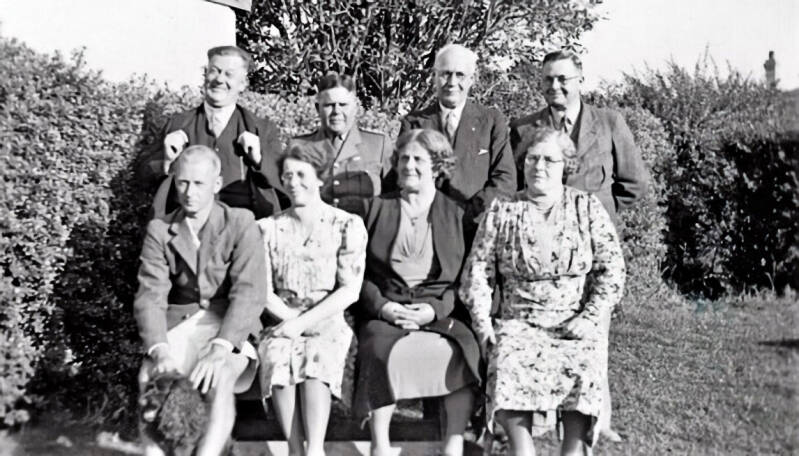
Ethel’s father, George Robert Scott, had emigrated with his parents from Glasgow, Scotland when he was only a year old and grew up in Dunedin, Otago. He was the only boy in the family, with five sisters. He was a police constable and married Thirza Harriett Elizabeth Havill on October 20th, 1880, in Dunedin. In 1883 his occupation was listed as a Clerk in the Civil Service. The family moved up from Dunedin to Karori, Wellington sometime between 1905 and 1910, where he lived until he died on September 27th, 1932.
His five sisters were Isabella (born in Scotland 1858), Agnes Elspeth (born in Scotland 1859), Margaret Ann (born in Dunedin 1860), Mary Jane (born in Dunedin 1863) and Christina Elizabeth (born in Dunedin 1865). Agnes was only 10 months old when she died at sea on the voyage out on the Sevilla.
I can find no conclusive information on Isabella after the family landed in Dunedin aboard the Sevilla.
Agnes Elspeth Scott died at sea on board the Sevilla on route from Glasgow to Dunedin when she was just ten months old.
Margaret Ann Scott was born in Roslyn, Dunedin, Otago, New Zealand on 28th of September 1860, and christened in the First Church, Dunedin, New Zealand on November 25th of that year. She married George Arbuckle Mitchell on the 8th of June 1883 in Kaikorai, Dunedin, Otago, New Zealand at the age of 22. They lived mostly on the West Coast and had eight children (2 girls and 6 boys) before George died of pneumonia at Burnetts Face, West Coast, New Zealand on August 6th, 1901, at the age of 44 yrs. On 25 Oct 1911 Margaret remarried to John Oliver Bunn at Burnetts Face Road, Denniston, Buller, West Coast, New Zealand. She died on 24th June 1929 in Dunedin, Otago, New Zealand.
Mary Jane Scott was born in Dunedin on September 9th, 1863. She married William Downton Davis there on the 22nd of July 1885. William had been born in Stepney, Middlesex, England in 1852 and his family had emigrated to Tasmania when he was young. His presence in Dunedin is probably explained by his profession, described as a wool expert. They had six children, all born in Dunedin, before William died on April 5th, 1924, and Mary died on January 10th, 1937. They are both buried at Andersons Bay, Dunedin City, Otago, New Zealand. Of their children
- Bertha Jane was born in July 1886 and died on August 1st at less than one month old.
- William Arthur Zephaniah (Chum) Davis was born on the 18 December 1887. He attended Kaikorai Valley school before becoming a wool classer at the Ross and Glendenning’s Roslyn Mills. In 1917 he married Christina Agnes Webster and in 1919 they were living at 16 Beta Street, Roslyn. Christina died on 26th August 1939 and in 1941 he remarried to Thirza Lindsay McLeod. He died in Dunedin on the 15th of October 1972.
- Agnes Mary Davis was born in Dunedin in March 1891. On the 9th of November 1916 she married George Scott Milne Crawford at the Roslyn Presbyterian Church. George worked as a Manchester Salesman at Bing Harris in Dunedin. She died on the 15th of January 1943 in Dunedin.
- Cyril Ernest Davis (Chap) was born in Dunedin on the 14th of February 1893. He married Reta (Rita) Elsie Burgess at the Roslyn Methodist Church on the 22nd of November 1916. They had a daughter, Lilly Elen, born on the 27th of December 1917 who unfortunately died when 6 months old on the 20th of June 1918. On the 8th of January 1920 they had a son, Francis Ernest (Frank) Davis at Christchurch, who married Marion Elizabeth Ullrich at St Barnabas Church, Fendalton, Christchurch on the 24th of November 1945. Frank was an accountant, then Manager at the ANZ Bank, so they moved around the country a fair bit, but while they were at Gore, Southland, they had three sons, Gerald, Peter and Robert Graham (Rob). Rob also moved around a bit, before marrying Carol Corbett in Rotorua on 1st of January 1975. They moved to Auckland in 1981, where Rob has had a variety of managerial roles, including Community Manager for Bowls New Zealand. When he and Carol weren’t at home, or travelling overseas, they travelled around the country in a mobile home, producing interviews and documentaries for Bowls NZ. It is in this capacity that Sharon and I have met them several times and found that Rob and I share a common interest in genealogy. He was a delightful man and most forthcoming and helpful in sharing his family history with me.
- Rita Elizabeth Harriet Davis was born in Dunedin in July 1903. In 1933 she married Humphrey ‘Gilbert’ Barton-Browne. Gilbert was a butcher and the following year they had a son, Kenneth Gilbert Barton-Browne in Oamaru. Rita died on January 28th, 1983, at Oamaru, Gilbert having died earlier on March 2nd, 1966, in Dunedin. They are both buried at Anderson’s Bay Cemetery in Dunedin. Gilbert did however have an interesting pedigree. His father, Charles Robert Barton-Browne was born in Meerut, Bengal, India in 1860, worked as an accountant in Reefton on the West Coast of New Zealand, married Manie Ann Caroline Waldron from Ophir, Central Otago, New Zealand in 1891, and died on the 6th of November 1932 in Burnham-On-Crouch, Essex, England. His father, Gilberts grandfather, was (Major General) Charles Frederick Browne who was also born in India in 1823, and who married Frances Isabella Hickey in Bangalore, Madras, India on March 18th, 1851. Frances was also born in Bengal, India in 1822 and through her father, William Hickey Esq. is directly related to the Plantagenet line.
- Eric Archibald Davis was born in Dunedin in April 1908. He was a wool scourer at Ross and Glendinning in Dunedin and married Muriel Jane Pile from Oamaru. He died on July 23rd, 1965, and is buried at Anderson’s Bay Cemetery in Dunedin.
George’s father was James Scott, born on 13th May 1833 in Cameron, Fife, Scotland. At age 17 he was working as a farm servant and was still an agricultural labourer when he married Agnes Bremner at the Cameron Manse, Cameron, Fife, Scotland on December 4th, 1857. As we have seen previously, changing land use and farm consolidation saw such jobs diminishing, while in the cities, industrialisation and urban drift saw conditions of poverty and overcrowding.
In 1859, after the birth of three children, they emigrated to New Zealand, departing from Glasgow on the 19th of August 1859 on the ship Sevilla. They arrived in Dunedin on December 2nd, 1859, after 103 days at sea, and the death of their daughter Agnes Elsbeth at sea. I
n 1859 Dunedin was a small settlement of mainly Scottish settlers, numbering only two or three thousand people, but that changed rapidly in 1861, with the discovery of gold at Gabriel's Gully leading to a rapid influx of people, and giving Dunedin the highest rate of population increases in the country by 1865.
George’s mother was Agnes Bremner, who was born in Leuchars, Fife, Scotland in 1834 to Alexander Bremner and Elspeth Robertson. On the 17th of November 1852, while they were living at North Dron Farm, Leuchars, Fife, Scotland, Alexander’s wife Elspeth died (possibly during childbirth). Left a widower with six children (after Agnes and Margaret had married), Alexander and the children emigrated to Dunedin, New Zealand aboard the Palmyra, departing from Gravesend on the 28th of October 1857 and arriving in Port Chalmers Otago New Zealand 14 February 1858. As noted at the time,
The Palmyra sailed from London for Dunedin on 28th October 1857. It arrived on February 14, 1858. It weighed 706 tons, and the captain was John Tierney.
Nine deaths occurred on the voyage - Mr Bateman, Mrs Docherty, and 7 children - and one girl since arrival in port. There were 7 births. The number on board at arrival was 300.
Among the steerage passengers were James and Hannah Lowe (nee Green), and their two children Annie and John. On board also were 3 cases agricultural machinery, 4 cases of implements, 1 case of stationery, 7 packages building materials, 64 packages for wooden houses, 100 tons coal, 13 packets hops, 1 case preserves, 1 case of cordials, 36 packages of wire, 1 crate hair felt, 199 cases wire, 14 casks brick, 1276 iron rails, 850 iron sleepers, 16 kegs nails, 257 bars, 47 bundles iron, 167 cases, 17 crates, 9 casks, 16 barrels, 1 tierce, 9 crates, 1 truss, 14 bales, 69 packages and 2 boxes.
The following is from the paper Colonists: "The Palmyra left Gravesend on the 28th, and the Downs on the 31at of October, and after a good run down the Channel experienced constant south westerly winds until reaching the northern tropic, where she caught the trades, which continued steady but light to the Equator, which was crossed on the 14th of December. Passed the Cape on the 8th of January and made the south-west point of the Middle Island on the 12th of February. Hove to in Foveaux Straits during the night and passed between Bluff Harbour and Dog Island next morning. Becalmed till noon of the 14th, when a smart breeze sprang up, and carried the vessel to the Heads, outside which she anchored at half-past 5. p.m., but could not get to Port Chalmers until the 19th. The voyage occupied 105 days, from the Line 64 days, and from the Cape 36. The chronometers were much out of order, which caused a delay of 36 hours in making land. The weather was generally fine during the passage, no spars having been lost, although a good many sails were split."
William Stanbury, Chief Officer of the barque Palmyra, was charged at Dunedin by John Tierney, Master of this barque, with stealing from a cask in the storeroom of said barque, one quart or thereby of Rum, on Sunday the 10th day of January last. Prisoner was dismissed.
John Tierney, master of the barque Palmyra, now in the port of Otago, was charged on the information of Charles Logie, Esq., Collector of Customs at Otago, with committing a breach of clauses 22,27, 32, 36,38, and 62 of the "Passengers' Act, 1855." Captain Tierney was found guilty upon three of the charges made against him and was fined £30.
Another account of the voyage was written in 1903:
Forty-five years today (14th February 1903) the American-built barque "Palmyra", 702 tons register, Captain Tierney (Dublin) arrived off Otago Heads, from London, with some 300 immigrants - English, Irish and Scotch. The Scotch were mostly from the Shires of Perth, Aberdeen and Inverness and the Kingdom o' Fife.
Being a youth of ten years of age then I cannot, altogether, give you accurate information relating to our voyage, which occupied 108 days from Gravesend to Taiaroa Heads.
We came through the Straits, and when passing the Bluff, we saw the barque William Hyde, stranded, lying inside the harbour. We came along the coast to close inshore, so much so, that we could see lights from some of the huts or whares in Port Molyneux - in fact, we were becalmed off there.
The voyage was rather an exciting one in some respects: any amount of fighting, which of course - to the youths on board - was looked on as fine fun. There was the brighter and livelier side of the picture by way of dancing in the fine evenings; and during the day, the Auld Scotty's (with due respect to them) amused themselves by playing the "Dam", or "Damned Board", to pass away the time. Broaching the cargo was another favourite pastime with a few of the passengers. I, innocently, assisted in holding a "naked" candle while the operation was going on. The chief mate (Stanbury), threatened to "blow" the ship up, for which he was court-marshalled, and was committed - not to a "dungeon-cell" - but into one of the cabin passenger's W. C’s. "Crossing the line", varied matters for one day; when I, with a few more of the small-fry, looked down from the lower fore-rigging (monkey-fashion), upon the scene of father "Neptune" coming onboard; when afterwards, he was mounted on the Port guncarriage and wheeled in triumph around the ship. Afterwards, the "duck-pond", on the starboard side, was called into requisition, for the purpose of giving those who had gone through the process of being "shaved", with some blunt instrument, and for a "lather", tar and soap, a chance of "scraping" down; which also reminds me of a few of the passengers hovering around the mainmast during the "Duke of Argyle".
We were nearly wrecked when off the Canaries; the look out, apparently, having gone to sleep. However, a calamity was arrested by Robert Gartshore, now of Russell Street; he having gone on deck early in the morning to have a smoke, when he at once noticed our position, and reported accordingly.
The younger members of the ship were half-starved, at least I was, often going to the gallery for a "smell" of pea soup, boiled "salt-pork" and a few other highly-flavoured eatables, including of course, "plum duff" with treacle sauce - a sauce well known to those who arrived in the early days.
We had a narrow "save" at the "Heads", when well I remember the late "Dick" Driver springing onboard and rushing on to the "poop", which was the means, I suppose, from saving us from total destruction.
After arriving at Port Chalmers, my father's family, along with some thirty other passengers, were the last to leave the Palmyra for Dunedin, transhipping to the sloop "Bloomer", Captain Malcolm, with his mate "German Charlie". We left Carey's Bay about 2 o'clock in the afternoon and sailed up the "short" channel, sometime towed by the dingy, and arriving at the jetty, Jetty Street, at 10 o'clock in the evening. We (our family), we were at once escorted to, and accommodated at the Commercial Hotel, High Street, which was then "run" by the late George Duncan, with the assistance of John Wain, who, I believe, was "headman" and waiter...
I am etc, Andrew Walker Bremner
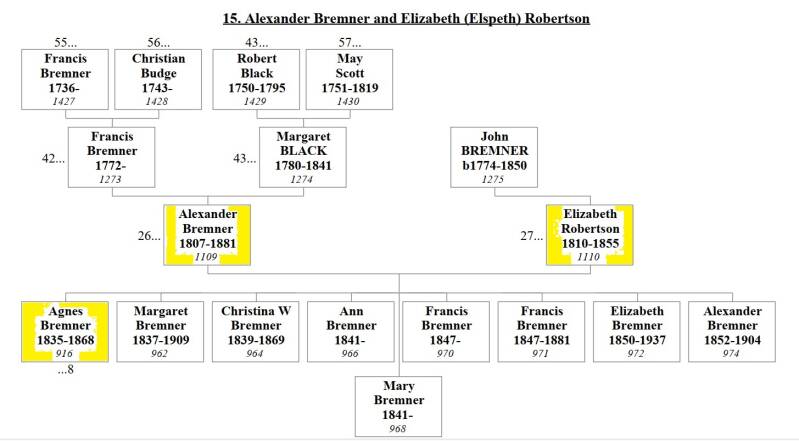
Of Agnes’s siblings.
Margaret was born in Leuchars, Fife, Scotland in 1837. She married James Pattillo, a cabinet maker from Perthshire, Scotland on June 12th, 1857, at 36 Lauriston street, Edinburgh Parish, Edinburgh, Midlothian, Scotland. Their first son, William Alexander, was born in Edinburgh on the 8th of May 1858. In 1859 the family emigrated to New Zealand aboard the ship Sevilla, arriving in Dunedin on December 2nd. They went on to have eight children, before Margaret died in 1909 and James died in 913. Both are buried at Dunedin.
Christina Watson Bremner was born in Leuchars, Fife, Scotland in 1839. In 1863 she married Alexander Garden, and they had three sons before she died at Orepuki, Riverton, Southland, New Zealand in 1869 when she was 30 years old.
Anna Henderson Bremner was born in Leuchars, Fife, Scotland in 1841. She married Richard Sandilands in Dunedin in 1860, and they had six children before she died in Dunedin in 1918, three years after Richard.
Marjoria (Mary) Henrietta Bremner was born in Rhynie, Aberdeenshire, Scotland in 1845, and she married Henry Boston Cassels in 1862 Riverton, Southland, New Zealand. They had seven children before she died in Riverton in 1887 at the age of 42.
Francis Bremner was born in Leuchars, Fife, Scotland in 1847. He married Margaret Gray in the Knox Church, Dunedin in 1871. They had five children before he died at Māori Hill, Dunedin, Otago, New Zealand in 1881 at the age of 33.
Elizabeth (Eliza) Bremner was born in Leuchars, Fife, Scotland in 1850. She married John White in Dunedin in 1875, and they had five children. She died in Dunedin in 1937, eight years after John.
Alexander Bremner was born in Leuchars, Fife, Scotland in 1852. He died on 26th of December 1904 at Tokarahi, Waitaki, Otago, New Zealand, at the age of 52yrs.
My Grandmother Ethel Jackson Scott’s mother, Thirza Harriett Elizabeth Havill was born in Serguay, Devon, England on January 27th, 1862, and baptised in the parish of Upton, Devon on March 9th, 1862. Her parents were William Havill, a plumber’s apprentice, and Thirza Chilcott, both of whom were born and lived in Exeter, Devon. Thirza was their oldest daughter, preceded by Charles, and followed by George and Emma.
In 1869 her father William died, which must have left his wife in a very difficult situation, with no source of income and four children to support. In 1871 the family were living in Clyst St. Lawrence, a small village just north-east of Exeter. Then in 1874, they took an Assisted Passage aboard the Ship Corona, leaving London on May 22nd, and arriving in Dunedin, New Zealand on August 28th.
Otago Witness, Issue 1188, 5 September 1874.
ARRIVAL OF THE CORONA.
The Corona, a stately ship of wooden build, and nearly 1200 tons register, arrived on the 28th inst. with another crowd of immigrants shipped at London. She was signalled shortly after the Bruce, and the signal of her name was immediately followed by that most welcome one of all— "All well on board." After placing the Bruce in safety, the Geelong went to the Heads again and soon returned with the Corona in tow. Just as the two vessels reached the Quarantine Ground it came to blow sharply from the S.W., and as the tug could not make headway against the breeze, the ship had to be anchored just below Palling Point and was there boarded by the Customs and Immigration Officer and others. Mr Collin Allan was, of course, present. The visitors were courteously received by Captain Robertson, and the surgeon superintendent, Dr Gordon. The report of the latter touching the sanitary condition of those under his charge was satisfactory. No infectious disease of any kind had appeared during the passage, and the immigrants on the whole were a decent lot of people. There were, however, some amongst them who had better have been left at home, and from the tenor of the Doctor's remarks, and also from what we could glean in other quarters, we inferred that the selection of the subagents had been carelessly conducted. There are 406 souls, equal to 390 statute adults on board the Corona, and include 93 married couples, 52 single women, 78 single men, and 180 children. Tho latter comprise 71 boys, 78 girls, and 31 infants. Eleven deaths and 10 births had occurred on the passage, the deaths being all in the case of children, excepting one. The first was that of George Whitehead, aged 6 months, who died of bronchitis on June 4th. On June 12th, Steven West, aged 16 months, died of atrophy; on June 29th, Michael Sullivan, aged 8 months, died of convulsions ; July 23, Ellen Willis, 5 months, died of atrophy ; August 23, Edward Walsh, 10 months, died of convulsions ; August 24, John Milton, aged 26 years, died of consumption ; and on August 27, Owen Sullivan, 3 years, died of inflammation of the brain, and as the death happened so near land the body was brought in to be buried on shore. The above were all the deaths amongst those who joined the ship at London, the remaining deaths are connected with the births which took place on board. These were as follows: June 4, Mrs White of a son; June 21, Mrs Le Faudcn of a daughter; July 21, Mrs Brooks of a son, who died on July 21. On that date Mrs Jopson was confined of a boy; July 16, Mrs Hannon of a girl; July 31, Mrs Barron of a girl, who died subsequently: August 11, Mrs. Walker of a girl, died August 13; and at later dates, Mrs Grewett was confined of a girl, and Mis Blackwood of a boy, still born. Taking the immigrants throughout, we were not unfavourably impressed by their appearance. They appeared to be strong and healthy, and one and all expressed their utmost desire for, and willingness to work. They were also satisfied with their entertainment on board and spoke in high terms of praise of the captain and doctor. The compartments were scrupulously clean, the single women's especially so, and the bunks were arranged London fashion, so as to make the most of the space at command. There was, of course, the usual herding in the case of the unfortunate married people, less care being taken to promote secrecy than is usually observable in London ships. The Corona is a fine vessel, admirably suited for the immigration business, her 'tween-decks being lofty and freely ventilated and lighted. She is pierced with side scuttles, and is liberally fitted up with roomy hospitals, dispensing and other offices The freshwater condenser, one of Chaplin s, worked well; the cuisine department was also well provided for. The ship made the passage in 9S days from the docks, which is somewhat in excess of average time. She was, however, much hindered by light weather, and by easterly weather at the latter end of the run. Her report states that she left London on the 22nd of May, Gravesend on the 24th, and passed through the Downs on the 25th. Light variable weather and fogs were experienced in the Channel, so that it was not until the 1st of June that she cleared the land, the Lizard being the last departure. Unsettled moderate weather prevailed until the 9th of June, when she picked up a N.E. breeze in latitude 33 that merged into the Trade wind. On the 22nd. the Trade died away in latitude 9 18. Thence the ship knocked about in the doldrum belt until July 2nd, when she crossed the Equator in longitude 2810 W. and on the following day— she then being 48 miles south of the Line— the SE. Trade was met with. It blew pretty steady and fair and gave out on the 10th in latitude 23. Northerly breezes then found the ship, and on the 15th the wind took westing, and held between N.W. and W. a few days. On the 19th she crossed the meridian of Greenwich, and between that and the meridian of the Cape she lost the westerlies, and had several days of light variable easterly weather, just where fresh westerly winds were looked for. This materially lengthen her passage. On the 25th of June, she crossed the meridian of the Cape, and on the 2Sth the wind veered to the westward, and held there steady and strong, bowling the ship along at a great rate. On the 1st and second inst. she logged at the rate of 11 and 12 knots per hour She passed the meridian of Cape Leeuwin on the 13th inst., and on the 17th the breeze hauled to the N.E. and freshened to a smart gale that brought her down to lower topsails for a few hours. Next day it worked round to the westward again and took her to within sight of the Snares on the 24th. Then she met easterly weather again, the strong gale of that date, and weathered it under snug canvas, and being favoured by a subsequent westerly slant, she fetched the Heads yesterday morning and was towed in as above.
Two vessels were signalled during the passage. Firstly, south of the equator, the ship Craigendarrock, from London bound to Adelaide. On the 20th of June, lat. 2.22 north, lat. 28 W., the ship Delaware, from Valparaiso, bound to Cork, was signalled. The Corona brings about 900 tons of cargo, chiefy dead weight railway material, and is consigned to Messrs Caiyills, Gibbs, and Co.
The Corona at Port Chalmers
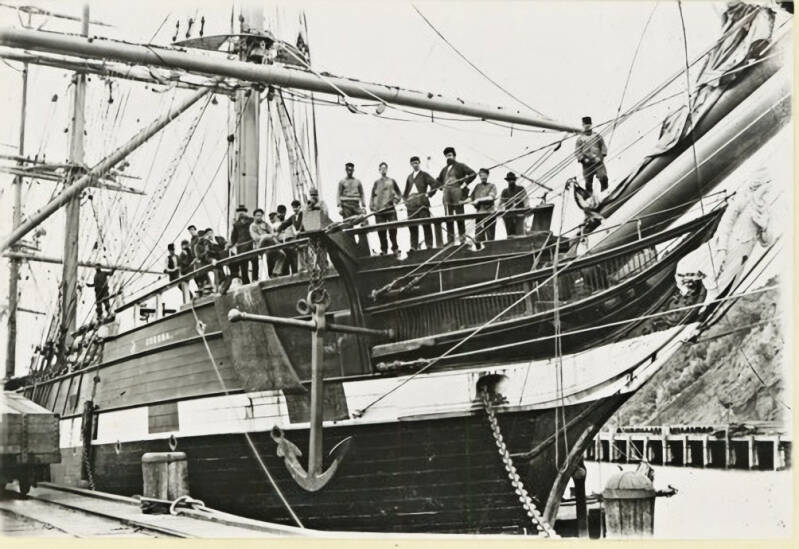
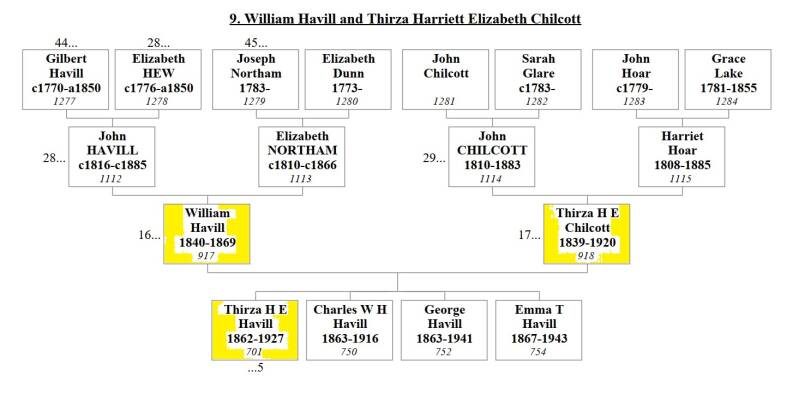
Of Thirza’s siblings, Charles William Henry Havill, born in Torquay, Devonshire, England in 1863, arrived in Dunedin on the Corona as a boy. In 1884 he married Betsy (Bessie) Hutchings, who had also emigrated from Devon, England with her family. He was variously listed in directories as a jeweller and a carter. They both died in 1916 and are buried in Andersons Bay Cemetery, Dunedin, Otago, New Zealand.
George Havill was born in Exeter, Devon in 1863 and was 10 when he arrived in Dunedin on the ship Corona. In 1884 at age 20 he married Henrietta Albertina (Hetty) Parnell, whose family had emigrated from Surrey, England aboard the ship Allahabad, arriving in Dunedin on May 31st, 1873, when she was 9. When she married George, she was 21 and working as a domestic servant, while George was a carter. They had a son, George William, who died just after birth, and daughters Henrietta Annie (Hettie) Havill and Emma Thyrza Havill, all born in Dunedin. However, they obviously moved to Victoria, Australia as both girls were married there, and both George and Henrietta died there.
Emma Thirza Havill was born in Exeter, Devonshire, England in 1867 and was 6 when the family arrived in Dunedin. She married Stephen Charles Gandar Swiney in 1898 in Wellington, where he worked as a butcher. They had three daughters, Melva Hazel, Gladys Thurza, and Vera. Stephen died in 1929 and Emma in 1947.

Almost all of my father’s generation saw some sort of service in World War II. Almost all of my Grandfather’s generation saw some sort of service in World War I. What my mother and grandmothers saw was threats, rationing, hardship, service on the land or in munitions factories, loss and grief. It wasn’t talked about a lot. Maybe that is why in my generation there was a backlash against war. That only seems to have lasted one or two generations. So, for all those who served or suffered in whatever capacity, making the most of whatever opportunities arose for hope and happiness, here is a family story about war, its grief and futility.
Desmond Scott was born at Kaitangata on November 13th, 1922, going to school at St. Patrick’s College and Wellington Technical College. He then worked as a clerk with the NIMU Insurance Company, Wellington. In November 1940 he applied for war service with the Royal New Zealand Airforce.
Flight Sergeant Scott was enlisted for aircrew training on the 9th of November 1941 at the training ground school, Levin and after completing his elementary flying training with the No. 2 Elementary Flying School, New Plymouth, he was posted on the 6th of April 1942 to No. 2 Service Flying Training School, Woodbourne. On the 15th of June 1942 he was awarded his flying badge and on the 14th of August promoted to Sergeant. On the same date, he embarked for England. His further promotion to Flight Sergeant occurred on June 1st, 1943, while he was serving there.
While on route to England, where he arrived on 20th November 1942, he obviously had a layover in New York after which he penned a letter home, the following is extracted from.
Dear Mum, Dad and Folks,
We had our first sight of New York on Saturday, 24th, at about 7 in the morning, and it took us till about 4 in the afternoon to get to the center of the harbour. For hours we just steamed past various outlying districts of New York suburbs, although the place is far too large to describe aptly.
We had a couple of American Sailors on board, and they described the various places we passed, such as New Jersey on the left-hand side, and then Long Island, Coney Island, Brooklyn and various places before town. We passed the Statue of Liberty about 2pm and then passed through a narrow channel and then into a huge basin which comprises of two big rivers, the Hudson and the East. There we saw some of the skyscrapers and are they big! One just looks up and up and you strain your neck looking for the top.
We berthed about 5, but owing to some obscure American Regulation, we had to spend the night on the ship. However, we got leave just after lunch on Sunday and we immediately made for the town. We were berthed at a place called Brooklyn which is almost as big as New York itself. The only way to get to the city is by subway, and these are as confusing as anything can be. They trickle along about 50 mph, about 100-feet below the ground and if you catch the wrong train or get out at the wrong stop, you are miles from nowhere. It is about 15-miles from our Pier to Times Square, and it takes about 20 minutes to get there.
After a lot of people directing us, we arrived into the center of the town and then felt properly lost, as from there you can see nothing but tall buildings and thousands of people moving in all directions. We wandered up some street and looked at the various shops with interest, as on Sunday the only shops that are shut are the Department stores and the offices, and the rest of the places are open as usual, hotels and bars included. We were given an advance of $20, or about £5 to last our stay here, however long it may be.
We had tea and by some devious means found our way into Broadway with its famous lights and crowds. However, they have a blackout over here now, which means that the electric signs are put out and the rest of the place is normal, making the whole street as light as it is in daytime. There are about 8 million people in New York, and I think about half of them were in Broadway that Sunday. About 7, a couple of girls rushed up and handed the two of us tickets for a Supper Dance that was being held at some Commercial College. As we had nothing better to do, we went along and had quite a good time, except that they dance a bit different from us. We left there about 11 and wandered back to Broadway, where there were as many people as usual. We then had Supper, found a subway and arrived home about 2.
We left the ship about 10am, and although it was pouring down it didn’t stop us. As it was still raining in town, we went into the huge Rockefeller Building, which is the biggest building, taking up about three blocks. There was some exhibition there and we went and had a look, and it was quite interesting. We met some Sailor, and all went to dinner where we got stung for 3/6d for a rotten meal. Then we went to the Pictures to see Judy Garland. Here the pictures start at 10 in the morning and go continuously until 4 the next morning which is not bad. After that, we went along to Jack Dempsey’s Bar (from which I sent a Postcard) and had quite a few drinks shouted to us by some people who I had never seen before. After a lot of talk about New Zealand, we left about 1 and arrived home about 3 in the morning once more.
Tuesday turned out to be a marvelous day, so we immediately headed for the Empire State Building, where they charged us 55-cents to go to the top. You have to take three lifts - one from the ground to the 64th floor, then from 64th. to 87th. and. then from 87th to 102nd, the whole process taking about a minute-and-a-half, which is not bad going to get to the top of a building about 1,100 feet high. We had a good look around and tried to pick out some of the places we knew, but it was very hard. We had afternoon tea, and I am sending you some souvenirs from there, as I have tried to do all along.
Later, we went to the USO and got a ticket for a dance run by the NCCS which is the National Catholic Community Service, and at which uniformed people of any denomination are welcome. They have a crowd of girls for the dances which are held three times a week and all the girls have to be RC’s. All the girls have masks so one just picks at random for a partner, and I happened to meet a very nice girl who I took out for the rest of the stay. About 9 they had some of the leading artists from Broadway and Hollywood who were in town to come along and give an item. Gracie Fields (my grandmother always calls her Lucy Fields) was there and I was introduced to her. Among the other people were the Four Yacht Club Boys, and one of them came from Melbourne and was quite interested in us and gave us an invitation to come along and have a few drinks with him at one of New Yorks best hotels, which we promptly accepted.
From then on, we were items of interest through hobnobbing with the stars of the evening. The dance finished about 12:30 and as we went down Broadway to catch a subway, we saw a movie that we wanted to see so we went to the movies (as they say over here) until about 3. By the time I took Helen home and caught a bus back to Brooklyn it was just on 5 and I was feeling pretty tired. However, I was up again about 10:30 on Wednesday and then we went up to Brooklyn, about 12 times the size of Wellington and did some shopping. We went into town about 4 and got some tickets from the USA for the Radio City Music Hall. This is about the best music hall in New York and a spectacle I wouldn’t have missed for anything in the world.
At all the bigger theatres they have one picture, a few shorts and then generally about an hour and a half of floor shows. The symphony orchestra I heard was marvelous, also the ballet, and a Negro Chorus singing ‘Glory Road’. It was all so good that I saw it twice, staying there about 4 and a half hours. The theatre itself is a marvel, and I've never seen anything like it betore or probably again. It holds about 9,000 people and there are always hundreds of people waiting at the back of the theatre for seats. There are no microphones in the place, and even at the back of the theatre one can hear perfectly, as it is built like a huge sound shell. All the tickets we received from the USO were free, and for that particular theatre, prices ranged from $1.10 to $2.20, so it was quite a saving.
Thursday, I went to Warner Bros to see Mr. Dillon but unfortunately, he had left the company. I met some of the overseas heads, whom I had met in NZ and had quite a long talk to them, then we went to lunch in their own cafeteria, and I had quite a good lunch for nothing. Then some other chap gave me two tickets for a play at one of the big theaters and an invitation to dinner at his club. I arrived about 5:30, had a couple of drinks and a nice dinner and left soon after to pick up Helen, who had to work until 8. She is section manager at a big department store and had to work late one night a week. The play was quite good but very short and as I had an invitation to a Ball at the Astor Hotel we went along to what turned out to be a United Nations Ball, held once a year for people from all over the world. After an enjoyable evening, we left at about 2 and I was home about 5.
(Continuing my tour of New York. Please excuse my writing, it is a bit worse than usual today, as we are now in the midst of an Atlantic gale and the ship is rolling all over the place.)
On Friday Nola Luxford arranged for us to broadcast over the NBC home. I’m afraid I, amongst others, got ‘mike’ fright but I managed to get out what I wanted to say, which is the important thing. After lunch I went to WB where the Secretary invited me to dinner at his home, about 35 miles out in the country. I went for a walk to kill some time, and some chap asked me if I would like a drive around town. He showed me everything in the place there was to see, including the tunnel under the Hudson River and Central Park. I met Mr. Perkins at 5:30 and we caught the subway to Grand Central Station. You could put Wellington Station in one corner and still have some room left over. We had to fight amongst the crowd for a train seat for the 30-minute, 25-mile journey, then we went home in one of his three cars. He has a marvelous home on a little island and one crosse over a bridge to get there. There is a wharf, a motorboat, a yacht and every conceivable thing you could want. After a very nice dinner we talked for a long time, and they invited me to stay the night, but as I needed to be onboard by 8 every morning, I left about 11.
After a quiet Saturday morning I went to watch some American football, on some free tickets from the USO. The ground is quite small by American standards but is the biggest I have seen. It is completely surrounded by stands and they had a crowd of about 45,000, which is just an ordinary Saturday crowd. We couldn’t understand it, but any Wellington Rep. Team could have beaten them. They have various stoppages for unknown reasons, and we gave up and left about 4. After 6 I picked up Helen from work and we had dinner down Broadway, then up to the Catholic Community Service for a Halloween Dance. We had a great time and won a prize of 200 cigarettes for a novelty dance, then had supper and went to the pictures in town. As this was my only weekend, we decided to make a night of it and went along to the Waldorf-Astoria Hotel for a while. Going home we passed the new St. Patrick’s Cathedral and went to 6 o’clock Mass. Some chap took us home and I arrived back at the ship just in time for breakfast. I slept until lunchtime, then went out to Helen’s place for afternoon tea and stayed for dinner. On Monday I went into town and said goodbye to all the people I had met, and we sailed for our next port of call.
I’m afraid that this hasn’t been put down too well, but I’ve never been much good at letter writing. We are now having some real cold, and I did 2 hours this afternoon and nearly froze to death, so all you have heard about the Atlantic is right. Life has been very uneventful except for our two N watches, which are the worry of my life. To try and keep warm I wear 3 pullovers, my Golf Jacket, a tunic, greatcoat, 2 pairs of socks and flying boots, and I’m still cold. For the last couple of days, it has been snowing periodically. We picked up a lot of women and children at New York and some of them are not taking the trip too well, as the boat is rocking about too much for convenience owing to the Atlantic storm we have been having.
I don’t think there is anything else I can say, so I’ll say cheerio.
Love to you all, including Lower Hutt and Palmerston.
Des.
Arriving in England on 20th November 1942, Flight Sergeant Scott reported to No. 3 personnel reception center, Bournemouth until posted on January 1st, 1943, to No. 9 Elementary Flying Training School, Ansty, Warwickshire for a refresher flying course. On the 9th of February he was posted to No. 3 (pilots) Advanced Flying Unit, South Cerney, Gloucestershire. During March he attended an instrument flying course with No. 1515 Beam Approach Training Flight Swanton Morley, Norfolk, after which he resumed his training with the Advanced Flying Unit. On the 13th of April 1943 he was posted to No. 30 Operational Training Unit, Hixon, Staffordshire to crew-up and complete his training on Wellington bomber aircraft prior to his posting on the 2nd of July to No. 166 squadron, Kirmington, Lincolnshire.
Commencing operational flying with this squadron, he took part in two operational flights. On the second, on the night of 8/9th July 1943, Flight Sargent Scott was Captain of a Wellington Bomber, briefed to lay mines at the Artichokes Area off Lorient. The aircraft failed to return to base, and all of its crew were deemed missing, presumed dead.
Desmond Scott, having been flying operationally for only a week, was declared dead on July 9th, at the age of twenty-one.
I found the following writing associated with the daughter-in-law of Herbert William Scott, one of my grandmother’s brothers. It produces an interesting insight into life during the great depression and World War II and is reproduced here with her kind permission.
Tragic, but I can't help but reflect on how different (and worse) it must have been for some of the other families in our tree. Particularly my grandmother, trying to survive as a widow through the depression on just a War Pension after WWI, with two daughters to support.
Introduction by PrueNZ.
This is about the first half of my life. I have written about events that I did not always understand, partly because I was too young and partly because often, I didn’t hear the full story. Back in those years children didn't hear of family plans until they were a fait accompli and if one asked questions, the reply invariably was 'children are seen and not heard".
I am very grateful that I was able to visit the South Island West Coast so often and learn its history of which my maternal grandparents were a part. Looking at old photos of places like Burnets Face, Denniston and Granity, it is hard to comprehend that the people who lived there. had a better life than they had left behind in Ireland.
My maternal grandparents were forced to leave Ireland because of the potato famine (as were my paternal grandparents) so conditions on the West Coast didn't seem so bad to them and there was tremendous community spirit. With abundant cheap coal they were always warm in winter - and there were films (which they called 'the talkies') every Saturday night in later years!
I still cannot understand what happened to my father - if he had resigned his job BEFORE the Depression, it would have been understandable - no one could see the coming disaster - but 3 years into it he had an excellent knowledge of overseas and local problems, especially those of the unemployed, because he helped so many desperate people. As it was until 1932, he didn't put a foot wrong, after 1932 he never again put a foot right.
MY MOTHER
Marion Elizabeth McElwee (known as May). Because of the 'Mc' people always assumed that it was a Scottish name, but it was Irish and pronounced Mackle-wee.
Born 1885 to Irish immigrant parents. Her mother was born in London to Irish parents, and her father was born in Ballyshannon. She was the youngest of a large family (11?) and because her mother died when she was very young, she was brought up by her older sister Jane. I don't know when her father died.
Jane married Harry Nahr (who owned the local brewery). Harry's brother Orlando owned a local pub, and he married May Seddon, a daughter of Richard John Seddon. The reason he was called Orlando had nothing to do with Shakespeare - his mother's maternity hospital bed overlooked the wharf where a ship called Orlando was berthed. When mining was in its heyday there were 17 pubs in Westport's main street, so Harry (who owned the only brewery) and Orlando did very well for a long time.
My mother was clever, ambitious and probably frustrated by the lack of opportunity on the West Coast. She matriculated very young, became a pupil teacher and was certificated. Over the next few years, she studied commercial subjects as well as teaching at Westport Primary School. She pushed herself so hard that she had a life-threatening duodenal ulcer at age 25.
About 1912 she went to Melbourne to teach commercial subjects to a class of Roman Catholic nuns so that they, in their turn, could teach. Friends and relations were amazed at her move - the few people who left Westport to further their careers were, almost without exception, men. Her brother Tom, whom she was very fond of, was working in Melbourne which was a bonus for her.
A large crowd gathered to see her off - by Newmans’s coach (called, in those days, an open tourer because it had no roof - umbrellas necessary at all times) and the luggage was strapped on the running boards. Rivers had to be forded, the hazardous Buller Gorge negotiated, and it was not a trip for the faint-hearted. I believe she loved every minute of her time there. I don't know the reason for her return to Westport or when that happened so there is a gap in my knowledge. She married in 1917 and soon after that Dad was called up and based at Featherston Army Camp. I don't know where she lived while he was there but at some stage, they bought a house in Ghuznee Street, and I was born at a nearby hospital in Abel Smith Street.
While she was in hospital Dad bought 9 Clark Street and she was very dismayed at the prospect of the coming move - their first baby had died soon after birth and she was very anxious about coping with a new baby and a very large, and at that stage sight unseen, house.
It was two-storeyed with a very large garden. The land had been part of the Hannah Estate and was sold to the Kirkcaldie family who built the house about 1904. They had several servants - a butler (there was a butler's pantry with a panel of room numbers - and bell pulls in most of the rooms), a maid and a gardener. They sold it to Sir George Richardson (I don't know when). He was born in England where he had lived at a 'country seat' called Oaklands. He named No 9 Oaklands too, although there was only one very small oak tree in the garden. We bought the house from him together with some of the very large pieces of furniture he had brought with him.
I think my mother's apprehension was right. The coal range had to be lit every day of the year to produce hot water, washing had to be boiled in a copper, to say nothing of the endless going up and down stairs. There were 5 fireplaces, 2 up and 3 down, and in winter at least 2 were alight all day every day (plus the range) and coal had to be fetched from a bin at the bottom the back porch steps which was a long trek. The house had a 12f foot stud and heating it ate up coal.
Housewives of my mother's generation worked terribly hard - most of the tasks needed great physical effort and that, coupled with no refrigeration made dealing with food an endless chore. When she had time Mum did wonderful embroidery and was famous for her smocking. She was also a very good pianist.
This seems a very short description of her, and it is really only an outline because more of her life is described in several of the other 'stories' I have written. As with most marriages in those days there was such a lot of physically hard work which, in her case, was in a house which was terribly inconvenient (but great for entertaining) and definitely over-large so there was very little spare time. Add to that my father's Irish gregariousness and therefore a large amount of entertaining and it all added up to hard slogging.
She had a major thyroid operation when I was 8 and it was a year before she recovered. In Auntie Madge's opinion she never regained full health.
Uncle Olando was convinced the Japanese would attack New Zealand and, specifically, Westport. His theory was that after an initial air attack they would land on one or two gently sloping beaches with landing craft and then they would need a port and Greymouth or Westport would be their choice. Both ports have treacherous bars, but Greymouth's is the more dangerous and therefore they would attack Westport, firstly by bombing and then landing heavy weapons.
Famous People I have Met
In 1942 the American Red Cross took over the Hotel Cecil (across the street from the western side of the Railway Station) and turned it into a drop-in centre for American and Allied servicemen and I was one of a group who helped on some weekends with preparing and serving simple meals, ice cream, coffee etc.
It was a lot of fun and hard work which came to an end quite abruptly when, in 1944 the Americans 'pulled out'. It seemed to happen overnight, and we were left with a lot of packing up etc. and were busy doing that when we were told the Mrs Roosevelt was coming to visit us. Because she was a VIP, and it was wartime there was no publicity about her visit - we didn't even know she was in New Zealand.
We had a mad rush to comb our hair, inspect each other to see that our stocking seams were straight, and she was there.
She was very tall, dressed in the grey and red American Red Cross uniform. She shook hands with each of us and then said how pleased she was to meet us all and how comfortable she was at Government House. Why, she said, I was even able to wash my hair and sit in your beautiful Noo Zealand sunshine to dry it - and added that her hair was long which didn't help.
We knew what she meant. In the days before hair dryers, and when hair was worn long, it was a problem. In winter one had to kneel in front of an open fire for at least an hour trying to get it dry.
She took her cap off and showed us her hair, grey and silky, pinned up in a topknot to accommodate the peaked cap. Then she was whisked away.
She had lovely blue eyes and was impressive and charming.
SUMMER 1931
One day at breakfast Dad said it had been arranged that he, as Chairman of the Babies' Home Committee would accompany the Governor General and his wife, Lord and Lady Bledisloe (I think they must have been patrons) and would show them round the Home that morning. The Home was in Khandallah Road, nearly opposite Simla Station - it is now a private dwelling).
It didn't mean much to me until Dad's 2IC, Mr Arnold, arrived at school in a great hurry and told Miss Cock that Lord and Lady B had kindly agreed to stop in Khandallah Road (at the end of Ngatoto Street) if we lined up and we had five minutes!
We were all bare-footed and there was a scramble to find our shoes and socks.
I couldn’t find mine, so I had to hobble on the stony, unsealed footpath to the inspection point, and I made it with a minute to spare before the viceregal limousine arrived.
Dad introduced our headmistress to them and then said, "I would like to introduce my daughter to you". Calling on my scant knowledge of protocol I stepped forward and gave a sort of bob. "What a sensible girl" said Lady B "to be barefooted on such a lovely summer day".
I found my footwear in the playground and ran home at lunchtime to relate the morning's event and when I told Mum what Lady B had said to me, she groaned (correctness was everything in those days) and I had to explain that there hadn't been TIME to search for shoes and socks. I had pigtails then and she was a bit mollified when I assured her that both hair bows had been in place – this was unusual because there was nearly always one missing.
Apparently, Dad didn't think of the idea until he got to the office and when he rang Government House, he was quite surprised when they agreed to do it.
West Coast Journey
By Hughla May Hurley Scott
It was mid-winter 1929 and my mother, father and I, aged eight, left Christchurch for Westport in a Standard car. The driver was Bill, a young man who worked in Dad’s office. My father had had driving lessons but gave them up after he turned into the garage, accelerated, went through the back wall and demolished the fowl house.
Christchurch was white with snow, which was still falling as we reached Lake Coleridge. It was covered with ice, and we all got out to have a look. When we returned to the car it wouldn’t move – the wheels were spinning in the thick snow, so the men used their handkerchiefs to scoop up gravel from the roadside and put it under the tyres. In the end it worked, and we had lift-off. The rest of the journey to Greymouth was cold, slow and getting darker by the minute.
“Nearly there,” said my mother as we headed towards Westport. Well, not really because we had still to negotiate the Fox River – literally – as there was a no bridge.
We didn’t get very far – about halfway, I think – when the engine stalled. The men took off their shoes and socks, rolled up their trouser legs, and walked through icy water towards a small light on a distant hill which they hoped was a farmhouse with a truck or draught horses.
Now we were left in the inky blackness with the only sounds the lapping of water against the running boards and the eerie call of moreporks.
A diversion was a car passing us on its way to Greymouth. When it drew level with us, the occupants shouted “You went in too far down” – a conclusion my mother had already reached.
Years later my mother told me she had been terrified while we waited and felt enormous relief when Bill waded towards us. Dad had been left to help the farm saddle a horse, but it was unnecessary because the car started immediately. We completed the river crossing, picked up Dad and were soon on the outskirts of Westport where a group of young men, equipped for tramping, waved their torches and shouted as we went past, and we waved back and tooted. Five minutes later we came upon a similar group, also waving their torches. The adults all agreed that West Coasters certainly were friendly.
When we arrived at my aunt’s house, she came rushing out to us, weeping and saying that everyone was very worried that we had had an accident, and she thought she would never see us again. There was a large number of people on her veranda – some were relative, but the rest turned out to be an early version of Search and Rescue who were about to dispatch the third search. The first two teams were brought back to truck, and we got to meet the torch wavers.
And how did the evening end? Well, my uncle owned one of the 17 pubs in Westport’s main street. Need I say more? Bill returned to Christchurch the next day and we followed a week later, comfortable cocooned in my uncle’s Auburn 8.
MY FATHER
Frank Hurley, born in Nelson in 1884 to Irish immigrant parents, was the youngest of 11 children and, like my mother, was orphaned very young and brought up by an older sister. I don't know anything about his childhood except that he won a scholarship to Nelson College.
When he was about 16, he renounced his religion - Roman Catholicism – because he saw it as a religion of fear. With his Irish Catholic background, he probably perceived it very differently from New Zealand Catholics, although it certainly was very powerful here and caused a lot of misery. [Handwritten addition: Birth control was frowned upon]
He had a variety of jobs (mostly insurance) in Nelson, Invercargill, Westport and Wellington. It is interesting that he moved around so much - in those days most white-collar workers aimed for one job for life. As soon as he got his first job his sister went to South Africa to marry. He never saw her again, which must have been very sad for him. He was not, of course, alone because he still had sisters and brothers living in Nelson.
He was very clever and ambitious, and I gathered that he quarrelled with his family and that they thought he was arrogant. He did, however, keep in touch with his sister and at some stage, when I was about seven, he wanted to move to South Africa where he saw huge opportunities, but my mother couldn't face going so far away - she had close ties with her family so it would have been much harder for her.
About 1922 he floated a new company - The Mercantile & General Insurance Company - with offices in Panama Street, and shortly afterwards he bought 9 Clark Street Khandallah - that purchase indicating how successful the company had become. Both the company and house were a great achievement for a man of 36 in those days - and it was just the beginning.
He joined St Barnabas Anglican Church in Khandallah and was soon a member of the vestry and on the board of their Babies' Home. He was appointed to the Red Cross committee and also became a Freemason. He attended Anton Koolman's gym and was a member of the Polar Bears Club - a group of Wellington businessmen who swam every winter weekday lunch hour at Te Aro Baths (now Freyberg Pool) which were filled with unheated seawater. He played golf at the Berhampore, Shandon and Titahi Bay links. He became so fed up with the shortcomings of Berhampore that he looked around for suitable land for a nine-hole course near the city. He formed a syndicate but, after a lot of planning, etc. they couldn't raise enough capital. The land they wanted is now called Crofton Downs.
He sometimes swam in the Khandallah baths before breakfast - they were unheated too. They were closed at that hour, so he used to climb over the high fence, frowned on no doubt by the caretaker who lived close to the pool. Dad helped run the annual swimming sports, so I guess the caretaker was a bit scared of him.
He had a very good singing voice and took lessons from Signor Cesaroni, a very ebullient Italian. He was a very knowledgeable gardener, dressed very well, smoked cigars, cigarettes and a pipe and was a liberal drinker. About 1930 the Signor decided to stage Aida with Dad singing the lead role as the King of Egypt. This was where our piano, a baby grand, was useful as my mother was able to play while Dad learnt the part. I had a silent part as a slave girl and was dressed in a sort of boiler suit made of very scratchy fabric. I had to sit by the throne, balancing a bowl of fruit on a 'turned back' hand. It was tiring and terribly hot and the other slave girl fainted and had to be carried off. There was only one performance, but I cannot remember the venue. Dad's very elaborate costume was a great addition to my box of dressing-up clothes.
Dad also gave what were called 'recitals' at Radio 2YA. They were, of course, live broadcasts and consisted of 3 or 4 songs of the Volga Boatman/Floral Dance type. There was much preparation- a 'run through' when he arrived home about 6 pm and then a light meal (too much food is bad for the voice) followed by an eggnog (very beneficial for the voice). Then it was time to get into his dinner suit, complete with starched shirt front, a lovely black alpaca overcoat, cream silk scarf and matching handkerchief and then it was time to walk to the Khandallah village, followed by a ride into town in a Bell Bus, a short walk from Bowen St to 2YA in Waring Taylor St and, when it was over, the whole journey in reverse.
Men and women of his generation walked a lot; some Khandallah businessmen walked to work - across Khandallah to the harbourside and onto a very rough, narrow track (called the bridle path) which wound down the hillside to Kaiwarra.
Dad's company had branches in Auckland, and he visited both frequently. Until 1937 the Wellington-Auckland Main Trunk line ran through Khandallah and then it was made into a branch line ending at Johnsonville and the passenger trains and expresses ran through Tawa. On his trips to Auckland Dad boarded the express in Wellington but on the return journey he would give the guard 2 ten-shilling notes - one for the guard and one for the engine driver - with the request that the driver slow down the train at Khandallah (not a scheduled stop) so that he could get off. It always worked - the train would roar through Johnsonville and Dad would arrange himself and suitcase on the carriage platform and as the train JUST stopped, he would step off, walk home, have breakfast and be at work at 9am.
'The train was not the only leviathan he stopped with money. In 1928 it was decided that my mother and I would go with him to Sydney and, on the day of departure, our maid, Mrs Wills, was deputed to take me to the Zoo, give me lunch and deliver me to the ship's side by 1.45 pm - 15 minutes before the departure of the SS Maraama.
At 1.45 pm there was no sign of us and my parents began to get anxious. They could see the wharf gates and Dad reckoned it would take us four minutes to get from there to the ship so at 1.55pm he took action. He went up the gangway, found a steward, gave him a pound for himself and five for the captain with the request that the captain delay sailing for 10 minutes. When the steward returned, he reported that the captain had said "Five minutes, not a second longer".
At that moment we appeared, running as hard as we could, and we arrived breathless at the ships side. There was no time for talk - a steward scooped me up, raced up the gangway with my parents right behind and they had only just stepped onto the deck when the gangway was pulled up, whistles blew, the ship shuddered and pulled away from the wharf as we waved goodbye to a very pale-looking Mrs. Wills. When we came back, she explained that she had never been to the Zoo before and had misjudged the travelling time. I assume that Dad would have sailed on his own if I hadn't arrived in time. Nearly all their luggage had been loaded into the hold, and someone would have had to deal with it on arrival in Sydney.
We checked in to the hotel and that evening I was given an early tea and put to bed in a corner of my parents' room, given some books to read while they went to the dining room for a quick meal. Soon after they had gone a man came into the room and when I told him where Mum and Dad were, he scooped jewellery and money off the dressing table and murmuring 'I'll take these to them' he disappeared.
When my parents came back from dinner, I told them about the man who had called. There was total disbelief, then panic. The manager came, the police arrived with tracker dogs (they were being used even then) and I went to sleep much later than usual. The thief was caught, but nothing was recovered, and the police said it was fortunate I didn't scream at the time because he was known to be violent.
The return journey was eventful, too. In mid-Tasman the ship was battered by a severe storm. Portholes were cracked, passengers were hurled down companion ways, a propeller cracked and wireless contact with Wellington was lost. High seas crashed over the decks and there were ropes everywhere for people to hang on to; one side of the ship was out of bounds and, within a few hours, most of the passengers, including Mum were lying on their bunks feeling dreadful.
The galleys weren't working (not that there was much demand for food) because the high seas meant that water was going down the funnels. At one meal Dad and I were the only people in the dining room - eating cold food, of course. All the tabletops had sides put up to stop things rolling off, and I can remember sitting at a table and watching the view through a porthole - one minute it was all sky and the next all water.
The ship struggled into Wellington two days late and disembarkation saw a lot of weary, weak passengers step onto solid ground, with a few being carried into waiting ambulances. Dad went straight to his office in Panama St, and we got a taxi. Mum asked the driver to stop at Kirk's. We went to the hosiery counter (rough trips were hard on silk stockings) where the assistant seemed very upset. When my mother asked her what was wrong, she said that she had a cousin on the Maraama, and she had heard that it had gone down and 'everyone was drowned'. My mother was able to give her VERY good news.
One of Dad's hobbies was buying and selling houses. He had them renovated, let them for a while and then sold them at a profit. When the Depression started, he owned the house at Titahi Bay (mostly for our own use, but sometimes let), a bungalow in Miramar (tenanted), a - 2-storey four-flat house in Constable St and, of course, Clark Street.
The Titahi Bay house was sold about 1932 and shortly afterwards some of the Clark Street land was subdivided and a section on the corner of Clark St/Simla Crescent was sold. This sale cut down the size of our section and, more importantly , what was left could be managed, most of the time, without a gardener. This was all part of the economies nearly everyone was making - it had the grand name of 'retrenchment'. Also, under that heading Mrs Wills left, and she was greatly missed. This, of course, meant much more work for my Mother; however, the amount and lavishness of entertaining lessened as the Depression worsened.
The workers who fared best in the Depression were civil servants. Most of them managed, just, but it was a grim struggle to survive and two pay cuts - one of 5 percent and another I think, of 10 percent were severe blows.
In the early days of the Depression those who couldn't pay their mortgages just walked away from their properties, penniless and hopeless. About 1933 the Government brought in a moratorium and people were able to stay in their homes provided they could pay a nominal sum - 2/6d a week, I think. As far as I know there was little or no help for farmers and there were many suicides. We also had many callers who came to see Dad to try and get help - I think they must have been referred to him by the Red Cross. Most of them were in threadbare clothes and had usually WALKED from Wellington to try and get assistance. At the same time there were unemployed men working on the roads around Khandallah. Most of them had been white collar workers and the manual labour was terribly hard on them. My mother and her friends fed them lots of hot scones and bowls of soup.
Sometime in 1932 I was told that two men (I'll call them Smith and Brown) were coming to the house for dinner and 'to talk about some very important business" and that the adults would have dinner in the dining room but Ann, my babysitter, and I were to eat in the kitchen and then it was bath and bed. I was told that the men had come from England which, in those days, took six weeks.
There was lots of laughter and the smell of cigar smoke during the evening, and at breakfast the next morning my parents seemed to be very pleased - until the phone rang for Dad. After a long conversation he sat down and said that Mr Smith had had a heart attack sometime during the night and had just been found dead, My parents were obviously very upset, and I was sent outside to play while they talked. Then I was told I was to take my lunch to school because Mr Brown was coming to talk about important business.
I was never told of the reason for their visit, but I think, in the light of subsequent events, that Dad had had plans to float a new company, and they were going to provide the capital. It must have been something very important for two men to spend six weeks getting and six weeks getting back, sadly for only one of them. I think Dad's chances of finding another source of capital were hopeless - the Depression was worsening by the day - and the takeover by Sun Insurance shortly after the visit led to his resignation.
There were differences of opinion with Sun (I got some sense of this listening to the conversation at the dinner table) and as the Company had been his baby I guess he felt he had no choice but to resign. He was only 46 and, apart from a few weeks' work in Auckland, was never to work again. In the years to come he must have agonised over his resignation a million times.
Shortly after this I was told we were moving to Auckland but, of course, had no idea why but I think it must have been a continuing search for capital. He had many influential friends, and I know some of them tried very hard to find employment for him, but the Depression was worsening by the day and there just weren't any jobs for ex-managing directors! I don't know if any 'ordinary' jobs were offered to him I doubt it because he just wouldn't have fitted in.
Clark St was turned into 2 flats and let, and we packed up and moved and lived for a while in a pleasant house in Parnell and I presume Dad did the rounds of his many business friends in search of capital or, at worst, a job. After a few months there we moved to a flat in Kingsland - I was never told why but realise now that our financial situation was getting worse. We stayed there for about a year and then moved again, obviously because of money, and this time we shared a house with a very cranky woman owner. I remember the date - 1936 - very well because the house overlooked Eden Park, and we had a wonderful view of the first (?) match of the Springbok tour.
During the first two years or so after he let the M&G I know we lived on capital and, when that ran out, we must have lived on the rental income from the various houses - and that was very erratic. In those days almost all accommodation was let furnished so if a tenant wanted to do a moonlight flit, they had only to pack their bags and their pots and go. Dad got caught several times, often for large sums. For instance, a Clark Street tenant with impeccable references left suddenly leaving 3 months' rent owing.
By this time, I was in the fourth form at Epsom Grammar, and the first term had only just begun when Mum had a stroke. At the time it was diagnosed as the 'flu and the doctor advised her to get out and about and cheer herself up - which produced a second, much more severe, stroke. In very bad conditions Dad, who was totally undomesticated, had to try and cope. When this had been going on for about three months, he had a blackout one day and came to lying in the hall. At the time he didn't know what it was.
It was a dreadful place to live and almost impossible to care for Mum properly there. Dad simply couldn't cope, and I came home each day from school to chaos. We simply weren't functioning as a family and there was no help available of the sort one can get today.
Then Dad managed to sell the Miramar house for a minute profit, which was unexpected luck, and we moved to a rented house at St Helier's. It was a comfortable, modern bungalow and quite pleasant, but fairly isolated and a long way from shops.
I went by bus to Grammar and began to make friends with other girls who used the bus. We hadn't been there very long when Dad started going to visit the Tetzners at weekends. Mrs. Tetzner had a title in her own right – Olga, the Baroness Rhebinder – and he had been a member of the Russian Parliament – the Duma. They fled from Russia to Shanghai (1918?) to escape the Revolution. Dad would leave on Friday afternoon and come back late Sunday, and I was absolutely terrified while he was away. I felt an awful sense of responsibility and, at night, total fear - over and over again I looked under beds, into wardrobes, and tested all the windows and doors. There were no close neighbours, infrequent street lighting and I felt very isolated. Thinking back, I was probably in more danger from fire than prowlers - there was dry knee-high grass on the empty sections on either side, and we had no telephone.
One weekend when Dad was away Auntie Madge came to see us. She asked where Dad was and gave a derisive sniff when I told her. She didn't say anything but a few days later she arrived at the front door in the early evening. She wouldn't come in, and she and Dad had an awful row outside. She accused him of not doing anything to help Mum recover. - that she was lying in bed all day and getting worse instead of better.
It was 1937 and, in those days, there was practically no remedial treatment for stroke sufferers but Queen Elizabeth Hospital in Rotorua had recently started a rehabilitation programme, including hydrotherapy, which they were having great success with, and Auntie Madge said that that was where Mum should go. I don't think the treatment was free and Dad probably thought he couldn't afford it (but he should have said so). Mum was to live another 20 years so it would have been worth it but, of course, that was not known at the time.
As a parting shot Auntie Madge told Dad he was loading me with too much responsibility and neglecting me, too. She never came to the house again when Dad was there - in fact I don't think they ever spoke again. Years later I realised that she disliked Dad, as did Auntie Jane, and I don't think they were surprised by the plight we were in.
Anyway, the farm visits stopped and shortly after that Dad told me Auntie Jane was coming up from Westport to help me 'for a while'. She didn't help at all; she just sat and knitted. I didn't say anything to Dad and being the sort of man he was, I don't think he noticed what was happening or not happening.
When she arrived in October, I was in the fourth form and a few days after she came Dad announced that he had taken office space in town 'to attend to some business'. I didn't ask any questions because I didn't understand what he was doing or why but looking back it is fairly clear. I think the business was some sort of insurance work that one of his friends had asked him to do possibly with the promise of more. What is also clear is that Dad saw this as his big chance to get back into the business scene - I think by that time he was grasping at straws.
Then Auntie Jane announced that she was going back to Westport in January. I was very surprised & asked " who was going to look after my mother, and she told me that I was - that I not going back to school. Whether Dad had meant to tell me himself I don't know but I think Auntie Jane disliked him so much that SHE decided to tell me. I couldn't believe it at first, and I think Dad should have talked about it, but he never did.
While this was going on Mum was still lying in bed day after day and any chance of her getting much better was not good. Mentally she was very apathetic. As the weeks passed, she made physical gains, but it was terribly slow, and her apathy didn't ever improve much. I think she felt she had nothing to live for and on reflection I think it would have been better if she had died after the second stroke.
The office work that Dad was doing seemed to decrease and then stop and then he announced that a flat at Constable Street had become vacant so we would be going back to Wellington. So, in 1939 we packed up and went back to Wellington. Mum and I went first and left Dad to deal with the carrier and clean the house. He was not a practical man - until Mum's illness he had never helped in the house (not even made a cup of tea) so he made heavy weather of household chores and must have found it all very tiring.
We went in a sleeper on the overnight express and Dad swamped me with instructions. I was too young to understand the responsibility of coping with a sick and disabled parent on the trip; however, I managed, and we were met at Wellington Station by friends, the McIntosh family and taken to their Karori home to stay for a while.
It was a wonderful old house with a beautiful garden and, best of all, there were 4 'teenagers' (the word hadn't been invented then - we were referred to as children) in the family, and I was thrust into, for me, a strange and exciting world.
Dad arrived a few days later and. we moved to Constable Street and had been there about a month when Dad went to town to call on old friends and his lawyer. On the way home he went into a Courtenay Place pub for a beer. He sat down at a table and the next thing he remembered was hailing a taxi and telling the driver (who thought he was drunk) that he couldn't remember where he lived but it was opposite a fire station (the Constable St fire station which isn't there anymore) and fortunately the driver got it right and helped him into the house and up the stairs to his bedroom.
Later that night he had a heart attack. We had no phone, so I had to run down Constable St and along Riddiford St to fetch the doctor. He gave Dad an injection and left a prescription. When I took it to the chemist he said, "Dad's got a touch of angina has he?" I don't know how I knew what angina was, but I did and was terribly upset. Dad didn't say anything at the time but a few days later he told me that he had angina and that the doctor had said that the blackout he had had in Auckland was in fact his first angina attack and the blackout in the pub was his second one.
I find it very sad that he was alone in a Courtenay Place pub when he had the attack - it was a sleazy part of town then. A few years previously he would probably have been having brandy and cigars with his colleagues in the boardroom at the end of a busy week.
Dad have been born with a very weak left eye, and the second heart attack caused a blood vessel to burst at the back of his right eye and his sight was cut by about 70%. From then on, he could only read for a few minutes now and then, and he always carried a walking stick if he went outside.
But worse was to come. Almost overnight he turned into a complete neurotic - he seemed not to care for anyone else· and was totally preoccupied with his health. He changed his diet every few weeks, his bedside table gradually filled up with patent medicines, and he took his pulse a dozen times a day. He lost a lot of weight and was very bent (partly because of his sight). Old friends came to visit, but his constant recital of his condition was very off-putting for most of them. Any hope he might have had of being part of the commercial world disappeared and in a sense his life wasn't worth living.
When we had been living at Constable Street for a few months, he told me that the house had been sold (I didn't even know it was for sale) and that we were going to Otaki to live because the town had a very good climate which he thought would be beneficial for his health. Young though I was I knew that no climate was going to help him. He bought the house sight unseen, and I did ask him how he knew the house would be alright and he became terribly angry. It turned out to be an ordinary bungalow, and its chief attraction was that it was two minutes from the village.
In those days Otaki was a very dull backwater, but worse, it was racially divided, and Māori and Europeans did not mix socially at all. In the course of his daily walk to the village Dad became very friendly with several Maoris and very soon he was visiting their homes and extolling their way of life. He began to make Māori herbal remedies in the desperate hope that one of them might alleviate, if not cure, his illness. None of them did, of course.
His fraternising caused a great deal of antagonism which I felt but did not know how to handle. I have no idea whether he felt it. Anyway, it really didn't matter. When we had been there about six months Dad announced one day that some people 'who had bought the house' were coming to lunch. Once again, I hadn't known the house was on the market. He said we were moving back to Khandallah. I didn't say anything because he became very irascible if he were questioned, and I was scared of his temper. Whether Otaki had just been a 'fill-in' until a tenant gave notice and one of the Clark St flats had become vacant, I don't know. I think it is quite likely because tenants often gave six months' notice in those slower times.
I don't remember the move very well, but it was probably an easy one because the Clark Street flats already contained all our own furniture. It was a different Khandallah, of course- the war had started a year or so previously and some of my old friends were joining up, as their older brothers had already done. Other friends were planning nursing or teaching careers. Old friends of my parents visited quite often even though Dad's pathetic state was off-putting.
The move to Khandallah must have done something for me because I began to realise that 1 MUST get some more education. The popular nursing/teaching careers were not possible because I would have had to leave home to train.
It seemed that a commercial college was the only choice I could make so I confronted Dad and said that something had to be done, and to my complete surprise he agreed, and it was arranged. Off I went to learn bookkeeping, shorthand and typing. I dropped shorthand pretty quickly - I hated it, and my mother had attained Hansard speed shorthand, and I knew I could never emulate that. When I was reasonably proficient in the other two subjects, I got a job at J. R. McKenzie's head office in Upper Willis St.
I loved it there - the work was mundane but there were lots of young people on the staff; however, the workload began to increase as one young man after another was called up, and several of the young women joined up, too. Several of the female staff were married to servicemen and they had to hide that fact because it was illegal to continue working if you were married. That was later rescinded when womanpower was desperately needed. What did not alter was that you could not work if you were pregnant but even so, some women managed to hide their state for months - they desperately needed the money.
After they left to have their babies, they often had a very rough time - away from their hometowns, in sub-standard rental accommodation which they could hardly afford, husbands overseas and miserly army pay. One of them was a widow by the time her baby was a month old.
With the departure of the young men, we had to work harder and soon were working overtime two or three nights a week. This was on top of a 5-day working week. It was very tiring and when worked finished at 9 pm I had to get on a blacked-out tram and make a very slow trip to the station, then get on a darkened train to Khandallah and then a 10-minute walk from the station through blacked-out streets.
Because of the absence of young men, we had to start fire-watching at weekends in 'teams' of four and every third Sunday from 10am - 4pm we gathered in the staffroom. The time passed quite quickly - we made toasted sandwiches, set each other 's hair and cut out dress patterns on the boardroom table.
The building consisted of three warehouse floors, the executive floor and a flat roof. Dotted around the building and roof were stirrup pumps. We were never shown how to use them, and I doubt whether we could have managed even. with practice.
Inside the building, and on the roof, were numerous buckets filled with sand and while those inside would have been manageable, those on the roof would not. The sand was almost always wet in the latter, and I doubt if we could have lifted them, let alone hurled the contents in the right direction. It obviously never occurred to the top brass that lidded buckets would have been a great step forward. We were told, in very vague terms, that (a) because the building had a flat roof it was considered to be a prime target (bombs are less likely to roll off a flat surface). and (b) that should a raid occur two executives (not named) would get to the building as quickly as possible. That would have been fine provided the executives' homes were not hit and that the roads were still usable.
Thank God the Americans won the battle of the Coral Sea - had they not I probably wouldn't be typing this now. After the war it was revealed that the Japanese expected the takeover of NZ would have taken two weeks. One of their plans - to put all the women in the South Island, and all the men in the North is still a chilling thought.
The danger receded, the blackout was lifted, but the overtime continued. Meanwhile, at home, things were getting worse. Dad's angina attacks were more frequent, each more severe that the last. The house was in need of repair, but all the tradesmen were at the war. I was barely coping with the garden, which was still a very large one, and I was getting very tired.
Our doctor managed to find a convalescent home which agreed to take Dad for a fortnight to give me a break; however, he only lasted there a few days - he discharged himself and came home but I never knew why. On a Saturday two weeks later, I came home from work at midday and about five minutes later he had a massive heart attack and died - there was no time to get the doctor. It was the end of what had become a tragically sad life.
When I looked back some years later, I realised that my mother and I rarely talked about him after his death. It was not deliberate, but we each in our separate ways had exhausted our emotions - she more than me probably, because a lot of what happened occurred when I was a child.
She did tell me of one episode in Auckland that I had never known about before. While we were living in Mt Eden, she had applied for, and got, a job teaching commercial subjects at Pukekohe High School, but she turned it down at the last minute. In the telling she became very upset and said that she should have taken it but 'your father didn't think it would have worked'. It might have avoided the strokes!
It would have been a very good solution for the foreseeable future -we could have rented a house there and I could have finished my education there. I think I am right in guessing that Dad saw it as removing himself from his contacts in Auckland where he hoped - no, probably was convinced that a breakthrough was going to happen, and he would be back in insurance.
There was a bus service from Pukekohe to the city - infrequent and slow it might have been - which would have enabled him to go to Auckland once a week and surely that would have been sufficient for him to maintain contact with the business world. But you can't beat an obsession.
I regret that he did not arrange for someone to act as a mentor for me when he died. There were several people he could have asked. George Swan, our lawyer, lived in Clark Street. I sometimes babysat his children, so he knew me quite well and, of course, he knew the house and how it was financed. It would have been ideal, but it didn't happen, and I struggled on, trying to cope with the large house and large garden.
We moved into the downstairs flat because my mother was having trouble with the stairs and let the top flat to Len and Naida Murphy. That was marvellous - they were such good company, and Len was able to attend to all kinds of repairs for us and help a bit in the garden, although this was still too large.
When I was 23, we sold the property. I just couldn't manage any longer nor could I see any solution - I was damned if I did and damned if I didn't.
Looking back on my father's life I realise that he had carried an intolerable load of guilt and failure for many years, and life had held no pleasure whatsoever for a very long time.
Early Westport
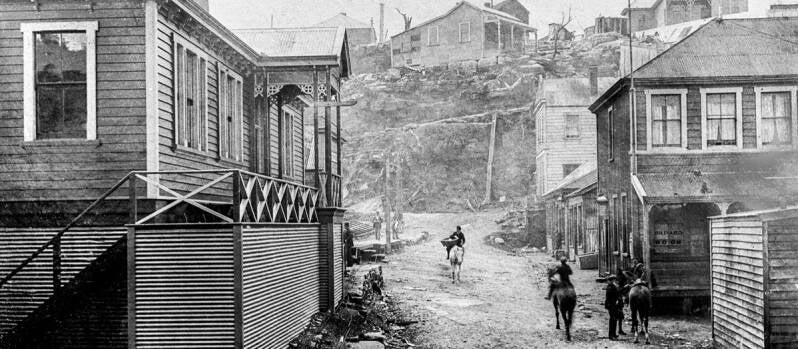
The Gapper family are related through Ethyl Jackson Scott’s brother, George Mackay Scott, and it is an interesting story that was alluded to earlier. It gives an insight into the life and conditions faced by an immigrant family that is fairly typical in my family tree. We will start with.
Bernard Gapper.
Bernard Gapper was born on September 26, 1805, in Chideock, Dorset, England. He was the son of Bernard Gapper, who was born in 1765 in Winsham, Somerset, England, UK, and Elizabeth Gapper (born Hallett), whose birth took place in 1775 in Chideock, Dorset, England. Bernard was baptized on January 1, 1806, in his hometown of Chideock. He had three siblings: Francis, Amelia, and Ann Eunice.
Bernard was born into the early 19th century rural England, a period characterized by the agrarian lifestyle that dominated Dorset. His birth in 1805 placed him within the Georgian era under King George III's reign, during which time Britain was embroiled in the Napoleonic Wars (1803-1815). The war affected trade and daily life but also fostered a sense of British nationalism. Bernard's baptism in January 1806 coincided with the aftermath of the Battle of Trafalgar (1805), a significant naval victory for Britain.
England at this time was experiencing social changes brought about by the Industrial Revolution. While still largely an agrarian society, especially in places like Somerset, the country was rapidly industrializing, leading to urbanization and shifts in traditional work patterns. This is reflected in his occupations of farmer, yeoman and a clothier in Winsham.
On October 20th. 1827, Benard married a 26-year-old Mary Ann Cordilla Dally at Winsham, Somerset, England, where she had been born on June 24th, 1801, to Samuel Dally and Mary Trenchard.
The following year Francis Henry Gapper was born to the couple, followed in 1829 by Mary Cordilla Gapper, who unfortunately died when she was eight days old. They were followed by Samuel Edward (1830), Carrington (1833), and another daughter also named Mary Cordilla in 1834. Carrington died in 1836, and three years later Anna Eunice was born, followed two years later by Amelia Elizabeth (1841).
That same year the family emigrated to New Zealand, departing from Gravesend on 18 December 1841 for Wellington and Nelson aboard the sailing ship Clifford. It arrived at Nelson on 11 May 1842. At the time of their departure on a 5-month voyage Benard was 36, his wife Mary was 40, and their five children Francis (13) Samuel Edward (11) Mary (7) Eunice (1) and Amelia (6 weeks). He was assistant surgeon on board.
Benard was one of the early settlers in Nelson and had a farm at Appleby, the Axe Farm, Waimea East, Nelson. He had a large family, as he and Mary had two more sons while in Nelson, Carrington in 1844 and Theophilus in 1849.
Like other settlers they underwent their share of the privations which followed the breaking-up of the New Zealand Company. He was drafted as one of the constabularies to go to the Wairau at the time of the massacre and stood third in the canoe which crossed the stream towards the Māori position and saved the life of Lieutenant Howard by shooting a native who was in the act of firing his piece at the Lieutenant. The next shot that was fired by the natives took effect in Mr Gapper's right hind, which it smashed, and for treatment of this wound he spent a considerable time in Wellington hospital. Subsequently he was appointed second officer of H.M. Customs (under Mr Logie) at Nelson, and was a member of the Stoke Roads Board, but afterwards resigned and settled on his farm in Waimea East district. Mr Gapper suffered from heart disease for 47 years and died on his farm on August 31sr, 1869 when he was 63 years old.
On the death of her husband, Bernard, in 1869 Mary was appointed his executrix. She passed away in 1892 age 91. Her death notice read:
DEATH. Mary Gapper. December 13, 1892, at her residence, Appleby, Mary, relict of the late Bernard Gapper, in her 92nd year.
Another very old colonist passed away at Nelson yesterday in the person of Mrs Mary Gapper, mother of Mr S. E, Gapper, of Masterton, The deceased lady was a native of Winsham, in Dorsetshire, England, and was born on 24th of June 1800, and had therefore attained the rather unusual age of 92. She left England with her husband (the late Mr Bernard Gapper) in the ship Clifford in December 1841 and arrived in Nelson in May 1842. At the Wairau massacre in 1849, Mr Bernard Gapper was one of the few to escape death, but he was so severely wounded that he was almost unable to do anything up to the time of his death. This threw the burden of bringing up and caring for a young family almost entirely on Mrs Gapper's hands, and with the true pluck of the pioneers of New Zealand, she did not shrink from her task, and in her declining years had the felicity of seeing all her children comfortably settled in life. The late Mrs Gapper leaves four sons and three daughters to mourn their loss. One of the daughters is the wife of Mr Gower, a well-known Foxton resident, and another is married to Dr Rockstrow of Palmerston North.
Bernard Gapper
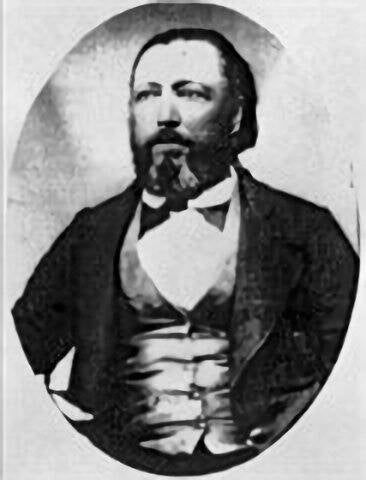
Mary Ann Cordilla Dally
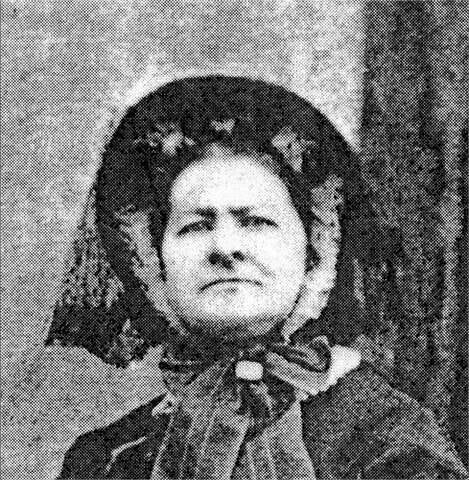
It is worth looking at the Rockstrow’s from some of the accounts of the time before moving on.
Anna Eunice Rockstrow (formerly Gapper) was the second daughter of Benard and Mary Gapper and was 1 year old when they emigrated to New Zealand. Anna had been born on 20 April 1839, and christened on 16 May 1839 at Norton, Hamden, Somerset, England, United Kingdom.
On 27 June 1867 Anna Eunice Gapper and John Frederick Rockstrow were married on the West Coast. Dr. Rockstrow was born in Prussia and came to the Colony early in life. The earliest days he spent on the West Coast and at Nelson. He was not entitled under British medical laws to practice in New Zealand, although he was thoroughly qualified in Germany, and refused to sit for examination under those here.
In 1873 he was invited by Sir William Fox, then Premier, to settle in Foxton, and as an inducement he was commissioned to act as medical officer to the Natives along the Coast, from Horowhenua to Rangitikei. It was an enormous district to cover; the roads were extremely bad at certain seasons of the year, and swamps and heavy bush had to be traversed, over roads that were up to the horse's girths in mud, but it gave Dr. Rockstrow a wide circle of acquaintances and an immense influence with the Natives and their chiefs.
Dr. Rockstrow paid his first visit to Palmerston North two days after Dr. Spratt (then resident medico in Palmerston) had left, and an effort was made to secure his services permanently, but Foxton was a much more convenient centre from which to work his Native practice, there being at that time large numbers of Māori at Horowhenua, Moutoa, and Motuiti, and he therefore determined to remain at the port which gave every promise of being the more important town of the two. The late Doctor also had a large practice among European settlers on this Coast, being for a great many years practically the only medico from Horowhenua to Rangitikei.
He entered into the public life of Foxton and filled from time to time most of the important public offices in the town. He was a debater of considerable ability, and his keen wit, vigour, and great intellectual capacity made men seek him rather as a friend than an enemy. Few men possessed a better knowledge of world politics or had a deeper acquaintance with most political questions. He continued to follow very closely German development and German politics, and he frequently was heard to deplore the tendency to misunderstand his native country. As a local politician the late doctor had shown great power in organisation. He had been a member of Manawatu County Council on many occasions, and a very energetic chairman. He was a man of warm heart and kindly disposition.
Eventually, he and his family moved to Palmerston North, where he practised his profession until his death and was also Coroner, with the exception of a short period he spent on his farm in Taranaki. He passed away quietly in his sleep on 30 May 1913. Notwithstanding his advanced age (79), he was fairly robust in health, and his intellect was keen and alert. The deceased in many ways was a remarkable personality, whose many excellent qualities were perhaps better known to the earlier inhabitants of the district, and most highly appreciated by those who lived here in the pioneering days, when unselfishness and self-denial were expected of men.
Anna Eunice Rockstrow, one of the earliest pioneers of the Manawatu, passed away on 7th December 1914, leaving a family of seven are left to mourn her loss, the eldest being Capt. J. F. Rockstrow, of the N.Z. Staff Corps. She is buried adjacent to her husband John Frederick and son William Caspari Rockstrow, in block 40 plot 33 of the Terrace End Cemetery, Palmerston North.
It is, however, Benard and Mary’s second son Samuel Edward Gapper that provides the link between the Gapper family and ours, and his life story is far from ordinary.
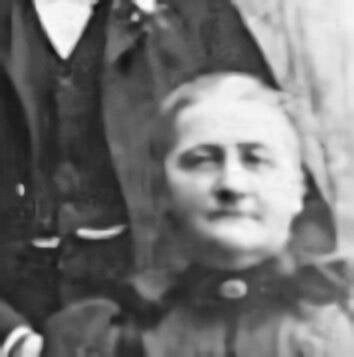
Anna Eunice Rockstrow (formerly Gapper)
John Frederick Rockstrow
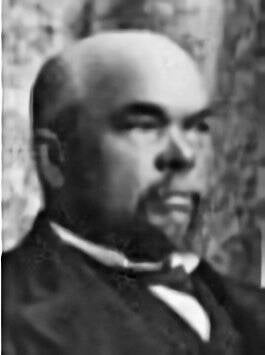
Samuel Edward Gapper.
As we have heard, Samuel was born on October 1st, 1830, at Winterborne Kingston, Dorset, England. He was eleven years old when he emigrated with his family to Nelson, New Zealand.
He was one of the very early colonists, having come to Nelson with his parents in 1842, when there was practically no settlement. He remained at Nelson for some years, before he moved to Masterton. Being of an inventive turn of mind, he directed a good deal of attention to the improvement of agricultural machinery and was the original patentee of the elevator attachment to threshing machines. Business in connection with this work took him to England by the ill-fated steam clipper ‘Royal Charter’, which was shipwrecked at Dulas Bay, Anglesey, Wales on Oct 26, 1859, during a hurricane. The ship broke up after having been driven on to rocks, and he was one of the few survivors of the several hundred on board, while about 450 died. The exact number is not known, as the complete passage list was lost in the wreak. The survivors, 21 passengers and 18 crew members, were all men, with no women or children saved.
In England he married Emma Bridge, a sister of one of the passengers who was drowned, on October 10, 1860, at Salford, Lancashire, England. They returned to New Zealand aboard the ship Morning Light, arriving at Victoria, Australia in January 1861, and Auckland, New Zealand the following month.
There is some debate as to whether the couple had children or not, but Emma (Bridge) became sick, and Samuel employed a young maid to assist them. She was also an Emma,
Emma Kate Gyllencreutz, was born in Dunedin on 29th August 1867. Her parents were English, but her grandfather’s family came from Sweden. She was only seventeen when she became pregnant, and on January 14th, 1886, gave birth to a daughter Blanche Adeline Gapper at Masterton. Blanche lived with Samuel and Emma(s) as a daughter and was not adopted or fostered out. At the age of 24, she married Frederick William Good in Wellington, where she had two sons. She died in Auckland in 1965.
Samuel’s business continued to prosper, and he was elected mayor of Masterton on one or more occasion. But in 1890 his wife Emma died at Masterton, and the following year on August 3rd, 1891, he married Emma Kate Gyllencreutz at the Wellington Registry Office. He was 60 years old, while Emma Kate was 23, an age differential so great that my database insists that it (and subsequent events) is a mistake.
On November 14th, 1892, they had a son, Frederick Edward Gyllencreutz Gapper. He became a dairy farmer at Opunake and never married. Then on January 22nd, 1897, when Samuel was 66 years old and Emma Kate was 29 years old, they had a daughter Emma Kate (Nemmie) Gapper.
Samuel died that same year, on August 2nd, 1987, in Masterton while Emma Kate (his wife) lived to see both of her daughters marry before she died in Opunake, Taranaki, New Zealand, (presumably at her son’s farm) on March 7th, 1949, aged 81.
Samuel Edward Gapper
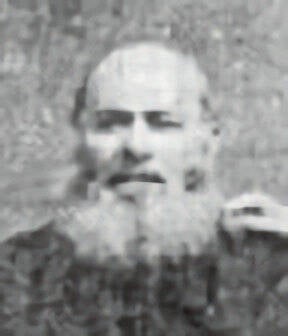
Emma Kate Gyllencreutz
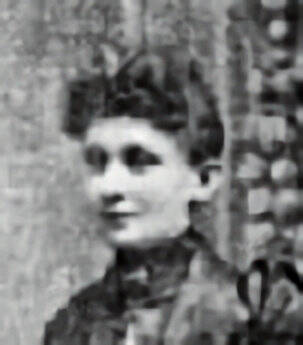
Emma Kate (Nemmie) Gapper.
Emma Gapper (Samuel’s daughter) was born on the 23rd of January 1897, at North East Valley, Dunedin. She was only 7 months old when Samuel died in Masterton.
On the 5th of April 1920, at the age of 23, she married George Mackay Scott in Wellington. George was my granduncle, Ethyl Jackson Scott’s brother. The couple had one daughter, Norrine Margaret (Billie) Scott, born on October 30th, 1920, while the couple were at Eltham in the Taranaki region. In keeping with the Gapper tradition, this was unexpectedly soon after their marriage.
George Mackay Scott, his wife Emma and their daughter Norine Margaret (Billie) Scott, have been described earlier in this section.
The couple retired to Raumati South, where George died in November 1975, and Emma died in November 1984, at the age of 87 years old. They are both buried in the Levin Old Cemetery, in Levin.
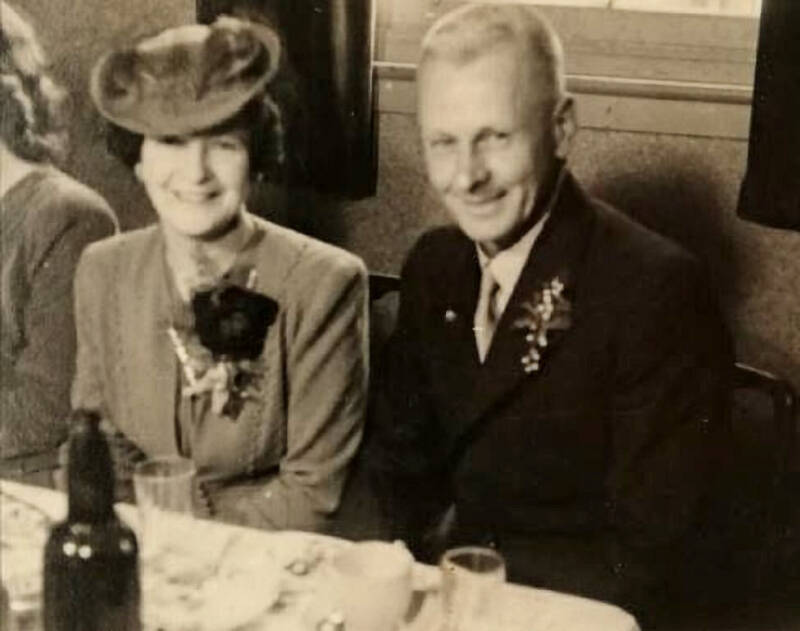
My Maternal Ancestry.
The major families in my mother’s family tree, on her father’s side are:
- The Falleni family
- The Gini family
While on her mother’s side, there are:
- The Morley family
- The Williams family
- The Higgs family
- The Holtham family
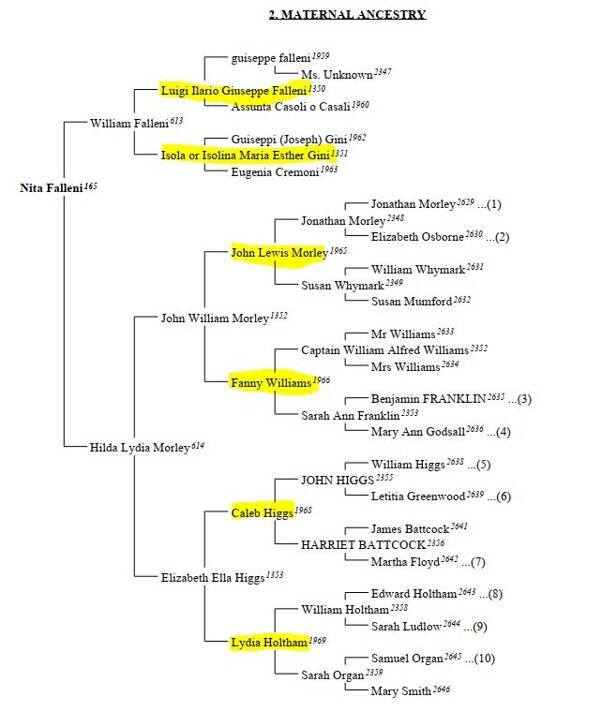
My Mother’s Family.
Mum was born Nita Falleni, on the 9th of December 1922, in Wellington. Her sister, Hilda was also born in Wellington, on 17th November 1924. They grew up as part of a traditional Island Bay Italian family. Their mother, Hilda Lydia Morley, had married William (Sonny) Falleni on December 27th, 1921. I never knew Mum’s father, he died before I was born, and her mother I knew only as ‘Nana’.
William was born in New Zealand (presumably Wellington) on November 28th, 1889, and died in Wellington on May 13th, 1941. Prior to the war he was a brick burner, and afterwards he operated a carrier business. Certainly between 1911 and 1914 he was listed as a brick burner living at 3 Somerset Avenue, Wellington South with other family members.
He enlisted during the First World War, and in December 1916 he embarked from Wellington with the New Zealand Expeditionary Force bound for Plymouth. He couldn’t have been in action for long before he was wounded with shrapnel to the chest, received while a Trooper in the Somme. He later told his children that the horse saved his life, as he took shelter between its legs as it lay in the mud and took the force of the shelling that tore up the area around them. Ultimately these wounds would cause his early death.
Returning to Wellington, William took over the family carrying business from his father Luigi, but after the war he was never really well, often bad tempered and irritable. However, he met ‘Nana’ (Hilda Morley) while she was working in a bakery in Wellington, and he was making deliveries there. They were married on December 27th, 1921.
William’s health continued to decline, and in 1936 the family shifted into a new state house at 29 Trinity Avenue, Lower Hutt. By then he had two daughters, Nita born December 9th, 1922, and Hilda, born November 17th, 1924. The only reference I can remember Mum making to it was that he ‘returned from WWI with half his stomach replaced by plastic tubing’. It was the sort of information that you accepted unquestioningly as a child. They lived there for five years before his death on May 13th, 1941.
There is a gap in my knowledge of Nana and the two girls she raised after Sonny’s death until the time her daughter Hilda married, but it must have been really hard raising two girls on just a widow’s pension. After Hilda married Norman Roy (Tom) Strange, Nana lived with them and their four boys until her death.
Amongst Mum’s old photos I came across a dashing young soldier in WW1 uniform. Tony and I are picking that this is William (Sonny) Falleni.
Of Williams siblings there are
- Eugenia "Nina" Falleni (1875-1938)
- Lisa Falleni – who was left in Italy when they emigrated.
- Federigo Ferruccio Falleni (1880-1880) born and died in Whanganui.
- Ida/Eda Marguerita McCutcheon (born Falleni) born 1882 in Whanganui.
- Marie Rose Crawford (nee Spencer born Falleni) (1883-1931).
- Emilia Maria Ginilia Haywood (born Falleni) born in Wellington in 1885
- Giuseppe Ilio Falleni born in Wellington in 1886
- Gimi Alfriedo Falleni born in Wellington in 1889
- Louis Hermandos Falleni (1892-1959)
- Alberto Georgio Falleni (1894-1894)
- Anita Mary Latta (born Falleni) (1895-1969)
- Lillian Mary Murray (born Falleni) (1897-1938)
- Lily Falleni (1898-1972)
- Henry John Falleni (1900-1987)
- Elvira Olive Falleni (1902-1902)
So many aunts and uncles I have never met or have no knowledge of! You would think that knowledge of or contact with the Falleni family in New Zealand would have been easy, given that there were so many of them with an uncommon name. But this is not so. Obviously, Mum kept in contact with one or two by letter, but this petered out when she died. And they seem to have specialised in keeping under the radar in terms of news and online histories, at least as far as my searches are concerned.
My brother Tony and our cousins say the same. He can recall some older aunts of our mothers visiting and sitting out in the sun chatting; and visiting one at mealtime and seeing a meal of pasta for the first time, then being told that it was too spicy for a child. Strangely, the only Italian-type food we had as children was spaghetti with a cheese sauce.
It seems to be a characteristic of the Falleni family, they keep themselves to themselves. Their recent history is as obscure as their origins. It has only been recent refinements in my DNA analysis that have identified substantial amounts of ‘Italian’ identified in its ethnicity. This, coupled with the lack of family history prior to Giuseppe Falleni in Ardenza and the fact that they left Italy in the period after the Garibaldi Wars, make me wonder if in fact the family didn’t originate elsewhere. Maybe that would explain where some of the wider spread of my ethnicity comes from? So many unanswered questions!
DNA analysis really is a moving feast, as databases grow, techniques are refined and increasingly, subgroups can be associated with places of origin. But by the latest estimates,
- 27.7% of my DNA comes from England, mostly from my mother through the Morley family.
- 17.3% of my DNA comes from Scotland and Wales, all exclusively from dad through the Watsons and Scott’s.
- 15.7% of my DNA comes from Northern Italy, and my mother's DNA. At least that makes sense.
- 14.3% of my DNA comes from France reinforcing the idea that the Morley's and other ancestors came over with William the Conqueror, or shortly thereafter.
- 8.2% of my DNA is Germanic, most of that from my mother.
- 6.5% of my DNA is Dutch.
- 4.2% of my DNA is Breton.
- 1.8% of my DNA is Swedish and is exclusively from father. It seems that there might be a little bit of Viking blood mixed in with the Scottish, which is entirely consistent with what we know about the Viking colonization of northern Scotland.
- 1.7% of my DNA is Southern Italian, again exclusively from my mother. Now there is a surprise, given that the only Italian ancestral origins I know of are in Northern Italy. This may well be some of that ancient DNA showing up.
- 1.4% of my DNA is Dannish, which could either be a spillover from the Germanic content or reflect their settlement in England in medieval times.
- 1.2% of my DNA is Spanish, Catalan and Basque, an unexpected addition that may be explained further in my next section, looking further back in history.
This is certainly an area where a wealth of information and knowledge is becoming available, and one that I intend to pursue further.
Here is the very little that I know of the Falleni family history:
Nita Falleni (1922-2003) and her sister Hilda (1924-2009) were born in Wellington to William (Sonny) Falleni and Hilda Lydia Morley. William and Hilda were married in December 1921, after William had returned from military service in WWI. Given that Nanna’s family (the Morleys) came from Hawkes Bay, it would be great to know how she ended up living and working in Wellington, but that too seems to be shrouded in the mists of time.
Falleni Ancestry
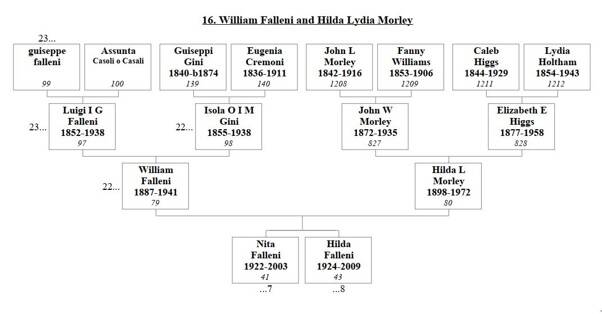
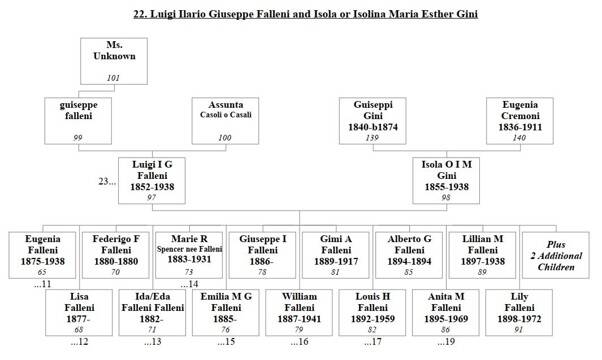
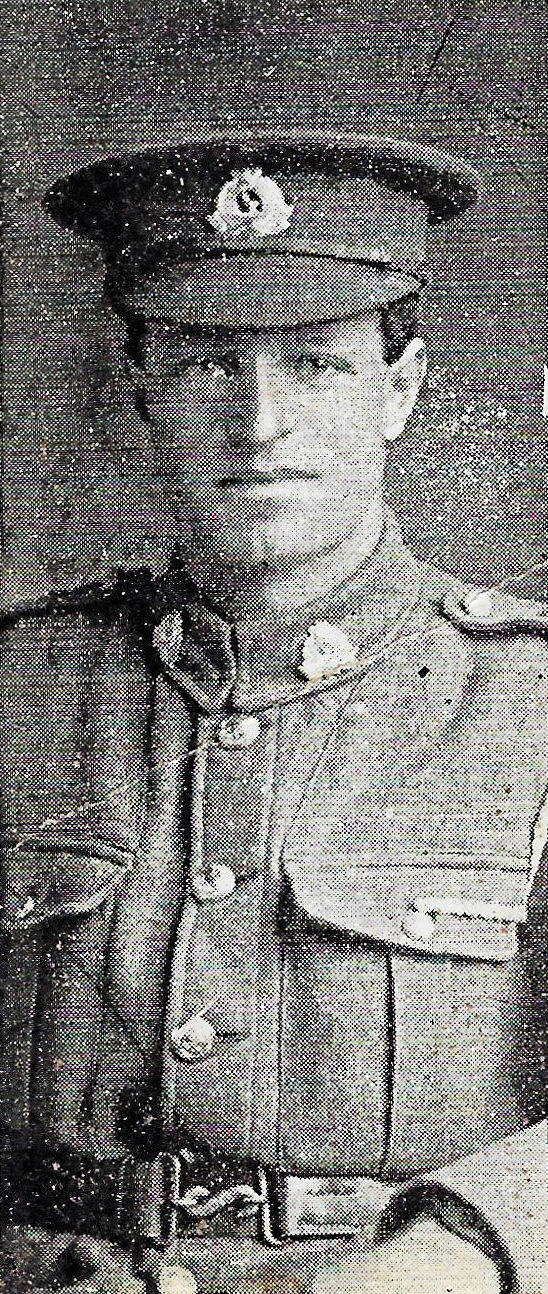
It seems that there is yet another skeleton rattling around in the family cupboard. The Falleni family history gets complicated, and more than a little controversial for the times. They came from a small town called Ardenza, just outside Livorno in Italy. They had left Italy in the period after the Garibaldi Wars (that is during the Risorgimento or period of Italian unification) along with 5 or 6 other families who may have chosen to leave due to their political affiliations. Or so I thought. As is often the case in History, when I started to research it, it turned out to be a bit more complicated than that.
Ardenza, Italy.
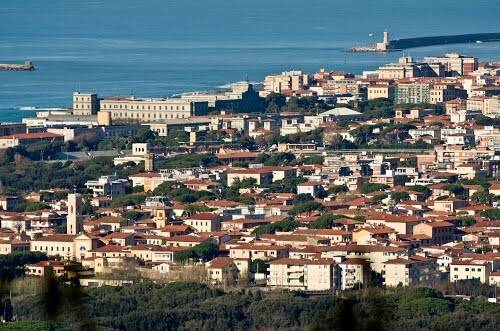
The unification of Italy or the Risorgimento (‘Resurgence’), as it is known in Italy, was a process which occurred across the Italian peninsula and the Plain of Lombardy in the middle of the nineteenth century and resulted in the emergence of a unified Italian state in 1861. The Risorgimento saw Italy formed into a unified state after being divided into over a dozen or at times dozens of small states since the High Middle Ages. Unification came about owing to the romantic nationalist sentiment that swept across Europe in the middle of the nineteenth century particularly during the revolutions of 1848. However, it brought great social problems to Italy, as new landholding and economic reforms were introduced. These led to grinding poverty across what was already one of the most over-populated regions of Europe at the time. As a result, a mass exodus of people from Italy began. Between unification in 1861 and 1920, it is estimated that fifteen million people left Italy, creating the vast Italian diaspora in countries like the United States and Argentina in the process.
Two major wars were fought to bring about Italian unification, the first between March 1848 and August 1849, and the second in 1859. The second was particularly significant as the French allied with Sardinia, allowing for the conquest of much of Austria’s territory in northern Italy. This was then handed over by the French to Sardinia in return for the ceding of Savoy and Nice in what is now south-eastern France to the French. Following this, Sardinia was in a position to unite some of the other larger Italian states such as the Duchies of Parma and Modena and the Grand Duchy of Tuscany under its rule. In 1861 King Victor Emmanuel II of Sardinia was then declared the first ruler of a united Kingdom of Italy. Rome remained under the direct jurisdiction of the Papacy, but with the outbreak of the Franco-Prussian War in 1870 and the removal of French troops from the city, it was occupied by the Italians, thus completing the Risorgimento.
Although detailed records are not available for the period prior to 1876, it is generally accepted that the period between 1861 and 1920 saw approximately fifteen million people leave Italy and move abroad, and certainly between twelve and sixteen million. This was most intense between the mid-1870s and the early 1910s, after which the outbreak of war in Europe saw a drastic decline in migration. The migration was driven by a wide range of factors, notably the fact that as one of the most urbanized parts of Europe for centuries it was also relatively over-populated. Consequently, when vaccines and other innovations in healthcare saw a steep decline in infant mortality and rising life expectancies across Europe in the nineteenth century, the population ballooned and placed enormous pressure on the new country’s ability to support and feed so many people. In tandem, the introduction of new economic policies which were skewed in favour of northern Italy by the House of Savoy fuelled migration.
The result was one of the largest waves of emigration out of any country in human history. The migrants left from all parts of Italy, not just the poorer regions in the south which are stereotypically viewed as the main origin points of Italian migrants. 1.7 million people, for instance, left the Venice and wider Veneto hinterland in the north-east between 1876 and 1900, though the source of migration shifted southwards from the 1890s onwards, with over two and half million people leaving southern Italy and the island of Sicily between 1900 and 1914. Poor old Giuseppe and Luigi! It is no wonder their families were struggling.
Giuseppe Falleni was a coach driver and married Asunta Casali. Their son, Luigi, also a coach driver, married Isola Gini at Livorno in 1873 when he was 22. Isola was a tailoress and described as ‘a woman universally loved’. She had 22 children, including two sets of twins. The oldest, Eugenia, was born in Ardenza, as was the second child, a girl called Lisa. Lisa had to be left behind in Italy when they emigrated, because at that time it took 3 or 4 months to come to NZ by sail, and it was too long a journey for someone so young. She was left with two of her fathers-in-law sisters who raised her. Later, when offers were made to bring her out, they were refused, as she had become too attached to the sisters. Eventually, contact was lost with them all.
I had always wondered how they even heard of New Zealand, much less decided to emigrate here, but it appears that Isola’s mother had remarried to a Vincenzio Buti before coming out here, and they were living in Wanganui. So once in New Zealand, the Falleni’s first settled in Wanganui, working as fishermen. They then moved to Wellington, settling into the Italian community at Island Bay, where Luigi worked as a carrier with a horse and cart, moving furniture or fruit and vegetables from the markets, or delivering goods to shops. His sons Sonny and Darky did the same. By all accounts, Luigi was a hard man.
Eugenia Falleni
Now Eugenia, the eldest daughter was proving to be a handful. Although all of the kids were schooled, she kept running away to work at the stables, or the docks. Later, when older, she would dress as a male and work in brickyards, stables, or docks. The family weren’t too happy about this, and more or less disowned her. In an attempt to settle her behaviour down her father arranged for her to marry a Braseli Innocente, and they moved to Auckland. Obviously, this was a disaster which was doomed for failure, and the marriage was quickly annulled, supposedly on the grounds that Braseli was already married!
Eventually, she ran away to sea as a (male) cabin boy called Eugene Falleni. After several years at sea her true sex was discovered, and she was repeatedly raped by the ship’s captain before being dumped at the next port of call (Newcastle, Australia), penniless and pregnant.
In the same year she gave birth to a daughter, Josephine Crawford Falleni, in Sydney, and put the child into the care of an Italian-born woman, Mrs. de Angeles. She soon took on a male identity as ‘Harry Leo Crawford’, of Scots descent, visiting his daughter only infrequently.
After a series of manual jobs in meat works, pubs and in a rubber factory, in 1912, Falleni entered the employ of a Dr G. R. C. Clarke in Northern Sydney. It was there that he met Dr Clarke's beautiful housekeeper Annie Birkett, who had been widowed several years before and left with a 13-year-old son to support. To Annie, Crawford was a handsome man who paid her vast amounts of attention whilst ignoring the advances of the other female staff.
Annie and her son left for Balmain where Annie used some of the money she had to set up a confectionery shop. Falleni followed her there and on 19 February 1913, after a brief courtship, they were married. Soon after their marriage the couple moved to Drummoyne where Falleni worked in hotels and factories at various kinds of work.
In 1917 Annie was told by a neighbour that Falleni was a woman. She confronted Falleni about it and he refused to confirm his birth sex, fearing that Annie would tell the police and have him arrested. Soon after this time it appears that Annie resolved to end the marriage whilst Falleni opposed this.
On 1 October 1917 at a picnic near Lane Cove River the two of them quarrelled after Annie revealed her intention to leave him as she could not continue the marriage with the knowledge that her husband "was a woman." At some point during the argument Annie slipped and fell backwards hitting her head on a rock and died within minutes. A distraught Falleni panicked over what to do with Annie's body, and resolved to dispose of it, choosing to burn it with the aim of making it unidentifiable. He feared that if Annie's body was identified, he would be arrested, and his sex would be revealed.
Annie's body was discovered in scrub land but not identified. When Annie's son asked Falleni about his mother's absence, Falleni replied that she had run off with another man.
In 1919 Falleni met Elizabeth King Allison, known as Lizzie, and fell in love. They married at Canterbury in September 1919 with Falleni giving his name as Harry Leo Crawford, place of birth as Scotland and his occupation as mechanical engineer. Lizzie was over fifty years of age at the time.
Falleni was arrested at a hotel on 5 July 1920. At the time of his arrest, he asked to be placed in the women's cells. He had been living with Lizzie in a house in Stanmore but requested that his wife be not apprised that he was not a man. Among male clothing in a locked leather suitcase, police located an ‘article’, later exhibited in court, made of wood and rubber bound with cloth in the shape of a phallus or dildo.
At the end of the hearing Falleni was committed for trial and refused bail. At Falleni's trial for murder in October 1920, the ‘Man-Woman case’ created a press sensation, with the accused appearing in the dock first in a man's suit and then in women's clothes. Falleni pleaded not guilty to the murder, but the Jury only took two hours to reach their verdict, and he was convicted and condemned to death. Falleni's sentence was commuted to imprisonment for life but his alleged immorality in passing "herself" off as a man was made much of in the popular press, which portrayed him as a monster and a pervert.
Friends of Falleni and 'prison reform workers' petitioned 'on several occasions' for his release and in February 1931, he was granted his freedom on the basis that he was nearly sixty years old and 'not of robust health'. Falleni assumed the name "Mrs. Jean Ford" and became the proprietor of a boarding house in Paddington, Sydney. On 9 June 1938 he stepped off the pavement in front of a motorcar in nearby Oxford Street and was struck by it and died of his injuries the following day in Sydney Hospital. He was only identified through fingerprint records.
His story has been taken up in Australia by a number of artists, playwrights and short film makers, museum and photography curators, and academics with an interest in gender studies. A new edition of Suzanne Falkiner's book, Eugenia: A Man, summarising new information, was published in 2014. A play based on the life of Eugenia by New Zealand playwright Lorae Parry premiered in the United States on March 1, 2012.
Eugenia Falleni
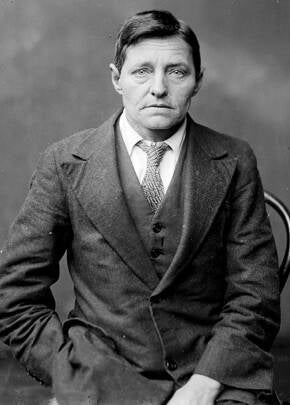
Annie Birkett
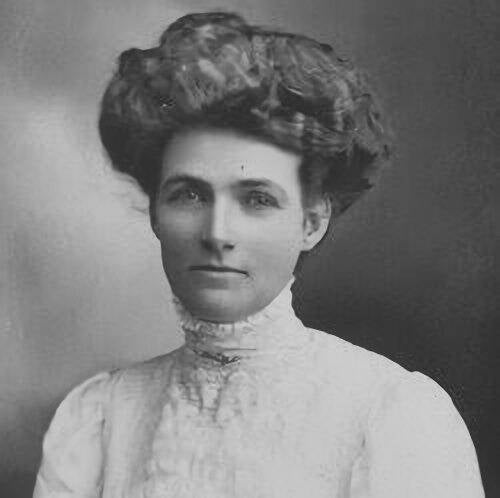
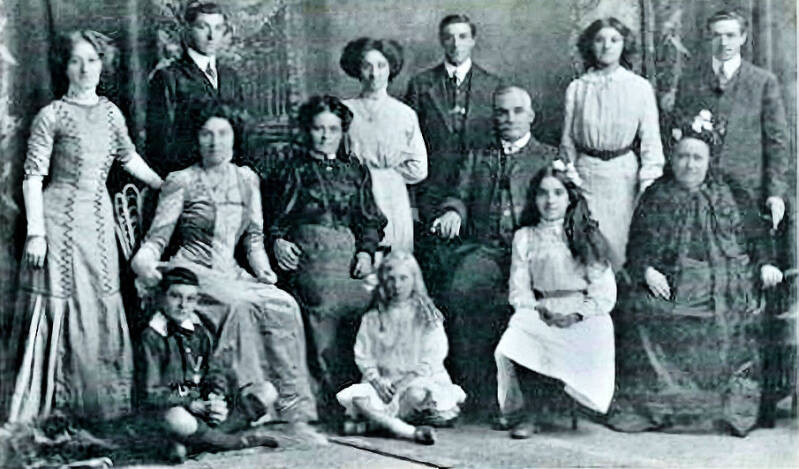
Falleni Family, New Zealand, about 1910.
Of William’s other siblings, all I know is:
The second child of Luigi Ilario Giuseppe Falleni and Isola or Isolina Maria Esther Falleni (born Gini) was a girl called Lisa, also born in Adenza, a suburb of the coastal town of Livorno, near Pisa. Lisa had to be left behind in Italy when they emigrated, because at that time it took 3 or 4 months to come to NZ by sail, and it was too long a journey for someone so young. She was left with two of her fathers-in-law sisters who raised her. Later, when offers were made to bring her out, they were refused, as she had become too attached to the sisters. Eventually, contact was lost with them all. Her fate is unknown.
Federigo Ferruccio Falleni was born while the family was in Whanganui on the 27th of April 1880. He died when he was 7 months old on November 16th, 1880.
Eda (or Ida) Margarita (Eadie) Falleni was born on the 15th of January 1882 in Whanganui. After the family moved to Wellington, she met and married Hugh McCutcheon, a tailor’s cutter, on December 24th, 1902. They had a daughter, Elsie Dulcimer McCutcheon born in Wellington on April 21st, 1904. Hugh had been born in Maybole, Ayrshire, Scotland in 1870 and his family had emigrated to Dunedin when he was less than a year old. He died in Dunedin in 1934, and Eda died in 1972.
Rose Minnie (Rosie) Falleni was born as Marie Rose Falleni, (also known as Mary) in Wellington on the 27th of June 1883. She married Ernest Roland Spencer in Wellington, New Zealand in 1913. As was reported at the time:
‘On Wednesday afternoon, at the residence of Mr. L. Falleni, the Rev. W. Shirer officiating, Miss Rose Falleni, third daughter of Mr. and Mrs. L. Falleni, of Somerset avenue, Wellington, was married to Mr. Roland Spencer, son of Mr. and Mrs. E. Spencer, of this city. The bride, who was given away by her father, looked charming in her cream lace gown, and carried an exquisite shower bouquet. The bride's brother, Mr. L. Falleni, was best man. After the ceremony the guests were received by the bride's parents, when the usual toasts were honoured. Many useful presents were received by the bride and bridegroom.’
Their son, Ernest William Spencer was born in Wellington on April 27th, 1917. I found the following biography of Ernest Rowland Spencer published online.
1918 INFLUENZA KARORI CEMETERY
SPENCER, Ernest Roland
Born 9 December 1889;
died 18 November 1918;
buried 20 November 1918; age 28
Two brothers died of the flu in Wellington within three days of each other. They were Ernest Roland SPENCER of 12 Herald Street, Berhampore and Enoch Harold SPENCER of 5 Hugh Street, Newtown. Both were admitted to Wellington College Temporary Hospital from their homes and were buried in the same plot in Karori Cemetery.
Ernest Roland Spencer was born on 9 December 1889 in Wellington, the fifth child of Enoch Spencer and Harriet HITCHENS. Harriet was born on 14 July 1862 in Wellington, daughter of Joseph Hitchens and Elizabeth BEVAN. Ernest’s father, Enoch Spencer Snr, was born on 10 March 1860 in Wellington, son of Edmund Spencer and Ann Frost SAUNDERS.
Enoch and Harriet were married on 12 July 1882 in the Wellington Registry Office and raised a family of nine children: Enoch Harold (b1883), Alice Harriet Winifred b1884, Amelia Annie b1886, Edmond Joseph b1888, Ernest Roland b1889, Lionel Albert b1891, Ethel May b1895, Henry Gordon b1896, Leonard William Bevan b1901. In the early Electoral Rolls, Enoch was listed as a brickmaker, living at Wright Street, Mt Cook.
As the family was living in the Mt Cook suburb of Wellington, Ernest and his siblings would have attended Te Aro Infants School and later Mt Cook Infants. From there the brothers would move to the Taranaki Street Boys’ School, and the sisters to Buckle Street Girls’ School. In the 1911 Electoral Roll for Wellington South, Ernest was living with the family at 5 Salisbury Terrace, Mt Cook, and his occupation was listed as coach painter.
His future wife was Rose Mary FALLENI, daughter of Luigi Falleni and Isola GINI. Luigi and Isola came from Livorno, a port city on the Ligurian Sea on the western coast of Tuscany, Italy. They had a family of 22 children, of whom 17 would make it past childhood. Luigi and Isola had arrived in New Zealand on the Waikato on 8 August 1877, as part of the Assisted Emigration into Canterbury. Luigi, a coachman, Isola and daughter Eugenie aged 3 were listed on the ship’s manifest. A number of the children born in Italy did not come out to New Zealand at this time. After the parents’ arrival in New Zealand, a further nine children were born. Rose Mary (registered as Marie Rose) was born in 1883 in Wellington. Rose’s parents celebrated their Diamond Wedding Anniversary in Wellington in May 1933, (they were married in Leghorn, Italy in 1873). Luigi died in June 1938, and Isola died in July 1938; both are buried in Karori Cemetery. Their daughter Rose married Ernest on 7 May 1913 at Somerset Avenue, Wellington.
In 1917 Ernest was listed on the New Zealand Army World War 1 Reserve Roll, living at 12 Herald Street, Wellington. His occupation was listed as a painter. However, Ernest does not seem to have seen active service. In 1918 Ernest became unwell with influenza. He was taken from his home to Wellington College Temporary Hospital, Mt Victoria and died on 18 November. He was buried in Karori Cemetery on 20 November 1918. His brother Enoch Harold was buried in the same plot on 24 November.
The following death notice was published:
SPENCER - On the 18th of November 1918, at Wellington College Hospital, Ernest Roland Spencer, beloved husband of Rose Mary Spencer, and third son of Enoch and Harriet Spencer; aged 28 years
Ernest and Enoch’s Headstone reads:
In Loving Memory of Enoch Harold Spencer
Beloved husband of Ellen Spencer died 21 Nov 1918 aged 35
'At Rest'
Albert aged 1 yr
Mary aged 4 months
Ernest Roland Spencer beloved husband of
Rose Mary Spencer
died 18 Nov 1918 aged 29
'So loved so mourned'
Rose Mary Crawford loved wife of R.P. Crawford
and mother of Ernie Spencer died 1 Nov 1951
Rose remarried on 1 March 1930, to Robert Paul CRAWFORD at St James Church, Wellington. When she died on 1 November 1951, she was buried with Ernest in Karori Cemetery.
Information from Penny Holden about her great uncle. Written by Beverley Hamlin
Sources:
- New Zealand Births Deaths & Marriages historical –
www.bdmhistoricalrecords.dia.govt.nz
- Newspapers – www.paperspast.natlib.gov.nz
- Karori Cemetery – www.wellington.govt.nz > Services > Community & Culture > Cemeteries
- New Zealand Electoral Rolls and family information – www.ancestry.co.uk
- Permission to use the photos is given by Penny Holden for the family
Ernest Spencer (seated, second from right) and his brother Enoch (standing, far left) at a family gathering in 1905
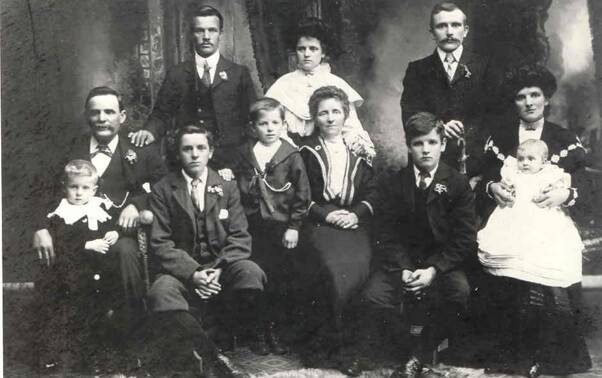
We have to go back to Ernest Roland’s grandfather, who was born in Basingstoke, Hampshire, England on June 27, 1813, to find another interesting story of emigration to New Zealand. Edmund (Ted) Spencer was a private in the 65th regiment. The 65th Regiment had the distinction of being the longest serving British infantry regiment serving in New Zealand, stationed here from 1846 to 1865.
“The men of the 65th who paraded were shaggy, bearded giants, roughly clad, with their arms in excellent order. The 65th man was a breezy, brawny giant, who moved about in loose clothes, open, chatty, and good-natured. He got blazing drunk whenever the opportunity offered, took his punishment as if it were a cup of coffee, was a perfectly wholesome child of nature, who laughed and shook hands with everyone he met. He was perfectly respectful to his officer, saluted him reverently with a twinkle in his eye, as though he would say “How goes it, Charley?” Their appearance is very different from that of the men belonging to others recently arrived. They are grave, serious, thoughtful men, with bronzed faces and flowing beards - living proofs of the healthiness of the climate. They are all in good condition and occupy one fourth more space on the parade-ground than any other regiment here.”
The regiment's official nickname was the "Royal Tigers", earned from their service in India, and the regimental badge. The Māori called the regiment the "hickety pips" after the Māori pronunciation of 65th -"hikete piwhete".
The regiment had gained honours in 'India' and 'Arabia'. They had also done service in Guadeloupe during the Seven Years' War, but this honour was not awarded till 1909. The Regiment, during August 1845 to May 1846, provided convict guards on six ships from England to Hobart Town in Van Diemen's Land (Tasmania) and two to Norfolk Island, delivering the convicts before continuing to Sydney. When disturbances broke out in the Wellington area, most of these men from the 65th and the 58th Regiments were shipped to Wellington on the Levant, arriving on 22 July 1846 (65th - 5 officers, 58th - 1 officer. 8 sgts, 7 cpls, 162 rank & file of both regiments). They would have been stationed at the Paremata Redoubt.
The construction of Paremata Redoubt, 1846-67, at the entrance to Te Awarua-o-Porirua Harbour, was commissioned by Lieutenant Governor George Grey. The redoubt was built to subdue Māori opposition to New Zealand Company immigrants settling in the wider Wellington area. In 1846 the entrance to Te Awarua-o-Porirua Harbour was a strategic military location being on the main Māori route from the west Wellington coast, via Pāuatahanui, to the Hutt Valley and Wellington.
The redoubt was built on the site of Paremata Pā, which had been occupied from about the early 1830s to about the mid-1840s, just prior to the building of the redoubt, by members of Ngāti Toa Rangatira iwi, which included the tohunga and older half-brother, Te Watarauihi Nohorua, and older sister, Te Waitohi, of Te Rauparaha.
When the first soldiers arrived on 16 April 1846, there was no accommodation provided, and the troops had to sleep in tents; the camp was on tabued ground. Barracks, to house Imperial troops, were completed in August 1847, but this was after the two fighting chiefs who were the main opponents of European settlement, Te Rauparaha and his nephew, Te Rangihaeata, had been subdued; Te Rauparaha had been captured at his kainga, Taupo, on Plimmerton beach and Te Rangihaeata had fled northwards from his pā, Mataitaua, at Pāuatahanui.
Clearance of the ruins of the barracks from late 1959 to early 1960 by the Wellington Regional Group of the New Zealand Archaeological Association revealed that they were rectangular with towers in opposing corners. The main building material was natural beach boulders, probably sourced locally, with brick quoins and window openings. The stonework had been knapped into line with a mortar made of sand, lime, and crushed seashells. The outside walls were 0.7 m thick, and inner walls were 0.5 m thick. The foundations were particularly strong: 1.1 m wide, and the lower part of the walls were 0.75 m wide to a height of 0.75 m. The ground floor had been divided into four main rooms, with a corridor leading to an entrance to the west. A small room, near the centre of the building, with walls as thick as those of the exterior, may have been an arsenal.
The two-storeyed barracks were the subject of many early European picturesque drawings and paintings. The towers had loopholes, probably to accommodate cannon, but the first shot fired so shook the fabric of the building that the gun was not used again. Further, the barracks were occupied only briefly. An earthquake in October 1848 damaged the barracks so severely that they could not be repaired and they were evacuated, and the troops were accommodated in huts. Another earthquake in January 1855 caused the upper storey to collapse.
Today the ruins of the barracks can be seen in Ngatitoa Domain.
Edmund Spencer had married Ann Frost Saunders in 1841 at Stonehouse, Plymouth, Devon, England when she was just 17 years old. She obviously followed he husband out to New Zealand, as their first child, a daughter was born in Bury, Lancashire, England in 1842, their next child, also a daughter, was born at sea, off Sulawesi Tengah, Indonesia, and their subsequent nine other children were all born in Wellington, New Zealand. It doesn’t seem that Edmund spent too much time away fighting.
Ernest Roland’s father Enoch had married Harriet Hichen at the Wellington Registry Office in 1882. They went on to have nine children in total. Her father, Joseph Hitchens was born in Darlaston, Staffordshire, England in 1828 and he married Elizabeth Beavon in All Saints Church, West Bromwich, Staffordshire, in 1851. They had three children there, including stillborn twins (a boy and a girl) before emigrating to New Zealand sometime between 1853 and 1856. They lived in Wellington until 1864, having another son and two daughters (including Harriet), before having four more children in Turakina. There is really only one thing that you can do in Turakina, and that is farming. In 1880 they returned to Te Aro, Wellington, where Elizabeth died in 1883 and Joseph died in 1905.
Back to the Falleni Family:
Emilia Maria Ginilia Falleni was born in Wellington on March 15th, 1885. She married Alfred Martyn Haywood on December 29th, 1916, at the age of 31. Alfred was a hairdresser. They had a son, Alfred Louis Haywood, born the same year, and a second son, John Costello (known as Jack) Haywood in 1919. Alfred died at 136 The Parade, Island Bay. New Zealand on October 21st, 1927, at the age of 36, and Emilia died three years later in 1930, at the age of 45.
Giuseppe Ilio Falleni was born on November 20th, 1886, in Wellington. I can find no records of him online since that date. Like several of his siblings, he remains a mystery.
Gimi Alfriedo (AKA James Joseph) Falleni was born on November 28th, 1889, in Wellington. His enlistment information for the First World War in 1914 describes him as a salesman. The 1916 electoral roll describes him as a grocer. He died in Wellington on January 10th, 1917, at the age of 27 years. Other than that, we know nothing about Gimi/James, except that he was sometimes called ‘darkie’.
Louis Hermandos Falleni was born on the 23rd of September 1892 in Wellington. He was a hairdresser by trade. On the 25th of August 1915 he married Elsie Catherine Rae, who had been born in Onehunga, Auckland and was 24 years old. Her mother had died in Auckland three years previously. They had one son, James William (Jim) Falleni, born on the 26th of March 1917 in Wellington. Interestingly, I have seen his profession listed as a Laboratory Technician, but I have no idea when or where. Louis and Elsie lived in Newtown, however in 1936 they divorced, and Louis remarried to Olga Sabina Barsotti. Olga had been born as Olga Sabina Brunicardi in Italy in 1906 and naturalised as a New Zealander in 1931. She had been previously married to Placido Barsotti, and they had a daughter, Josephine Enricetta Barsotti in 1927, and a son Leo John Falleni, born on the 16th of April 1928. Placido had died in July 1930, when Olga was 24 years old and Leo was just 2. Leo was also a hairdresser and (unless there is something I am unaware of) adopted Louis’s name and is referred to as Leo John Falleni. Louis died in Wellington on the 25th of July 1959 aged 66 and is buried in the Karori Cemetery. Olga died in February 1998 and is buried with Placido in the same cemetery.
Alberto Georgio Falleni was born in Wellington in 1894 and died the same year.
Anita Mary Falleni was born in Wellington on the 27th of March 1895. She married Robert Sidney Latta on the 25th of September 1918. Robert was a sawmiller, born in Invercargill in 1883, and they lived in Clutha, Otago where they had Robert Sidney Latta (Jr) in 1920, Dorothy Isabella Latta in 1921, who died the following year, and Edith Agnes Latta in 1923.
It was Robert’s grandfather, also called Robert Latta who had been born at the Grange Toll Bar, Alloa, Clackmannanshire, Scotland in 1830 and who emigrated to Australia where he married Jeanine Linn in 1858 at her parent’s property at Greenside near Macclesfield, South Australia. They lived at Bulls Creek, Adelaide, Australia, where Robert was variously a Dairy Farmer, Timber Merchant, and Brewer, and where they had two sons and two daughters before the family emigrated to Balclutha, Otago, New Zealand in 1863 where they had a further three sons and a daughter before Jeanine died in 1875. Robert returned to Australia, where he died in Melbourne in 1891.
Robert Sidney Latta (Snr) died in Papatowai, Catlins, New Zealand on the 12th of June 1924, at the age of 40. Two years later Anita married William Gordon Gardner. Anita died in Wellington on November 21st, 1969, at the age of 74. William died in Dunedin on the 22nd of March 1977.
Lillian Mary Falleni was born in Wellington on January 8th, 1897. She married Frank Milton Murray, an Ironmonger from Newtown on the 26th of October 1921, when she was 24. Franks grandfather Robert Murray had emigrated from Scotland as a single man, where he had been born in Kirkinner, Wigtownshire, in 1830, and married Christina Moore in Nelson in 1863. On the 1st of October 1924 Lillian and Franks daughter June Lillian Murray was born in Wellington. Lillian died on the 11th of January 1938 at the age of 41 and was buried at the Karori Cemetery. Frank remarried to Ruth Beatrice Berry in 1938 and died in Lower Hutt, Wellington in 1962.
Henry John Falleni was born in Wellington on the 6th of February 1900. On December 21st, 1921, he married Kiti Hemi Gage. Kiti Hemi’s father was David Richmond Gage, a member of the Māori Football Team (1888-89) and the third official New Zealand Captain in 1896. They had three children, Alan Patrick Falleni in 1922, Raymond Falleni in 1923, and Joyce Kathleen Falleni in 1924. Kiti seems to have dropped off the radar after this, and I can find no further records of her, or her death. Henry is listed in the 1935 electoral roll as a hairdresser, and the same year there is a record of his marriage to Gladys Lotti Adams. On May 1st, 1939, Henry was charged with negligently driving a motor car, causing death, and disqualified from driving for three years. He died in Wellington on the 19th of September 1987, at the age of 87.
Elvira Olive Falleni was born in Wellington on the 11th of September 1901 and died the following year on the 15th of October 1902.
My great-great-grandfather on my mother’s side was Guiseppi (Joseph) Gini. He was born in Italy in 1840 and married Euginia Cremoni sometime between 1856 and 1859. Euginia was born in pastoral Lari, Tuscany, Italy in 1836, just as the Risorgimento, or the Italian unification movement, was gaining momentum. She married Joseph before 1855 and they had three children, Isola Maria in 1855, Rosina (Rosa) in 1860 and Orazio in 1864, against the backdrop of the Second Italian War of Independence (1859) and the subsequent unification of Italy under King Victor Emmanuel II, as has been described (above).
Guiseppi (Joseph) Gini died in 1874, and Euginia remarried to Vincenzio/Vincenzi Buti in 1875 in Livorno. The same year the family emigrated to New Zealand aboard the ship "Herschel", leaving Italy on June 17th, 1875, and arriving in Wellington on October 23rd. Euginia had another son Guiseppe Frederigo Buti, born in 1878, but he died the following year in 1879. Vincenzio died in Wellington on the 4th of February 1908, and Euginia died at home in Somerset Avenue, Newtown, Wellington, New Zealand on August 6th, 1911.
My maternal grandmother was born Hilda Lydia Morley, in the Wairau Valley, Marlborough, New Zealand on 21st September 1898. She was bought up in Otane in the Central Hawkes Bay, where her father was a butcher. It was while they were there that her parents separated, which may serve to explain why we know so little about that part of her life (those sorts of things were not talked about in the family back then), and also why her father ended up in Wellington while her mother ended up in Gisborne. Hilda also moved to Wellington, presumably to stay with her siblings, and it was one of those quirks of fate that she was working in a bakery there when a certain ex-serviceman called William Falleni was making deliveries to the bakery, and the rest, as they say is history. They were married on December 27th, 1921. William’s health continued to decline as a result of the injuries he had received in the war, and in 1936 the family shifted into a new state house at 29 Trinity Avenue, Lower Hutt. By then they had two daughters, Nita born December 9th, 1922, and Hilda, born November 17th, 1924. They lived there for five years before William’s death on May 13th, 1941.
There is a gap in my knowledge of Hilda and the two girls she raised after Sonny’s death until the time her daughter Hilda married, but it must have been really hard raising two girls on just a widow’s pension. One of the reasons that my Mum left school and went to work (apart from needing the money) was that Hilda was still at school, and they didn’t have enough for two school uniforms. My mother never spoke about it much, but I know that it was instrumental in making her who she was. After her daughter Hilda married Norman Roy (Tom) Strange, Hilda (her mother) lived with them and their four boys until her death. I remember her as a kind, gentle, loving woman who loved her family dearly. She died in Carterton on October 15th, 1972.
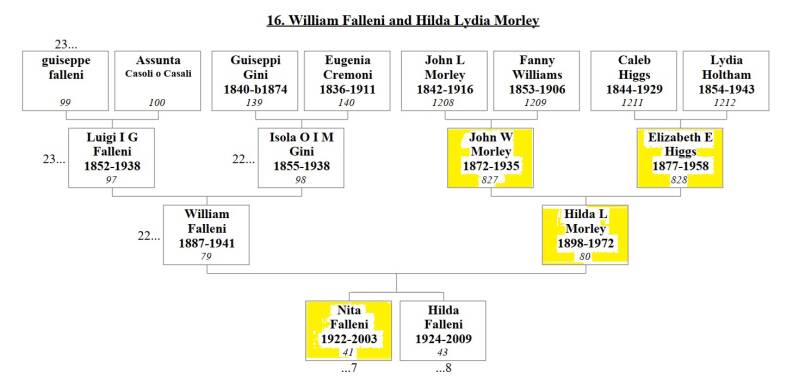
Hilda Lydia Morley was the daughter of John William Morley and Elizabeth Ella Holtham. Her siblings were:
- John William Morley. John (Jnr) was born on July 9th, 1895, in Spring Creek, Blenheim. By the time he was 21 he was living in Gisborne and working as a civil servant. He married Emma Elizabeth Greaves, a local Gisborne girl on February 11th, 1926. It was Emma’s grandparents, John Greaves and Elizabeth (nee Woodward), an Agricultural labourer, who had emigrated from Warwickshire, England, and settled in Gisborne. John and Emma moved to Ponsonby, Auckland where he worked as a Post and Telegraph employee, and they had two sons, Barry Leonard in 1926 and Lloyd John in 1930. John died on October 16th, 1954, when he was just 59. Emma survived until 1992, when she died at the age of 91.
- Rita Morley. Rita was born on the 23rd of December 1902, in Wairau Valley, Marlborough, New Zealand. On the 16th of August 1923 she married a local Gisborne lad, Dean Kelvin Mansell Hacche. Dean’s grandparents had emigrated from Devon, England to Gisborne where in 1881 his grandfather Henry was working as a carpenter. Dean and Rita moved to Wellington where Dean was a clerk, and where they had one son, Raymond Albert Dean Hacche on November 28th, 1925. Dean died on the 4th of September 1969, and Rita died on the 4th of January 1972 in Wellington.
- Vera Morley. Vera was born on October 25th, 1904, at Wairau Valley, Marlborough, New Zealand. Sometime between 1906 and 1912 they had moved to Otane, Central Hawke's Bay, Hawke's Bay, New Zealand. On September 8th, 1924, she married Angus John Binnie. Angus had been born in Sefton, Waimakariri, Canterbury, on November 7th, 1893, and was 31 when he married the 20-year-old Vera. He was working in sheep stations around Hawkes Bay and the East Coast, being a shepherd at Ngatapa in the Bay of Plenty in 1928, and the Station Manager at Tarewa Station, Gisborne, East Cape, in 1931. Angus’s grandparents were Scottish, and like some of my other Scottish ancestors, emigrated as soon as they were married (6 days in fact). They came out on an assisted passage on the 785-ton ship Gananoque, which sailed from London on February 9th, 1860, and arrived in Lyttelton on May 9th, 1860, after 85 days at sea. Vera and Angus had four children, Alexander Desmond Binnie in 1925, Noelene Alicia Rowe (born Binnie) in 1927, Bruce Denzil Binnie in 1928, and Galene Rita Quinn (born Binnie) in 1934. Vera died and was buried in Napier on the 13th of August 1966 and Angus died in Gisborne on the 17th of July 1970 and was also buried in Napier.
- Clarence Alexander Morley. Clarence was born on the 28th of December 1906 in Blenheim, Marlborough, New Zealand. After the family moved to Hawkes Bay, he met and married Phillis Kathleen Bai in 1931. Phillis was born in Waipawa, Hawkes Bay in 1912. Her father, Edward (Ted) Jorgensen Bai was born in Norsewood, Tararua, Manawatu-Wanganui, New Zealand, just up the road from Dannevirke. He was one of ten siblings, so the Bai family was well known in Dannevirke, Norsewood and Ormondville, (where they had a brickworks), and some of them are buried there. I wonder if my parents were aware of that connection. Her grandparents came from Denmark, emigrating on the ship Fritz Reuter, en route to Napier in 1895. In fact, one of her uncles, Alfred Ryn Jorgensen (Alfred Payne/Alf) Bai, was born at sea on that voyage. Clarence and Phillis had at least one daughter, Joan Hazel Morley in 1931 and they moved to Gisborne where Clarence was listed as a truck driver and mechanic in 1951. He died there on the 18th of April 1983, and Phillis followed on the 8th of July 1996, also in Gisborne.
- Noel Morley. Born 23/12/1912 in Otane (Central Hawkes Bay). Noel moved to Gisborne where he was a truck driver. I wonder if he worked with Clarence there. In World War II he was in the Airforce and trained in Canada as a wireless operator, air gunner and bomb aimer, achieving the rank of Warrant Officer First Class. On the 1st of January 1949 he married Iris Jewel Walters, a local Gisborne lass. It was Iris’s great-great grandfather John Walters, who had been born in Crowan, Cornwall, England in 1803, and who was a Surface Captain copper miner, who had emigrated with his family in 1845, first to Sydney, New South Wales aboard the barque "Agostina", and then on to Auckland onboard the barque "Isabella Anna". He worked as variously a Butcher, Farmer, and Contractor in New Zealand. Noel and Iris had one daughter, Leigh Alice Morley in 1950. Noel died on the 3rd of December 1977 at the age of 64, in Gisborne, and Iris died there on the 30th of April 2001.
Hilda Lydia’s father (John William Morley) was born 28/6/1872 in Collingwood and died 21/11/1935 in Wellington. He married Elizabeth Ella Holtham on 3/4/1894 in Blenheim. She was the daughter of Caleb Higgs and Lydia Holtham, was born in Blenheim in 1877 and died in Gisborne on 7/9/1958. That was 23 years after the death of her husband in Wellington, and she was living in Gisborne with her son Clarence, other son Noel, and his wife Iris.
Her grandfather was John Lewis Morley, who was born in Newton, Suffolk, England, around 1826 and seems to follow a familiar pattern of large families (he had 9 siblings) leaving small agricultural villages due to changing land practices and ownership. He emigrated on the ship 'Strathallan' which sailed on the 12th of October 1858 from Gravesend and arrived in Lyttelton via Timaru on the 21st of January 1859. Morley disembarked at Lyttelton. He married Maria Henrietta Smith in Christchurch in 1868. Maria had been born in London, but I can find no record of how she got to New Zealand. They had two children Arthur Lewis Morley, born in Nelson the year they were married and who unfortunately died in Motueka, Tasman, New Zealand when he was 9 years old, and Maria Henrietta Morley, born in Collingwood, Golden Bay, New Zealand in 1870 and who married Henry Fowler in 1890. They kept up the family tradition of large families, having nine children. She died at Riwaka, Golden Bay, New Zealand in 1961 at the age of 90.
John Lewis Morley was a Sawyer. He remarried in Collingwood to Fanny Williams on the 19th of August 1871. She was the daughter of William Williams and Sarah Franklin. Fanny was born on the 4th of September 1853 in Nelson, and died on the 15th of November 1906, also in Nelson. John Lewis died of heart failure in Mangapapa, Gisborne, East Coast, North Island, New Zealand on the 16th of September 1916.
John Lewis Morley (who had 9 siblings) had ten children from his two marriages, his second wife Fanny was one of eight children, and Hilda’s mother, Elizabeth Ella Higgs, was one of nine children born to Caleb Higgs and Lydia Holtham, so these branches of the family get very big, very fast.
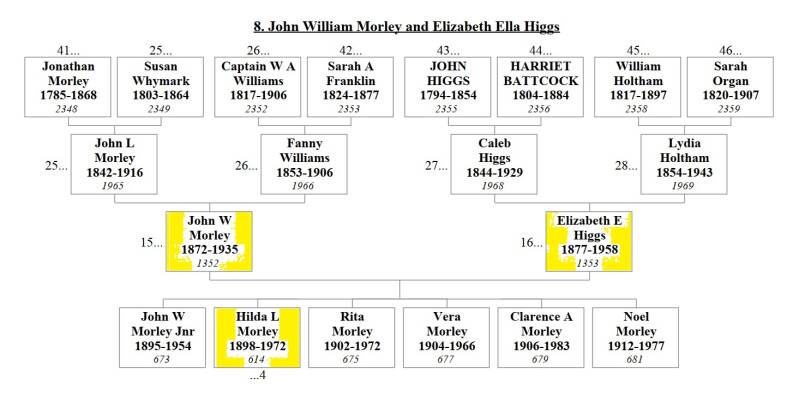
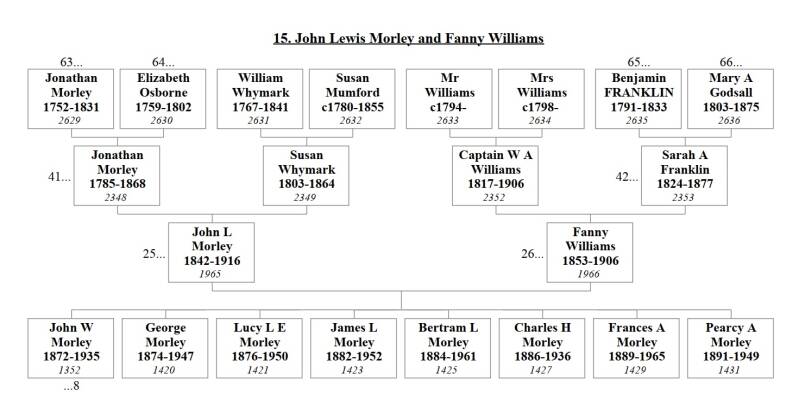
I have no personal recollections of John William Morley’s siblings. Here is what I know of them.
Arthur Lewis Morley was born to John Lewis Morley and Maria Smith on the 27th of September 1868 in Nelson. He died in Motueka, Tasman, New Zealand on the 25th of August 1878, when he was 9 years old.
Maria Henrietta Morley was born to John Lewis Morley and Maria Smith on the 21st of July 1870 in Collingwood, Golden Bay, New Zealand. Her mother died during the birth, and she was given to the midwife to look after. Her father visited her for about 2-3 years but then married one of the midwifes daughters and moved to Nelson. Maria was looked after by the midwife and her husband, called Trafford Williams and he was the ex-captain of the Collingwood pilot boat. He was strict. On one visit to Collingwood Maria escaped with the help of the Riley’s and crossed the Parapara river to meet up with her 'lover'. They travelled to Riwaka by horse and dray and stayed with her future brother-in-law. They then moved to Nelson, stayed with her real father and were married there. They then moved to Ashburton where Lorna was born.
She married Henry Fowler in 1890, who worked as a bookkeeper in his family’s drapery store in Ashburton. They had nine children before Henry died at Riwaka, Nelson, in 1914. Maria died at Riwaka on the 6th of January 1961, after celebrating her 90th birthday with her extended family.
Maria Fowler’s 90th Birthday celebration.
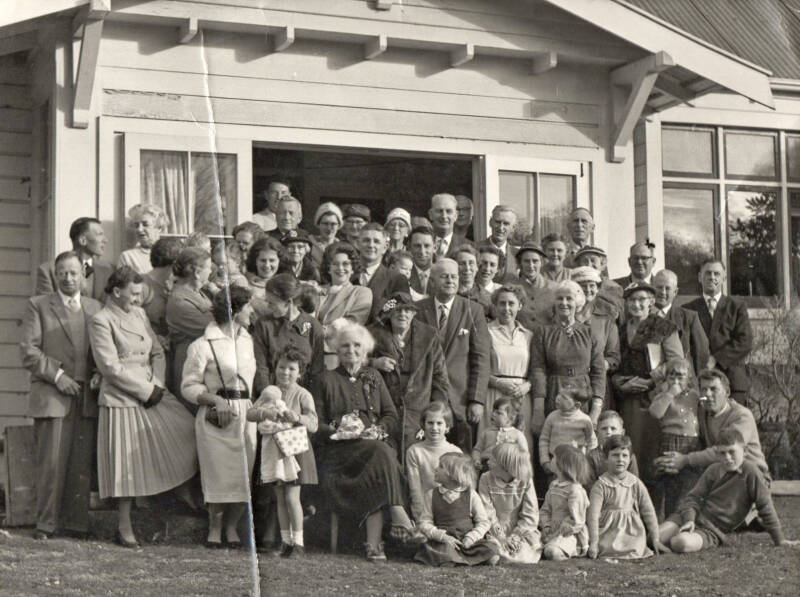
John Lewis Morley and his eight children with Fanny Williams, believed to be taken after her death in 1906.
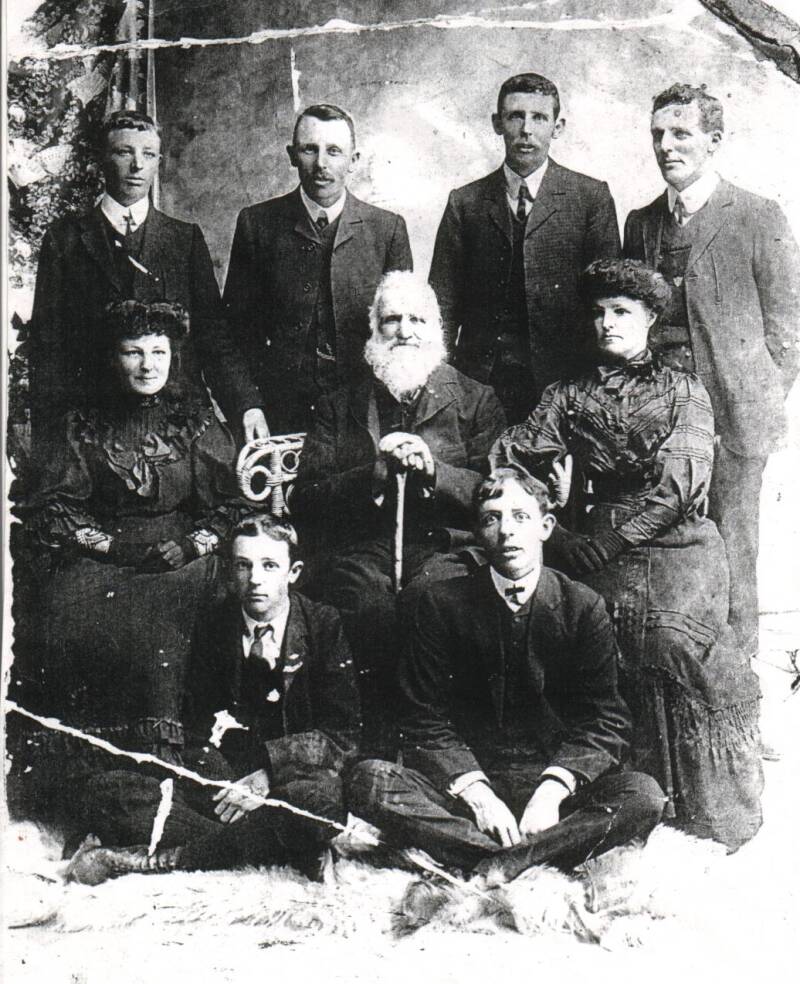
As we have learnt, Fanny Williams was the daughter of the midwife that looked after Maria Henrietta Morley, after her mother died in childbirth. She became John Lewis Morley’s, (the father of the child), second wife, marrying him in Collingwood, Golden Bay on the 19th of August 1871, when she was 17 years old, and he was 45. They moved to Nelson where they had eight children before Fanny died of diabetes on November the 15th 1906 at the age of 53.
Fanny herself was one of the 12 children of Captain William Arthur Williams and Sarah Ann Franklin. He was Harbourmaster at Collingwood, and she was a midwife. But given their habit of adopting children who had lost parents, it is hard to know how many of them were their biological children.
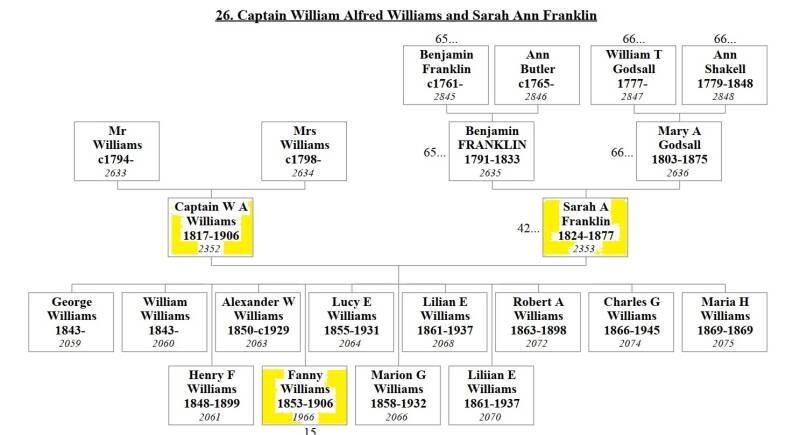
William Arthur’s ancestry and life story is obscure and more than a little confusing, not helped by being the son of Willian Alfred Williams, so they had a common First and Surname and shared initials. He was born in the Isle of Wight, Hampshire, England, in 1815 and obviously came out to New Zealand at a young age. In 1845 he married a Mary Ann Peckham in New Zealand, and they had a daughter, Mary Ann Williams in 1845. Both her and her mother died in 1848 (under what circumstances I know not), and the same year William Arthur remarried to Sarah Ann Franklin in the Episcopal Church, Motueka, Nelson, New Zealand.
Sarah had been born in 1824 in St. Marylebone, London, England and like William, lost a parent when she was still young. William’s father, William Alfred, was lost at sea in July 1821, when he was just 6 years old, and Sarah had lost her father in 1833 when she was 9 years old. As we have seen previously, the loss of a parent often precipitated a journey from England or Scotland where conditions were tough and unpleasant, to the prospect of an assisted berth, and new start in a new land in New Zealand.
As we have also heard, William Arthur was harbourmaster at Collingwood, and Sarah was a midwife. They had a large family of both their own and ‘adopted’ children, but they were very strict and many of the children were only too keen to leave the nest. Sarah died at her daughter’s residence at Tasman Street, Nelson in 1877, when she was 53 years old. William Arthur lived on until he was 91, dying at Hardy Street, Nelson in 1906.
Returning to John Lewis Morley and his family with Fanny Williams, we have
John William Morley, whose family we have already heard of.
George Morley was born in Nelson on April 8th, 1874. In 1890, at age 19, he was working as a carpenter. By 1916 he was living in Aberdeen Road Gisborne with his brother John William, which was the same year that his father died there. By 1922 he was living in Stanley Road, Gisborne with John’s family. He died in Gisborne, a bachelor, on the 11th of October 1947, aged 73.
Lucy Lillian Emily Morley was born in Motueka, Tasman District, New Zealand on the 20th of October 1876. In 1914 she was living in Rolleston Street, Wellington, where she married John Taylor on the 18th of August 1915. Apart from apparently being born in New South Wales, Australia, I can find no further information on John, or indeed Lucy, apart from the suggestion that, having died in Wellington on the 4th of November 1950, she is interred at Karori Cemetery as Lucy Skinner. John had died 5 years earlier and was interred at Waikumete Cemetery & Crematorium, Glen Eden, Auckland, with wives listed as Lucy Lillian Emily Skinner; and Mary Ann Taylor.
James Leslie Morley was born in Nelson on the 15th of April 1882. James moved to the Manawatu, where he was a farm labourer, and where he met and married Agnes Stewart McEwen on the 9th of November 1904 at Tiakitahuna, just south of Palmerston North, where her parents lived. The McEwen family story is a familiar one, with her grandparent’s family leaving Scotland from the Clyde in Glasgow in 1839, immediately after they were married. Originally settling in Wellington, they moved to Karere in the Manawatu, becoming one of the original settlers in the region. James and Agnes had four children in the Manawatu before they moved to Central Hawkes Bay where their last daughter was born at Otane, and where James was a billiard saloon proprietor in Waipawa. James died in Palmerston North in April 1952, and Agnes died there in August 1959. They are buried in Kelvin Grove Cemetery.
Bertram Lewis Morley was born in Nelson on the 26th of April 1884. He followed his brother James to the Manawatu where he was a farm worker and where he married his sister-in-law’s sister, Annie Victoria Beatrice McEwen on the 26th of May 1909. They had five children at Palmerston North before Bertram died there on the 27th of November 1961, and Annie followed on February 5th, 1970.
Charles Henry Morley was born in Nelson on the 21st of September 1886. He lived in Wellington where he was a mechanic. He died on the 5h of January 1936 and is buried in Karori Cemetery. Not to be confused with the Charles Henry Morley who was born in Christchurch, was twice married and was a Salvation Army Chaplin.
Frances Amy Morley was born in Nelson on June 13th, 1889. She married Elliot Vernon Remnant in Waverley, Taranaki, on May 21st, 1908. They were farmers, living in Taranaki and Bulls before moving to Te Kuiti, in the Waikato. They had seven children before Elliot died at Te Mapara, Te Kuiti, Waikato on the 7th of August 1936, at the age of 49. Frances died in Hamilto, Waikato on the 11th of August 1965, at the age of 76.
Percy Alexander Morley was born in Nelson on the 30th of August 1891. He grew up in Central Hawkes Bay and married a local lass from Waipawa, Elsie Caroline Maulder on the 2nd of February 1915, by which time they already a son, Robert John William Morley and daughter, Thema Elizabeth Morley. Percy was variously a labourer and a butcher, and the couple had another four children in the Central Hawkes Bay before Percy died at Lower Hutt, Wellington on the 23rd of December 1949 at the age of 58. Elsie died at Lower Hutt on March 3rd, 1978, at the age of 87.
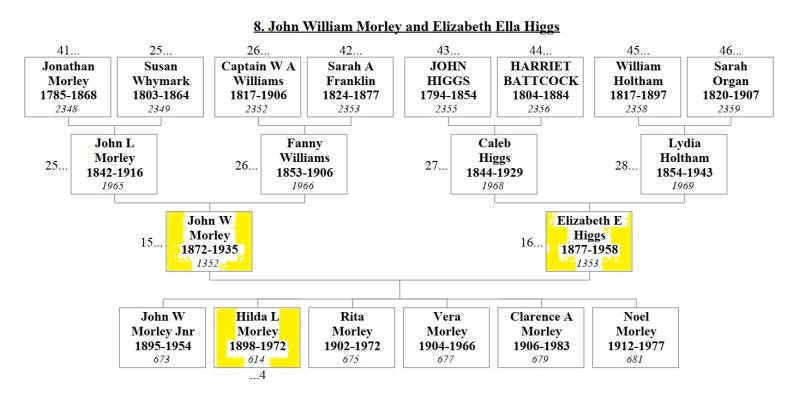
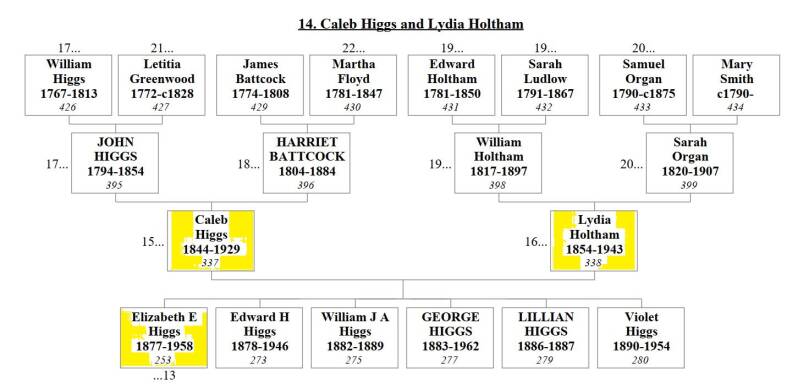
I had expected to find documenting the Higgs/Holtham family histories to be difficult. My brother had warned me of large families, confusing names and a lack of written records. After taking a quick look some years back, I set up a separate database for the Higgs Branch, where it has self-seeded and grown, wild, untamed and untended, ever since.
But their stories turned out to be woven together by a single thread, a voyage into the unknown driven by the sweep of British history. Despite their different individual and personal circumstances, this common thread defined all of the families within this branch of my tree, as it did to some of the other branches I have already described.
It began with the industrialisation of the British economy, and more importantly, the development of a national rail network. Most of my ancestors were small holding farmers or agricultural labourers, living in hamlets or villages, and as essential to running of family farms as they had been previously to the feudal system of land ownership. The industrial revolution saw the rapid development of cities, linked by railways, producing vast quantities of steel, iron, cotton and wool from huge mills and fed by coal shipped in by barge (as most were located beside waterways) or by rail.
Concurrently mechanisation and improvements in agriculture saw a demand to produce more from the land and traditional small holdings were rapidly bought out and aggregated into large agricultural production units that could produce the food and wool required by such cities more efficiently. This emptied out the rural landscape as people moved into towns and cities to find work and perhaps an improvement in their living conditions.
What they found was often very different. Just as land ownership returned to being the privilege of a wealthy few, so too did industrialisation produce a small number of very wealthy people and families while many others found themselves working long hours in very primitive conditions with little chance of self-improvement. The cities themselves quickly outgrew their capacity to sustain such growth, resulting in poverty, overcrowding, a lack of sanitation, disease and early deaths (i.e. slums).
As Britain became the centre of a global industrial empire, importing raw materials from the colonies and around the world, and exporting food and manufactured goods back out, and with the abolition of slavery, the need for colonists who could produce such materials grew and produced a ‘trade’ where families and skilled labourers were offered inducements to move across the world to populate far-flung colonies with ‘suitable’ people. Not that the circumstances that many found themselves in required much inducement.
As we have already seen, such inducement started with the promise of free land, including a forty-acre farm, and later included assisted passage, where the government essentially paid the passenger fees of people wanting to emigrate by ship. These were often oversold, with the ‘farms’ turning out to be undrained swamps, or at best covered with thick bush or forest, while later, reports printed in British newspapers described lush pastures and easy living, when the reality was anything but. And the colonists already there eagerly awaited each ships arrival and to see who was on it. Friends and family? Eligible bachelors or spinsters? People whose trades were desperately needed?
One such voyage was on the ship Leicester, which departed London on the 22nd of October 1876 and arrived in Wellington 92 days later on the 20th of January 1877. The following is a report published in The Post at that time:
ARRIVAL OF IMMIGRANTS.
The ship Leicester arrived in Wellington at 4 p.m. on Saturday from London, bringing about 350 immigrants of which 50 were for Marlborough, besides several cabin passengers, all of whom are in the best of health. On the voyage there were only two deaths of infants and three births. The Leicester is a remarkably roomy vessel and specially adapted for carrying passengers, her 'tween decks being particularly spacious and lofty. Captain Caddy has been presented with three very flattering addresses by the passengers; her surgeon-superintendent, Dr Warren, has also been presented with an address.
The voyage out occupied 92 days from London, and 85 from land to land, and altogether has been a particularly fine weather run. A paper was published on board called the Leicester Gazette, and concerts, theatrical performances, &c, made the passage a very enjoyable one. But the greatest interest was taken in a Baby Show, and from a personal inspection of them the Post can safely say they would compete very successfully with the Wellington babies. The passengers all speak in the highest terms of Captain Caddy, his officers, and crew.
The Leicester is a composite ship of 1308 tons register and specially chartered by the N.Z S. Company to covey immigrants to Wellington. On Thursday 52½ statute immigrants by the above vessel arrived at Blenheim by the Lyttleton. The following are their names and ages: — Bassett William, 27, farm, labourer ; Mary his wife, 25, and three children, William 7, Annie 3 and Herbert 1; Clive Patrick 30, Shepherd, Mary his wife 25, and 2 children, Margret 6 and Michael 3 ; Holtham William 56, farm labourer, and Sarah his wife 53 ; Higgs Caleb, 32, gardener, Mary his wife, 29, and. four children Harry 7, Thomas 5, Albert 3 and Anne 6 months, Patchett John jnr. 33, farm labourer, Sarah his wife 35, and four children, Charles 9, Tom 6, Charlotte 3 and Geo.; H. 6, months.: Patchett John, farm labourer. 56, Elizabeth his wife 50, and two children Lizzie 11 and Sabrina 5, Patchett Charles, farm labourer 23 Jane his wife 25 and two children' Agnes 3 and Israel 2, Patrick John farm labourer 36, Mary his wife 31, and three children- Percival 5, Alice 3 and Ernest 4 months. Smart John Navvy 37, Mary his wife 36; Gilbert William B labourer 44, Lucy his wife 45, and two children Annie 11, Hettie 9. - for Kaikoura. Hodson Geo. farm labourer, 60, and Jane his wife 60; Patchett Reuben, farm labourer, 21, and Mary his wife 21; Lee John James, sawyer, 44, and Rebecca his wife 45 nominated for Duncan's sawmill Pelorus Sound; Lee, Wm. G. sawyer 22, and Sarah his wife 26 nominated for Duncan’s sawmill, Pelorus Sound; Patchett. Wm; 19, Patchett, Robert 17; Patchett, George 13; Gilbert, Fredk 17 and Albert 13— Nominated for Kaikoura’s to join father and mother ; Hodson, Jonathan 12; Druig, John 28; Hornbuckle, Arthur 18 ; Hartnell, Timothy 20— for Kaikoura’s ; Hickey, Edward 19; Leonard, John 21 ; Rampling, Clark 35 ; Byford Thos. 21 nominated ; Gilbert, Mary E. 15— for Kaikoura’s with parents; Hartwell, Margaret 18 - for Kaikoura with brother ; Harrington, Margaret 20 ; Cook Mary 21 ; Holtham, Selina 20; Holtham, Lydia 22; Yardley, Maria 20 ; Lee, Ellen M. 16 ; Malone, James 28 and Bridget his wife 26 and Barry, James 1
It seems to me that today, we might have replaced the industrial revolution with the digital revolution, the age of steam with the age of information, we might travel by aircraft rather than by train, but we seem to have neither learnt nor changed very much. We know so much more and apply it so much less. The world is still racked by wars and pestilence. People are still colonising, marginalizing and brutalizing others. We continue to degrade our environment without a second thought. People are still migrating around the globe in search of peace, stability and a better way of life, while their personal freedoms are increasingly curtailed. And the concentration of personal wealth (and hence power) in the hands of a few who have little thought of its application, has never been greater.
The Higgs have their roots deep in the English countryside of Surrey and Hampshire. Their family story is a great illustration of the political, social and economic changes that shaped people’s lives in the 1800’s. My great-great-grandfather was Caleb Higgs, born in Chertsey, Surrey, England on the 22nd of September 1844, the son of John Higgs and Harriet Battcock. In 1851 John was a farmer of 3 1/2 acres in Water Lane, Long Ditton, Surrey. Living with him and his wife Harriet Battcock, were their sons George 13, John 9 and Caleb 6 and daughter Harriett 10. His daughter Betsy aged 16 had already left home and was working in nearby Hook as a servant with Sarah Ede.
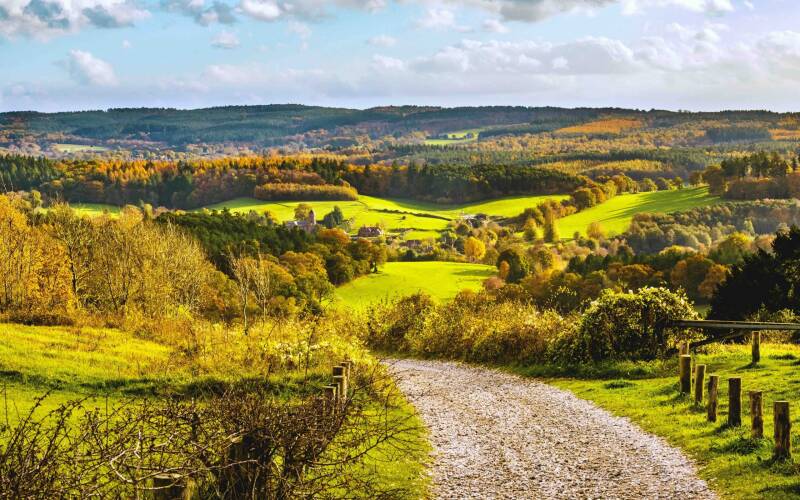
Surrey, England Countryside.
However, in the 1850s, Surrey, England, experienced transformation from a predominantly agricultural county to a prosperous area closely connected to London, driven by the expansion of its railway network. New towns emerged near railway lines, while wealth attracted businessmen who built country houses, leading to a significant population growth. The rapid population increase presented challenges, leading to the decline in agriculture, an urbanisation of the population into towns and cities and resulting in poverty and overcrowding.
By the time he was 16 years old, Caleb was working as a gardener in Beckenham, Kent, England. In 1867 he married Mary Ann Hammond in Edmonton, Middlesex, England, when he was 23. By 1869 he was working as a Gentleman's Gardener, living at 3 Taylors Lane, Wells Road, Sydenham., Sydenham, Kent, England, where their first son was born. This was followed by two more sons and a daughter in 1870, 1874 and 1875 respectively. In 1876 for the sum of £50, the family took assisted passage on the ship Leicester, leaving London on the 22nd of October and arriving in Wellington 92 days later on the 20th of January 1877. Listed onboard were Caleb Higgs 33, Mary Ann Higgs 29, Harry Higgs 7, Thomas Higgs 5, Albert Higgs 3, and Annie Higgs 8/12 (known as Dolly). On the 25th, 52 immigrants (including the Higgs family) sailed on to Blenheim.
So very little is known about Mary Ann Hammond. Mary Ann was the daughter of Thomas Hammond and Mary Ann Brooks. The family lived in Edmonton, Middlesex, and Mary Ann was the 3rd child born to this couple. She had siblings James, Nelly, and Frederick. She married Caleb Higgs at the parish church on the 26 Dec 1867, Edmonton. The family moved frequently around the Kent, London, Sussex area during their early married life. Mary Ann returned to her parents or one of her sister’s homes at Edmonton to give birth to each of her children - Thomas, Albert & Annie, except for Harry who was born in Sydenham. By the 1871 census Caleb & Mary Ann had settled at Burwash, Sussex, a place that the couple had being living at since at least late 1869. Their 2 oldest children Harry & Thomas had been baptised there. By Sep/ Oct 1876 the decision was made to emigrate across the other side of the world - New Zealand. Why did Caleb & Mary Ann make that kind of decision - possible knowing that you wouldn't be seeing your family again? But Caleb had already lost 2 of his siblings at a young age, Betsy was 28 & George was 30 [they left young children behind]. The family left Burwash, Sussex on the 20 Oct 1876 and boarded the ship 'Leicester'. The voyage was to take 91 days. From a letter we have from Mary Ann back to her family in England on the voyage, we learn that apart from Harry, Thomas and herself suffering a little from sea sickness, Caleb & herself knew they had made the right decision for their family. On arriving in New Zealand, the family settled in Picton, Marlborough. The couple purchased a house with an acre of land; had chickens, 2 milking goats and a vegie garden. Plenty of room for the children to play and plenty of food especially meat. Mary did comment on how she had to learn more than back home such as baking bread & learning how to make yeast. Their 5th child Charles was born 17 Dec 1877 at Picton. But tragic was to strike the family - Mary Ann died 5 Feb 1878 at Picton at the age of 30 years.
On April 14th, 1881, Caleb remarried to Lydia Holtham in Blenheim. Caleb had been working as a landscape gardener, but by 1884 he was proprietor of the Globe Hotel in Renwick, a position that he held until at least 1902. During that time, they had another four children. What happened after that is a little unclear, but by 1911 they were living in Pukehou, Waipawa, and Caleb was again a gardener. He died of a stroke on the 6th of March 1929 at Otane, Central Hawkes Bay, and is buried in the cemetery there.
Elizabeth Ella Higgs’s siblings with Mary Ann Hammond:
Her half-brother, Harry Arthur Henry Higgs, was born in Sydenham, Kent, England on the 14th of September 1869, to Caleb Higgs and Mary Ann Hammond. He was 7 years old when he arrived in Blenheim with his family after emigrating from England. By 1896 he was living in Windsor Park, Oamaru, Otago, and working as a labourer. On November 7th, 1904, he married Alice Christina Luxton in Palmerston North, Manawatu.
She was born in Rangiora, Christchurch, Canterbury, on May 5th, 1881, to John Thomas Luxton and Elizabeth (Eliza) Jane McKeown. Both John and Elizabeth had emigrated from Britain as children; John, having been born at Southye's Cottage, North Lew, Devon, England in 1841, arrived on board the ship "Castle Eden" on February 14th, 1851 in Lyttleton, Banks Peninsula, New Zealand, when he was 6; and Elizabeth, born in Armagh, Northern Ireland, United Kingdom in 1853 was already working as a domestic servant when she emigrated to New Zealand with her family on the ship "Greyhound" from London on May 7th 1865 at Lyttleton, Banks Peninsula, New Zealand. John and Eliza were married on February 22nd, 1868, at the private residence of Mr W Bramley in Rangiora, Canterbury. John, a farmer and contractor, was 24, and Eliza was 15 years old.
Harry and Alice were living at Te Aute in 1905, where Harry was a contractor, when their first child Mary Elizabeth was born. The following year Caleb Reid Higgs was born at Waipawa. By 1909 they had moved to Wellington, living at 1 Coults Street, Wellington East when George Arthur Clifford Higgs was born. Harry was working as a driver. The following year Albert John Higs was born at Mangaweka, in the Manawatu, and in 1914 they were living at Kawhatau, where John was a roadman. In 1915 their daughter Ruth Lorraine was born in the Kawhatau Valley, Mangaweka. By 1919 they had moved again to Kakahi, Waimarino, in the Bay of Plenty, where Harry was a timber worker. By 1928 they had returned to Wellington, living at 119 Daniell St. Wellington South, where Harry was a labourer. By 1935 they had retired and were living at 14 Kensington St., Wellington Central. Harry died in Wellington on July 7th, 1942, and Alice on March 9th, 1947, having lived, worked and raised a family in many of the places I would later frequent, to fish and explore the backcountry roads.
Thomas Edward Higgs was born in Ticehurst, Sussex, England on December 10th, 1870, and was 5 years old when the family arrived in Blenheim from England. In 1896 he was a labourer at Renwick, Wairau, Marlborough. He moved up to the Wairarapa and moved around a lot, doing different things. He worked as a station hand and cook on Molesworth Station, Riddifords, Lysons and the Bidwells in the Wairarapa. He had several accidents, including losing toes, being shot in the calf and losing one eye cutting gorse at his Uncle Charlies place in Mapua. He had to sue his Uncle Charlie for compensation under the Old Workers Act, which caused ill feeling in the family, who viewed him as a black sheep.
On April 29th, 1905, he married Deborah Abina (Gobinet) Duggan, who had been born in Killarney, County Kerry, Ireland and who had emigrated with her parents to Tua Marina, Marlborough, New Zealand. She had been married at least twice previously, and the marriage didn’t seem to last.
In later years Thomas lived with Ruth Lorraine (Harry’s daughter- his niece), and for a while he had a bach in Paremata. Later in life moved into Central Park, a benevolent home and hospital in Ohiro Road, Brooklyn, Wellington where he died on the 14th of May 1958, aged 87.
Albert John Higgs was born in Edmonton, Middlesex, England on the 26th of August 1897, and was 3 years old when the family arrived in Blenheim. Information on Albert is sketchy at best, but in 1908 he was living in Masterton and working as a yardman. In 1917 he was listed in the army reserves as living in Waihou Forks, south Canterbury. Albert served overseas during the first World War, went missing and the family thought that Albert was lost in action, but he turned up in Australia apparently suffering from shell shock. By 1941 he had moved to Bowen, Queensland, Australia. He died in Cairns, Queensland on May 20th, 1948, at the age of 73 and is buried in Charters Towers, Queensland.
Annie Maud Mary (Dolly) Higgs was born in Edmonton, Middlesex, England on the 15th of November 1875. She was just 8 months old when the family arrived in Blenheim, and only 2 years old when her mother, Mary Ann Hammond, died in Picton. She was adopted by the Divens family of Picton, at whose residence she was married on July 21st, 1898, to Arthur Hore. Arthur was born in Bangor, Wales and had emigrated with his family to Christchurch. They had one son, Kenneth Allen Hore, born in Christchurch on January 4th, 1900. Arthur died in Christchurch in 1950, and Annie died there on the 18th of November 1955, and is buried in Picton.
Charles Augustus Higgs was the only child of Caleb Higgs and Mary Ann Hammond to be born in New Zealand, on the 17th of December 1877. He was less than 2 months old when his mother died. How he was cared for in the subsequent years is unknown, and it seems that he may have fathered a child with a Margaret Jane Vowless in Wellington in 1901.
The next we hear of him is his marriage to Maud Evelyn Austin Smith in Napier on the 29th of December 1902. Charles was working as a carpenter, but what Maud was doing in Napier when she and her family came from Dunedin is also unclear.
The family moved around a bit in the next decade as evidenced by their children, with William born in Napier, then Euphemia in Waipawa, Constance in Wellington, and Generiffe and Arthur in Te Kuiti in the King Country. Finally in 1914 the family moved to Mapua, where Charles had an orchard growing apples and where their sons John and Gordon were born. Charles became involved with the fruit grower’s association, for many years holding the position of secretary and Nelson delegate to the annual national conferences. Charles was also involved in getting a school established for the local children - the school room started off in their lounge until a neighbouring barn was offered.
However, tragedy was to strike the family twice, with Euphemia dying at age 15 at Christmas 1920, after a Party in the apple orchard and children were sleeping in the haybarn when there was a fire, then in 1922 when Arthur was playing at the Mapua wharf and drowned aged 8.
Charles died in Nelson on the 2nd of March 1958, and Maud died there on March 1st, 1961, aged 84.
Elizabeth Ella Higgs’s siblings with Lydia Holtham:
Edward Holtham Higgs was born to Lydia Holtham in Blenheim on November 11th, 1878. He adopted the surname of Higgs after his mother married Caleb Higgs three years later. On December 10th, 1909, he married Lillian Ethel Osman, at which stage both were living in the Wairarapa.
The couple continued to live in the Wairarapa for the next year, moving to the Manawatu the following year. They had a total of 11 children, but tragedy was to strike the couple twice during the early years of their marriage with the loss of 2 of their daughters: Lydia in 1913 at 10 months and Elizabeth at birth in 1916. Edward continued to reside in the Manawatu apart from a brief time the family moved back to Masterton (their 2nd son Charles was born there) perhaps so Lillian could help with her father who died in 1912. Then between 1920-1923 the family lived in Wanganui [Ruby born there].
During his working life Edward was always listed as labourer, working for the local council. He died at his son's (Ruffie's) home at Patea on the 7 Feb 1946 after a long illness. The family were unable to bring Edward's body back to Levin for burial due to the fact that they were unable to afford the cost of bringing him home. So, Edward is buried at Patea. It must have been with a great deal of sadness that the children were to farewell their mother within 18 months of their father passing away.
As reported in - The Levin Chronicle Newspaper; Deceased. On February 28, 1946, at Patea Hospital Edward Holtham Higgs, beloved husband of Lillian Ethel Higgs, Tiro Tiro Rd, Levin, after a long illness. The funeral occurred at Patea Hospital. Deceased was a resident of Levin for 32 years and was well known throughout the Manawatu. He leaves a wife and family of five sons and four daughters.
George Higgs was born in Blenheim on the 3rd of November 1883. Like many of his siblings, he moved around a lot. In 1905-06 he was working as a contractor in Te Wharau, Wairarapa, Wellington. By 1911 he was working as a porter at the Oxley's Hotel, Picton, Wairau, Marlborough. Between 1914 and 1917 he was living in Wellington and working as a driver. In 1930 he married Rachel Catherine Tweeddale in Christchurch. They had a daughter Rae and a son Peter there. In 1935 George was working as a gardener at Hurunui, Canterbury. In 1939 their daughter Jean was born, followed by twins Judith and David in 1942. Between 1949 and 1954 they lived at Umere, Flaxmill Rd., Karamea, Buller, West Coast, New Zealand where George was a labourer. George died at Westport, Buller, West Coast on August 22nd, 1962, and was buried at Karamea.
William Higgs (Billy) was born in Wairau, Marlborough on July 5th, 1885. On September 3rd, 1912, he married Alice Isabella Christall McCabe in Wellington. They had one son, Leslie Caleb Higgs, born 21st December 1913. Billy was a taxi proprietor, owning a fleet of vehicles including a number of 7–10-seater Chryslers and Cadillacs. The couple retired to 22 Main Rd., Paremata, in 1963 and Billy died on April 21st, 1964. Alice died on September 30th, 1967.
Lillian Higgs was born at Renwick, Marlborough, on the 5th of November 1886 and died 4 months later on the 10th of March 1887.
Violet Higgs was born in Wairau, Marlborough on July 2nd, 1890. In 1907, when she was 17, she married George Thomas Phillips. Their first son, George Jnr was born in Greytown, Wairarapa in 1909. They moved to Central Hawkes Bay, where George was a sawmill hand at Waipawa in 1911. They had two children born there, Ronald in 1913 and Mavis in 1915. Harold followed in Pukehou in 1917, then Allan in Waipukurau in 1920. Hazel was born in Waipawa in 1923 and Rita in 1925. In 1928 George was working as a farmhand at Pukehou, with Frederick being born at Otane in 1930. By 1946 George is listed as a farmer at Otane, and by 1954 they had moved into Hastings, where Voilet died on October 31st.
The Globe Hotel, Renwick.
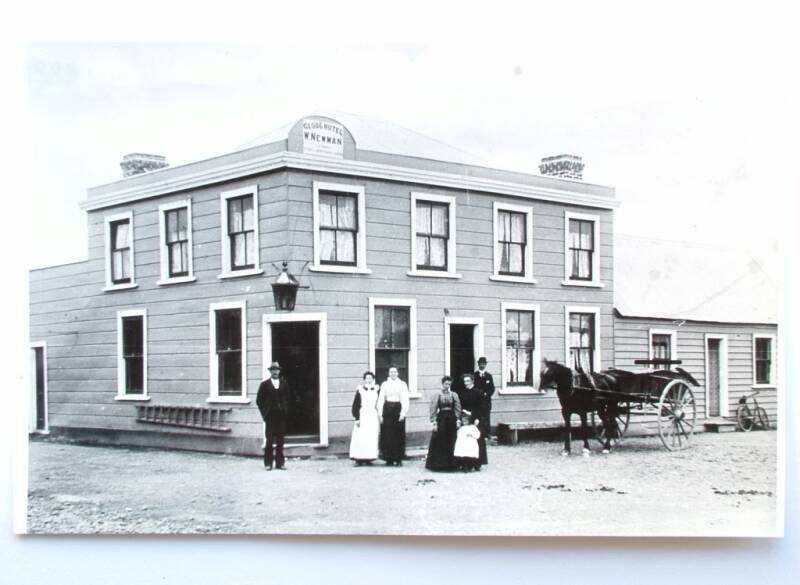
Some of Billy Higgs vehicles at Epuni Street, Wellington.
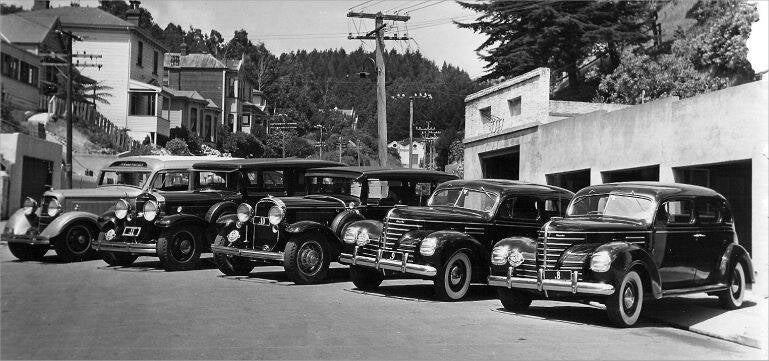
Lydia Holtham is my maternal great-great-grandmother. She was born in Cheltenham, Gloucestershire, England on October 2nd, 1854, one of eight children born to William Holtham and Sarah Organ. Her family history is not an easy one to document, with numerous dead ends, brick walls and a distinct lack of documented records, but I am beginning to build up a picture.
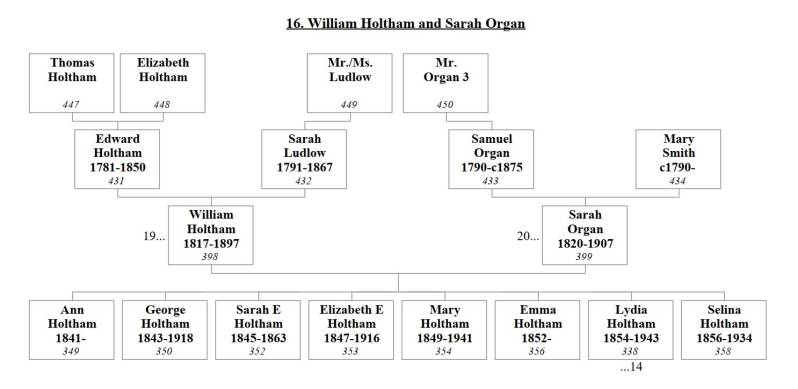
Lydia’s father William was born in Birdlip, Brimpsfield Parish, Gloucestershire on July 24th, 1817. On December 21st, 1840, he married Sarah Organ, at Gloucester, St Mary De Lode, Gloucestershire. William was an agricultural labourer and quarryman and the history of Gloucestershire is by no means different to most of rural England in the mid to late 1850’s, where small farm holdings were aggregated into large production units owned by the wealthy, forcing rural inhabitants off the land and out of villages into the developing cities to provide cheap labour for the wool, cotton and steel mills and the coal mines that fed them. In those cities, whose growth was spurred by the expanding rail network, poor wages, overcrowding, disease and pollution persuaded many to take up offers of cheap or free fares to populate the colonies. The Holtham’s were no exception, and it scattered them around the globe.
Ann Holtham was the first daughter born to Willian and Sarah, born in Birdlip in November 1841. In 1861 at the age of 19 she was working as a domestic servant to William and Sarah Dryall in Cheltenham. After that, she simply disappears from the public records, and I can find no trace of her either marrying, emigrating or dying.
George Holtham was born to William and Sarah on January 21st, 1844, in Cowley, Gloucestershire, England. You wouldn’t have thought that the name George Holtham was too common in Gloucestershire in the 1800’s but there was also George who was a veterinary surgeon, and George who was a labourer and who ended up in the workhouse. However, we do know that on the 5th of October 1865 George married Fanny Westbury in Cheltenham. George was working as a gardener at Hatherley Manor at the time.
In June of 1867 their daughter Ada Alice was born in Cheltenham, and by 1871 they were living in the hamlet of Barton St Mary, Gloucestershire. The following year they emigrated to the United States of America, living in Cleveland, Ohio, where Edward George Holtham was born on October 2nd, 1872. I can find no record of their arrival, which is unusual for the USA, but it is recorded in the 1900 Federal Census.
By that time the couple also had Annie, born in Detroit, Wayne, Michigan, United States on August 19th, 1873, and Emily Grace, born in Cleveland, Cuyahoga, Ohio, in March the 7th 1878. Family stories would suggest that George became a successful accountant, but subsequent census records describe him as a foundry iron worker. George died of arteriosclerosis in Detroit, Wayne, Michigan, on the 28th of May 1918. Fanny died there on May 19th, 1925.
Sarah Elizabeth Holtham was born to William and Sarah Holtham in Birdlip, Brimpsfield Parish, Gloucestershire in May 1845. She died in Cheltenham in July 1863 at the age of 17.
Eliza Ella Holtham was born to William and Sarah in Cowley, Gloucestershire, England in April 1847. She was working as a servant when in 1868 as a single woman she took an assisted passage to Melbourne Australia, on board the ship Sir Robert Sale, arriving in October of that year. Two years later, on the 18th of July 1870, she married John Edward Lancaster at Christ Church, Hawthorn, Victoria, Australia. They lived in Richmond, Victoria where John was a carter, and where they had eleven children, four boys and seven girls. Eliza died at Northcote, City of Darebin, Victoria, on the 30th of May1916 at the age of 69, and John died at 584 Canterbury Road, Surrey Hills, Victoria (the home of his son John George) on the 13th of August 1917 at the age of 75.
Mary (Polly) Holtham was born to William and Sarah in Cowley, Gloucestershire, England in June 1849. Much like her siblings, verifiable records of Mary’s life are scant and confusing. So, what do we know? Well, Mary married William George Bassett on the 7th of June 1868 at Cheltenham, St Mary, Gloucestershire. The following year they had William George, followed by Annie, then Herbert Joseph, and what happens after that gets rather hazy. Until they turn up emigrating on the Leicester in 1877 with others of the Holtham family, including Mary’s parents. When they arrived in Wellington, William was 27, Mary was 25, William (Jr) was 7, Annie 3 and Herbert 1. William (Snr) died in Auckland on December 11th, 1922, and Mary died there on January 22nd, 1930.
Emma Holtham was born in Birdlip, Gloucestershire, England, in 1852. On the 2nd of August 1874, she married George Stephen Crook in Cheltenham, Gloucestershire. George had been born there in January 1849. And once again, credible, verifiable records of what happened next simply dry up. Here is what the internet hivemind thinks, which seem to fit what facts I know. It appears that the couple emigrated to Australia sometime after they were married, although I can’t find this recorded anywhere. In 1879 they left Victoria, Australia and arrived in New Zealand (again, no records of this). Certainly between 1887 and 1889 George Stephen Crook was living in Blenheim, Marlborough according to the electoral roll and street directory. Meanwhile, Emma moved to Queensland, Australia in November 1884 (undocumented). George may well have returned to Australia also as there is no New Zealand record of his death.
Lydia Holtham (my great-great-grandmother) was born in Cheltenham, Gloucestershire, England on the 2nd of October 1854. In 1876 at the age of 22, she, along with her parents Willian and Sarah and sister Selina, aged 20, took assisted passage on the ship Leicester, leaving London on the 22nd of October and arriving in Wellington 92 days later on the 20th of January 1877. This was the same vessel and voyage carrying Caleb Higgs, his wife Mary and their children, and William Bassett his wife Mary (nee Holtham) and their children.
We don’t know much about Lydia’s life after disembarking in Marlborough, but we do know that in 1877 she gave birth to Elizabeth Ella Higgs (my great-grandmother) and in 1879 she had a son, Edward Holtham Higgs, and sued the father for failing to support him.
HOLTHAM V. MACMAHON. In this case, in which Lydia Holtham charged the defendant with neglecting to support his illegitimate child, of which she was the mother. Mr McNab, who appeared for complainant, applied for a postponement until Monday next (for the attendance of Mr Conolly, who appears on the other side) which was granted. February 12, 1879, The Marlborough Express.
On the 14th of April 1881 Lydia married Caleb Higgs at Blenheim in Marlborough. Caleb’s first wife, Mary Ann Hammond had died 3 years previously, leaving him with a young family. Lydia would have known the family well, having emigrated on the same boat as them. In fact, although I can find no official birth records, Lydia’s first child, Elizabeth Ella Higgs (born in 1877) always seems to have Caleb identified as the father, unlike Edward Holtham Higgs (above), so she may have known him very well indeed. Regardless of the circumstances, Caleb with 6 children and Lydia with 2, melded into a family unit.
On 19 September 1893, after submitting a petition with nearly 32,000 signatures, New Zealand became the first self-governing country to grant women the vote. In most other democracies – including Britain and the United States – women did not get that right until after the First World War. New Zealand women voted for the first time in a general election on 28 November 1893.
Lydia Higgs, signatory
In 1893 when she signed the petition Lydia Higgs (1854 - 1943), nee Holtham was 39 years old. She was the second wife of Caleb Higgs, whom she married in 1881 and together they had 6 children (the first being born in 1878). Caleb also had 6 children with his first wife, the youngest of whom was just a few months old when Caleb and Lydia got together.
Caleb's first wife, Mary Anne Hammond, died only a few months after giving birth to her 6th child at age 30, so Lydia certainly had her hands full!
In 1893 Caleb and Lydia were in negotiation to take over Smiths Wairau Restaurant, Alfred Street, having for the previous ten years been the publicans at the Globe Hotel in Renwick. They sold the restaurant business a year later and moved to Otane in the Hawkes Bay.
While living in Renwick, Lydia and Caleb regularly competed in, sponsored and judged Horticultural Society competitions, Lydia winning prizes for her pansies and phloxes.
Lydia and Caleb also ran the bar and luncheon booth for the Upper Wairau Races in a "most efficient manner". Lydia sang in a fundraising concert to aid the Renwick Cemetery. Both Lydia and Caleb were well and favourably known throughout the district.
From the Marlborough Museum and Archives.
They moved to the central Hawkes Bay where by 1911 they were living in Pukehou, Waipawa, and Caleb was again a gardener. He died of a stroke on the 6th of March 1929 at Otane, Central Hawkes Bay, and was buried in the cemetery there. Lydia remained there until her death on May 23rd, 1943, and she is also buried in the Otane Cemetery.
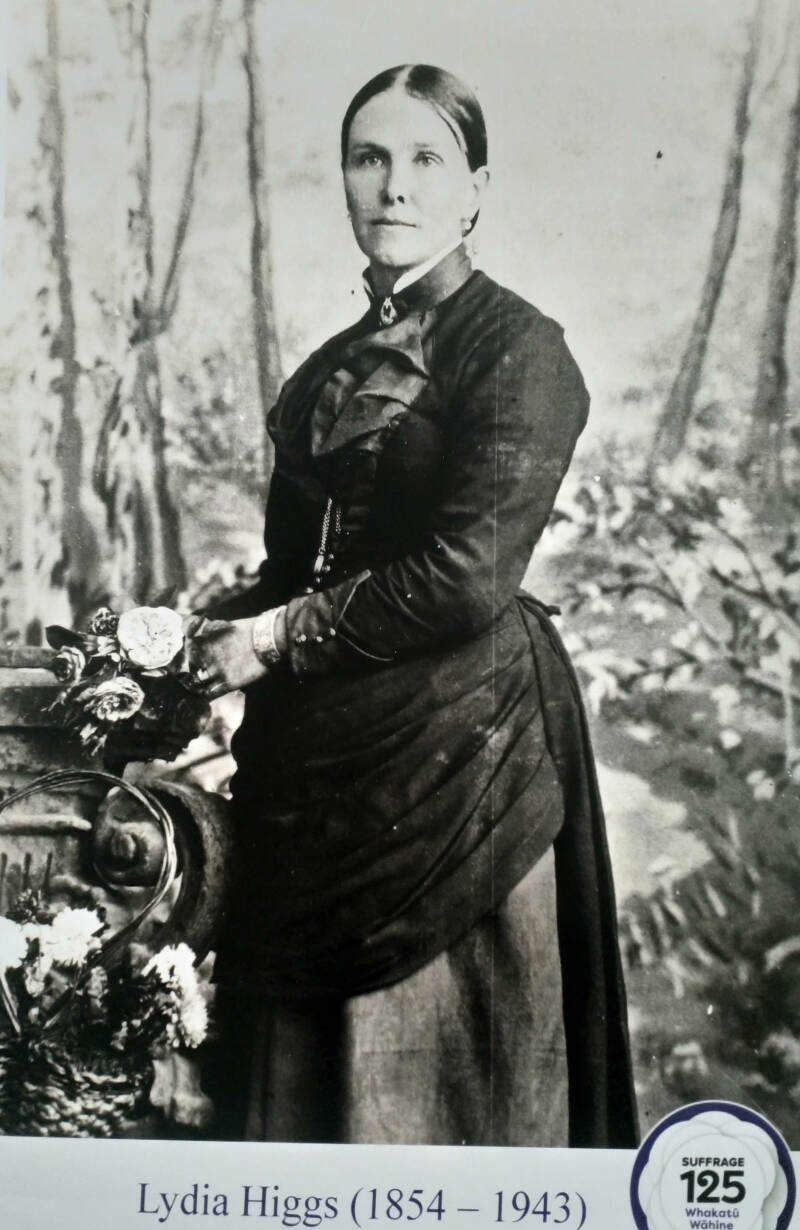
Selina Holtham was born to William and Sarah Holtham at Birdlip, Cowley, Gloucestershire, England on the 20th of September 1856. As we have seen, when she was 20, she emigrated with her parents and sister Lydia on the Ship Leicester to Blenheim, New Zealand. Six months later, on June 14th, 1877, she married Francis Bowden Terrill in Blenheim.
Francis was born in Redruth, Cornwall, England on the 2nd of February 1838, and was a tin miner by profession. He had married Mary Ann Hugo in Redruth in January 1859 and in 1862 they emigrated to Nelson New Zealand on board the sailing vessel Magnum Bonum with their two daughters, Elizabeth Ann and Catherine Jane. They had four more children in Marlborough before Mary Ann died four days after the birth of Thomas Hugo Terrill.
So, Selina also married into a ready-made family, just as her sister Lydia would do with Caleb Higgs four years later. Francis and Selina went on to have five more children, while Francis was a storekeeper at Tua Marina and a preacher in the Wesleyan church, and Selina practised as a ladies’ nurse at her home.
Francis died of a stroke at Fairhall, Marlborough, on the 25th of May 1910, having been paralysed by an earlier strike. After Francis died, Selina moved in with her daughter Irene. She died in Blenheim on August the 8th, 1934, aged 78.
Francis and Selina Terrill and family
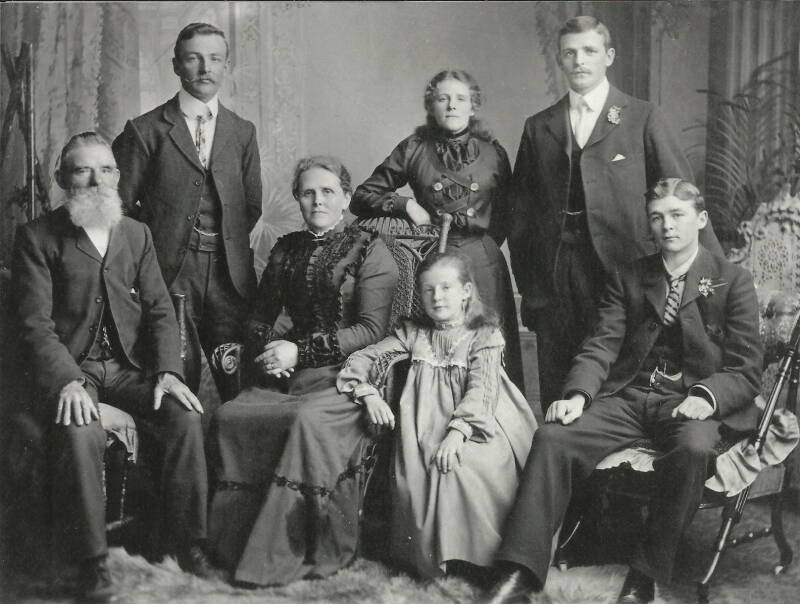
I have spent many years researching my own family history, and it has been a wonderfully illuminating and rewarding experience. But it is time to return to where it all began. Our family represents a melding of the Sims, Falleni, French and Miller Families. When I first began this documentation, I was spurred on by the fact that Sharon’s parents organized and held massive family reunions every 10 years, a tradition that has sadly fallen by the wayside in this modern far-flung world. Additionally, her cousin Gordon Miller had already researched, documented and self-published a book on the Miller family since its establishment in New Zealand. Given the research tools that were available at the time, this was a huge and valuable achievement. My first efforts were an attempt to add some of this material to an on-line database, so that it could be shared and appreciated more widely. But it is time to look a little deeper into some of the French and Miller family stories.
As we have seen in My Landscapes, Sharon was born Sharon Elmar French in Te Kopuru in Northland on May 24th, 1952, to John Eric (Eric) French and Marjory Ella (Marj) Miller. She was the youngest of their four children.
John Eric (Eric) French was the son of Thomas Corlett French and Mary Gertrude (nee Stallworthy), the only boy amongst his four sisters. He was born in Aratapu, Kaipara, New Zealand on November 29th, 1906.
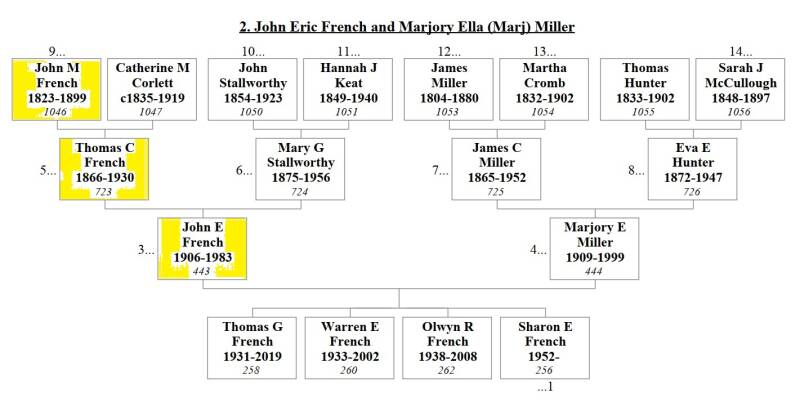
The Siblings of John Eric French:
Gertrude Clarice French (Known as Clarice) was born in Tokatoka, Kaipara, Northland, New Zealand on the 12 of August 1869 to Thomas Corlett French and Mary Gertrude Stallworthy. At 16 she is recorded as having passed her New Zealand Teacher and Civil Service examinations and licence. On the 18th of August 1920, at the age of 24, she married Glen Carver Robson at Mangawhare, Dargaville, Northland, New Zealand.
Glen had been born at Awhitu Central, Franklin, Auckland, on the 23rd of September 1893 and was dairy farming at Raupo, Northland with his father Edmund (Ned) and his older brother Erroll. Raupo was a low-lying area of river flats and wharf just south of Tokatoka on the Wairoa River. His father Edmund Henry Robson had been born in County Cork, Ireland and arrived in Auckland with his parents when he was 2 years old. He had married Amelia (Amy) Mabel Carver at Woodville, Tararua in 1889, and 3 weeks after the marriage the couple left Napier on the schooner "Dunedin" as settlers from New Zealand and sailed to Raoul (Sunday) Island in the Kermadecs. They joined Amy’s father Robert William Ind Carver, his wife Mary Ann Carver, (born Nicholas), and their 3 brothers and 2 daughters on Sunday Island in September 1889. However, in November of the following year the ship Hinemoa arrived in Auckland from Sunday Island in the Kermadecs carrying ten settlers from Sunday Island, who report the settlement a total failure, and regretted ever having gone there. They were almost starving at times, and during the winter subsisted chiefly on mutton birds. Mr Hovell, the promoter of the settlement, returned disgusted with the Kermadecs. The following year Amy and Erroll returned to Auckland, leaving Edmund and the eldest son Frank to return later. Apart from Frank Hamilton Robson who was born on Raoul Island, in the Kermadec Group, Edmund and Amy went on to have 14 more children, of whom Glen was third oldest.
Glen and Clarice farmed at Ruawai and raised 6 children of their own before moving to 111 King Edward Avenue on the North Shore in Auckland, where Clarice died on the 10th of June 1960, and Glen followed on the 14th of June 1962.
Margaret Alma French (Known as Alma) was born to Thomas Corlett French and Mary Gertrude Stallworthy at Tokatoka, Kaipara District, Northland, New Zealand on the 11th of October 1898. She married Harry Kelly Hill on the 12th of July 1922 at the Methodist Church, Mangawhare, Northern Wairoa, Northland, New Zealand. After they married, they had a dairy farm at Piako Road, Turua, on the banks of the Waihou River in the Hauraki Plains in the North Island of New Zealand, close to the mouth of the river, 9 kilometres south of the Firth of Thames and 12 km south of Thames. In fact, when Marj and Eric were married, their first sharemilking job was on Harry and Alma’s farm.
Harry was born in the Whangarei district of Northland on January 12th, 1900, and died at Te Puru, on the western side of the Coromandel Peninsula about 12 km north of Thames on August the 24th 1966. His grandfather was Edward Swanston Hill who was born in Swansea, Glamorgan, Wales on 11th of November 1825. He emigrated to New South Wales, Australia and married Maria Kelly. She had travelled via assisted passage from Ireland to New South Wales, but we know little more of her history than that. They had one son, Henry Swanston Hill, born in Richmond, Victoria, Australia in 1860. They moved to Auckland, New Zealand soon after that, and both Edward and Maria died there. By 1890, Henry was living in Whangarei and working as a saddler. In 1893 he married Blanche Blackburn in Auckland. She was the daughter of John Blackburn, born in Clayton, Yorkshire, England in 1831, and Jane Elizabeth Corlett who was born on the Isle of Man, England in 1835. John was a tailor, initially in Auckland but they subsequently moved to Whangarei. Henry and Blanche also moved to Whangarei, where Henry continued as a saddler and where they had four children: Edward Blackburn Hill in 1895, Henry Claude Hill in 1896, Harry Kelly Hill in 1900, and Ada Esmee Hill in 1903.
Alma and Harry went on to have two children at Turua: Ngaire Alma Hill in 1924, and Ross Harry Hill in 1931. Alma died in Auckland on October 21st, 1993, and is buried in Manukau.
Blanche Estelle French was born in Tokatoka, Kaipara, Northland, New Zealand on the 18th of May 1900. She married Arthur James (Duffy) Woods at the Methodist Church, Mangawhare, Northern Wairoa, Northland on the 19th of October 1921, when she was 21 years old. They lived in Dargaville, where Arthur was a butcher, and where their daughter Joyce Estelle Woods was born in 1922. Their next two sons were born in Ngāruawāhia, in the Waikato, Earle James in 1937 and Barry William in 1939, after which they moved to Auckland, where Duffy was a butcher in Hobson Street in 1942 and they retired to Devenport on the North Shore, Auckland, where Blanche died on the 30th of May 1954, and Arthur died on January 1st 1982.
Arthur Woods family is one of those frustratingly vague and contradictory ones that is very short on verifiable details. We don’t know for certain where he was born (although it was probably Northland). His father was William John Woods, born in Lambeth, London Borough of Lambeth, Greater London, England in 1855 and he probably emigrated by assisted passage around 1877 after his father died. Which is a familiar story in our family histories when families lost their principal money earners in England. By 1885 William was working in Whangarei, Northland as a boiler riveter. The following year he married Charlotte Ruth Susan Farr in Whangarei on the 13th of September 1886. Charlotte had been born in Frome, Somerset, United Kingdom in October 1862 and spent her whole life in New Zealand working as a Registered Nurse in Dargaville, as well as raising six children. William died in Dargaville on the 2nd of May 1910, aged 55 years. Charlotte died in Auckland on the 21st of February 1949, aged 86.
Iris Cynthia French was born in Tokatoka, Kaipara, Northland, New Zealand on October 26th, 1901. At the age of 24 she married Eric Walter Edwards, probably in the same church in Mangawhare, Northern Wairoa, Northland as her sisters had. The year was 1925.
Eric had been born at Earl's Court, Kensington and Chelsea, London, England on the 24th of March 1902 to Albert Edwin Edwards and Florence Margaret Bates. After serving in the Royal Army Service Corps between 1914 and 1920, he was a farmer until he emigrated to Auckland, New Zealand at age 23 aboard the ship Maloja, departing 8th of May 1925. After marrying Iris the same year, they were farming at Waiuku in the Auckland region where on November 19th, 1928, their son Trevor Ian Edwards was born. Two years later in 1930, Eric, Iris and Trevor emigrated to England on board the ship Tainui, arriving at Southampton, England on the 17th of December 1930.
In 1938 the family were living in Oxford, Oxfordshire, England where Eric was a M/C (motorcycle?) storekeeper. Their son Trevor married Peggy Gillard in July 1950 at the Tiverton, Devon, England registry office. Iris died at Porthleven Kerrier, Cornwall, England in April 1971, when she was 69. Eric died at Churchdown, Gloucestershire, England on February the 8th 1990, when he was 87 years old.

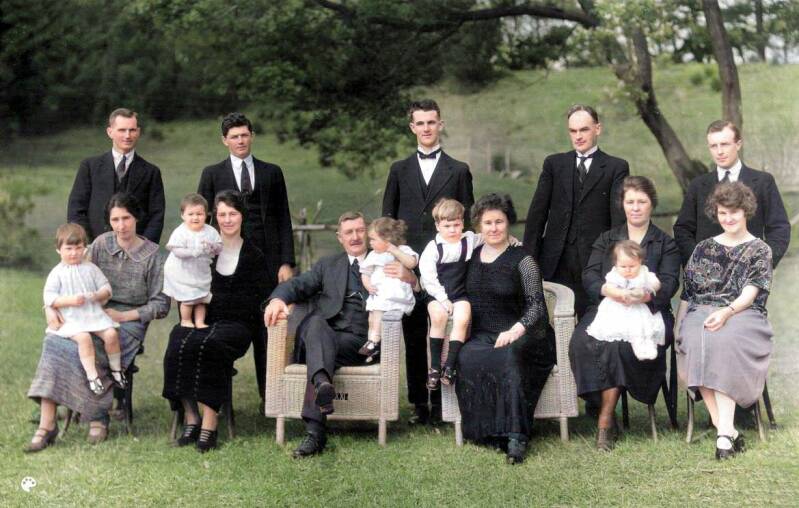
Sharon’s paternal grandfather was Thomas Corlett French. Thomas was born in Auckland, New Zealand on the 27 July 1866 to John Michael French and Catherine Margaret Corlett. He was their only son; however, he had six half-brothers from John Michael’s previous marriages. Thomas was a clerk, first in Auckland and then in Dargaville, subsequent to his marriage to Mary Gertrude Stallworthy in Dargaville on June the 11th, 1895. For many years he was the representative of the Public Trustee & agent for the State Fire Office. They lived on a 50-acre block near Dargaville called ‘The Wattles’ that was owned by Gertrude, where they raised their four daughters and a son (Eric). It was a large homestead, so large in fact that later they were able to supplement the farm income by taking in boarders.
There were tennis courts adjacent to the house, which were the scene of numerous, lavish and quite formal tennis parties. Access to the courts by the grandkids was strictly controlled, especially by Gertrude later in her life.
Thomas died suddenly at the Wattles on the 4th of April 1930, when he was 63 years old. He was buried in the Mount Wesley Cemetery, Dargaville, Kaipara, Northland, New Zealand.
The Wattles
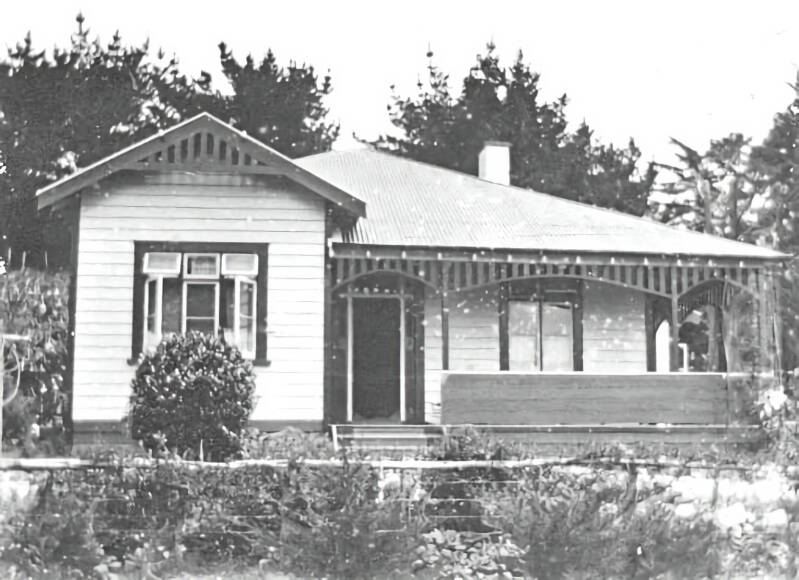
Tennis Party
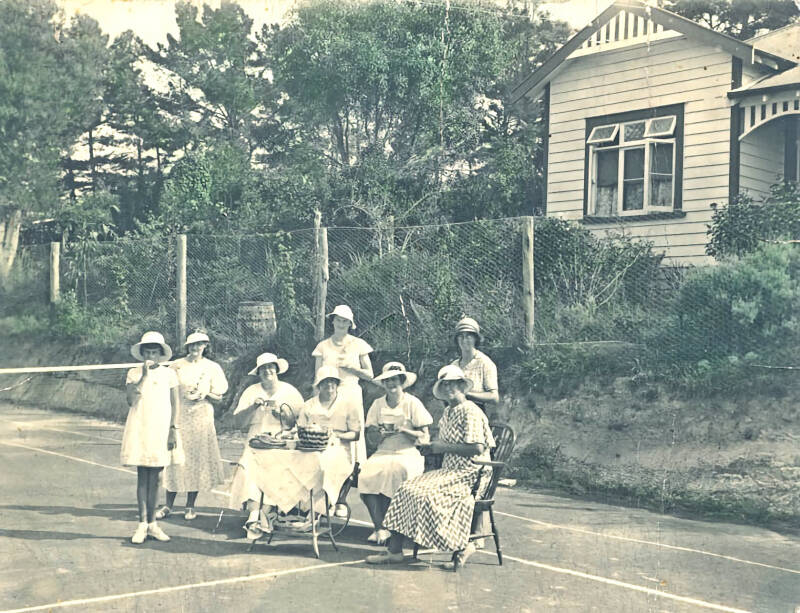
I will stay with Sharon’s parental line for one more generation before returning to her Grandmother, and the Stallworthy family. Another family that deserves its own section, it not a book, of their own.
Thomas Corlett French’s father, John Michael French was born in Ludford, Lincolnshire, England on the 11th of October 1823, to Francis James French and Mary Ann Oliver. Francis had been born in Cornwall in 1791 and was a farmer and a lay preacher. In 1831, at the age of 40 Francis French, his wife Mary and eight of their children, left England in April 1831, arriving in Van Diemen's Land on the barque Mary Ann on the 23rd of August 1831. They settled in the Longford district. Francis was a lay preacher for, and a driving force behind the Wesleyan Church. Their son John Michael was 7 years old and remained behind in Lincolnshire.
By 1847 at the age of 23 John was working as a shoemaker when he married Ann Richardson in Bradley, Lincolnshire, England. They had five sons, Robert, John William, James Michael, George and Arthur there before they arrived in Auckland, New Zealand just after Arthur was born in 1847.
On the 7th of February 1860, their son John William died in Auckland at the age of 10, and his mother Ann died 22 days later on February 29th. John then married Elizabeth Ann "Catherine" Trenwith on the 28th of November 1860, and they had a son in March of 1863, who they also called John William French. Elizabeth died shortly afterwards on the 11th of April 1863 in Auckland when she was 32 years old. Elizabeth had been born in Penzance Cornwall on the 6th of March 1831, to John Trenwith and Elizabeth ‘Eliza’ Rowe. Her father was an established bootmaker in Cornwall but died in 1857. His son, also called John Trenwith followed in his father’s trade and emigrated to Auckland, New Zealand in 1865 where he established a large boot manufacturing and importing business with a factory in Wakefield Street. Elizabeth had already emigrated to Auckland by then, although we don’t know exactly when, and had married and died. Her mother and four of her siblings had all emigrated to New Zealand, although not all at the same time, following her father’s death. A familiar story.
The same year (1863) John remarried for the third time to Catherine Margaret Corlett in Auckland, and three years later their son Thomas Corlett French was born in Auckland on the 27th of July 1866. Catherine appears to have been born in Ramsey, on the Isle of Man, England in 1835, but how and when she got to New Zealand is not known. John was living and working as a grocer and draper in Newton, Auckland, but unfortunately his grocery business went bankrupt in 1878. John died on the 9th of February 1899 of tuberculosis and congestive heart failure, and was buried in the Symonds Street Cemetery, Auckland, New Zealand. Catherine survived for another 20 years, dying in Auckland on the 17th of March 1919.
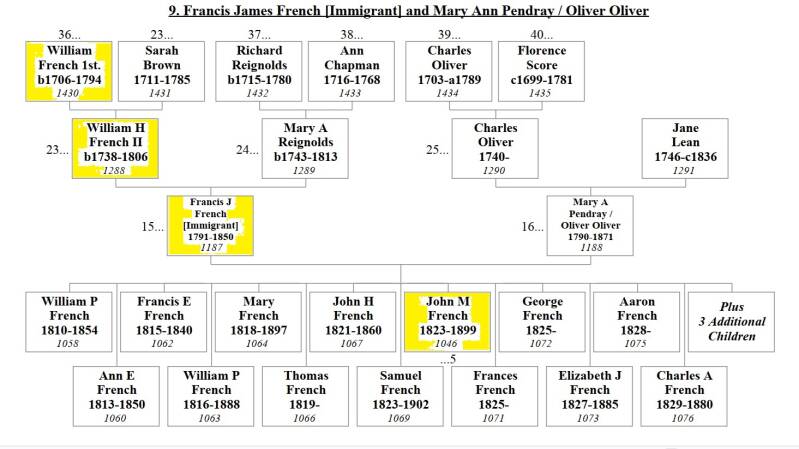
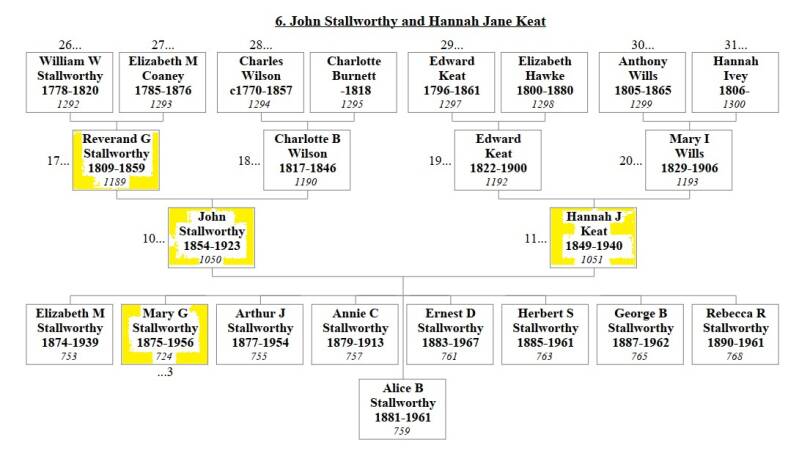
Elizabeth Marion Stallworthy.
The eldest child of John and Hannah Stallworthy was known as Marion. She was born in Newmarket, Auckland on the 14th of November 1873. She was 6 or 7 years old when the family moved to Aratapu in Northland after her father, who was employed by the Auckland Education Board as a teacher, was posted there in 1880. In 1896, at the age of 23, she married Alfred John Sowter.
Alfred had been born in Derby Unitary Authority, Derbyshire, England on the 27th of July 1866, to Benjamin Sowter and Harriet Knoghton. In 1881, at the age of 14, he was listed as a butcher’s apprentice. In a twist of fate so often repeated among these stories, his father Benjamin died in 1878, leaving Harriet with five children and no support. The following year the family emigrated to New Zealand, on November 21st, 1889, when Alfred was 23 years old.
Together Marion and Alfred had ten children, while Alfred continued his trade as a butcher. He died in the Military Hospital at Trentham Military Camp during the First World War where he was a driver, on the 17th of May 1916, and was buried in the Karori Cemetery, Wellington, New Zealand. Marion continued to live at Aratapu, Northland, New Zealand until her death on March 18th, 1939, at the age of 65.
Mary Gertrude Stallworthy
The second child born to John and Hannah Stallworthy was known as Gertrude, as it was the family tradition to call children by their second given name, a tradition carried on in the French family. Gertrude was born in Newmarket, Auckland, New Zealand on the 5th of September 1875 and was around four years old when the family moved north to Aratapu.
She married Thomas Corlett French in Dargaville on the 11th if June 1895, at the age of 19. They had four daughters, and a son, as has been described above. Thomas died suddenly on the 4th of April 1930, when Gertrude was just 54 years old. She lived on until she was 80, dying in Paeroa in the Waikato on the 13th of January 1956.
Arthur John Stallworthy
Arthur John Stallworthy was the third child, and the first son, born to John and Hannah Stallworthy, in Newmarket, Auckland on the 18th of April 1877. He was about 2 years old when the family moved to Aratapu. His father became a newspaper proprietor there but was blind for the last ten years of his life, and Arthur Stallworthy took over the running of the Wairoa Bell and Northern Advertiser. After his father's death in November 1923, he inherited the newspaper, which he sold soon after.
At the age of 23 Arthur married Jessie Christina French, at her parent’s home in Belmont Terrace, Remuera, Auckland, on the 14th of November 1900. Jessie was also 23 years old, and she was the middle daughter of the seven children of Robert French and Marian Hunter. Her paternal grandparents were John Michael French and Ann Richardson. John Michael French was also the father of Thomas Corlett French after he remarried when Ann Richardson had died, and Thomas had married Arthur’s sister, Gertrude Stallworthy as described above.
Arthur soon became involved in local politics, he was an original member of the Hobson Power Board, a promoter of the Dargaville Fire Board, the District High School and other local institutions. He and Jessie had 4 children, 2 girls and 2 boys, who were educated at Auckland University Collage, and eventually Arthur and Jessie moved back to Auckland to be nearer to them.
In Auckland Arthur served as a member of the Auckland City Council in 1927, before being elected as a Member of Parliament, where he served between 1928 and 1935. He was the Minister of Health from 1928 to 1931.
Arthur died at home at 2 Albury Road, Epsom, Auckland on the 1st of August 1954. Jessie also died there 5 years later, on November the 23rd 1959. They are buried at the Purewa Cemetery & Crematorium, Meadowbank, Auckland. But we can’t really move on without looking at their extraordinary family:
Eva Marion Stallworthy was their oldest child, born in Mangawhare, Northern Wairoa, New Zealand on the 19th of March 1904. She qualified as a teacher in Auckland in 1918 and on the 31st of May 1927, at the age of 23, she married the Rev. William Thomas Blight at the Methodist Church, Newmarket, Auckland. William was also the son of a Minister, the Rev. Joeseph Blight and Emma Jane Moyses, both of whom were born in Clare, South Australia, but had travelled to New Zealand to marry. William and his sister Ursella were born in Dargaville, before the family moved south, first to Dunedin and then to Canterbury. William died in Christchurch on the 22nd of August 1983, and Eva died there on the 1st of June 1988.
Sir Dr. John Arthur Stallworthy was the second child of Arthur and Jessie Stallworthy, born at Dargaville on July 26th, 1906. He won a national scholarship to Auckland Grammar School and went on to gain a Junior Scholarship to Auckland University. He took first-year examinations in both law and medicine and decided to study the latter which he did at the University of Otago, in Dunedin, where he obtained a senior scholarship. This approach, in which options were assessed and then clear decisions made and adhered to, was typical of the way he approached everything in later life. John Stallworthy had little room for doubt if he felt the evidence was clear. In 1939 he graduated with distinction and the Gold Medal in surgery, gynaecology and obstetrics. Having won both a one-year medical and two-year obstetric postgraduate travelling scholarship, he chose the latter and studied in Melbourne, London and Vienna between 1932 and 1938. He became a Member of the Royal College of Obstetricians and Gynaecologists in 1935 (and a Fellow in 1951) and a Fellow of the Royal College of Surgeons of England in 1936. In 1938 he was invited to become First Assistant to Professor Chassar Moir in the new Department of Obstetrics and Gynaecology at Oxford University at the Churchill Hospital.
Moir was concerned at the number of women who were dying in childbirth often before help could reach them. Following a concept which originated in Newcastle, he gave Stallworthy the task of setting up a mobile emergency service covering an area with about a 50-mile radius from Oxford in which the care team went to the patient's home. Whether this allowed Stallworthy to indulge legally in one of his lifelong passions of driving fast cars is not recorded. This obstetric 'flying squad' soon had to double then treble its size and was an important factor in making the maternal mortality rate in the Oxford region the lowest in Britain.
In 1939 Stallworthy was invited by Sir Farquhar Buzzard, the Regius Professor of Medicine at Oxford, to take charge of a new 'Area Department' being planned in the Radcliffe Infirmary in order to bring general practitioner obstetricians into a closer working relationship with midwives and hospital consultants. In this he was highly successful and, in addition, he soon established his national and international reputation for the management of female cancers, particularly cancer of the cervix.
Moir had established the reputation of the Nuffield Department for clinical practice, teaching and research and, when he retired in 1967, Stallworthy accepted the invitation to succeed him thereby amalgamating the two departments, ultimately in the new trendsetting John Radcliffe Maternity Hospital in Headington. The department flourished under his leadership and his towering personality soon made it a focus for visitors from around the world. He was a fine, if dogmatic clinician, and an outstanding obstetric and gynaecological surgeon. Some prospered mightily under his tutelage; others, equally talented, did not. All feared him and many, but not all, idolised him.
He was President of the Institute of Religion and Medicine in 1956-58 and became Vice-President of the Royal College of Obstetricians and Gynaecologists in 1969. Knighted for his services to medicine in 1972, he was President of the Royal Society of Medicine from 1973 to 1975 and 1980 to 1981, and of the British Medical Association in 1975. He was awarded the BMA Gold Medal in 1981 and chaired their Working Party on the Medical Effects of Nuclear War from 1981 to 1983. Leeds University and the University of Otago both conferred the honorary degree of D Sc on him in 1975. For several years he was chairman of the governing body of Headington Girls School.
He married Margaret Wright Howie in 1934. Margaret had been born in Invercargill on the17th of March 1908, the 10th child of John Howie and Margaret Wright Todd. She was only 11 years old when her father died, married John Stallworthy at 23, and they moved to England almost immediately. They had one son, Jon, the biographer, literary critic and Professor of English Literature at Oxford University, who was born in London on the 18th of January 1935, and twin daughters, Sally and Wendy.
Lady Margaret died on the 12th of April 1980 at Shotover Edge, Old Road, Headington, Oxford, Oxfordshire, England at the age of 72, and Sir John died of a heart attack on the 19th of November 1993 at 8A College Green, Gloucester, Gloucestershire, England at the age of 87.
Dr. Kenneth Robert Stallworthy MB Ch B Otago was born to Arthur and Jessie Stallworthy on March 4th, 1915, at Dargaville. He was a Psychiatrist, qualifying at Otago University. On December the 3rd 1938, at the age of 23, he married Moira Anna McKenzie in Dunedin, where she had been born 22 years previously to Duncan Norman Mckenzie, a Presbyterian Minister and his wife Sarah Annie Evans. They moved to Auckland, where their daughter Jane Griffith Stallworthy was born on the 15th of June 1940. Tragically, Moira died two years later, on the 3rd of June 1942, at the age of 26.
The following year on the 3rd of March 1943 he remarried to Edith May Hughes a psychiatric nurse, and on the 28th of December of that year, their first son, Peter Kenneth Stallworthy was born. The family had a stint in England, where he worked at St James Hospital, Milton, before returning to Auckland on the ship Rakaia on the 6th of November 1947. Kenneth died on the 4th of July 1963 in Waikato Hospital, Hamilton at the age of 48. Edith continued living and working in Auckland, where she died on the 12th of March 2003.
Jessie Tui (Mary) Stallworthy was born to Arthur and Jessie Stallworthy on the 5th of August 1922. She was a scholar and a schoolteacher. She married Dr. Campbell Newman Smith D'Arcy, a GP at St Andrews Church, Epsom, Auckland on the 22nd of September 1945, the reception being held at the Mount Eden Tea Kiosk. They travelled overseas, returning to New Zealand aboard the Dominion Monarch, which left England on the 11th of May 1951. She died at the Sarah Selwyn Hospital, Auckland on the 6th of September 2014, having survived her husband by some 12 years.
John Stallworthy

Hannah Jane Keat
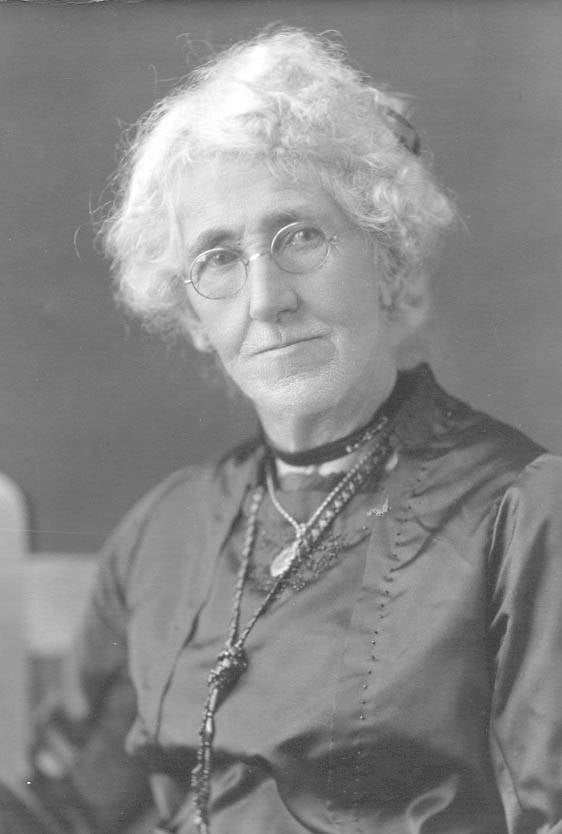
Mary Gertrude Stallworthy
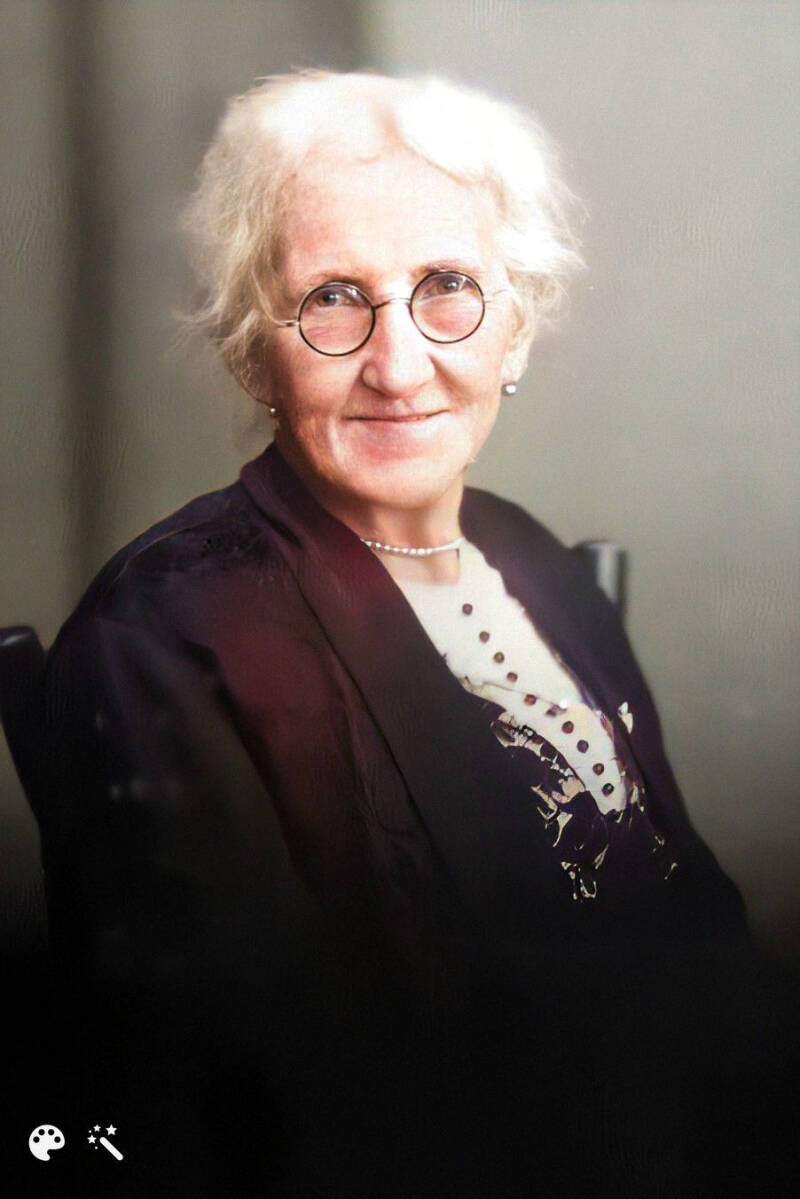
Thomas Corlett French
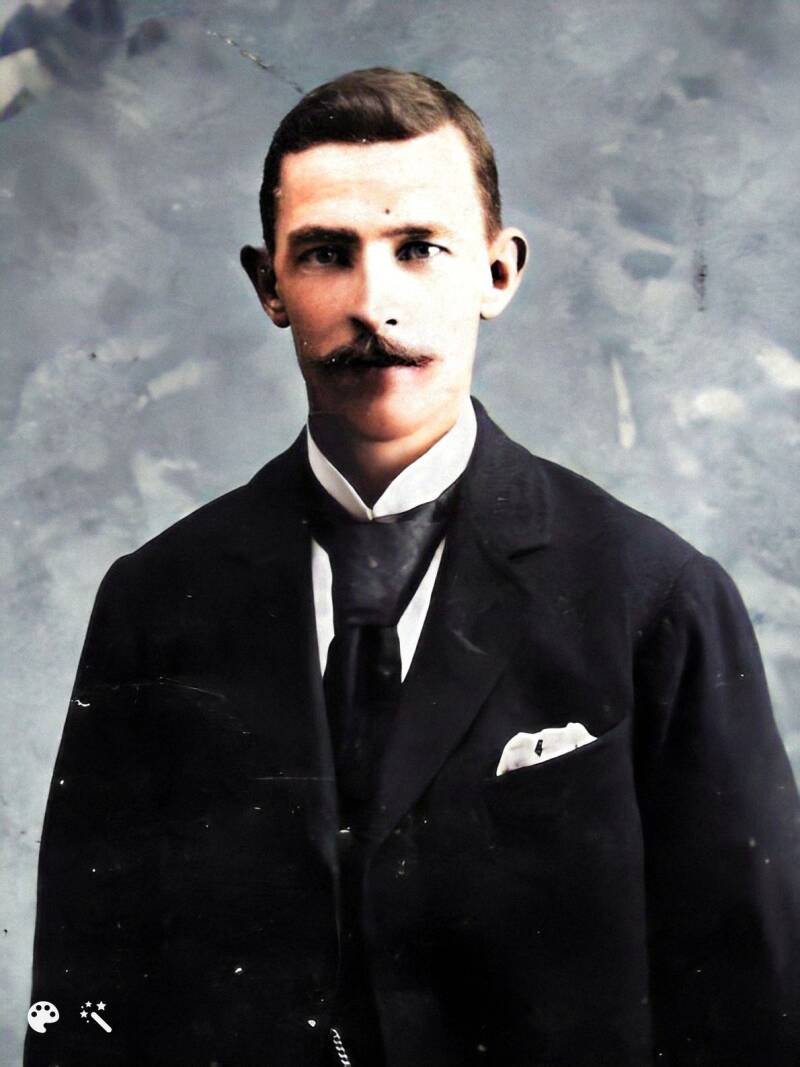
Elizabeth Marion Stallworthy
Arthur John Stallworthy
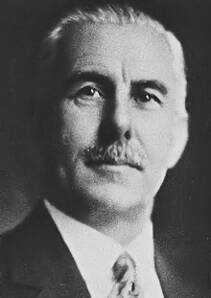
Annie Cynthia Stallworthy was known to all as Cynthia and was born to John and Hannah Stallworthy on the 6th of March 1879 in Auckland. She would have been only about a year old when the family moved to Aratapu in Northland. On the 3rd of April 1900 she married Roland Wordsworth at Aratapu, when she was 21 years old.
Roland was born in Gateshead, Durham, England on the 23rd of July 1875, to Joseph Wordsworth and Mary Ann Dyson. Like other parts of Britain during the industrial revolution, Gateshead had boomed with the arrival of the railway, becoming a rapidly industrializing town in County Durham, defined by coal mining and heavy industry, with an associated booming population leading to overcrowding and slums and significant poverty (such as workhouses overflowing), and poor, insanitary housing, leading to disease. Unemployment became a recurring problem, and the area remained notorious for vagrancy and crime. I haven’t found when or how the Wordsworth family emigrated to New Zealand, but by the end of the 1880’s they were living and working at Aratapu.
Roland and Cynthia had four children, Lilly in Aratapu, Walter in Ruawai, Dora in Charleston, Buller District, on the South Island West Coast, and Bert, born when the family had returned and settled in Tokatoka, Kaipara District, Northland. Tragically, Cynthia died on June 2nd, 1913, when she was just 34, and Burt was only 3 months old. Roland had been working as a labourer, foreman and gum digger, and as Dora’s birth would suggest, a return to coal mining. Three years after Cynthia’s death, Roland remarried to Elsie Lewes from Thames, the second youngest of 9 children of Phillip Jacob Lewes (born in Triest, Oost-Vlaanderen, Belgium in 1844) and Susannah Philpot Herivel (born in Alderney, Channel Islands in 1857). Roland and Elsie had two children while at Tokatoka, Lewes Wordsworth (who tragically died at the age of 14) and Ulna (who married Albert James Schick). Roland died at Tokatoka on the 21st of January 1947, and Elsie survived him until the 17th of December 1977, when she died at the age of 86.
Alice Blanche Stallworthy was known to all as Blanche and was born to John and Hannah Stallworthy on the 28th of March 1881 at Aratapu, Dargaville, North Island, New Zealand. On the 31st of July 1901, at the age of 20, she married Andrew Wordsworth at the Wesleyan Church, Aratapu, Northern Wairoa, Northland. Andrew was no relation to Roland Wordsworth, who had married her sister Cynthia the year earlier.
Andrew Wordsworth was born in Wakefield, West Yorkshire, England in 1875 to William Wordsworth and Mary Alice Clarke, their second son after the birth of Frank Wordsworth in 1873. In the 1800s, Wakefield, West Yorkshire, transformed from a prosperous market town into a booming industrial hub, leveraging its position on the River Calder for trade (wool, corn) and industry (textiles, coal mining, engineering), marked by significant population growth, new civic buildings (Court House, Prison), two major epidemics (cholera), and the rise of diverse businesses like breweries and the Portland cement works, all while retaining its market town status, hosting Britain's largest cattle market. In a now familiar story, the rapid growth and industrialisation of these towns and cities also lead to unemployment, poverty, overcrowding, poor living and working conditions and disease. Certainly, the Wordsworth family had enough, and in 1876 they boarded the sailing ship ‘Horrah’ and emigrated to New Zealand, bound for Wellington. Unfortunately, thet couldn’t outrun the damp, crowded conditions they had left, or Mary’s consumption and on the 14th of November 1876, Mary died while they were still at sea. They were only two days out of Wellington and as William was denied permission to bring her body ashore, she was buried at sea just off the Wellington Heads. After landing William worked for about 6 months in Wellington, the two young boys were looked after by friends. Andrew and Frank were then put into a church orphanage while William went north looking for work, William, having experience in the timber industry, spent a couple of months in the Manawatu before moving to Northern Wairoa in 1887 where he accepted a job as sawyer at the Aratapu Mills, remaining there for fourteen years. The following year (1878) he married Hannah West, who had been born in Sussex, England on the 10th of June 1859, and who had arrived in Hawkes Bay by assisted emigration with her family when she was 14 years old aboard the Queen of the South. They then brought the two young boys up to the Northern Wairoa. After 14 years as a sawyer, William turned to farming, owning a property of about 325 acres. He made a generous gift to the district of the present site of the of the Northern Wairoa Hospital at Te Kopuru. William and Hannah had a family of 15 children, twelve sons and three daughters.
But back to Andrew and Blanche. After they were married, Andrew worked initially as a gum digger, then a carpenter, before going farming with his brother Frank and half-brother William at Aratapu. The couple had five children, Theodore in 1902, Vernon in 1904, Ruby Alice in 1906, Hilda Blanche in 1908, and Olive Cybthia in 1919. Andrew died at Te Kopuru on the 25th of October 1957, with Blanche following from there on the 1st of January 1961, at the age of 79.
Ernest David Stallworthy was born to John and Hannah Stallworthy on the 7th of February 1883 at Aratapu, Dargaville, North Island, New Zealand. He became a compositor and printer by trade and on the 29th of March 1905 he married Florence Margaret Grice.
Florence was born in Wharehine (Port Albert), Rodney, Auckland, New Zealand on the 6th of February 1884, to Thomas Marshall Grice and Margaret Cray. So, I immediately knew that was part of the Albertland Community. We have come across them before when describing Charles Bloomfield. And indeed, Florence’s father Thomas was one of the original wave of those settlers. He was born in Grimsby, Lincolnshire, England on the 17th of December 1843, and was an apprentice wheelwright. It is worth reiterating the story of the Albertlander’s, as it opens a window on the naivety and sense of entitlement that characterised much of the settlement at that time.
Albertland was to be a city to rival Auckland, a third religiously based settlement following the successful examples of Anglican Christchurch and Presbyterian Dunedin, based in a quiet arm of Kaipara harbour 15 kilometres west of present-day Wellsford. It was devised by a William Rawson Brame in Birmingham in 1861 as a Non-Conformist based settlement to colonise the country and named after the popular HRH Prince Albert—Prince Consort, husband to Queen Victoria. It proved immensely attractive to land-hungry British families forced off small holdings and into city slums at a time when the civil war in the United States closed off that country to them, as was the promise of 40 acres (16 ha) of freehold land per man, plus a further 40 for his wife and 20 each for his children, if he stayed on the land for five years. To the ambitious lawyers’ clerks, carpenters and barbers from terraced houses in the smoky cities; and to skilled farm workers who had no chance of tilling their own piece of dirt in the land of their birth, the 40-acre scheme promised untold riches.
The 800 Non-Conformists in the first wave of three ships were farewelled from London Docks on May 29th, 1862, by approximately 15,000 enthusiastic supporters. After just under 100 days at sea in trying conditions, the ships limped into Auckland and the settlers given temporary accommodation in the government immigration barracks in Freeman’s Bay. Living conditions were primitive, few houses boasting the modern conveniences of gas, coal, baths or even a decent water supply and wet weather turned the roads and ground into an impassable quagmire. Plus, fearsome Waikato and Hauraki Māori threatened daily to march on the infant city and raze it to the ground. 12,000 miles from home, Brame’s followers began to wake up to the grim reality behind the rosy dreamscape. But work in the city was plentiful, so many of the migrants quietly evaporated, taking jobs, moving their families out of the barracks and forgetting their contract with Brame to settle in Albertland.
Slowly, either by sea around the treacherous coast or overland on narrow hilly tracks through wet bush, the remainder made their way to their allotted land. Of those who came with the intention of being part of the Nonconformist settlement scheme, only about half actually went to the Albertland area, and of these less than half remained to pioneer the district. It didn’t take them long to work out that they had been abandoned in a wilderness. Their block consisted of scrub and fern; there was no road—anywhere—and seafarers didn’t want a bean of their custom if it meant sailing into the dreaded Kaipara Harbour. Without the goodwill of the local Māori, the colonists would have found themselves in dire straits, despite their suspicion of them. Many of them knew nothing about rural life and simply gave up. Of the 3000 who had signed up to the Albertland settlement scheme, around 1500 made it north from Auckland, and it is thought that fewer than 300 attempted to stay on for any length of time. By 1881, only two families out of the original migrants—the Ingers and the Hindles—remained in Port Albert itself.
But once the remaining pioneers had worked out that their English farming methods didn’t apply, instead of persisting fruitlessly with arable farming they turned to cows, and Albertland became famous for its superb butter and cheeses. Dairy farming is still the foremost agricultural enterprise in the area.
Florence’s father Thomas was about 18 when he joined the original wave of Non-Conformists, sailing on the ship Hanover and leaving London on the 29th of May 1862. The ship arrived in Auckland on the 17th of September of that year. I don’t know how he got to Albertland, but on the 15th of May 1868 he married Margaret Cray at the Minnesdale Chapel in Wharehine. Her family was from Southampton, Hampshire, England and had also travelled to New Zealand on the ship Hanover, so they may well have met onboard. Florence was the seventh of eight children born to Margaret and Thomas born at Wharehine before she died of cancer at the age of 50. Thomas remarried to Mary Roberts Bailey three years later, and they had a daughter Dolly the following year.
Ernest and Florence had four children: Hannah in 1908, Thomas in 1911, Amy in 1914, and Florence Jean in 1919. Unfortunately, Amy died when she was two, and Jean when she was 12. Florence died at Birkenhead, Auckland, New Zealand on the 20th of January 1964 at the age of 79. Ernest died in Kaikohe, Northland, New Zealand on the 14th of May 1967. He had been active in the management of Auckland Cricket.
Herbert Stanley Stallworthy
Herbert Stanley Stallworthy was born to John and Hannah on the 13th of June 1885 at Aratapu, Northern Wairoa, New Zealand. In 1910 at the age of 25 he married Alice Gertrude Wordsworth. Alice had been born at Tokatoka, Kaipara District, Northland, on the 11th of September 1884 to William Wordsworth and Hannah West. William was also the father of Andrew Wordsworth (who married Alice Blanche Stallworthy – above) and Hannah West was his second wife, after Mary Alice Clarke had died near Wellington on their voyage out from England on the ship Horrah on the 15th of November 1876 and was buried at sea.
Herbert and Alice farmed at Aratapu and had a son Vivian Osbourne Stallworthy who was born the year after they married, on the 26th of October 1911 at Aratapu. Vivian married Ruth Emily Roberts, who had been born in Dublin, Ireland on the 1st of October 1912
Herbert died at Aratapu on the 13th of June 1885 and is buried at Te Kopuru. Alice died on the 27th of December 1971 and is also buried at Te Kopuru.
George Stallworthy was born to John and Hannah at Aratapu, Dargaville, North Island, New Zealand on the 5th of July 1887. In 1915 at the age of 28 he married Elsie Elizabeth Littin, the daughter of Albertlanders Henry (Harry) Littin and Jane Partridge. Elsie was born at Port Albert on the 9th of February 1888. It was her grandparents, William Henry Littin and Honor Pickard Littin who had emigrated from Devonshire, arriving on the ship William Watson in 1859. They first settled at Otahuhu, and then went to Hunua, where they took up land and from where they were driven by hostile Māori at the outbreak of war. As the district was very unsettled for some time, they went to Kaiwaka, where their land had been allocated under the 40-acre scheme in 1866. Her father Harry had been born at Otahuhu and married Jane at Kaiwaka on the 4th of May 1881. By 1884 they were living at Port Albert, where they had three sons and two daughters. George and Elsie were farming at Aratapu when just 4 years after they were married, Elsie died on the 3rd of March 1919. She was buried at Port Albert.
George remarried in 1921 to Jane McKay, the 9th child of 14 born to an Irish couple, John Ambrose McKay and Joanna Bourke, who had emigrated from Ireland while still single, married at St Joseph's Cathedral, Dunedin, Otago, New Zealand and raised a large family in Otago. How Jane, who was born and raised in Wedderburn, Otago, met George from Northland is unknown. Jane died at Tokatoka, Kaipara District, Northland, on the 9th of March 1945 and was buried in the Old Mt. Wesley cemetery, Dargaville. George continued farming at Aratapu until his death on the 10th of February 1962. He is also buried in the Old Mt. Wesley cemetery, Dargaville.
Rebecca Ruby Stallworthy was born to John and Hannah at Aratapu, Northern Wairoa, New Zealand on the 4th of February 1890. She was a schoolteacher, passing her examinations in Palmerston North in 1909. The following year she married Percy Goldsmith Lewis at Aratapu on January 4th, 1910. Percy’s father, John James Lewis had emigrated from Abergavenny, Monmouthshire, Wales, to Otago and had met and married his mother, Minnie Ellen Goldsmith Bowles in Waimate, Canterbury, New Zealand on the 2nd of September 1880. Her parents had emigrated from Deal in Kent England by assisted passage with their first two daughters, in 1858 on the ship Mystery, surviving an outbreak of both smallpox and scarlet fever which claimed the lives of 15 of the 300 immigrants on board during the 91-day voyage.
Percy was also a schoolteacher and was already teaching at Aratapu in 1909. The first two daughters of their six children were born there, Dora Elaine on the 15th of January 1911, and Valerie Gwendolyn on the 23rd of September 1912. Their eldest son, John James Lewis was born in Utiku, King Country, New Zealand on the 16th of December 1917, followed by Trevor Stallworthy Lewis, born in Bulls, Manawatu-Rangitikei in 1922. Sadly, Trevor died in Napier, Hawkes Bay when he was just 4 years old. Evan Rhys Lewis was born to the couple in Napier on the 4th of March 1928, followed by Rodd Geoffrey Lewis on the 12 of September 1930. They moved to Auckland, where Rebecca died on the 20th of December 1961, followed by Percy on the 26th of April 1970.
Alice Blanche Stallworthy
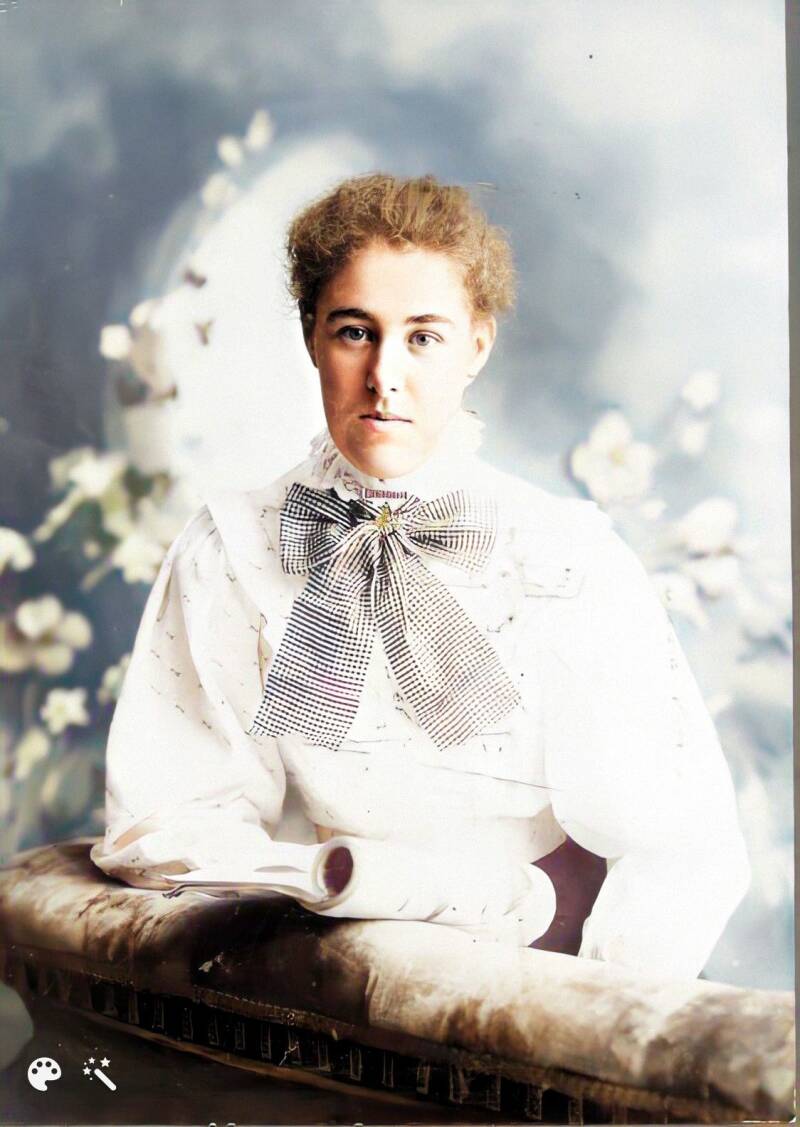
Annie Cynthia Stallworthy
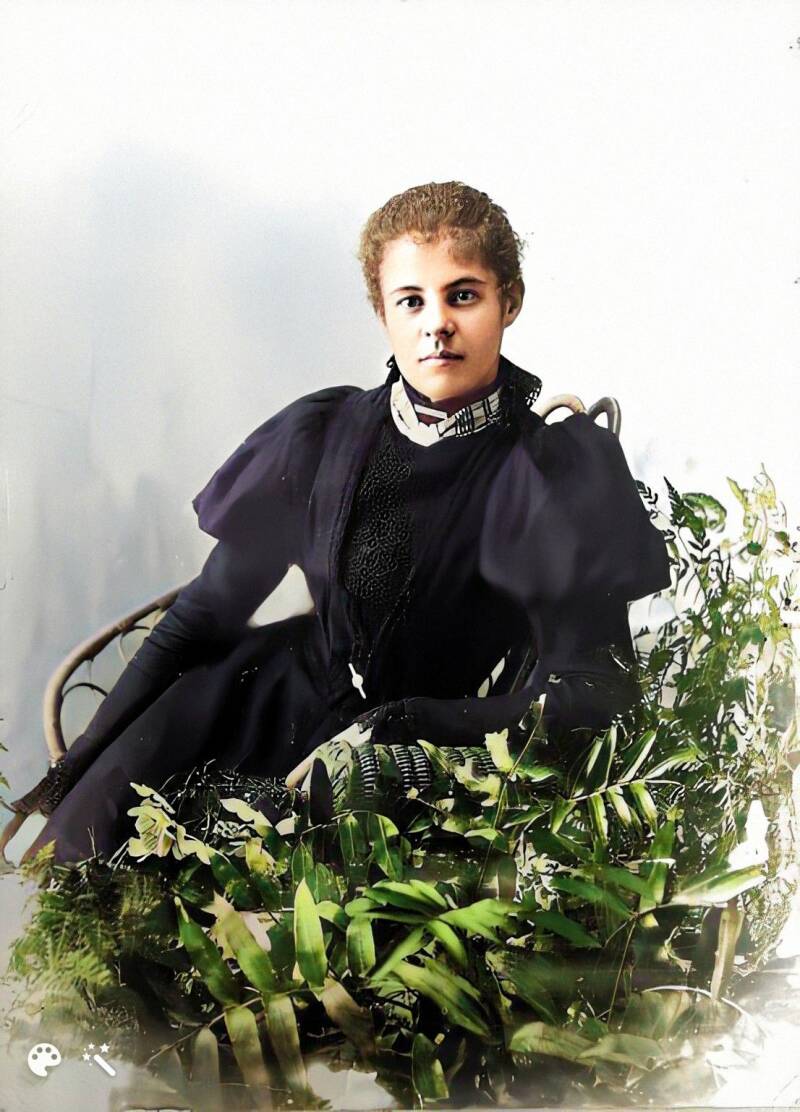
John Stallworthy’s father was the Reverand George Stallworthy.
There was a story told within the French family (Sharon’s Dad’s family) that the distinctive French features, thick black hair and swarthy complexion were the result of some Polynesian genes being introduced into the family tree from missionary work in the South Seas. So, I was particularly interested in having a closer look at the life and times of the Reverand George Stallworthy:
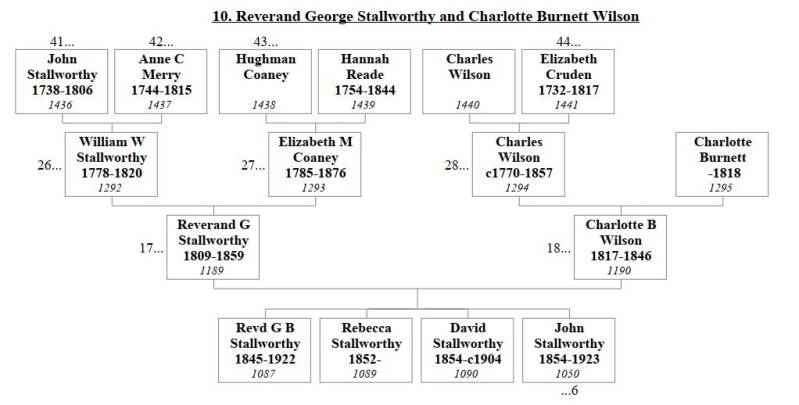
George Stallworthy was born on August 16th, 1809, in Preston Bissett, Buckinghamshire, England, to William Stallworthy and Elizabeth (nee Coaney), both of whom were born and married there.
The picturesque village of Preston Bissett is situated in the fertile Aylesbury Vale district of Buckinghamshire, England, and is grouped round the parish church, which stands in a churchyard on rising ground. The cottages of which it is mainly composed are thatched, many of them dating from the 17th century, whilst the inn known as 'The Old Hat,' which stands opposite the church, is an ancient building of interest. A house on the south side of the church dates probably from the 16th century and still retains some of its oak-mullioned windows.
Preston Bissett is recorded in Domesday and was part of Bernwood Forest in the medieval period. Bernwood had been a hunting forest from the time of Edward the Confessor. It grew to its largest extent under Henry II. The whole area was not covered by forest, in the medieval period a forest was a place where deer roamed for hunting and so included open land, villages and fields. All those who lived in the forest were not allowed to hunt or even gather wood without a special license from the king. Bernwood Forest was finally disafforested in the reign of James I in 1635, although it had been shrinking in size since the time of King John (1199-1216). In the 1800’s this was an agricultural landscape.
Preston Bissett village, Buckinghamshire
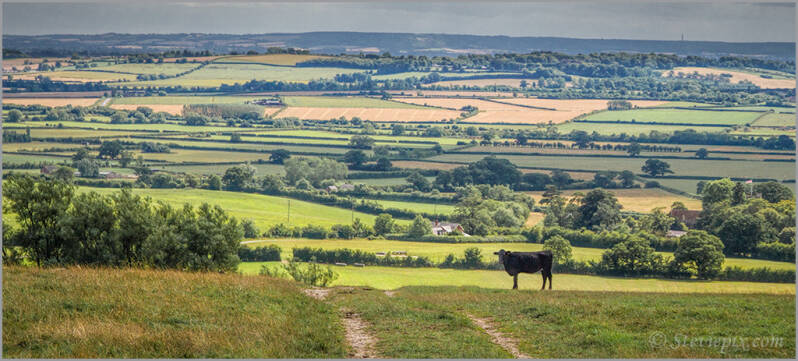
When he was just 10 years old, George’s father died on July 11th, 1820, at the age of 42, which probably left the family in a precarious financial position. It seems that he was taken on as an apprentice in the town of Newport-Pagnell while still a youth, although we don’t know what trade or profession this was. Shortly after finishing his apprenticeship, George made an offer of his services to the London Missionary Society, which was accepted, about the year 1829. After his acceptance by the Society, he pursued a course of study at Homerton College. We are not aware how long his course of study lasted: we suppose it would be about three years.
In the year 1833, the Directors of the London Missionary Society decided to recommence missionary operations on the Marquesas Islands, a pair of volcanic archipelagoes in French Polynesia in the central South Pacific Ocean, 1,200 km northeast of Tahiti. The islands are one of the most remote island groups in the world. These distant volcanic islands are located farther away from a continental landmass than any other island in existence. (They are so isolated they even have their own time zone.) For the most part they are high and craggy, with jagged peaks rising in places to some 1,200 meters. Two unsuccessful earlier attempts had been made to introduce the Gospel to that group; however, for unknown reasons, these missionaries had thought it their duty to abandon the group, after a residence upon it of about twenty months or two years.
George was obviously the man to remedy this and in October 1833, in the company of the Rev. John Rodgerson, he sailed from England, and after spending some months at Tahiti, they reached their destination at the Marquesas in October 1834. Owing to the extreme ferocity and profligacy (utterly and shamelessly immoral behavior) of the Marquesan’s, who are distinct from the Tahitians, Mr. Rodgerson considered it unsuitable to remain among them with his wife and children and retired to Tahiti in 1837. George, who was unmarried at the time, considered it his duty to remain at his post. He continued his labours alone, until he was joined by a fellow labourer, Mr. Thompson, in 1839. The mission continued till the close of 1841, when, in consequence of various untoward circumstances, these men, with the concurrence of their brethren at Tahiti, considered it their duty to retire from the group.
The Marquesas Islands.
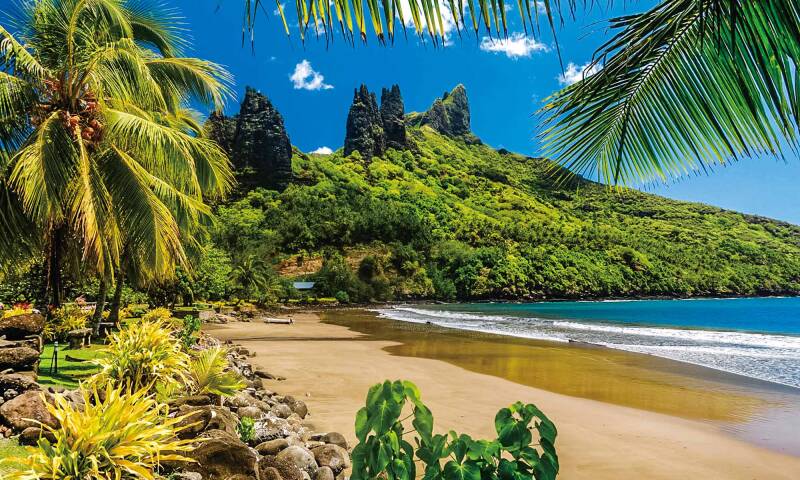
I would love to know what those ‘various untoward circumstances’ were. They sent a single 24-year-old male missionary to the same islands that Paul Gauguin returned to as an artist to paint his Polynesian nudes. One man sought to immerse himself in and celebrate the native culture. The other sought to destroy and replace it. But did George, basically living alone among the ‘shamelessly immoral’ natives, resist their temptations?
Shortly after leaving the Marquesas, Mr. Stallworthy joined the Samoan mission. He was appointed to the district of Falealili, on Upolu, where he continued till within a few months of his death. On February 2nd, 1844, George married Charlotte Burnett Wilson in Tahiti. He was 34 and she was 27 years old. Charlotte was born in Punaʻauia Tahiti in 1817, to Charles Wilson and Charlotte (nee Burnett), who were another missionary family. Her mother had died in Tahiti when she was only one year old.
One year after they were married, in 1845, George and Charlotte had a son, George Burnett Stallworthy, born in Upolu, Samoa, who also went on to become a Minister. Unfortunately, the following year Charlotte died of tuberculosis at Fale'alili, Upolu, Samoa on August 2nd, 1846, at the age of 29 years, just as her mother had.
The following year, on October 13th, 1847, George married Mary Anne Darling, the 28-year-old daughter of David and Rebecca Darling. The Reverand David Darling was yet another Scottish missionary, who spent 43 years in Tahiti, before retiring to Sydney, New South Wales. Mary Anne was born at Elmeo, Tahiti in 1819, and married George at Apia, Upolu, Samoa.
Between 1849 and 1859 George and Mary had 9 children, 4 girls and 5 boys. One of the boys, William Darling Stallworthy died when he was 2 years old. Then, suddenly and unexpectedly, on the night of the 7th of November 1859, George died when 50 years old, leaving a Mary a widow with nine children, the eldest only 14 years of age and the youngest but ten days old. George was buried in the cemetery at the Mission Seminary, Malua, Upolu, Samoa.
Mary decided to return to England with her family, but disaster was to follow them. The missionary Braque John Williams had arrived in Samoa on the 17th of December 1859 and Mary and her family were to board it. The John Williams departed Samoa on January 16th, 1860, and visited Aitutaki, Rarotonga, and Mangaia. On February 16th, 1860, little Louisa Stallworthy fell ill with a putrid sore throat. Despite all efforts to treat her, she died suddenly on February 22nd, just outside Tahiti harbour. She was three and a half years old. She was buried in Tahiti.
Rev. George Stallworthy.
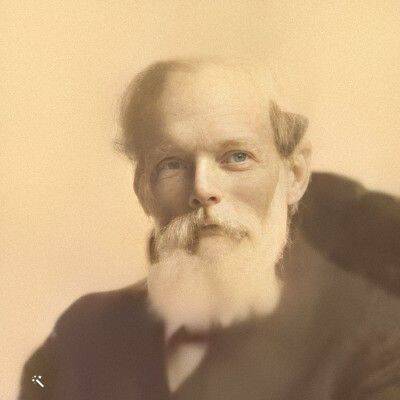
The Braque JOHN WILLIAMS entering the Bay of Huahine, Society Islands.
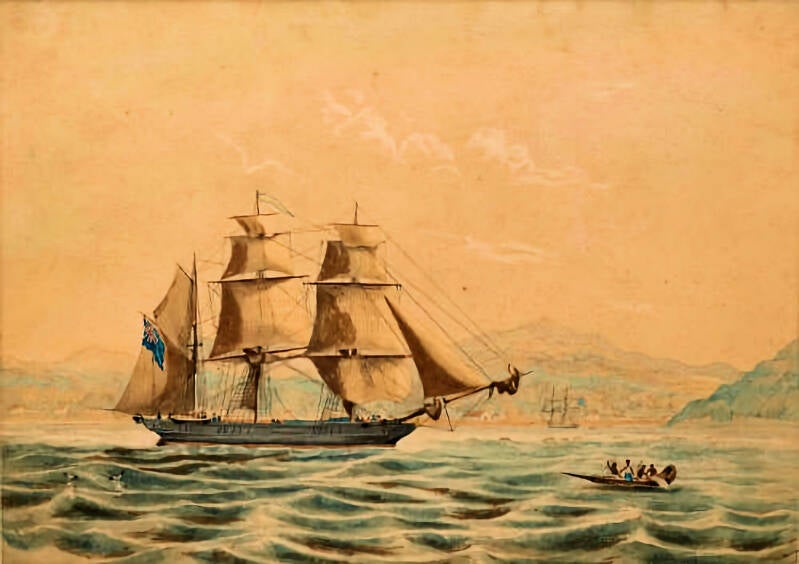
The voyage continued, but on February 26th as the ship approached Huahine, nine-year-old Sarah Ann Stallworthy, who had become ill the previous day, also died, and was buried there. On March 5th, 1860, the John Williams arrived at Raiatea, with two more of the Stallworthy children, a boy and a girl, dangerously ill. On the 10th of March, two-year-old Willian Stallworthy, who had been ill for 5 days, died as well and was buried at Raiatea. Two days later the John Williams departed Raiatea, with the disease still present among other passengers, but without the remaining Stallworthy’s on board, as the two children who had been so ill were considered too weak to proceed on the voyage.
The Stallworthy’s stayed at Raiatea for nearly 2 months before catching the ship Sultan, and arriving in Sydney, Australia on May 29th, 1860, where Mary Ann’s father had retired to. They departed again on the 13th of June on the ship Phoenician, bound for London, England, where Mary Ann died on October 26th, 1872, in Gravesend, Kent, England at the age of 53.
It is speculation of course, but the descriptions given of the illness that took Stallworthy children’s lives; a combination of croup and quinsy, a putrid sore throat with what sounds like pseudo membrane formation, and sudden, unexpected death, all sound rather like diphtheria. And one wonders if in fact, George wasn’t the index case, perhaps a complication of the tuberculosis that had killed his first wife. In 1860, the causative agent, Corynebacterium diphtheriae hadn’t been identified yet, much less a vaccine developed. The treatments available at that time and given to the children were the constant and frequent administration of tartar emetic with occasional doses of calomel, the internal administration of silver nitrate to the throat and when things got really bad, bleeding them.
It is of course, Mary Ann’s son John Stallworthy that provides the link to the French family. It is not known whether he was the child that was dangerously ill when the John Williams arrived in Raiatea, but if so, he recovered to make it to England with his mother and remaining siblings, being recorded as living at Parrock Street, Gravesend, Kent, England in the 1871 census. The following year he signed on as Able Seaman on ship "City of Auckland", disembarking in Auckland, New Zealand. He went on to have a remarkable career as a farmer, publisher and politician. He married Hannah Jane Keat, who had also emigrated from Cornwall on the same ship City of Auckland in 1873 that John was working his passage on, and their second daughter, Mary Gertrude married Thomas Corlett French in Dargaville on June the 11th, 1895.
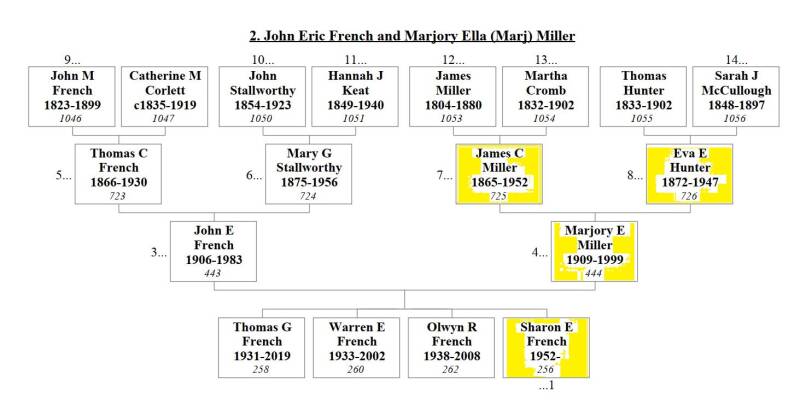
Marj was one of eleven children born to James Cameron (Cam) Miller and Eva Ellen Hunter.
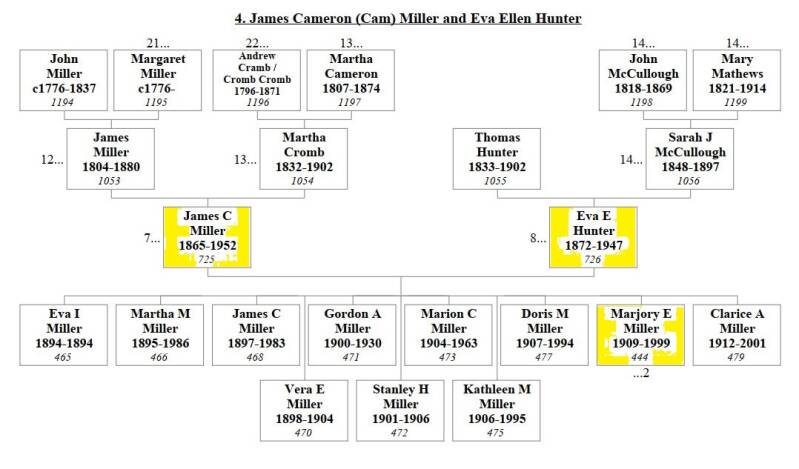
James Cameron (Cam) Miller was one of five sons born to James Miller and Martha Cromb.
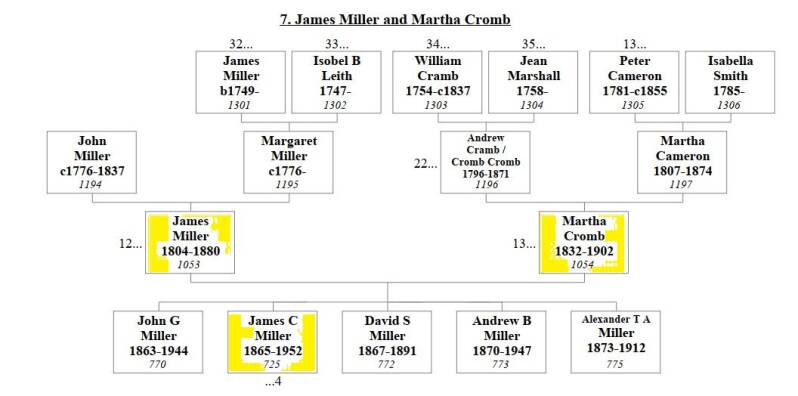
Marjory Ella Miller was born to Cam and Eve Millar at Maungakaramea on February 18th, 1909. Maungakaramea was a rural locality in Northland, situated southwest of Whangārei. The area is home to a basaltic volcano of the same name, which rises to a height of 225 metres. The name "Maungakaramea" is Māori, with a common interpretation being "Red Ochre Mountain," referring to a coloured clay used for traditional war paint. At the time it was an established but isolated rural settlement in Northland, undergoing a major transition from a timber and kauri gum extraction economy to pastoral farming, primarily sheep and dairy cows on its rich volcanic soil. Although declining, kauri gum digging was still a significant activity in Northland, peaking around 1900 with thousands of diggers working in wetlands. Transport was difficult, especially over boggy roads in winter, and horses, or horse and carts, were the norm. Life was pretty primitive, without electricity and often running water.
In 1916 the family moved to a 200-acre farm at Kopuarahi on the Hauraki Plains southwest of Thames. Marj attended Maungakaramea and Kopuarahi Schools and in 1923, was a foundation pupil of the Ngatea District High School, which later became the Hauraki College. Although she helped on the family farm at Kopuarahi, her skills were not limited to the handling of stock, for Marj was highly proficient in knitting, crochet and embroidery.
Marj and Eric married on September 25th, 1929, at St James Church at Thames and their attendants were Tommy Collins (best man), Mac Miller, Beth Benny and Clarice Hunter. They lived in Dargaville and Broadwood in the year immediately after their marriage, but started sharemilking, firstly on Piako Road, Turua for Harry Hill and on the Campbell Road end of Cam Miller’s farm, before returning to Dargaville, where they share milked for Richie Powell.
In 1940 they bought their first farm at Waihue, north of Dargaville, which covered an area of over 100m acres of fertile river flats, which were susceptible to flooding, but which was excellent dairy country. Timber recovered from the stream which formed one of the farms boundaries was used to extend the farmhouse. When they sold in 1954 and bought the Rotokohu Road property at Paeroa, they were greeted there by a flood of such generous proportions that for a time their journey to Edgecumbe for the wedding of their eldest son Gordon to Stella Hunter (no relation), was in serious doubt.
Marj and Eric moved to Flora Street, Paeroa in 1957 and Eric spent some turbulent years in the employ of Dudding Brothers Ltd, but they returned to the farm for six years, before retiring to Taylors Avenue, Paeroa in 1976. They both enjoyed bowls and golf, and Marj achieved accolades not only for her achievements in the games, but also for her part in the administration of the sports.
The celebrations for Marj’s ninetieth birthday extended over several days. Visitors to her home included many of her golfing and bowling friends, and family and friends joined her at granddaughter Robyn and John Kelly’s Tamahere residence, where her spritely demeanour and warm friendliness impressed the gathering.
Three of Marj and Eric’s family members have earned high honours in the sporting domain. Daughter Sharon Sims represented New Zealand at bowls in two Commonwealth Games, winning gold at Edinburgh as well as firsts and seconds at World Bowls. In 2007 she was awarded the New Zealand Order of Merit for her services to bowls. Grandson Grant Bradburn followed his father Wynnes’s footsteps by also representing his country on the cricket field. He is currently coaching the Pakastani national team, having previously coached the Scottish national side.
Gordon and Stella spent the greater part of their life farming at Edgecumbe before moving to Whakatane. Warren and Margaret farmed up the Rotokohu Road before moving into Paeroa; Olwyn and Wynne Bradburn fielded a life around the cricket pitches of the Waikato while living in Hamilton, and Sharon and Ken Sims bowl and fish respectively around the Manawatu.
Eva Isabella Miller
The first child born to Cam and Eva Miller was called Eva Isabella, and she was born on the 24th of March 1894 at Maungakaramea, Whangarei, Northland. Tragically, she only lived for a month, dying at Maungakaramea, on the 14th of April 1894.
Martha May Miller
Martha May Miller was born to Cam and Eva Miller on May 17th, 1895, at Maungakaramea.
May as she was known, spent much of her youth with the Jonny Miller family at Maungakaramea, going to the local primary school and then to the Whangarei Girls High School in company with their daughter Roy. May played sport in the district and became a familiar figure around the Boarding House and Store, where she assisted her Aunty Mary with the chores and activities that went into the running of the premises. May was 19 and engaged to Ernest Ashley Crawford when he was killed in an accident at the Tauraroa Quarry on Mr. Gunson’s property, on April 10th, 1914.
When the Cam Miller family moved to Kopuarahi in 1916, May found much to occupy herself with in her new surroundings. And it was at Kopuarahi that she met and married John Richard (Jack) Flynn on June 19th, 1918. Jack was the son of Patrick Flynn and Bridget Healey, both of whom were Irish and who had emigrated, probably initially to New South Wales, Australia before settling in Fordell, Whanganui-Manawatu, New Zealand where Jack was born on the 11th of January 1894. (You have no idea how many Patrick Flynn’s there are on ships passenger lists of the time).
Jack had recently returned from serving overseas in the first World War when they married, and they initially settled on Piako Road, Turua, dairy farming there until 1939 when May and the family shifted to 26 Rolleston Street Thames for a couple of years while their Mangatarata farm was being developed and a house built. This new home was where May and Jack were to spend the longest period of their married life. The Mangatarata farm with the sheep and a small herd of cows became synonymous with Jack’s pipe, and those lovely gardens that surrounded the house, which like all of her other homes, were testimony to May’s green fingers. During the second World War, Jack held the local Home guard together and May’s knitting benefitted many a young man overseas. Both were involved in district affairs, Jack with the Federated Farmers and May with the Woman’s Division, and her talents on the piano and organ augmented her lovely singing voice, and all were to bring pleasure to the local community.
Jack died suddenly on May 6th, 1963, and about a year later May moved to her new home in Richmond Street, Thames where she resided until 1975 when a severe stroke necessitated that she be cared for in the Thames Hospital until her death on September 25th, 1986.
On the 24th of February 1919 their eldest son Allan Braidwood Flynn, (who is named after the sister-in-charge of the Turua Maternity Hospital, Sister Braidwood), was born at Turua, on the Hauraki Plains, and after travelling the highways and byways of the Auckland Province, retired to live in Auckland. He married Alice Ethyl Arthur, whose father Edward Arthur was born in Willesborough, Kent, England and married Ethyl Marshall (born in Rainrhet, Bengala Occidental, India) there before they emigrated and settled in Pipiroa, just west of Kopuarahi on the Hauraki Plains.
Elder daughter Evelyn, born in Turua on the 29th of January 1920, married Louis Raymond Pratt, at Ngatea on March 23rd, 1943, and was only 49 years old when she passed away. Louis was a boilerman at Turua and it was his grandfather George Henry Pratt who was born in Chilvers Coton, Warwickshire, England on the 28th of September 1841 and who married Sarah Bridget Busby there on the 21st of October 1862. Their first son was born the following year and in 1865 they emigrated to New Zealand, their second child, Georgina Isabella being born at sea off Sulawesi Tengah, Indonesia on the 15th of May 1865, before they settled in Omaha, Auckland farming 141 acres.
John Allister (Allister) Flynn was born in Thames on the 14th of January 1927 and married Avis Bertha Green in Te Awamutu in the Waikato in May 1950, before they went farming at Kopuarahi. They raised two sons and a daughter there before retiring to Auckland.
Marjorie Allison Flynn was born on the 25th of April 1929 and married Arnold Joseph Pattimore Schuler on the 21st of May 1949 at Thames. They farmed at their Waitakaruru farm where they also raised two sons and a daughter. Arnold’s father, Joseph Augustus Schuler was Swiss, but I can find very few records of him or the family he came from.
James Cameron (Jim) Miller
James (Jim) Miller was born to Cam and Eva at Maungakaramea on March 1st, 1897, and spent much of his youth with the Jonny Miller family so that he could attend the Maungakaramea Primary School and the Whangarei Boys High School, while his parents were away completing bush contracts. He assisted his Uncle John, and it was not long before he was bringing the mail from Whangarei to add to his talents of driving bullock teams.
Jim served overseas during the latter stages of World War 1, as a Gunner (Regimental No. 57947) with the Field Artillery in France. He left New Zealand on board the ‘Willochra’ on April 23rd, 1918, and returned on the ‘Matatua’ in August 1919.
His parents and family were firmly entrenched at Kopuarahi by the time he returned, and it was on an area of 120 acres at Hamilton Road, Turua, that he settled. After many years of hard labour, the swamp was transformed into a dairy farm which was later used as a dry stock unit.
He married Doss (Dorothy Blanche) Lloyd on September 27th, 1923, at St. Georges Church, Thames. Doss was the younger daughter of Richard Redmond (Dick) Lloyd and Martha (nee Stilwell). Her paternal grandparents were John Ormsby Lloyd (born in Honeymount House, Tipperary, Ireland in 1838) and Mary Ann Welch (born in Stepney, London in 1841). Mary had emigrated to New South Wales with her family when she was 11 years old and the couple had married in Hokitika, Westland, New Zealand in 1868. Her maternal grandparents were Henry Stillwell (born in Guildford, Surrey, England in 1819) and Harriet Francis (born in Greater London, England in 1829). They had married in Clapham, Lambeth, England in 1866 and emigrated aboard the ship Ida Zeigler, arriving on October 19, 1866.
Doss was interested in the Plunket Society and assisted them in their various endeavours, and with Jim, played a full part in the local Patriotic Committee during the period of the Second World War. Jims’s hobby was his thoroughbred horses, and the best of them were Melanoin and Classeen. Jim was not interested in local body politics but wasn’t afraid to remind them should they waiver from the interests of the people.
Jim and Doss lived on Hamilton Road for all of their married lives, except for six years (1931-1937) on Cam’s property at Kopuarahi.
Their family of three were their everlasting delight. Elder son Derek was born on March the 3rd 1925 and married Bev (Maureen Beverley Fisher) in Kerepehi, Hauraki, New Zealand on the 16th of January 1953 and they lived for many years at Kopuarahi, and after moving around the North Island following Derek’s career as a boilerman, settled into a pleasant retirement at Whangamata. Derek died at Thames on July 7th, 2007. One of the most delightful aspects of Derek and Bev’s family for us is meeting and staying in touch with their eldest daughter Lynn and her partner Michel Beland.
Coralie Fay (Fay) Miller was born July 31at 1926 at Thames. She married Torrens Alexander (Tom) Chick there on the 2nd of April 1949 and they farmed at Peka Peka Road, Kerepahi, where they raised three daughters. Tom died at Thames on July 8th, 1966, and Fay continued to live amongst the flowers and her artists palette on her farm at Kerepahi, until her death on March 24th, 2010.
Gordon Ormsby Miller was born in Thames on the 2nd of April 1931. After farming at Hamilton’s Road, Turua, Gordon married Laurel Marie Read at Ngatea on the 27th of November 1981, when he was 50 years old. They ran tearooms from their place at Waitakaruru. Gordon and Laurel were something of legends in the Miller family as they meticulously researched the family history and they were certainly the star feature of the Miller family reunions, significant birthdays and other gatherings, with walls lined with genealogy charts, photographs and stories. They self-published a book on it in 1999 to commemorate the 140th anniversary of the arrival in New Zealand of the Miller ancestors, which has become something of a family heirloom. Considering the scant resources they had back then compared to today; it remains a testament to their skill and determination. Much of the information on the extended Miller family in here comes from their efforts.
Vera Evelyn Miller
Vera was born to Cam and Eva at Maungakaramea on the 15th of August 1899. She died when she was only four years old, on April 2nd, 1904, at Maungakaramea, and was buried in the cemetery there.
Gordon Alexander Miller
Gordon, who was known as Goog, was born to Cam and Eva Miller at Maungakaramea on the 19th of March 1900. After the family moved down to Kopuarahi on the Hauraki plains, he died of Pneumonia shortly after his thirtieth birthday, on the 18th of May 1930. He was buried at the Totara Cemetery at Thames.
Stanley Hunter Miller
Stanley was born to Cam and Eva at Maungakaramea on the 1st of June 1901. Cam was mainly a farmer and bush contractor, and his teams of working bullocks were well known throughout the area. Cam and Eva took their young family with them to bush camps as far away as Broadwood and Peria. It was at Peria that tragedy struck the family. While Goog and Stanley were getting supplies for the camp on May 6th, 1906, 5-year-old Stanley fell between logs and was killed. He is buried at Mangonui, but as there are no existing graveyard plans, the exact location is unknown.
Marion Christina (Chris) Miller
Marion Christina, who was known as Chris, was born on June 4th, 1904, to Cam and Eva Miller at Maungakaramea.
Chris and Cyril Victor Marceau (known as Joe) were married at Thames on July 18th, 1923, and started their married life farming in the Kopuarahi area, before moving in 1935 to their own property at Oparia Road, Turua, where Chris was to spend the rest of her life.
A keen gardener, Chris was also interested in floral art and was an accomplished maker of bouquets and floral arrangements, as well as producing spectacular floral displays. She played a prominent part in community affairs and was an organiser for the Queen Carnival to raise funds for the Turua School baths and filtration unit. She was a founding member of the Kerepehi Woman’s Outdoor Bowling Club, president of the Turua Youth Club for many years, and principal organiser of the Youth Club Debutant Balls. Chris was secretary-treasurer of the Turua Anzac Committee and a member of the Patriotic Committee which was responsible for farewelling and welcoming home all those from the district who left Turua for overseas wartime duties, and for dispatching parcels to them overseas. She was organist for the Presbyterian services at Kopuarahi and Turua for 45 years.
Chris received the Gold Honours Badge for her work with the Thames-Hauraki Federation of Country Women’s Institute, fulfilling many duties within the organisation at both a local and national level.
Chris died in her 60th year on July 12th, 1962, and later Joe moved into the Turua township and passed away nearly twenty years after Chris, on June 8th, 1983. They are buried in the Totara Cemetery.
Their daughter Pauline was born in Thames on October 6th, 1924, did her nursing training at Auckland Hospital, and married Robert Theo (Bob) West on January 8th, 1949. Bob had completed his training as a Civil Engineer after an interruption of two years when he served with the military forces in Italy and Japan. They lived in several places in the lower half of the North Island including Featherston while the Rimutaka Tunnel was being built, always with the Ministry of Works. Later they were in Taumarunui while the Tongariro project was in progress, and they settled in Wanganui in 1965 to retire there to enjoy bowls, music and travel. Pauline and Bob celebrated their Golden Wedding anniversary by entertaining their friends and close relatives at a luncheon at Devonport, Auckland. Their guests included most of their wedding party.
Chris and Joe’s elder son Cyril Edward was born in Thames on October 12th, 1927, and married Dorothy Jean Candy at Kerepehi on June 14th, 1952. They farmed at Kerepehi and Rotokohu in the Paeroa district, before Jean died in November 2010 and Cyril died in February 2022.
Their younger son Lester Brian was born in Kopurahi, Hauraki, New Zealand on January 11th, 1932, and married Bernice Iris Airey at Papatoetoe on January 2nd, 1960. They spent years at New Zealand Army establishments throughout the country and raising three children, before they retired to Wanganui where Lester died on November 1st, 2003.
Cyril Victor Marceau
Everybody knew Cyril Victor Marceau as Joe, and he was born at West Dapto, New South Wales on May 22nd, 1893, the son of Benjamin Marceau (1860-c1923) and his wife Mary (nee Barber). Joe’s paternal line is one of those great examples of how much fun it can be to follow ‘the rabbit hole’ and see where it leads. His grandfather, Joseph Marceau, was a French-Canadian who settled in the Illawarra district of New South Wales in the 1840’s, after being pardoned for alleged political crimes for which he had been incarcerated in Canada, namely rebelling against British rule there. After the rebellion was put down, he was amongst a group of prisoners transported to Australia in chains. From Joseph we can follow his paternal line for five generations in Quebec Canada to reach François Marceau who was born in Thiré, diocèse de Luçon, Fontenay-le-Comte, Vendée, Pays de la Loire, France, in 1641 to Andre Jacques Marceau and Marie Grand Guignand. It appears that Andre took his two boys, Francois and Pierre to Quebec with him leaving his wife back in France. He died in Montmorency, Quebec, Canada in 1650, at the age of 39. I’m sure that there is an interesting family story there too, I just haven’t been able to piece it together.
Joe came to New Zealand when he was 22 years of age, in the company of a Cousin Lance Marceau, with the intention of learning the art of cheesemaking and then returning to the land of his birth. But the New Zealand Government regulations formulated at the time of the outbreak of World War 1, demanded that he, like other Australians joining the armed forces, should serve under the New Zealand flag while they were overseas during the war. Cupid also interfered with any plans that he held to return to Australia, and Joe remained in New Zealand to earn the respect of all who knew him.
Kathleen Mary (Kit) Miller
Kit was the only child of Cam and Eva to be born away from Maungakaramea, and her birthplace was Peria, in the Kaitaia district.
Kit received her schooling at both Maungakaramea and Kopuarahi schools, and while her sisters stayed at home to help with the home and farm, she was the only one allowed to obtain outside employment, which she did at the Turua Post Office. During that time, she met Charles Keith Fox, who had arrived as a nineteen-year-old from Taranaki to farm south of the township and they were married at Turua on August 4th, 1926.
Keith was a proficient rugby player and in later years, a successful administrator. The Hauraki Plains Senior Team, under his guidance as coach, gained prestige as Peace Cup holders. Soon after he arrived in Turua, he became involved in the administration of his local Dairy Company and was a member of the Hauraki United Drainage Board, as well as its chairman for many years. He grappled with the problems of drainage for most of his life.
Keith’s father, James Smith Fox was born on the 12th of November 1867 in Arbroath, Forfarshire, Scotland, a historic coastal town in Angus, Scotland (historically part of Forfarshire) on the North Sea coast, about 16 miles (26 km) east-northeast of Dundee. The town's history is closely tied to Arbroath Abbey, founded in 1178 by King William the Lion. The King was buried within the abbey's precincts in 1214. The town grew substantially during the Industrial Revolution, focusing on the flax, jute, and fishing industries.
James Smith Fox was working as a commercial traveller when he emigrated to New Zealand in 1891 at the age of 24. Initially he was in charge of the dairy factory on a farm for the National Bank of NZ at Tataraimaka, before being employed by the Crown Dairy Company. In 1899 he started his own business at Okato, New Plymouth, having previously married Alice Jane Shaw at Tataraimaka, Taranaki in 1896. Her father, Thomas William Shaw was born in Plymouth, Devon, England in 1837 and had emigrated to New Zealand with his family on the ship Amelia Thompson when he was four years old, arriving in New Zealand on the 25th of March 1841. He was farming at Okato and had married Annie Allen Nicholls in 1871.
Annie’s father, William Allen Nicholls, had been born in St George in The East, London, England in 1828, and had emigrated to Adelaide, South Australia where he married his wife Mary Ann Saint, and where Annie was born. William died in Adelaide in 1853 at the age of 25, and Mary, 35 years old, with two children and described as an innkeeper, remarried to Stephen Johnson Roebuck, a 26-year-old clerk. In 1864 Stephen enrolled in the Melbourne contingent of the Taranaki Military Settlers, but for some reason, gave his name as Frank Johnson. He came to New Zealand on the ship Brilliant and Mary Ann and the children travelled with other families in the ship Swiftsure, and they settled in Okato. On the 23rd of January 1865 Stephen was shot dead by a fellow soldier at Mataitawa, where his company was stationed. The cause of his murder remains uncertain, although it is said that the other soldier had long held a grudge against Corporal Roebuck and deliberately shot him dead in broad daylight. After this Mary Ann and the children, including five born to Stephen, moved to Molesworth Street in New Plymouth.
James Smith Fox, as well as being an agent for the Southy British Fire and Accident Insurance Co., owned two stores, one being a post office and bakery, as well as selling groceries, ironmongery, boots and shoes, grains, and general produce; the other selling clothing and drapery, run by a manager. He employed nine people, and two delivery carts. James and Alice had six children and died at Okato, James in 1933 and Alice in 1965.
Kit Miller was renowned for her beautiful singing voice, and she entertained many audiences in the district.
Kit and Keith had four children:
Gwenyth Rae was born at Turua in 1927 and married Henry Hardey (Harry) Simpson there in 1948. They farmed at Whitianga and quietly celebrated their Golden Wedding Anniversary and lived their golden years in retirement at Simpsons Beach, Whitianga.
James Bruce (Bruce) Fox was born at Turua in 1929 and farmed at Piako Road, Turua. He married Heather Isobel Mackey at Morrinsville in 1947, and they had three sons before retired to collect bowling accolades and pinecones at Pauanui.
Noel Keith Fox was born in Thames on the 26th of September 1935 and married Annette Mary Verran there on the 26th of October 1957. Noel has paced his way through a career of calculating avoirdupois, and Annette, the fastest typist in town, live on their Hamilton Road farm where they raised three daughters.
John Cameron Fox was born in in Thames on the 31st of August 1947 and married Susan Faye Scott there on the 14th of March 1970. He can hear the murmur of flyover traffic in Newmarket, Auckland, when he is not sprucing up relaxation pools.
Keith died on December 22nd, 1963, when they were living on their retirement block on Mount Sea Road, in the foothills of Thames, and Kit passed away on July 10th, 1995, while residing at Willoughby Street, Thames. Both are buried in the Totara Cemetery.
Doris Minnie Miller
Doris Minnie was born at Maungakaramea on December 19th, 1907, a delightful Christmas present for her parents Cam and Eva Miller.
She married Herbert (Bert) Cook who was born in Ponsonby, Auckland on July 25th, 1902, the son of James Sydney Cooke Mills and Charlotte Maria (Lottie) Wheeler. James (usually known as Sydney) was born at 4 Lebanon Place, Walworth, London on the 13th of January 1861 and had emigrated to New Zealand (probably via New South Wales) about 1878. He married Martha Ann Wheeler in the Church of the Holy Trinity, Waiuku where she had been born on the 4th of June 1885 and they had six children, all with the surname of Mills. Martha died in 1913 and James remarried the following year to Charlotte Marie (Lottie) Wheeler (no relation to Martha) at the Auckland Registry Office on the 17th of August 1814. Bert took the surname Cook (dropping the e at the end) which was his paternal grandmother’s name.
Although Doris and Bert were married in Thames on July 20th, 1927, they started their married life working on a sheep station at Waipawa in the southern Hawkes Bay, where Bert was a ploughman doing all the cropping on the station. The magnificent team of horses were groomed and fed each day ready to begin work at eight in the morning.
Doreen Eva was born while they were at Waipawa on December 30th, 1927, and in 1929 the family arrived on their farm at Bush Road, Ngatea, which they developed before purchasing more land on the Neavesville Road, Puriri, where they were to live for many years, until the Government wartime regulations bought them back to Ngatea.
Later, ill-health forced the sale of both properties and the family moved to Waiheke Island to run a Dairy/Grocery business there; the daughters looked after the shop; Doris maintained control of the kitchen; while Bert enjoyed being odd-job-man if he was unable to pursue his hobby of fishing.
Eventually they sold out on Waiheke and moved to Papatoetoe, where Doris and Bert enjoyed retirement and bowls. Many of their family have also enjoyed the game of outdoor bowls and a couple have received recognition in the sport. Grandson David Clark represented New Zealand in the Under-25 Bowls tournament in Sydney, Australia in 1992, and his father John has been an Official Umpire at both the 1988 World Games and the 1990 Commonwealth Games, which were held in Auckland.
Bert passed away on his 84th Birthday, July 25th, 1986, and Doris died nearly eight years later, on July 3rd, 1994. Both were cremated.
Doreen married George James (Jack) Bartlett, who had been born in Dannevirke in 1918, and who sadly died when the eldest of their three sons was only twelve years old, and she remained in Papatoetoe where they had moved to until her death on the 22nd of January 2013.
Lois Mae was born in Thames on the 26th of March 1930, and married Donald Alfred Croll in Papatoetoe on the 10th of March 1951. Lois and Don Croll lived there for many years raising their five children before moving to Snells Beach to the call of the tide.
Beverley Bronwyn Cook was born in Thames on the 16th of July 1944 and married John McKenzie Clark in Papatoetoe on October 29th, 1966. They did not venture too far from the green fields of Papatoetoe, where they raised their four children.
Clarice Audrey (Chum) Miller.
The youngest child of Cam and Eva was their daughter Clarice Audrey, who was born at Maungakaramea on March 17th, 1912, and has been known all her life as Chum.
When Chum was about twelve years old, she spent about a year in Auckland to improve her health. She stayed with May Miller and her son Stanley in Ponsonby and while there, she attended the Bayfield School. Stanley, and by coincidence Bert Cook also attended the same school.
Chum married Cecil Charles Allan (Ces) Nicholson at Turua on February 23rd, 1930. Ces, whose parents were George Nicholson and Charlotte (nee Griffiths) came from Auckland to work at the Kopuarahi Cheese Factory and Chum and Ces lived nearby for the first five years, during which time both their sons were born. Ces was promoted to be First Assistant at the Orini Dairy Factory, and they enjoyed the camaraderie of the factory staff there and using the ‘Beauty’ Ford that Grandpa Nicholson judiciously selected for them, as many as the Ford would carry would journey near and far. After two years they moved to the Netherton Cheese Factory where their house was the first that Chum and Ces lived in which included a bathroom and washhouse and had hot and cold running water. Gone were the days of boiling water in a kerosene tin on the coal range and carrying a tin bath into the kitchen to bathe in.
The family enjoyed happy times, but there was also a great sadness. Their beautiful daughter Valmai died when she was only ten months old.
After two and a half years Ces was promoted to a much bigger dairy factory at Manawaru, near Te Aroha. But ill health intervened and Ces and Chum went farming, first on Bert and Doris Cook’s Ngatea property and then at Waihou, where Ces enjoyed the cricket games and the whole family participated in the activities of the Te Aroha Brass band, where Maurice and Earle became proficient on their musical instruments.
After the death of Chums mother Eva, Cam asked the family to live with him in Thames. But it was not an easy decision to make because Chum and Ces were at this time contemplating the purchase of the land they were farming. However, they moved and were to spend the next five years in Williamson Street, Thames. Ces won an appointment as Dairy Inspector for the Paeroa District.
After Cam passed on, Chum and Ces bought a section on Thames Road, Paeroa and Ces built the house that was to be Chums home for the next thirty years. During those years Chum continued her many activities including being a leader of the group of Paeroa ladies whose handcraft interests and talents were developed by their meetings. Crochet was Chums speciality, as the ‘NZ Herald’ noted when reviewing the group’s activities, but she was also proficient at cane weaving and needlework.
Ces died on June 23rd, 1973, and Chum stayed on in her home for another ten years before choosing a smaller, easier-to-manage home and section in Franklyn Street, Thames. There she met, and married, Brian McMillan and they moved to the sunny Bay of Plenty to live in Tauranga. Chum died in Tauranga on the 20th of July 2001, aged 89, and Brian died there on the 9th of December 2005.
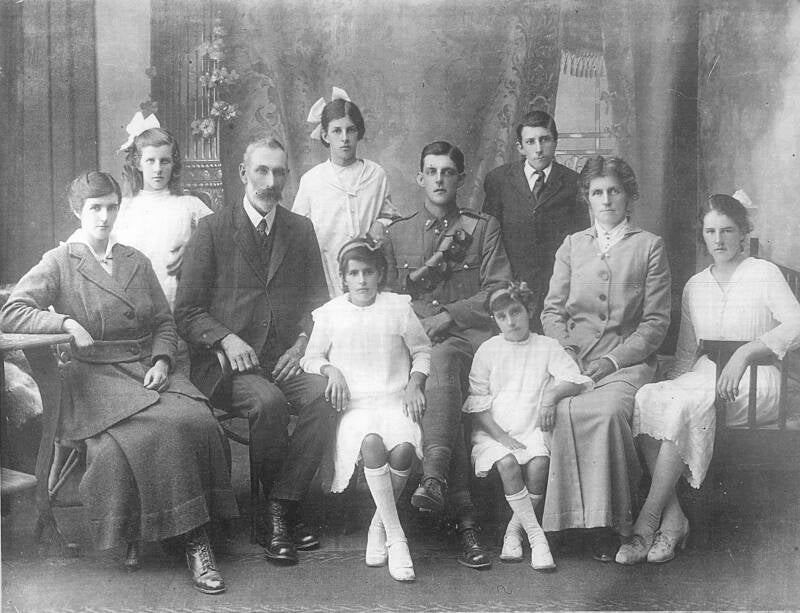
Marj French’s parents, and Sharon’s maternal grandparents, were James Cameron Miller and Eva Ellen Hunter. James Cameron was the second son of James and Martha Miller, who was born at ‘Glen Miller’, Maungakaramea on October 15th, 1865, and was known as Cam.
By 1865, Maungakaramea was a small but burgeoning community of "Forty-Acre men"—settlers who had emigrated from Britain and Ireland under a government scheme promising 40 acres of land to any adult who paid their own passage. While today the district is known for rolling green pastures, in 1865 it was a mosaic of dense native bush, fern-covered hills, and tea-tree (mānuka) scrub. Most settlers lived in "whares" or "raupo huts" (built using Māori techniques) or simple slab timber cottages. These dwellings often had dirt floors and chimneys made of clay and sticks. Life was defined by the back-breaking labour of "burning off" the bush. Settlers used hand tools—axes and cross-cut saws—to fell giant trees, followed by fire to clear the stumps for pasture or grain. Most families owned a small herd of cattle, and grew wheat, oats, maize, and potatoes. While farming was the goal, many men spent time digging for Kauri gum in the swamps and hills to earn "ready cash" for supplies like flour, sugar, and tea. Life was not for the "faint-hearted." Newspaper accounts from the time warned that many came "dreaming of a livelihood without earning it," only to find themselves in extreme poverty. For women, the isolation was particularly acute. With men often away working on roads or digging gum, women managed the children, households, gardens, and livestock in near solitude. But we are fortunate to have an account of life there written by Cam himself around 1948 (below).
Cam played rugby football, but the sport he favoured was cricket. He spent many days carting soil and levelling a pitch twenty-five yards square on the property of Mr. James Walker, which was the pride and joy of the local Maungakaramea enthusiasts, and visiting teams would often suggest that any return matches should be played on this carefully prepared pitch. Cricket was certainly important to Cam. He captained the first representative Maungakaramea team.
Cam and Eva Ellen Hunter were married at ‘Mount Pleasant’, the Ruarangi home of Eva’s parents, Thomas and Sarah Jane Hunter, on the 31st of May 1893 by the Rev. Griffith Jones. Cam’s brother Barrie and Eva’s sister Emma were witnesses.
Eva is remembered with affection by her descendants. Her cheerful disposition made for a harmonious household. Many of the early years of her married life were spent in bush camps where she assisted Cam in his contracting enterprises, and she was kept extremely busy cooking with less than perfect facilities for the men, as well as caring for the needs of her growing family.
Although Cam’s teenage years were spent surveying throughout Northland, where the first survey under his supervision was at Tutukaka, he was mainly a farmer and bush contractor, and his teams of working bullocks were well known throughout the area. Cam and Eva took their young family with them to bush camps as far away as Broadwood and Peria. It was at Peria that tragedy struck the family. While Goog and Stanley were getting supplies for the camp, 5-year-old Stanley fell between logs and was killed. He is buried at Mangonui, but as there are no existing graveyard plans, the exact location is unknown. They probably returned from Peria in 1907 to live in a Maungakaramea house known as ‘Rockingham Castle’, which was situated opposite the Boarding House.
By 1911, Cam’s enterprises had grown significantly. When he was giving evidence to assist the Railways Commission in its deliberations on a suitable route for the Northern Railway, it was noted that besides being a partner (with his brother John) in the Maungakaramea Boarding House and Store, Cam owned 500 acres of freehold land at Maungakaramea, between one and two hundred acres at Waikiekie, and nearly 600 acres at Kirikopuni.
He assisted local activities around the Maungakaramea district, like the school where he encouraged the sporting aspirations of its pupils, the Undenominational Church and the Dog Trials.
Between 1911 and 1914, Cam represented the Mangapai Riding (which included the Maungakaramea district) on the Whangarei County Council.
He sold his land holdings in Northland and in 1914 purchased 200 acres at Kopuarahi on the Hauraki Plains. This land had been drawn by a Mr. Higgins in the first Kopuarahi land ballot of 1910, when the Lands and Survey Department started to progressively open up the Hauraki Plains for settlement. When Cam and Eva bought their family to live there in 1916, their homestead with its unusual tower had already been built from kauri that Cam had milled in the North.
It was not until the family moved to Kopuarahi that Eva really had her first house, and the modern amenities which it contained included not only spacious rooms and a large kitchen for her family, but also hot and cold running water, a novelty, and a true pleasure for her. The family evenings were often spent with Eva at the organ, Cam on his violin, and the children singing in harmony. The house soon became home.
The distinctive belvedere was a vantage point for viewing scows arriving at the Shelly Beach Wharf near the mouth of the Piako River, and for checking cattle on the farm. It was also used as a beacon for vessels coming into the river. The large sitting room was the first ‘public hall’ that Kopuarahi had – Eva and Cam generously allowed its use for the benefit of the early settlers. Many years later, when holidays were to become an annual event, the family would often stay at the ‘Hazelwood’ Guest House at Te Aroha.
Soon after his arrival in the Kopuarahi district, Cam became the Turua Riding member on the Thames County Council. Then, in 1919 when the Hauraki Plains County Council was formed, he was elected as its first Chairman, holding office until 1926. He was a foundation member of both the Thames Valley Electric Power Board and the Hauraki United Drainage Board.
His community work is recognised by the naming of Miller Street in the town of Ngatea, but perhaps the memorial to his public service would be the Kopu Bridge, which opened in May 1928, and only replaced in 2011. When it was constructed, it was a lifeline for the Hauraki Plains settlers who previously had to cross the river by launches and ferries. Cam’s initiative and enthusiasm was responsible for the construction of the bridge, which cost £30,000.
Cam, who was a Justice of the Peace, and Eva moved to Thames in 1931, living temporarily in a rented house in Mackay Street (now demolished and on the Thames Bowling Club site) until they purchased their house in Williamson Street.
Besides Stanley, who was drowned at Peria when five years old, Cam and Eva’s eldest child Eva Isabella died when she was three years old, Vera Evelyn passed away before her fifth birthday, and Gordon Alexander, who was known as Goog, died of pneumonia shortly after his thirtieth birthday.
Eva passed away on November 8th, 1947, and Cam died on December 13th, 1952, and they are buried in the Totara Cemetery in Thames.
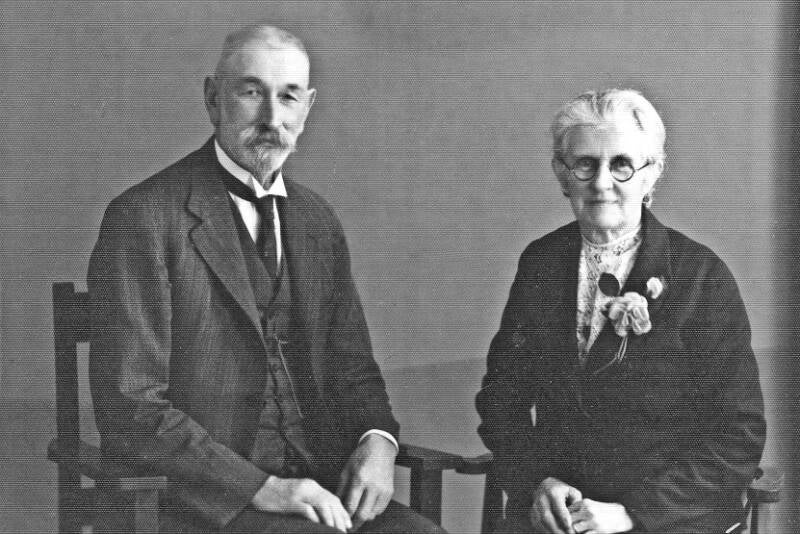
It was probably about the year 1948 that Cam Miller, in response to requests from the Maungakaramea residents, recorded his impressions of the early days of the Maungakaramea district, and his notes are reproduced here.
Being the oldest Maungakaramea-born person now living, I have been persuaded to brush up my memory a little and write down what I know and remember of the early settlement of that district. Before continuing with that aspect of it, I think I should explain here, (to those who may not know) that the Parish of Maungakaramea as a whole, and the settlement of Maungakaramea, does not actually mean the same place. The parish extends from what is known as Oakleigh, (adjacent to the old Maungakaramea wharf) to the west as far as the Tangihua Ranges. From Oakleigh westward for about one-third of the length of the parish is considered and looked upon, as part of Mangapai. The remaining two-thirds is known and recognised as Maungakaramea. The reason for that is – the parish being of considerable length, and the eastern end being adjoined to the Mangapai settlement and being fairly close to the tidal waters where small trading vessels could come in, and where the first stores were opened, making a natural centre for the eastern portion of the Maungakaramea Parish. Trusting the above explanation will be sufficient to show why so much of the parish is considered to be part of the Mangapai settlement.
One question asked was, who was the first settler? That is a question I can’t answer, as there are a number who appeared to have come and gone before I was born, but I have been told about most of them, and I know all those hardy and determined pioneer men and women who made their homes in the district, those settlers who pioneered the wilds of New Zealand were and are a race to be proud of, not knowing where they were making to, only knowing that there was nothing to go to but hard work and very primitive conditions. Although I am not a pioneer, I am a descendant of one of the early ones and so have a fairly good idea of what the conditions were like. Those who have come and gone before I remember anything of them, but who I have been told about, are so far as I remember; SCOTT, who I believe was a Magistrate, SHERLOCK, NESBIT, COLVILLE, WOULDES, SWAN, SPITTLE, CRAIG, HAMMOND, MOFFAT, JAGO, nearly all these left some relic or tangible indication that a start, or an attempt had been made to establish themselves there, but gave up and went to look for something more hopeful; others who were more determined or too badly off financially, weathered the storm and I think ninety percent of them made comfortable homes for themselves, reared large families.
I was born in 1865, so by the year 1870 I could begin to see and realise (although not to the same degree as elderly people) that it was impossible to have or get things that were really needed. Those who stuck bravely to the development of the district, with that independent spirit and determination to do something for themselves and make and have a happy home they could call their own. To enumerate those who settled and made good are, (if I don’t overlook any), PORTERS, CHILDS, SNELLS, KERR, COOK, WATSONS, WILSONS, CRAWFORDS, GUNSONS, Duncan McLACHLAN, DONALDSONS, HAYWARDS, MILLERS, COURTNEYS, JAMES, O’CARROLLS, WRIGHTS, and BELLS. One family, Thomas and James SANDS and wife came and left before I can remember, they went back to Ireland, and stayed there some little time, then went to America, I don’t remember how long they stayed there but went back to Ireland again. Then, after staying there for a while, they made up their minds that there was no place to compare with Maungakaramea in New Zealand, so they came back to where they left, and bought a section of land adjoining (I think) the section they occupied in the first instance in Maungakaramea and made good. An instance worth relating here is that there being no tanks to collect water, people just dug a well which soon supplied plenty of water for all household purposes. Most people know how children like to play about or in water. The SANDS’ two eldest children, Mary and Tommy were just like other children in that respect and would persist in playing about the well and that worried their mother so much that their father, when he found them playing by the well, threw them in and left them in long enough to give them a good scare and I think that cured them of the habit.
The wharf at Oakleigh was built at the junction of two channels so that vessels could turn around easily, especially when the tide was suitable, and some fair-sized boats would come to load and unload. A yard for stock was built alongside the wharf where fat cattle could be taken and put aboard for the Auckland market. The way they were got aboard was by putting a rope around their horns and dragging them into the tide then put slings under them and by use of a winch, lifted them out of the water and into the hold. At that time cattle fattened quite well running in the bush, because the young tender growth had never been interfered with, and the bush was full of it. The wharf was used by four districts, Maungakaramea, Mangapai, Ruarangi and Waikiekie, where they all got goods from Auckland. The first store being at Mangapai, was where the settlers of these districts got their provisions. During a wet winter it was no joke, with mud knee deep in many parts of the road and going only at a walking pace on horseback, that is those lucky enough to have a horse. When my brother and I were old enough or big enough to carry anything, it was our job every Saturday to go to Mangapai for the weekly provisions. We had to go to COLE’S store, which was about two miles further on than the present store in Mangapai. I don’t know why we had to go to the furthest store, but I expect my father had started with Mr Cole and still kept with him. If it hadn’t been for these storekeepers, the settlers would have been in queer street many a time. Long credit had to be given, and these two storekeepers were really very patient. They got to know that the settlers were quite honest and that when they had money, the storekeeper (who had kept them alive) would be the first one to be paid. I well remember when my father got a riding horse. We could ride to the store and lead the horse home with the goods, and better still, if the load was light enough, I could ride home as well. One day my father went for the goods, and I remember he very sad news he brought home. The storekeeper, Mr David Cole, that day had been killed. He was riding on his dray, drawn by a pair of bullocks, which capsized and fell on him. His wife, Mrs Cole still carried on the store business, and we continued dealing with her for many years.
In attempting to write a record of all the early movements of a district, one has to deal with it in a manner much like raking up a field of hay, where you can only bring one rakeful at a time, so I will have to make several mental trips backwards and forwards to give a clearer understanding of the particular events as and how things came about. In this case I will have to go well back, even to before my time. The first church to be built in Maungakaramea was opened (I am told) just a fortnight before I was born, that would be October 1st, 1865. It was opened by Bishop SELWYN, a man whom everybody liked and spoke well of. The church was ‘Church of England’, but when the Bishop opened it, he said it was open to any denomination that cared to use it. It was built by the settlers of the district, all the timbers being pit sawn.
There were several men in the district who were very handy with carpenters’ tools, I think the main ones were Frederick SNELL, Mr Alfred Watson and Mr Charles Hayward, and I have been told whether carpenters or not, everyone was ready to give a hand with anything, so as to get along with the job. The Church was used as a school for a few years when another small school was built on a reserve between Mr Frederick SNELL’s and Mr George KERR’s farms, which was used as a half time school in conjunction with the Church. I think the first schoolteacher was a Mr W. G. ROGERS, whose daughter was Mrs John COURTNEY. There are several Courtney descendants living in the district and surrounding districts. Mr Rogers was a kindly old man, he was a little man with a long white beard, wore a grey bell topper hat and a swallow-tailed coat and always carried an umbrella. There were later (at different periods) two other teachers at these half-time schools, Mr BOGUE and Mr GOOCH, but I don’t remember which was the first of the two. My father had working bullocks to plow with. They became very quiet and tractable, and we boys could quite easily handle them. On one occasion I had taken them (one pair) to Mangapai to get something too heavy to bring on horseback. The vehicle I had was just an ordinary sleigh and as I was coming home, I sometimes got on the sleigh and sometimes, by way of a change, get off and walk for a while, and while I was walking, a man (Mr Peter FAWCETT) caught up with me, he had been to the store for his goods, and was carrying them in a bag over his shoulder, when he caught up. He immediately put his load on the sleigh, we walked along for probably a hundred yards or so, and then he suddenly asked if there was room for his pack. Young as I was, I thought that was about as funny a thing as ever I heard – after he had seen it on the sleigh for 100 yards or more and could see there was ample room. The first pair of bullocks my father has was called Don and Baalam. The pair I had with the sleigh was a later pair named Rob and Abb. When I was quite a little chap, I was standing rather too close to Rob and he stuck his horns, one under my armpit and the other somewhere into my clothes and threw me right over the bullock on the offside. I remember my father giving him a terrible thrashing.
While on the bullock part of the reminiscence, a very amusing thing (to anybody but me) happened. When the bullocks were required, it was our (the boys) job to go and find them and bring them home. The place he frequented was that swamp just about half a mile east of the Maungakaramea School, known in the early days as ‘Bell’s Swamp’. It was generally my job to go and get him, he was a red bullock, and his name was Bruce, he was quite a nice quiet beast, and I used to get on his back and ride him home. So, one morning I thought it would be a good idea to have a pair of spurs, so I got two forked sticks, pointed at the stem end, and tied them to my feet, (bare footed). I got on Bruce down in the swamp and rode him to the top of the range but never touched him with these spurs. When I got well on the top of the range, I thought I would give him a jab with them, and quick as a rat trap going off, I was thrown on to the ground, and Bruce ran down the hill right back to where I got him. I don’t remember whether he let me get on him again, but I think he did. I expect Bruce made a condition that spurs were to be barred, a condition I readily agreed to.
To get back to the useful side of these episodes, in the year about 1872 or 1873, Mr Thomas CHILD was carting sleepers from Mr Henry COOK’s place to Mangapai wharf, to be taken (I don’t know where) probably Auckland. To get to his destination he did not follow the long beaten track along the ranges about a mile, or more to the north of the present road to Mangapai, he just broke his way through fern and titre well towards the south of the present road, making a rough bridge over the Tauraroa River, still breaking his way through natural scrub, and again crossing the same river just below the present hall at Mangapai, then down to the tidal waters to what at one time was known as Mangapai wharf. While Mr CHILD was doing that work, he had with him his little son Oliver, a boy of about nine or ten years old to help him. He had a homemade bullock dray, wheels made of wood, drawn by a team of six bullocks (three pairs). Their names were Rock and Ruler; Damper and Doughboy; Ben and Star. The above will roughly show what the pioneers had to contend with regarding road facilities. Mr CHILD was the farthest back settler in the district, who (like others) had to go to Mangapai store for goods. His wife (Mrs CHILD) who was an ideal pioneers wife, seemed mostly to get the goods from the store, and as we lived pretty close to the road she would often call, and as she didn’t talk about what she would like to wear at the next ball, or whether she didn’t think much of the ‘New Look’, she talked some solid sense, and my father and mother were always pleased to see her. My mother was a great one to give anyone a cup of tea. If my mother knew that anyone had been a long time in getting back after being to the wharf with a team and got delayed by either the steamer being late, or never came in at all, teamsters would wait at the wharf until it was certain that no steamer would be there that day, so just had to make home with nothing (which often happened), when my mother heard them coming, she would be out at the road with a jug full of hot tea and a bite of something to eat.
What I am going to tell you now, some might say, ‘you’d better tell that to the marines, because soldiers won’t believe you’. Everybody I think knows what an ordinary cartwheel is. Well, I’ve seen the roads so bad with mud, that you could not see one bit of daylight through between the spokes. The wheel was so choked with mud that it looked just one big solid wheel, not only once, but several times. Another of the scenes of the early days was Mr Thomas PORTER, whose family being mostly girls (like mine) and they being the eldest, had to do a lot of boy’s work. They too, lived a long way from the store, and to get their store goods, the girls seemed to be the ones for the job. They had a quiet bullock which sometimes they rode, but very often the bullock hauled a sleigh, being only one bullock instead of a pair yoked together, this bullock had an ordinary horse collar turned upside down, so he was worked just the same as a horse except the collar reversed.
The first Post Office in the district was kept by Mr Joseph BELL, J.P. (whose grandson, Frank BELL, now Chief Draughtsman at A & G Price’s Foundry, Thames) and the Miller boys were the first to carry mail to the district, the route was - leave Maungakaramea in the morning, go to Whangarei, back to Maungakaramea, then on to Tangiteroria. In the winter and spring, the road to Tangiteroria was knee deep in mud most of the way, and it was often 8 or 9 o’clock before we got there. But when we did, we stayed the night at Mr WATSON’s place. They were the kindest people anyone could wish to see, and I scarcely ever pass that way without calling in to see them. The only one left is Mrs CLARK, who was only a baby about six months old when I first went there. The Post Office at the time was where ATTWOOD is now. When the district was first settled, the recognised centre was where the cemetery is, and where the first church was built. The now recognised centre, at that time, was all unoccupied. From where the Hall now stands to where the Roman Catholic Church is, was an open fern flat. The northern edge of it was that little clump of bush in front of where Mr James (Jimmy) WALKER now lives, and the southern edge of it was very near Mr ALCOCK’s, previously Mr John WALKER’s. The above is by way of giving those who may not know what the place was like in its natural state before it was settled and developed to what it is today.
Now revert back to the year 1874 or 1875. When coming to the start of the rise just below the Hall (which was known as’ The Bluff’) was the edge of the bush, and when going as far as the Hall (up the rise) was bush, then right in front of you was the ‘fern flat’ (mentioned above). The fern flat, known at the time as ‘Graham’s Flat’ an area of 150 or 200 acres, bordered by a beautiful border of Taraire Bush. As will be seen a few clumps still remain, one clump the northern edge of this flat still remaining, is where I fired my first shot and brought down a pigeon just before I was ten years old. I expect when some people read the above, they’ll say, “You’d better tell another while your mouth is hot.” I will explain here, how, and why I shot it. My father was a bit deaf and when he went pigeon shooting, he took me and my brother with him, and when the weather was a bit cloudy and dull, the pigeons did not fly very much, they kept in amongst the trees. We, (my brother and I) could hear them fluttering about when my father couldn’t. I heard one and saw it amongst some leaves and branches, but I could not get Dad to see it, so he told me to have a shot at it, which I did, and down it came. (So that’s that!)
When the weather was fine and the sun shining, the pigeons would be flying across this fern flat in all directions. I don’t think there was ever a better locality for pigeons, it was quite a simple matter to get forty or more pigeons a day. Before any settlement about there, it was solid bush to the west, right over the Tangihua Ranges, on to the Northern Wairoa River; to the south-west just about the same; to the north about one mile and to the east only about 150 yards. On the western side of this fern flat, (very near the house where Mr Jimmy WALKER now lives) there was a large number of peach trees – the result of early Māori settlement. It was always known as ‘The Peach Orchard’. The early settlers could and did get all the peaches they wanted to make jam. I think there is still some indication of the orchard still to be seen.
In the year around 1880 or 1881, Mr James WALKER (father of the present Jimmy Walker) came to Maungakaramea from somewhere near Morrinsville (Waikato) and bought all the land surrounding the above fern flat, including the flat. I think the acreage would be one thousand or twelve hundred acres. With him came his family, his wife and ten unmarried ones. Just directly after them, came two married daughters and their husbands, Mr W G HARP and Mr James MURRAY. Mr HARP seeing it would be a good centre for a store, started business, which was the first store in Maungakaramea. I am not quite sure of my statement here, because Mr George WRIGHT when he owned the farm on which Mr Alan CRAWFORD now lives, but I think Mr HARP was the first one to keep a store in the district. When Mr James WALKER and his family and relations settled and established themselves in that locality (where previously no one was settled), it became quite evident that the previously recognised centre where the first church was built was, and never could be, the true and proper centre for the district. So, a move was soon afoot to build a School suitable to accommodate the whole district. There being no opposition of any consequence to the proposition, it was not long before the proposition became an established fact. I think the first schoolmaster was Mr POOLEY, who in addition to his teaching in the daytime, undertook to teach those who cared to come, three evenings during the week, Monday, Wednesday, and Friday. That meant, all those who were considered over school age. There were about a dozen of us who took advantage of it. I might say here that I might be wrong in saying that we took advantage of it, because if they were all like me, they were forced to go. Because, somehow, I never liked going to school, my brother John (or Jack as everyone knew him) was not averse to going to school, he was always quite good at lessons, learning seemed no trouble, but I, being a champion dunce, was, I suppose, the reason for my antipathy for going to school.
All the earlier born ones of the district certainly did not have the opportunity to receive an education such as we now realise everyone should get. Nevertheless, I believe that attending night school did us all good, as we being old enough to know that we should try to improve our backward state. Two or three of us were really naughty boys, because we took delight in frightening a very nervous horse which one of the boys used to ride to night school on. We bad boys used to hide on the roadside with a lighted lantern hidden under our coat, and when we heard this unfortunate young man come along, we’d rush out and chase him with the lantern. We always chose a place suitable for carrying out this dirty trick, so as to make sure the horse would either trip up or throw his rider. Many a time the poor chap had to walk home, or if by good luck by not being thrown, he would have to go another way home, many miles further round. When I think of it now, I feel and know it was fortunate for us, and everybody else, that a serious accident didn’t result. All of us who were responsible really deserved goal. None of us had a grudge against him; he was really a good young chap and developed into a fine public-spirited man, holding many public positions.
In a proper developing of any district, good facilities and lines of communication are necessary. Good roads being perhaps one of the most important. Whoever first surveyed the district didn’t appear to have the slightest interest in whether the roads they surveyed were ever to be formed or whether they were on a grade where animals could be reasonably expected to haul a load of any ordinary weight. The roads they surveyed were along the tops of ranges and without any pretence at seeing they were in such a position that they could be formed so that someday they might be of some use. For instance, the road from the Store corner and the Hall, going easterly, the original survey is straight for three quarters of a mile or more. The only part of that straight used today, is the portion across the swamp (known as Bell’s swamp) the other portion of that straight is all deviations. I am just pointing out that portion to give an illustration of what has taken place in practically every road in the district, where a road is supposed to be of any use. I might mention here another road so near the centre and I think so well known to most people. I refer now to the road running north, on the west side of the School, from the road at the bottom of the hill below the Hall. Perhaps very few people know that the road is a deviation; the original surveyed road is on the eastern side of the school ground, now growing pine trees. The thoughtless manner in which the roading part of the original survey was done has been the cause of a lot of expense by having to pay compensation to many people for having to force a road across their property, in order to make a road worthy of the name.
Whangarei becoming more of a business centre generally than Mangapai, it became very evident that some move would have to be made to improve the road to that town. So the local settlers, (I think Mr John Lewis CLARK was the promoter of the proposition), considered the possibility of raising a loan of £3,000, for the purpose of improving that road, more particularly metalling, and so (if my memory serves me right) Mr CLARK canvassed the district to see what support the movement would get, with the result that he got the required signatures to his requisition to make application for a loan, without the necessity of advertising and taking a vote for or against the proposal. The work to be done being outside the Road Board District, had to be undertaken by the Whangarei County Council. The amount, together with a Government subsidy of pound for pound, being £6,000, was at that time a pretty big contract. When tenders were called, I think there was only one tender, which was considered too high. So about eight or ten settlers (who had carts and horses) formed themselves into a company, and as the main object was to get a metalled road, instead of making a lot of money out of the job, the company (amongst themselves) fixed and arranged the price per yard for the different lengths of the different sections, and any one of the company, or anyone else could, put on as many carts as they liked, and receive the price arranged for that section, so that everyone knew where he was as regards payments. The metal spreaders kept a tally of the amount, (the number of yards) each carter delivered, as well as the carter himself, so everything went with a swing, with the result that the Maungakaramea – Whangarei Road became an all-weather road.
We should have had a ‘Scotch Night’ over that, but I don’t think we had. About half the length of the road at the Maungakaramea end was metalled with volcanic stone, the other was metalled from a quarry known as ‘Vyles Quarry’, the stone was of a softer nature but made quite a good road. It was much easier to break and a lot lighter in colour but would not stand up to the heavy loads that the volcanic stone can stand, being more easily crushed by the cart tyres. Previous to the road being metalled, it was a bit of a nightmare in wintertime to go to Whangarei with a team and cart for goods, and I think my brother John had as much experience of that as anybody, for by this time, he and I had bought the store and fifty acres known as Harps. He did most of the carting, and his wife looked after the store and many a time it would be nine or ten o’clock at night before he got home, the travelling in the mud was so slow.
Taking now a look at the other side of life. We were a very enthusiastic cricket club (although none of us ever got away with the New Zealand boys). We were quite a fair country team, we very soon found out that you can’t play cricket amongst clods, so we spent days and days carting soil and levelling a pitch 25 yards square. The place we selected was an ideal spot, where a nice piece of native bush could be used to shade the onlookers, while we made duck eggs. The cricket pitch was on Mr James (Jimmy) WALKER’s flat, where we had full liberty to go and come as we liked, and I don’t suppose we have ever said thank you yet. The reason for laying it 25 yards square, was so that it could be played on either way, not allowing any part of it to get broken up. There was a good portion of it as good as anything to be seen anywhere. When visiting teams came to play a friendly game with (or rather against) us, and instead of us going to play a return match in their district and on their ground, they preferred to make the journey and play the return match on our ground. The first cricket team chosen from five or six clubs south of Auckland to play a team from about the same number of clubs in the Whangarei district was captained by a Maungakaramea man (myself), neither team made big scores, but Whangarei managed to win. We had two very good bowlers in our team, John MILLER and Francis O’CARROLL, and although we might not make a very big score, these bowlers saw to it that the other fellows didn’t either. As time went on, we could see that it was time we were to make some move to secure a piece of land as a public recreation ground. I think perhaps Mr Thomas O’CARROLL was responsible for that move. Anyway, it was the proper thing for most districts to do. It took some time for all hands and the cook to decide where exactly that piece of land should be, and several meetings were held to finally decide which would be the most suitable. At last it was settled to be either one of two different places. So at a meeting to finally decide, things were much like they had been for a good while, someone suggested that we all go on to the ground, and as the two pieces in dispute were adjoining it was suggested that we go to the dividing line and each man stand on the piece he favoured, but before doing that, each was to give their word of honour to support whichever side won. On that occasion it was the best voting spirit I’ve ever seen. You would see a father on one side, a son or son-in-law on the other, brothers-in-law on different sides, nobody took any notice of the other. They knew it was their last opportunity to stand firm to their own private opinion. When the count was taken it was found to be equal, the chairman of the meeting having his casting vote put the recreation ground where it is today. And I honestly believe everybody in the district is quite satisfied that it is in the best place.
If there is anything not just right, it might be that it is a pity it was not a bit bigger. The voting was even. I (the writer) was chairman of the meeting and as I had to settle the question with my casting vote, I therefore must be the person who decided where our recreation ground should be. Mr James (Jimmy) WALKER owned the land, and he gave the people the option of three different pieces to choose from, one piece was in our opinion rather beyond our means, so was cut out, leaving the two pieces referred to. I don’t remember what the figure was but was quite reasonable according to their respective situations.
In glancing through all the foregoing remarks, I see that I have omitted the name of an early settler, Captain SEON. I can just remember him; he had a pair of blue trousers. To me and all early people of the district and perhaps many of the younger ones, the place known as ‘Captain Seon’s’ was a well-known landmark. To those who may not know it, I will explain where it is. It is about a quarter of a mile on the eastern (or south-eastern) side of the Horseshoe Bush on the road to Whangarei. I think some of the gum trees are still there, (but I am not sure), but there must be a number of people who know the place and can tell anyone who does not happen to know. Captain SEON was appointed pilot at Hokianga Harbour, which (like all harbours on the west coast) is a dangerous one, on account of sand bars always shifting.
Golden Wedding
Cam and Eva Miller celebrated their Golden Wedding on May 31st, 1943, and the occasion was commemorated with over 100 friends and relatives at two functions, one at the Masonic Hall at Thames, the other at the Turua Hall.
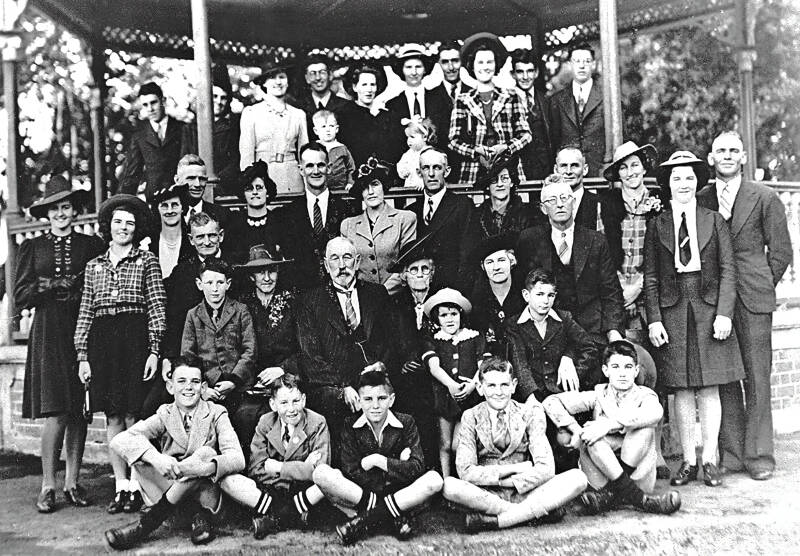
Golden Wedding photo taken at the Band Rotunda, Thames.
Left to Right
Back: Bruce Fox, Evelyn Flynn, Pauline Marceau, Alan and Alice Flynn, Colin and Maureen Flynn, Doreen Cook, Derek Miller, Gwen Fox, Alister Flynn, Cyril Marceau.
Middle: Fay Miller, Marjorie Miller, Doris Cook, Bert Cook, Jack Flynn, Marj French, Eric French, Doss Miller, Jim Miller, Kit Fox, Joe Marceau, Keith Fox, Chum Nicholson, Lois Cook, Ces Nicholson.
Seated: Noel Fox, May Flynn, Cam Miller, Eva Miller, Olwyn French, Chris Marceau, Earle Nicholson.
Front: Gordon French, Lester Marceau, Maurice Nicholson, Gordon Miller, Warren French.
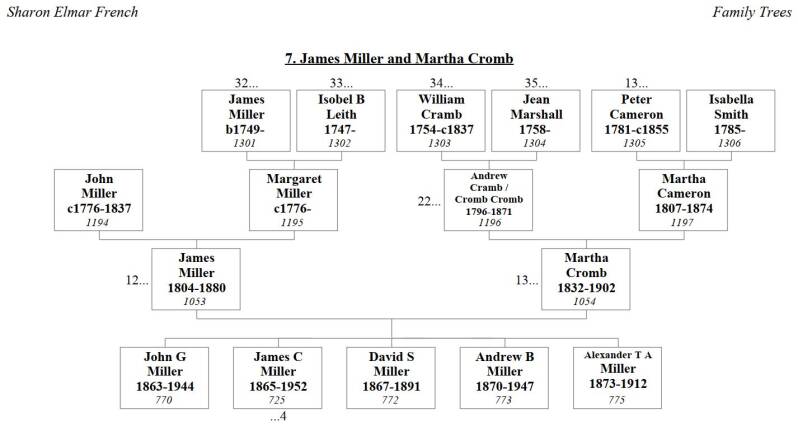
John Gorrie Miller.
John Gorrie Miller was the eldest son of James ad Martha Miller and was born at ‘Glen Miller’, Maungakaramea on May 29th, 1863. He was christened by, and named after, the Rev, John Gorrie, who had been ordained in January 1862 as the Minister for the Whangarei Parish of the Presbyterian Church. It is family oral history that John was the first child to be christened in Maungakaramea by the Rev. Gorrie.
Like his younger brother Cam, John did not attend school, for the simple reason that there was no school available when they were children. But later, a teacher, Mr Pooley, did provide evening classes for those children considered to be too old to attend school.
In 1879, at the age of 16 years, John, who was known as Jack in his youth, secured the first mail contract to carry mail between Whangarei and Maungakaramea, and later to Tangihua, Not bad for a 16-year-old!
His father died the following year, 1880, but with Jack’s capabilities already apparent, he must have been very supportive of his mother, in helping her to maintain a farming property and care for the three younger children.
The Rev. Griffith Jones married John and Mary Jane Hunter on February 24th, 1892, at ‘Mount Pleasant’ Ruarangi, the home of her parents with their brother and sister, Cam Miller and Eva Hunter as witnesses.
Mary was the oldest child of Thomas Hunter and Sarah Jane (nee McCullough). The couple that was their best man and bridesmaid, were to marry fifteen months later.
From William John Harrison’s diary, it is noted that there was a tennis party in honour of Mary Hunter on her wedding day. Such were the celebrations of those days. William was later to marry Mary’s sister Emma in `1901.
Mary endeared herself to all who knew her, throughout her life. She was renowned for her cooking abilities, and she won many prizes at the Annual Show Days at Maungakaramea. The Boarding House that the Miller brothers, John and Cam, owned in Maungakaramea from about 1904 until 1920, was dependent on Mary’s organising abilities for much of its success. On Sale Days at Maungakaramea, where Mary provided lunch, there were those who considered that luncheon was as important as the sale itself. As the years rolled by, her daughter Roy and her niece May Miller, neatly attired in their long skirts with ankle-length white starched aprons, became regular assistants who waited on the tables.
The ‘Telephone Club’, a privately owned telephone system of party lines, was set up in Maungakaramea in 1897. Soon afterwards it operated from the store which was run in conjunction with the Boarding House until 1924, when the first official Telephone Exchange was opened.
John played his part in local affairs. He was chairman of the Maungakaramea School Committee for 10 years from 1908, as well as being Treasurer and a Committeeman for many years. As well, he assisted with the development of the amenities in the District, and the District Hall, the Library and the Maungakaramea Undenominational Church all received his help, and he was seldom without an honorary secretaryship of the many organisations that went to make up the social life in the country district.
John and Cam were aware of opportunities that existed in the area, and for example, in 1902 their tender of £198 was accepted to build a new school building at Mangapai. The building was sixteen and a half feet by eighteen feet, together with a small porch.
John was first and foremost a farmer and was a competent judge of stock. In his younger days, he was clerk for all of the stock sales in Whangarei.
About 1920 John and Mary, together with their two sons Bun and Mac, moved to the Hauraki Plains to a property on Shellbank Road, Kopuarahi, which was owned by Bond and Bond, and they subsequently purchased the farm. Her daughter Roy and her husband Bert Morfette may have lived with them for a short time before they moved permanently to Kaikohe. The family stayed with the Cam Miller household at Kopuarahi until their first house was constructed on the shell bank. Later, the familiar homestead was constructed at the Bush Road entrance to the property. There were considerable shell deposits on the farm and in the surrounding areas, and all of these were crushed during the next 20 years by the Kopu Calcined Shell Lime Company Ltd, which was operated by Mr. Jim Mearns.
John and Mary continued to assist with the many local activities in the Kopuarahi district as they had done in Maungakaramea. John was a Committee Member of the Kopuarahi School from 1921 until 1928.
John enjoyed his game of cricket, which incidentally was the first organised sport in the Maungakaramea District and cricket remained his lifelong interest. He is credited with organising the first cricket club in Kopuarahi and it has endured to be a competitive club ever since. Johney was a bowler of repute – there may have been those who were his equal in the north – but none was superior.
The home of Uncle Johnny and Aunty Mary, as they were universally known in the Kopuarahi district, became one of the focal points for family gatherings and many celebrations and Christmas parties were held in Mary’s extensive gardens and orchard.
Johnny died on September 4th, 1944, and Aunty Mary passed on nearly a year later, on September 1st, 1945, and they are both buried at the Totara cemetery. At the time of their passing, they were survived by their two sons and one daughter, and eight grandchildren.
Obituary:
Mr. John Miller.
A prominent figure in the Maungakaramea district for over 50 years, Mr. John Gorrie Miller has died in the Hauraki Plains district. He was aged 81 years. Mr Miller spent the greater part of his life at Maungakaramea, his birthplace, his parents being one of the first families to settle there.
After attending Maungakaramea school he assisted on his father farm and the later, in partnership with a brother he commenced storekeeping at Maungakaramea, as well as carrying on with his farming activities. Expanding his business the brothers entered inro contracting, both in bush and on roads. The brothers worked bush in practically all parts of Northland, and so in this connection, were well known over a wide area.
While in Maungakaramea Mr Miller took a keen interest in local affairs being a member and chairman of the school committee for many years. He was also a member of other local organisations that worked for the welfare of the district. Cricket in the Whangarei county owes a lot to Mr Miller, he being a player of note and perhaps the best bowler that Maungakaramea has produced. He was untiring in play and could bowl all day without showing any fatigue. Even in his later years he continued his interest in cricket circles in the Hauraki Plains district,
About 20 years ago, Mr Miller with his brother, who had been so long in partnership with him, left Maungakaramea for the Hauraki Plains and there successfully farmed. Another brother, Mr A B Miller still resides at Maungakaramea.
Over 50 years ago, Mr Miller married Miss Mary Jane Hunter, whose parents were early settlers in the Mangapai district. There are three children, Mrs E, Morfette (Kaikohe), and Mr Bun Miller and Mr Mac Miller, both of the Hauraki Plains.
Northern Advocate
Compiled by Gordon Miller (1999).
Mary Roy (Roy) Miller was born to John and Mary on September 29th, 1895, at Maungakaramea, and she attended the local Maungakaramea school and the Whangarei Girls High School.
She was a great assistant to her mother in the running of the Maungakaramea Boarding House and the store which was part and parcel of the business. Although the boarding house enterprise was time consuming, Roy played hockey and was a capable sportswoman and found the time to become an accomplished pianist.
Ethelbert (Burt) Morfette, whose parents were George Morfette and Mary (nee Puttenham) was developing his skills in the butchery trade at Maungakaramea where Roy and he were married on June 13th, 1917. Later they moved to Kaikohe where their three daughters were bought up, and it is the district of Kaikohe that many of their descendants’ regard as home. The butchery business was well known and highly regarded.
Burt suffered a severe stroke a few years before his death, but with his courage and determination he largely regained his mobility and speech. He died on August 23rd, 1963. Nearly thirteen years later, Roy passed away on May 13th, 1976, and they are buried at the Kaikohe Cemetery. When Roy passed on, she was survived by her three daughters, ten grandchildren and six great grandchildren. While their daughters all lived in Kaikohe, a great number of their descendants have also remained in the winterless north.
John Hunter (Bun) Miller was born to John and Mary on January 2nd, 1906, at Maungakaramea, and was known universally as Bun.
He suffered severely from asthma as a youngster and often his mother kept him inside the Maungakaramea Boarding House to cook meals, while she braved the elements to milk the cows and do the outside chores. Mary was an excellent tutor and Bun a superb student and the combination proved unsurpassable. His renown in the culinary department was proven by his success in producing top class baking and by his ability as a judge of many cooking competitions. Wedding cakes from his oven graced many a bridal table and when Bun catered for a social event in the district, the guests were treated to excellence.
Bun was also amongst those who assisted with the musical entertainment at dances, and he was handy on the violin. He excelled at hockey, representing his district at Country Week Tournaments and played against a visiting Indian hockey team.
After the Jonny Miller family moved to Kopuarahi, Bun met and wooed Edna Candy, the daughter of William and Anne Candy. Willian Candy was born in Stratton on the Fosse, Somerset, England on the 18th of January 1872, and had emigrated with his parents and six siblings arriving on the ship Wairoa on October 4th, 1882. He met and married Annie Wall in 1902 at the age of 30. Annie had been born in Satley, Co. Durham, England on February 8th, 1871, and had emigrated with her family when she was about 8 years old. Edna Winifred, one of their 4 daughters and 3 sons, was born at Wanganui on the 1st of August 1907, and was 23 when she married Bun.
They were married on September 24th, 1930, at St. James Presbyterian Church, Thames, and the main witnesses were their brother and sister, Mac Miller and Ada Candy. The bridesmaids were Ethel Candy and Chum Miller, Rita Law was the flower girl, and the groomsmen were Stanley Miller and Hilary Candy.
Bun and Edna have the distinction of being the first members of the Miller family to have celebrated their Diamond Wedding anniversary.
Bun and Edna Miller
They farmed part of the original land holding there, living firstly in the original house on the shellbank, and after Jonny and Mary had passed on, they moved into the homestead.
On their retirement from the farm Bun and Edna lived at The Terrace in Thames. Bun pulled many a pint in his ‘retirement’ years at the Hauraki Tavern at Kerepehi, the Kopu Station Hotel, and the Imperial Hotel in Thames, and the patrons at some of these establishments enjoyed Bun’s counter lunches.
Bun was always interested in thoroughbreds, and amongst the best horses he raced were Te Rongo Silver Banner.
When Bun passed away at the age of 85, on the 15th of June 1993 at Thames, he was survived by his wife Edna, his three daughters, seven grandchildren and eleven great grandchildren. Edna died there on April 3rd, 2001, and they are both buried at Totara Cemetery.
Mary Jane Hunter and her sister Eva’s father was Thomas Hunter. Thomas Hunter was born in Newcastle-upon-Tyne, England and after residing in Bendigo and Melbourne in Australia, returned to Newcastle to marry his wife Mary Anne and they arrived in New Zealand and settled at their property at Ruarangi, which was to become known as ‘Mount Pleasant’. But a short time after their arrival, Mary Anne died on July 27th, 1865, and was buried in the Mangapai cemetery.
Thomas married Sarah Jane McCullough on August 29th, 1866, at the Mangapai residence of her parents, John and Mary McCullough, the ceremony being conducted by the Rev. John Gorrie, with the witnesses being William Harrison of Mangapai and Thomas Porter of Maungakaramea.
Sarah was born in Dublin, Ireland on the 23rd of Jun 1848 to John McCullough and his wife Mary (nee Mathew). They had emigrated as early settlers with seven children on board the ship Tornado, which departed from Liverpool on June 10th, 1859, and reached Auckland on September 26th of that year, carrying 285 passengers.
Thomas and Sarah were blessed with seven children, but Thomas John passed away as an infant and Annie Isabella died when she was seven years old. Both are buried at the Mangapai Cemetery.
Their eldest son, William Edward Hunter, was born at Ruarangi on April 4th, 1869. He spent his early years in the Maungakaramea district working as a blacksmith and was also engaged in bush felling and farming. On February 1st, 1899, William and Charlotte Ethell Snell were the first couple to be married in the newly constructed Maungakaramea All Saints Church ad they were staunch supporters of the church for many, many years. Ethell, as she was known, was born on October 24th, 1872, at Maungakaramea, the second of the four daughters of Fredrick John Snell and his wife Edith Theophilia (nee Hewelett). In 1916 William and Ethell moved into Cross Street, Whangarei where he was a land agent and showed his prowess as a wonderful gardener. He and his sons later developed a block of farmland at Whatitiri. They both died at Whangarei, Ethel on December 16th, 1958, and William two and a half years later on June 13th, 1961.
Two of their daughters, Emma and Florence (Flossie) were the brides in a double wedding which took place in Maungakaramea on November 20th, 1901. Emma Margery had been born at Mount Pleasant on August 29th, 1870. She married William John Harrison, and they made their home at Mangapai, where their only child Madge (Marjorie Jane) was born in 1902. William died at the early age of 38 years on April 19th, 1908, dying suddenly and unexpectedly of measles, and Emma passed away on the 15th of May 1959.
Sarah Jane and Thomas Hunter’s youngest child arrived in 1875 at Mangapai, and while she was known as Flossie, her name was Florence Ida. She married William Grey Thomson in a double ceremony with her sister Emma. William was the son of a local Scottish early settler couple Robert Thomson and Jessie (nee Muirhead). Flossie and William farmed at Mangapai and were blessed with six children, but on November 26th, 1926, Flossie passed away. William died over ten years later at Whangarei on July 21st, 1937.
We learnt from his obituary notice that the family spent several years at Papatoetoe (or was that Flat Bush, because there are references to them having lived in that area between 1881 and 1884) however, we know nothing of his parents or any of his relatives.
Sarah passed away on June 10th, 1897, before her 49th birthday and is buried in the Mangapai cemetery. Thomas lived another five years and on July 17th, 1902, he died at the age of 69 years and was also buried in the Mangapai cemetery.
John Gorrie Miller
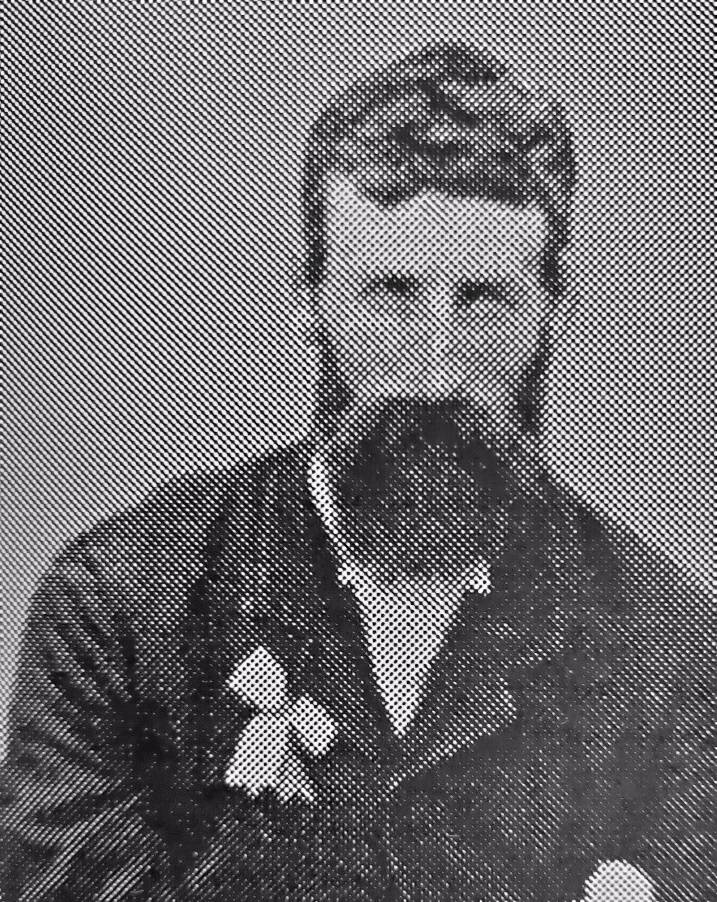
Mary Jane Hunter
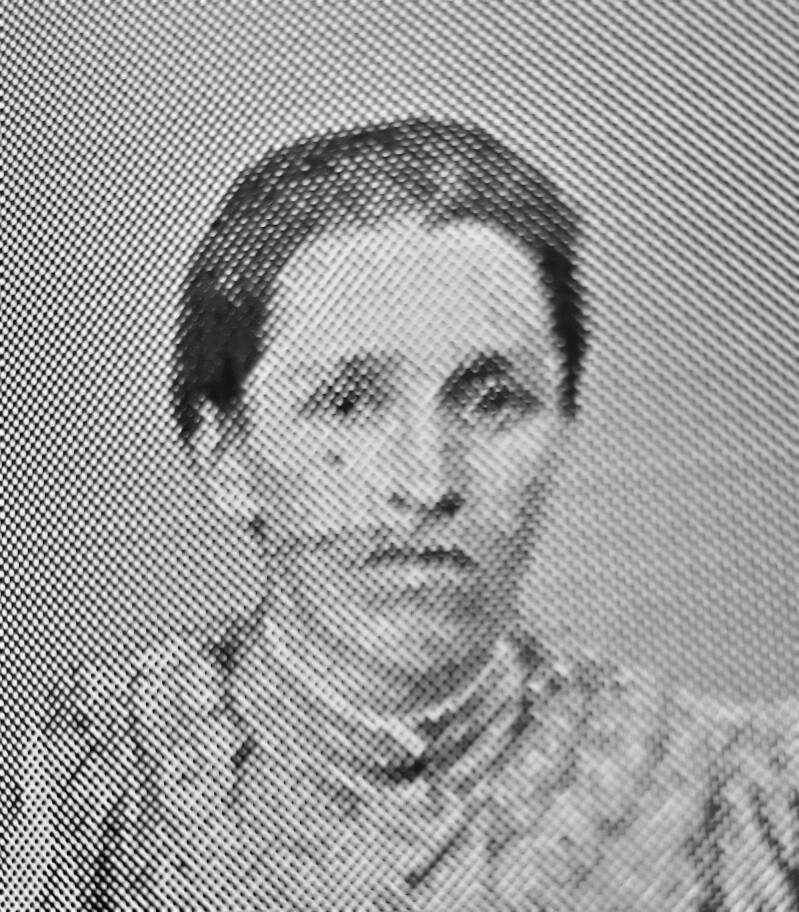
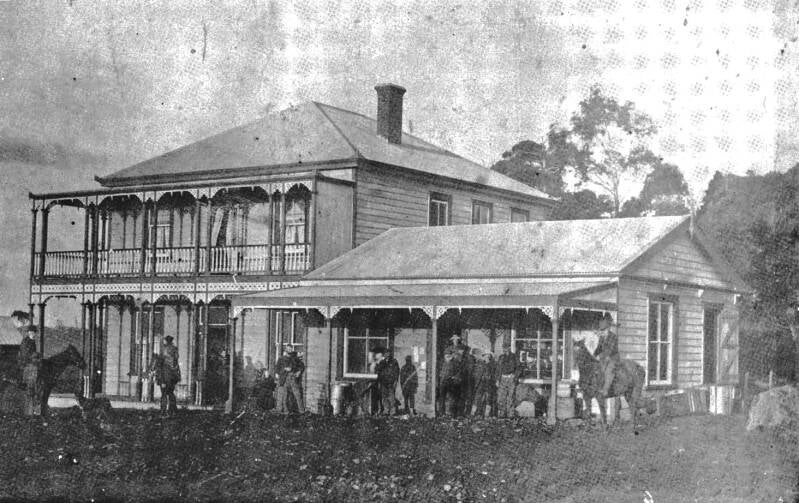
Miller’s Store and Boarding House, Maungakaramea.
Born November 3rd, 1867. Died December 24th, 1891.
Tragedy struck the family on Christmas Eve 1871, when their first four sons were aged from sixteen months to eight years. The Maungakaramea Correspondent to the ‘New Zealand Weekly News’ gave this graphic report in the issue of January 13th, 1872.
Lamentable Accident at Maungakaramea.
A House Burned, and Child Roasted Alive.
It is our melancholy duty to record this week one of the most distressing accidents that has ever occurred in this neighbourhood.
The household of Mr James Miller had been engaged preparing for the Sunday and Christmas and had retired to rest about half-past 11 o’clock on Saturday the 23rd of December. The following morning Mrs Miller awoke at about 3 o’clock and found the house in flames. She immediately ran to two of the children who slept by the side of the chimney, roused them and pushed them out. She them took the child that slept with herself and told her husband to take David, the little boy who slept in an adjoining room.
Mr Miller, who is advanced in years, and afflicted with deafness, appears to have been bewildered by the calamity, and went without the boy. On finding out the omission he called out “Where are you, David?” “I am here Dada” a voice replied. Mr Miller then went into the boy’s bedroom, put the bedclothes together, and thinking that the boy was in the middle of them, carried them out. But the boy was not in them, and the house was then enveloped in flames, so that no further effort could be made. From the position of the charred remains, it would appear that David, instead of going out when called, had turned into an adjoining room, where it is supposed he had suffocated. One of his little hands was held up in an attitude of defence, as if fighting off the flames. It is somewhat remarkable that, when Mr Miller was aroused, he had been dreaming that a dray had passed over the house, and that one of the wheels had crushed and killed David.
The chimney was a large wooden bush-chimney, and it is thought that some embers may have fallen from the over-lid in the course of the evening, got between the boards, and had been smouldering there for some time and caused the fire. Efforts are being made to have the house rebuilt, and we have no doubt the public throughout the province will be lending a helping hand. The neighbours have done all in their power to assist the sufferers by supplying their more immediate wants.
David had had his fourth birthday about six weeks before his death.
Andrew Barrie (Barrie) Miller
Andrew Barrie Miller was born to his parents James and Martha Miller on August 10th, 1870 at their home ‘Glen Miller’ Maungakaramea. Barrie attended the local Maungakaramea School and spent all his life in the district.
He married Margaret Sands, who was a daughter of James and Margaret Sands. James and Margaret had originally arrived in New Zealand in company with his brother Thomas and were in the Maungakaramea district, but the group returned to Ireland in 1868. Later James and Margaret went to the USA and after spending some years there, travelled to New Zealand again, arriving on Boxing Day 1874, on board the ‘Assaye’ together with their children John, Mary, Annie Rosina, Thomas, Letitia, James, Edward and Margaret. They settled in Maungakaramea on an adjoining block of land to their original home. Barrie’s wife Margaret was born in about the year 1874 in Cleveland, Ohio, before the family settled in New Zealand.
Her father James, who was born at Rostrevor, Kilbrony Parish, County Down, Ireland on the 30th of November 1835 and who died in Maungakaramea on May 29th, 1902; and her mother Margaret Fearon/Feron, who was born in 1841 in County Down, Ireland and who died at Maungakaramea on July 3rd, 1891, are both buried in the Maungakaramea cemetery.
Barrie was an expert in the art of blade shearing of sheep. With his cousins Allen, Stirl and John P. Crawford, he would regularly shear sheep in the district. It is recorded that when he was seventy-five years of age, he put through one hundred sheep in a day. That must be something of a record! Barrie owned a block of land in the Maungakaramea district and was a roading contractor for many years.
He was a member of the Maungakaramea Sheep Dog Trial Club throughout his life and was always prepared to assist any organisation in the district. He was a Committeeman of the Maungakaramea Picnic Club for many years.
Barrie and Margaret had two children, Marguerite Roy (Rita) and Andrew Frederick (Fred).
Their daughter Rita, who remained unmarried, was a noted cook and gained many prizes at the annual Maungakaramea Shows. She lived most of her adult life in Second Avenue, Whangarei, and worked at the Whangarei Hospital. She was born in Maungakaramea on August 1st, 1898, and passed away on October 10th. 1968 at Whangarei and is buried in the Maunu Cemetery.
Andrew Frederick was the only son of Barrie and Margaret Miller and was born on March 20th, 1912, at Whangarei, and was known as Fred.
He served with the NZ Army during World War 11.
He married Ismay Beatrice Kitts on November 12th, 1944. Ismay, who was born in Deliquine NSW on February 19th, 1915, was adopted by John Kitts and his wife Caroline (nee Langwell).
After battling personal problems for many years Fred died at the early age of 51 on July 27th, 1963, at his home in Whangarei, and is buried in the Returned Services section of the Maunu cemetery.
Shortly after Fred’s death, Ismay suffered a severe stroke and in her later years was cared for by her sister Mrs Laurie Beazley and her brothers John and Peter Kitts. She passed on at the Carnavon Private Hospital, Henderson on October 12th, 1991, and was cremated.
Fred and Ismay are survived by their daughter Margaret and Whakaria (Mac) Puru, and their five children and six grandchildren, who live in the remote and beautiful Takou Bay, Northland.
Barrie’s wife Margaret died on July 15th, 1935, in Whangarei and Barrie died at Maungakaramea on August 12th, 1947. They are both buried in the Maungakaramea cemetery.
Alexander Tweedale Anderson Miller
The youngest of the four sons of James and Martha Miller was born at ‘Glen Miller’ Maungakaramea, on November 2nd, 1873, and was known as Alex.
We know little of Alex’s short life. He attended the Maungakaramea school and probably received further education as he became a schoolteacher. He possibly taught at the Maramarua School, but it is definitely known that he was Headmaster at Onewhero School (near Tuakau) in 1912. The 1912 appendix to the Journals of the House of Representatives gives the following information:
Onewhero School:
Miller, Alexander T.A.
Classification: D.I.
Position: Headmaster
Salary: £198
Assistant: Wilks, DORIS c.
Alex and Ellen May Appleby were married on January 29th, 1902. May’s parents were William Appleby and Annie (nee Grady). William was a farmer who was born in Derbyshire, England in 1841 and Annie was born in Auckland, NZ in 1843, to Irish parents, and although they married in Papakura on March 7th, 1863, they spent most of their married life in the Mangatawhiri Valley. William and Annie Appleby were the parents of 14 children.
Alex and May often spent school holidays at Maungakaramea, and it was during one of those visits that Alex became ill and he died there on October 3rd, 1912. May and their son Stan lived at Albany Road, Herne Bay, Auckland, but settled at ‘Greenhill’ Mt Albert Road after May’s mother had died, and May was to spend the remainder of her days there, passing away on April 8th, 1967. Alex and May are both buried in the Maungakaramea cemetery.
Alexander Stanley (Stan) Miller
Stan, as Alexander Stanley Miller was known, was born at Onewhero on June 19th, 1904, the only child of Alex and May Miller.
He was only 8 years of age when his father died, and soon after that sad occasion, May and Stan were in residence in Albany Road, Herne Bay. Later they moved to “Greenhill’ on Mt Albert Road, Auckland.
Stan was an accomplished pianist, and he supplemented his income by teaching pianoforte during the period when he was studying for his law degree at Auckland University.
He married Zita Yvonne (Yvonne) Blackmore at Auckland on August 8th, 1942, when Stan was serving in the NZ Army. He practiced as a solicitor in Pukekohe, and it was while Yvonne and he were living there that their two children, Ross and Carolyn, arrived to complete the family. Yvonne, using her book-keeping talents, assisted Stan in the solicitor’s office for many years. Stan died in Auckland on June 29th, 1971, and is buried at Purewa cemetery.
Yvonne remarried to Joseph (Joss) Weldon on May 7th, 1977, and they lived in Auckland. Joss was a widower who had been Chief Engineer aboard the HMNZS Leander during World War 11 and in later years was employed by NZ Industrial Gas Co.
Ross has spent his working career in the banking industry while undertaking computer studies at university. Margaret is an office manager and her involvement in the Girl Guides movement has been recognised by the awards bestowed upon her. Carolyn and Noel are in Texas, USA where Noel recently opened a restaurant and bar.
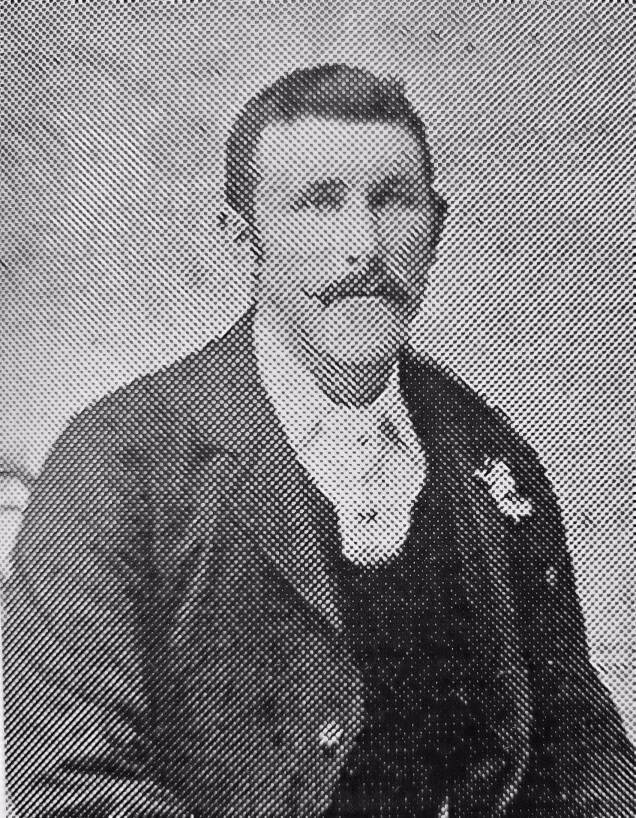
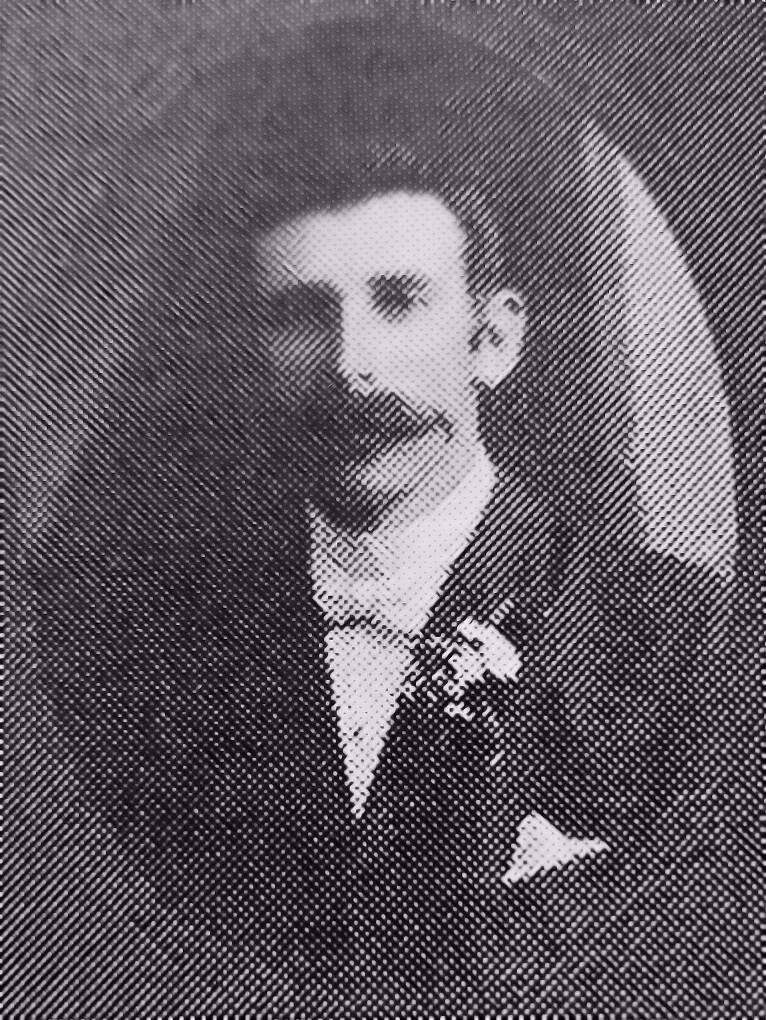
This brings us to the first of the Miller family who journeyed from Scotland to New Zealand, Sharon’s maternal great-grandparents.
James was born (23/4/1804) at Orwell, Co. Kinross, Scotland, the eldest son of John Miller and his wife Margaret, whose maiden name was also Miller. John and Margaret were married in the Westertown Parrish Church, Litchill, Orwell on August 23rd, 1797, by the Rev. Robert Forsyth. John was a farmer at Ledlanet, in the Orwell Parrish, and Margaret’s father, also named John Miller, was also farming, but at Westertown.
James is listed in the 1851 Census Return for Ledlanet as an unmarried farmer of 200 acres, employing 8 labourers. On Monday November 8th, 1858, when he was 54, he married Martha Cromb (aged 26) of St. Martins, Williamstown, Perthshire, in the Church of Scotland Church at Milnathort, Orwell, Co Kinross.
Martha Cromb was born on July 6th, 1832, at Williamstown, Saint Martins, Perth, Scotland, the second child of Andrew Cromb and his wife Martha (nee Cameron). Andrew, who was born on December 4th, 1796, at Saint Martins, Perthshire, Scotland, and who died there on July 5th, 1871, was a lint miller and linen manufacturer, and had married Martha Cameron on the 26th of October 1829. Martha had been born in 1807 at Aughillarger, Perthshire, Scotland, to Peter Cameron and his wife Isabella (nee Smith).
Orwell, Scotland - its history goes back a ways.
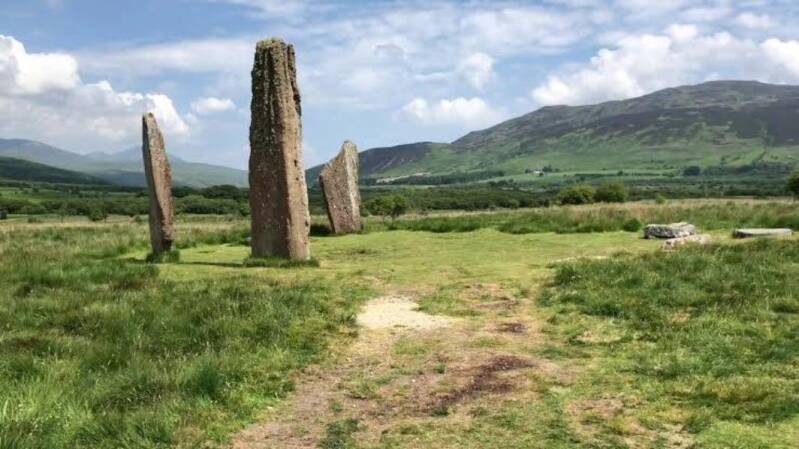
We will never know why James and Martha decided to come to New Zealand and on their departure they both left brothers and sisters behind them, not knowing if they would see them again. Martha’s parents were still alive, although we don’t know when James’ parents died. As events turned out, one of Martha’s sisters, Isabella Roy Cromb, who was only 13 years old when they departed, joined them in New Zealand sixteen years later.
It is part of the Miller family oral history that James Miller came to New Zealand because he had lost a substantial amount of money as guarantor to another person who subsequently went bankrupt. Perhaps the advertisements that were posted throughout the United Kingdom in 1858 whetted their appetites with the promise of a life together in a new and developing land. The ‘Forty Acre Scheme’ was introduced for a short time in 1858/1859 by the Auckland Provincial Government. Many early settlers availed themselves of this opportunity to acquire a land grant which was of forty acres for each family member over the age of 18 years, and twenty acres for each younger member. James and Martha’s block of land was of eighty acres near Maungakaramea in the Whangarei District.
James and Martha would have travelled from Scotland to the south coast of England by train and boarded the ‘John Scott’ at Plymouth on November 20th, 1858, for the journey to New Zealand, where they landed in Auckland on March 7th, 1859.
The Auckland Harbour would have been a very primitive place in those far off days and probably made the open steerage berths (at £18 each) on the ‘John Scott’ seem luxurious! The first necessity for those families who had just arrived would have been provisions and a place to sleep on their first night in their new land. We are unaware of the precise conditions that prevailed in March 1859, but the following report from the NZ Herald, fourteen years later, gives us some idea.
‘The immigrant ship ‘Bear’ arrived in Auckland waters with 311 passengers from London. The next day, a Thursday, all were landed on the wharf. There was no official to receive them, none to render any information, and all they could learn was that there was a barracks in the vicinity of the town where they could be quartered. The single men found their way to the bars of the hotels, also we fear several of the single ladies.
Towards afternoon the married couples with their families found their way to the barracks and were shown a long room, with a row of rough board bunks lining the walls. Here in this room without any partitions over 40 married couples with 108 children were huddled together to pass the night.
The modesty of decent married women was outraged.
There was no nourishment beyond dry bread and tea without milk for the children, and no provision made for quiet, rest or refreshment for exhausted mothers, many of them with suckling infants. Only a small stove was available for the cooking of the necessary food for over 300 people.
Obviously, the single men and some of the single girls had a whale of a time. There was no one placed in authority over them, and they were permitted to smoke unchecked and scatter bedding and bedclothes over the floor. They returned from their perambulations in a state of semi-intoxication and conducted themselves in wild disorder.’
Martha stayed for about a year on Motutapu Island in the Auckland Harbour, presumably while their land was cleared, and a house of some description erected. James first journey to Maungakaramea would have involved travelling in a small coastal boat from Auckland to Whangarei Harbour, then up the tidal Mangapai River to the small Mangapai jetty, which is long since gone, but which was used in conjunction with the Maungakaramea Wharf (now known as Oakleigh).
From the wharf it was a walk of sixteen miles or more to their land, carrying all that they could put on their backs. When the track petered out, they crossed streams by using fallen logs, climbed steep ridges through primeval forest, guided only by a Land Department map and the numerous surveyor’s pegs, until they reached an unoccupied whare or shanty where they could spend the night. These were constructed of wattle branches with laced titre and nikau to form the sides and roof.
James may have had the company of the Hayward brothers, Charles, and Harold, who, with their families had travelled on the same voyage of the ‘John Scott’, but while these brothers went to their Maungakaramea land in 1859, they did not settle there permanently until about 1867.
Amongst the other families that arrived in this part of the country at about this time were John and Mary McCullough and their children. They had arrived in New Zealand on September 26th, 1859, aboard the ‘Tornado’ and arrived by cutter from Auckland on Christmas Day, 1859 to have their first meal in the district, Christmas Dinner, at Mangapai. We have already met the McCullough’s through their daughter Sarah Jane, in previous pages.
James and Martha’s section was described as lot 62 and was situated on the Maungakaramea to Whangarei Road, on the western side of the junction of the road running south to Mangapai. It covered an area of 80 acres (32 hectares) and the property was to become known as ‘Glen Miller’. It is noted that in the ‘Return of Freeholders’ (October 1882), which was after James had passed away, Martha Miller was recorded as the owner of 243 acres, valued at £116, in the Maungakaramea Parish of the Whangarei County.
Having been born on Scotland, it is not surprising that James and Martha should have been proficient in the Gallic language. What could have been more natural for them, than to speak Gallic in and around their home, and that their four sons would have learnt the language also? It was certainly a language that stayed with Cam all of his life. His grandson Derek tells of an occasion while on a visit to Northland, that Cam met up with an old friend and the pair then entered into a deep and lasting conversation in their ‘home’ language, which remained just between themselves.
Tragedy struck the family on Christmas Eve, 1871, when their house caught fire during the night. Everyone made it to safety, except for their 4-year-old son David who was trapped by the flames and died in the fire. He had had his fourth birthday about 6 weeks before his death.
James Miller died on December 30th, 1880, at Maungakaramea, of continued debility over the previous 12 months, and was buried in the Church of England yard, usually known as the Maungakaramea cemetery, on January 1st, 1881. He had been in New Zealand for nearly 22 years, and was survived by his wife Martha, and four sons John, Cam, Barrie, and Alex.
Martha Miller passed away on July 12th, 1902, at Maungakaramea of heart disease and was buried with James in the Maungakaramea cemetery on July 14th, 1902. She was survived by her four sons and seven grandchildren: John’s daughter Roy; Cam’s children May, Jim, Vera, Goog and Stanley; and Barrie’s daughter Rita.
The Maungakaramea correspondent of the New Zealand Herald wrote her obituary in the Wednesday, July 23rd, 1902, edition.
‘One of the oldest settlers in this district passed away to the great majority on the 12th of July in the person of Mrs. James Miller. The deceased, who was in her 71st year, left Plymouth in the ship ‘John Scott’ about November 1858, landed in Auckland in March 1859, then lived about 12 months at Motutapu, but since 1860 has resided at Maungakaramea. In 1880 the deceased lady was left a widow, with a young family of four sons. The cause of death was heart disease and weakness after a long illness over many months. On the 14th of July about 200 people from the surrounding districts of Whangarei, Maungatapere, Mangapai, Otaika, Ruarangi and Waikiekie gathered at the store of Messrs Miller Bros. And followed the remains to the cemetery, where the Rev. J.W. Griffin of Whangarei impressively read the burial service. The deceased was much respected and beloved by all who knew her, and leaves four sons, also many relatives, to mourn her loss.’
Extract from the Book ‘Miller Companions’, a collection of researched family history compiled by Gordon Miller, Waitakaruru, RD6, Thames and published in 1999 to commemorate the 140th anniversary of the arrival in New Zealand of the Miller ancestors on the ship “John Scott”.
The History and Stories of the Cromb Family:
William Cramb and Jean Marshall
Two separate but related branches of the Cromb family emigrated to New Zealand in the mid to late 1800’s, one ending up at Maungakaramea in Northland, and the other at Ranfurly in Central Otago. Both branches share a common ancestor in William Cramb, who was born in Ochmagie, Perthshire, Scotland on July 16th, 1754, and who married Jean Marshall at Perth, Perthshire, Scotland on November 23rd, 1776, when she was 18 years old, and he was 22 years old. William is Sharon’s 3x Great Grandfather.
It is worth noting at the onset that the family name Cromb gets spelt and pronounced variously as Cromb, Cramb, or Cram, and occasionally Crom or Crombe, presumably at the whim of the recorder.
Located in the very heart of central Scotland, the region of Perthshire is home to Scone Palace, the ancient residence of Scottish monarchs. The Perth and Kinross area includes two of Scotland’s major geological features: the Grampian Highlands and the East Central Lowlands of the Midland Valley. The Highland Boundary Fault divides these into the area’s Highland and Lowland zones, with differences reflected in topography, vegetation and land use. Both are characterised by a diverse mix of rural and urban land use, which varies considerably from rich lowland arable farming to extensive upland forestry, and from the main population centre of Perth to small, remote highland communities
Scone Palace, Scotland.
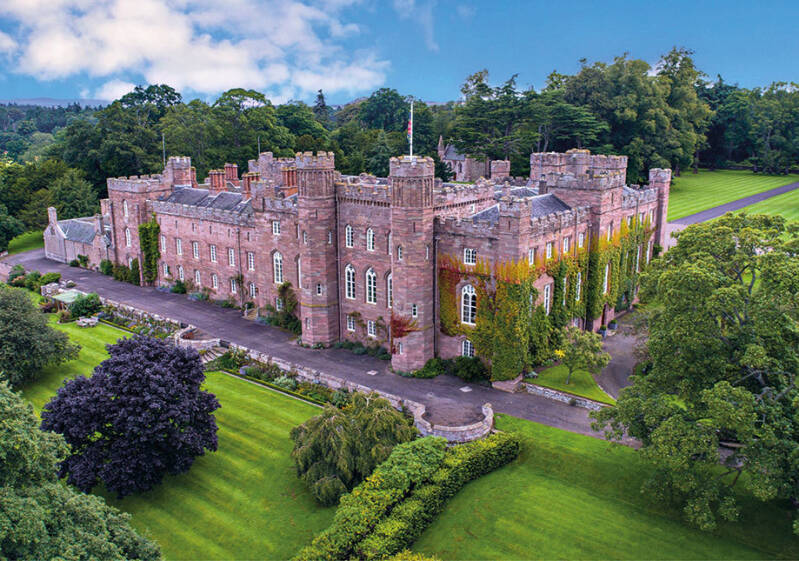
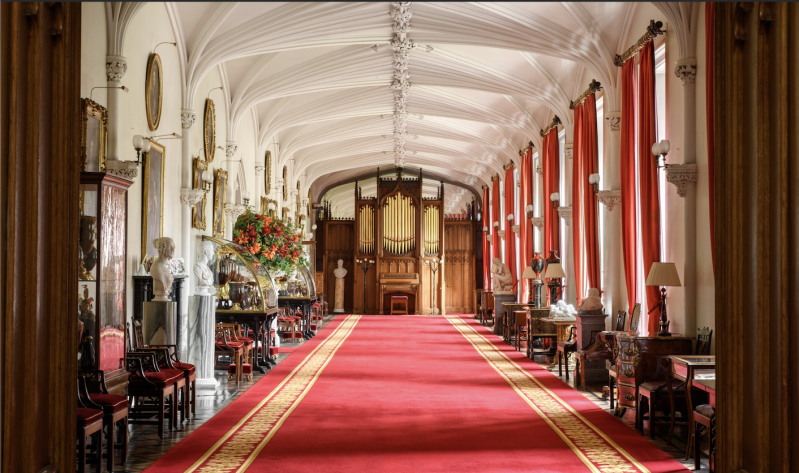
To put it in a historical context, William was born during the time of the Highland Clearances after the Battle of Culloden, when many Lairds involved in the uprisings had their estates forfeited and given to English soldiers. The period marked a dramatic shift in land use from communal mixed agriculture to consolidation into large estates farming sheep. This displaced much of the population to other land, industrial cities, or other countries.
William and Jean went on to have a family of seven boys and one girl, whose births showed that the family was fairly mobile in the Perthshire area, between Kinclaven, Collace and St. Martins, reflecting the changes occurring from small holding farms to estates and industrialisation in the cities. Two of their sons are of particular interest; Alexander Cramb, born on 23rd April 1791 at St. Martins, Perthshire, and Andrew Cramb, born on the 4th of December 1796, also at St. Martins.
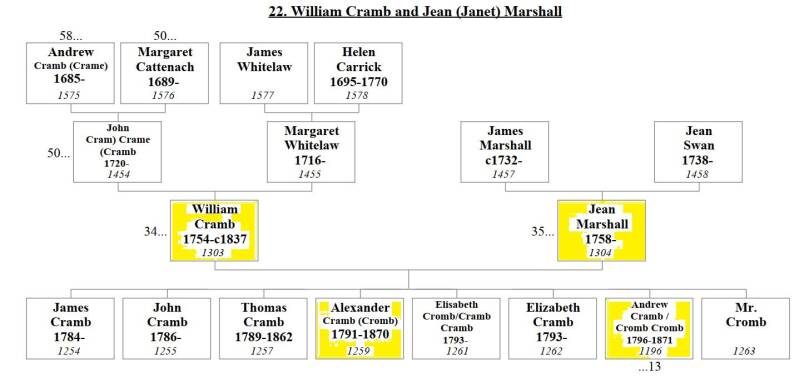
We will never know for certain why James and Martha decided to come to New Zealand and on their departure they both left parents, brothers and sisters behind them, not knowing if they would see them again. It is part of the Miller family oral history that James Miller came to New Zealand because he had lost a substantial amount of money as guarantor to another person who subsequently went bankrupt. It is also worth noting that the potato blight hit Scotland in 1846 and lasted well into the 1850s. The Highland crofting communities were severely affected due to being heavily dependent on potatoes but in sharp contrast to Ireland, where people were mostly left destitute, the government, charities, and Scottish diaspora raised money to help the 200,000 Highlanders at the highest risk during this period. So, times were tough, traditional agricultural labouring jobs were fast disappearing, and poverty was widespread.
Perhaps the advertisements that were posted throughout the United Kingdom in 1858 whetted their appetites with the promise of a life together in a new and developing land. The ‘Forty Acre Scheme’ was introduced for a short time in 1858/1859 by the Auckland Provincial Government. Many early settlers availed themselves of this opportunity to acquire a land grant which was of forty acres for each family member over the age of 18 years, and twenty acres for each younger member. James and Martha’s block of land was of eighty acres near Maungakaramea in the Whangarei District.
As we have already learnt, James and Martha would have travelled from Scotland to the south coast of England by train and boarded the ‘John Scott’ at Plymouth on November 20th, 1858, for the journey to New Zealand, where they landed in Auckland on March 7th, 1859. They had open steerage berths, which meant that for over 3 months they were at the bottom of the pecking list onboard, did not have cabins at all, and instead they lived out the voyage in tiny, dark bunkrooms below deck. They did all their own cooking, washing and cleaning, were allocated plenty of shipboard chores and were only allowed to roam some areas of the main deck.
The 1858/1859 journey was described in the newspapers of the day as follows:
The ‘John Scott’, under Captain Harrison, arrived in Auckland Harbour on Saturday afternoon, 106 days out from Plymouth. She left Gravesend but took her departure from the Downs on the 18th and from Plymouth on the 20th of November 1858. On the 30th, whilst off Lisbon she encountered a tremendous gale which lasted for 24 hours but did no damage. She had no northeast trades – crossed the equator on December 23rd on latitude 280 west, passing in sight of Pernambuco on the 26th, and picked up very favourable south-east trades in 4o south latitudes. Passed the median of the Cape of Good Hope on the 19th of January and 19 days afterwards was in the meridian of Cape Lewin. Ran down her eastings between the parallels of 47o and 48o south with strong westerly weather. Sighted two icebergs. Passed the southeast of Tasmania on the 13th of February, from whence she had to make a dead beat all the way against a succession of light ENE winds. Fetched within 100 miles of the North Cape of New Zealand on 21st of February, but it was not until Tuesday, the 1st inst., that she was able to double it. There was one death – that of Louisa Constable, a child, which took place on the 26th ult. There was also one birth. The ‘John Scott’ spoke no vessels during the passage but was in the company of the ‘Gazelle’ for the last day or two and followed close upon her heels into harbour. She is a fine, sprightly ship; brings a considerable accession of an apparently highly respectable class to our population and has come into harbour in a remarkably clean and creditable condition. She has also bought the lifeboat ordered by the Auckland Provincial Government for use in the Manukau Harbour.
The Auckland Harbour would have been a very primitive place in those far off days and probably made the open steerage berths (at £18 each) on the ‘John Scott’ seem luxurious! The first necessity for those families who had just arrived would have been provisions and a place to sleep on their first night in their new land. We are unaware of the precise conditions that prevailed in March 1859, but what we can surmise has been described above under James Miller.
James Miller died on December 30th, 1880, at Maungakaramea, of continued debility over the previous 12 months, and was buried in the Church of England yard, usually known as the Maungakaramea cemetery, on January 1st, 1881. He had been in New Zealand for nearly 22 years, and was survived by his wife Martha, and four sons John, Cam, Barrie, and Alex.
Martha Miller passed away on July 12th, 1902, at Maungakaramea of heart disease and was buried with James in the Maungakaramea cemetery on July 14th, 1902. She was survived by her four sons and seven grandchildren: John’s daughter Roy; Cam’s children May, Jim, Vera, Goog and Stanley; and Barrie’s daughter Rita.
Isabella, Martha Cromb’s younger sister and the youngest member of the family of Andrew Cromb and Martha Cameron was born in Williamstown, Perthshire, Scotland on September 9th, 1845. She was only 13 years old when James and Martha left for New Zealand, and 16 years later, she came out to join them.
Isabella travelled to Auckland, New Zealand on board the ‘Ocean Mail’ leaving the United Kingdom on August 14th, 1875, and arriving on November 23rd, 1875. She stayed with Martha and James Miller at ‘Glen Miller’, Maungakaramea, but within seven months she had met and married John Crawford, on May 10th, 1876. John was born in West Kilbride, North Ayrshire, Scotland on 14th September 1839, and along with his brother William had arrived on the ‘Talbot’ in 1864, joining their older brother Hugh, who had already arrived in New Zealand in 1861.
John and Isabella took up a section of land on Crawfords Road, Maungakaramea and proceeded to carve out of the bush and stone covered country, a farm that is today one of the most desirable properties in the district.
They were a highly respected family and Isabella, who became fondly known as Grannie Crawford to all in the district, was a local celebrity. Many of the children born in her era have her to thank for their safe delivery into this world and her midwifery and nursing skills were often called upon during her active life.
John and Isabella retired to live in a small house, known as ‘The Cottage’, in the heart of Maungakaramea, but shortly after they moved John died on July 28th, 1920, aged 80 years. Isabella continued to live at The Cottage until she died on December 12th, 1936, at the ripe old age of 91 years.
On the occasion of her 90th birthday a unique function was accorded her, when the districts residents gathered to present her with a gift from her well-wishers. In a newspaper report on the memorable event, it was said that no Queen from her throne received her subjects with greater joy and graciousness than did Mrs Crawford. She was still able to read without glasses, and a remarkable memory allowed her to greet each of her guests by name.
John and Isabella were survived by two sons and two daughters.
Alexander Cramb was born on 23rd April 1791 in St. Martins, Perthshire, Scotland, the fifth son of William Cramb and Jean Marshall. It is reputed that sometime, probably before 1825, he eloped with a Catherine Smith from Collace, Perthshire. Alexander would have been around 30 years old, while Catherine might have been as young as 18. Without records, we just don’t know. What we do know is that the couple went on to have eight children, two girls and six boys, all of whom appear to have been born in St. Martin, Perthshire. And it seems that they all lived and died in Scotland, as did Catherine and Alexander, so we have to move to the next generation before their children start to emigrate to the colonies.
William Glass Cramb (or Cromb)
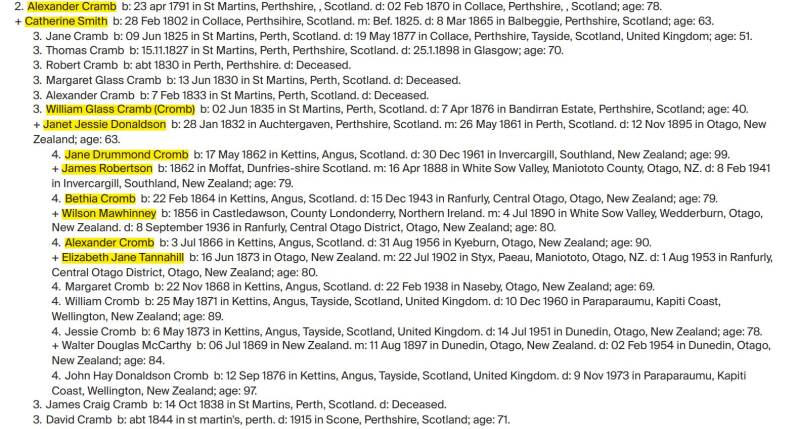
Alexander and Catherines sixth child, William Glass Cramb (or Cromb) was born on June 2nd, 1835, at St. Martins, Perthshire. On May 26th, 1861, he married Janet Jessie Donaldson in Perth, Scotland. Together they had seven children while living at Kettins, Angus, Tayside, Scotland, four girls and three boys. However, on April 7th, 1876, while working at the Bandirran Estate, Perthshire, Scotland, William died, aged 40 years.
As we have seen (above), times were tough in Scotland, and none more so than for widowed families without an income. So, it is perhaps not surprising that Janet and her children elected to travel to the other side of the world, to start life anew. A journey we will return to later.
Alexander Cromb
And what of William and Janet’s oldest son, Alexander Cromb, who along with Jane Drummond (Jessie) Cromb, their oldest daughter, had arrived in Otago, New Zealand prior to Janet, Berthia and the rest of the family? In his own words (which tend to slip into the third person) …
Early Settlement, by Mr. Alexander Cromb.
When the writer arrived in the district some settlers had already arrived, such as Messrs. W Hall, Herlihy, Greer, Baxter and Peter Law on the Eweburn and several others from the river up to the old Eweburn Hotel at the crossroads. Most of these holdings are still in the possession of sons of the early settlers.
Sometime in 1883/84 Gimmerburn settlers came in and some of their sons are still farming the same lands. Maniototo and Highfield was cut up and surveyed in 1891, and the new owners were settled in in 1892. At that time wool realized only 4d to 5d per pound and there was no outlet for any surplus stock and no railway for some considerable time after that.
When I first came to Maniototo in 1884, I came with an old wagoner named Jimmy Leslie over the old Dunstan Road. It was a very rough trip, and the travelers were stuck on the top of the mountain which was called Mr. Hard’s or the Half Way House, of which only the walls are standing today.
When the writer first came over the Dunstan Road in August 1884, the rush for gold was all over, but there was still a good deal of traffic on the road. I was going to work on Linnburn Station and managed to pick up one of the wagoners at Outram, who was taking a load of stores to Eweburn. By that time the old road house on the mountains had been demolished and nothing but the walls were left.
The travellers had a rough trip and stopped at the ruins of the road house to take shelter from a howling blizzard and were marooned there for two days. The ten horses made for shelter and did not turn up again at the wagon until the second afternoon, when it had cleared somewhat. The travellers continued and got to Styx the next day, and Linnburn the following day.
The first view of the plain was when they came over the top, this side of McPhee’s, six miles up the hill from Styx.
Mr. Tannahill took over the Styx Hotel from Mrs. Potter in 1871 and was one of the wagoners who came over when Gabriel’s Gully broke out, and they bought their wagons and teams with them from Ballarat. Some of these early settlers were Bob Gawn, Sandy Owen and James Tannahill. At that time the coach and escort during the gold rush stayed at Styx overnight and there was a constable stationed there. The old police quarters are still there with the saddle racks and ringbolts where they chained the prisoners overnight. The writer thinks that this historic building should be preserved instead of being used as a calf pen or such like.
The stations on that end of the plains were the Linnburn, Puketoi, Patearoa, Hamilton’s, and on the north Highfield, Maniototo, Kyeburn, McMasters and Longburn.
Linnburn was at the south end of the plain and had the Taieri River for boundary between Patearoa and Rocklands, then with Beamont right back to the head of the Taieri River, which divided it from Treviot Station, better known as Cargills and Anderson’s, then Galloway came in and along the top of Rough Ridge with Puketoi.
When Mr. Cromb first came to Linnburn the station carried 25,000 merino sheep but later, with the increase in rabbits, the total dropped to 22,000. Shearing time was in December and the 16 shearers, with classer and rollers and other shed hands went on to Hamilton’s Station. Later, Hamilton’s was cut up and joined Puketoi. The wool was conveyed by 10 horse wagons over the hill to Outram, a load being about 40 bales. Some of the teamsters were Jimmy Leslie, Bill Pacil, Jack Leslie and Brenssell.
Patearoa Station belonged to Murray Roberts & Co. and was run in conjunction with Gladbrook Station on the Middlemarch side of the hill, which was managed by a Mr. Wilson. The original owner was Dr. Buchanan. Puketoi Station belonged to Mr. Watson Shannon, who bought out the first owners, and was managed by Andrew Jopp. Hamilton’s was managed by Mr. Mathias, whose son now owns the homestead.
These places were staffed mostly by two or three shepherds, a ploughman, cowboy and groom, a few rouseabouts and a cook. Rabbits were very plentiful at this time and there was always a man trapping in the summer and poisoning with phosphorized grain in the winter, and in those days, skins realized about £1 per 100. The writer recalls that he and his brother had a contract to poison the run one winter, and they put on 14 men and started at the Dismal Swamp (Lake Onslow) and worked towards the front, finishing up with something over 42,000 skins. The station owner took the skins and sent them home with his wool clip and Mt. Cromb, his brother and the hired men were paid £1,500 for their efforts.
There was still a good bit of mining going on in the district, with a few claims at Sowburn as it was then called. Strange to say, there was neither hotel, store nor post office in the area, although there was a post office at Blackball, which used to be a hotel and store in earlier times, kept by a man called Harman and his four daughters. Mr. Harman would go for the mail to Hamilton’s on Saturday and bring it to Serpentine on Sunday and take the outgoing mail to Hamilton’s on the Monday, so the settlers had delivery of mail and papers only once per week.
There was quite a colony of miners at Serpentine, and a hotel and store, kept by Mr. Joe Edmonds. There was also a church, built as a community church, but in early days it was never used as such and the miners made use of it as a dwelling.
The Bank Manager used to ride in from Blacks once a month to take the gold to the bank there.
Settlement was just beginning during the early ‘80’s – W Hall, Herlihy, Greer, Baxter and Peter Law at Sowburn, andall, H at Eweburn, Kearney, Bleach, Dougherty, Mulholland, Mawhinney, Allison, P Kearney and J Packman. At that time there was no railway nor for a considerable time after, so the farmers had nothing but the local market, Naseby being the nearest source of supplies.
It is interesting to see the Mawhinney’s mentioned at Eweburn, as Wilson Mawhinney later married Alexander’s sister Berthia at White Sow Valley, Maniototo in 1890.
Alexander went on to marry a Tannahill girl, Elizabeth Jane, in Styx, Maniototo on the 22nd of July 1902, when he was 36 and she was 29 years old. Together, they had a family of 3 sons and 2 daughters.
Jane Drummond Cromb
Jane was the eldest daughter of William and Janet Cromb, and was born at Kettins, Angus, Scotland on the 17th of May 1862. As we have heard, she accompanied her brother Alexander out to Otago, New Zealand prior to the rest of the family emigrating here after their father William died.
At the age of 25, she married James Robertson at White Sow Valley, Maniototo County, Otago, New Zealand, on the 16th of April 1888. James had been born in Elvanfoot, Moffat, Dumfriesshire, Scotland on the 10th of February 1862, and had emigrated with his family as a young child to Invercargill, Southland. He was an engine driver, having worked on the railways all his working life. Together they raised a family of five children, before James died in Invercargill in 1941, and Jane followed him in 1961, at the age of 99.
Bertha Cromb
Bertha Cromb was the second eldest daughter of William and Janet Cromb (or Cramb) and was born at Kettins, Angus, Scotland on the 22nd of February 1864. As we have heard, Bertha travelled with her mother and siblings to New Zealand as a 13-year-old girl, on board the steamer 'S.S. Kaikoura', leaving on October 22, 1887, and arriving at Wellington on December 3rd. Her father had died the previous year, and their eldest daughter and son, Jane and Alexander had already preceded them by travelling to Otago earlier.
In New Zealand Bertha became a school teacher, and on July 4th, 1890, at the age of 26, she married Wilson McQuillen Mawhinney at White Sow Valley, Wedderburn, Otago, New Zealand. Wilson had been born in Castle Dawson, County Derry, Ulster, Northern Ireland on April 16th, 1857, and had come to Otago as a young man, farming at Eweburn, as we have seen (above). They settled at Ranfurly, in Otago, where Wilson farmed and Bertha taught, and where they raised a family of three sons and four daughters.
Bertha Mawhinney (third from left, seated) and family
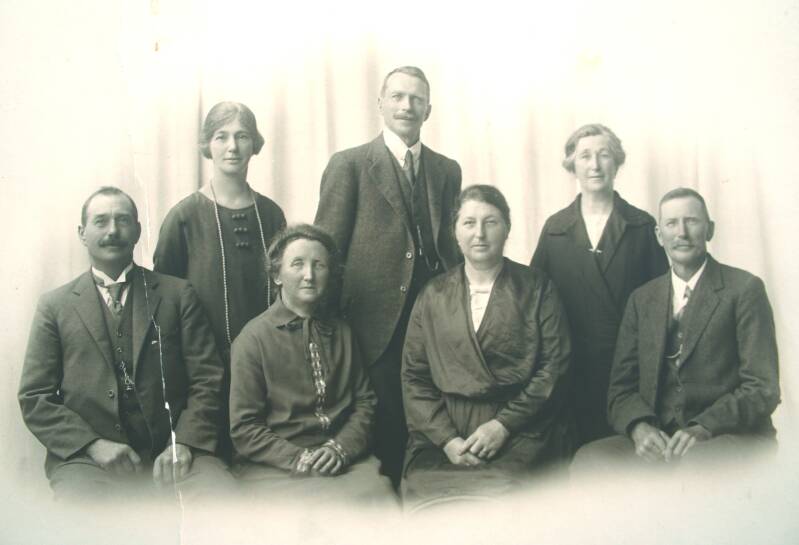
It is fitting that I end this section with Bertha, as I have tried to coral this seemingly limitless story by concentrating on answering the questions of where did families come from, what drove them here to New Zealand, and what did they do, and where did they go when they got here? It is an attempt to put some boundaries around an endless story. It is by no means complete, or even comprehensive, but as anyone researching their family history will know, it is never complete, finished, or all-encompassing. This section, however, must start and end somewhere.
I’ll expand on this in the Epilogue, but basically, everyone’s family came here from somewhere else, so it seems appropriate to end with a detailed account of one person’s journey across the world to a new land and a new life.
The Diary of Bertha Cromb
Bethia CROMB travelled with her mother, brothers and sisters from Scotland to New Zealand in 1887. The family was - Mother - Mrs. Jessie Cromb (aged 55 - page 65), Bethia (23 - p. 66), Margaret (Maggie, 18 - p. 71), William (16 - p. 72), Jessie (14 - p. 72) and Johnnie (11 - p. 73). The other two members of the family, Alexander (p. 69) and Jane (p. 65) had arrived in New Zealand earlier. Through the curtesy of Margaret Arnold of Invercargill, we are fortunate to have a copy of Bethia's diary written during that voyage because it not only gives an insight into the conditions that prevailed at that time, but also into her personal ability to record the events of the day. Unfortunately, some words and phrases are missing from the manuscript as they were unable to be deciphered when transcribed from the original diary, and we are not to assume that they are 'expletive deletives'. Bethia became a respected School Teacher and with her family settled in the Ranfurly district, Otago, New Zealand.
'S.S. Kaikoura' 4p.m., Saturday October 22, 1887.
We have got fairly out to sea, and to keep off thoughts of seasickness have begun to write.
We left Edinburgh at 9.20p.m. on Wednesday. Although we had an 'Engaged' carriage to ourselves (which we owe to Col. MacDonald's influence with Mr Patton the Stationmaster) we did not sleep much. We stopped for a short time at Sheffield about 4.15 on Thursday morning and we reached Derby where we had breakfast about 5.30. The train was a slow one to Birmingham and from there to Bristol fast, stopping only at the principal stations. The country as far as Birmingham and beyond was very monotonous and anything but pretty. About Gloucester and Worcester, the country began to improve. The fields are very small - hardly worth the name indeed - and all divided by neglected looking hedges often growing on the top of a bank. One was inclined to wonder at the waste of ground taken up by the boundaries among so much miniature farming. The boys were amused at the mode of working the ground. We saw no smart "pair" of horses, the ploughs were drawn by three and sometimes four - one in front of the other, tandem fashion - and usually with a man or a boy to drive besides the one holding the plough. We could not help thinking that farming in Scotland could not afford so many men and beasts to accomplish the same amount of work. The horses seem lighter than our farm horses and all had long tails. Jack was always thinking they were breaking in "staigs". I have been told since that the ground is so stiff it requires three horses to turn it over, but their carts are drawn in the same way. We saw a good many donkeys - sometimes such queer yokes as a donkey first and a little towsy "staig" after. One thing we remarked - we did not see one woman at work in the fields, in all the length of England. In the Southern part, a great deal of the ground is orchard. The trees seemed to have got stripped only the day before we passed, for the apples were lying in heaps, each kind by itself ready to be lifted. Where they had been removed, the orchard had got other occupants, namely the pigs, dozens of them we saw feeding under the trees, or basking in the sun; beauties some of them (If I may apply the word to a pig). I yield the palm to the English there.
We changed carriages in Bristol, and from there the country was lovely - the trees were of so many pretty shades and the bright day showed them up so well. We came to the seacoast in the South of Devonshire. The railway skirted the shore at the foot of the red sandstone cliffs, overgrown with bramble and bushes on one hand, while on the other lay the calm, bright water, which was to be our home for many days to come. Dawlish cliffs are the grandest but all along is pretty. '
We soon reached Plymouth after that. We had tea at the Station, saw our boxes safely disposed of and made for the Depot, which is at the back of the Forts at the outside of the Harbour. While there we were very comfortable - crowded a little at mealtimes, but with nice comfortable beds and a nice clean yard to walk in overlooking the Harbour. We had to pass the Doctor on Friday and got our boxes searched and relabelled - keeping out what we wanted for present use. Then the men carried out our boxes to the lighter which was to take them out the Harbour to the "Kaikoura" which arrived from London on Friday night.
On Saturday morning we had to be in readiness to embark at any moment and the order came about 12 noon. Our names were called and as we got orders, we passed the Doctor again and another older Doctor besides, who asked us if we felt all right. We all did I suppose, I beard of no one who was turned there, but there was a woman with two children who had whooping-cough, kept back at the first examination on the Friday. It was an ordinary large river steamer we embarked on, and we soon streamed out to where our gallant ship awaited us.
We got on board, were shown our quarters, sought out our baggage and got it stowed away - and stowing it away without space to stow is no joke. We had got our dishes the night before at the Depot - all tin; a soup plate, a flat plate, knife and fork, tablespoon and teaspoon, jug for tea, small tin basin to wash in, and a hook-pot. Pothooks I have long been acquainted with - but this was my first introduction to a hookpot. It was something between a jug and a teapot to be used as either, according to the will of the owner. Besides these there were (one for each mess) a wooden bread bucket with a lid (not like a pail - nicer than that), a tin water drum, pepper, salt and mustard dishes, two dishes to take the place of assiettes and a basin for washing dishes in. Our mess was all Scotch, Miss Stewart Newburgh, Miss Kay Comrie, Misses Alexander, Edinburgh, Mother, Maggie, Jessie and myself.
We had to make our beds before going on deck. We found in each, a good soft mattress, a pillow and blanket, two sheets and a coverlet - all good, only the bed itself was so little. Jessie and I should have been side by side in the lower row, but Mother did not like the climbing so took Jessie's place beside me and Jessie slept above while Maggie is alongside her, over Mother. The upper berths have most room to sit up on, but I believe they are hotter. When we got all arranged, we went on deck. The Steamer belonging to the "Mission to Seamen" came alongside and three gentlemen held a meeting on our deck. We had had the service by a regular clergyman at the Depot the night before. The Catholics had service through the day on Friday and went to confession in one of the rooms. We set sail at 2.25p.m. and were soon beyond the Breakwater saluting a man-o-war as we passed - steaming on. Past Mount Edgecombe and Lizard Point, till we were alone on the green waters of the English Channel.
Many have just left those near and dear to them, yet few seem very sad, I saw one old man and his wife crying sorely as we left the wharf in the river steamer, besides a few girls - but very few. The business of the moment seemed enough for everyone. Oh, believe me! It is easier to go than to see those you love go from you. It is getting too dark to write more tonight. A good many are downstairs sick already - we shall all have to follow to bed bye-and-bye.
WEDNESDAY OCT. 26th.
I was not able to resume writing till today. When I went down to get to bed on Saturday, I got very sick, and Mother not long after. On Sunday Morning we did not feel like rising, but our Matron, Miss Monk (who sleeps in a rough little Cabin about 8ft. square - opposite our two berths) came around coaxing us to get on deck if possible at all, else we should have a fever - so many lying in a close little space. Ventilation is good, but it does get a little close. ' Jessie rose first. She had not been ill till then but grew bad before she was ready to go on deck. Maggie never got ill at all. She thinks that the rumble and shaking of the machinery under the workroom in Perth made her feel the ship's motion less. Well, we all struggled on deck - and a sad sight the deck was for that day - nothing but poor sufferers lying around, like some battlefield - and a battlefield could not have furnished more ghastly subjects. However, we began to get a little better - at least the others did in the afternoon - I was ill for days myself. Our friends from the men's quarters - which are at the opposite end of the ship - as are also the married people's - are allowed to visit us from 2.30 to 4p.m. on Sunday afternoons, provided they ask a pass from the Doctor. Our boys did not know on Sunday so were turned back at the very stair. Mother was so disappointed as there was no prospect of seeing them till next Sunday. On Monday (24th) we were all better except about eight of us. We were in the Bay of Biscay by that time, but it was anything but rough. One gentleman who has sailed on it five or six times says that he never saw it so smooth.
The Second Officer comes every day to mark on a chart, which is on the side of the stairs, our exact position and how far we have sailed each day. From the time we sailed on Saturday (2.25p.m.) till noon on Sunday we sailed 281 miles. From noon on Sunday to same time on Monday, 317 miles. All Monday there was a troop of little green birds about the wheels of the windlass over the hold, at our end of the ship. They are exactly like our Scottish "green linties" but so fat and so tame. They had probably come from Spain, but they left again in the night. On Tuesday the 25th the sea was a good deal rougher, though we were out of the Bay of Biscay, and a great many were sick again. Mother was and Jessie; and I who had never been quite better was bad as ever.
We were nearing Madeira and our letters were wanted to be ready. I tried writing in the afternoon but was not successful, Maggie had to do it all nearly. We went 323 miles that day. In the afternoon we passed a ship - steamer homeward bound from Madeira. Our flag was run up in salutation - which the stranger returned. The weather was getting hotter, so the sailors erected an awning over all our decks, which makes them so much more pleasant. You must understand we live on deck and a very pleasant dwelling place it is, only not the best for getting writing done so you will overlook any eccentricities in my calligraphy here. Downstairs only means the place we sat and sleep in, we trouble it as little as possible.
Wednesday 26th - early in the morning we saw land on the Port side i.e. the left hand looking the way we are going. This was only a barren rock one of the Madeira but after breakfast we saw on the opposite side the brown cliffs of Madeira proper, and by ten in the forenoon we were at rest in the bay. Funchal. The waters get green when near land, out in the open ocean they are deep, dark blue. The view from the bay is lovely. The hills rise with a slope above the town, but at some parts of the island they rise perpendicular out of the sea. The Hills are rather like our Perthshire hills - our Sidlaw Hills. I should rather compare them to - a succession of round-backed heights, the sides and tops covered with trees. I was told the trees on the hill sides of Madeira were palms - they certainly looked, at the short distance we were, very like Scotch fir. Lower down the slopes are covered with vineyards and gardens with little white thatched houses hardly discernible among the greenness. The houses are all white - Alabaster, Miss Monk told me. It is so common as to be the usual building stone.
The last vestige of seasickness vanished with the sight of Madeira and no wonder for the scene was lovely. The smooth bay with its glistening waters - the pretty white town among its vines and orange-trees with its white Cathedral and marble tombstones crowning the nearest height; while higher and farther rose the hills, with the grey clouds creeping down their slopes - all made a picture which it would be hard to forget. In the bay I counted ten good-sized ships besides our own. One of them a sailing vessel came in about the same time as ourselves, but from the east, possibly from Portugal. One very large steamer there was, the "Athenian" from Cape Town to Southampton, carrying the Mails.
Our errand was for coal, but before we were well into the bay we were surrounded by dozens of small boats with one or two dark-skinned little savages - for they looked little better - grinning and shouting for a "pennee". Where a penny was thrown into the water they would dive after it often down out of sight bring it up either in their hands or feet, and hold it up triumphantly as if assuring us that our good money was not lost (?) They looked so like large yellow "puddocks" sprawling under the water, one could hardly believe they claimed one common brotherhood with ourselves.
They tired of the diving after a bit, and a shoal of older visitors coming out, brought them dry clothes (They had not many wet ones - they took the right place about that and left the most of them at home). The men in the larger boats brought wicker chairs and baskets, parrots, canaries, feather-flowers, oranges, apples, bananas, chains, filigree work, jewellery, walking sticks, embroidery, knitted silk shawls for sale on board. We bought lovely feather-flowers - pure white and coloured for going under a shade for 2/-. We were commissioned to take them to a friend in New Zealand. They are 15/- there. Mother bought a silk knitted shawl - same pattern as the Shetland shawls - large size for 1/-. The Doctor put it all through his ring, it goes into such little bulk. I am writing these details for the benefit of my lady friends.
The coal boat soon came alongside and a hard afternoon's work the men had, stowing them in, till six in the evening. The men who stowed the coal came from Madeira. A man came out with their dinner in baskets about two or three O’clock. They seemed to be very hungry, but in Scotland a hard-wrought man would have deemed the fare but scanty I fear - dry boiled rice seemed to be the sum and substance of it. They seemed quite satisfied, however. About 4p.m. the "Athenian" got up steam - said "Good-bye" to us, which our flag responded to, and sailed away, carrying our letters home. I happened to be one of the two Postmistresses among us girls, so can tell you the number of letters we sent. There were seventy-two. We left Madeira at 6p.m. The busy clamorous scene, of swaying boats dancing under the very edge of our ship, of jabbering dark-skinned Portuguese, of water covered with such litter as wicker chairs and orange-baskets, of decks covered with eager purchasers and more eager vendors - seems already like a dream, and yet a dream whose details do not soon leave one's mind (289 miles to-day). All day the Hospital has had one occupant - an Englishwoman very bad with erysipelas - "the rose" as we call it. We had five minutes of stolen visit from the boys in the confusion today - discipline was relaxed a bit.
THURSDAY OCT 27th.
I was not well in the forenoon but have quite revived. We saw a sailing vessel on the starboard side, but it was too distant to be "spoken". In the forenoon we came in sight of the Canary Islands. We passed at the back of Teneriffe so did not see the town, Santa Cruz, which would have been our calling place if we had not called at Funchal, Madeira. The back of the Island is very barren, no sign of vegetation or inhabitants except on one sloping part where there appeared something like bushes, and a few white specks which were probably huts. The other side is better, I am told, resembling Madeira. We sailed up to noon today from the time we left Madeira - 245 miles.
FRIDAY OCT 28th
It is a lovely day everyone really seemed in excellent health, and spirits are up accordingly. The sea all along has been - to quote the official report - "Moderate". We have not yet seen a big wave today. I believe they are a little higher. This morning two waves came in at the Portholes beside our berths - which are on the windward side of the ship - the first little taste of the sea water we have had. I was on deck myself, but Mother was down about. She thought someone was pouring the water overboard. They got the Port closed but not before some of the shawls got drenched, and the floor was sailing. The Matron tells some story of a woman under her charge in a former voyage, who was surprised by the water coming in at the Porthole on her. She thought it was a trick and kept calling out, as ever another shower came over her "I'll tell the Matron, I'll tell the Matron" - a threat which the billows would no doubt respect(?) We brought up our beds in the forenoon to get aired on the railings of the deck. The mattresses had to be marked with each one's name as we get our things to keep, and it is not pleasant to get them mixed.
It turns out that we have onboard a stow-away from Madeira - a good big lad of about 18 I should say. They were teaching him to work today. He had hidden among the coals and did not come out till yesterday. The Second Officer was just telling us how the men pretended to be going to hang him before he would promise to work. They are a lazy set the natives of Madeira. He has been sweeping the deck, and he has taken three times as long as the other boy does. He is going to Cape Town, what for I do not know. Today we made 328 miles - the wind favours us, and we are pushing on with both sail and steam. The weather is getting very warm but on deck it is not bad as we have a good breeze.
SATURDAY OCT 29th
This is a busy day downstairs - all the dishes have to be scoured with sand before the inspection hour. Every day at 11 a.m. the Captain, the Doctor, the First Officer, the Purser and the Chief Steward go over the ship - into every corner - to see that it is thoroughly cleaned. Only the Captain and the Doctor came down our stair - the other three remained at the top. The Matron has been accustomed to the whole five of them going down, but in each ship these very small details differ a little, although the printed regulations are the same in each.
About 3p.m. a homeward bound steamer passed us. Of course, the flags spoke the usual "How d'ye do". We were near enough to see the people on the deck wave their handkerchiefs. Just before tea the men were called up for fire and boat drill. The hose kept playing bravely out at the Port holes, but we could see little of the fire drill as the Saloon Passengers' deck was between ours and where operations seemed chiefly to be conducted. We could see them (the sailors and a few of the men passengers) called out - could hear the boatswain's whistle and sharply spoken orders - and then each man flew to his post - two in each boat - loosening the ropes - fitting in the rudders - lowering the boats - with a cool promptitude which made one feel we were in skilful hands, even at the moment when their air of desperate earnestness made one draw one's breath with a shudder as if in the presence of a real danger. By the side of the two boats at our end stood a sailor, each manned by another two - his knife at his belt, waiting the word. These two seemed the smallest and apparently, the last to be lowered. They swing out the others - lower them till they almost touch the waves - a man has loosened the lifebuoys. It wants only the terror to complete the scene. Instead comes the familiar homely call "Tea is ready" and we go down to enjoy it. When we come upstairs again the hurry is over. We see only our neighbours, the saloon passengers lounging about and the Captain on the bridge, beneath which, we can catch a glimpse of the distant forecastle, with our brothers (or some other body's - it is so far?) cheerily waving their hands to us. Two Scotch girls among us play the melodion and one or two among the Irish girls, the concertina. After tea as we were sitting on deck watching the moon rise one of the girls who had been playing, struck up a familiar Scotch reel. It reminded one so much of home - it was irresistible, so we soon got up a set. They had had dancing a little, through the week, but this was the first time I was able or inclined to join them. After we were tired, we sat and sang Scotch songs. The Matron is very fond of them; indeed all the English are. The Saloon passengers same along to swell the audience and seemed to appreciate the performance which kept up almost until we had to go below. The distance up to noon today was 327 miles.
SUNDAY OCT. 30th
We got through breakfast as usual, but when we got on deck, I noticed that the majority had dressed for the service which was to be held in the or perhaps it was for the first muster which was to come before that. Anyhow we were nearly all extra tidied, and we were glad afterwards that we were in keeping with the rest of the ship. The weather had been very hot for a few days - nothing unpleasant on deck, as there was always a good breeze, but very hot downstairs.
A little before 10.30 we got an order according to the number of our berth (I am 38 - 3rd of Mess No. 5) and in a few minutes Captain Crutchley and Dr. Jennings came along to see us. They were in their Sunday clothes too - and bravely they looked in white trousers, black coats with double row of brass buttons and caps embroidered with the New Zealand Shipping Company's badge. They merely called our name which we answered to - to prove that we had not succumbed to the horrors of seasickness, I suppose. Afterwards, the crew were mustered on the Saloon deck, the Saloon Passengers I suppose had been mustered downstairs for every soul on the ship has to appear before the captain in the general muster - unless in hospital. Everyone took his place according to his rank. The Officers were standing across the ship at one end - Down one side were the Carpenters, Engineers etc. On the other were the Stewards, cooks, baker and all attendants - what they all get to do I cannot imagine. I had been told there was a crew of one hundred on board the "Kaikoura” and laughed at the idea. But when I began to count round the near side and down the other as far as I could, and got to 65 and not nearly done, I was convinced that there must be all those. The First Officer, Mr. Easton answered for himself first, and then called the roll for the Captain. The First Officer wears three gold stripes on his cuffs, the second Officer, Mr. Millwood wears two, and the third and fourth Officers - one each. Dr. Jennings wears two gold stripes with a silver one between and the purser wears one of silver. There are others with stripes, but I do not know who they are. Since we came to the Tropics the Officers wear entirely white uniforms, they look nice and cool.
After the muster we had a Service - English Church Morning Prayer - some singing and an address from an independent Church Minister. It was held on deck and was very reverential and home-like so far out here in mid-ocean. Far away on the starboard side we saw two ships - the first a Steamer going Southeast, the other a sailing vessel going Northwest. They were much too distant to be "Spoken".
The boys came along at 2.30p.m. and stayed till 4 O’clock. They are both looking very well and very lively. Johnnie was full of a wonderful sight he had seen that morning - a shoal of porpoises with a shark after them. I saw the porpoises - hundreds of them popping up and down in the water like a lot of black pigs. They were evidently in a hurry. I thought perhaps our ship had disturbed their morning nap but though I watched them closely, I saw no shark. Some of the men say they saw ~t however. Later in the day we saw a shoal of flying fish. They are small compared with porpoises. the latter are twice as big as a large salmon - (perhaps bigger still) - the flying fish appeared to be like good large haddocks only dark in colour (with short glistening fins or wings at their sides). We sailed only 301 miles as the wind was fairly in our teeth and we had not the help of a yard of canvas. The weather continued hot, but although in the Tropics, not oppressive.
MONDAY OCT. 31st
I do not think there is anything particular to relate of today's progress. We ate, drank, cleaned up and lounged about as usual. I suppose we cannot expect much variety for a week or two. We passed a large steamer between 7 and 8 p.m. as we were sitting on deck in the moon light. It was all lit up of course and signalled to our ship with lights it carried in front of the foremast. I am not sailor enough to know the masts yet. I know the backmost one beside us is the mizzen-mast. Our ship also carried a lamp on the front mast, the boys who are at the front of the ship, were astonished at the size of it. I have not seen it. All our quarters are lit with electric light. Distance for today was 303 miles.
TUESDAY NOV. 1st
Today the Matron opened the workbox and distributed its contents. This is a box of sewing and knitting materials given by the New Zealand Government to keep the girls from wearying. No one need make anything unless she pleases. When made, the maker gets the article to keep. Some got worsted for stockings, some crochet, some calico for underclothing and some pretty prints for aprons. Maggie took cotton, Mother calico, Jessie, who is in my sewing class got patchwork when we began it last week, and she also got crochet with the big people today. She is a very handy addition to the mess. If it is a question of an extra allowance of anything to the half-dozen little girls among us, she gets share about with the others. The Matron made me sewing mistress at the beginning. My first business was to get two patchwork bags made to hold the work; they shall be mine at the journey's end. At first the six little girls did patching, now they are doing their own pinafores. I have got a couple of yards of printed calico for an apron to myself - resplendent with blue and red "cockatoos". I always was fond of them you know. At present I am making an apron for my youngest pupil - a girl of 5½ years, from Stonehaven. The second Officer came along in the afternoon. He challenges any of us to make a buttonhole as well as he will. I would accept the challenge if I thought he were in earnest - but he hardly ever is. Distance - 306 miles. One ship in the far distance.
WEDNESDAY NOV. 2nd
We crossed the Equator today a little before 11 a.m. We heard the men at the other end cheering, but no-one here seemed much interested. The distance today is only 300 miles. The wind is still dead against us, but the sea is not rough. One afternoon we had a "chopping sea" some kind of under-swell that made the ship rise and fall from end to end - up in the front - then down, while our end would be up. Mother got quite sick and went to bed. The Matron says we may expect chopping seas from the Cape. All were right by the next morning, however.
THURSDAY NOV. 3rd
I began duty as Captain of the Mess today. We are to take week about although generally the Captains hold the office for all the time, but it means a lot of work and bother, so it is only fair to take it in turn. Today there were some revels and nonsense about the other end of the ship, in honour of crossing "the Line" yesterday. There was the usual visit of Neptune along with shaving, ducking, etc., but we only hear tell of such comedies. (A girl whispered to me not to write down that we had plum-pudding for dinner so for spite I may tell you we had. We always have on Sundays and Thursdays). We get plenty of excellent food rather roughly served certainly, but excellently cooked. We have coffee in the morning - no tea - but we get hot water to make our own with bread and butter to eat with it. Besides we have every other morning another dish - oat-meal porridge, curried meat and rice, or potatoes and meat. They come in regular turn, I think. The porridge is excellent - but one misses the milk. We have condensed milk of our own and are allowed one tin a week out of the ship's stores, for Jessie, but I cannot think of beginning it. We have nice bread - baked on board - a little loaf for each, both at breakfast and teatime. We get it fresh for every meal. For dinner, we have soup - never two days the same kind successively. Then we always have potatoes (but they are bad, where they get their potatoes this year I cannot imagine) with roast mutton, salt beef, roast pork or tinned meat to eat with them, and then our plum-puddings, which Miss Dally seemed so jealous of you hearing of, come twice a week as I said before. We have our tea between 5 and 6p.m. I have just come downstairs to finish, as it is too dark on deck to write. The whole thing of this has been written on my lap on deck with the wind blowing pretty strong, so it has some excuse for being bad. The distance for today is 297 miles. We are far out in the ocean again with the deep Gulf of Guinea between us and land. For the last week we were not too far from the coast of Africa, the swallows visited us every day, but now they are all gone again. We had rain this afternoon in showers but they soon passed over, though it was very heavy while it lasted.
FRIDAY NOV 4th
The weather is getting colder again although we are still in the Tropics. The wind is almost due South and is quite sharp. The run today was 305 miles.
SATURDAY NOV. 5th
We were very busy all forenoon scouring our dishes for the Captain's inspection. He is very particular - peeps into every teapot to see if they are right inside as well as out. When I was down in the afternoon getting tea ready with the other captains, a message was sent to us to close the Portholes and go on deck. We did so and found the ship's crew lowering the boats. We might have been alarmed if we had not remembered it was the hour for fire and boat-drill gone through every Saturday. The boats nearest us were manned each by two sailors while a third stood by each, ready to help lower it. The Stewards, Cooks etc., were ranked up on the Saloon deck and at a word they dispersed to hurry back in a few minutes - two to each boat - one carrying a large bag of sea-biscuits the other a tin of meat. Two of each were laid beside each of the smallest boats - a can of fresh water would also go in case of real danger. We had to stand by the rope at the inmost end of our deck - the Matron at the head as usual. Our orders in case of fire or any other emergency are - "Close the nearest Port-hole - seize your blanket and hurry on deck". But we hope for better things than ever to have that order to obey in earnest. There was no notice of the distance today. The sheet was marked "obscured".
SUNDAY NOV. 6th
We had the muster this morning as last Sunday. Afterwards we had service - by a Presbyterian Minister this week. It was very home-like. The weather was very stormy all day, the sailors have taken down the awning we do not need it now. The boys were along in the afternoon both looking very well and in capital spirits. The ship began to roll very much this afternoon - dipping over till the Portholes were on a level with the water, so we had them shut. The Carpenter has screwed them tight so that we cannot open them till we are in smoother waters. We sat till dark on the deck singing our old Psalm tunes over, till we had to go downstairs. There is no moon just now, so we do not remain on deck after dark. The distance for yesterday and today together was 589 miles. A little boy died in the morning and was quietly buried in the afternoon.
MONDAY NOV. 7th
The ship is still rolling very much - a few sick again. I have been very well since I once recovered at the end of the first few days. The first Saloon passengers had sports on their deck and ours, in the afternoon. There was an obstacle race all-round the deck, over seats, etc. - then jumping and cockfighting. This last I had never seen before. A ring is drawn on the deck in which the two combatants sit. Each has a pole which he has to hold in a certain way so that his hands are not free, then each tries to upset the other, and to shuffle him out of the circle with the help of feet and the ends of the pole. The young ladies tried races with a potato in a spoon in their hands. Of course, the potato easily rolled out which hindered them so long as to replace it. Then we had our turn. Mr. Easton, the first Officer drew a pig on the deck, a starting place was fixed, the one trying for the prize was blind-folded - turned three times round and set off with a piece of chalk to mark the pig's eye, but it would have had eyes all over it if chalk meant them, before we were done. The first prize was a box of sweets, and I did not get it, my eye was not on the pig at all. Distance today 286 miles.
TUESDAY NOV. 8th
There was a continuation of the sports today. There was horseracing first i.e. running with another man on their backs, then there were plain races round the deck, children's races and another race where they had to lift an equal number of potatoes, one at a time, and carry then to a pail at the end. One man was five potatoes behind one time. The Doctor beats at everything he tries - racing, putting the stone (a bag of shot), etc., etc. A young Scotchman beats at running and leaping. I never saw him contend with the Doctor at running. I do not know how they would stand. After tea there was another pig's eye to chalk for a like reward, in fact they are at it now. The distance today was 301 miles.
WEDNESDAY NOV. 9th
We wrote letters for home in the afternoon for postage at Cape Town. We were just telling our friends that we had not seen a big wave, but the first news after tea was that a gale was expected and it soon came. Before bed-time half of our number were sick again. (302 miles)
THURSDAY NOV. 10th
The gale was very strong all night and the tins were rattling and flying about in an uncanny way. In the morning a great many were very sick, Mother among the number. The other three of us kept very well. Locomotion is very difficult. If one shaped their course for the stairs, they would find themselves wandering over to the hospital door in a very short time. Meals were a dangerous business, teapots etc. were continually taking an excursion on their own account down the tables. The tables were fixed across the ship, so they did not go over the side but solemnly slip down the tables and over the end, at the risk of scalding anyone sitting there. We made as little cleaning up as possible do for one day and such as were not in bed got on deck, Campstools and chairs were no use. Writing was out of the question. It was as well we wrote on Wednesday. All we could do was to sit on the deck, propped against a ventilator and try to keep steady. It was laughable when an extra bad lurch came, to see everyone sliding, shawls and all across the deck to the rail, trying vainly all the way down to stop themselves by clutching at the smooth boards. I would have enjoyed it very much if so many had not been suffering around us.
We went to bed whenever we went below, a great many had been in bed all day. The gale got worse and worse, four girls lost their hats during the afternoon. When we were going to bed we discovered a new feature on the scene. The boxes in the upper hold had got partially unpacked by the men's having taken out the great ropes to moor the ship when we came to Cape Town and were rolling about under the floor in our corner, with a violence which made one think the ship's side would be damaged. I slept fairly well; the rocking does not disturb one at all but the noise of this falling and boxes banging made continuous sleep next to impossible. The waves never came over the deck at our part as the wind was in the head of the ship. I suppose the young men were driven from the forecastle ·altogether with the water. Had the waves been coming broadside on, we would likely have caught it. In spite of all we made 288 miles.
FRIDAY NOV. 11th
We reached Cape Town a little before six in the morning. We had orders not to go on deck until we should get notice as the sailors were to be busy there. Only a few got up to go to breakfast, the invalids did not care to risk rising to sit below. We were soon peeping out of the Portholes to see what our surroundings looked like - glad of a change after the seventeen days of nothing but tumbling waves and the sky. On one side I could see a neatly flat with a light house at the extremity - on the other a black peak beside a square topped hill which I could easily guess was Table Mountain.
We got up the stairs as soon as permission was given and found ourselves in a calm bay, with hills all round except on the side and even that was protected by a breakwater which the Convicts of the Colony are busy at. All round the bay for miles lay the town with its yellow sandstone houses looking as if they were finished building just yesterday. The very gardens and the trees looked as if they would take many a year to be like home. The better part of the town was at the western side of the bay - too distant for us to see it rightly. The most conspicuous object from our station point was a huge windmill with long arms shining white in the sunlight. Immediately in front of us were the docks with a goodly number of large steamers and sailing vessels coming and going, and half a dozen more very large ones taking a rest apparently in the inner most corners.
Behind the docks among some trees was a handsome yellow stone building which we were told was the new hospital. Close beside us was a large leaden coloured vessel with a wheel on the prow which the Second Officer told us was the telegraph ship. A large steamer - the "Gladstone" was just leaving - probably for home - and a little later a Royal Mail Steamer for Durban and the other towns on the eastern coast also left, exchanging the usual courtesies with us as she passed out. The next departure was a large sailing vessel towed out by a little steam tug.
We soon had a lot of niggers on board selling flowers, raisins, nuts, ostrich feathers, bananas, a few oranges and "kippered" mackerel. The nigger boys were fishing for mackerel over the edge of the pier and offered us what they caught for sale afterwards. One girl got a bunch of five as large as big haddocks for 3d. We will get the Steward to coax the Cook to make them ready some time. They are fresh at any rate - they shook their tails for half-an-hour after they were brought on board. We were to get coal in, so a lot of little lorries - drawn by two mules each were soon plying between our pier and the store-houses farther ashore. The drivers were nearly all niggers - nice respectable honest looking people, a great part of the negroes seem. There were a few loafers as there are at any wharf at home, but they seem an improvement on the Portuguese at Madeira.
The report arose that the Doctor gave us permission to go ashore after 10 O’clock. The married people and the young men were already out and about, but we "Single Women" (nominally) are another matter. That order was soon contradicted, but the belief was that it was because the Matron would not accompany us on shore nor answer for us. The Doctor had to answer for the others and did not care to take the responsibility of us on his head as well I suppose. It did not seem ridiculous since we had our Mother with us, and many had both father and mother on board yet could not accompany them. However, I never counted on it, and the town was rather far for the short time so I did not mind.
The boys came along the pier, and by request, got along for some orders for things from the town - little things that help to make things more pleasant, such as jam, biscuits etc. etc. They came back after a couple of hours, laden with biscuits, jam, sugar, figs, herrings, eggs etc. etc. and spent the remainder of the forenoon with us on deck. We bought some nuts, raisins, oranges and strawberries from those who came on board to sell. The fruit is not plentiful as it is only very early summer in the Southern Hemisphere.
After dinner I began to write on deck. I was just new begun when the men began to take over the mooring ropes and stow them into the hold, and we were drifting out of the bay again. We have only stayed eight hours, unlike Madeira. Our friends the Muleteers are waving farewell from the pier already a good bit behind the begins its never-ceasing turn and soon send us round the breakwater. An engine is stopped on the outer extremity with six trucks of stones behind it. They have emptied them into the sea behind the iron piles already fastened there. I do not know if it still can be termed Cape Town that we see now - rows of pretty villas apparently - facing the sea with striped awnings shading the front of them. There is such another heath that we passed on the opposite side of the bay, when going in this morning, and the lighthouse also similar to the one on it. The second Officer points out part of a wreck which has lain there for 22 years. We are still in the shadows of Table Mountain. The Table Cloth has come over it again - that is a peculiar white cloud that rests on its square black top. It was not there this morning but came down about mid forenoon - lifted again and now creeps down once more. The wind is blowing strong again that we have got out of the shelter of the bay. It was like a warm summer’s day there, now it is cold again. I must go down for my jacket. Addio ones Annis. P.S. Johnnie says he saw twelve oxen in a waggon in the town with horns three times as long as our Floss's, and in another place a yoke of six. Willie says they greatly resemble our Highland cattle only very much larger and leaner - (9p.m.) The Doctor has just been his usual evening visit, he tells us that one of the young men, Dawson by name has been left at Cape Town. He had met two old friends that he has not seen for twelve years and that together with the Cape wine - (which is only 8d and 9d a bottle) made him forget the time and we started without him. We also put the Portuguese boy ashore, but we found two strangers in his place - one an Englishman - apparently used to a sea-faring life - the other a German. We went 200 miles today up to noon, notwithstanding the stoppage.
SATURDAY NOV.12th
We had a renewal of Thursday's storm whenever we got fairly out to the ocean again. The boxes renewed their dance again down in the hold - only the ropes which had been stowed away again, made it not so bad. Those were only our small "Wanted" boxes in the upper hold which we get at every week. I do not suppose the contents of the lower hold move at all. We managed to get up enough of us to prepare breakfast and help the others to it in their beds. Bed was almost the only safe place and even there one's bones got sore rocking from side to side. I got on deck after breakfast, but it was a very strong gale and very cold. The waves were still striking across the head of the ship, so that we on the poop were quite dry, but it looked uncanny to look along the length of the vessel to the forecastle and see the water come dash over every minute, while every roll of the vessel almost made the rail touch the water. I cannot understand why the ship manages to right herself again, it seems she must turn over altogether, but no! in another moment she seems in danger of going the opposite way.
We managed to get down some dinner. The Constables (two of the married men who carry our food, water etc.) had a hard time of it for a day or two. There is one of them a stout man, and he looked a little more pitiful each time he appeared. First, when he brought the breakfast, he came minus a cap, then he came with a white handkerchief tied over his head. He had staggered against something - a very common accident, and lastly, he did not appear at all - given up as a bad job. We did with short allowance of water those few days, it was really dangerous carrying the heavy water drums. In the afternoon a very few of us tried the deck again, but it was cold and Mr. Easton the first Officer told us when he came to get the skylights closed that it was getting rather dangerous - we might get pitched overboard. So down we went. A great many were sick again, bed seemed to be much the best place, and we all turned in early. It was another wild night. We each got out a bit of twine to fasten things to. I tied the water drum to the foot on a table to make sure of its not taking any disastrous pilgrimage through the night - otherwise made things fast and turned in. Well, a narrow bed is a necessity sometimes, one could not have slept in a wide one some of those nights. We made 269 miles from Cape Town on Friday at 2p.m. till noon on Saturday.
SUNDAY NOV.13th
It was a fearful night hardly any possibility of steadying oneself in bed - and yet slept wonderfully well - awoke perhaps with an extra bad lurch but slept again in a minute and yet I was conscious all the time of the rush of the sea past the Porthole near my pillow. As if we were tearing through the water, of the bumping of those boxes, of the creaking of the over-balanced, over-strained wood-work of the beds on the other side, of the gurgling of an overturned water-drum and the rattling of tins as they scuttled across the floor - truly I never imagined I could sleep among such discord - and yet I did. We were not at all frightened. There were a few who added their sobs to the characteristic noise of a stormy night at sea, but the majority seemed to have perfect faith in knowing She has gone, eight times before - and safely. We will hope she shall have like fortune for many more voyages.
After breakfast we heard some rumour of muster as usual, but it was not attempted. Service was out of the question. After dinner we were allowed on deck to await our friends when they came on their weekly visit. It was certainly improving a little. Mother did not go on deck. She had been on the sick list for two days, but the Matron let us have Johnnie downstairs to see her. She was sea-sick and very weak for a few of the most stormy days but is quite well again. The distance was 286 miles.
MONDAY NOV. 14th
The weather still is stormy and the ship rolling very much. We had to try the usual routine of cleaning etc. however on deck the wind was cold but dry. There was the usual sliding across the deck when a sudden unannounced roll came, but it was only good fun. Chairs have been discarded for a week, they have not found their sea legs any more than the rest of us, the deck is safer. We had every sail set during the day, and the record was unusually high - 358 miles.
TUESDAY NOV. 15th
The storm is abated so much as makes sitting on deck pleasant again. The wind is from the South and very cold. There is nothing to be seen but the great swelling waves - we have not seen a ship since we left Cape Town with the exception of one we saw - a steamer from Australia on the same day as we left. Three great Albatrosses joined us soon after we left the Cape and their number has increased considerably since. They keep with us - usually a little to the rear - probably wise enough to know that we have lots of refuse for them. It is amusing to watch them circling over an old box or a stray cap left bobbing on the wake. They are grand birds - some are all brown with a blacker head but the big white ones with grey wings and head are splendid birds. I am told that some measure feet from tip to tip and I can well believe some of our followers are not much less. The distance was 322 miles today.
WEDNESDAY NOV. 16th
The gale is going down and the roughest of the Cape's terrors are behind us. I hope. It is dry and sunny on deck but cold. In the afternoon the Matron had a small Dorcas Society in her Cabin, six of us sewed while one read aloud.
An Irish girl - a Protestant who sleeps in our corner was telling the Matron that if she saw the Doctor (who by the way is allowed to be the handsomest young man on board) she would tell him that she was very much wearied for a paper of sweets. The Matron called her to speak to the Doctor when he made his evening call, but alas! poor Anna's bravado had dispelled and "never a word she spak". The Matron told him on the quiet what her request was to have been, and he is to tell the Cook to make us a dish of toffee. Distance today is 312 miles.
THURSDAY NOV. 17th
The day is very bright but cold. The deck is lovely and the ship has almost returned to its accustomed glide (N.B. So has our stout Constable). Most of the Albatrosses have left us but a great many pretty speckled birds - black and white - are still keeping us company. The Constable told me that two whales were seen on the starboard side this morning. 318 miles.
FRIDAY NOV. 18th
The weather is very cold, snow has fallen a good deal, it has drifted down to the landing, a couple of inches deep in the corner of the deck. All day showers fell at intervals. A little boy of four years died among the steerage passengers through the night; he was quietly buried in the early morning. We did not hear of it until all was over.
SATURDAY NOV.19th
The weather is very cold indeed and still stormy. Just before breakfast a great wave broke over the deck and rushed down the ventilator on the other side of the room from our beds, drenching any who had not risen and swamped the place. Nobody seemed to know where the water was coming from. Somebody shouted "The Porthole" thinking it had been burst in. The Constables were in the act of bringing down the water-drums, but they were hurried into the Hospital, to close the suspected Porthole as the water having rushed from the other side of the Hospital, was rushing out again with a new roll of the ship. Before there was time to discover where the calamity had in truth come from, another wave poured in at the sparred hatchway right in the middle of the room - two storeys down from the upper deck. By this time the mops had been got out, the last roll had sent the bulk of the water into the lavatory, where it was kept until the most of it was mopped up. The beds near the ventilator were saturated and those about were drenched. Our side was quite out of the evil, we have neither ventilator nor hatchway very near us. The first cabin passengers fared worse than us. The Doctor was telling us that it was over the ankles with them during the day.
The First Officer was telling the Matron what he considered a ludicrous story about it. When the Cabins were swamped, he went to see if he could be of any service. An old lady called him into her cabin to help to rescue her belongings from the wet. She handed him first her bonnet-box and the other articles of wearing apparel, all of which the gallant Officer deposited high and dry in some safe place. It was not till the most valuable item had been attended to that the old lady recollected she had not dressed for the safety of her goods. So, she informed Mr. Easton that she would dispense with further services. They would be rather scary I daresay, more especially as they were not out of bed.
We get up at 6.30a.m. unless indisposed. We had to make ourselves as comfortable as possible downstairs as deck was out of the question. We made the upper berths our sitting room, and sat very comfortably at our sewing, reading, playing cards, etc. The men came to get us up our boxes, in the afternoon. We get them up once a week if we wish them - weather permitting. We have only had one box, once, they get so knocked about, if one can do without them, they are better undisturbed.
At seven in the evening, Mr. Millwood the second Officer came down with the Doctor to entertain us with some recitations. He gave us "The Countess of Burleigh" ("The Village Countess" I have seen the piece called elsewhere) then a short piece about the wreck of a man-o-war in the Bay of Biscay and the self-sacrifice of the Captain, next "Edinburgh after Flodden" (the whole of it, I never heard it all before) and forth a funny bit "People will talk". It was very good natured of him. We gave him three hearty cheers, and he went away to begin his watch at eight O’clock - weary work it must be on a night like this pacing the bridge from eight to twelve. The Sailors had forgotten to shut the skylight over the stair and, after the Matron was in bed it was discovered by the draught coming from it. Three of us were sent on deck to close it. It was a wild, cold night and very dark. We had a look around for the Southern Cross but could find no trace of it. The light is turned off about 10 p.m. so I must stop. The wind is in our favour still. The distance for the two days was 678 miles.
SUNDAY NOV. 20th
It was still rather stormy and very cold. We were not asked to muster on deck. The Captain and the Doctor came below and called the roll there. Soon after we had service. The Officiating clergyman was Mr. Webster, a Presbyterian Minister. He has often been in New Zealand and speaks very highly of it. His daughter accompanied him, of course it was downstairs - not a very commodious place of worship but we made the best of it. In the afternoon the weather was milder, and we quite enjoyed sitting on deck with the boys when they came to see us as usual.
The distance for this day was 340 miles - the wind is S.W. now; we have showers of snow.
MONDAY NOV. 21st
The weather is decidedly milder, and the ship is pretty steadier, but we find it more pleasant to sit downstairs with our sewing, writing, than on deck. The weeks seem to go quickly now. We went 341 miles today. In the afternoon the boxes were got up for those who required them. We shall not ask for ours until the next time they are at it - the last time that shall be.
TUESDAY NOV. 22nd
Nothing particular occurred today. I was on deck for an hour in the forenoon and a couple of hours before tea. I think it has been the pleasantest afternoon we have had for a fortnight. The deck is so white too since the wind changed to blow the smoke the opposite way. We had our share of it after we left Madeira, not the smoke really - the funnel is too high for that but the heavier sooty particles blew right along the Saloon and decks. Now the steerage passengers at the other end and the young men haw it, only not so bad as we had for the wind is a little to one side. We went 335 miles today.
WEDNESDAY NOV. 23rd
The weather is colder again today. Except in the forenoon, I did not go on deck. After dinner I was sitting sewing busy enough but thought I ought to go on deck for a walk. The length of our portion of the deck from the rope which separates us from the Saloon passengers to the end of the ship is 35 steps of mine - not a long walk certainly but one can double it by going around obstacles as a great anchor and a multitude of ropes. Well, I intended having a promenade but was just preparing when we heard a splash and some screaming. We knew what it meant, a wave over the top deck where the girls were, and down they were coming all more or less wet. It had knocked down two or three and washed right over them soaking them through. No-one went up again tonight. We had been warned that we should have 24 hours of rough sailing about today as we are opposite Cape Leeuwin, the Southwestern point of Australia - so far south of it certainly but not too much so not to feel the force of opposing currents that sweep around it. We sailed 339 miles today. We are all really well. Mother has been quite herself this week again. There is no seasickness now, there is one young English girl in Hospital with inflammation and one or two more have had a milder touch of something the same, it has been so cold. There have been a good many sore throats - but as yet no illness to alarm us.
There were sports among the young men today.
THURSDAY NOV. 24th
It is still cold - worse than it was on Monday and Tuesday. We did not have it rough after all; the Matron tells us we have got past very easily. We have had a change of followers again, the Black and White speckled birds have all left us, but instead, we have hundreds of birds of a larger size, white underneath with grey back, wings and head. I saw only one great Albatross about today. It looked like a large swan when it alighted and sat on the top of the waves behind us. 354 miles
FRIDAY NOV. 25th
The weather is a little milder and the ship fairly steady. We made 343 miles today. In the morning, we got an intimation of a long-promised event, namely a Concert which the Saloon Passengers were to give us. After tea we dressed a bit and soon after the Steward, Constables and Sailors came down to arrange things. The Concert hall the square space at the foot of the stair - was neither spacious nor convenient but it was the best available. They hung the great Union Jack over the wooden partition between our mess and the landing - it covered it all - they draped the pillars with flags of other pattern and hung others - a scarlet cross on a white flag - a red, white and blue etc. etc. over the front of the Matron's cabin and the Hospital. Then the Saloon piano was brought down and secured and then we began to take over our seats. Chairs were arranged near the piano for our expected visitors, the invalid was carried out of the Hospital and placed comfortably, and we knew we might soon expect the performers.
Mr. Easton, the first Officer was Chairman and General Manager, so he was up and down for some time directing operations but at last he appeared with the ladies. We knew them all well by sight from our adjoining decks - some of their names we also knew - the programme which we got before the performance told us some of the others. The programme was as follows:
Mr. Greeson Piano Solo
Mrs. Beckett Recit. "Wait till the clouds roll by"
Mr. Wildish (2nd Engineer) Concertina
Mrs. Davies Song "Clochette"
Mr. Bathgate Recit. "Mary Queen of Scotts"
Miss Uran Piano Solo
Mr. Dymond "I wish I were Single Again"
Miss Lissaman "The Flower Maiden"
Mr. Bathgate "The Collier's Child"
Miss Thomson Violin Valse
Mr. East "Taupaulin Jacket"
Mr. Dymond Zither Solo
Misses Thomson "Sleigh Bells"
Dr. Jennings "The Midshipman"
Mr. East excused himself as having a sore throat, Miss Lissaman sang for him another song and Dr. Jennings when encored sang "Taupaulin Jacket". We were asked to join in the Choruses always. Mrs. Beckett is a tall, lovely lady, wife of the M.P. for {I think) Whitby. She was dressed in black flowered satin, heavily trimmed with jet. She sang very nicely. Mrs. Davies has a sister and I think, a brother (the Champion of the Sports) on board. She wore a lovely dress of cinnamon plush short sleeves etc. etc. They had just left the dinner table before coming down. Miss Uran wore a black lace dress with vest and sash of cardinal satin - half sleeves etc. and looked very pretty. So did the younger Miss Thomson who wore also a black lace dress with a white fielin and cardinal bows. One had pure white, another greens. Altogether it was very enjoyable.
We gave three cheers for "The Ladies" "Miss Monk" "Dr. Jennings" "Mr. East" (The Captain who was not present, was overlooked I fear). Then we sang "God Save the Queen" and the affair closed - about 10.30p.m. Mr. Easton stayed to superintend the removal of the piano but before hoisting it up he played and sang one song - to Mrs. Quin - a queer old Irish wife (for whom he had proposed three cheers at the same time as the others were cheered). It was Irish of course, and very funny. We gave him an extra cheer as he finished. He is a typical "jolly tar" so nice. I think he has girls of his own at home. He certainly is married.
SATURDAY NOV. 26th
We did the cleaning in the forenoon as usual and then went on deck. It is mild enough to write on deck again but a little showery - 330 miles today.
We have just heard in a roundabout way that we had a narrow escape from having a collision the other night. About midnight, the watch discovered a sailing vessel running right across our bows. She carried no lights and the watch was surely asleep, or they could not have missed seeing ours. Anyhow there she was seeming a merchant vessel but without any sight of life on her and in a few minutes, we would have cut her in two. The "Kaikoura" was stopped and she sailed on without us discovering who or what she was. We would not have slept so soundly had we known what a tragedy was hanging over us.
SUNDAY NOV. 27th
It was mild enough to have a muster on deck at l0 a.m. as usual. Then we had service held this time by an independent minister from Girvan. Mr. Wesyer his name is. I was presenter, there were also hymns we sang. A number of the First Saloon Passengers joined us. After service we went down to dinner and then sat reading on deck till our weekly visitors came over. A great many who had no relatives at this end come over just to see the place I suppose. Willie tells us he has been helping the Cook this last week and consequently fares better than usual.
We made a run of 323 miles only today.
MONDAY NOV. 28th
We were expected to see land before night. About 2.30p.m. I was on deck with two other young ladies besides our own Maggie and two younger children - we had the deck all to ourselves for a wonder with the exception of Miss Monk and two visitors of hers who were on the other side. We had been running races with the children and now I was sitting sewing while they were running about. We were looking towards the North where we expected to see "Tasmania" when we happened to notice the Second Officer Mr. Millward look along - he was on duty on the bridge - and point as if to make us look for land. We went to the side and scanned the horizon but could see nothing and concluding he was only teasing sat down again still watching, however. In about ten minutes I discovered two hill tops on the horizon with a hollow between. You cannot know what a treat it is to see land after nearly three weeks of nothing but sea and sky. We soon spread the good news, and everyone came hurrying up on both the saloon deck and ours to see. It got nearer and soon we could trace a whole range of peaks from north to south, some of them very high so that we had been taking them for clouds at first.
As we approached, we found them to be great rocks rising perpendicular out of the water. The seaweed clinging to their base and covered with dark green scrub - stretching range behind range farther and higher with the white clouds in the hollows between till we could not distinguish them from the clouds which hung over them. The sun shone on the white sandstone for such it seems to be so that it looked like snow in the clefts. Farther out stands an isolated rock very much resembling the Bass Rock, with the waves dashing up its sides and the sea birds clustering around its summit. I believe it is very like the west coast of Scotland or a scene on the coast of Norway. We are watching for each new development of the scene. I have discovered smoke rising on a lower wooded part stretching down to the shore. We wonder if they - for there is more than one - are campfires of some of our fellow countrymen "on the swag" looking for "pastures new" among the interminable hills. But the Matron says it is a bush fire - how caused we know not.
We go down to tea but hurry up again unwilling to miss the pleasure of watching the ever-varying panorama opening out before us as our good ship ploughs her way on. Bye and bye it gets dark - but the moon is nearly full and the sky unclouds, so we still stay above.
About 7.30 a message came from below to say that the electric light was escaping. There was a little consternation at first as some had ideas of explosion etc. but it was soon put to rights. The covering of one of the wires had worn through and the light was disporting itself along tables, etc. fizzing and flashing in an alarming way. It was turned off at the engine until the damaged wire was disconnected and all the loss was the light for one side - the opposite from ours - for the rest of the evening.
We stayed on deck till 8.30 walking back and forward in the moonlight then we went below. The last things we could see were the never ending hills showing black behind the clouds which had hovered under the higher summits all the afternoon - white first - then pink in the setting sun and now blue - with the bush fires now far in our wake glowing red, reminding us of the whims burning on an April evening on the hills at home, and the light house at the southern extremity of the island twinkling in front of us.
326 miles was the run today. We shall be in Hobart by mid-night - we have got not long to stay and hope we shall not be left before we get up tomorrow.
TUESDAY NOV. 29th
I awoke at 1.30 with a great chattering in the beds near me and discovered that the ship had stopped. I looked out of the Portholes and found that we were at Hobart. On one side I could see the town with a fortification and docks on the side nearest us, on the other, some pretty white houses among gardens and fields. The day light was just coming in, so went to bed and slept till 5.30.
When we arrived at 1.30, they fired three cannons and half an hour later, two more. I did not hear the first salvo, a proof of sound sleeping, is it not? But was awake before the second. I got up at 5.30 only a very few were stirring, we were not sure if we could get on deck before the usual time 7 O’clock - but we did as soon as we were all ready. The neat little steamships of the New Zealand Steamship Co. had already taken some loads of our passengers ashore to see the town. Not so many went as at Cape Town where we were alongside the pier. Willie and Johnnie went and as usual we were prisoners and had some little commissions for them. They were to get till 10 a.m. when we intended leaving. There were also two large coal-boats alongside the front part of the ship, giving us another supply. The town did not look half awake at first, and there were very few of the shopkeepers enterprising enough to send things on board as at Madeira and Cape Town.
It is the prettiest place of the three, I think. It lies in the hollow at the foot of high hills wooded to the top. The houses are all white or the colour of yellow sandstone, but as a great many large trees have been left when the clearing was made for the town, it has not the bare look of Cape Town. The hills are all wooded but up their sides there are cottages and gardens where the ground was likely to be worth the clearing, and higher still one could see at intervals a hut shining here and there through the trees as if someone further in roads. On the very summit of the highest but one, there was a house and near it a flag-staff - but we could not see its surroundings, it was so far above our level. Quite close to the water were some nice houses and lovely gardens, the flowers showed in masses of purple, crimson and scarlet even at a distance and between those and the inner harbour was a fort with turf embankments built with apertures for cannon - but within a park with seats as if in its confidence the town were using it for a pleasure ground. At 8p.m. our Union Jack was hoisted, later on the fortress flags were hoisted not in honour of our visit however, but as we soon discovered by their being half-mast high, for some distinguished citizen's funeral. One of the first settlers it was I believe.
There were some crows about, their cawing sounded so like Bandirran. Cows seem to be more abundant than at the Cape, they are very scarce there.
We bought some sea necklaces and a pair of young whales’ teeth - good ivory. I suppose the points are 2/6d a pair. The seller a wholesale dealer in marine curiosities sends such things all over the world. The boys returned about 9a.m. and by ten we thought all was ready. The Captain, who had gone ashore - had come in the last boat load, the gang way was raised and the "Kaikoura" started when we saw two of the little steamers hurrying off to us once more. We stopped once more to see who or what was wanted. The first one bore a solitary passenger an old lady of the First Class. She got on board - rather flurried as a matter of course and the second came alongside. It had three distinguished passengers, Mr. Beckett M.P., his wife and sister-in-law. It was touch and go for them.
We left a good many passengers for the Australian ports, among them two of our ministers. We were soon going down the estuary on the last stage of our journey. I am writing now at 1.30 on deck and we have not yet turned the last rock before continuing eastward once more. Before dinner we passed two lighthouses, one above a stretch of perpendicular rocks at the side, the other on a bank of white sand nearly in mid-channel. When we came up from dinner we were alongside a huge plateau which rose with basaltic columns out of the sea on the left side and stretches away inland. The outermost end with its broken pillars reminds me of a picture of Pengal's Cave. We have left that behind now and are alongside the last hill - a jagged black mass of rocks rising right out of the water, with the mist on its summit and the waves rising in white breakers round its gloomy walls. We passed one large sailing vessel an hour ago going up the channel to Hobart. There are not so many large vessels here as at Cape Town. You are all sleeping the sleep of the just with the cold November winds sweeping in the glen, while I am sitting in the bright sunlight without a jacket and looking at the fields of cut hay and green cotton-fields (There are "Skelachs" among it) it is strange. I must await the march of events before I write further. P.S. I wrote no letter from here and we shall make one do from New Zealand. 209 miles today.
WEDNESDAY NOV. 30th
The weather is very dull and damp - the deck is not very inviting, but we do not weary downstairs for we find plenty to do gathering our effects together and stowing them away preparatory to going ashore. There is also some extra cleaning to be done so as to leave everything ship-shape when the time comes to leave.
The Chief Steward treated us to buns and marmalade for tea and later he came with a half a dozen of his subordinates at his back, bringing us raisins, nuts, etc.
We cheered him heartily, stimulated by the fact that each round of cheers was succeeded by a fresh consignment of good things from the stores conveniently near the stair top. Cupboard love was it not. We kept these goodies till supper time and by then the Doctor had sent down half a dozen of wine with his compliments. Before supper Mr. Millward came down and with his usual good nature treated us to a number of readings and recitations. We thanked him heartily for this and other kindnesses, After supper we utilised the Doctor's present by drinking his health. and after some speechifying toasts, etc. we concluded with some singing, and now to bed.
THURSDAY DEC.1st
There was a good deal of cleaning done in the forenoon. It was very wet; nobody went on deck till afternoon when a few ventured up for an airing. I was engaged all the forenoon in the Matron's Cabin illuminating and writing addresses to the Doctor, the Captain, Officers and Crew, expressing our thanks for their kindness, care and courtesy during the voyage. The Captain sent a very gallant letter in reply immediately after receiving ours which was signed by each of us in order. While we were busy getting the signatures in the evening Mr. Millward and Mr. Dymond (a first Saloon Passenger) came downstairs to show off their fancy costumes. They are having a mask ball in the Saloon tonight. Mr. Millward wore only an ordinary shooting costume - white trousers and gaiters, velvet coat and cap and his gun under his arm. Mr. Dymond was dressed in a white suit like a cricketer but with pink scallops round the sleeves, legs, neck etc. a pink heart labelled "A Lover" decorated his breast and on his head, he wore a fiester cap and a pink mask. He looked an awful guy. They did not stay long till we heard Mr. Millward calling down the companionway for leave to bring down some ladies.
He had three with him. One, Miss Thomson was dressed as Queen of Night (I think) all in black net with gold moons shining out of the draperies, which were confined at one side by a large crescent. Another crescent adjoined the front coils of her hair, while a third glittered on the top of a sceptre which she carried in her hand. Another lady was in white tulle with a veil down her back. Her dress had silver moons glittering in its folds and a star glittered above her forehead. She too carried a wand or sceptre. I thought she was the "Fairy Queen". Maggie thought she represented "A Bride". Another lady was dressed in white muslin with an apron with pockets and blue bows. I think she was a "Flower Girl" or something. It was a marvel to me how they ventured along the wet lower deck and down our wet stair with their lovely white dresses (for it poured of rain) all to please a lot of girls.
FRIDAY DEC. 2nd ·.
Still extra cleaning was done in the forenoon. In the afternoon the boxes were got up to allow us to get out our go-ashore dresses. Later in the afternoon the girls wished a testimonial to Miss Monk, to be drawn up and signed, and as before I was scribe. She got it in the evening and was very pleased. We are going to bed early as we are to be up early to bundle up.
SATURDAY DEC. 3rd
All rose about 4.30 and began to bundle up. I was on the sick list with erysipelas in my face, and kept my bed till 8a.m. Those who did not wish to take their mattresses etc. pitched them into the sea. Those who were to take them - and they are good useful things were supplied with thread etc. to sew them into a bundle, which was labelled with the name and destination of the owner. We got breakfast and cleaned up (as we thought) for the last time, but the wind which had been against us ever since we left Hobart - seemed to do its utmost to tantalize us. We had seen land all day - green hills covered with broom - or Manuka - in some parts and bush in the hollows, with little huts here and there in the sheltered parts along the shore. The sailors said that Mother's trunk was as large as some New Zealand houses and indeed it looks so, they seem very small. It was very rough at the Heads just before getting into Wellington, but no one seemed discommoded. I suppose excitement kept seasickness out of all heads. It was 2p.m. when we caught sight of Wellington. We went on deck to have a peep at it but did not care to stay as the weather was dull, cold and wet. I heard some say, that rain means good luck. If so, we are sure of it. The yachts with their white sails and freights of white jerseyed youths seemed out of season and chilly among the mists. We had hardly stopped when a small launch came alongside bringing the Commissioner to inspect the ship and Mr Redward, the Immigration Officer to receive the nominated Passengers. The next arrival was the "Despatch for the Mail Bags". Mr. Millward checked off the numbers and the boatswain's mate (I think) slid them down the plank into the smaller boat. They are ordinary sized bags, but numbers are sung out as the bag is let go. "One, two, three, four, five, six, seven, eight, nine, tally" and then "One" again.
I never imagined there would be such sackfulls of letters come every fortnight, besides the other mails by other routes. I would guess them at 300 sackfulls. There was quite a little steamer load. We got ashore and went off in the "Waihora" for Dunedin on the Monday.
To Sister Jeannie
This the original diary was never finished, and though I have the complete copy I have not had the time to write the remainder for your benefit as I would have liked to have done. Excuse the mistakes here for circumstances did not often prove very favourable for writing.
Bethia
I started to write an epilogue while still only halfway through writing up this section, because I was becoming much clearer about one of the reasons why I was doing this, and why it is important. I started this to continue on from my first section (which tried to document my life to date), and to document the stories of our immediate ancestors – where they came from, when and why they came here to New Zealand, and what happened to them when they arrived. And it should come as a surprise to nobody that some common themes emerged.
The first of these themes is flight. As a result of changing agricultural practices, resulting in small family farms and villages being bought up and incorporated into large estates that could produce far more produce through consolidation and mechanisation, many families were forced off their small farms into cities, to work the mills and machines that turned that produce into exports (and large amounts of money for the estate owners and mill owners). This in turn was facilitated by a vast new rail and barge network to supply raw material such as wool, coal and steel to these factories and mills. And you would expect that the benefits of all that product from the land would also flow into those cities, but you would be wrong. Cities grew much faster than their infrastructure could keep up with, or that landlords wanted to support, producing vast slums that, coupled with poor wages and abysmal working conditions, made for hellish living conditions for many, even middle-class families. It doesn’t matter whether you are looking at England, Scotland, Ireland, Italy or elsewhere in my family roots, the stories are the same. If you and your families could somehow get yourself to new lands, particularly the colonies, your chances of a better and longer life were there for the taking.
The second theme is inducement. Industrialists needed the colonies to produce goods and raw materials that could be exported back, turned into products and resold at a profit. That required a workforce. Concurrent with that was the stark colonial expression of the time that said colonies needed the ‘right sort of people’ to populate them and run them in an approved manner (Australia is a bit of an exception here). With the demise of the slave trade, other inducements were required, and as we have seen here, they ranged from a free 40-acre farm, assisted passage paid for by the government to ‘approved’ people, and the absence of any government documentation or approval required for people leaving for the colonies of their own volition and expense. So, many of our ancestors took up these offers in one form or another to arrive on these shores and to settle the land. Land that had been described as ‘virgin’ or ‘uninhabited’, just waiting for their taming and control.
And the third theme was promises. Life in the colonies was often portrayed as a glowing utopia, even if the reality was vastly different. Many potential settlements, such as Albertland, faltered and died as circumstances changed or because their expectations were unrealistic, or because their sites were simply inappropriate. It is interesting to read the newspapers of the time and to see that the expectations of the settlers already here were just as great, with each new shipload of colonists eagerly scanned for new recruits and desired trades. To see who had been sponsored as employees to businesses already established here. There was also another, less overtly stated human trade going on as well. As a result of war and other circumstances, the ‘old world’ found that it had a surplus of young women, while the ‘new world’ had a deficit. Many of our ancestors arrived as young single women looking for employment as domestic servants. Many of them were just as quickly married.
That leads to another theme that runs throughout our family histories, and that is the determination and resilience, particularly of the women, often in the face of destitution, danger, adversity and the threat of societies condemnation. It is easy in today’s relatively permissive and enlightened society to forget how ridged and controlled life was for women back even a few generations ago, when not only was there was no easily accessible contraception, but a theocratic expectation that you would produce as many offspring as possible regardless of your health or circumstances, that you must be married to do that, and the penalties and consequences of doing one without the other were severe. Many of our maternal ancestors found themselves in a situation where their husbands died, leaving them with young families and no means of support. Assisted emigration and the hope of a better life was one of their only options. Others came on a blind hope and just disregarded the expectations of the society of the day. Most showed an amazing strength of character and fortitude. If the men provided homes and infrastructure with sweat and labour, it was women who built social connections and communities. For which, they were treated like chattels or possessions and denied basic human rights.
But regardless of the individual hopes and dreams of those who arrived here, there was one overriding expectation. They were here to build a society based on the values of the one they had left behind.
There is an obvious and glaring oversight there. What I found was there was an underlying story to all of these family histories that was rarely told. Indeed, it was as if it had never existed, and yet the holes it left in the fabric of these new societies were everywhere. And that was of course that this brave new land, so empty and rich in promise and expectation, actually already belonged to someone else. Someone to whom explicit promises of ownership and self-determination according to their own traditions had already been made. Well, that was an inconvenient state of affairs that couldn’t be allowed to continue, and it didn’t take long for the colonists to override it, reverse it and completely subjugate any threat of Māori ownership and control either at the point of a gun or by legislation so punitive that it continues to reverberate today. And for each of my ancestors that took the time and effort to learn te reo and reach out to Māori communities there is another who thought they were somehow completely justified in hunting them down with muskets or carbines. And to use the same laws and behaviour that had driven them out of their homelands to drive Māori out of theirs.
To ensure that subjection and control was complete, the colonial powers used the two methods that had aways worked to ensure docile compliance within colonised populations (and which continue to this day). The first is the myth that all men are equal (as long as it is our definition of equality, not yours – which we, your overlords, will probably ignore, being more equal than others). The second is Christianity (once again, your lord, our God, will tell you what to think and do, under threat of eternal damnation). Something, you may observe, is only applied when it is convenient to do so.
When I began researching and writing this book, I was anticipating documenting family stories of hardship and trauma, daunting sea voyages to unknown lands, new beginnings and the hardships of breaking in a new land. The last thing I expected was to be left with an overwhelming sense of collective guilt. But like a nagging toothache, it cannot and will not be ignored. There is a great wrong that has been done here, and I cannot simply ignore it or pretend that my own family stories aren’t part of that wrong. The fact that it was not my personal doing, or that it was replicated in every country colonised by my ancestors is not the point. The harm and trauma, which was conscientiously and intentionally applied, still stands. Wittingly or unwittingly, knowingly or not, I profit by it at the expense of others. And no amount of saying ‘sorry’ will fix or change that.
And what is most frustrating of all is the awareness that, not only is there no real collective social or political will to even address this wrongness, but there is an active campaign, for the basest of all motives (personal greed), to pretend that it never existed in the first place. To write it out of history, as if that was even possible.
Reading books, newspapers and journal articles written at the time as part of this research has been instructive, not just by what was said, but by how it was phrased. There never was, and was never going to be, a harmonious and equitable melding of cultures into a single New Zealand identity. It was ‘my way or the highway’ according to British custom, enforced and reinforced from the very beginning by both British and Government troops, and local militia. Backed, as noted, by punitive legislation designed specifically to disadvantage and disenfranchise any thought of indigenous title.
The stories of opportunity, challenge, change, hardship, deprivation and migration from our respective families still stand. These were not bad people, just ordinary folk, reflecting the whole spectrum of society, trying to make the best of the situations they found themselves in. And their journeys and their endeavours did forge a nation.
On a personal level, I have spent a lot of time researching what has been written above. Not quite as disciplined research as I would have ideally liked, but it is what I could afford in terms of time, finance and opportunity. As mentioned in the introduction, I started this journey out of curiosity about my own family history, which I knew little about. And it seems a shame not to share some of what I have found. But while as much as possible of the information is verified by ‘official’ records, that doesn’t automatically mean that they are correct. You remain hostage to the vagaries of transcription error, human misinterpretation, personal memories and the research of others.
Nor is it as comprehensive as I would wish, but it has reached the limits of what I can comfortably fit into one volume. That is why it is confined largely to immediate ancestors – who they were, where they came from, when and why they came here to New Zealand, and what happened to them when they arrived. I will continue to work on recording and sharing things like family trees, older family stories (of which there are some fascinating and surprising examples) and the whole new subject of origins and DNA analysis.
I hope that it gives you a taste of the very different lives some of our ancestors lived. As anyone who has investigated their family trees will tell you, ‘families are complicated!’ Not all of the stories or the people they portray are ‘nice’ and ‘pretty’. But they have to be seen in the context of the times and beliefs of the times they were lived and not judged by current personal standards and values.
Mostly, I hope that it stimulates you into looking further into your own histories and to fill in some of the gaps with your own family stories. I would welcome feedback on the contents, particularly any glaring mistakes, of which, despite my best endeavours, there are bound to be some. And also, stories and information to expand on the lives these people lived, what they achieved, and how they achieved it. This section can always be expanded!
Ken Sims
1 March 2026
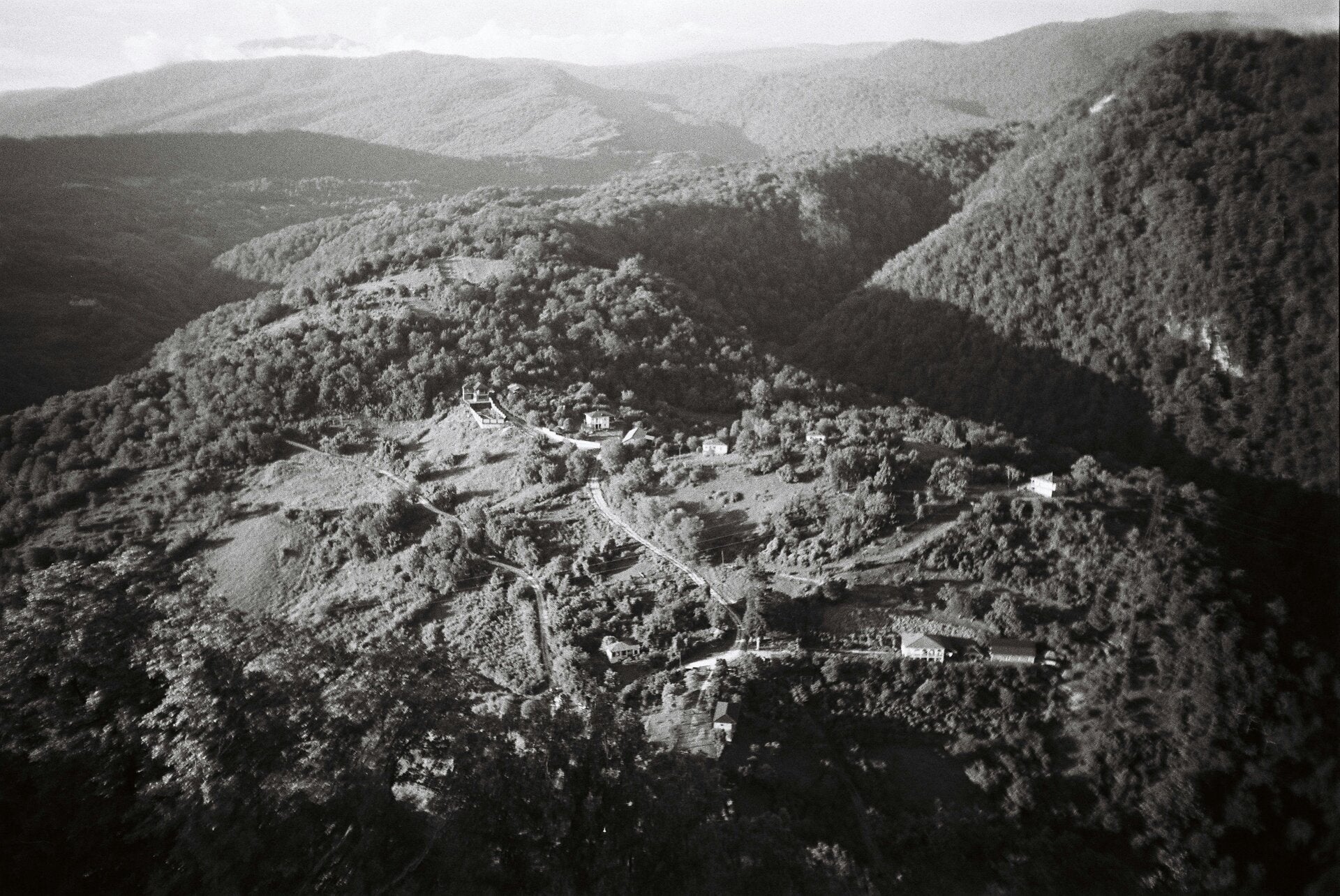
Building new lives in New Zealand
Upon arrival, our early arrivals faced the challenges and opportunities of a new land. This page documents their initial experiences, the communities they helped build, and the diverse contributions they made to the development of New Zealand. Their resilience and hard work laid the groundwork for future generations, including our own.
This section, yet to be attempted, will present whole new challenges of its own.