

Our family's landscapes and the stories they tell
These are the stories of the families of Kenneth Ross Sims and Sharon Elmar French. We have been married for 54 years and live in Palmerston North, Manawatu, New Zealand. It is safe to say that things have changed considerably during our lives.
Although this didn’t start out to be an autobiography, memoir, or family history as such, it is rapidly turning out to be all of those. It has also turned out to be quite a fascinating journey. I hope that some of this is of interest to you, too. It has been written over the period of quite a few years, so it too is also a personal journey of discovery. I am just an ordinary guy, and this is just his ordinary life story. But I suspect that it mirrors or resonates with many others who share these times, this culture, these places and these histories.
And it turns out; to begin with, it was all just about a journey through my life’s landscapes….
I am a landscape person. Don’t get me wrong, I enjoy the closeness, the detail and the intimacy of portraits. And I have spent a fair chunk of pleasurable time exploring them. But I love the rich, layered, detailed perspective of landscapes. They encapsulate so much of what interests me and what I find enjoyable. From the geology, geomorphology and meteorology that form and transform them; to the plants insects and animals that inhabit them in their own ecosystems; to the people that inhabit, live their lives in and modify them, they all have their own unique environments. Landscapes can contextualize portraits. And I have a special affinity for the way water moves through and transforms such environments.
You can enter these environments, sit still, observe, and watch the layers interacting with each other. You can pick out scenes and scenarios that show pieces of such interactions. That is what I try to do, with varying amounts of success, when photographing, or just experiencing them. And those experiences, like my reflections on them, tend to be quite personal.
So, these are my landscapes. Enjoy.
- Our Immediate Families
- The Sims Family
- The Falleni Family
- The French Family
- The Miller Family
- Early Memories - Dannevirke
- School Days
- Early Communication
- Hamilton
- Palmerston North
- Sport and Recreation
- Arts and Science
- Epilogue
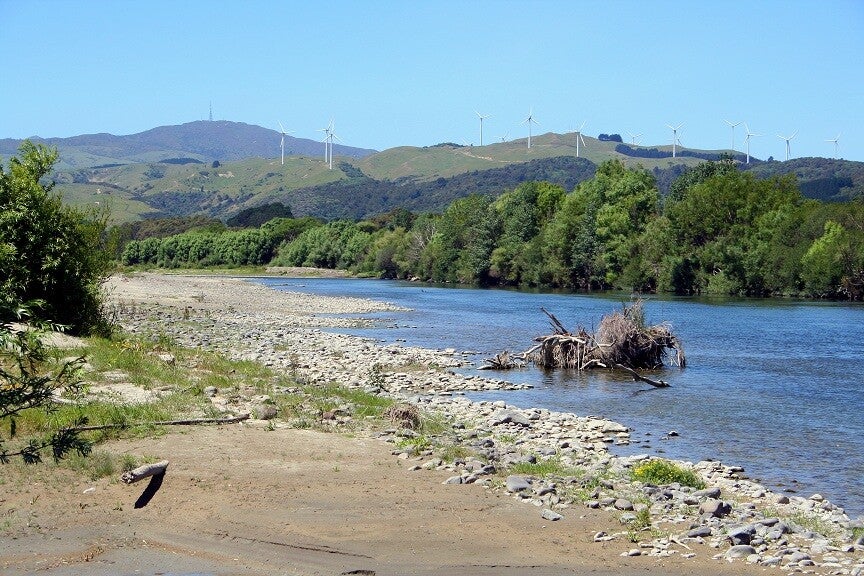
My home landscape. The Manawatu River flows beneath Wharite Peak and the Ruahine Ranges.
Our Immediate Families
The Miller Family
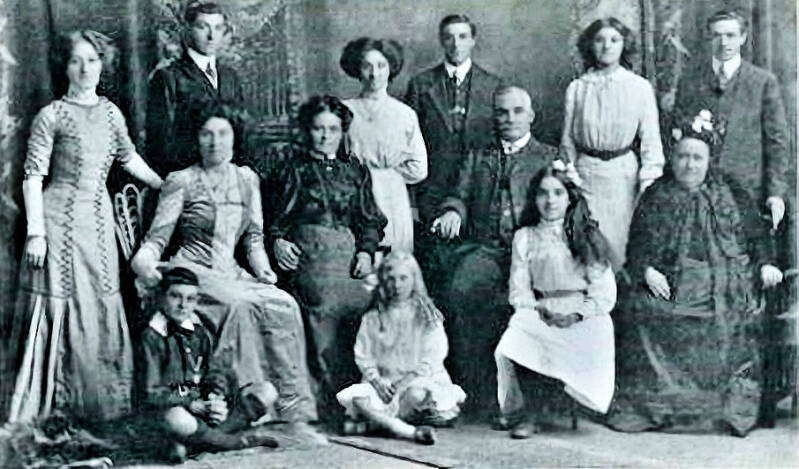
The Falleni Family
The Sims Family
Preview
I started here because it was an area that I didn’t know enough about, and I thought it might spur me into action and learn more about it. At the least, it was somewhere to put down and organize the little I do know.
It was interesting to reflect on my parents, after they had been gone for so long. What did I have of them? Familial love. A shared childhood. A few mementos. Some old photographs and some fading memories. And of their parents—even less. Beyond that, lay unknown history. It was an uncharted land that cried out for me to explore and map out. I thought that it would take someone with more patience and perseverance than myself. But once I started, it became a bit easier, so I have recorded what I can.
My extended family was never a particularly close one, especially on my father’s side. Yet I knew even less about my mother’s family history. Unlike my wife’s family, where such information seemed to be still valued and even recorded in a book published by a family member, while in my family there were just tantalizing clues.
I started with the Four Families that intersect ours:
- The Sims Family
- The Falleni Family
- The French Family, and
- The Miller Family
And it became a very long but fascinating journey. Each family has their own sources, their own history, their own people, their own landscapes.
Well, that was how it started. But since then, this journey has developed a whole life of its own. And it has certainly deepened and enriched my knowledge and appreciation of my own history. It has taken me to places, landscapes and whole countries that were totally unexpected.
It began with my brother Tony starting to trace our family tree online. I joined in with my own. It was supposed to be part of his, but somehow, I ended up with my own tree although we can share each other’s. My first thought was to put online most of the rich family history that Sharon’s uncle Gordon Miller had written, so that others might share it. Which I did. It gave me a huge appreciation of the hours of manual work he had put into such a project.
Compared to that, todays shared databases and electronic information sources make the exercise a breeze. But it is not without its frustration, false trails and knowledge gaps. There are some people and families that just do not have a digital footprint, and whose whole history seems lost in the mists of time. Then again, accessing such information as birth, marriage and death details, emigration, and immigrations records and even variations on names can be expensive, and means spending a lot of time online.
But what an amazing journey this has become! I was vaguely aware that the Sims name was a recent event in the family history. It turns out that just three generations back that surname changes from Sims to Watson. And it wasn’t just my direct ancestor that changed his name, his whole family did. The reason for this still remains a mystery.
But even greater revelations were instore. An email from a (then) stranger described a close relationship between our families, which had become apparent because both my brother Tony and their daughter had their DNA tested. This was a surprise to everyone involved. But getting my own DNA analysed confirmed that Tony and I indeed had a half-brother neither of us were aware of! And the father of the man that this woman Margaret had married was not his father at all, my dad was! It seems that there are plenty of skeletons rattling around in the family cupboard. Plenty of unknown landscapes with stories to tell.
Having DNA tests done also threw up some other questions, and possible answers. In terms of its ethnicity, my mother’s maiden name being Falleni would suggest a fair amount of Italian origin. And the other Sims/Watson strands tracing back to Scotland and England would similarly suggest even stronger Anglo-Saxon origins. Yet both Tony and my ethnicity showed strong west European origins.
A concentrated effort during Covid lockdowns tracing back to the 1000’s revealed that direct ancestors in both my parents’ families came over from Europe with or after William the Conqueror in 1066 and settled in England. It seems a plausible explanation. I will explore this further in Story Set Three.
Just to add a bit of perspective to my online history, starting from my parents’ family and Sharon’s parents’ family, since I started tracing our families’ trees in April 2017, it has blossomed out to over 23,000 direct and indirect relatives, and is still growing! It is a major effort in self-discipline to keep on the main branches and not go scampering up the side-branches just because they look interesting.
Needless to say, within those branches are many landscapes, and many stories. Some have grabbed or demanded my attention, and I have pursued them further. So, I have decided to keep this first account dedicated to our immediate families and will document the wider families and earlier histories and stories in a separate set of stories as family histories.
The Sims Family
My parents are:
- Geoffrey George Sims (1912 – 2000)
- Nita Falleni (1922 – 2003)
They had two sons.
- Anthony Geoffrey (Tony) Sims (born 1945)
- Keneth Ross (Ken) Sims (born 1948)
Dad also had another son, our half-brother.
- Malcolm Godfrey Cody (1941 – 1993)
I was born on October 22nd, 1948, at Wellington Maternity Hospital, in New Zealand. My parents were Geoffrey George Sims and Nita Sims (nee Falleni). They had ‘won’ a new state house in a ballot, and had moved from a rented flat in Kings Cresent, Lower Hutt to Queens Drive, Lyall Bay in 1946.
Almost certainly, only my mother, a Doctor and Nurses would have been present at my birth. In those days, the fathers, if present at all, were relegated to a waiting room during the birth process. My elder brother, Anthony Geoffrey (Tony) Sims had been staying with family friends, Lorna and Jack Higgins, while my mother was in the maternity hospital, which was for about a week, but he remembers her bringing me back to the new home at Lyall Bay.
To the best of my knowledge, there was nothing special about the story of my birth. I don’t think it was an easy process, as my mother was in the Wellington maternity hospital for about a week, although mothers did tend to stay in maternity units much longer back then than today. I know that I was bottle fed from birth. Again, that was a lot more common back then.
In many respects, I was a typical example of the times. The Second World War, with all its chaos and casualties, rationing and restrictions, had only ended three years previously, and there were many returned servicemen trying to readjust to civilian life and put the trauma of war behind them. For most, that involved starting or resuming careers, building homes, and starting (or resuming) families. There was significant re-adjustment for their wives as well. Many had worked during the war years replacing the men who were overseas fighting, (my mother had worked at the Ford Motor Company in Petone, making munitions for the war) and were reluctant to simply resume traditional housewife roles, even though that was still economically feasible back then.
Geoffrey George Sims
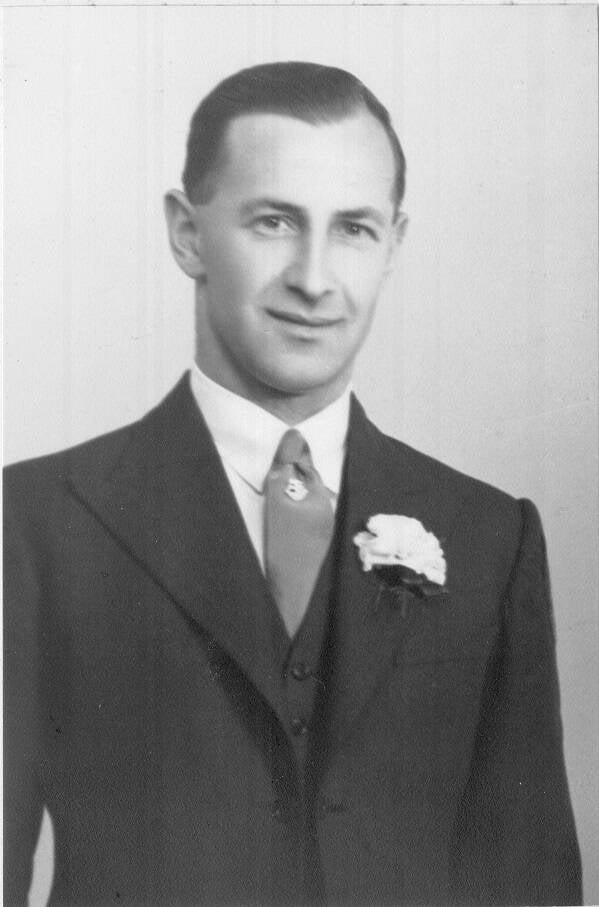
My father was born in Hawera, a period in my grandparents’ life we know nothing about. He would have been 7-8 years old when the family returned to Wellington to live at 250 Cockayne Road, Ngaio.
As an aside, it is funny how names keep popping up in family histories. It wasn’t until I was tracing out my family tree that I discovered that there was a notable Sims ancestor, a Sir John Cockayne born at Ashbourne Hall in Derbyshire, England around 1360 AD. He was my direct ancestor, 20 generations ago. Cockayne Road, Ngaio however was named after Leonard Cockayne, regarded as New Zealand's greatest botanist and a founder of modern science in New Zealand.
Ngaio is an inner suburb of Wellington, situated on the slopes of Mount Kaukau. It takes its name from the native tree, being originally a logging village known as Upper Kaiwarra or Kaiwharawhara. The area that modern day Ngaio occupies was originally called 'Tarikākā' by Māori, which means 'nest of the kaka’. It is linked to Wellington through the Ngaio Gorge and is obviously quite hilly. When the land was first cleared along Cockayne Road it used to be a dairy farm.
My father was one of four boys and three girls and attended Ngaio school. Like my mother, Dad had to go out to work at an early age to help support the family, he left Primary school at thirteen years of age to begin work. He had to relinquish his ambition of becoming a teacher and instead started working for the Wellington Electricity Company as a clerk. He met my mother at a table tennis club where they were both playing members. He was 25 and she was only 15. Initially she thought he was aloof – ‘stuck up’ were the words she used. It seems he won her over.
Geoff and Nita were married on December 18th, 1943. They lived in a flat in Lower Hutt, right next to the Eastern Hutt School in Kings Crescent. At that time, Dad was earning five pounds per week at Electricity House, and the rent for the flat was exactly half that. Tony was born while they were there on June 19th, 1945. The following year they ‘won’ a new state house in a ballot, and moved to Queens Drive, Lyall Bay.
Lyall Bay is a bay and suburb on the south side of the Rongotai isthmus in Wellington, New Zealand. Today it is Wellington’s most popular surf beach, but such activities were unknown back then. It is a wide bay with a sometimes-rocky shoreline, exposed to the southerly gales that sweep in from Cook Strait. Lyall Bay was earlier known as False Bay because ships would mistake the bay for the entrance to Wellington Harbour.
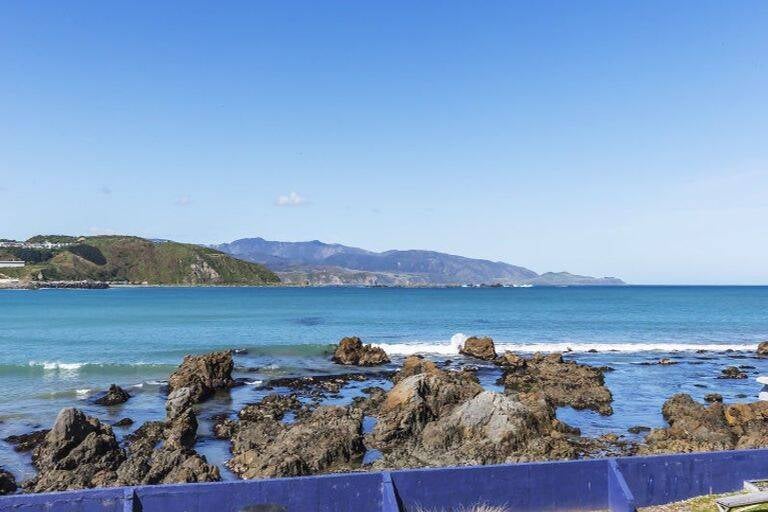
Queens Drive, Lyall Bay, Wellington.
I have no recollections of living in Lyall Bay, but Tony certainly has. He can remember fishing off the rocks along with friends, using bread in milk bottles, and Dad hauling in what seemed to be huge Leather Jackets and Kahawai as he fished off the rocks. As kids they spent a lot of time at the beach, usually forbidden time but state houses did not run to fenced sections at that time. A favourite time was when the Italian fishermen hauled their fishing boats up out of the water and discarded all the less than desirable fish (red cod mostly) into the sea, when the kids would wade out to retrieve them, and fight over the biggest! On one occasion the wire rope cable used to haul the boats up on to the beach broke and whistled over their heads, decapitating a Pohutukawa tree they were standing under.
He can also remember standing up on the terraced gardens Dad had dug from the huge sandhill behind the house, and fertilised with hundreds of wheelbarrow loads of seaweed, taunting my very pregnant mother, who could not get past the first level. Dad had no such difficulties though.
As a new and developing suburb, there were considerable road works being done, and this proved irresistible to kids like Tony. He can recall, somewhat painfully, falling into a barrel of liquid tar, and the mess it made in the bath while Mum and Nanna scrubbed him down with sandsoap and kerosine. The stormwater drains also provided an unscheduled swim, after testing out his strength in lifting the cast iron grate.
The odd scrap with the kids up the road had him in hospital with a cracked skull, somewhere he returned to a few weeks later with a poisoned arm, and then again for six weeks quarantine with scarlet fever. That wasn’t so much fun as it meant no Christmas presents or visits. The poisoned arm necessitated an ambulance ride to the hospital. Having only ever had one ride in a uncles open Austin seven, Tony was impressed with the ride in the ambulance, and its sheer size. He had his arm operated on, and the surgeon or anaesthesiologist asked him to count to ten, which he did and waited with the chloroform cloth over his nose. When the surgeon picked up his scalpel and Tony’s arm, Tony asked him what he was going to do, whereupon he was asked to count to twenty, and he doesn’t recall anything much after that.
He can also remember his first day at school, walking down the wooden corridor of Lyall Bay School with our mother to class, with a male teacher which must have been unusual for junior classes, although back then there seemed many more men teachers than women. From then on, it was the adventure of copying the other more streetwise and experienced characters and going by Tram – as a non-paying customer of course – riding on the steps and jumping off while still in motion. A wonderful treat was fish and chips for lunch and streaming across the road with other school kids to the shop with sixpence for a piece of fish and a scoop of chips. Lyall Bay School had but one tiny triangle of grass, by the flagpole, and nobody was allowed on it. A rather vigorous game of Fire Engines saw Tony lose a tooth, which was never found despite his desperate searching, along with all the other kids, knowing that the Tooth Fairy would not visit and leave the usual three pence.
He can also recall the battle of walking into the wind, and on occasions not being able to move because of its power or being blown across the footpath and road. During several storms Dad would be up on the roof fastening down the concrete tiles before they joined the others in hurtling across the section. Also, he remembers the thick ice that would form on the puddles, that was so much fun to smash and suck on.
Tony was severely asthmatic as a child and had considerable difficulty breathing at times. Opening the window for some air in those southerly gales was not at all appreciated by our mother, probably because the new blinds took such a beating. However, the upshot was that the doctor advised a move away from the pollen from the lupins that surrounded the house, and for some reason, the sea air. That was when Dad took a job as an AA Patrolman in Dannevirke, as far away from the sea as possible, and we shifted there around 1950. Thus began another stage in our family’s life, which will be dealt with below, as will more information on my brother Anthony Geoffrey Sims..
But before then, it is worth noting that all of this was happening against a backdrop of World War Two (1939 – 1945). Dad was never eligible to serve overseas, having had osteomyelitis as a child, which necessitated his wearing callipers for a time. He was however in the Home Guard. So, he married my mother in the midst of the war, with all its chaos and casualties, rationing and restrictions and unsettling uncertainties. And Tony was born just before it ended.
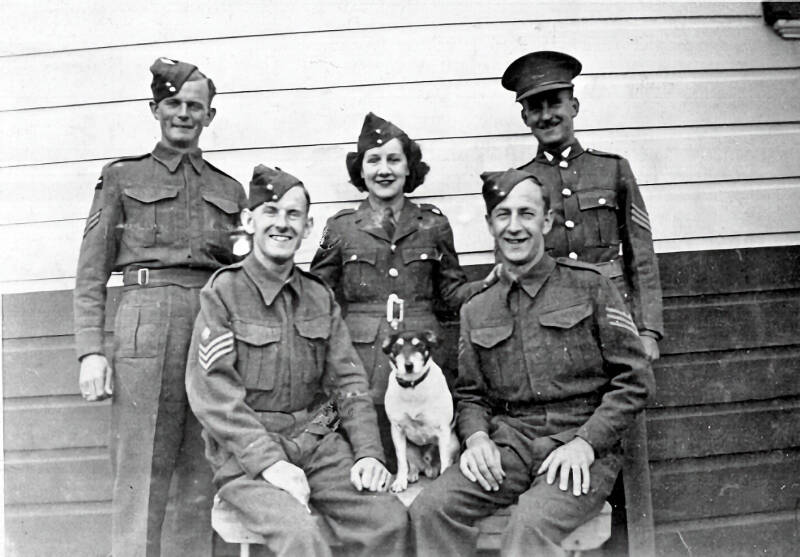
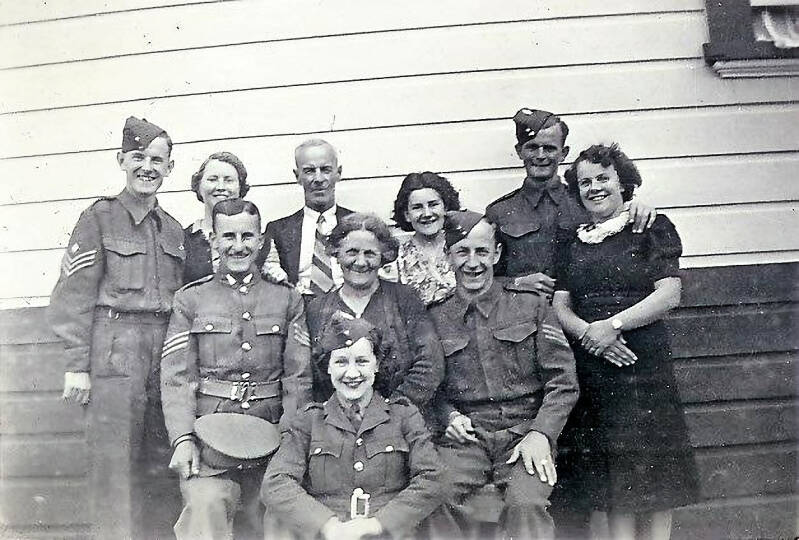
The Sims Family in wartime (WW11) at Ngaio.
My early memories of my father are quite different to those of my mother. Mostly they are impressions rather than specific memories. My father was caring, loving and supportive, but there was always a certain reserve compared to my mother. Perhaps that was because it was a pretty traditional household with traditional roles, which undoubtedly reflected his own upbringing. Perhaps it was the fact that he worked in a military-like uniform, the appearance of which my mother was at pains to protect, and which lent him a certain authority. If there was disciplining to be done (and as young boys there was plenty of cause), and my mother’s use of a wooden spoon or belt didn’t suffice, then it was my father who administered it. The words “just you wait until your father gets home” were the ultimate threat.
So perhaps it is not surprising that my first clear memory of my father just being my father is in that role. The northern exterior wall of our house in High Street faced a narrow strip of lawn and path between our place and the Hargraves house next door. Halfway down it was a large wooden coal box. And I can still remember my brother Tony hiding in there to avoid my father, who had been called upon to administer some corrective actions to his behaviour.
But it wasn’t all about the negative. My father was the one who took us places and connected us with the outside world. He was very familiar with country around Dannevirke as part of his job, and perhaps my next clear memory of him was during the 1953 floods, when he drove us out to Oringi, and we stopped above the river dip to survey what seemed to me to be an endless sea of floodwater stretching before us.
I grew up in a fairly orthodox, middle-class family in a small town, in the 1950’s. My father was a caring, loving man, and his place within the family was as expected. He was the head of the household, the ‘breadwinner’, and the final arbiter of decisions made about the family. He worked hard to support his family, and he was strong and decisive. As kids, we simply accepted this. After all, it was no different in any other household we knew.
So, my first realization that there were more dimensions to this paradigm was when he fell ill. Dad had osteomyelitis when he was a child, which necessitated him wearing bracers or calipers on his legs for some time. It was the reason that he was excluded from serving overseas in the Second World War. And when I was still young, probably about 6 or 7 years old, the bone in his leg became infected with tuberculosis. Given what I have subsequently learnt about this disease, you would have to wonder whether it was a new infection, or a recurrence of the original one.
But regardless of its origins, Dad was packed off to the Tb Sanitorium at Waipukurau, where he stayed for almost a year. Again, with the advantage of hindsight, I can appreciate just how much the early antituberculosis antibiotic treatments would have knocked him around while he was there, but as kids, we had no concept of that. All we knew was that my father was very ill and a long way from home.
It was my first hint that there was a vulnerability in my father’s status and authority, and perhaps an unspoken threat that it, and the familiar order we had grown up with, may not be permanent. Of course, my mother stepped up to fill that role, she had no choice but to; not that my brother and I made that easy or realized just how much of a strain it put her under.
So, my main memories of that time were the long car trips to Waipukurau to see Dad, with Mum driving the old citron car we had at the time, with front-wheel drive and a gear leaver that stuck out of the dashboard, while Tony and I sat in the back seat, usually fighting (as we usually did), because we knew Mum couldn’t do much about it. I remember Dad, initially looking pale and gaunt, on the occasions we were allowed to see him, and playing in the sunshine in the sanitarium grounds when we couldn’t.
But it certainly changed the family dynamic, and even after Dad recovered and returned home, Mum was much more assertive and played a bigger role in supporting the family through her own career.
As a child, my father was very good at encouraging us to develop and follow our own interests, both physical and academic. Within the accepted boundaries of the family behaviour, of which he was the final arbiter, we had a lot of freedom to pursue our own interests. Although I have to admit that I was a lot keener on the academic rather than the physical. Not that I was in any way gifted academically, something I realised from an early age. But with both sets of activities, the concept of ‘being first’, ‘winning’ and ‘being better than the others’ was something that I always struggled with.
So, I somewhat reluctantly participated in the physical activities he organised for my brother and I, such as swimming, athletics, and cross-country running. As kids, I’m sure that they were good for us, and perhaps because he had osteomyelitis as a child and was denied many such activities, there was a bit of compensation involved, but my participation was a lot more dutiful than enthusiastic. My brother Tony was the complete opposite, he enthusiastically participated in such activities, which didn’t make my reluctance any easier.
That aside, my father was very good at allowing us the freedom to develop and pursue our own interests, both recreationally and career-wise. With one proviso; that we did it on our own, off our own bat. We could count on him for encouragement and support, but it was up to us to make it happen. I know that my brother struggled with that, especially when he found that his chosen career of going farming was out of his reach and he had to take his second choice (just like both of my parents had to), but to me it was liberating. I had already decided that I didn’t want to go to university without a clear goal of what I would do afterwards, even though there was a certain academic expectation and back then it was even affordable. That led me to a profession that challenged and stimulated me academically, that satisfied my desire to help others rather than just myself, and most importantly, paid me from day one. There is more than a little irony in the fact that it involved five years of intensive study and more examinations than I had ever encountered before in my life, before I qualified, but it was something I thrived in. And I had my father’s encouragement every step of the way.
My father was a remarkably tolerant man. That didn’t mean that he wasn’t critical, he was. But he was remarkably accommodating of others, and other points of view. He almost never argued with my mother, who held much firmer and more rigid views of the world, and what was right and wrong. His advice was lived, modelled, and explained, rather than dictated, and there are a whole lot of things wrapped up in that.
He showed me that you could care about people without necessarily agreeing with them or even liking them. There is a concept of service in there which may have originated in his parents and grandparents’ religious beliefs, but which he could demonstrate without the doctrine, such as in his own career. I think that the concept of community service was a whole lot stronger back then, especially in small communities, but it certainly had a bearing on my thinking and my ultimate career choice.
He showed me not to sweat the small stuff (and I was an expert in sweating the small stuff). He was not particularly materialistic or driven by wealth, something else I have also inherited. Both my parents were very careful with money, having lived through a depression and a World War, but were content with being ‘comfortable’ rather than just acquiring ‘things’. Sunday drives and picnics in the countryside were a regular thing when I was young, rather than organised events, as I suspect was the case when they were younger.
He also taught me to ‘be the best that you can be’ in whatever your endeavors were, and to take pride in that, rather than trying to be better than everyone else. Which was a valuable lesson as I was never going to particularly excel competitively, either academically, socially or sporting wise. These days, ‘mindfully enjoying doing what you like doing as best you are able’ tends to be more passive than active, but it has aways been my motto; whether climbing mountains or fishing rivers and lakes, walking along beaches and through forests, photographing landscapes (as in the past), or biking along the river trail, researching the family history, or just watching the clouds drift past as the seasons change (more likely these days).
Sunday picnics were a feature of my childhood, even (or especially) when we had friends and family visiting. We would often go to the Manawatu River at Kaitoki, just east of town. These excursions seem to have been a feature of Dad’s family, with many of what old family photographs we still have, showing family picnics ‘in the bush’.
Sunday drives were also a frequent activity, but not quite so popular with us boys. It wasn’t too bad when they were to visit farming friends at Tataramoa or Makotuku, but otherwise being cooped up in the back of the car for no good reason was not our idea of having a good time.
Which is interesting, because later in life, exploring the landscapes of the surrounding countryside became quite an interest of mine. I wonder if that was a continuation of this family tradition, or sparked subconsciously from when I was a boy? It seems to have been a feature of Granddad’s as well, with his trips up to see the Manawatu Gorge when it opened, or the results of the Napier earthquake.
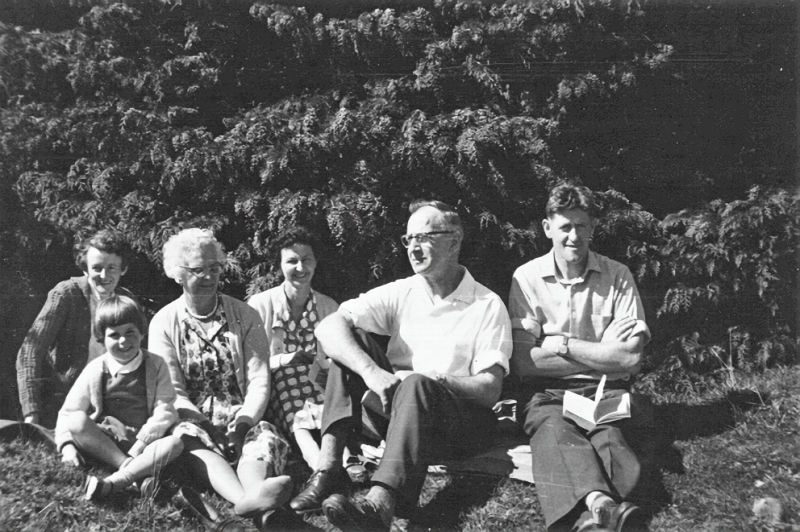
Picnic beside the Manawatu River, with Lorna and Jack Higgins and ‘Nana’ (Hilda Falleni).
My Dad’s other family:
Before we leave this section, there is the small matter of Geoffrey George’s ‘other family’. It would seem that he had a relationship with a Marjory Cody (nee Rousell) while both were members of the Ngaio Tennis Club. Dad was still single at the time, but Marjory was not. As a result of this relationship, Malcolm Godfrey Cody was born in 1941. The Cody family had no idea that Ivan Charles Cody (Marjory’s husband) was not the father until Malcolm’s daughter took a DNA test while investigating her own family tree, which showed a very strong relationship to Tony’s DNA. Having my DNA tested put this beyond any doubt.
Margaret, Malcolms wife, is a lovely lady, who was already heavily involved in her family’s history. She was very patient with leading us to the conclusion she had already come to, assisted me in getting my DNA tested by the same database as hers and her daughters, and very welcoming when we all arrived at the same irrefutable conclusion. We had a half-brother that we knew nothing about! We were all set to meet their family personally when the Covid pandemic lockdowns made that impractical, and but we have since had the opportunity to meet Margaret and her new partner, and her daughter Lynaire and her husband when they have come down to Palmerston North.
However, the pictures she sent us of her husband Malcolm left very little doubt. The resemblance to Tony and to Dad when he was younger was striking. Malcolm had two brothers – Graeme and Russell Cody. Malcolm and Margaret have three children: Lynaire, Vaughan and Hayden.
All of which begs the question – did Dad know? And did Mom know? Was it a family secret they were determined to bury and take to the grave, or something they were unaware of? In hindsight, and from what I have learnt since, I rather suspect that they both knew, but we will never know for sure as everyone who could confirm it is now dead. It is a bit like walking up a river whilst fishing and stumbling across a fascinating side stream, hidden by a fold in the hills, but not being able to access it to explore it further.
Malcolm, the half-brother we never knew, was born in Wellington and grew up at Pinehaven, a suburb of Upper Hutt. He died in 1993 at Waharoa of bowel cancer when he was 52 years old. He and Margaret owned and ran the dairy opposite the Waharoa Dairy Factory (both of which have since been demolished), and later he was a roofing contractor. The funny thing is that I remember that shop and can envisage it clearly, as I drove past it on numerous occasions going fishing while living in Hamilton, and later when we were visiting Sharon’s family in Paeroa.
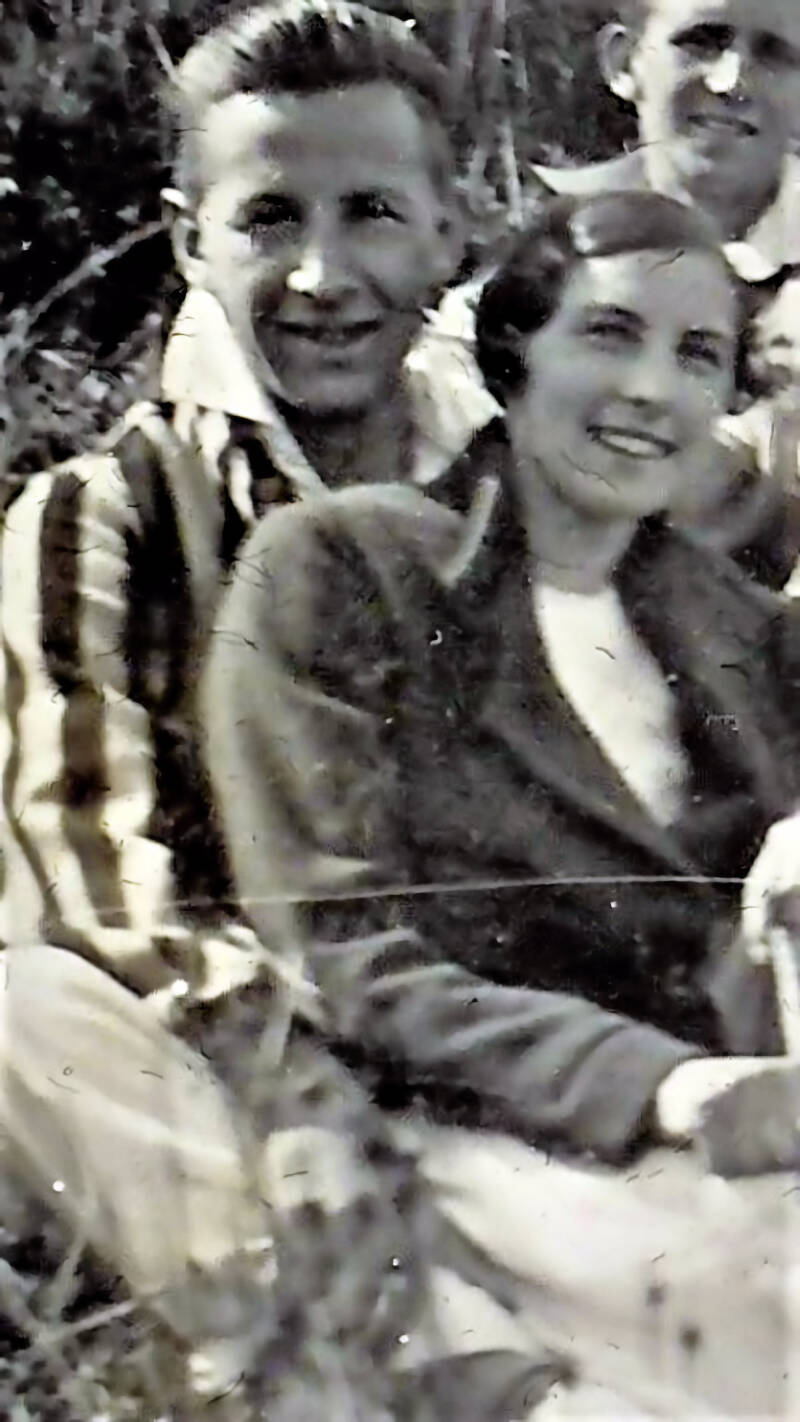
Dad and Marjory Cody - 1936
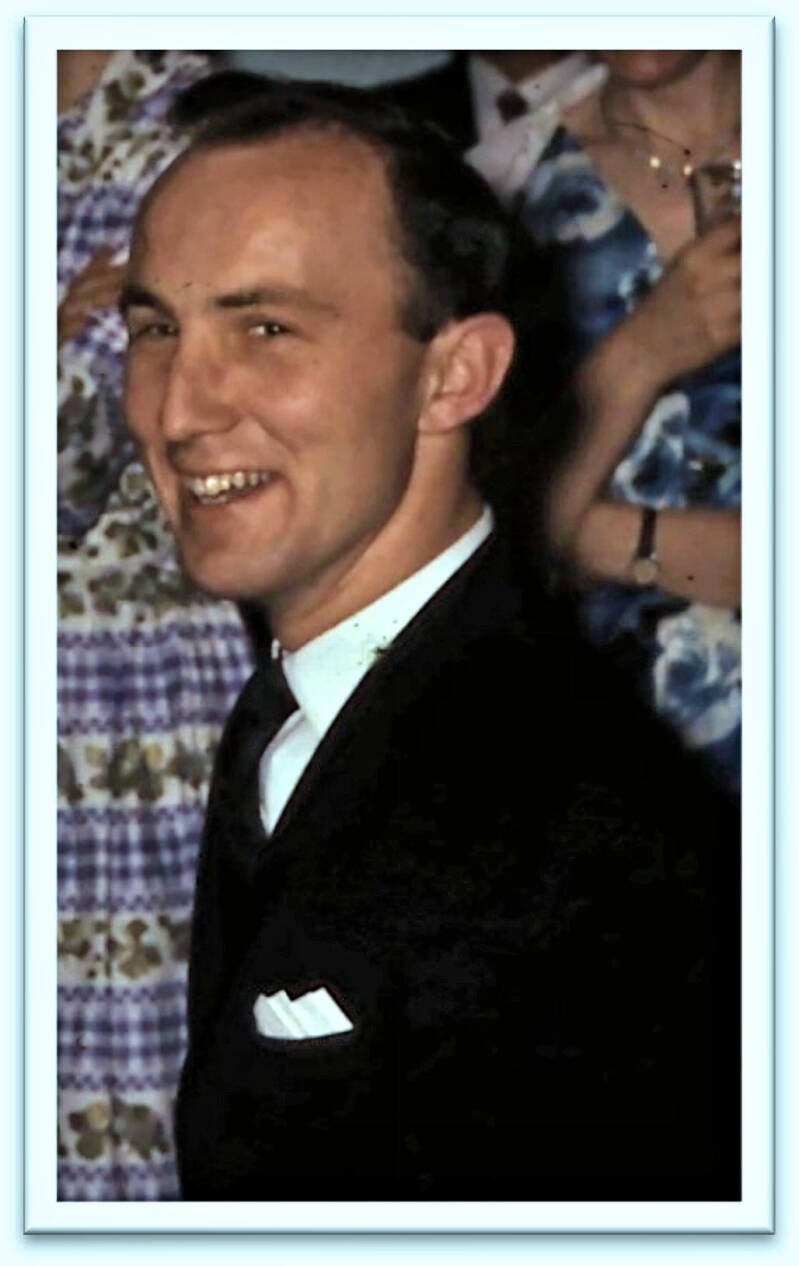
Malcolm Godfrey Cody 1941-1993
My Dad’s immediate family.
My memories of dad’s brothers and sisters, and their families, are even more elusive.
Trevor, the eldest and his wife Barbara, lived in Wellington and he always seemed a slightly intimidating figure, with close cropped hair and a military gait. During the Second World War he was a dispatch rider and as the result of shellfire, lost the tips of his left-hand fingers, which were wrapped around the throttle of the Old Indian motorbike he rode. Barbara always seemed a kind and gentle woman. I remember that they had a son Alex and a daughter Glenda, but not much else. In fact, there were 4 children, Nola, Glenda, Trevor and Ian.
Peggy and husband Ben used to run hotels. One of the few memories I have of them is when our family drove up to Auckland and stayed with them at their hotel on Khyber Pass Road in Newmarket, Auckland. Back then hotels were dimly lit places of dark stained wood and smelt of stale beer. There wasn’t much that a small boy from down country found attractive about Auckland, even then! Peggy had been a WREN stationed in London during WW2, which I gather was a pretty exciting time. Following an air-raid she awoke to find the whole window frame, less the shattered glass, draped around her neck, and never suffered a scratch. Ben Heaton was her second husband, having previously been married to Alan Richardson.
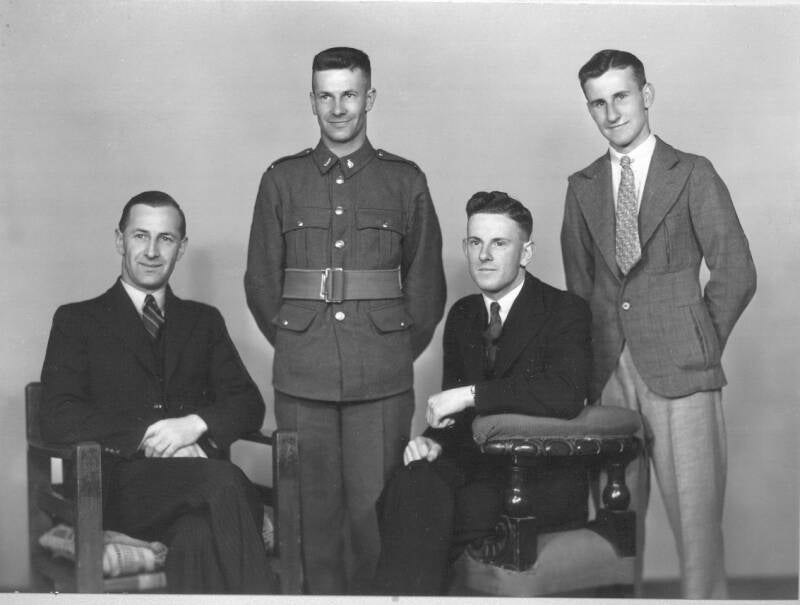
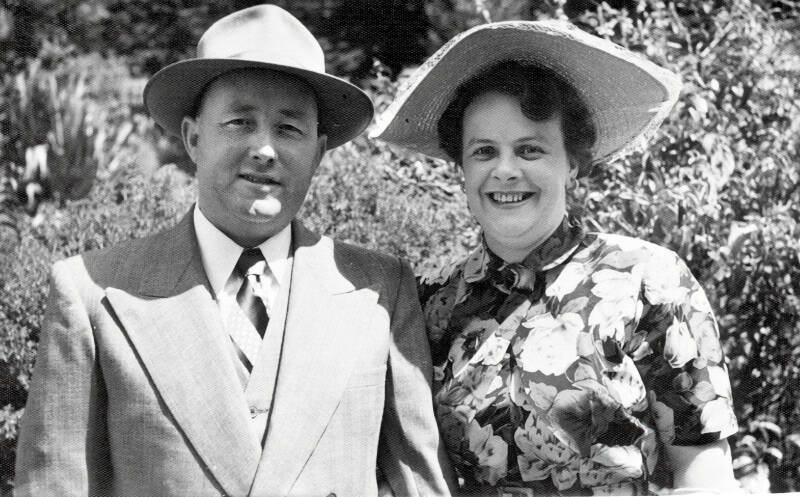
‘The Boys’ Geoff, Trevor, Norman and Bill
Peggy and Ben Heaton
Norm and Mildred were the closest of the Sims Family to ours. They often visited us in Dannevirke, and we often visited them in Wellington. They had a house up on the hill at Strathmore Park, overlooking Rongotai. I remember the winding, narrow streets with nowhere to park, which seemed ridiculous after the wide flat streets of Dannevirke. I also remember going down there to watch the opening of Wellington Airport. It made a great place to watch all the planes coming and going, including the Vulcan bomber that flew so low it scraped its bottom on the tarmac. Their eldest son Chris was just slightly older than Tony while Carolyn was a bit younger than me.
It was Norm who was the original Sims historian, and who was able to shed a little light on the Sims/Watson name change. Tony can remember him recalling seeing his grandfather Thomas Watson sitting cross-legged on a table, sewing a suit. Norms endeavours at the family tree were inherited by his daughter Carolyn.
Chris moved to Australia and had a family there with his wife Christine. I remember that Sharon and I looked him up just out of Melbourne, when we were travelling the Great Ocean Road, west of Melbourne.
Carolyn and her family live at Waikanae, on the Kapiti Coast. We have been able to re-establish contact and keep in touch with them.
Of all of Dads family, Bill and Coralie are perhaps the most enigmatic and hazy. I really don’t have many memories of them at all. Which is strange, given that Bill died (and obviously lived) in Hastings, which isn’t that far from Dannevirke. Like the Watson/Sims name change, I just get the feeling that there are a lot of family questions still to be answered in Hastings. All I know about Bill is that he lost the sight in one eye as a result of a darts game when he was young but being keen to enlist for the Second World War, he had his brothers each memorise a line of the eye chart and was thus able to be classed as A1 – fit for action. This was fine until he was knocked over by shellfire in Italy and subsequently given another eye test, which of course he failed. Rather than send him home with no sight in one eye and receive a pension as he was no longer A1, he was kept over there, and he spent to last year or two of the war joyriding about in the American Bombers.
Nancy and John: Again, I have very few recollections of Nancy and John. I get a vague impression that Nancy was a favourite sister of Dads, but we really only saw them at family gatherings. Which is a pity really because John’s family tree looks really interesting. But back then, that particular landscape was of no interest to me as a child.
Molly and Fenton (Fen) are another relationship coloured by the actions and attitudes of my parents. Because they weren’t particularly close, I didn’t give them much thought. Fen, I remember as a tall, very polite and correct man. Molly was just lovely. They showed a keen interest in Sharon’s bowling career, and she probably met them more often at Horowhenua bowling events than I did. Interestingly, their son Larry uses the same online database as me to map the family tree.
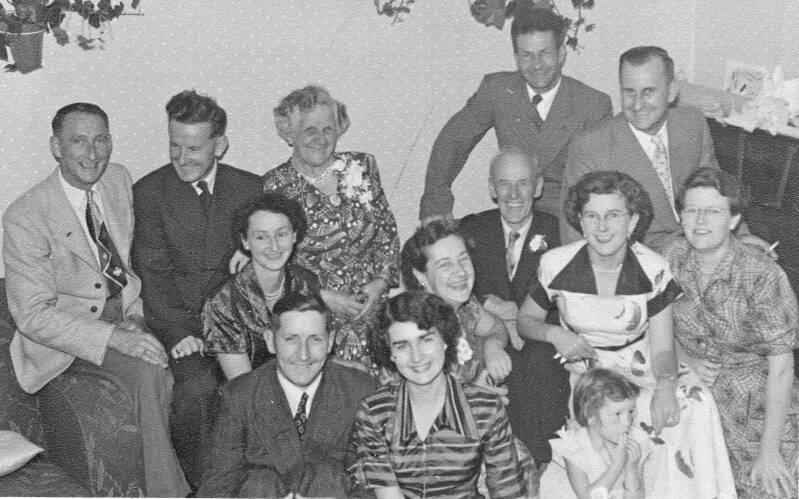
Thomas and Ethyl’s family at their Golden Wedding
So, there are some conversations I wish that I could have with him, that I’ll never get the chance to. You see, as he got older Dad tended to slip into the background of our lives. This was not deliberate or intentional, but as his life slowed down ours speeded up, full of things that seemed important at the time (but really weren’t). Then there was the tyranny of distance, again not great and more perceived than real, which tended to limit visits. And finally, when he had to go into supported care, that seemed to add another hurdle, and barrier between us.
I would love to be able to have a non-judgmental conversation with him about how much (if anything) he knew about his son Malcolm. And if he knew or suspected, why did he keep it a secret from us. And whether my mother shared that knowledge. Conversations we will never have and questions I will never know the answers to. I would love to be able to let him know what I now know about Malcolm and his life. I’m sure that he would be chuffed by it.
Again, from having explored our family history, it would be great to talk to him about what I now know, and don’t know. It simply wasn’t important, or of any interest to me at the time; but times and interests change. Dad seemed to have a very close relationship with some of his family, and quite a distant relationship with others. I would now love to know why. And just as I can look back on the immense changes in my lifetime, I would love to be able to talk to him about the changes in his, and what he thought of them. I would love to show him what I have learnt about our family history. Would he be interested? My interest in it, as well as Tony’s, had to come from somewhere.
Ever since I was a boy, I have always had a fascination with the landscapes around me, the forces that shaped them and the creatures that inhabit them. Did I get that from Dad? I rather suspect that both he and his father shared that interest. Certainly, my interest in landscape photography came from them both. But again, these are conversations we will never have.
Dad saw more than his fair share of sickness during his life. When he was a boy, he had osteomyelitis that required him to wear calipers on his legs. When he was an adult he got tuberculosis, again in his leg, which saw him shipped off to the sanitorium at Waipukurau for over a year while the pretty harsh drugs that were available at the time finally cured him. The family afflictions of cardiac arrythmia requiring a pacemaker and having cataracts removed from his eyes both affected him. Then later in life he had Paget’s disease which badly affected his mobility and caused him considerable pain. This also caused him to withdraw into himself even further as physical activity and even driving became denied to him. It is only now that I enter a comparable age, and find my own mobility and activity begin to be compromised, that I can start to understand his utter frustration and loss of interest. I wish I could talk to him about it, from where I stand now rather than where I was back then.
So, I guess that if there is a message here, it is to not wait to have these conversations with other family members. Because it may become too late, and the knowledge and answers you might seek can become lost in the mists of time.
Geoffrey Sims Parents:
My dad, Geoffrey George Sims, was born at Hawera on October 30th, 1912. He was the second eldest of seven children born to Thomas Herbert Sims and Ethel Jackson Sims (nee Scott). His brothers and sisters were:
- Trevor Herbert Sims (1911 - 2007)
- Norman Harold Sims (1916 - 2008)
- Helena (Peggy) Sims (1919 - 2000)
- Laurence Noel (Bill) Sims (1921 – 1990)
- Nancy Winifred Sims (1923 - 1985)
- Molly Ethel Sims (1927 - 2011)
Trevor, Geoff and Norman were born in Hawera, and the rest were born in Wellington.
Thomas Herbert Sims (my Granddad)
Thomas was born in Wellington on 6th November 1884 and died in Wellington on 10th February 1978. His wife Ethel was born in Dunedin on 10th March 1886 to George Scott and Thirza Harriett Havill. She died in Wellington on the 14th of December 1961. So, granddad was a widower for 16 years before his death.
Granddad was born into and raised in a strongly orthodox Methodist family, and always seemed severe later in life, as if perplexed as to why us kids always asked questions. He obviously raised his family with the same traditional values, but while the values might have been retained, the dour Scottish severity seems to have been shed by my father’s generation.
After leaving school, his parents arranged for him to be apprenticed to a watchmaker, but he disliked the job and took himself off and arranged his own apprenticeship with the building firm of Paterson and Martin of Wellington. It perhaps says something about his family life that he didn’t discuss this with his parents and the first they knew was when he arrived home with tools that were obviously far too big for watchmaking!
After they were married in 1910, Thomas and Ethel moved to Hawera, where their first three children were born. I have not been able to find out what Granddad was doing in Hawera, although I assume it involved building. He is certainly listed in the 1916 Hawera Street Directory as a carpenter.
Returning to Wellington sometime around 1919, they had a house in Ngaio (250 Cockayne Road). He had a wonderful workshop under the house that smelt of wood shavings, sawdust, and polishing oil – rather like he did. I have a vague memory of garden paths leading down steep, tree-clad slopes amid bush and shrubs. Which I guess is the sort of thing that makes an impression on a preteen boy such as I was.
Granddad was a skilled carpenter and joiner. He used to make ‘coffee tables’ expertly and intricately inlaid with native timbers. Later, when that became too much, he made wooden stools with his own tapestries covering them.
He was also a keen gardener, always pottering about in the huge section they had, and a keen photographer, and my father recollected sitting with a fixed smile for minutes while the huge cameras of the day operated. Among his collection of photos are some he took as a builder from the top of the Wellington Town Hall, which he helped build. At that time, it had a tower on top.
He was an interesting character though, he once told Tony that he walked up from Wellington to see the newly opened Manawatu Gorge, and that he rode an Indian Motorcycle up to Napier to see the aftermath of the 1933 earthquake.
The place at Ngaio obviously became too much, because they moved to a smaller place, tucked in under the hill in Miramar. Granddad always was on the frail side.
Despite generally good health (he lived to 94) Granddads biggest problem was a combination of stubborn independence and failing eyesight. This used to cause my mother (and his other relatives) considerable angst. One of the few enduring memories I have of the inside of his place in Miramar was of his living room carpet covered with brown circles, where he had dropped one of his cigarettes and then couldn’t find it again. Mum was convinced he was going to burn down the place around his ears.
I think that the final straw was when we visited him (well into his eighties) and found him up on the roof trying to fix a leak. Not being able to see much meant that he had to crawl around and work from touch, but that didn’t seem to bother him. Granddad moved into a retirement home not long after that, where he spent the rest of his days.
As a small boy, my memories of visiting Granddad were shaped by different things. I remember the fox terriers he used to keep, and later the yellow canaries singing incessantly in the cage hanging in the sunshine by the front door. Directly behind the back of the house at Miramar was a steep hillside, its crumbling rock face covered with scrub. My favourite activity was hunting the abundant, handsomely marked common skinks that basked in the sun on the rock faces. I used to catch them, pop them in a jar, take them home and ‘liberate’ them in mum’s rockery. To my knowledge, none ever survived the subsequent attentions of the neighbourhood cats.
I have very few memories of Ethel. A large, warm, affectionate woman, who always seemed cheerful, she died in 1961, when I was thirteen. But her family will feature largely in a further section of this site.
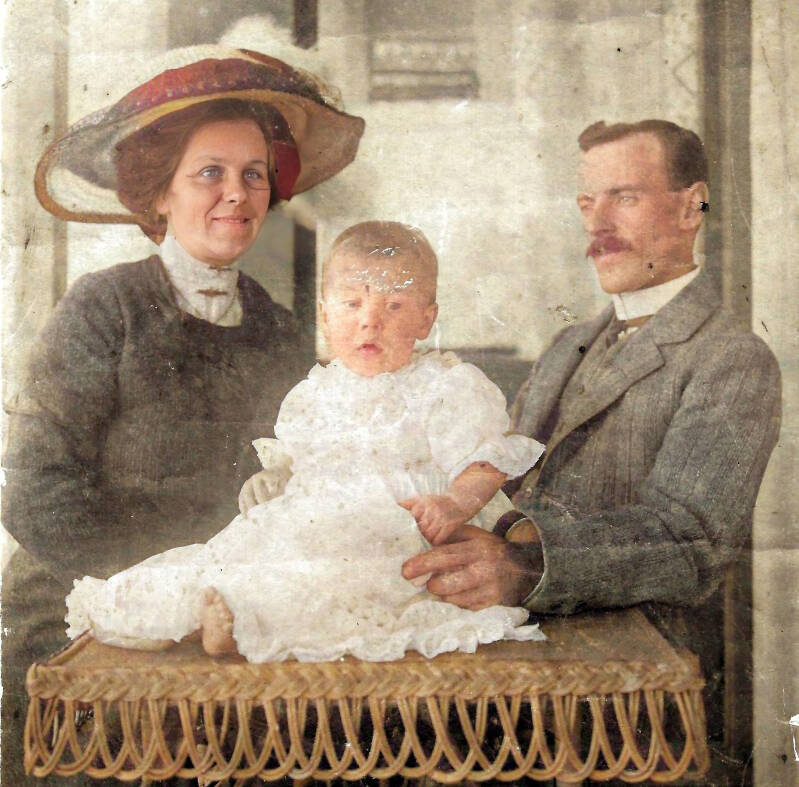
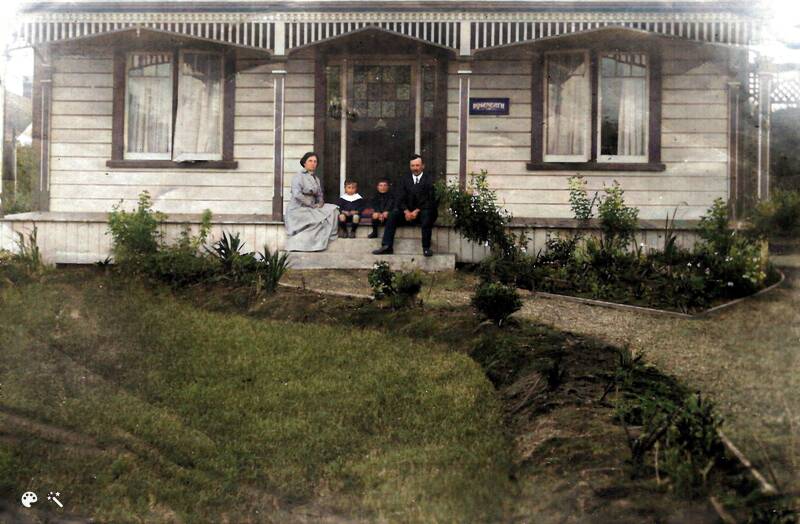
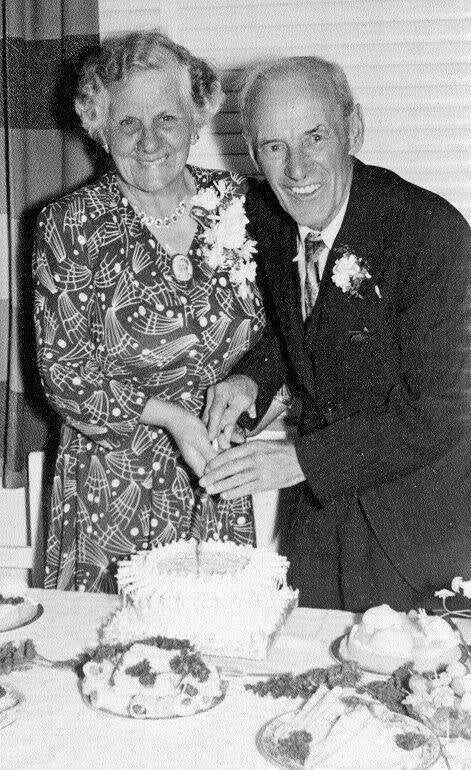
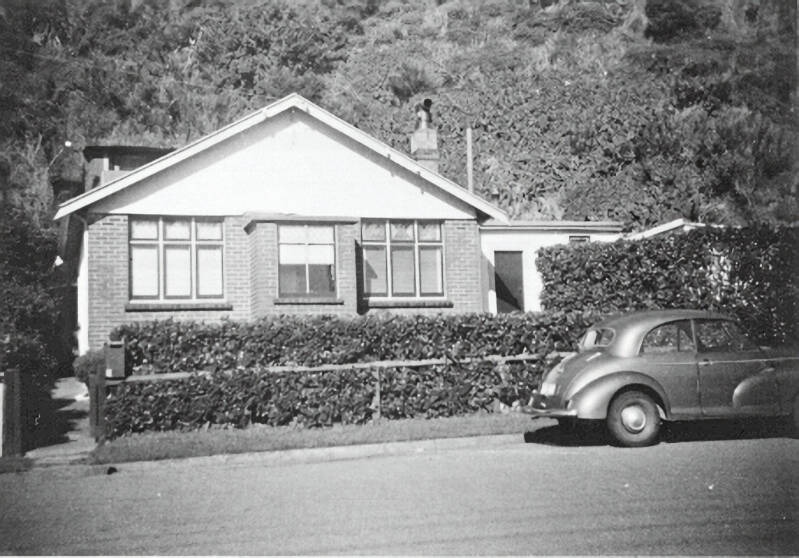
- Thomas, Ethyl and Norman at Hawera
- The house at Hawera
- Thomas and Ethyl's Golden Wedding
- The house at Miramar
The Falleni Family
My Mother’s Family.
- Father: William (Sonny) Falleni (1887 – 1941)
- Mother: Hilda Lydia Morley (1898 – 1972)
- Sister: Hilda Strange (born Falleni) (1924 – 2009)
My mother was born Nita Falleni, on the 9th of December 1922, in Wellington. Her sister, Hilda was also born in Wellington, on 17th November 1924. They grew up as part of a traditional Island Bay Italian family. Their mother, Hilda Lydia Morley, had married William (Sonny) Falleni on December 27th, 1921. I never knew Mum’s father, he died before I was born, and her mother I knew only as ‘Nana’.
Of the many different memories of my mother, I’ll pick some things that I admired most about her. And there are a couple of those which are interrelated.
Firstly, there was her unconditional love for her family, her unwavering loyalty, friendship, and inclusiveness for close acquaintances, and her ability to relate to and be part of her wider community. There were strict boundaries to this, particularly the latter, and I’m unsure how much of this was the product of her upbringing and the times she lived in. As with many families, my mother was the glue that bound us all together. Her love and affection for her immediate family were unshakable, despite what I suspect were some substantial challenges. Her joy in having a grandchild was immense. It was my mother who maintained contact and connections with members of both sides of the family, usually by letter writing (because that’s what you did back then).
She developed, fostered, and maintained a group of family friends and acquaintances who she cherished. Early on it was close family members, such as their parents, her sister Hilda and husband Tom’s family, and Dad’s siblings’ families. As well there were Wellington friends such as the Moats, and Jack and Lorna Higgins. Later it was Dannevirke friends and neighbours such as Curtis’s, Mackenzie’s, and Cushing’s. Finally, there was the ‘Clatter Club’, a group of women who were firm friends, a mutual support group, and which provided a ready excuse to socialize.
Then there was her ambition and determination to make the most of whatever opportunities presented themselves, or which she could make, for personal growth and to be part of and serve the community she lived in, despite her lack of any formal training. When she was young, my mother wanted to become a dietitian but, like my father, she had to relinquish that dream and go to work at a young age to help support the family. At that time, after only a few years at school, her mother was widowed and surviving on just a war widower’s pension, her sister was about to start school, and they could only afford the one school uniform. She became a qualified dressmaker, working at a shop in Coutney Place, Wellington. When I look back on family photos, I am struck by how impeccably dressed we were as kids, the product of her spending long hours hand sewing, or with the Singer Sewing Machine, making, altering, and mending our clothes. Later, when both my parents were on a pension, it was still being supplemented by my mother’s sewing and knitting, with the sewing machine largely superseded by a knitting machine, and my mother an active member of the Country Women’s Institute, and the Dannevirke Spinning and Weaving Club.
While my brother and I were at school, my mother started teaching. She had been President of the Dannevirke Mothers Club and Free Kindergarten Association, and although a qualified dressmaker, she had no teaching experience. That changed in or about 1958 when a new ‘Home Science’ block was built at Dannevirke North School and as there were no trained home science teachers available, my mother applied for and was awarded the position. So, she started teaching home craft (cooking and sewing) at Dannevirke North School. She worked there for several years before moving to a similar position at Dannevirke High School. Back in those days, 3rd and 4th Form girls were taught home crafts, and the boys were taught woodwork. By the time she finished many years later, she was teaching subjects as diverse as History, Geography and English to ‘lower stream’ classes. She took to it like a duck to water and thoroughly enjoyed it, and there weren’t too many families in Dannevirke that she didn’t know by association with their kids.
After retiring from teaching, my mother was also an active member of Probus, and the National Organisation for Women (NOW). She had very definite views on social equality and opportunity, as well as service to the community, albeit seen through the Anglo-Saxon lens that her heritage gave her.
My mother was very family oriented, but she was always very conscious of what others thought and said. Fitting into the norm was very important to her. We were raised in an era when it was perfectly feasible to buy a house and raise a family on a single average wage. This made it possible to be a fulltime ‘housewife and mother’ rather than having to work from necessity.
Having said that, we were never ‘well off’ as a family, although we always had sufficient in terms of housing, food, and clothing. My mother was always very thrifty, and I guess I never really appreciated just how much of her time was consumed by activities designed to extend the family income, such as making and mending our clothes, buying food in bulk, and bottling (and later freezing) seasonal fruit and vegetables. It should be remembered that back then there were no supermarkets importing and offering out-of-season food from around the globe, or cheap clothes and footwear imported from elsewhere.
I don’t remember it ever being talked about, but I think that my parents went through considerable financial hardship with their families, particularly my mothers. And after a depression and a couple of world wars, one of which they had lived through, that was probably quite common and accepted. I can’t help but think that there are a lot of life skills they had, which are lost in today’s younger generations, and which perhaps shouldn’t be.
We accepted what we had, and I never really thought about the time she spent sewing, altering, and knitting clothes for others, or the procession of boarders that we had, in terms of supplementing the family income. As kids we accepted that things like washing clothes in a gas heated copper and keeping food in a ‘safe’ was just how things were done. We also just accepted that if you wanted more, you had to work for it, so both my brother and I had daily ‘paper runs’ delivering newspapers by bike, the pay for which went into our savings account to buy new and better bikes!
My mother had a budgeting system for handling money that she ran for as long as I can remember – a series of brown top-opening envelopes in an old leather camera case. Each envelope was named and each week on payday money was placed in the envelopes, usually coins but sometimes notes. At the due times, bills would be paid from the envelopes, or money taken from them to pay for ongoing needs. Somehow our parents managed to save money, as there was always a ‘Rainy Day’ somewhere ahead that needed hard-earned cash put aside for. That saving ethic was never lost and even in later years when they were just on the pension they still managed to save, supplemented by my mother’s sewing and knitting, Dad’s driving new cars for a local car sales firm, and living mostly from their considerable vegetable garden – the size of which diminished as Dad got older and was less able to tend such a large garden. Frugality and correctness were the order of the day.
Given the constraints of those times, and the sense of correctness my mother had, the other surprising thing about our childhood, was the amount of freedom we had. Dannevirke was a close-knit neighbourly small-town community back then. We thought it suffocating at the time, but it was anything but. If you had told me back then that growing up in a small provincial town at that time, in a not too affluent family, was a privileged upbringing I would have laughed in your face. And yet, looking back on it and comparing it with today, it certainly was. There was a simplicity and an innocence that has disappeared from today’s society. There was no television, no computers and no mobile phones, no instant and ever-present access to music, film, or knowledge. And yet, we thrived on what we had. Most importantly, either by nature or nurture (or both), there was an empathy for others and the outside world instilled within us that seems smothered by today’s consumer driven and ‘you do you’ society.
Unless the weather was inclement, in which case we would be in our room reading (or fighting), we would be outside and away, enjoying the nearby countryside. I am amazed at the tolerance that my mother showed over this (although on reflection, she probably had little choice), but as long as we were home for tea, we were out of the house and away, where she knew not.
All this was done by bike, totally without adult supervision, and yet with no sense of danger or constraint. It was a pretty magical time. It was, of course, tempered by the necessities of schoolwork. Both our parents had been required to give up their dreams of careers and left school early to start work and supplement their families’ incomes. They were both determined to ensure that the same fate would not befall my brother and me. We were never allowed to forget how important education was to our own careers.
However, when I was a lad, Mum was just mum. A source of constant love and affection. The provider of food and clothing (even if I didn’t enjoy some of it). Someone who kept the household running and insisted we did our share of it. Someone who took a keen interest in what we thought and did, and who set firm boundaries around that. A font of knowledge for small curious brains (Mum’s are supposed to know everything, right?) Someone that introduced us to and fostered contact with the wider family, family friends, and our own friends. Much of which we took for granted. But as our horizons widened to the world outside of the family, we could see and appreciate the love and care she gave us.
Today, I can appreciate my mother for much more than just the label and role she assumed as a mother. A woman from a very humble, even hard, background born in the aftermath of one world war and who then had to live through another, while losing her father while she was still in her teens. She had to sacrifice much as a child and young adult, including a full education and dreams of a career. She was determined to leave those aspects of her life that she disliked so much behind her and ensure that we never experienced them. She had very definite views about what was right or wrong, but she was never bitter. In fact, when I think about her, it is her laughter I remember first.
She worked extremely hard, not only to provide us with the kind of childhood that she never had, but to fulfill her own potential in a community where she found respect, firm friendships, and a career in the most unlikely quarter – education.
As a child I was always closer to my mother than my father. That’s not to say that I was distant from my father, but that I grew up in the 1950’s in a quite traditional household in a small rural New Zealand town. My father worked hard to provide for us, and to provide a connection between the family and the community. It was accepted that these roles would mean that he was away for a lot of the time. There were also periods of illness, such as when he had tuberculosis, when he spent almost a year in a sanitorium.
My mother was, at least when I was young, a traditional housewife and mother, nurturing us and the household. This was also hard work, not the least because she had two boisterous boys, but also because, while we weren’t poor in the sense that they had experienced as children, neither did we have the conveniences we tend to take for granted these days. The first house I grew up in was small, cold and draughty, with a fireplace in the front room and a chip heater in the kitchen as the only heating. The water pipes would regularly freeze solid when it was cold. So, there was coal for the fire and wood for the chip heater to tend to. Most of the floors were polished timber, and I suspect that the antiquated Hoover vacuum cleaner was a fairly late addition, which meant that buckets, brushes and mops were the usual cleaning routine. Outside, apart from the gardens, there were chooks to attend to. Having just lived through World War II; I suspect that eggs were a welcome novelty. Even after we later moved to a much more spacious house, which my father spent ages renovating, things such as a washing machine or a refrigerator were initially unheard of.
All of which is to say that, although we didn’t have a lot of ‘things’, which made routine life busy, there was a whole lot of love and nurturing, and mostly that revolved around my mother. In addition, I was quite an introverted child, so the consistent love and affection (and cuddles) from my mother was even more important to me.
I think that one of the most important pieces of advice my mother ever gave me was this; ‘There will always be rainy days coming, so you had best be prepared’. My mother was no stranger to rainy days, having had a father who never fully recovered from his wartime wounds and experiences and who died when she was in her teens. The family had to survive on a war widows’ pension and then experience a second world war. Life wasn’t all doom and gloom, but it was hard. It gave her a deep appreciation of friends and family, and a determination to give her family a better life, with better chances of success than her own. Both my parents worked hard to achieve that and expected us to do the same. My mother’s ability to budget the family income and squirrel away savings was legendary and a lifelong habit.
Our childhood passports to freedom (new bikes) were purchased from the money we earned from paper runs, carefully banked into our post office savings accounts each week. From my very first (meager) paycheck in my very first job, part went straight into a superannuation scheme, which I not only continued but which I was fortunate enough to be able to transfer when I changed my job and employer from Waikato Hospital to the Ministry of Agriculture and Fisheries.
When my employment at MAF and the superannuation scheme finally petered out (the Govt. at the time considered it too generous and expensive), we were given the option of either capitalizing what had been paid in or activating the superannuation at a lower amount than what it would have been, had it matured in full. Most people chose to withdraw the money, but I chose to activate the scheme at a lower amount.
This has proved to be a godsend in supplementing our income since we retired, as universal superannuation has in no way kept pace with inflation and the cost of living, and current Government policies all point to this getting much worse in the near future. Interestingly, other ex-employees who took the money have subsequently expressed regret about the choice they made.
When we were young boys and starting out on our own, following our mother’s advice wasn’t high on our list of the things we wanted to achieve, and her experiences at the same age seemed a lifetime away from ours. But this advice has certainly stood me in good stead.
At first, I couldn’t think of how family habits or traditions from my mother’s family could apply to me, but my family just laughed and pointed out that I am indeed my mother’s son. And while following family traditions may not feature strongly in my family, habits certainly do. My mother was a creature of habit, and so am I. Routines and habits are the cement of my daily life, allowing me to function efficiently, as they did for my mother. You could accuse me of lacking spontaneity with considerable justification, but there is a comfort and solace in the familiarity found in following routines and habits that I find appealing. And the way I see it, once you establish the most practical, convenient, or efficient way of doing something, why change it unless the circumstances surrounding it change?
When I think about it on a deeper level, every job I have had has required the precise and accurate adherence to scientifically validated methodology to achieve results. I’m sure that is no accident, and equally sure that it can be traced back to my mother’s meticulous approach to what she did, and how she organised her time.
Nita Sims (nee Falleni)
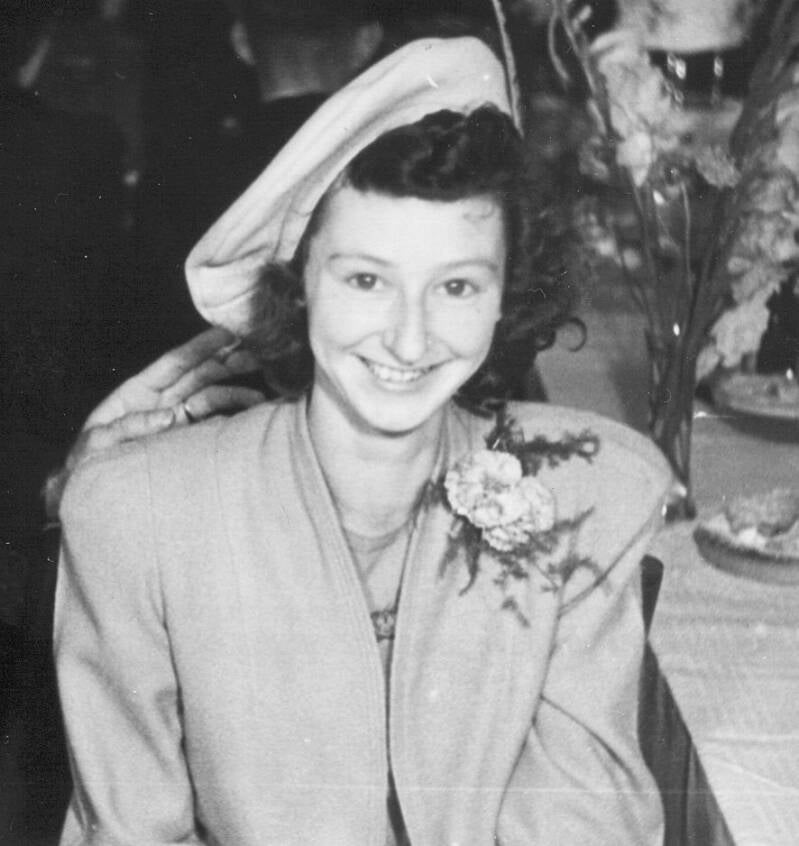
Hilda Falleni
My mother’s sister, Hilda Falleni was born in Wellington on the 17th of November 1924. She married Norman Roy Stange (known as Tom) in 1947 at Lower Hutt, Wellington. After they married, their mother Hilda Lydia Morley lived with Hilda and Tom and their family until she died on the 15th of October 1972. Hilda and Tom had four boys during their marriage:
- Rex John Strange, born on August 20th, 1950
- Max Stephen Strange, born on May 13th, 1953
- Wayne Paul Strange, born on November 29th, 1955
- Mark William Strange, born on July 31st, 1959
Mum and her sister Hilda, and our respective families remained close when we were young. Not only were there plenty of respective visits between Dannevirke and Lower Hutt (and later Carterton), but for a number of years we spent Christmas holidays together. Uncle Tom had built a cabin on a farm out from Martinborough, where he used to go rabbit shooting. This was pre-myxomatosis, and there were lots of rabbits! Our family used to drive down at Christmas and spend a week or so there. We would camp in a large tent next to the cabin. I’m not sure what Mum thought of it – the only water was from the creek you drove through to get there, and there was only power in the cabin for the stove. Cooking rabbit was expected. But to small boys, it was pretty close to heaven. We got up and went to bed with the sun. We damned the creek to make a swimming hole. We could roam the farm early morning and late afternoons, shooting as many rabbits with .22 calibre rifles as we could find.
As we got older, it only got better. The farm behind the one we stayed at had been abandoned. It was becoming overgrown with gorse and regenerating bush. The cattle had gone wild and roamed freely. Wild pigs were plentiful. If you went back far enough into the hills you came to the bush line, and a plentiful red deer population. Below that, around the waterholes in the gullies, I saw the only wallabies I have seen in the wild. You had to be careful around such things as wild pigs and cattle, but Tony and I had a ball.
Perhaps my favourite memories of my father are from when we went down to the farm just out from Martinborough at Christmas. I have written about this previously, but it was when my father was most relaxed and happy. It was also when we saw some of the skills he had, that certainly appealed to us as boys. We would drive down through the Wairarapa paddocks bleached white from the summer sun to meet up with Mum’s sister’s family who stayed in a Bach that Uncle Tom had built there. We stayed in a large tent that Dad and Uncle Tom erected, sleeping on stretchers, and illuminated at night by the wonder of a hissing kerosine lamp. As if crossing a ford to get in (the stream being our only water source) and camping in a tent wasn’t exciting enough, we had the run of the farm to play in all day.
Dad helped us dam the stream to create a swimming hole to cool off in during the heat of the day, but most importantly (in our eyes) he introduced us to rabbit shooting; a shared activity that he, Tom, my brother and I, and Tom’s boys would participate in on an almost daily basis, walking the hills surrounding the river flats at dusk. We were all using .22 calibre rifles and Dad and Tom would patiently ration out the ammunition, and teach us about gun use, gun safety and shooting accurately. For any of the poor rabbits we intended to keep for food, there were the additional mysteries of taking them down to the creek (below the camp) to gut and skin, carefully checking the livers to make sure that there were no spots that would indicate disease.
In addition to all this, he would teach us about the sheep farm, it’s working and staying safe on it. To us boys, holidays couldn’t get much better than this. Of course, even Dad’s knowledge of these things was soon eclipsed by Tony’s, who was already developing a passion for farming that he hoped to turn into a career. But during those halcyon days of midsummer holidays, we could only admire and appreciate Dad relaxing, opening up and teaching us skills that would remain with us and which we could build upon.
Tom was a favourite uncle of ours, especially for Tony, as is described elsewhere. After he retired, they moved to Carterton. Of all our relatives, the Stranges were the closest to our Mum and Dad, with frequent visits between Lower Hutt and Dannevirke. Tony and I grew up with their boys, yet after our respective parents had died, we drifted apart, lost contact and it has proved very difficult to re-establish it again. Eventually, I regained contact with Max, and he was able to give me an insight into Tom’s family. Tony was able to attend Rex’s funeral, but there has been little ongoing communications with any of them. I have noticed that Tania, Max’s daughter now living in Australia has popped up on an ancestry database, having also had her DNA tested and confirming her relationship to me.
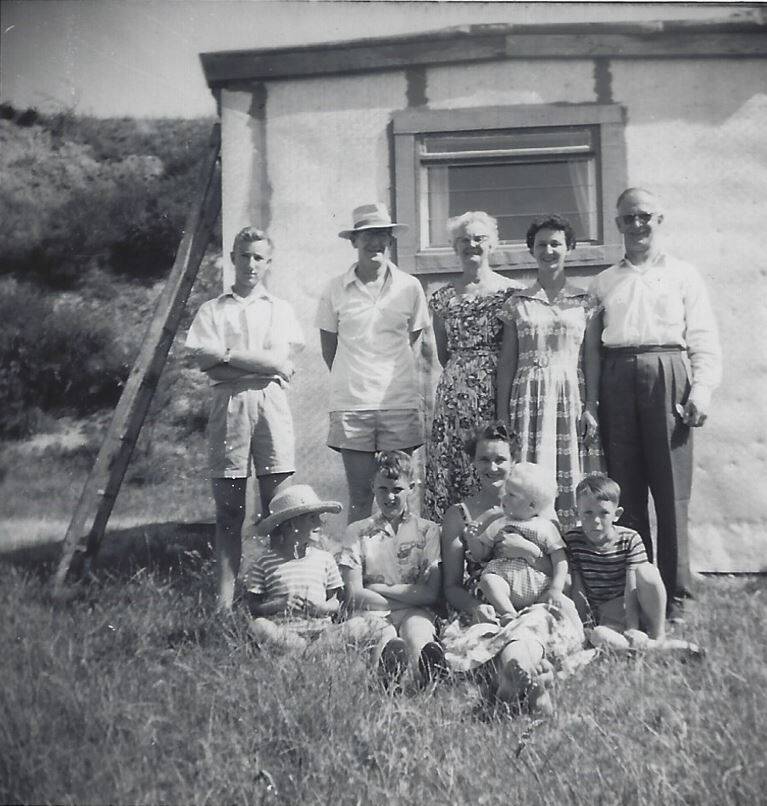
Nana (Hilda Morley), Nita, Geoff and Tony, Tom, Hilda and Rex, Max, Wayne and Mark. Martinborough, January 1961.
William (Sonny) Falleni.
Mum’s father William was born in New Zealand (presumably Wellington) on November 28th, 1889, and died in Wellington on May 13th, 1941. Prior to the war he was a brick burner, and afterwards he operated a carrier business. Certainly between 1911 and 1914 he was listed as a brick burner living at 3 Somerset Avenue, Wellington South with other family members.
He enlisted during the First World War and in December 1916 he embarked from Wellington with the New Zealand Expeditionary Force bound for Plymouth. He couldn’t have been in action for long before he was wounded with shrapnel to the chest, received while a Trooper in the Somme. He later told his children that the horse saved his life, as he took shelter between its legs as it lay in the mud and it took most of the force of the shelling that tore up the area around them. Ultimately the wounds he did receive would cause his early death.
Returning to Wellington, William took over the family carrying business from his father Luigi, but after the war he was never really well, often bad tempered and irritable. However, he met ‘Nana’ (Hilda Morley) while she was working in a bakery in Wellington, and he was making deliveries there. They were married on December 27th, 1921.
William’s health continued to decline, and in 1936 the family shifted into a new state house at 29 Trinity Avenue, Lower Hutt. By then he had two daughters, Nita born December 9th, 1922, and Hilda, born November 17th, 1924. The only reference I can remember Mum making to it was that he ‘returned from WWI with half his stomach replaced by plastic tubing’. It was the sort of information that you accepted unquestioningly as a child. They lived there for five years before his death on May 13th, 1941.
There is a gap in my knowledge of Nana and the two girls she raised after Sonny’s death until the time her daughter Hilda married, but it must have been really hard raising two girls on just a widow’s pension. After Hilda married Norman Roy (Tom) Strange, Nana lived with them and their four boys until her death.
Considering the distinctive name, and how many of them there are, the Falleni family have proved to be very elusive, leaving few digital footprints and clues as to their families. Here is the little that I know:
Nita Falleni (1922-2003) and her sister Hilda (1924-2009) were born in Wellington to William (Sonny) Falleni and Hilda Lydia Morley. William and Hilda were married in December 1921, after William had returned from military service in WWI. Given that Nanna’s family (the Morley’s) came from Hawkes Bay, it would be great to know how she ended up living and working in Wellington, but that too seems to be shrouded in the mists of time. However, a closer look at the Falleni and Morley families will be taken up in the second set of stories.
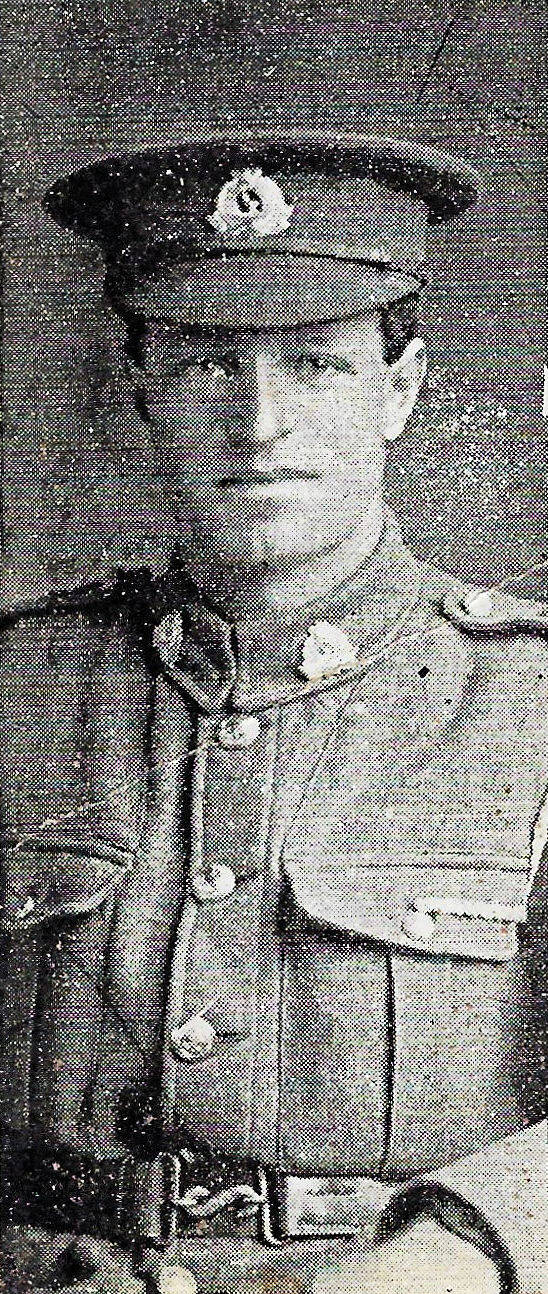
Amongst Mum’s old photos I came across this, a dashing young soldier in WW1 uniform. Tony and I are picking that this is William (Sonny) Falleni.
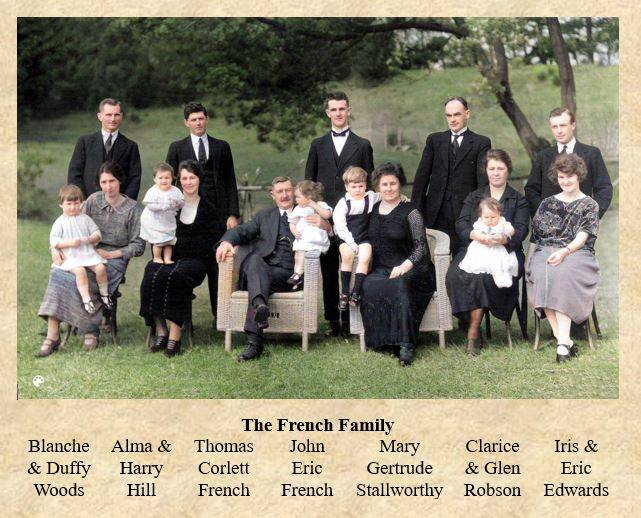
The French Family
Sharon’s father was John Eric French. He was known as Eric.
John Eric (Eric) French was the son of Thomas Corlett French and Mary Gertrude (nee Stallworthy), the only boy amongst his four sisters.
His family were:
- Father: Thomas Corlett French (1866 – 1930)
- Mother: Mary Gertrude Stallworthy (1875 – 1956)
- Sisters: Gertrude Clarice French (1896 – 1960)
- Married Glen Carver Robson 1920
- Margaret Alma French (1898 - ?)
- Married Harry Kelly Hill 1922
- Blanche Estelle French (1900 – 1954)
- Married Arthur James (Duffy) Woods 1921
- Iris Cynthia French (1901 – 1971)
- Married Eric Walter Edwards 1925
He was born at Aratapu, seven miles south of Dargaville in the Te Kopuru District, and played a good game of cricket in his younger days and excelled at rugby. Following his active playing years in this his favourite sport, he became a respected referee. Eric worked in an office after matriculating, drove the ambulance and was a truck driver on road construction in the Dargaville area.
Marj and Eric married on September 25th, 1929, at St James Church at Thames and their attendants were Tommy Collins (best man), Mac Miller, Beth Benny and Clarice Hunter. They lived in Dargaville and Broadwood in the year immediately after their marriage, but started sharemilking, firstly on Piako Road, Turua for Harry Hill and on the Campbell Road end of Cam Miller’s farm, before returning to Dargaville, where they share milked for Richie Powell.
In 1940 they bought their first farm at Waihue, north of Dargaville, which covered an area of over 100m acres of fertile river flats, which were susceptible to flooding, but which was excellent dairy country. Timber recovered from the stream which formed one of the farms boundaries was used to extend the farmhouse. When they sold in 1954 and bought the Rotokohu Road property at Paeroa, they were greeted there by a flood of such generous proportions that for a time their journey to Edgecumbe for the wedding of their eldest son Gordon to Stella Hunter (no relation), was in serious doubt.
Marj and Eric moved to Flora Street, Paeroa in 1957 and Eric spent some turbulent years in the employ of Dudding Brothers Ltd, but they returned to the farm for six years, before retiring to Taylors Avenue, Paeroa in 1976. They both enjoyed bowls and golf, and Marj achieved accolades not only for her achievements in the games, but also for her part in the administration of the sports.
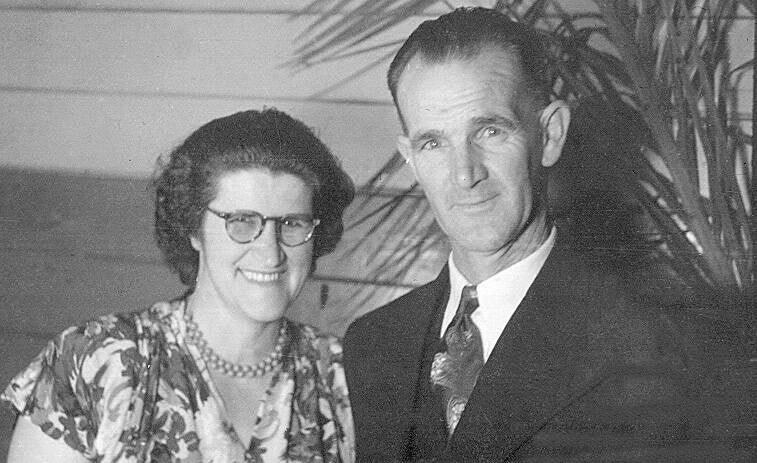
Gordon Miller
Marj and Eric were a lovely, well-respected couple, widely known in the Paeroa community through their involvement in sport, specifically golf and bowls. They were keenly interested and involved in their respective families, not just their own, but their wider cousins, aunts, uncles and in-laws. They used to organise extensive family reunions every ten years which were enthusiastically attended by the extended family and friends. Being introduced to this large, exuberant, close-knit family group by Sharon was a bit of a culture-shock for me, whose family seemed the complete opposite. But they were accommodating and inclusive and welcomed me into their families, despite seeming to have many life skills and experiences I had never been exposed to.
Eric French died in Thames Hospital on February 3rd, 1983, and Marjory died in Waikato Hospital in 1999.
The families history is expanded on in a subsequent set of stories.
The Miller Family
Sharon’s mother was Marjory Ella (Marj) Miller.
On February 18th, 1909, Marjory Ella Miller was born to Cam and Eve Millar at Maungakaramea. She was the second youngest of their eleven children.
The family was:
- Father: James Cameron (Cam) Miller (1865 – 1952)
- Mother: Eva Ellen Hunter (1872 – 1947)
Children:
- Eva Isabella Miller (1894 – 1894)
- Martha May Miller (1895 -1986)
- Married John Richard (Jack) Flynn in 1918
- James Cameron (Jim) Miller (1897 – 1983)
- Married Dorothy Blanche (Doss) Lloyd in 1923
- Vera Evelyn Miller (1899 - 1904)
- Gordon Alexander (Goog) Miller (1900 – 1930)
- Stanley Hunter Miller (1901 – 1906)
- Marion Christina (Chris) Miller (1904 – 1962)
- Married Cyril Victor (Joe) Marceau in 1923
- Kathleen Mary (Kit) Miller (1906 – 1997)
- Married Charles Keith (Keith) Fox in 1926
- Doris Minnie Miller (1907 – 1994)
- Married Herbert (Bert) Cook in 1927
- Marjory Ella (Marj) Miller (1909 – 1999)
- Married John Eric (Eric) French in 1929
- Clarice Audrey (Chum) Miller (1912 - 2001)
- Married Cecil Charles Allan Nicholson in 1930
Marjory Ella (Marj) Miller (1909 – 1999)
Marj attended Maungakaramea and Kopuarahi Schools and was in 1923, a foundation pupil of the Ngatea District High School, which later became the Hauraki College. Although she helped on the family farm at Kopuarahi, her skills were not limited to the handling of stock, for Marj was highly proficient in knitting, crochet and embroidery.
Marj and Eric married on September 25th, 1929, at St James Church at Thames and their attendants were Tommy Collins (best man), Mac Miller, Beth Benny and Clarice Hunter. They lived in Dargaville and Broadwood in the year immediately after their marriage, but started sharemilking, firstly on Piako Road, Turua for Harry Hill and on the Campbell Road end of Cam Miller’s farm, before returning to Dargaville, where they share milked for Richie Powell.
In 1940 they bought their first farm at Waihue, north of Dargaville, which covered an area of over 100m acres of fertile river flats, which were susceptible to flooding, but which was excellent dairy country. Timber recovered from the stream which formed one of the farms boundaries was used to extend the farmhouse. When they sold in 1954 and bought the Rotokohu Road property at Paeroa, they were greeted there by a flood of such generous proportions that for a time their journey to Edgecumbe for the wedding of their eldest son Gordon to Stella Hunter (no relation), was in serious doubt.
Marj and Eric moved to Flora Street, Paeroa in 1957 and Eric spent some turbulent years in the employ of Dudding Brothers Ltd, but they returned to the farm for six years, before retiring to Taylors Avenue, Paeroa in 1976. They both enjoyed bowls and golf, and Marj achieved accolades not only for her achievements in the games, but also for her part in the administration of the sports.
The celebrations for Marj’s ninetieth birthday extended over several days. Visitors to her home included many of her golfing and bowling friends, and family and friends joined her at granddaughter Robyn and John Kelly’s Tamahere residence, where her spritely demeanour and warm friendliness impressed the gathering.
Three of Marj and Eric’s family members have earned high honours in the sporting domain. Daughter Sharon Sims represented New Zealand at bowls in two Commonwealth Games, winning gold at Edinburgh as well as firsts and seconds at World Bowls. In 2007 she was awarded the New Zealand Order of Merit for her services to bowls. Grandson Grant Bradburn followed his father Wynnes’s footsteps by also representing his country on the cricket field. He is currently coaching the Scottish national team.
Gordon and Stella spent the greater part of their life farming at Edgecumbe before moving to Whakatane. Warren and Margaret farmed up the Rotokohu Road before moving into Paeroa; Olwyn and Wynne Bradburn fielded a life around the cricket pitches of the Waikato while living in Hamilton, and Sharon and Ken Sims bowl and fish respectively around the Manawatu.
Gordon Miller
My knowledge and recollections of the Miller families is scant, and mostly the result of attending a couple of family reunions when we were in Hamilton. Again, we can turn to the remarkable family history written by Gordon Miller to flesh out Marj’s immediate family.
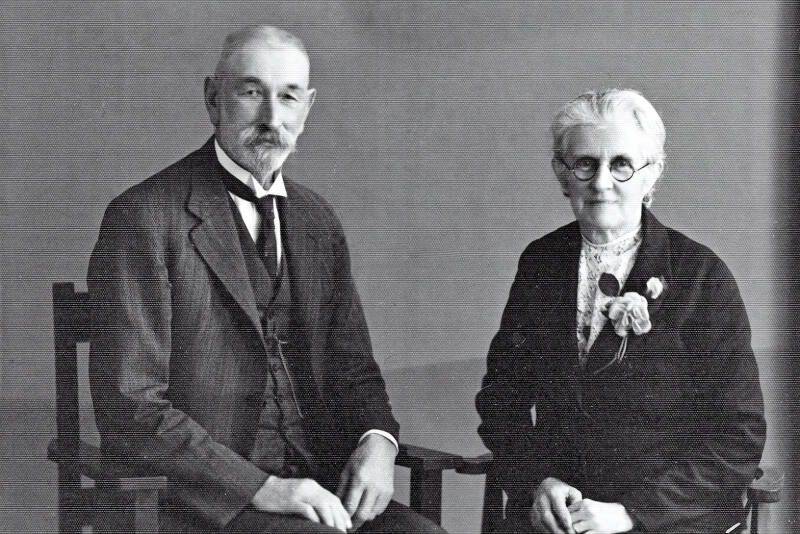
Cam and Eva Miller
Miller Family Children
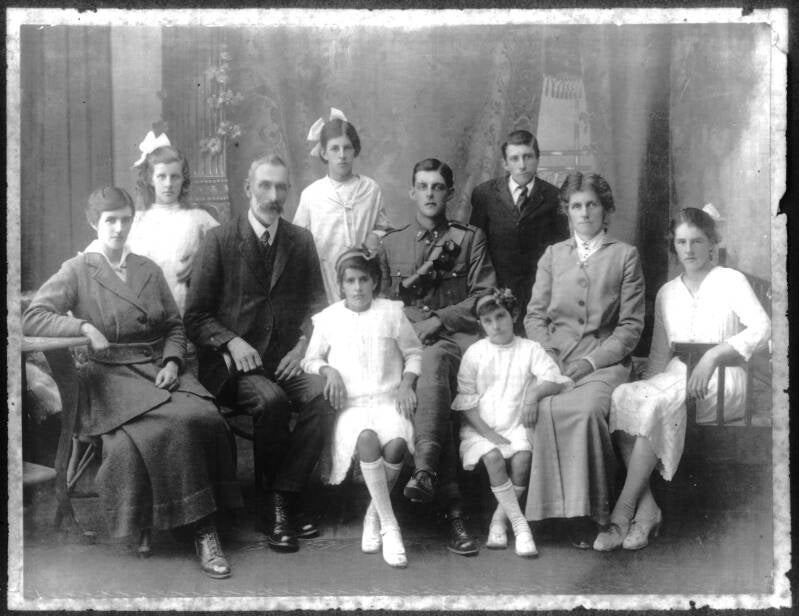
Martha May Miller (1895 – 1986)
She was known as May, and was born at Maungakaramea on May 17th, 1895. She spent much of her youth with the Jonny Miller family at Maungakaramea, going to the local primary school, then to the Whangarei Girls High School in the company of their daughter, Roy. She was a familiar figure around the Miller Boarding House and Store, assisting her Aunt Mary with the running of the premises. She became engaged to Ernest Ashley Crawford, but he was killed in a Quarry accident at he Tauraroa property of Mr Gunson on April 10th, 1914.
After the Cam Miller family moved to Kopuarahi in 1916, May met and married John Richard (Jack) Flynn on June 19th, 1918. Jack had recently returned from serving overseas in WW1 and they initially settled on Piako Road, Turua, dairy farming there until 1939 when May and the family shifted to 26 Rolleston Road, Thames for a couple of years while their Mangatarata farm was being developed and a house built. This was where May and Jack spent the longest period of their married life, running sheep and a small herd of cows.
Jack died suddenly on May 6th, 1963, and about a year later May moved to her new house at Thame, where she lived until 1975, when a severe stroke meant she had to be cared for at the Thames Hospital until her death on September 25th, 1986.
James Cameron (Jim) Miller (1897 – 1983)
James (Jim) Miller was born to Cam and Eva at Maungakaramea on March 1st, 1897, and spent much of his youth with the Jonny Miller family so that he could attend the Maungakaramea Primary School and the Whangerei Boys High School, while his parents were away completing bush contracts. He assisted his Uncle John and it was not long before he was bringing the mail from Whangerei to add to his talents of driving bullock teams.
Jim served overseas during the latter stages of World War 1, as a Gunner (Regimental No. 57947) with the Field Artillery in France. He left New Zealand on board the ‘Willochra’ on April 23rd, 1918, and returned on the ‘Matatua’ in August 1919.
His parents and family were firmly entrenched at Kopuarahi by the time he returned, and it was on an area of120 acres at Hamilton Road, Turua, that he settled. After many years of hard labour, the swamp was transformed into a dairy farm which was later used as a dry stock unit.
He married Doss (Dorothy Blanche) Lloyd on September 27th, 1923 at St. Georges Church, Thames. Doss was the younger daughter of Richard Redmond (Dick) Lloyd and Martha (nee Stilwell).
Doss was interested in the Plunket Society and assisted them in their various endeavours, and with Jim, played a full part in the local Patriotic Committee during the period of the Second World War. Jims hobby was his thoroughbred horses, and the best of them were Melanoin and Classeen. Jim was not interested in local body politics, but wasn’t afraid to remind them should they waiver from the interests of the people.
Jim and Doss lived on Hamilton Road for all of their married lives, except for six years (1931-1937) on Cam’s property at Kopuarahi.
Their family of three were their everlasting delight. Elder son Derek and Bev lived for many years at Kopuarahi, and after moving around the North Island following Derek’s career as a boilerman, settled in pleasant retirement at Whangamata. Fay continued to live amongst flowers and her artists palette on her farm at Kerepahi, and Gordon and Laurel researched from Waitakaruru.
Chris (Marion Christina) Miller (1904 – 1962)
Marion Christina, who was known as Chris, was born on June 4th, 1904, to Cam and Eva Miller at Maungakaramea.
Chris and Joe were married at Thames on July 18th, 1923, and started their married life farming in the Kopuarahi area, before moving in 1935 to their own property at Oparia Road, Turua, where Chris was to spend the rest of her life.
A keen gardener, Chris was also interested in floral art, and was an accomplished maker of bouquets and floral arrangements, as well as producing spectacular floral displays. She played a prominent part in community affairs and was an organiser for the Queen Carnival to raise funds for the Turua School baths and filtration unit. She was a founding member of the Kerepehi Woman’s Outdoor Bowling Club, president of the Turua Youth Club for many years, and principal organiser of the Youth Club Debutant Balls. Chris was secretary-treasurer of the Turua Anzac Committee and a member of the Patriotic Committee which was responsible for farewelling and welcoming home all those from the district who left Turua for overseas wartime duties, and for dispatching parcels to them overseas. She was organist for the Presbyterian services at Kopuarahi and Turua for 45 years.
Chris received the Gold Honours Badge for her work with the Thames-Hauraki Federation of Country Women’s Institute, fulfilling many duties within the organisation at both a local and national level.
Chris died in her 60th year on July 12th, 1962, and later Joe moved into the Turua township and passed away nearly twenty years after Chris, on June 8th, 1983. They are buried in the Totara Cemetery.
Their daughter Pauline did her nursing training at Auckland Hospital, and married Bob West, who had completed his training as a Civil Engineer after an interruption of two years when he served with the military forces in Italy and Japan. They lived in several places in the lower half of the North Island including Featherston while the Rimutaka Tunnel was being built, always with the Ministry of Works. Later they were in Taumarunui while the Tongariro project was in progress, and they settled in Wanganui in 1965 to retire there to enjoy bowls, music and travel.
Pauline and Bob celebrated their Golden Wedding anniversary by entertaining their friends and close relatives at a luncheon at Devonport, Auckland. Their guests included most of their wedding party.
Chris and Joe’s elder son Cyril, and Jean, have farmed at Kerepehi and Rotokohu in the Paeroa district, and younger son Lester, and Bernice, after spending years at New Zealand Army establishments throughout the country, retired to Wanganui.
Cyril Victor Marceau
Everybody knew Cyril Victor Marceau as Joe, and he was born at West Dapto, New South Wales on May 22nd, 1893, the son of Benjamin Marceau (1860-c1923) and his wife Mary (nee Barber). His grandfather, Joseph Marceau, was a French-Canadian who settled in the Illawarra district of New South Wales in the 1840’s, after being pardoned for alleged political crimes for which he had been incarcerated. Joe came to New Zealand when he was 22 years of age, in the company of a cousin Lance Marceau, with the intention of learning the art of cheesemaking and then returning to the land of his birth. But the New Zealand Government regulations formulated at the time of the outbreak of World War 1, demanded that he, like other Australians joining the armed forces, should serve under the New Zealand flag while they were overseas during the war. Cupid also interfered with any plans that he held to return to Australia, and Joe remained in New Zealand to earn the respect of all who knew him.
Kathleen Mary (Kit) Miller
Kit was the only child of Cam and Eva to be born away from Maungakaramea, and her birthplace was Peria, in the Kaitaia district.
Kit received her schooling at both Maungakaramea and Kopuarahi schools, and while her sisters stayed at home to help with the home and farm, she was the only one allowed to obtain outside employment, which she did at the Turua Post Office. During that time, she met Charles Keith Fox, who had arrived as a nineteen-year-old from Taranaki to farm south of the township and they were married at Turua on August 4th, 1926.
Keith was a proficient rugby player and in later years, a successful administrator. The Hauraki Plains Senior Team, under his guidance as coach, gained prestige as Peace Cup holders. Soon after he arrived in Turua, he became involved in the administration of his local Dairy Company and was a member of the Hauraki United Drainage Board, as well as its chairman for many years. He grappled with the problems of drainage for most of his life.
Kit was renowned for her beautiful singing voice, and she entertained many audiences in the district.
Kit and Keith had four children; Gwen and Harry quietly celebrated their Golden Wedding Anniversary and live their golden years in retirement at Simpsons Beach, Whitianga; Bruce collects bowling accolades and pine cones at Pauanui; Noel, who has paced his way through a career of calculating avoirdupois, and Annette, the fastest typist in town, live on their Hamilton Road farm; and John can hear the murmur of flyover traffic in Newmarket, Auckland, when he is not sprucing up relaxation pools.
Keith died on December 22nd, 1963, when they were living on their retirement block on Mount Sea Road, in the foothills of Thames, and Kit passed away on July 10th, 1995, while residing at Willoughby Street, Thames. Both are buried in the Totara Cemetery.
Doris Minnie Miller (1907 – 1994)
Doris Minnie was born at Maungakaramea on December 19th, 1907, a delightful Christmas present for her parents Cam and Eva Miller.
Herbert (Bert) Cook was born in Auckland on July 25th, 1902, the son of Sydney James Mills and Charlotte Maria Wheeler.
Although Doris and Bert were married in Thames, they started their married life working on a sheep station at Waipawa in the southern Hawkes Bay, where Bert was a ploughman doing all the cropping on the station. The magnificent team of horses were groomed and fed each day ready to begin work at eight in the morning.
Doreen was born while they were at Waipawa, and in 1929 the family arrived on their farm at Bush Road, Ngatea, which they developed before purchasing more land on the Neavesville Road, Puriri, where they were to live for many years, until the Government wartime regulations bought them back to Ngatea.
Later, ill-health forced the sale of both properties, and the family moved to Waiheke Island to run a Dairy/Grocery business there; the daughters looked after the shop; Doris maintained control of the kitchen; while Bert enjoyed being odd-job-man if he was unable to pursue his hobby of fishing.
Eventually they sold out on Waiheke and moved to Papatoetoe, where Doris and Bert enjoyed retirement and bowls. Many of their family have also enjoyed the game of outdoor bowls and a couple have received recognition in the sport. Grandson David Clark represented New Zealand in the Under-25 Bowls tournament in Sydney, Australia in 1992, and his father John has been an Official Umpire at both the 1988 World Games and the 1990 Commonwealth Games, which were held in Auckland.
Bert passed away on his 84th Birthday, July 25th, 1986, and Doris died nearly eight years later, on July 3rd, 1994. Both were cremated.
Doreen married Jack Bartlett, who sadly died when the eldest of their three sons was only twelve years old, and remained in Papatoetoe, where Lois and Don Croll lived for many years before moving to Snells Beach to the call of the tide, but Bev and John Clark did not venture too far from the green fields of Papatoetoe.
Clarice Audrey (Chum) Miller (1912 – 2001)
The youngest child of Cam and Eva was their daughter Clarice Audrey, who was born at Maungakaramea on March 17th, 1912, and has been known all her life as Chum.
When Chum was about twelve years old, she spent about a year in Auckland to improve her health. She stayed with May Miller and her son Stanley in Ponsonby and while there, she attended the Bayfield School. Stanley, and by coincidence Bert Cook also attended the same school.
Chum married Ces (Cecil Charles Allan) Nicholson at Turua on February 23rd, 1930. Ces, whose parents were George Nicholson and Charlotte (nee Griffiths) came from Auckland to work at the Kopuarahi Cheese Factory and Chum and Ces lived nearby for the first five years, during which time both their sons were born. Ces was promoted to be First Assistant at the Orini Dairy Factory and they enjoyed the camaraderie of the factory staff there and using the ‘Beauty’ Ford that Grandpa Nicholson judiciously selected for them, as many as the Ford would carry would journey near and far. After two years they moved to the Netherton Cheese Factory where their house was the first that Chum and Ces lived in which included a bathroom and washhouse and had hot and cold running water. Gone were the days of boiling water in a kerosene tin on the coal range and carrying a tin bath into the kitchen to bathe in.
The family enjoyed happy times, but there was also a great sadness. Their beautiful daughter Valmai died when she was only ten months old.
After two and a half years Ces was promoted to a much bigger dairy factory at Manawaru, near Te Aroha. But ill health intervened and Ces and Chum went farming, first on Bert and Doris Cook’s Ngatea property and then at Waihou, where Ces enjoyed the cricket games and the whole family participated in the activities of the Te Aroha Brass band, where Maurice and Earle became proficient on their musical instruments.
After the death of Chums mother Eva, Cam asked the family to live with him in Thames. But it was not an easy decision to make because Chum and Ces were at this time contemplating the purchase of the land they were farming. However, they moved and were to spend the next five years in Williamson Street, Thames. Ces won an appointment as Dairy Inspector for the Paeroa District.
After Cam passed on, Chum and Ces bought a section on Thames Road, Paeroa and Ces built the house that was to be Chums home for the next thirty years. During those years Chum continued her many activities including being a leader of the group of Paeroa ladies whose handcraft interests and talents were developed by their meetings. Crochet was Chums speciality, as the ‘NZ Herald’ noted when reviewing the group’s activities, but she was also proficient at cane weaving and needlework.
Ces died on June 23rd, 1973, and Chum stayed on in her home for another ten years before choosing a smaller, easier-to-manage home and section in Franklyn Street, Thames. There she met, and married, Brian McMillan and they moved to the sunny Bay of Plenty to live in Tauranga, where she died on 20th July 2001.
Eric and Marj French’s Children.
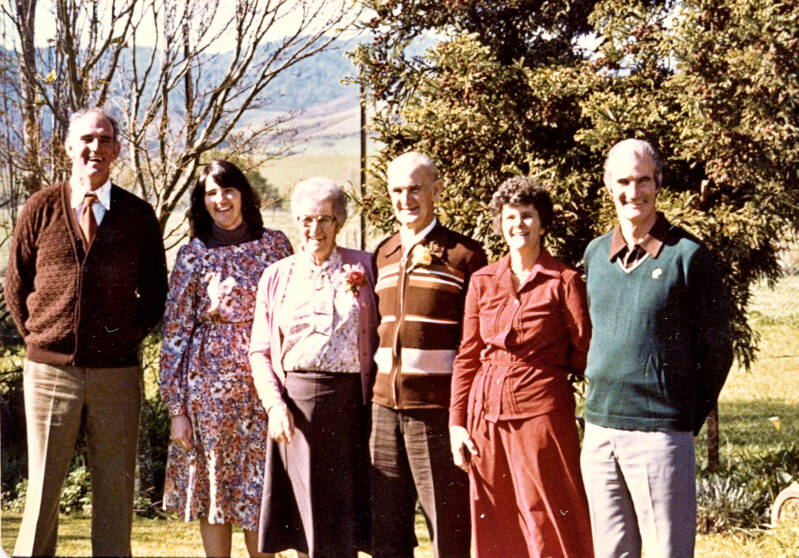
Marj and Eric had two sons and two daughters.
Gordon, Sharon, Marj, Eric, Olwyn and Warren French at Rotokohu Road.
The eldest son was:
- Thomas Gordon French (1931 – 2019)
- Married Stella Elizabeth Hunter in 1954
They had two daughters
- Colleen Rae (born 1957)
- Married Maxwell (Max) Scott in 1976
- Wendy Lynne (born in 1962)
- Married Alan Edward Law in 1986
Thomas Gordon (Gordon), the eldest son was born in Te Kopuru on January 15th, 1931, and was named after his grandfather, but always called by his second name. He was still a youngster when the family moved to Kopuarahi in the Thames Valley, on to a one-hundred-acre river flat farm owned by Marj’s father. His Uncle Jim joined them, and he farmed half and Eric farmed half. The family later moved back to a fifty-acre block owned by my Eric’s mum near Dargaville, living in the large homestead with his parents before moving to a farm cottage while Eric share milked on a farm owned by the local butcher. After about 5 years, Marj and Eric were able to buy their own farm at Waihue, about ten miles north of Dargaville.
Leaving school (early) Gordon enjoyed helping his father run the farm before taking up a truck driving job at Whakatane in the Eastern Bay of Plenty. Working for a couple of roading and cartage contractors, it was here that he met Stella Hunter, who worked for Prices Four Square at their Whakatane store.
He married Stella Elizabeth Hunter on May 22nd, 1954, and they soon moved back to Erics new farm at Paeroa, where along with brother Warren they helped convert the dry stock unit to a dairy farm, eventually splitting the farm up and milking one hundred acres each. It was here in 1957 that their first daughter, Colleen Rae was born. Two years later, the opportunity came up for them to 50/50 share milk on Stella’s Dads farm in West Bank Road, Edgecumbe. They were keen for Stella to move back to the Bay of Plenty and have the family closer to them. The farm was 47 acres of first-class Rangitaiki plains country with a small run-off which despite the smaller acreage compared with Eric’s Paeroa property, this Rangitaiki Plains forty-seven acres would prove to be a better producer than the 100 acres. A year later, his father-in-law purchased a 90-acre property on Putiki Road which allowed them to buy the 47 acres.
In 1962 their second daughter Wendy Lynne arrived, and eventually both Colleen and Wendy went on to work for the Rangitaiki Dairy Company in Edgecumbe. Gordon decided to get out of milking and subdivide the property. He’d had enough of cows, and with the Kiwi Fruit industry taking off, decided to retain some of the land for planting citrus and kiwis. Colleen and her new husband Max Scott came in as partners in the orchard business. Wendy met and married a dairy farmer, Alan Law, in 1985. They lived just up the road from Goron and Stella, which could not have been better. However, Stella’s health was not robust, and while the doctors couldn’t say why, it was probably the intensive and toxic spraying regimes the orchards required that contributed to it.
The 1987 Edgecombe earthquake was perhaps a wakeup call for a change in lifestyle. Gordon and Stella moved into a house in Whakatane, Colleen and Max moved to Australia, while Wendy and Alan went on to own a number of farms in the district. In 2003 Stella suffered a severe stroke which left her debilitated and unable to get around without a wheelchair or a walker. She died in 2008. Gordon lived on, enjoying his golf and his family, until he died in 2019.
We were able to visit him just prior to that, when he was living in assisted care in Whakatane, and say our goodbyes. Like all of Sharons family and siblings, there was an easy acceptance and genuine interest in our lives that I found quite different to my own.
Gordon was a large, enthusiastic man, who had obviously spent a lot of time out in the Bay of Plenty sunshine. Stella was a homemaker and a traditional farmers wife. She was just lovely and very friendly. She held very definite views of the world though. Their oldest daughter Colleen is a similar age to Sharon, so they were quite close growing up. Like Stella, Colleen was asthmatic, a condition exacerbated by the spraying required by the surrounding kiwifruit blocks, and which ultimately led them to settle in the township of Whakatane.
Eric and Marj’s second son was
- Warren Eric French (1933 – 2002)
- Married Margaret Anne Shaw in 1957
They had four sons and a daughter:
- Warren Michael (Michael) French born in 1958
- John Gary (Gary) French born in 1959
- Married Karen Cristine Beere in 1986
- Susan Margaret French born in 1960
- Clifford Anthony (Tony) French born in 1962
- Married Sandra Annette Reeve in 1981
- Married Karen Moore Morrison in 1988
- Married Angela Claire Caffell in 1998
- Norman Andrew (Andrew) French born in 1968
Warren was born in Thames in the Coromandel on the 29th of October 1933. Like his older brother Gordon, he was actively involved in assisting his father on the family dairy farm, first at Waihue in Northland, then at Rotokohu Road in Paeroa. Unlike Gordon, he was a little more enthusiastic and adept at high school, reaching the sixth form before leaving to help on the farm.
After the family moved to Paeroa, he assisted converting the dry stock farm to a dairy farm, then later splitting it into two one-hundred-acre farms, one of which he farmed. Initially he lived with his parents in the homestead on the top farm, while Gordon and Stella lived in the three-bedroom house on the bottom farm.
He married Margaret Shaw on June 1st, 1959, in Paeroa and they moved into the home on the bottom farm off Thorp Road while Godon and Stella moved back to Edgecombe. Like Stella, Margaret was a homemaker and soon had a family of five children to look after. Like their father, they grew up helping on the farm.
The French farm on Rotokohu Road was next to the Paeroa Golf Club and the whole family became enthusiastic golfers. Marj and Eric were longstanding members, with both being made a life-members. Gordon was a keen golf player his whole life, Warren who always preferred golf to rugby, became Club President, and Sharon was a regional golf representative while she was at high school. A creek ran through the golf course next to the farm and then continued on through the farm. There were always plenty of free golf balls to find after the weekend.
Eventually, with the children growing up, Warren and Margaret moved into Paeroa township, where Warren died in 2002.
Their eldest daughter was
- Olwyn Rae French (1938 – 2008)
- Married Wynne Pennell Bradburn in 1960
They had two daughters and a son:
- Raewyn Ivy Bradburn born in 1961
- Married Grant Breton Higgins in 1983
- Robyn Ella Bradburn born in 1962
- Married John Kelly in 1982
- Grant Eric Bradburn born in 1966
- Married Marree Young in 1995
Olwyn was born in Dargaville on December 4th, 1938. She married Wynne Pennell Bradburn in Paeroa in 1960 and they lived in Hamilton. As they lived there while we did, we saw quite a lot of them and the kids. Their house in Greta Street was not far from ours in Cricket Place.
Wynne was a cricketer who played for Northern Districts and represented New Zealand in two test matches against South Africa in 1964. After his playing career ended, he served as an administrator, selector and coach for Northern Districts. Consequently, Olwyn and the kids were a familiar feature at matches around the country. It was a devotion that I could only admire. Wynne was a diabetic and as a consequence, had both lower legs amputated in later years.
Olwyn worked as a Dietitian at Waikato Hospital, but she also suffered from ill health in later years and died in 2008. Wynne died hours after her funeral of a heart attack. They were both 69 and had been married 48 years.
We were particularly close to Raewyn and saw a lot of her and Grant and their kids after they settled in Tauranga. Robyn became a radiographer and she and John settled in Havelock North. Grant followed in his father’s footsteps and became a successful cricketer, also playing for Norther Districts and representing New Zealand seven times between 1990 and 2001, before coaching the Scotland and Pakistan cricket teams. He married Maree Young, a local Hamilton lass, and like his siblings and cousins, their children are scattered around the country and around the globe.
Their second daughter was:
- Sharon Elmar French (1952 - )
- Married Ken Sims in 1972
Sharon was born in Te Kopuru in Northland on May 24th, 1952. After leaving Paeroa College she worked at the Waikato Hospital Laboratory, where she met Ken Sims, who was also working there. They married on January 15th, 1972, in Paeroa and continued working at Waikato Hospital until moving down to Palmerston North in 1978. Their daughter, Leile Katherine was born on May 31st, 1979. So much of this story features elsewhere in this section.
Sharon Elmar Sims NZOM
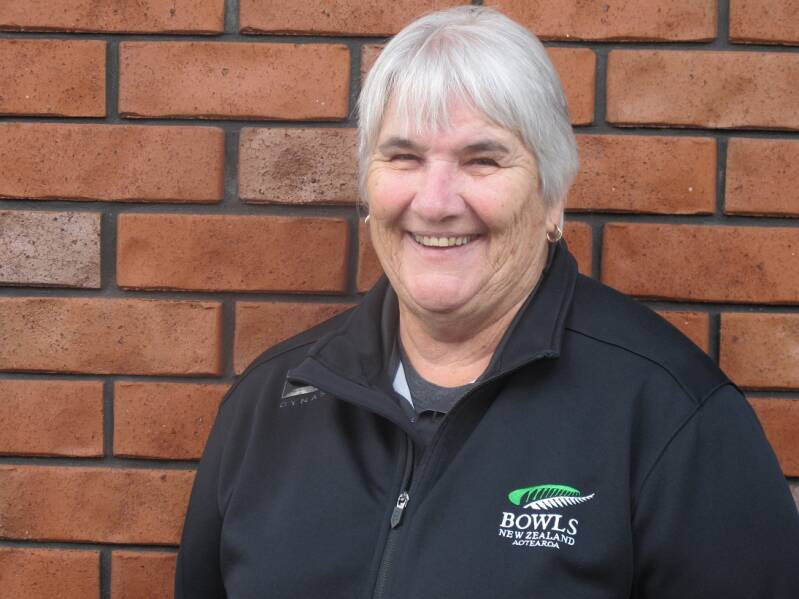
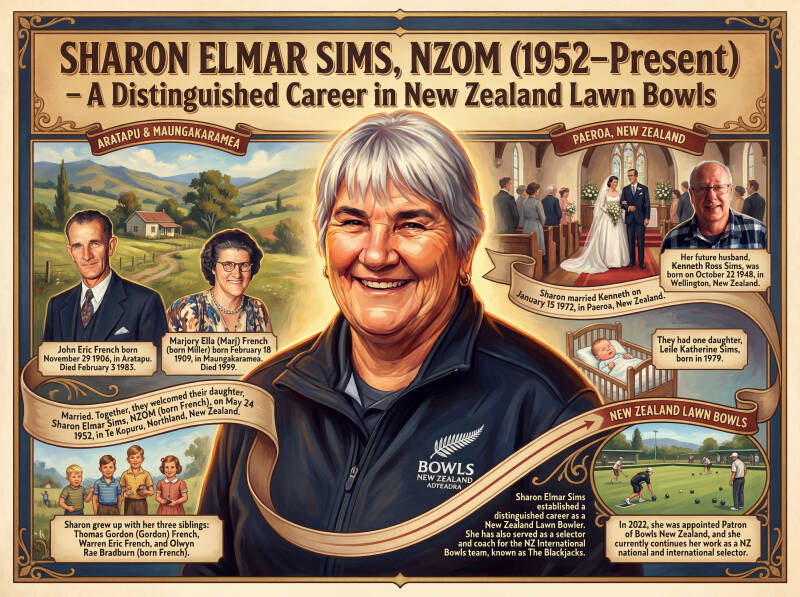
Early Memories - Dannevirke.
Dannevirke is a valley town. It nestles close to the Manawatu River, between the Ruahine Ranges in the west, and the Puketoi Ranges in the east.
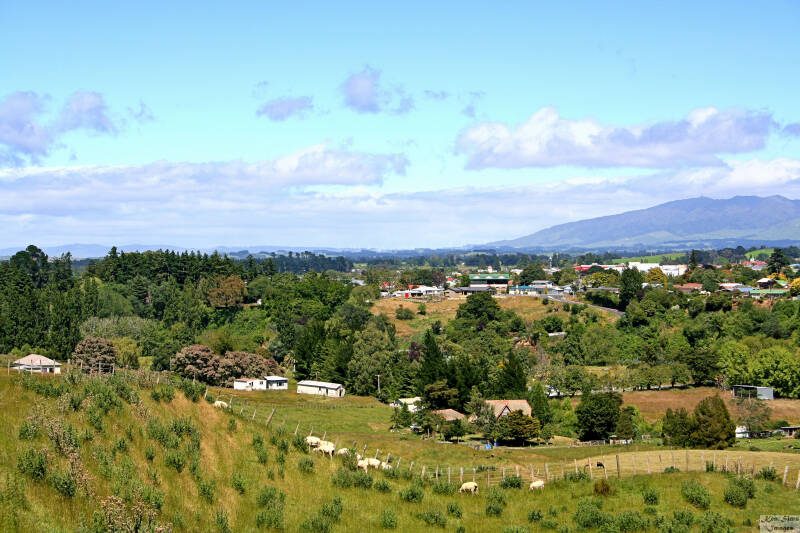
Looking over at Dannevirke, from Tipapakuku Road.
Coming down from the Puketoi Range and looking across to the Ruahine Ranges (behind the rain).
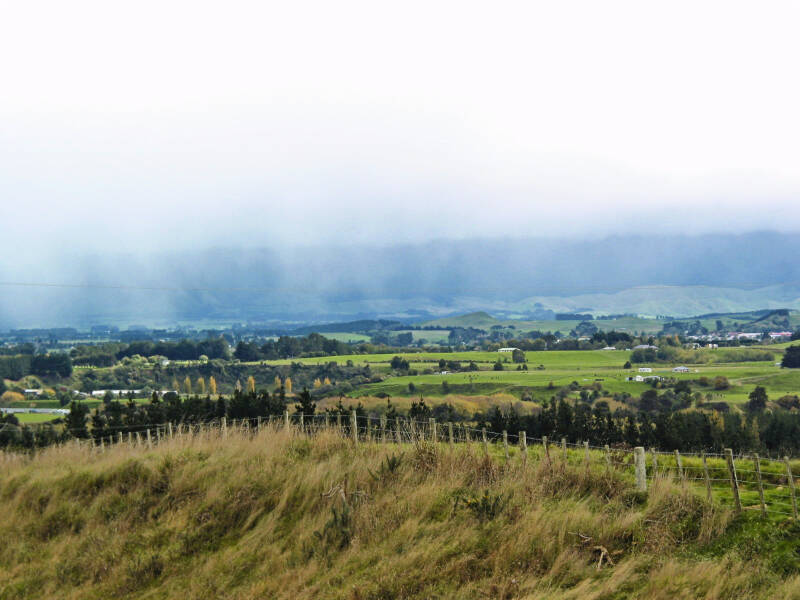
Neither are too far away. Originally the valley floor was a huge expanse of tall forest (part of the forty-mile bush), but like most of the country it has been burnt, cleared, drained, tamed and transformed.
To the west, in the generous rain shadow of the Ruahine Ranges, lush pasture supports dairy farms, whose milk is transported south to the factory at Pahiatua. Once there were many small dairy factories dotted throughout the landscape, serving the small family farms surrounding them. Today, such farms have amalgamated into intensive corporate enterprises, all feeding the single voracious factory in Pahiatua to the south.
The eastern hills were also burnt and cleared. Their softer nature and thinner soils became the foundation for sheep farms, with some stations reaching prodigious sizes (Akitio Station alone was 200 km2). Like most of the eastern seaboard hills they are very prone to erosion. This, plus the uneconomical nature of farming such country has led to the establishment of large pine forests in their place. Ecologically, these vast monocultures are not necessarily an improvement.
As children, we were taught that Dannevirke was settled by Scandinavian settlers (mostly of Danish descent) in 1872, hence the names of towns like Dannevirke and Norsewood. They cleared, logged and burnt the Forty-mile bush and turned it into productive farmland. This was admirable. Never once was I taught that long before that it was known as Tāmaki-nui-a-Rua. That it was the home of Rangitāne whose tribal ancestors arrived at Māhia Peninsula aboard the Kurahaupō waka in about 1350 before moving south. Apart from a few Marae, the most obvious being the Makirikiri Marae just south of town, almost all traces of indigenous culture had been erased, and was never acknowledged.
This was part of a deeper, darker valley in the small-town social landscape that was always present, but never openly acknowledged or spoken of. At least, not in my company as a child. It wasn’t until I hit High school that it even became apparent, and it has taken until now, over seventy years later to realise its full all-pervasive extent. I am of course talking about poverty and racism and their counterpart’s privilege and entitlement.
Logs felled at Rua Roa, just west of Dannevirke.
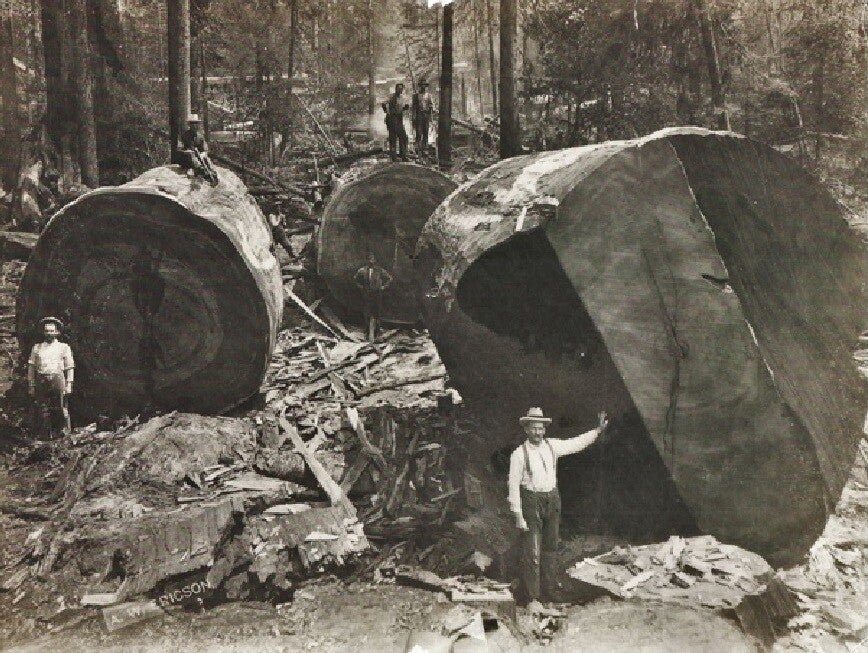
Forty Mile Bush, near Dannevirke.
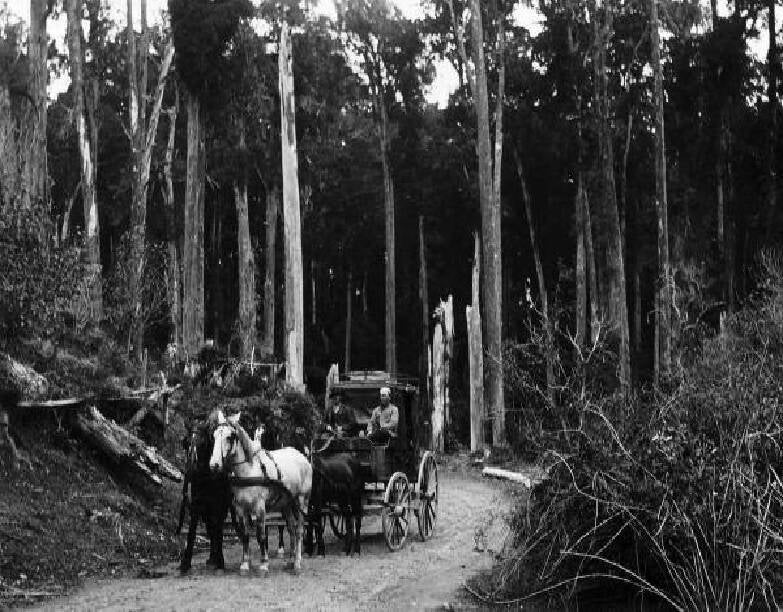
Just by way of an example, while our childhood was full of good colonial tales and of heroes like Beau Guesde and Biggles, no one ever taught us the pre-colonial history of places like Te Rehunga. Te Rehunga is the name of a small farming district just to the southwest of Dannevirke. Marlene Kelly’s family, (my brother Tony married Marlene), had a dairy farm there along Topgrass Road.
Whatungarongaro te tangata, toitū te whenua
(People pass, but the land remains)
Te Rehunga was a Ngāti Kahungunu man from Heretaunga Hawke’s Bay, who married a Rangitāne woman, Te Hore, from the Tamaki nui-ā-Rua district. They made their home on the land of Te Hore several generations ago.
Te Rehunga was living in the Takapau area when he met Te Hore, they then moved and settled on her land, which is the land we now know as Te Rehunga. He was followed down here by a number of his relatives and began allocating them land. He didn’t have the right to do this and was told by the locals not to give land that was not his. Despite the warnings, he continued to allocate land to his people. As a result, Rangitāne decided to banish him and sent him back to the Heretaunga area.
One of the Rangitāne chiefs, Tireo, erected a post on the northern banks of the Manawatū River, at Tuhimata, (close to today’s Ormondville), naming it Puakiteao, after his mother. This was to demonstrate that the lands so allocated were Rangitāne land and was not to be given up lightly to outsiders.
Te Rehunga, hearing of the erection of the post, had it cut down. Tireo in retaliation reinstated the pou and prepared for war.
There were several skirmishes with Te Rehunga and his people through the Central Hawke’s Bay area. Tireo returned home, hoping that would be the last of Te Rehunga.
Sometime later Te Rehunga assembled a war party and headed south, however, Rangitāne anticipated this move and met the war party of Te Rehunga at Piripiri just north of Dannevirke where a huge battle took place with many casualties on both sides. Defeated, Te Rehunga and the remnants of his war party returned to Heretaunga.
Te Hore was to remain in the Tamaki nui-ā-Rua district. Many of the descendants of her union with Te Rehunga, including myself, still reside in the district today.
- by Stephen Paewai, (who I suspect I went to school with).
How much richer our childhood appreciation of our local landscapes would have been with knowing such stories.
Puakiteao – we remember her - Mākirikiri Marae, Dannevirke.
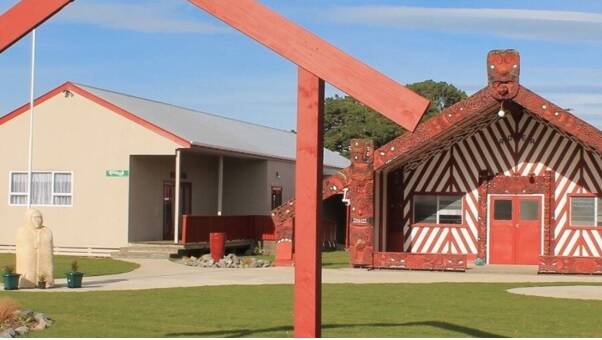
As a family, we were never rich, and I never really appreciated just how hard my parents worked to give us what we needed. I never questioned why we would take in boarders, let alone associated that with supplementing the family income. But we were never poor. Bad people were poor, and if you were poor, you were probably bad too. If you were Māori, you were almost certainly poor, and probably bad. Mum was particularly hard on Māori, and I don’t know if that was simply the accepted European assumption of the times, or something deeper. These days, with the benefit of having a family tree behind me, I wonder what her reaction would be if she knew that one of Dad’s Aunties, a Te Amohau Eileen Sandbrook lived in Dannevirke too.
The contrast with the entitlement and the assumption of privilege by the European farmers and their children was stark, but never stated or overt. It was just an accepted part of the landscape. Just as it went without saying that forest and bush was at worse bad, and at best a waste. Green verdant grassy landscapes with the occasional tree (introduced of course) and crammed with as many sheep or cattle as you could get away with, was the only proper use of rural land regardless of its topography, history, or previous ownership.
Mum and Dad moved up from Wellington, where they lived in Lyall Bay, to Dannevirke when I was about 18 months old. Tony suffered from asthma as a child, and doctors recommended moving away from the ‘sea air’ and the pollen from the lupins on the sand dunes behind their house. As it has transpired, there may well have been a quite different reason to move away from Wellington.
Dad got a job as the Automobile Association Area Officer, based in Dannevirke, which came complete with a house with an office attached in the High Street just south of York Street. At that time, it had a timber yard on one side, and Hargraves Transport yard on the other. Of all of that, only the timber yard remains today. The transport yard and our old section is now a petrol station, complete with a MacDonalds food outlet attached. I wonder what my mum, who used to teach home cooking, would make of that?
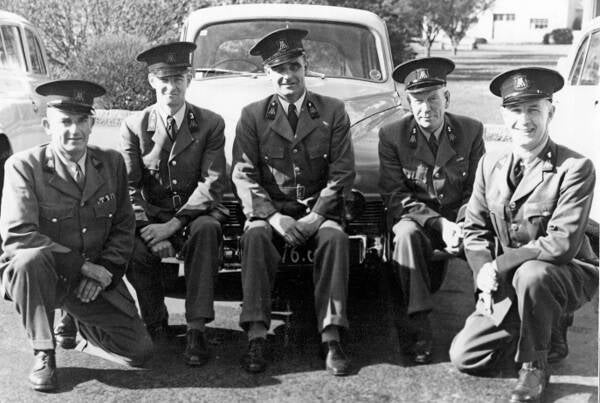
Hawkes Bay Automobile Association
When the petrol station was built, our house was removed and incorporated into a house being built (cobbled together) at the bottom of the hill off Cemetery Road. You could say that Mum and Dad are still keeping an eye on it!
The section in High Street was long and narrow, with a large macrocarpa hedge down the southern side. The house was set back, with the office facing the road, and an old wooden garage in the front, with large wooden doors opening onto the footpath. Behind the house was a back yard with a clothesline and hen house. Along the other side was a narrow strip between the house and the fence between us and the Hargraves house. As Tony remembers it, the house was large, cold, and hard to heat. On frosty mornings the water pipes would freeze and there would be no hot water until the chip heater in the kitchen had been going for a while. When the wind blew, the wallpaper, which was many layers thick and attached to scrim, would balloon out from the walls while we huddled over the inadequate fireplaces. No wonder we lived in the kitchen over winter.
Perhaps my earliest memory is playing under a large kaka beak bush in our back yard and watching the activity in the transport yard next door. At that time, it was run by Bill Hargraves (Snr). His wife (who seemed old to me at the time) was also a kind neighbour, who I would often go and visit. I must have had a tendency to wander (or even run away) as a small child, as my mother used to put me in a harness attached to a long leather lead (they were called reins) to prevent me from disappearing altogether. Sometimes this was attached to the revolving clothesline, allowing me movement around the yard – but not too much.
Such restrictions may well have been justified, as when I was four years old, I did run away. Not that I considered it as such; I just decided that I wanted to start going to kindergarten and there happened to be one just up the road on the other side of York Street. So, I bowled up and joined in. Mum had no idea where I had gone, so naturally she was in a blind panic. She had all the friends that she could muster plus half the drivers from the transport yard out looking for me. Eventually the kindergarten teacher made contact, and I was returned home oblivious of all the fuss I had caused.
I remember that there was a coal box set against the house on the northern side, because I can remember Tony hiding from Dad in it, on one occasion when he was due for some behavioural adjustment after Dad got home.
Both of us were handfuls when we were kids, and we would fight constantly. Not because we didn’t like each other, but because we liked fighting! As an extra bonus, our parents hated it.
It is a strange thing, but of all the memories I have as a child (and they are not that extensive), memories of birthdays simply don’t feature as prominent events. We were a traditional family of the times, and I’m sure that we celebrated my birthdays in a traditional fashion, with presents and a special dinner with birthday cake, etc. but they are not what has stuck in my mind. I don’t even remember having birthday parties outside of the family when I was young, although we may well have had them.
We were more likely to have got new clothes and books than a lot of toys, so I guess that my earliest birthday memory was getting a Hornby Train set. I was probably 4 or 5 years old, and it came in a large cardboard box with tracks you could set up and trains and carriages to run on them. I can definitely remember playing with it on the polished wooden floor in our High Street house and getting under my mother’s feet. It is crazy to think of the prices they fetch these days.
Prior to that there was a large grey stuffed woolly dog which I carried around everywhere with me and played with. It was probably an earlier present, but I simply remember it always being part of my life.
The garage at the front of the section was the scene of my first (but by no means last) introduction to medical care in the town. Back then, Dannevirke was fortunate to have a large (up to 180 beds), well equipped hospital, built during the Second World War to treat soldiers wounded in the Pacific War. It served the town and surrounding district well until it was closed in 1997. But, back to the garage. Tony was working on his bike at the back of the garage, when I went out to tell him tea was ready. Whatever he was doing involved a heavy pair of tinsnips and a lot of effort. Somehow, they flew out of his hand and collected me on the forehead as I poked my head around the door. That produced a superficial cut that required a few stitches to close, but nobody thought much more about it for a few days, until it became obvious that I wasn’t getting any better. So, I was carted off to hospital where they found I had a compressed skull fracture, with fragments of bone pushed back into the brain (yes, I know, it explains a lot!) It is a huge testament to the GP (Dr Stephenson) and that rural hospital that I survived what by then had become emergency surgery, where basically they lifted the top of my skull up and removed the offending bone fragments.
I spent a long time recovering from that in hospital but only remember glimpses of it. One of my more vivid memories (I must have nearly recovered) was of the Thursday line up. They used to schedule tonsillectomies on a Thursday and there would be a row of kids admitted for the day. I would watch them wheeled off one by one, then come back and get woken up. Most of these kids were straight off farms from around the district, and their language when they woke up again was colourful, to say the least! A feed of ice-cream was administered to calm the tempers and sooth the throats.
Later on, that macrocarpa hedge would feature again too. As I have said, we weren’t the best behaved of kids, and Mum was known to have a leather strap handy to threaten us with, and on rare occasions to use on our legs. She gave up on that idea after she found a succession of them, chopped them up with the kindling axe, and the pieces nailed to the macrocarpa hedge trunks. She took to using a long handled wooden cooking spoon after that, but it didn’t take us long to work out that if you let her hit the bony bit at the top of the knee; it did more damage to the spoon than to us. After she gave herself a fright by breaking one of her spoons, she gave up on that idea as well.
Another memory I have of High Street is sitting at the top of a large tree we had in front of the office. I would often climb up there, but I remember this day because we had been listening to the Queen’s Coronation on the radio (no TV back then), when news came through that Hilary had conquered Everest. He had done that on May 29th, 1953, and the Coronation was on June 2nd. I sat up in the top of the tree looking directly over the houses across the road at the dome (Takapari) on the Ruahine Ranges, trying to imagine the scale of what he had achieved.
Sometime around then, on a road trip back from the Hawkes Bay, I must have got my first inkling of an unknown past family history. I had always associated my family with Wellington or the Hutt Valley. That’s where my relatives lived, and that is where my parents came from. My maternal grandmother (who I only ever knew as Nana) had always lived with my mother’s sister’s family. That it was a result of the untimely death of the mysterious grandfather who I never knew, didn’t really register. Neither did the fact that she had been born and had lived elsewhere. But it seems that her parents, John and Elizabeth Morley, had lived at Otane in Central Hawkes Bay. It was obviously mentioned as we drove back down State Highway 2, and as kids, you simply accepted that. There is (or was) a very distinctive old farmhouse in a paddock on a hill, on the left just south of the township itself. I always associated it with where I heard of them as a child as we journeyed back to Dannevirke, although the actual house they lived in was on a sideroad at Otane itself.
Somewhere about this time, Dad contracted Tb. Whether it was M. tuberculosis or M. bovis I’m not sure, but the primary lesion was in his leg, and it spread to the bone. There was obviously a weakness there, as he had osteomyelitis as a child. Dad was packed off to the Pukeora sanatorium just south of Waipukurau. Antibiotic treatment for Tb was still in its infancy back then, and pretty savage. It seemed to me that he was there for a very long time. I remember playing in the grounds on top of the hill, and I remember mum driving us there and back. We had an old Citroen car (traction avante?) complete with front-wheel drive and the gear lever mounted in the dashboard. Mostly I remember Tony and I sitting in the back seat on the journey home, fighting like cat and dog because we knew mum couldn’t do anything about it, and driving her to distraction! It is a wonder we got home in one piece.
Tucked away among the mementos of my parents that I kept after they died, is a poignant letter that Dad wrote to Mum from the Sanatorium. Although undated, he had been there for six months, and had just been told that he would be there for at least another 3 months, taking Streptomycin and INS. It gives a hint of the huge stress that my mother must have been under, coping with two young boys and an uncertain future, with a sick husband far removed from their home. It is also a reminder, in this age of instant electronic communication, that back then even a telephone call was an expensive luxury reserved for periodic or special occasions, and that to communicate with someone, you wrote them a letter. Consequently, they were actually very good at it, and adept at expressing their thoughts and feelings.
The only plus to all of this is I must have been exposed to Tb at an early age and built up a natural immunity. So, when all the other kids were lined up at school for their BCG vaccination (they still did that back then), I was exempt, as my Manitou was positive. It probably didn’t hurt later on either when I was working in a laboratory where you had a 1:8 chance of catching Tb by growing it from cultures. I’m sure that my microbiological technique was impeccable, but having a natural immunity was definitely an advantage. These days, with the knowledge of disease aetiology we now have, it is certain that I was exposed and probably colonised by the disease, and like many others it is tucked away shielding somewhere in my body, kept in check by a healthy immune system.
Dad and the AA parted company in 1958, and we moved to a bungalow at 42 McPhee Street. It was there that I grew up and ‘blossomed’, (as much as I ever grew up or blossomed – I was still a pretty introverted naive kid when I left). Compared to High Street, it was large, as far as both the house and section went. I remember Dad completely renovating the back (kitchen and dining room), and of course the sitting room and rest of the house needed paint and wallpapering as well. We ended up with three bedrooms and a ‘sunroom’ (which became an extra bedroom); but the wash house was still separate from the rest of the house via a covered back porch, and boasted a large copper bowl set in concrete with a gas fire underneath, to do the actual laundry in. It was only later that it was joined by an archaic electric washing machine, with the meanest wringer you could imagine on it. (Oh dear, today’s youngsters won’t know what that means).
The AA House in High Street, Dannevirke (taken long after we were there)
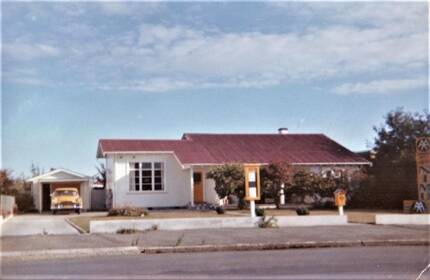
42 McPhee Street Dannevirke
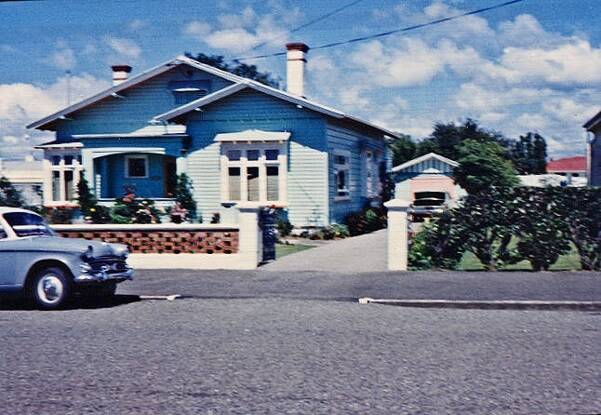
It was about this time that Mum started teaching as has been described previously, firstly at Dannevirke North School, then at Dannevirke High School. Not long after that, we started to take in boarders. While the master bedroom was in the front of the house opposite the sitting room, and Tony and I shared the middle bedroom opposite the dining room, the back bedroom and sunroom became the domain of a succession of high school teachers who were new to the town and school, and who Mum seemed to adopt as ‘family’. It started with Anne Colquhoun, and included Mary Wade, Jenny, Peggy Ryan and later, Jane Reid. I think that Jane was the only one who wasn’t a teacher, but she worked in town. Naturally, having a mother who was a teacher, plus having other teachers living with us, got me viewed with a little bit of circumspection and even suspicion when I also attended High School, but it was also handy in protecting someone as introverted as myself. School yards were not the kindest places, especially back then.
But these extra family members did give us boys an external focus for our high spirits. We used to play all sorts of mischief on them. ‘Apple pie-ing’ their beds, when the bottom of the top sheet was folded up to look like the top creating half a sheet length, was routine. As was filling the resulting half sheet with broken up Wheatbix. And balancing whatever we could find that would make a noise when it fell on top of their ajar doors while they were out. While she was with us, Peggy Ryan bought a brand-new Vauxhall Velux Deluxe, which was her pride and joy. One day, not long after she got it and parked it in our drive, we jacked up the back wheels and stuck some bricks under the back axle, so that the wheels were just off the ground – but not so much that it was noticeable. Ah, the consternation when Peggy jumped in and put it in reverse to drive out, only to have the back wheels spin uselessly. She wasn’t going anywhere! Jane was also the target of our attention. Maybe it was because she could stay out on dates as long as she liked, while we were under curfew. One night while she was out, we apple-pied her bed and put Mum’s dressmaking dummy in it. Then, because she had an adapter on her bedroom light that she could plug her hair drier into, we removed the bulb and plugged the vacuum cleaner into the adaptor. When she did finally get home from her date that night, closed her door and went to turn on the light all that happened was the whine of the vacuum cleaner! It was a long time before she could get to bed, by which time the whole household was awake!
It was a close-knit neighbourly small-town community back then. We thought it suffocating at the time, but it was anything but. Neighbours became family friends, including Jim and Jean Curtis, Roly and Betty MacKenzie, and slightly further afield, Frank and Isabel Cushing.
As kids, we simply accepted what we had (or didn’t have). I don’t remember it ever being talked about, but I think that my parents went through considerable financial hardship with their families, particularly Mums. And after a depression and a couple of world wars, that was probably quite common and accepted. But the world was quite a different place when we were kids, to what it is today. Not only were things built to last, but the average wage was sufficient to sustain and raise a family with only one parent working. Raising a family was accepted and expected to be a full-time occupation for women who wanted to do so. That tended to put some quite ridiculous financial constraints on them, such as not being able to sign a cheque or get a bank loan without their spouses’ approval.
Given that, keeping chooks to supply eggs and poultry was commonplace. If you wanted new clothes, you made or knitted them. When they wore out you mended them. When things broke you fixed them (or got them fixed). You grew your own vegetables and fruit and ate seasonably. Surpluses and bulk buying (particularly with fruit) were preserved for winter. Hawkes Bay peaches by the case, peas and potatoes by the sack. You couldn’t or didn’t buy such things out of season, and there were no supermarkets to import them from the other side of the world. I can’t help but feel that there are a number of skills sets that have been completely lost to the current generations that perhaps shouldn’t be.
Mum had a budgeting system for handling money that she ran for as long as I can remember and somehow our parents always managed to save money, as there was always a ‘Rainy Day’ somewhere ahead that needed hard-earned cash put aside for. One such occasion was when Tony needed his tonsils removed in a private hospital in Palmerston North when was about nine years old. Asked if he wanted a small bed or a big one, he naturally opted for the larger one. He can still remember that was an additional cost for dad, one of those big green twenty-pound notes. That saving ethic was never lost and even in later years when they were just on the pension they still managed to save, supplemented by Mum’s sewing and knitting, Dad’s driving new cars for a local car sales firm, and living mostly from their considerable vegetable garden – the size of which diminished as Dad got older and was less able to tend such a large garden. Frugality and correctness were the order of the day. What people thought of us was important to Mum, so emotions were reined in, and Tony can only ever recall them arguing once, a short-lived affair over a bike for my Christmas present (a cheap import from Czechoslovakia).
That arrived at Christmas 1955, when we were still at High Street, and Tony and I both got new bikes. They became our passport to school, to the town, and to the surrounding countryside. We rode them everywhere, in all weather. After we moved to McPhee Street, they also became a source of income, as we both at various times had paper runs, delivering the local newspapers either before or after school. The Dannevirke Evening News has long since disappeared, along with the children who used to deliver it. Tony used to deliver the Dominion in the mornings before school, and I would sometimes accompany him. The most outstanding memory I have about that is finishing the run (still early in the morning) and heading down to Trafalgar Street at the bottom of McPhee Street. Mr. Cheers used to have a small commercial bakery down there, and if we timed it right, they would just be taking small half loaves of current bread out of the ovens. We would pick up one of those and by the time we got home, the warm sweet insides would have been completely consumed.
Later, I had an afternoon run after school, delivering the Evening News up around the Cole Street, King Street area. That was quite a way to go for small legs, but I thought nothing of it. I can still remember the self-pride I felt when I saved up enough money from my ‘wages’ to buy a new bike. With three gears and both hand and foot brakes, there was nowhere I couldn’t go!
Unless the weather was inclement, in which case we would be in our room reading (or fighting), we would be outside and away, enjoying the nearby countryside. I am amazed at the tolerance that my mother showed over this (although on reflection, she probably had little choice), but as long as we were home for tea we were out of the house and away, where she knew not.
But we had plenty of choices. The Mangatera Stream ran along the eastern edge of town, at the end of our street in fact; just the right size to safely play in, but big enough to hold eels to be caught. If we got bored with that, we could always snap some cabbage tree fronds off the local trees, straddle them between our legs, and toboggan down the grassy slopes. We could cut through to the Dannevirke swimming pool off York Street, across the sports fields of the Upper Domain, and down to the Lower Domain, with its stands of trees, ponds and walks leading down to the camping ground. There was no aviary or deer park back then, but we could make our own fun. And there were the swings and slides in the Upper Domain.
Just past there was Riverdale Road, a steep winding road going down to a concrete bridge across the Mangatera Stream, before winding up again towards the Tipapakuku Road. We always knew it as Swing-bridge Hill, which reflects a much earlier designation.
The hill on the far side of the bridge was a bit gentler and it was there that we used to race trolleys. Building trolleys became quite a thing there for a while, and old prams were especially coveted for their free-spinning wheels. They were a pretty standard design, with a single beam frame holding a rotatable front axle with a pram wheel on each end and a rope loop to steer with, a fixed back axle holding the back wheels and an apple case on top to sit in. They could build up quite a speed downhill too. There was just one design flaw that we never mastered, and that was brakes! There were three alternatives. You could build a lever that applied a bit of wood to one of the wheels, but that tended to influence the stability of the cart when going at speed, so it was really only useful on fairly flat surfaces or slow speeds. You could deliberately steer into the bank on the side of the road – as opposed to the ditch on the other side (not without its own perils at speed). Or you could hold on for dear life, try to keep the cart as stable as possible, and use the hill on the other side of the bridge to slow you down. Provided you could negotiate the sharp corner just beyond the bridge! We thought this was great fun, although sharing the road with the occasional car was a bit problematic. And of course, there was no safety equipment of any kind if you did crash, which served as a great incentive not to – especially after the first time.
But we ventured far further afield than that. To the north of town at Mangatera we would wander up the stream in summer, lying on our stomachs in the warm grass looking into the water and poking koura (freshwater crayfish) with the stems of rushes or ryegrass until they fastened on to them and we could flip them out on to the grass. When we had a few, we would boil water in an old tin can, drop them in for a minute or two, then sit back and eat them. It was here that I saw my first wild trout. I was searching for koura when this impressive fin and bow-wave hurtled upstream. Many years later, I learnt that there used to be a hatchery just downstream from there.
Beside the Mangatera Stream was an old quarry, whose deep pools held large numbers of frogs and tadpoles. It was a favourite playground of ours until one day, when the water was nice and muddy from chasing tadpoles, I stepped on some broken glass and sliced my heel open. That necessitated flagging down a passing car and a quick trip to the local hospital to get ten stitches put in, and a tetanus shot in the heel that I remember to this day.
Just to the north of the stream, the road went up a hill through a cutting. There was a large pine tree on the downhill side of the cutting (long since removed). We used to borrow one of Mum’s old purses, attach it to a length of heavy nylon, and toss it on the side of the road. We would hide behind the tree and wait for a passing motorist to spot the purse and stop. While they stopped the car, we would haul in the purse and scarper.
To the south of town, where the Weber Road crosses the Mangatera Stream, was Timber Bay. When I was older, I used to go there and dig fossil shells out of the soft papa banks. I even went as far as sending some down to the Dominion Museum to get them identified and aged. That sparked an interest in Geomorphology. That in turn lead to a later appreciation of landscape art and photography.
About 15 km to the west of town are the Ruahine Ranges. Even that wasn’t too far for us. I remember us biking out to the forest park, climbing up one of the tracks and sliding down the shingle scree, before biking back. We thought little of it, but today it seems a considerable journey - by car.
There is another memorable incident that is worth recording from when we were living in McPhee Street. Our elderly neighbours on the eastern side of the house passed on and were replaced by a young couple. The thing that I remember most about them was that they had a Fox Terrier, which I was quite impressed with. But the husband, whose name I can’t even remember, was a top-dressing pilot and he gave me my first flight in an aeroplane. It wouldn’t be possible in these days of Health & Safety Regulations, but back then was different. We took off from Dannevirke airport (more an airstrip back then) very early on a cloudless summer’s morning. In those days the airstrip was surrounded on three sides by a large macrocarpa hedge, and you had to clear the sheep off the strip before you took off. We were flying in a DH Beaver top dresser with a large radial engine in front. We had a quick, smooth and uneventful flight down to Masterton airport to see if his mate’s plane was still there. Smooth and uneventful that is until we got over the airport and he flipped the plane on its side to have a decent look around. That left my stomach somewhere back behind the plane, but I soon recovered. His mate’s plane wasn’t there, so he decided that he was probably working out in the Puketoi Ranges, and we would go and join them.
Once again, it was quite pleasant flying out over the Puketoi foothills, watching each ridge come up then slide underneath the plane as another valley opened up below. Pleasant until my pilot leaned over and said, “see that down there?” pointing to a heap of metal halfway up the next ridge, “that was the plane I was flying last week. Didn’t see that damn line strung across the valley!” I guess I paid a little more attention after that and soon we came to the airstrip his friend was using. Again, my interest was heightened further, for it was perched on the top of a rather large hill. Even my pilot was concentrating now, as we flew straight at the top third of the hill and he wound back the flaps, cut the throttle, and as the nose lifted, we popped down on the top of the hill. It sounds easy when you say it like that, but it impressed the hell out of me.
After catching up with his mate, it was time for us to return. Again, that was an interesting experience, involving winding the engine up with the brakes on until things started to shake and then flying off the hillside until the lift caught us and we were away! Back to Dannevirke we flew, but the excitement wasn’t ending there. To land back then involved drifting down over the tops of the very large macrocarpa hedge on the western (road) side of the strip, buzzing the sheep off the strip, then sharply turning and putting it down before they came back again. By then I counted myself as a seasoned passenger. Even today, that moment when a plane you are in taxies to the end of a runway, and accelerates for take-off, takes me straight back to that hilltop in the Puketoi Ranges.
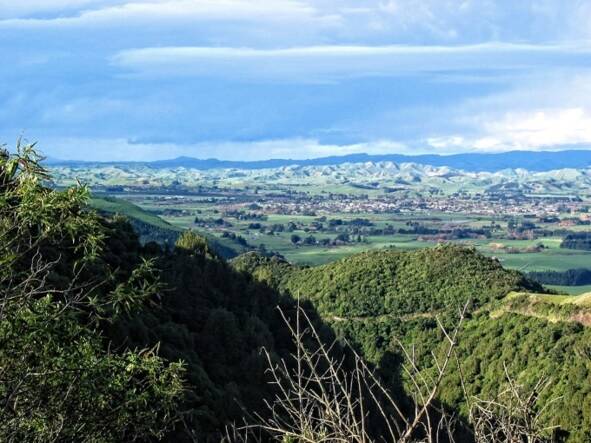
Puketoi Range from the Tararua Ranges.
Holidays, particularly trips away, were usually purposeful, social occasions for my mother. They were used to catch up with friends and family. There would be trips down to see her mother and sisters’ family, either at the farm out from Martinborough at Christmas, or their house at Lower Hutt, and later Carterton. There would be trips down to see Dads parents in Wellington, or his family, particularly his brother Norm’s family who we were close to. Visits were also made to their friends from Wellington such as Lorna and Jack Higgins at Tawa. One memorable holiday trip was to visit the Moats family at Taupo. Gwen Moats was a long-time friend of Mum’s; I think from when they both worked at the Ford Motor Company making munitions during WW11. Her husband was working at the Wairakei Geothermal Station just north of Taupo, and we had a very impressive tour around the geothermal field, including the ‘rogue bore’ that had swallowed up half the previous road through the field..
Another very early Christmas holiday was spent at Pourerere Beach with the Hendy family, Rowena Hendy being a friend of Mums. They used to live in Dannevirke, up by the showgrounds, and I always had a lot of respect for their four boys, who went on to excel academically. Back then, Pourerere Beach was pretty primitive, and the Bach was down by the old Whaling Station, with plenty of huge old whale bones still lying around. You could only get in and out by driving down the beach, and you had to time the tides just right to do so.
So, holiday trips away, just for the sake of a holiday, were very rare and only two stick in my memory. There were a couple of trips up to Hastings, where we stayed in cabins at the Kennedy Park Motor Camp. While there was a swimming pool and swings and stuff to play on (my brother was much more enthusiastic about swimming than I was) my main recollection was that it was pretty boring, despite the trips up to the Napier foreshore.
The other was a trip up to the Crystal Hot Springs, about 7km out of Matamata. This was a holiday park with motel accommodation and a couple of thermally heated swimming pools surrounded by native bush. We spent a lot of time either swimming in the pools or tripping around the Waikato. This was before anyone knew about the dangers of amoebic meningitis which ultimately closed the pools in favour of the nearby concrete lined Opal Hot Springs, although in a strange twist of fate, I was working in Microbiology at Waikato Hospital when it was discovered, in the most unfortunate of circumstances.
It is only with the knowledge and vision of hindsight that this trip becomes more unusual, and which also perhaps throws some light upon it. It was the middle of winter, and rural Waikato in winter is not a particularly appealing place. It was cold and wet, and a seemingly unusual choice for a family holiday. And it wasn’t until January 2021, that it began to make any sense. That was when I received an email from a Margaret Lines (who I didn’t know from a bar of soap at the time), who had discovered a close DNA relationship between her family and ours, and a half-brother, as has been described previously.
Malcolm, the half-brother we never knew, lived and died in 1993 at Waharoa. He and Margaret owned and ran the dairy opposite the Waharoa Dairy Factory (both of which have since been demolished), and later he was a roofing contractor. The thing is, Waharoa is just 23 km up the road from Matamata. Did Dad know this, and was he looking to make contact? And did Mum know also, and was she supporting him? These are questions that I’ll take to the grave, as all of those involved had died before my brother and I knew anything about it. If so, it was a remarkable secret to keep from us for so long, but as I have said before, social acceptance and appearances, and what others thought of them, were very important to my mother.
School Days
Primer One - Dannevirke North School
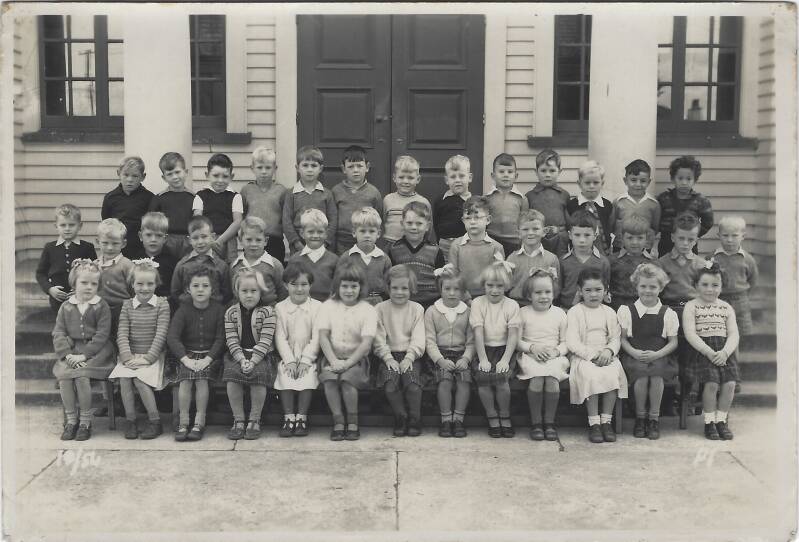
Gradually, formal education and the school system played a larger and larger influence in my life. It went from something that you just accepted, to something that you tolerated, to (eventually) something that you appreciated. I started Primary schooling at Dannevirke North School, which is now called something completely different (Ruahine Range School).
North School didn’t leave a huge impression on my memory, with one exception. It obviously had some infrastructure issues because around standard two, our class got to have our schooling at one of the produce halls the Dannevirke showgrounds just up the road. I don’t think that it made a significant difference to our schooling, but being away from the main school seemed like a bit of a holiday to us.
After Standard 4, I switched to South School for my last two years Primary schooling. I think that it had a much better reputation academically. I enjoyed it. During my last year there I even got to be organiser for the School Patrol, which supervised a busy pedestrian crossing across the main road just up from the school.
Then it was off to Dannevirke High School to complete my education. The DHS was a large school serving not just the town and environs, but also further afield by virtue of having a boarding school attached. Country kids either came and went by bus daily or stayed at the boarding school if they were from further afield.
You have to bear in mind that schools back then were very different places to what they are today. They were much more rigid and rule-bound for a start. And from a very early age, corporal punishment was not just accepted, it was expected. If you broke one of the myriads of rules, you could expect to be punished. Getting a rap over the knuckles with a ruler progressed to getting the strap in front of the whole class, where you had to extend your hand out, palm up, which was then hit forcibly several times with a leather barbers’ strop. Once at High School, corporal punishment also progressed to ‘the cane’. While not used as often as the strap was at primary school, its impression and effects tended to be a bit more long-lasting. If you had a difference of opinion with one of your fellow pupils, you were expected to sort it out in the playground or behind one of the school blocks. Given that a lot of them were fairly big lads straight off the farm, some with a well-developed sense of privilege, one of the early lessons that you learnt was who not to annoy!
The other very different feature of High School back then was compulsory military training. This involved every boy at school dressing up in military uniforms and marching around the sports fields on parade. Believe me, we had some teachers who were natural born sergeant majors as well. One of the things that it also involved was rifle drills, where you learn to strip down, clean and reassemble very real Lee Enfield 303 rifles. I can’t see that going down well in today’s education curriculum.
DHS Cadets, taken on the bank leading down to the bottom field.
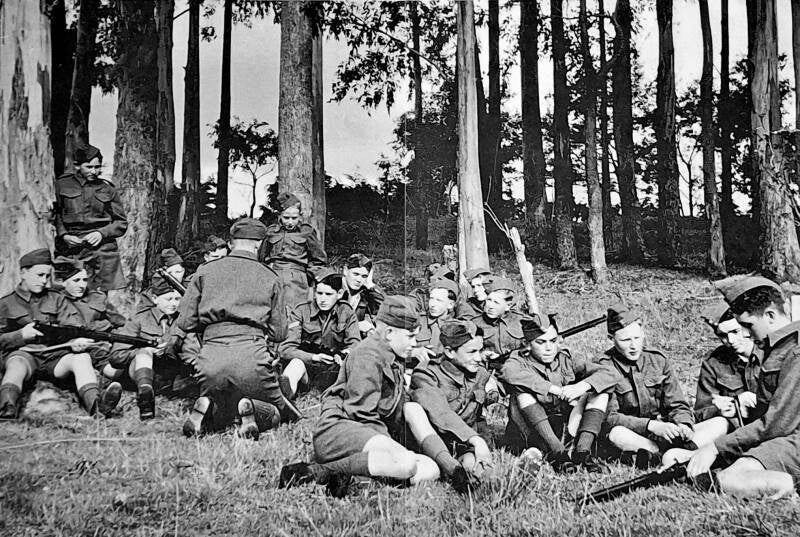
Other compulsory activities involving the whole school were sports (additional to PE classes) which mainly involved cross-country running, and singing assemblies. The periods where the whole school came together in the assembly hall for singing (mainly hymns) were interesting too. Mostly they were fairly chaotic, and when various factions of kids decided to play up, largely out of control. But just occasionally, as if by some unspoken agreement, the whole school would decide it was going to sing. Then it would almost literally raise the roof and leave the music teacher shaken.
Sport was interesting in what it taught me about both myself, and those who played it. The DHS was a very traditional place, as exemplified by the ‘school song’ which was ‘Forty Years On …” which I also hated. If you were a boy you were expected to play rugby in winter, and cricket in summer. For girls it was netball or hockey and softball. The jocks in the rugby 1st Fifteen were exulted at school and tended to be held up as a shiny example of what to aspire to and featured prominently as Prefects and Head Prefects. You didn’t have to be a genius to work out that a lot of them were academic dullards and to put it mildly, bullies. Consequently, I avoided rugby like the plague and was lucky enough to be able to play hockey instead, as we had a couple of teachers who were pretty proficient in the sport. I used to play on the left wing, not because I was particularly talented, but because I could run faster than the others. The biggest problem with playing hockey at that time was a lack of competition (everyone played rugby), so we used to compete in the town’s senior competition. There were a number of country teams we would travel to and play, which sometimes involved chasing the sheep off the paddock in places like Norsewood before we could compete. Generally, sport at school reinforced what I was learning about myself academically. It was not about a lack of ability, but a lack of competitiveness. If I did something it was because I was interested and wanted to, not because I wanted to be ‘best’ at anything. Another reason why a rigid academic pass/fail system left me dissatisfied. Even back then I realised that no matter how good I became at something, there would always be lots of people who were better, and that was good thing because you could always learn from them. But throughout my life I have been continually tripped up by people and systems that judged you for being ‘better’ than others (or not, as the case may be) and made everything competitive.
Despite being mediocre academically, I was streamed into the top science classes. There I struggled with chemistry, physics and maths, as much because most of the curriculum lacked relevance to me and involved a lot of rote learning, as anything else. My saving grace in science was being able to switch physics (which I hated) for biology (which I loved). I was also a dead loss at French and managed to abandon that in the fourth form. I was still pretty immature at the time and consequently missed getting School Certificate on an aggregate pass in my first year of fifth form and returned to repeat it the next year. That year made a world of difference, and I suddenly discovered a love of critical thinking which made things like English comprehension (literature) a breeze and a delight. I still had issues with maths as well as the examination system, but back in those days there was no such thing as internal or cumulative assessment, you had one crack at a formal examination, and you either passed or failed.
So, I drifted through the school system. I enjoyed English because it led me deeper into the analysis of literature and books, which I had always liked. It also gave me an opportunity to express myself through the written word, and I found that I enjoyed that. I appreciated art and music, although I was not talented in either. I loved biology because it related to and explained the natural world, and I had a deep love and respect for the natural world in all its forms. I grew passably good at sport (hockey) despite struggling with a lack of competitiveness. Everything else was something to be learned, regurgitated, and forgotten. I was cognisant enough to realise that, apart from the jocks of the school, there were two types of achievers. One worked really hard and maximised their knowledge. The other just seemed gifted and achieved with the apparent minimum of effort. I had friends who fitted either description. I also knew that I was neither, I wasn’t going to set the world on fire or be a captain of anything. And that was just fine.
As the inevitable end of my secondary schooling came ever closer, the question of ‘what did I want to do next?’ became more insistent. From my point of view, it was more a question of what I didn’t want to do. I was quite sure that I didn’t want to become a teacher, like my mother and brother. And I was sure that I didn’t want to go to university without a clear and pressing goal of what I wanted it to lead to. Even though back then it was basically free. Somewhere along the line, it was suggested that I have a chat with the technologist running the laboratory at the local hospital (Ray Gibson?) He was a nice, approachable guy (and it annoys me that I am unsure of his name) and certainly encouraged me to look further into making medical technology a career. Although not in a position to offer training himself (the lab was too small), he suggested that I apply to Waikato Hospital Laboratory in Hamilton, which back then was a large teaching establishment taking on more than 30 trainees a year. The idea appealed to me on several levels. It was biological science based. There was the concept of helping others, without the arduous prospect of training to be a doctor. There was the prospect of being paid while you trained for a qualification. And then there was the prospect of leaving the small-town confines of Dannevirke behind, which as a teenager seemed really attractive.
In the end I wrote away, asking to be considered for their next training intake; as well as sounding out several other government science establishments, mainly based in Palmerston North. I almost immediately heard back from what was then DSIR Grasslands, based in Palmerston North, who were looking for a trainee technician. While botany wasn’t my overriding passion, it was a good opening and was soon followed up with an interview and an offer of employment. No sooner had I accepted this, than a letter arrived from Waikato Hospital offering me a place in their next intake – sight unseen! Such are the twists and turns of fate that shape our lives. It really was a ‘no contest’. I cancelled my acceptance of the Grasslands employment and made a quick trip up to Hamilton, was interviewed by the Senior Pathologist and Technologist, and accepted into the following years intake as a trainee medical technologist.
So began the end of my childhood, and a major chapter in my life. I secured boarding with a nice family in Hamilton, within walking distance of the Hospital. My brother Tony, now a qualified teacher, had been teaching in various country schools from Mauriceville to Foxton, before returning to the local Hillcrest school in Dannevirke. There he met and married another local teacher, Marlene Kelly, whose family farmed on Topgrass Road at Te Rehunga.
My interests had already started to coalesce. Apart from the normal teenage interests in contemporary music, dances and girls, there was still a love of reading, an abiding interest in the natural world including its geomorphology, and the beginnings of a passion in freshwater angling. I was becoming fascinated by the landscapes that surrounded me, from the dappled textures of a forest canopy to the way the early morning or late afternoon light picked out and accentuated the valleys in the surrounding hills.
Sixth Form – Dannevirke High School
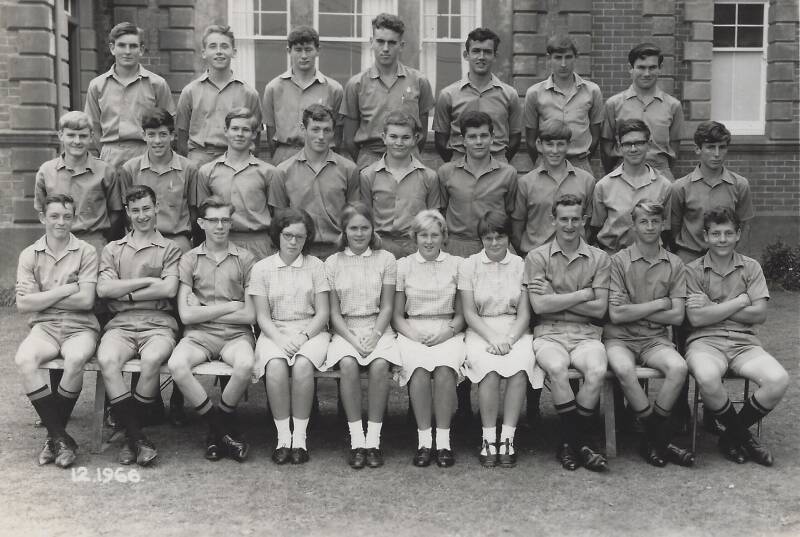
Anthony Geoffrey (Tony) Sims.
Before leaving this chapter and my childhood behind me, it seems an appropriate place to record my brother’s experiences. And how better to do that, than in his own words, which he recorded in 2003, after Mum died. While I have incorporated a lot of his early childhood in the preceding pages, I will pick up those from Dannevirke and beyond here.
Small town New Zealand was a wonderful place to grow up and live in then. This is certainly not the case today.
When Dad joined the Automobile Association, his territory stretched from the Manawatu Gorge to the top of the Sanitorium Hill, just south of Waipukarau. Which was a bit prophetic, as he was to spend a lot of time there later, when he has tuberculosis. I often travelled with him and can still see the Manawatu Gorge flooded to road level, with horses and cattle being swept past us, and the huge slip that came down just after we had driven out of the parking area.
From Dannevirke, and even before we shifted there, I would spend my school holidays staying with my aunt and uncle. Tom was originally a driver for General Motors in Petone, and then in later years, became a buyer for them. He would take me to work with him on the bar of his bicycle, and I enjoyed the attention I got, as he was a popular worker and got on well with all the others there. My Captain Marvel tee-shirts and Superman tee-shirts were always the source of a joke or two. First by truck and later by van, we would spend the days about Wellington delivering car or truck parts to and from General Motors. It was a magical time visiting factories and businesses and there always seemed to be perks, both for me and for Tom, who seemed to be good at doing favours for people. Lunchtime was spent fishing from Queens Wharf whilst eating fish and chips or a pie, and the cat always had a good supply of fish nibbles. One Christmas I recall that the tray of the Bedford van was literally covered in hams, cases of whiskey, flowers, beer, wine and other assorted items like slippers, shoes, and clothing. To a youngster it was an amazing experience. On another occasion we filled the cab of the truck with bananas from an overturned railway wagon, along with many other truckies who happened to be in the yards at that time. The stadium now stands there.
Other well remembered times include watching the Sunderland Flying Boats taking off and landing in Evans Bay at the start or end of their long Trans-Tasman flights or waiting in the cab of the truck while ships were winched up on to the hard at the Patent Slip, having to cross the road to do so.
I outgrew the asthma thanks to all the breathing exercises I was ‘encouraged’ to do by joining the local brass band (spit and dribble we called it), playing rugby on Saturday mornings (playing barefoot in the frozen mud, which was only painful until our feet got too cold to feel the pain), running with the local Harrier Club on Saturday afternoons, as well as taking up a paper run in the mornings and afternoons. Six days a week I hauled over 10 Dominion’s in the morning and the Dannevirke Evening News in the afternoons. The delivery took over an hour and I was paid the princely sum of one pound two shillings and sixpence per week – paid fortnightly less any papers missed. The bag of papers on my bike was often so heavy that if the bike fell over, I could barely pick it up. The crossbar on my bike (my father’s old bike) broke – through age most likely, and I made my first memorable purchase of the most expensive bike in the local shop. £23 it cost and I was able to pay it off over Christmas with the help of tips. It was without doubt the fastest bike at all our school picnics; it had a new and radical three-speed gear system. It was very much in use as we knew every fruit and nut tree in the town and made a point of ‘visiting’ them all, and any visiting groups such as the circus that came to town each year. They must have had trouble with an elephant one year as it wrapped its trunk about my legs (I was obviously standing much too close) but I managed to wriggle free. The next day they all paraded through the town, down the main street from the showgrounds, all except the elephant which bolted and ran through town pulling a gypsy caravan behind it. I recall the ground shaking as it ran past our house.
Our explorations of the area were helped with family outings (those dreaded Sundays drives) to the normal mushrooming, pine coning and manuka gathering areas, all important money-saving activities and practiced by everyone we knew and to the best of my knowledge permission for these was never sought or given.
In addition to knowing all the fruit trees in the area, we also knew the creeks and streams and every eeling hole around. We had many successes, even managing to persuade my mother to cook them for us. Our largest catch was in excess of six feet long and was caught while eating lunch under a bridge. It was wriggling its way across the ground and presented quite a challenge, both in catching it and getting it home, causing quite a stir as we staggered up the road with it slung between us like the prized object it was.
The hill up which we caried the eel was also our trolley hill, and I cringe at the memory of all that skin I and others left behind as the old pram wheels salvaged from the rubbish dump either gave up or fell off the trolleys with the speed and force of the corners we careered around. On one occasion a friend had a close brush with a large truck, passing beneath it as he sped downhill screaming in fright and totally out of control while the truck lumbered uphill, both meeting on the same corner. When I look at the hill today, I seriously question our sanity.
Good wheels meant good speed, and my cousin Chris, who lived above the Wellington airport in Strathmore, had good wheels and a long, long steep footpath to speed down. The trolley was not big enough for Chris, Ken and me, so we made a trailer. This arrangement worked well for a few minutes before the speed threw the trailer off, after overturning and spilling Ken out on to the road some distance back on a corner. But on we careered until a telephone booth bought us to a sudden and painful stop, shattering the side of the telephone booth.
Cousin Chris also bequeathed me a pair of brown rubber-soled shoes, the first I had ever owned, and which made me feel great, and what a grip I got when racing about the place and how light they were compared to the heavy black leather soled shoes I had only ever owned until then, although most days I, like most kids, went barefoot at school. One classmate, Paul Bartlet, took pride in never wearing shoes for the whole of his primary schooling. How he coped with the frosts and cold, I do not know, but his feet were like leather. My mother exercised her sewing skills and cut down a pair of my father’s uniform trousers, fob pocket, hip pockets and all, and they made a pair of shorts to die for. No one ever wore long trousers, and jeans, when they appeared on the market when I was about twelve, were forbidden, as respectable boys never wore those sorts of things according to my mother!
A couple of Christmas holidays were spent at Pourerere Beach, out on the coast from Waipawa, with the Hendy family, who had access to a Bach there. Pourerere, with all its reefs and rockpools was a great place for kids to explore and learn about things aquatic. We set nets each tide, and a crayfish pot was dangled over a reef, and was always filled to overflowing, and often came up with an octopus attached. The area had been a whaling station and there were many sections of backbones and other bones and tri-pots still there that made great playthings for us kids. At high tide there was no access to our Bach several miles down the beach, and to get fresh milk and bread the duty fell to us kids to walk the beach, collect the goodies from a huge station ‘mailbox’, and return before the tide closed us off again. This also made arriving at, and leaving the beach by car a little hazardous, and on more than one occasion one car had to be towed from the wet sand by the other with the tide lapping at its tyres and rather excited occupants.
The bulk of my primary schooling was at Dannevirke North School. They seemed happy days. Three brothers (of the non-clergy type) taught at the school, and from the ex-naval one I developed my interest and enjoyment of poetry, which he took the time to talk us through while in Standard Two. Thus Banjo Patterson and the like became preferred reading, along with Biggles and Captain Hornblow. He somehow bought to life Horatio holding the Bridge, and the Sounds of the Congo had the very smell and heat of the place. There were more men than women teachers at the school and at afternoon break the male teachers would all gather for a cigarette, some rolled their own whist others got into the ready-rolled variety.
It was an interesting experience meeting him again many years later at an NZEI conference, he the principal of a small rural school and me the principal of Winchester in Palmerston North. He seemed smaller too. He taught us in a leaky Prefab – when it rained we would have six or seven buckets or containers collecting the drips. But the wood fire in the front of the room was wonderful, especialy over those wet, cold lunch hours when we could toast our sandwiches. I recall 28 frosts in a row one October and it could really get cold there.
One Easter my mother made her usual dough for the Hot Cross Buns but to her horror nothing happened so I was dispatched to the bakers for some more yeast and the dough was made again, the first batch being dumped in the compost trench my father always had in the garden. In the cool frost of the next morning there was a huge white, gently steaming mountain of dough emerging from the trench that provide great interest and amusement, not just for my brother and I, but all our friends s well.
The old gas-powered copper (Dannevirke made its own gas from coal at the time) that took up so much space in the washhouse and which was the center of much activity on Saturday mornings when the sheets and shirts were boiled furiously, was joined by a modern washing machine that had its own wringer on top. The old mangle was relegated to the rubbish heap. And from what I recall, the next savings project was to produce in a years time a brand new refigerator, our first. That was a lot more exciting for us kids than the washing machine, no more warm milk and having to get meat out of the meat safe outside, and we now had the opportunity to make icecream, which my mother did – rock hard it was too.
My class went on a farm visit at school, about a 20 minute walk away. The parents of a classmate had a dairy farm with pigs, whey, cheese and a few killers, - those suffolk sheep in the padock next to the house. This was a new concept to me and made quite an impression, as it was a preferred occupation for many years. The whole balance, cycle and sense of the farm really appealed.
One advantage of being a senior pupil and a boy at that, was to become a milk monitor. Not only did we get to secrete a few bottles in a cool spot for ourselves, but we got to stack those wonderful metal crates. Weighed with a fellow pupil, those crates would just fly down those wooden corridors, much to the danger of anyone who dared step out of a room. Not to be outdone, the senior girls (the Prefects) were allowed to wash the Headmasters car (an ugly Standard Vanguard) and this in a school that would not let pupils be part of a class photo if they were not in uniform!
Remember those half-pint milk bottles? The race against the teacher to drink down the cold milk, and the pain above the eyes after doing so? I remember also, the tiny ‘bookrooms’ that served as school libraries, and how tiny the staffrooms were, not that pupils other than the senior girls – the staffroom monitors – ever got to go into the staffroom.
‘Carrot-top’ Everdon taught us in Std 5. He had a great sense of humor, and the quickest strapping action I have ever seen or experienced. During a spelling test he gave us the word ‘thrust’ and in the approved manner used it in a sentence “I will thrust this broom through the window”, which he duely did, and if the shattering glass didn’t stun and delight us, his following exclaimation certainly did!
Much to my envy, the neighbouring class of Wyn Yeoman’s (I think) had the most wonderful adventure where they put their bicycles on a train, took them to Gisborne and then cycled back to Dannevirke over the next week, stayhing in schools on the way. I recall pleading with our teacher to do something similar or better, but to no avail.
As a Primary aged student, there were two important dates each year; Labour weekend when we literally ‘broke the ice’ on the public open-air swimming pool, and Easter weekend when we had our last swim of the season, and the water was equally chilly. There was always a queue and a competition to be the first in the pool for the year which ofter meant standing, mostly naked, in the freezing air or rain, waiting for the pool door to open so we could rush in, throw our penny at the custodian and dive in, and then spend the next hour or so shivering and trying to get warm. Today I’m not at all sure why we did that, and wonder if those sort of crazy customs continue.
However, it was while I was at primary school that my uncle and aunt began taking their holidays camping on a farm out of Martinborough – which later became Blue Rock Winery and then Murdock James. For years, they would pitch their tent, and having no kids of their own at that time, seemed to adopt me. I’m sure that is where a lot of my enjoyment of the outdoors came from. Over time, the tent became a wooden bach and many home comforts crept in. Rabbit shooting was the norm, but pigs and deer were also accounted for. I was still shooting there when at Teachers College and count myself fortunate in seeing and shooting over mobs of deer of 50 – 60 animals as they gathered around the waterhole. A ten pointer in velvet was my best trophy – the head being carried back by my brother, while I carried a full pack of back steaks. The velvet was worth £51 the next day, which added to the success of the hunt. Interesting to think that in later years, I would be back living in the area.
It was a quick transition to Dannevirke High School and being streamed into the ‘professional’ stream, French that meant, but also none of the really interesting subjects I really wanted to do, like geography, history, woodwork, metalwork, etc. I never really enjoyed those years at secondary school, but the holidays were a different story as I worked on as wider variety of farms as possible. Dairy farms, sheep farms, cropping farms, and a sheep station out at the coast where I found out what wind in really like. A friend and I got that job under false pretences – being able to ride a horse was a requirement that we fudged the truth on to a certain extent. So it was a shock, just after arriving, to be shown the horse paddock, tack rooms and stables and being told we were to select a horse early the next morning and saddle up before breakfast, so that we could make an early start. The next task was to shoot a beast for the cook to deal with, none of the shepherds had the stomach to do the job, so it fell to me. At breakfast it became apparent why a beast was being sacrificed – as the steaks hung over the edge of the plate and barely stopped the four eggs from slipping off.
After the drama and terror of trying to first locate a horse in the dark and then persuade the monsterous thing into the stable, where it impatiently tolerated my fumbling attempts to saddle it, the next eight hours spent riding around with a shepherd learning the lambing beat, was a piece of cake. Necessity makes for fast learning, and the next day we were on our own, getting back some ten hours later, just in time to stop a bad tempered search party from heading out after us. Within a couple of days I was off on my own, seriously tending my flock, but when meeting up with my mate at the end of the day we raced about the circuit, galloping at speed along streams and tracks, and scaring outselves silly. When speeding back to the warmth of the shepherds quarters the horses jumped the cattle stops with us hanging on to their necks and only just stopping on the cobbles of the stable yards. It is easy to see why we needed a fresh horse each day.
That’s where I learnt why the shepherds carried a skinning knife, what dog-tucker really meant, and that time often meant the most expedient course of action for a ewe in trouble was simply to cut its throat. I even saw experienced shepherds perform rudimentary caesarians and came to see that beneath their gruff exteriors they were all big softies.
One day the wind was so strong I needed to ride the horse against a hilltop farm gate to get it closed and on another occasion the wind pinned the horse and me against a rocky cliff, which didn’t do my leg too much good.
An on-going and year long money earning project occupied 6 of us for much of my 4th form year. Neil’s father and mother had several acres of land on the outskirts of town and offered us kids the biggest macrocarpa tree to fell and split into fenceposts, for which they had a market. We went to auctions and farm-clearing sales where we bought a large two-man crosscut saw, axes, smaller saws, a sledge hammer, mallet, wedges and, wonder of wonder, a blasting gun. Weekend after weekend we worked on that tree. Boughs were sawn off and stacked, and the small branches piled up and burnt, until we were in a position to have the main trunk felled. All this activity wasn’t without its causalties. A bough fell on Neil’s foot whilst up the tree sawing and split it badly, meaning trips to the hospital and stitches. Blisters and sunburn were common and we frequently had barely enough strength left to bike home after a days labour there. We bought blasting powder from the local hardware shop, having to sign for it, and began the never-ending task of splitting up the tree trunk, having practiced well on the boughs already stacked. The pile of stacked fence posts grew each weekend and we had to renew our wedges and sledgehammer. The trunk was not about to split easily, and we had to work like demons to prise posts out of it. We advertised our posts, but had no takers. About that time Neil’s parents sold sold their property, along with our pile of posts and what was left of the tree trunk and badly worn saws, axes, sledgehammer and broken blasting gun. In hindsight, the work kept us out of trouble for the best part of a year, gave us a great challenge, and no doubt did its bit in developing 6 teenage bodies.
Tony, splitting fence posts out of the Hawes macrocarpa.
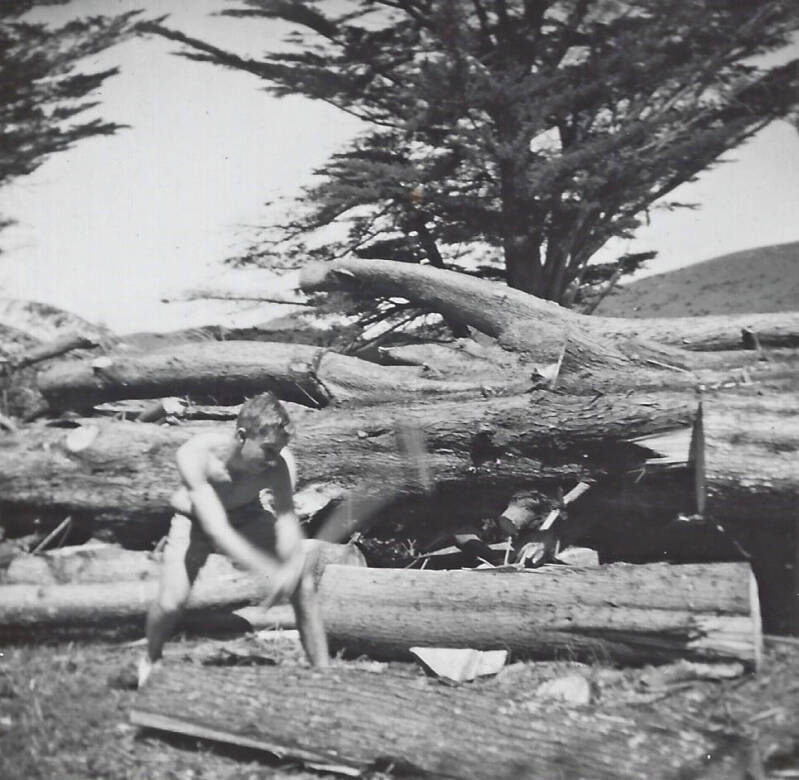
Tony with the Harriers Cup
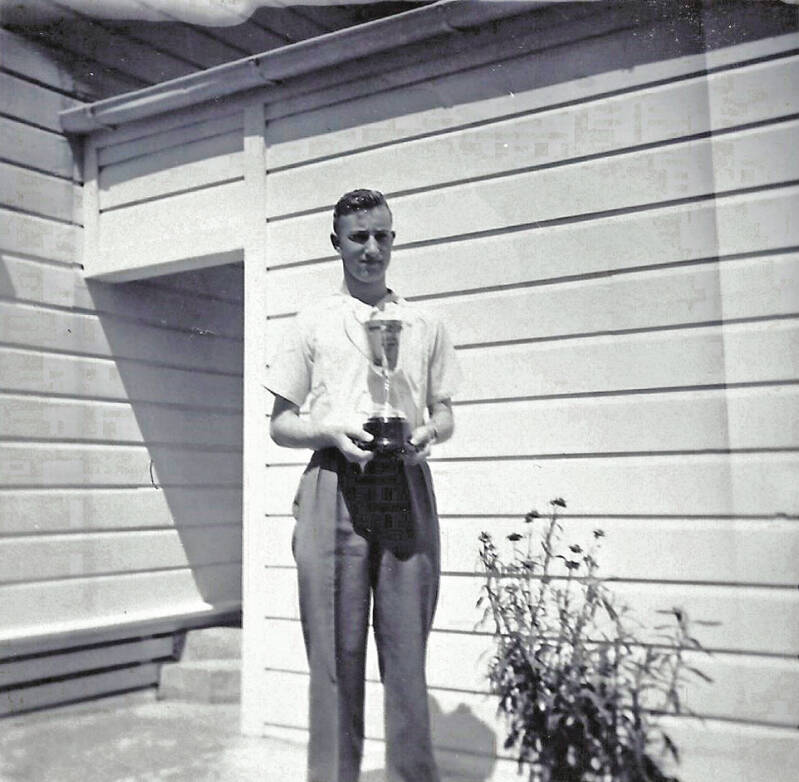
The paper-run had given way to working in the grocery department of Wairarapa Farmers (later Wright Stephensons, Hayrights and then oblivion). I worked there before and after school and during hoidays. It was an oldfashioned grocery with high shelves and a mobile ladder that ran along a rail, and up which we scrambled to both stock the shelves and empty them as we served customers or made up grocery orders. I had some favourite tasks – slicing cheese from the huge rounds with a wire strand was one, another was grinding coffee, before the days of instant coffee, although I recall after some years we were allocated 6 tins of imported Nescafe per month. The other task and one a little more dangerous was slicing bacon off the rolled sides. I lost at least one thumb nail in the process. A least favoured task was bagging the sticky dates after taking them from their wooden packing boxes and removing all the wevils.
Moving an old fashioned store like that to a more modern approach with deep freezers and display cabinets wasn’t without its problems. Cleaners were engaged, giving us more time to do our job, but on two occasions they switched off the new freezers and display cabinets at night with the result of all the frozen food thawing and not being fit to sell. On each occasion, the throwout foods almost filled a truck, which I directed to home. We ate like kings for several days, as did friends and neighbours, with foods we only ever dreamed about.
One learns that every trade has its tricks and perks. I learnt from the permanent staff how to open sauce bottles to flavour the saveloys we now sold, how the sauces all tasted different, how to opwn pickle jars and have a taste from each, how to cook the wonderfully thick bacon ends and ham steaks, how to eat the returned chocolate tabs (wevills and all) as long as gthe wrappers were kept, and best of all, the wonderful flavour of some imported cheeses. I think it was Bonz cheese from Australia that came in large tin rounds some 60 cm across, that made me realise that all cheese, like all foods, are not equal. Sometimes the internal pressure on those tin rounds was such they blew holes in the tin, but the wonderfully pugnant cheese made our normal chedder taste like soap. It was ‘tasty’ for me from then on.
That, and my other farm-working holidays provided a whole host of memories, and a whole lot of growing up and learning about people, myself included. What boy wouldn’t love swimming horses across a wide and very deep river pool, sliding on horseback down steep, wet banks, cattle drives of over 1000 head of stock, mustering a 1000 acre paddock, driving tractors and milking cows morning and night, and spending days scrub-cutting with hands soft from the milking shed and being told to pee on the bleeding blisters that eventuated.
As a student, and later as a Prefect (the first to be caned in years) I was involved in several delegations to the Principal of our High School in order to bring about a change in interschool sport. He was rather incredulous that anyone would actually want to do cross-country running when there was rugby to play (but at least it wasn’t soccer!) and as for playing softballi n summer instead of cricket – how the world was becoming americanised! Sport was a significant part of my life and much time was devoted to its pursuit. Weekend trips to Gisborne, Wairoa, Napier and Wellington to run or defend provincial athletic titles also served to widen my horizons and highlight the enjoyment of competing well and being part of a team.
High School was a means to an end. I wanted to go to Lincoln University to do a farm managers and valuation degree. My application was sucessful, and I looked to the future with excitement and all sorts of plans buzzing in my head. So there was some real sense of loss that eventuated after a long discussion with my parents who indicated that they were in no position to assist finacially towards buying a farm and didn’t think I would ever be able to afford to buy one on the wages being paid at the time. In hindsight I don’t think they really understood the situation any more than I did, but as a viable farm cost about $40,000 in those days the sheer enormity of it all overwhelmed them. As I recall, my father retired from his position on about £750 per year, which made $40,000 rather a lot to contemplate.
So at the last minute I applied for teacher training (a steady job for the Government for life), was accepted, and set about getting ready to go to Ardmore like all the other Hawkes Bay tranees and about 10 others from Dannevirke High School. I was met there by Roger MacLay (later the Commissioner for Children) then in his second and final year, who showed me to my Hall of Residence – the one allocated to the few of us that opted to do university work whilst at Training College.
Early Communication
I decided that this topic deserved a short chapter of its own because, if there is one thing that has changed beyond all recognition during my life, it is how we can communicate with each other.
It seems a little bit weird today, when communication with anyone, anywhere in the world is instant, and you have the choice of written word, video, speech or even sight; to think back about growing up before any of that was possible, let alone ubiquitous.
As kids we devoured books, almost literally. When we weren’t out playing, we were in our bedroom reading. We had our own collections of books, not just novels and adventure stories (some read many times over), but reference books as well. Included in that was a set of Arthur Mee’s Encyclopaedias, twelve heavy tomes covering just about any subject you could think of. Today’s instant internet-based ‘knowledge’ on anything and everything wasn’t imagined or imaginable, and if you wanted to learn about something, you had to research it off your own bat through books or journals. We were also on intimate terms and within pedalling distance with the Public Library, thinking nothing of taking out six to eight books at a time and returning them all read within the week.
The only other written information coming into the house was via the local newspaper, or letters. If you wanted to correspond with someone back then, you wrote letters. Mum was quite a prolific letter-writer and regularly corresponded with friends and family. It was an occupation she reserved Sunday evenings for.
In terms of entertainment, apart from books and comics, there was the radio. The radio was a large, white, Bakelite affair, full of valves, hisses, and whistles, which was our window on the world. It sat on top of a cupboard in the dining room in McPhee Street and took a wee while to warm up and actually produce any sounds once it was turned on. As kids we would stand beside it, leaning against the cupboard, soaking up music, documentaries, drama, news, and comedy, either from the NZ national broadcaster, the BBC or from hundreds of other overseas stations. Imagine that! No local radio stations. No commercial radio stations. Just the National programme, trying to cater for everyone in the country.
As kids, we were allowed to listen to strictly supervised programmes (such as ‘Life with Dexter’) until it was our bedtime. There were no transistor radios back then, so you listened to what everyone else listened to, or you went and read a book.
The other link between our house and the outside world was the telephone. Perhaps more than anything else, these have changed beyond recognition. Ours was quite a modern variety as you can see, but I can still remember when you went through the ‘telephone exchange’ to place a call. The exchange was a real place with real people in town, and when you wanted to talk to someone, you rang the exchange and asked them to connect you to them! Later on, they were replaced with an automatic exchange that did that when you dialled their number, but for a considerable time, if you wanted to speak to someone outside of town or in another town (a toll call that you paid for), you had to go through an operator to be connected.
Even stranger to think of these days were our rural friends, who were on ‘party lines’. Here you had a whole group of people (perhaps different farms down the same road) who shared a single line between them. You had to wait until everyone else was off the line before you could make a call of your own, and you were never quite sure who else might be ‘listening in’.
So again, for a whole lot of historical, financial and social reasons, use of the telephone was a bit of a controlled activity, although that loosened up considerable by the time that I became a teenager.
Later, as we got a bit older, a ‘stereogram’ was installed in the front room. This was a long wooden cabinet with a speaker at each end and featured both a valve radio and a record player hidden under a lift-up lid. In the middle was a large cupboard for storing records. The front room was the formal sitting room with lounge suite and China cabinet, so our ability to access it and our behaviour in it was fairly strictly controlled. Of course, record players were nothing new. There had been large turntables available for a long time, playing huge, bulky, heavy discs at 78 rpm. But not in our house.
Again, in today’s culture of downloadable music and film, it is difficult to imagine the impact that vinyl records had. Suddenly, you had almost unlimited choice to listen to what you liked, whenever you liked. Record collections grew and grew (as you could afford them), and were prized and looked after, unless you tired of them in which case you could swap them around your friends.
There were movies, of course. In fact, a town as small as Dannevirke could support two movie theatres. What I remember most vividly as a child, was the Saturday morning matinees shown at the town hall. What a godsend to parents they must have been! And as the town hall was at the top end of McPhee Street, it was easily accessible. The Saturday morning kids’ matinees were, of course, total bedlam. An absolute tribute to the tolerance of the theatre management. There would be a series of cartoons to start with, followed by a western or some other action movie suitable for young eyes. Combine that with a lot of rowdy kids, sweets and ice cream, and a darkened theatre, and pandemonium ensued. The ushers would bravely prowl the isles with their flashlights, kicking out anyone who went completely overboard, but they were always fighting a losing battle. It was total anarchy, and huge fun!
I remember when television first came to town. There it was in the window of the electrical shop in High Street, a large grey plastic box with a small eight-inch screen, showing grainy moving black and white images. It was still revolutionary enough for small crowds to gather outside at night to watch it, all rugged up against the cold. Just think, if you were rich enough, one day you could own one of those in your own home!
Eventually, and long after they had become more commonplace, we got one installed in our own front room. It shouldered the Stereo aside in pride of place, and rather than listening to the radio in the dining room at night, the family would retire to the living room after tea to watch television. Although it had graduated to a twelve-inch screen, it was monochromatic, one channel, no choice as to what you saw, but what a revolution!
I was probably in my late 20’s before computers even became ‘a thing’. Initially the stuff of science fiction, early computers were the size of small rooms and then only performed basic functions. How that has changed in the space of 40 years!
There has always been a bit of a love/hate relationship with this technology. I saw it first in medical technology, where computerised equipment became increasingly common, sophisticated, and complex. It was great for performing mundane, repetitive tasks, or even highly complex ones. But I was trained in a system that said if you use a machine (for anything), you need to know not only the sensitivity and specificity it has, but how it works and you must be able to take it apart, diagnose any faults, replace anything that needs it, reassemble it, retest it and make sure it behaves to specifications. All this before you got to use it on actual people. Suddenly our Labs were becoming full of machines too complex to do this, and if you found a fault you had to call and wait for a specialised technician to fix it.
I saw it again when Personal Computers finally arrived in our lives. Of course, they offered huge advantages. When I was working at MAF, we had a typing pool. No kidding, there was a (quite substantial) group of employees, almost exclusively women because that is what the education system produced, who typed your letters for you. If you wanted to communicate with someone you wrote out a letter, sent it into the typing pool, got back a typed version the next day (or two), corrected it, sent it back, got it back, and sent it out. It seems laughable these days, but that was how the world operated. Those people further up the corporate tree had their own secretaries, who did this for them exclusively.
I was involved in a project to develop a Regional intranet. Suddenly this allowed any employee to have a PC and communicate directly with any other employee. Some people took to it like ducks to water. Many others, who saw their role as being ‘out there doing it’, flatly refused to use them. It took a fair while to bring them around. Back then we used to hand-code everything. It wasn’t too different to the ‘on-off’ switches coding electronic documents, and the commands were fairly simple. Gradually it became more and more complex as it became more sophisticated and performed more complicated tasks, until now it is a specialised function for the specially trained. I look at a piece of computer code these days and have no idea what it is trying to achieve. Interestingly, they have started to teach it to the youngsters in school. Now days, my grandsons can write a program that will print a copy of just about anything on their 3-D printer, which we would have thought of as ‘science fiction’ back then.
The equipment has had to change to accommodate this as well. I remember our first storage discs, 5.25 inches across and capable of storing 160 kilobytes! We thought that was huge! For those of you who come across archaic terms like floppy disks, those 5-inch ones were made of thin vinyl and were indeed ‘floppy’.
The discs reduced in size to 3.5 inches, and their capacity went up to a whopping 1.4 MB. They were replaced by CD-Rom discs which could store up to 700 MB, which have in turn been replaced by portable hard drives and USB Sticks storing Terabytes of data. Even these have become redundant as information and files are wirelessly sent to, stored in and retrieved from a ‘cloud’. Computers don’t usually come equipped with disc readers anymore.
Once upon a time we used to write letters on computers. Today we use them as telephones that can show us who we are talking to, play videos and movies on them, watch television on them, and use them to run our homes with voice-activated commands. Once they sat imposingly on desks and workstations. Now they sit in your purse or pocket.
More than any other single factor, modern communication has broadened the landscapes we live in, from local vistas to global horizons. I can plot the sweep of our family histories online, going back generation after generation, country after country, and share it with others from all over the globe. I almost certainly will never watch the Northern Lights from the frozen north of Norway or Canada; film a tornado as it sweeps across a prairie, nor climb the Alps or the Rockies and see the sweeping vistas below. But I can see it all through the eyes of others, who post it online.
The digital divide between generations is perhaps best summed up by my eldest grandson, who when being introduced to books and stories, wanted you to ‘swipe’ the page, rather than turn it!
But the changes in communication keep on being exponential. A couple of years ago, a major international news outlet announced that we were ‘living in a post-truth world’. I wonder if even they understood how profound and prophetic that would be, We have become used to and immune to people like politicians saying the first thing that pops into their vacuous heads that they think sounds good or popular. Even if that contradicts known facts, or even what they said yesterday! Once upon a time we would call them lies, but that was before we lived in a post-truth world. Before they owned the media that has stopped reporting facts and switched to reporting ‘opinions’ that seek to influence or tell people what to think.
Now the capabilities of presenting fiction as fact have become far more pervasive and encompassing. Having accustomed people to using visual images as information sources, be that through film and television, computers or smart phones, today’s technology allows the production of artificial intelligence to masquerade as reality so realistically that it is indistinguishable from the real thing. It can produce images of people as realistic as you or I. It can make them move and speak, paint a picture, sing or play a musical instrument that you wouldn’t know is artificial. It can give them the faces and appearances of anyone that you have an image of. It can produce scenes and events based on something real or imagined, that is indistinguishable from reality, but false. There is now no way of knowing that what you see or hear is real unless you experience it with your own senses. And even that could be manipulated. Worse, if it is artificially produced, you don’t know whether it is a result of someone writing a computer program, or the computer writing its own program. The next step, already well underway, is to produce artificial people who look, sound and feel identical to real people. It is the stuff of science fiction – to the nth degree. You can no longer trust what you see, hear or experience to be real. It could be manufactured. And having conditioned people to reach for their smart phones or computers as a source of information and knowledge, that is a problem.
Hamilton, Aotearoa:
Hamilton is a plains city, and a river runs through it.
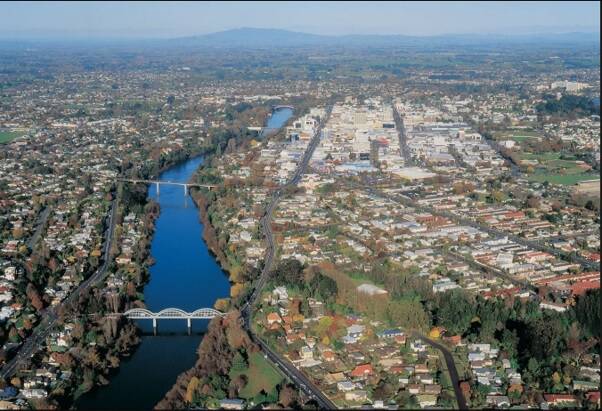
Hamilton is a plains city. It basically sits in a huge basin surrounded by hills or mountain ranges. The basin drains either into the Waikato River which flows through it before eventually turning west into the Tasman Sea, or to the north-east where peat and swamplands drain into the Firth of Thames.
It features three major river systems, the Waikato River itself, New Zealand’s longest river, and its major tributary the Waipa River to the west, while in the east the Waihou River drains the Kaimai and Mamaku Mountain Ranges, flowing north into the Firth of Thames.
In 1967 I began a whole new chapter of my life; away from home, away from family, and plunging headlong into a career as a Medical Technologist. There are a couple of other contexts that this needs to be seen in.
Firstly, although part of a large work intake (over 30 a year for the first-year intake), Medical Laboratory Technology at Waikato Hospital at that time was an all-consuming apprenticeship. You worked, studied, attended lectures, learnt, and were tested all in the same place at the same time. And there was a lot to study and a lot to learn. It took 5 years full time just to qualify with the academic equivalent of a Master’s degree. Almost as soon as you started, you were rostered on to shift work, and then later on to on-call work. This involved working weekends and night shifts, then being on-call until the next day shift started. And almost as soon as you started you were involved in visiting patients in the various wards, collecting specimens or observing procedures. So, you were always grounded in exactly why you were there, and the importance of what you did and doing it correctly. But in context, if you were on shift or call and needed to get to the lab (or home again) at any time of the day or night, you simply called a taxi, and the hospital took care of the rest.
There wasn’t much time for anything else, certainly not regular team sporting activities, which I guess was one reason that there was a significant drop-out as the years progressed. And as you learnt, became more proficient, and were approved to perform more tests, so your responsibilities grew while working alone and unsupervised. It was then your role to teach them to junior trainees. There were four major disciplines to come to grips with, Blood Bank/ Immunology, Haematology, Biochemistry and Microbiology. There were major national examinations in each of these after three years (usually held in Palmerston North) comprising three three-hour written, then oral, and then practical examinations for an Intermediate qualification. That was followed by either a further full year’s study and examinations in each of two of the disciplines, or a further two years advanced study in one of them, resulting in resulting in a formal qualification (and a scroll signed by the Governor General) which allowed you to put ANZIMLT after your name. It could be hard and unforgiving work and was absolutely the best way to learn. Given my loathing of examinations, and a precocity to freeze up during them, simply completing such a regimen was a huge achievement for me.
The other context was the times in which this occurred. I suppose everyone thinks of the period in which they matured as a special time. But during this period of the 1960’s and 1970’s society really did change considerably. And we were part of that. Again, you need to appreciate what the situation was in the ‘50’s to appreciate the depth of rebellion and change that subsequently occurred. There are many ways that you could illustrate this, but perhaps one of the easiest is through music, which I was just beginning to take an interest in. The music of the 50’s, such as ‘swing’ music was a bit like my life as a child growing up. It was easy, safe, controlled, orderly, predictable, unassuming, and inoffensive. Not necessarily bad, but some would say very boring. It fitted in with a lifestyle that accepted that your hair was short, your back was straight, your dress was modest, politeness and diffidence to your elders was mandatory, and nobody blinked an eye about youth being compulsorily shipped off to train, fight and indeed die in foreign wars that were meaningless to them. Like aspiring to the 1st 15 rugby team, it was considered an honour and a duty.
Suddenly, along with the newfound freedom of living on my own or with similar flatmates, we were introduced to Woody Guthrie, Bob Dylan and Joan Baez and a whole new protest movement, closely followed by the complete anarchy of rock music from the likes of Cream, the Rolling Stones, Jimmy Hendricks and many, many others. Even before that we were familiar with the culture shift coming out of Berkley Campus and Heights Ashbury in San Francisco, preaching love, peace, and sexual tolerance, other than the current societies ‘norms’. And then there was Woodstock, like nothing that had ever been heard or seen before.
Of course, the establishment fought back, as it always does. And it was far better equipped, as it always is. The student anti-war ‘riots’ in Boston and Duke Campus were ruthlessly put down with young people shot out of hand. Closer to home we had the anti-apartheid movement, the South African rugby tour, and the infamous police ‘Red Squad’ with their long batons and riot tactics. Yes, I was in Hamilton the day the test was cancelled because of the pitch invasion. My abiding memory of that was of that night, when the hospital grapevine kept us up to date on the casualties coming in, as gangs of alcohol-fuelled frustrated football fans roamed the streets looking for ‘hippie’ people to beat up. And suddenly the huge police presence that had been there to control them was nowhere to be seen. I learnt a lot about my fellow man that day, both good and bad.
But, like living life pretty much on your own terms, most of the changes we experienced were liberating. Personal growth and learning might not have been structured, but it was expansive. Suddenly, not only was my non-work time my own, but I was earning money that allowed me to follow my own interests. The first couple of years were pretty wild, living in cheap grotty flats with alcohol and noisy parties featuring prominently, but I wasn’t going to suddenly switch from being an introvert to an extrovert, so my path remained set. And there was always plenty of studying for work to be done. But along with an interest in hard rock musical record albums, came a similar interest in folk music and classical music. Along with the compulsory work textbooks (which we bought) came an interest in classical writing, contemporary and science fiction and non-fiction, which I also bought.
Back in those days, a lot of the wetlands surrounding the city, especially to the south around Rukuhia and the peatlands to the north-east, had yet to be drained for farmland, and in winter, that meant fogs. Thick, heavy, cold, damp, cloying fogs. I can remember some days when you would wake up in thick fog, go to work in thick fog, it would lift enough to be able to see where the sun should be at just before midday, then by three o’clock in the afternoon it would start to come down again. And the next day would be exactly the same. How we survived in those cold, damp, draughty, poorly heated flats I’ll never know. But we did.
And as much as what was happening externally, there were a couple of people who made a huge difference to my life back then. The first was Ross Richards, a fellow trainee from my year’s intake. When I look back on it, you couldn’t get two more diametrically opposed people if you tried, and yet, we became firm friends. Ross was a confident, exuberant extrovert. He wrinkled me out of the comfortable boring family I was boarding with, and we went flatting. We drank, played loud music, and had frequent parties. He bought a car (an old Morris Eight) which was handy because I didn’t even have my driver’s license. Having come from a fairly restrictive family and a single-sex education he had a mission to bed as many young women as possible, something he was remarkably successful at. Unfortunately, this tainted view of the opposite sex was to play a major part in his latter life. But back then we were happy and carefree, and the world was our oyster. For a couple of years, we were simply young, irresponsible working students.
Ross Richards, whose enthusiasm, optimism and friendliness were difficult to ignore.
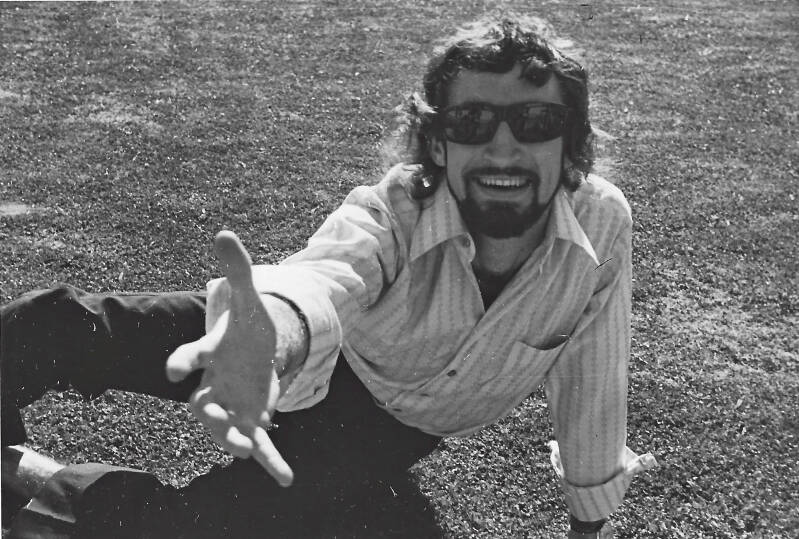
Luckily (for me) all this was tempered by another young trainee who started a couple of years after me. But again, perhaps some scene setting would be helpful in terms of an introduction. When I first started, the laboratory was in the old main building, on the second floor above the main entrance, and one floor below the operating theatres. It was an old, run-down, dimly lit place of narrow corridors, painted concrete walls and linoleum floors. The lab’s leading off it weren’t much better. It was a typical institution of its day. Just to the right of the top of the stairs to the floor was the Laboratory Reception, and in front of the desk, was a fridge. This was where specimens collected from the theatres or the wards during the night, which weren’t urgent, were left. For those of us who started early (and I used to be one of those) the first order of the day was sorting these specimens out into the disciplines and ‘booking them in’. Like a box of chocolates, you never knew quite what you would find in there. Along with the routine blood, faecal and urine samples you sometimes got things left there from emergency surgery during the night. Two things that stick in my mind were an amputated gangrenous thumb in a jar, and a right leg complete from the knee down. Again, there was little chance that you forgot why you were there.
One of the Pathologists working at the Lab was a Dr Stephenson. A large, florid man (which may have been due to the whiskey he drank), he would nevertheless take a friendly interest in young trainees and provided what could be described as a right-of-passage. Dr Stephenson specialised in treating leukaemia’s, especially childhood leukaemia. Back then, just as there wasn’t the number of antibiotics available today to treat infections, the treatment of leukaemia was also rudimentary. Acute adult leukaemia was pretty much a death sentence, and the childhood diseases was only better by degree. The disease was diagnosed and monitored by performing bone marrow examinations, involving punching a hole in either the sternum or femur bone with a very tough needle, sucking out some bone marrow, and examining it microscopically. This was performed under local anaesthetic and was particularly painful.
Dr Stephenson would suddenly appear in the lab, grab a first-year trainee, and whisk them off to assist with the slide preparation during the procedure. Not only did it serve as a graphic reinforcement of exactly why you were working in the lab, it provided an interesting insight into the trainee’s resilience. There was a sort of unofficial competition over who would faint, and who would not. Often it was the burley guys who would slide first! Despite this, some patients became familiar faces around the lab, and it was hard not to develop an attachment to them, especially the kids. There was one young boy, who fought stoically and bravely. When he finally succumbed, the whole lab went into mourning. I also remember taking blood samples off another brave little Māori girl who had caught measles. With little immunity, she also succumbed.
One of the more intriguing aspects of Dr Stephenson’s work was to try and work out what might be precipitating the disease. It appeared to be less than random and would often present as a cluster of cases. There was one particularly striking cluster of cases at Netherton, a small rural settlement on the Hauraki Plains. No causal link was ever identified, but I sometimes think that if we knew back then what we know now, maybe that would have been different, and a whole lot of human suffering may have been avoided.
But back at the lab change was foot, and it was planned to knock the place down and build the country’s first clinical services block in its place. This huge megalithic building would have a whole floor of purpose-built, state of the art laboratories, all in the one place. Obviously, it would be a huge improvement on the old labs (anything would) but suffice to say that the original plans came back from the architects without a window in the entire five stories of the building. “Why do you need windows?” they reasoned. The whole building is completely air conditioned and artificially lit. Now anyone who has worked in labs would know that there are times when there is simply no substitute for natural light, and eventually we got windows – narrow features that didn’t open and which were too high up to see out of, but at least they let the light in!
While this was getting sorted out and built, the lab moved into temporary quarters in a new wooden, almost prefabricated building down beside the old Ward Seven (the dementia ward). What a breath of fresh air that was! The windows opened, it was light and airy, and the building was surrounded by open space, grass, and trees. As additional entertainment, we could look out the windows and track the old guys (they were almost always guys) making a break from the dementia ward, hotly pursued by nurses and orderlies. When we eventually moved into the new clinical services block it was almost an anti-climax, with artificial light and air conditioning that meant that when labs like Microbiology and Biochemistry (which had a lot of heat producing equipment in them) got too hot and turned the temperature on the floor down, the other labs and offices froze.
But one fine summers day in January, Ross and I had just returned to work in the New (temporary) lab after being on holiday. We got through the morning okay, but the main business of the day was organising a water fight at lunchtime when all the Heads of Dept’s and Pathologists were away at lunch. These were a quite regular occurrence and usually started between Roger Leach, Dennis Jones, and us, and they could occasionally escalate to the stage of using buckets to deliver water, rather than large syringes. And suddenly, there they were. New girls, part of a new intake of trainees, looking wide-eyed in disbelief at the mayhem. Among them was a tall girl with long dark hair, who would eventually change my life completely. She was Sharon French, a dark eyed, hugely intelligent dairy farmers daughter from Paeroa.
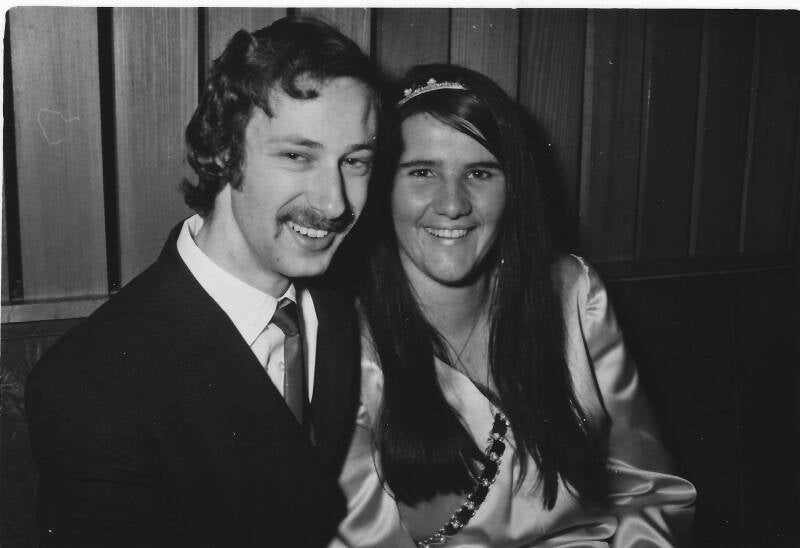
While there was attraction, there wasn’t any immediate inkling of what was to come on my part – I was still a bit naive and immature, although I suspect Sharon was a bit more certain of her feelings. Gradually we went from being part of a group that hung out together, to a couple who hung out together. There were others who came and went, but we always ended up back together. And out of acquaintance grew respect and friendship. And out of friendship grew love.
It is hard to describe how that dark haired, dark eyed girl changed my life, and continues to do so, except to say that it was like the dawn. It started gradually and kept building. It was exquisitely beautiful. Eventually it coloured and flooded through everything I saw, was, and did. Today (some 55 years later) there is no part of my life that isn’t seen through the lens of us, rather than me. I have been so incredibly lucky.
We became a couple. That wasn’t so unusual when you had a large group of young adults working together in an intense, demanding occupation. And the very nature of the job and the fact that most of us were away from home meant that you socialised together as well. So, there were lab parties, Nurses Balls, and organised events like car rallies, tennis tournaments, and even raft races in the Waikato River. Many of the couples we became firm friends with were also ‘lab-couples’. They were fun times, and for a while there, we were young, carefree, and bullet-proof. But reality has a habit of catching up with you, and back then, it was often work related.
Compared to today, lab work back then was pretty primitive. But that was part of the attraction. Things weren’t cut and dried, and there was no automation. If you wanted something done, you did it yourself. If the answers you came up with weren’t ‘textbook’, then it was up to you to figure out why. If you were using equipment back then you had to know how and why it worked, how to take it apart, fix it and put it back together again, and calibrate it so that you knew it was accurate and precise. In Microbiology, if you wanted to grow organisms, you made up the growth media yourself, so you knew what it contained, why, and what it was supposed to do. Because you not only made it but tested it on target organisms before using it on patients’ samples.
But there were risks, and that too was an accepted part of the job. They wouldn’t be acceptable today, but they were back then. We used to pipette body fluids (including blood and serum) by mouth with only the most rudimentary of precautions. We used some pretty dicey chemicals, also often with only rudimentary personal protection. And of course, we were growing some pretty nasty bacteria, because that was how you diagnosed the diseases they produced and also tested whether they were sensitive or resistant to various antibiotics.
I have already mentioned that working in Microbiology meant that you had a 1:8 chance of catching Tb. While I was lucky, and probably already had some immunity thanks to my family history, others I worked with weren’t so lucky. And it is fair to say that its clinical prevalence out in the community was far greater back then as a result of social conditions. When I was still a first-year trainee, I went to a lecture by a visiting Auckland specialist respiratory physician and still remember him saying (to a bunch of doctors) ‘if you have a patient who presents with a fever (PUO) and no other obvious symptoms, they have tb until you prove otherwise.’
But that wasn’t the only danger. Apart from other nasty bacteria, glandular fever would regularly sweep through the lab, and hepatitis was always a possibility. Today we know a lot more about subclinical exposure and latent and post-infection manifestations of such diseases, but back then it was just an accepted risk.
Which brings me back to Sharon and me. Sharon came down with hepatitis and was packed home to her parents to recover. That isn’t the sort of illness that you recover quickly from, and she was stuck in Paeroa, and I was stuck in Hamilton for a couple of months with no way of seeing each other. If I ever needed any prompting, that certainly brought home to me just how much I loved and missed her. Our only real form of communication was by letter. When she finally returned to Hamilton and work, we had some serious catching up to do. But then I came down with it as well. I was as crook as a dog, and there was no chance of going home to get over it, so the Pathologist admitted me to the Medical Ward. And there I stayed for over a month, although the first couple of weeks are pretty much a blur. Slowly things got better, and I had plenty of time to contemplate what was important in my life. And at the top of that list was a dark eyed, dark haired girl called Sharon French.
So began a new, deeper phase of our lives. There were 21st Birthday celebrations (a coming-of-age ritual that probably no longer exists), friends’ weddings, and then our own engagement and wedding. I got to know, like, admire and be accepted into Sharon’s family, and she into mine. There were many similarities, but also many differences between the two. One of those was the fact that I came from a small family without many close ties to relatives and family members. Sharon was just the opposite. Not only was her sister Olwyn living in Hamilton with husband Wynne and three kids, but her extended family stretched across the Hauraki Plains to Paeroa, Thames, Whakatane and beyond. Just how many there were, was bought home to me not long after we were married, at a Miller/French family reunion. Marg and Eric, Sharon’s mum and dad, used to organise one of these events every 10 years in Paeroa, and the only place in town large enough to hold it was at the racecourse. I remember walking into the venue and seeing a huge sea of faces, and it struck me – I am now related to all of these people! That was a challenge for an introvert like me, but they were all so nice and easy to get along with, it was not at all a problem. But I am getting a bit ahead of myself.
Our circle of friends still revolved mainly around work colleagues, although as I mentioned, Sharon’s sister Olwyn, husband Wynne and young family, Raewyn, Robin and Grant, lived close by and gradually became a bigger part of our lives. We were still flatting in town, and I still didn’t have my own transport and had only just got around to getting my license to drive. Luckily, Sharon had bought a car, a little white Ford Anglia, so we went everywhere together in that. A lot of the time (when we had time away from work at the same time), that was over to Paeroa to see her folks. Initially they had a house in Flora Street in town, but then they moved back out to the farm on Rotokohu Road, next to the golf course. It was there I sort her parents blessing and popped the question, and we got officially engaged.
We eventually moved into a flat in Nixon Street in Hamilton East and upgraded the old white Anglia car to a shiny yellow Datsun 120y hatch-back.
New Car at the Nixon Street Flat
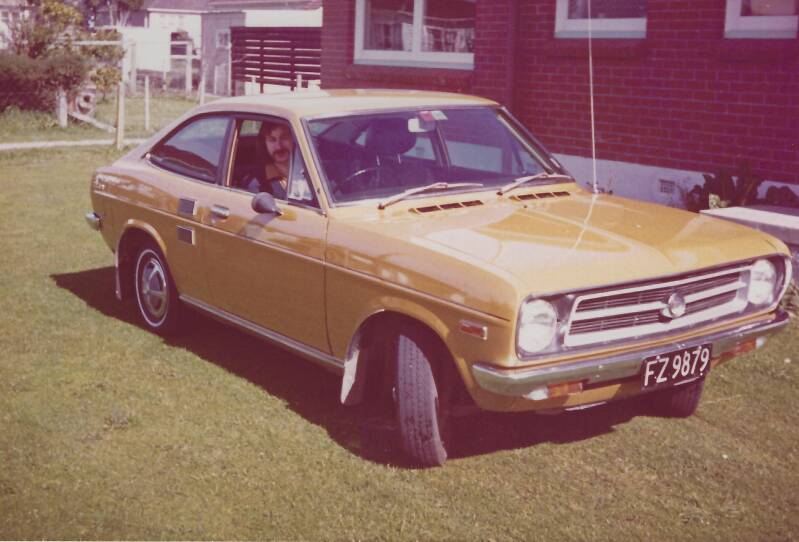
Preparations for our wedding carried on with minimal input from me. Sharon’s family were pretty traditional, and a traditional country town wedding was planned. Ross was to be my best man, and it was perhaps fortunate that the bout of hepatitis (and consequent danger of further liver damage) put paid to any excessive alcohol consumption. We used to drink a fair bit of our discretionary cash when we were younger, reckless, and flatting, so it is an ill wind (as they say) that blows nobody any good. My parents came up for the wedding and on the morning of January 15th, 1972, along with friends and family, we made our way over the now very familiar road to Paeroa, and the small wooden church we were married in. Once things actually got underway, I could relax and enjoy myself and the occasion, - I don’t even remember being particularly nervous. Sharon, in a traditional white lace gown, looked absolutely amazing, and everything else was just pomp and ceremony whose main importance was the public affirmation of our love and commitment to each other.
January 15th, 1972. Paeroa, New Zealand.
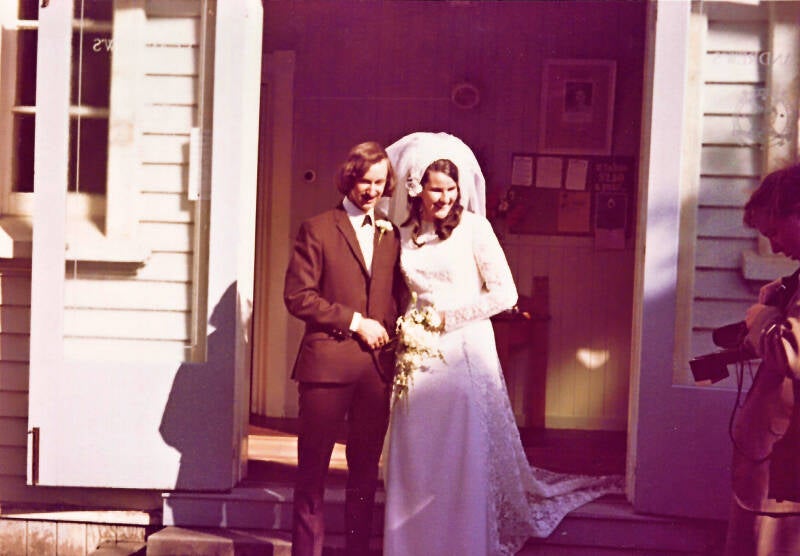
Post honeymoon house and window cleaning about to commence.
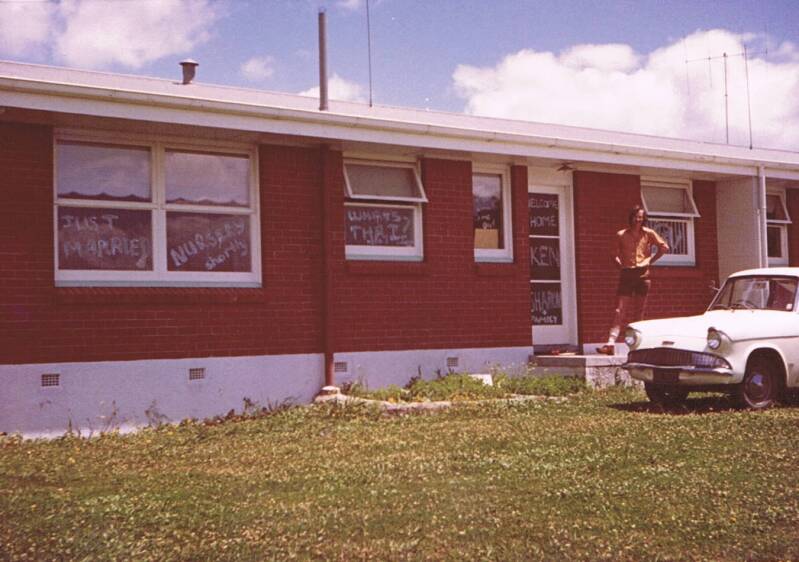
With the ceremony and formalities over, we went off to get our photos taken, before returning to the hall in the main street where the wedding breakfast was held. Word of our return got about, and I remember watching a stream of new Aunties (and a few more new Uncles) streaming out of the pub across the road and into the venue. It was perhaps my first introduction to the size and strength of Sharon’s larger family. The breakfast was a happy, relaxed, engaging occasion and it was quite late before we finally made our farewells. Luckily, we had anticipated this and booked into a motel not too far away, before continuing on to a honeymoon on Pakatoa Island. We returned back to our flat in Nixon Street, to find that our friends had been busy ‘decorating it’ to welcome us home.
It was about this time that my training was coming to an end, and I qualified as Medical Laboratory Technologist. My interest in Microbiology had really started while we were in the ‘temporary laboratory’ where one of our pathologists was a Dr. Mandal, an affable and extremely knowledgeable Ceylonese whose international experience in infectious diseases (which he readily shared) caught and held my attention. It was always the discipline closest to my interests in natural systems, and I followed my Intermediate qualification with an ‘O’ level, then an ‘A’ level in Microbiology.
Life wasn’t all about work however, as much as it impinged upon everything else. We bought a house in Cricket Place, in Melville, not too far from the Hospital, but far enough away to be able to forget it when we weren’t there. This was a major revelation to me. We both had steady jobs and were making reasonable money, and there was a Credit Union associated with the Hospital that was only too happy to lend us the deposit and arrange a favourable mortgage.
The section was down a right-of-way and backed on to a reserve, so it was nice and peaceful. We were happy homeowners! We had a well screened section complete with a large Para pool. This was great on hot summer days but tended to get a little bit neglected over winter, turning green and soupy, but great at growing up frogs. Unfortunately, our cat grew quite adept at catching these and bringing them inside to either dispatch with loud squeals, or to release so they could play hide and seek with us.
Another advantage of living in Melville was that we were close to Olwyn, Wynne and their family, and could spend a lot of time with them while the kids were growing up.
Our first home, Cricket Place, Melville, Hamilton.
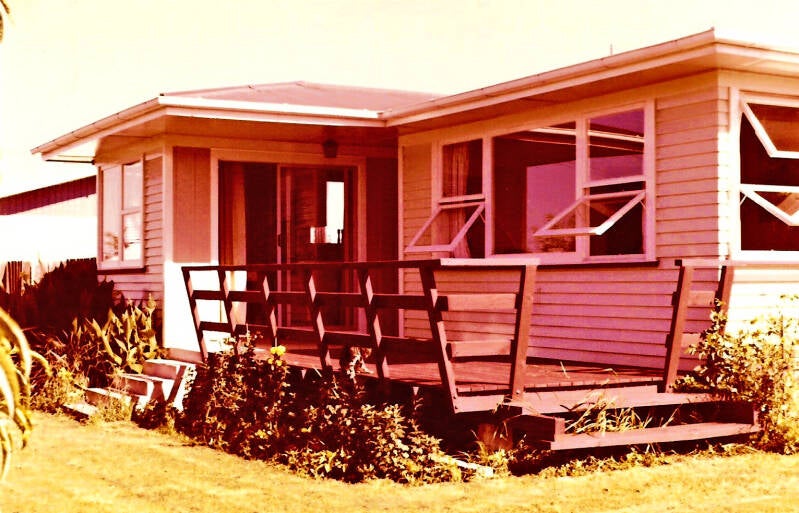
Relaxing on the lawn at Cricket Place, with the Bradburn’s dog, Jerry.
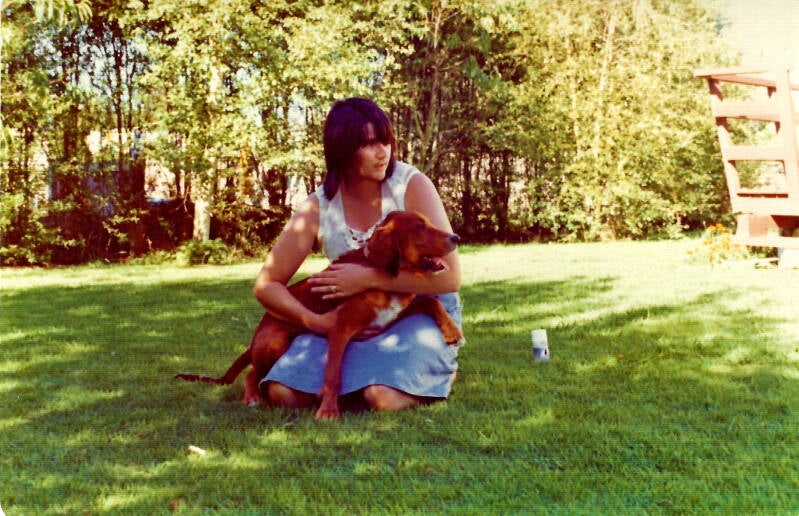
But things were changing, and our friends were moving on. Ross had completely self-destructed. He had paired up with Miriam, a lovely girl from the lab who worked as a histology technician. They became engaged, then married. I was Ross’s best man, just as he was mine. If Ross and I were from divergent backgrounds and personalities, his marrying a quiet Presbyterian minister’s daughter seemed even more incongruous. We remained friends but eventually the inevitable happened. She was a gorgeous doe-eyed junior trainee, and the now married Ross fell for her heavily. They ran off to Australia where they soon separated. The last I heard of Ross he had obtained a degree and was working at a University hospital doing research in haematology. He had apparently found God and renounced all of his former acquaintances.
Interestingly, I kept in touch with Miriam on social media. She was living in Australia also, and had remarried, but this unfortunately also didn’t last. She reached out to Ross (who she still carried a torch for) but was rebuffed. That might sound harsh, but I can understand that if you have drawn a line under one chapter of your life, reopening it may seem fruitless.
Also interestingly, Ross wasn’t to be the only highly intelligent male friend who ‘found God’ and lost everything else. One of my bosses at MAF did something similar after losing a son in a tragic road accident. In Ross’s case, it served as a loss of innocence for me. The complete reversal of values and beliefs seemed incomprehensible. But I was to come across this again on several occasions in my working life when people I had known and worked with in a dedicated service setting, suddenly developed highly capitalist behaviour, to the point of abandoning friendships and loyalties, when it was advantageous to them.
Lyn Cresswell and Gavin Hoggard (also close friends and colleagues) had married, then after qualifying they had travelled to Canada and were working as Med Tech’s there. Merilyn Tait had gone over to visit them, met another friend of theirs called Bob (also an American Med Tech), married him and they were living and working in Los Angeles. They asked us to come over for a trip they were planning together, and that was how we got to spend 3 months touring and camping in landscapes in the USA. Both couples eventually returned to New Zealand. Both eventually separated.
It was still an’ age of innocence’ in terms of my awareness of the ecological, social, and political consequences of our actions, (that probably didn’t start to happen until the mid-1980’s). As alluded to earlier, I was still coming to grips with the social landscape of my new extended family. And there was a lot to discover.
Marg and Eric French (Sharons parents) lived in Paeroa. I like to think of Paeroa as a ‘transitional’ town. It sits beside the great plains and wetlands of the Waikato basin, nestled against the hills and mountains of the Coromandel Forest Park. It is connected to the ocean by the Karangahake Gorge to the east, and to the Firth of Thames to the north. It is close to the junction of the Waihou River and Ohinemuri Rivers. There are lots of different landscapes going on.
Sharon’s family was large and inclusive. When we first became a couple, her parents were still living in in Flora Street, in town. Later, before we married, they moved back out to the farmhouse on Rotokohu Road, not far from the Golf Club, (which they were enthusiastic members of). So, the road between Hamilton and Paeroa became quite familiar to me, with frequent trips across to visit them. Usually taking the ‘backroad’ across the undulating peat country (as it was then), the 77km car trip took just over an hour.
As outlined in later accounts, there were plenty of reasons to make the journey, apart from just escaping to the peace and quiet of the family home. Family Reunions, life milestones, new grandkids and weddings all drew the wider families back together again. There were trips through the Karangahake Gorge to Waihi Beach and to visit Gordon and Stella and their family, first in Edgecombe and later in Whakatane. Sharon even dragged me out on to the Paeroa Golf Club a few times for a round of golf (we had actually joined the new Ngāruawāhia Golf Club, at that time still only 9 holes and just 10 minutes’ drive north of Hamilton city.) Sharon had been a representative golfer whilst still at school.
The Homestead on Rotokohu Road.
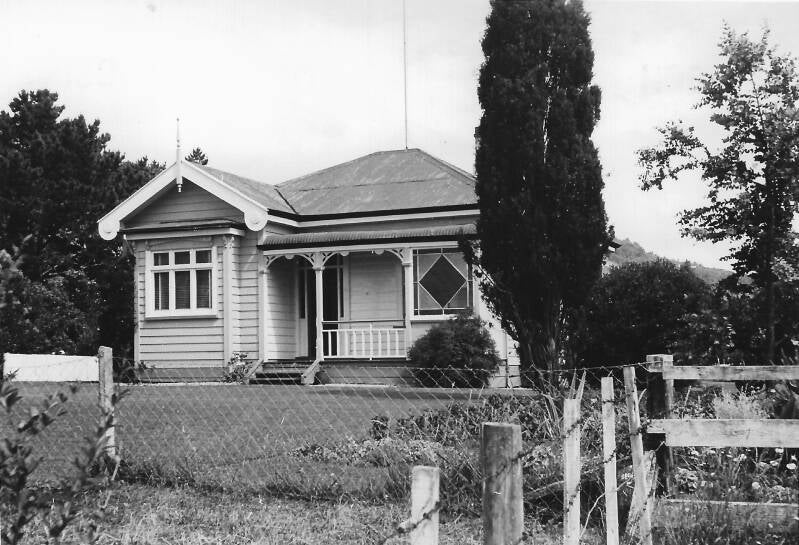
Later, after we were married, Eric and Marg moved back into town, to a house in Taylors Avenue. This was subsequently also to become a familiar destination, as trips up to see them from Palmerston North with Leile were a frequent occurrence.
In an amazing coincidence, I had just scanned this photo in when we were alerted by a cousin to a television program of this place being bought again (and people wonder why I don’t normally watch television). Apart from a bit of a spruce up inside, very little has changed since it was grandma’s house. Structurally, it is the same. And the outside hasn’t changed a bit, except Marg’s large vegetable garden behind the grapevine wasn’t there. What has changed is the price, it was selling for well over 10 times what it sold for after Marg died. For what is essentially the same house, that is ridiculous. I remember that it had a great view from the back porch of the black escarpments on the surrounding hills.
The House at Flora Street, Paeroa.
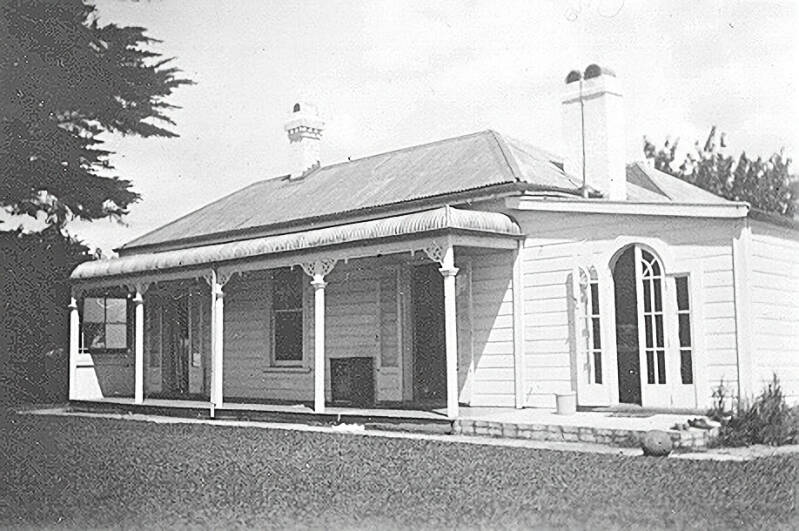
Taylors Avenue, Paeroa.
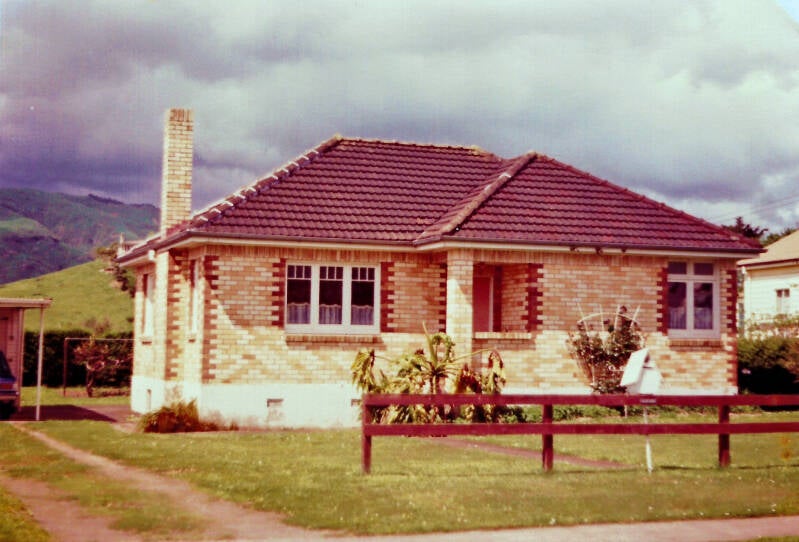
The lab threw up another diverse interest for me. Don Mickelson was another technologist, and we became friends. Don had a passion for building and flying radio-controlled gliders, and I soon found myself immersed in that as an interest. It was a hobby of three parts. Firstly, there was the technical aspect of starting with a plan and some balsa wood and tissue and building your own model planes. We started small on hand-held models with a small engine that would take the model up before cutting out, so it glided. Secondly, there was the actual flying, and learning about air currents, thermals, and waves to keep the models airborne, as well as mastering the radio controls. Lastly, there was the art of repairing them and putting them back together after they had crashed!
There was quite a strong model aircraft club in Hamilton, and we used launching strips dotted all over the region. Here was an aspect of the landscape I had given very little attention to up till now, how thermals bubbled up from the flat open paddocks and plains in the Waikato Basin, and how to find them and use them to keep your model planes aloft. Alternatively, you could use the waves of air formed as the wind pushed air up the hills and mountains that surrounded the Waikato Basin. Waharoa strip was a place that was used quite often, both for model and full-scale gliders, as it was close to the escarpment where the Kaimai Ranges rose from the plains, providing good wave lift for both types of aircraft.
We are not talking about small models here. Most of the gliders were scale replicas of full-sized gliders, initially made with doped tissue, then as they became more sophisticated (and expensive), of moulded fibreglass. Before I knew it, I was the proud owner and a licenced user of a second-hand radio-controlled Skywalker with an eight-foot wingspan! We used to launch these from bungies, about 50-60 feet of elastic cord tethered to a strainer post at one end of the strip. When full stretched out, with the other end attached to the release clip on your model, by the time you released the model and sent it skyward, it was about 100 feet up in the air at the release point. It was then up to you to find some thermals and use them to keep your craft aloft.
The old hands were very adept at this. There were often cross-country competitions, and you would see them launch their gliders, find some thermals, then pile into cars with their radio-control aerials sticking out the window, chasing their gliders down the backroads.
Sometimes, especially in tricky winds, these gliders could be quite difficult to control. One of the reasons for this was remembering that you nudged the controls in one direction to turn the glider to the left (or right) when it was moving away from you, and in the opposite direction when it was coming towards you. It was easy to make a mistake when these things were bouncing around the sky, hundreds of feet above you.
I vividly remember one occasion when we had travelled to a small strip on the eastern side of the Kaimai’s. It was basically a small area of flat land surrounded by deep, gorse-filled gullies. Our cars were lined up on one side of the strip. My flight was brief and did not end well. But at least I turned it round and crashed on the strip. Later it was the turn of a sleek modern fibreglass model. The pilot launched it from the bungy, caught a crosswind, and the model disappeared down the gully behind us. The next minute it shot back up again, levelled out and zoomed between two of the parked cars, taking out the aerial of one of them, before crossing the strip at right-angles and heading out over the opposite gully. Apparently speed plus fibreglass was stronger than the metal aerial. I could just imagine what it would do to a bystander.
Sadly, the Skywalker never fully recovered from a particularly spectacular crash. I never fully mastered the radio controls. More specifically, my brain never fully mastered the technique whereby the planes flaps and ailerons reacted to the radio control one way when the plane was facing away from you, but the opposite way when it was facing towards you. And gradually, a more earthbound interest took over what leisure time I had.
Flying from the Waharoa strip
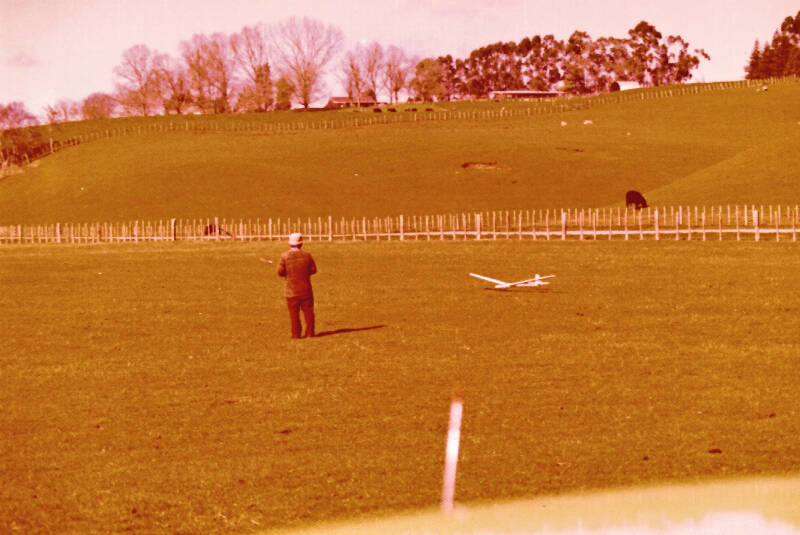
The Skywalker in action (albeit briefly!)
By 1978 we were both qualified Med. Tech’s. I was 2IC of Microbiology and Sharon had specialized in Serology/Blood Banking. Out friends were also settling down and starting families, and in what spare time we had Sharon took up Bridge while I rekindled an earlier interest in trout fishing, roaming the rivers and lakes of the Waikato.
There were plenty of choices when it came to this, some of which I’ll cover in the chapter on fishing. An interest in this activity had been kindled before I left home, with occasional visits to the Manawatu River with a spinning rod and lures. They were not successful at catching fish, but they did spark an interest in how water flowed through and changed the landscape, as well as the creatures that lived within it. With the gradual increase in discretionary time, and discretionary income that came after I was qualified, I was keen to revisit this interest.
Initially, I used to go out with Gavin Hoggard, and together we explored the rivers, lakes, and dams of the Waikato Basin. The rivers were quite different to the middle Manawatu I was used to, and were either rainbow trout, or mixed rainbow and brown trout fisheries. Draining a basin as large as the Waikato, most of these rivers were larger, longer and deeper than I had previously encountered. Many flowed through peat land, and there were even hydro lakes to sample. And I even started catching fish in some of them! Almost accidentally at first, but gradually I started to figure out what worked, and why, and could repeat those successful strategies on other rivers and lakes. I must have been a bit more enthusiastic about it than Gavin, as increasingly I went out on my own. That was the beginning of the activity becoming an immersive experience, with just myself, an everchanging river, the environment it flowed through, and the life it sustained. And if I was lucky, some of that life ended up sustaining me!
We fished the Waihou and its tributaries under the Kaimais, The river was quite pastoral and could be heavily weeded, but we enjoyed success fishing it. To the west and south the long Waipa River provided many different fishing opportunities, from its headwaters to the junction with the Waikato at Ngāruawāhia. To the southeast, the Pokaiwhenua River was a personal favourite, with its rocky gorge holding good fish before it too flowed into the Waikato River. And I fished the Waikato River Hydro Lakes, especially Karapiro, Arapuni and the Waipapa (another personal favourite). And of course, when visiting Paeroa, the Ohinemuri River offered great fishing opportunities.
I fished the fast-tumbling headwaters and gorges, the slow, deep pools on the plains, and the brooding stillness of the lakes; from limestone country to peat plains and everything in between. Without even realising it, I became absorbed in the countryside and its waterways.
Headwaters Fishing
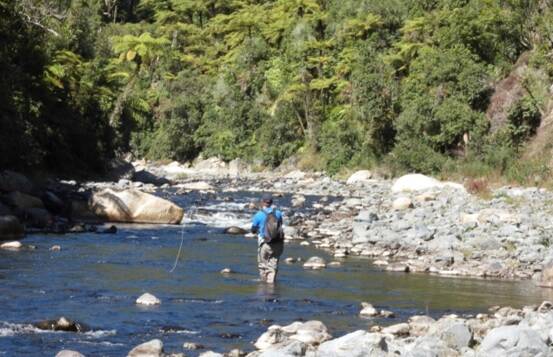
Holding Water
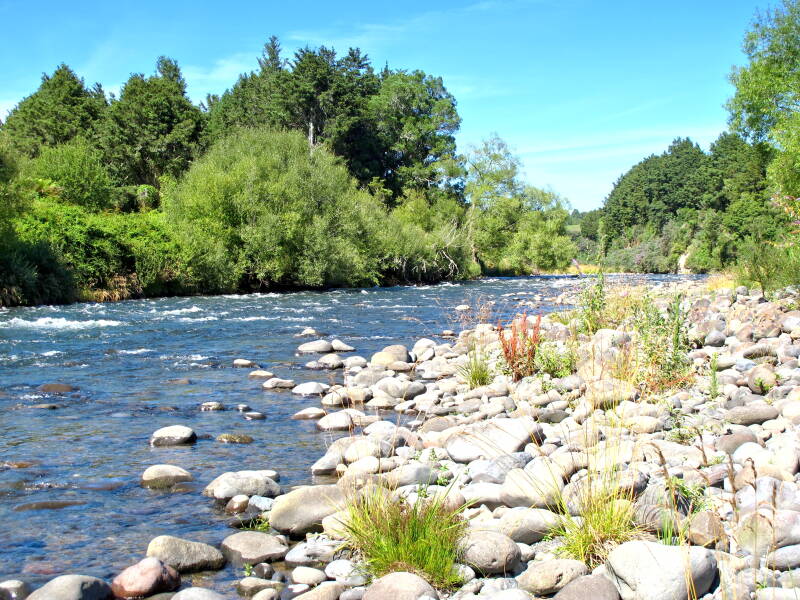
But we were both getting restless. Despite the family, the friends, the fishing, the bridge, the golf, and having a place of our own. We were both well qualified in our respective disciplines, with responsible positions, and there were always conferences and seminars to go to, with socialising as well as learning. But the nature of the work and the qualifications were changing. University trained scientists were accepted as equals, at least up to Intermediate level. This was great for pay parity, but their medical knowledge and experience was woeful. They simply lacked the grounding in patient care that we had been given. And pathology privatisation was beginning to appear. Many of our friends embraced this change as an opportunity. To me it felt like we were in danger of losing something really important. It was all about picking and testing the low hanging fruit using the least skilled (and therefore paid) staff you could get away with. And at that time I simply couldn’t see the opportunity of advancement past where I already was happening anytime soon.
There was definitely something missing from the Landscape we lived in. It seemed a good time for a change of scene. Sharon and I, both from small rural town backgrounds, were starting to feel that even Hamilton was getting too big, too fast, and too much like Auckland. I can’t even remember how I even heard of it, but there was a position of Charge Microbiology Technologist going with the Ministry of Agriculture and Fisheries in Palmerston North. It seemed a great opportunity to keep learning and developing in a very similar field of study, but without the urgency and demands of human health. And Sharon was open to the idea as well. I applied for the position and was accepted. We were off to Palmerston North!
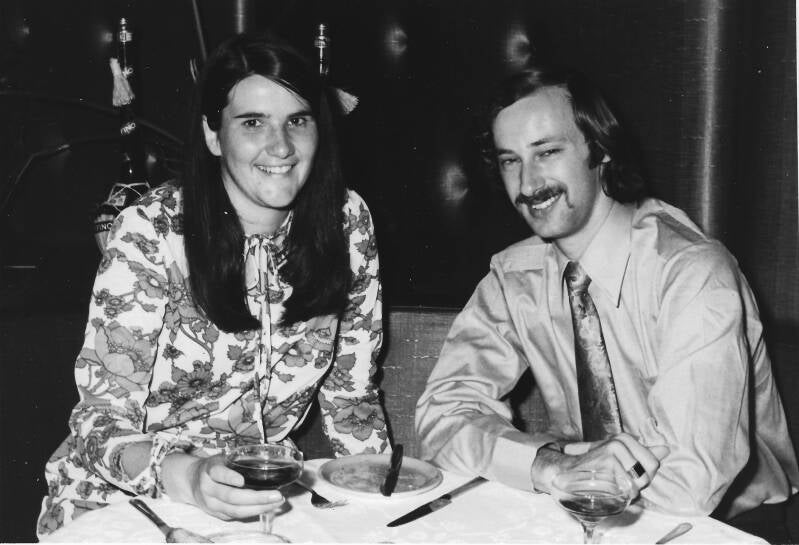
Palmerston North.
Palmerston North is situated on the Manawatū River floodplain
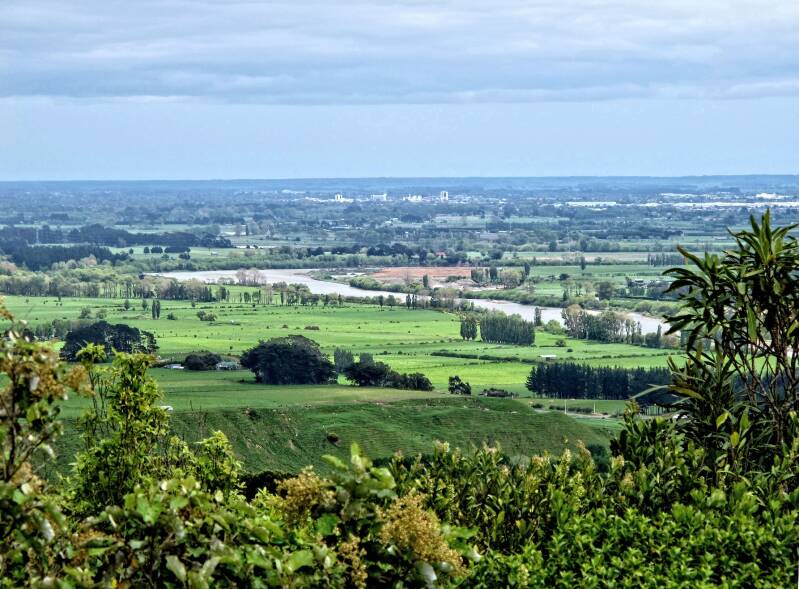
In 1978 I applied for and got a new job running the Microbiology Lab. at the MAF Animal Health Laboratory in Palmerston North. It was a very similar set up to the Hospital Lab, except the range of diseases and infectious agents was greater and less familiar. But as a bonus, there was no shift or call!
It was never our intention to settle in Palmerston North for a long time. Our previous experience with the city, apart from visits when I was young, was to fly down in mid-winter to sit national examinations, then fly back to Hamilton. This may well have influenced how we perceived the place!
But Palmerston North was where the diverse elements of our landscapes merged into a place of comfort and belonging. Beside the Manawatu River that I had grown up with, under the ever-present peak of Whareti in the Ruahine Ranges that I had known since a lad, the city sprawled out on the river’s floodplain.
The floodplain basin was rather like the Waikato, but on a smaller scale and with the rivers flowing south and west rather than north and east. To the north the plains quickly transformed into undulating hill country, pushed up by land movement against the main mountain range and ultimately culminating in the towering protective volcanic peaks of Taranaki to the west, and the central plateau to the north. To the east the Ruahine and the Tararua Ranges towered above the plain, split by the Manawatu Gorge, one of the few places where a river transected the country’s main ranges. To the south, the plain was squeezed into an ever-narrowing gap between the mountains and the sea. And to the west lay the huge sweeping ocean curve of the South Taranaki Bight, with its relatively shallow sandy waters.
Within this basin the competitive dynamic forces of the rivers transporting shingle and soil west from the eroding hills, and the encroaching sandhills from the sea, produced a large, wide, low, flat floodplain that once contained vast lowland forests and even larger swamps. Both of which had been cleared and drained, then transformed into rich grassed pastures.
The city was smaller and less bustling than Hamilton but had everything we needed. It was flat and easy to get around. It was somehow cheerful and more personal.
Early History.
Manawatū, a name that means “heart standing still’, is a place where fertile plains nourish, where the river carves its own path forward and the mountain ranges - Ruahine and Tararua - stand tall. First settled some 400 years ago by Māori, the region is home to many iwi; Rangitāne o Manawatū, Raukawa and Ngāti Kauwhata. At Kākāriki, Tokorangi and Te Reureu are Maniapoto and Tūwharetoa.
The Manawatū region takes its name from the mighty river than runs through it. The great Manawatū River was named by an explorer named Haunui-a-Nanaia who had travelled down the coast from Taranaki, chasing after his runaway wife and her lover. Haunui-a-Nanaia had already crossed other big rivers, naming them as he went. Whanganui (meaning expansive mouth), he splashed through the waters of Whangaehu (cloudy waters), felling a tree to cross the Turakina (turaki - to throw down) river, he looked upon the Manawatū river with great apprehension. His heart stood still when he saw it because of its size and beauty and so it was named Manawatū River. Manawatū meaning ‘Heart Standing Still. Manawa meaning heart, and tū meaning standing still.
The traditional history of the Manawatū begins with the arrival of Whātonga. Whātonga was one of three chiefs on board the Kurahaupo waka, which journeyed across the Pacific Ocean to Aotearoa, New Zealand, possibly as early as the 12th Century.
Whātonga was the father of Tara, the eponymous ancestor of the Ngai Tara people, and grandfather to Rangitāne (also known as Tānenuiarangi), from whom all Rangitāne descend. He lived near Te Matau a Māui (Cape Kidnappers in Hawkes Bay), where he built a meeting house called Heretaunga, but he was also a great explorer.
On one expedition, he sailed along the Wairarapa coast to Te Whanganui-a-Tara (Wellington) and across to the Wairau Region at the top of the South Island. Eventually, he sailed up the West Coast of the Lower North Island, entering the mouth of the Manawatū River. Whātonga paddled on upstream where he eventually encountered vast forests and bountiful food resources, which he first viewed from a high point on the Tararua Range just south of Te Apiti - Manawatū Gorge. The forest at the eastern end of the gorge he named ‘Te Tapere Nui o Whātonga’, meaning ‘the great district (or food basket) of Whātonga’.
This expedition by Whātonga triggered an expansion and migratory phase for the Ngai Tara people, who made their way south from Heretaunga to Central and Southern Hawkes Bay, the Wairarapa and Te Whanganui-a-Tara. The Rangitāne people went on to settle in Central and Southern Hawkes Bay, the Wairarapa, Manawatū, Horowhenua and Wellington Regions of the North Island, and the Wairau Region of the South Island.
The lower reach of Kapiti Island was the boundary line between the two tribes, giving rise to the full name for Kapiti Island – Te waewae kapiti o Tara rāua ko Rangitāne.
Until 1866 Palmerston North was a clearing, known as Papaioea, in the forest that stretched from the main ranges almost to the west coast. It was an area of significance to Rangitāne with pā sites at Awapuni, Te Motu o Poutoa and Te Wanikau.
The land was sold to the Crown in 1864 and in 1866 a township, designed by J. T. Stewart, was laid out in the clearing. The township stagnated until the revival of immigration and public works in 1871. The first European settlers were Scandinavians. They, and later others, worked primarily at roadmaking. For many years Palmerston North relied on public works and sawmilling. But by 1886 its future was assured. The west coast railway from Wellington was built, and pastoral farming was underway.
Te Wanikau Pā and lookout over the Manawatū River.
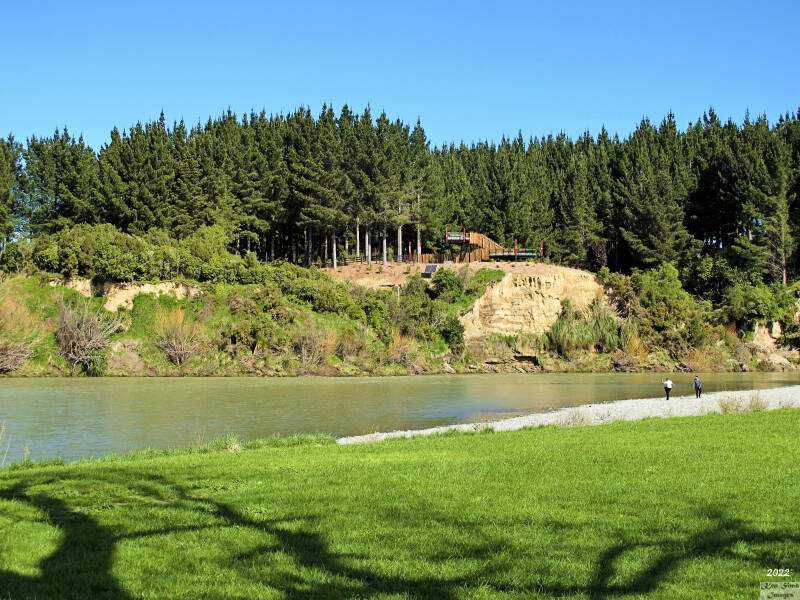
We moved down from Hamilton and rented a house at the top end of town in Conway Place, near the PN Golf Club. I started to come to terms with veterinary pathology, while Sharon started working for the local Medical Lab. At that time, the AHL was in rented laboratories on the 5th floor of the Veterinary Tower at Massy University. Microbiology had a staff of three, plus me and Barry Stevenson, the veterinary pathologist. There was also ‘Chappie’ Peter Chapman, the Head Technologist, a most affable Australian.
It was a great time for me. The work was new and interesting and there was a lot to learn – including new pathogens, new ways to diagnose them and new host species they interacted with. The university environment was great fun, and the pathology team approachable and helpful.
A significant difference back then was that most of the specimens we received were collected in the field by veterinarians (often at autopsy) and mailed to us in wooden boxes. They came from all over the country, a journey which may have taken days, and there was no refrigeration or overnight couriers back then. Consequently, in midsummer, specimen reception was a very ‘interesting’ place, and the smell when the boxes were opened was not for those with weak stomachs. There was much that was simply far too autolyzed to be diagnostically useful at all.
It was an ideal work environment for me. There wasn’t the stress of doing continual shifts and callouts in a hospital situation, but it was still a public service in the true sense of the words. There were heaps of new and interesting things to learn and plenty of knowledgeable people eager to teach me, but I could apply all the skills and knowledge I had already accumulated. There was an explicit expectation that as well as applying what knowledge I had, I would make the time to develop more, and further to that, research areas of interest and investigate how they could be applied in a veterinary setting.
As described elsewhere, before I knew it, an infectiously friendly guy called Colin Potts had recruited me into the Massey Angling Club, so there was no problem filling in the extra discretionary time I had outside of work with something I really enjoyed. The club was a collection of professorial and technical staff from within the veterinary science and wider university, so it was not only great fun but also a great way to meet and relate to the wider university environment. And best of all, I got to learn, explore, and know the landscapes, rivers, and fisheries within the wider Manawatu, Tararua and Wairarapa regions.
The Animal Health lab continued to grow, and just like there had been with the Waikato Hospital lab, there were great plans afoot to build a new, state-of-the-art laboratory complex that could house all the functions in one place. As a start, we moved to a temporary laboratory building just below the university beside the old original Batchelor homestead. This grand old building had unfortunately deteriorated beyond repair, so the plan was to knock it down and build a large new laboratory complex, combined with the MAF regional office, which was currently housed in town.
Much like the temporary new lab at Waikato, the MAF temporary new lab was a great experience, and a happy time. It was light and airy, I was doing work I loved and which I considered useful, I had autonomy and freedom in my decisions, was still learning, had great staff and support, yet along with the responsibility and work, there was still the capacity to have fun.
We bought a house on Maxwells Line, Awapuni, on the southern end of the city. It was one of the original houses in the area and had been built by the racehorse trainer Trevor Knowles after he won the Melbourne Cup, using heart Totara and Rimu milled from Wanganui. If you wanted to nail something into a stud, you had to just about drill a hole first, the bones were that tough. There were paths out the back that used to lead to stables, a horse paddock next door, and we could look out of the kitchen window straight across to the racecourse. One of the features was a sliding glass door separating the lounge from the dining room, with the winning Melbourne Cup horses etched on it. Not that we were racegoers, but the house was homely and comfortable. I could bike the 7 km to work and back on the bridle path beside the river, which I really enjoyed.
It was well fenced, and when we bought it there was a ‘paddock’ down one side of the section that was being used to graze a sheep in. There were also 3 heritage apple trees and a large apricot tree, and I gradually increased ‘the orchard’ with newer apple trees, plums, pears, mandarins, limes, grapes, elderberry, raspberries, and even a mulberry tree (I had no idea just how big they could get!) We also ripped out and remodeled the kitchen, which was about the only thing that needed doing to make the whole house comfortable.
The House at Maxwells Line
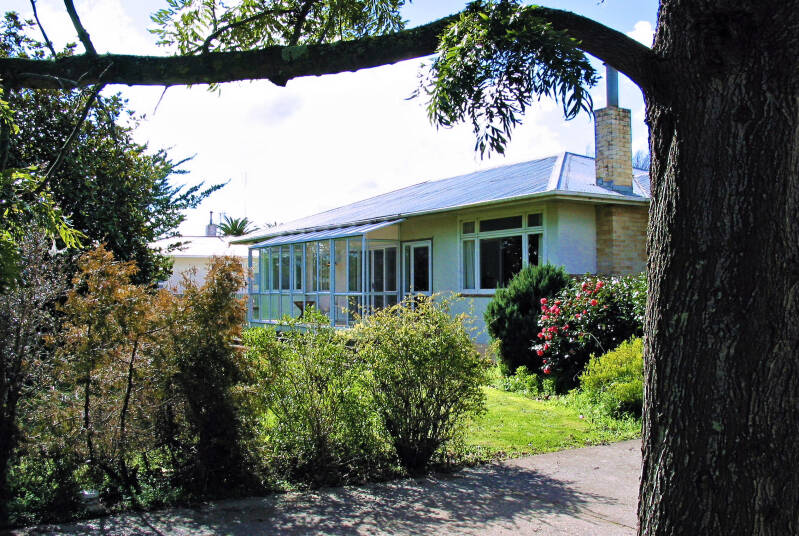
Starting a family and raising children had many challenges for us, the first being actually having any at all. We both struggled with fertility issues. I have often wondered whether working in a laboratory environment at that time, with the many toxic chemicals handled so casually, had any bearing on that, as some of our contemporary friends had similar problems. It became a case of the harder we tried, the more desperate the need became, and the more sharply the disappointments were felt.
Fortunately, the year after moving to Palmerston North and both starting new jobs, we were thrown a lifeline. In May of 1979 we were offered the adoption of a newborn baby girl, which we readily accepted and named her Leile Katherine Sims. And just like that, a huge hole in our family life was filled up, and that richness has only increased ever since. We were so lucky. She has brought so much joy and happiness into our lives.
This created another seismic shift in our lives. But one tinged with magic and rewards far beyond the additional responsibilities of raising a small child. Needless to say, both sets of our parents were delighted, and trips over to Dannevirke, and up to Paeroa, became a regular occasion. Unfortunately, Leile was not a good car traveler, which made trips through the gorge a bit of a trial, but which also encouraged me to slow down and take our trips more carefully.
Another challenge was that we didn’t get much warning (a few days as opposed to nine months), so it was a bit of a scramble to get prepared, but we managed perfectly well. Sharon had to give up work and become a full-time Mum, and we were suddenly a family.
One of the greatest challenges about raising children is that it doesn’t come with any instruction manuals! You can only do what you think is best for them, based on your own abilities and experiences. I always struggled with the conflicting emotions of wanting to protect our daughter from possible harm, while trying to allow her to be her own individual rather than an extension of my personality. I was certainly a bit over-controlling. Fortunately, Sharon was much more sensible and level-headed than I was, with an innate mother’s instinct for what was right. Even more fortunately, our daughter grew up as a strong, independent, and intelligent woman, whom was patient and loving when she challenged my preconceptions and expectations. As a result, the most challenging aspects of raising children have become the most rewarding.
Perhaps my favourite memories of my daughter growing up were watching her play, either with us, on her own, or with friends. It is easy to get so absorbed in adult life and responsibilities that it loses some of that spontaneity. Sure, she was learning while playing, but her joy and enthusiasm in simple games reminds you of the sheer fun it was to be a child. And now I can watch the same thing in her children. Life can be hard and troublesome and sad at times, but you only get one crack at it, so do the things that give you joy and have some fun!
There are so many moments as a parent that make me proud. We were so lucky to have a daughter who grew up loving and caring, with an innate sense of social justice, and who was also smart as a whip. But amongst them all, the most endearing and enduring would have to be the resulting family. The pride and joy of seeing your children grow into wonderful adults and parents, and through grit and determination having a fantastic family of their own, surely surpasses anything else. It is a continuing source of amazement and love, and worthy of another chapter, elsewhere.
But, back at work the new Batchelor laboratory complex was built and opened. A large, state-of-the-art complex with four separate laboratory wings and a two-storied central administration/office building linking them all. Our staff numbers continued to grow along with the workload and the breadth of my responsibilities, so staff management became a larger part of my job. But this too was well catered for by attending workshops, courses and seminars. There was a large, well-resourced and staffed library and IT Dept. (an area that I was increasingly interested in) and ready access to the whole Massey Veterinary Science Dept. If I had to describe my ideal job, this would pretty much be it.
Of course, it couldn’t last, and it didn’t, but it was glorious while it did, and when it changed, like in my school days, it taught me a great deal about people’s nature and how they react to changing situations.
We were well settled into life in Maxwells Line, and Leile was well settled into the local schools. Any thoughts of moving on had dissipated. Sharon had gone back to work and when Leile was a little more independent, Sharon decided that she wanted to increase her knowledge of immunology and genetics and do a degree at Massey University. Despite the recognized equivalence of her qualifications, she was required to do a Batchelor of Science degree first. Which she walked through, again bemoaning what we had seen at Waikato when Batchelor degrees were recognized as equivalent to our Intermediate exams, and they started hiring graduates; namely that their learning and understanding of basic science was woeful.
By the mid 1980’s another seismic shift began to rattle our lives. Sharon was well into her Masters Degree in Microbiology and Genetics, specializing in Immunology, and at work ‘Chappie’ Chapman had left to go back to Australia, and I had assumed responsibility for Microbiology, Serology and Histology. They were still halcyon days, but the work and responsibilities were very different. And the implications of Rogernomics were beginning to make themselves felt.
Meanwhile, I had been asked to set up a dairy testing laboratory in one of the wings of the new labs. This testing was normally done at Lynfield in Auckland, testing samples of milk powder and products for the presence of salmonella before they were shipped overseas. However, the dairy industry and their products had grown to a stage where Lynfield could no longer cope with the demand. It was pretty exciting to get to set up a completely new testing laboratory on a commercial scale, and I set about it with a vengeance. For two years we operated as a commercial laboratory, using a skeleton of permanent staff and Massey students for the rest (the peak workloads conveniently occurred over the Christmas University holidays). In retrospect, it was not a good fit for me for a couple of reasons. The idea was to test for salmonella as quickly as possible, as cheaply as possible. But if salmonella was there, I was going to find it and find it we did. To my surprise, this was extremely unpopular as each isolate or suspected isolate prevented that batch of product from being shipped overseas. There were many dollars at stake and a great deal of pressure not to find any salmonella.
Then I found out just what running a lab in the new commercial public service really meant. After two successful years of doing everything asked of us, some cost center clown in Auckland decided to put the whole dairy testing service out to tender. Now the national MAF testing program was run by a couple of in-house microbiologists, one from Auckland and one from New Plymouth. I considered them colleges, even friends. I guess that the fact that they had over-inflated opinions of their value as public health experts should have been a red flag, but the idea that they would gleefully screw over their own organization as a career move, to satisfy some Auckland bean-counter, and get rewarded for it, simply didn’t occur to me. And I wasn’t involved in the tender process directly, that was handled by my boss and his boss, both veterinarians at Batchelor.
Perhaps predictably, we were undercut on price by an unspecified commercial laboratory, with no information on what we were competing against either in terms of staffing and expertise, methodology or the sensitivity and specificity of the testing. Even back then, as the Lange/Douglas government gave way to the Bolger/Richardson government, the political sentiment was that no public service institution could possibly compete with private enterprise. So, there I was with a defunct laboratory and 5 permanent staff that I had spent two years developing. Once the shock settled down, I got on the phone, ringing every local lab and research institute I knew of, finding potential jobs for each of the staff. Then I repeated the process, finding homes for the major pieces of equipment, mainly the biohazard cabinets we used to keep the integrity of our samples as we tested them.
After all that, a cost center manager from MAF Auckland (possibly the same one) flew down out of the blue and wanted a meeting with me, my boss, and his boss. He tersely suggested that in situations such as this, it was expected that I would submit my resignation. I don’t know which shocked me most, the fact that he expected me to be the fall guy and meekly go away, or that my two bosses, who had actually done the negotiations, sat there silently, saying nothing. It was enlightening to say the least and did little to improve my mood. So, after we discussed where he could take his suggestion, and what he could do with it once he got there, he equally abruptly left.
That left both me and the Batchelor lab with a bit of a dilemma. As I had spent the last two years succession training the Microbiology staff to carry on without me, there was nowhere to go back to and no way forward. But while all this had been going on, MAF had been completely restructured, Fisheries had been split off into a separate Government Department, and the rest split into two with meat and food quality called Asure, and Livestock services now known as MAF Quality Management. It was about the time that Quality Management systems were sweeping the world’s industries, based predominantly on Japanese and Asian quality assurance systems, although few managers within MQM (as it now was known) had a great understanding of what exactly they had been named after. However, we now had a regional office out at Batchelor full of managers for the various services we were responsible for, and it was suggested that I join them as a Quality Systems Designer. It seemed a logical extension of the quality assurance that had always been part of the laboratory work, so I took it up and thus said goodbye to microbiology and laboratory work forever.
Meanwhile, on a much more positive and cheerful note, Sharon was making great strides in her bowling career. Tournament success was almost immediate, first at a club level, then center level, and then at a national level, and within six years she was representing New Zealand in the sport. I also joined the Manawatu Club and played the sport for about 18 months. Whilst I enjoyed the social aspect of the club, I quickly got to the point where I could see that I would have to spend a lot more time practicing and playing to get any better, not that I would ever have been as good as someone as gifted as Sharon. In the end it came down to a simple choice; did I want to play bowls competitively (even at a club level), or did I want to go fishing? I chose to go fishing.
Sharon meanwhile joined the Northern Bowling Club, which back then had a history and a reputation for producing and fostering bowls champions. A resume of her remarkable bowling career to date and my recreational activities can be found here:
Meanwhile, I continued to learn as much as I possibly could about Quality Management. I got to be the Regional Quality Coordinator, and part of a National Quality Management team. It was fun and I got to learn a lot about the various 'business streams’ within the organization whilst helping them with their service delivery.
Around this time, I suffered my first major health scare. A perforated diverticulum resulted in my being admitted to hospital for an emergency laparotomy, a bowel resection, and a colostomy. I spent a long time in hospital and at home recovering from that. Perhaps fortunately, Sharon was overseas for the worst of it. Even luckier, they could reverse the colostomy when I had recovered sufficiently. While I understood that it was lifesaving and absolutely necessary, it wasn’t something I in any way enjoyed. But major surgery like that does tend to focus you on what is important in life.
Back at work, I picked up another couple of projects. The first was developing an organizational-wide intranet with Grahame Walton, another manager who used to be responsible for apiarists. I was developing a keen interest in the use of computers in the workplace, and there was a plan to have all employees with access to one. If you think that this wasn’t (a) necessary, and (b) revolutionary, consider this. The Regional Office (in town) had a pool of about 40 typists. If you wanted to communicate with a client (or even another manager/employee) other than by telephone, you wrote out a letter and sent it into the typing pool. They typed it out under an official letterhead with an addressed envelope and sent it back. If it contained mistakes, you corrected them and returned it to the typing pool. Once it was returned mistake-free, you could send it out.
Communication was not a speedy process! So, in conjunction with Geoff Haworth, the local IT Manager, we developed a system whereby any employee could communicate electronically with any other employee, or by email to any external clients. Or they could type and print their own letters (oops, sorry typists). The results were interesting. Most people took to it like ducks to water. But a significant number of employees refused to have anything to do with it, seeing it as not part of their jobs. Of course, the speed and ease of the system sold itself, and even the most recalcitrant eventually came on board.
Another job I picked up was that of Regional Resource Coordinator for Biosecurity. At that time, MAF ran a ‘standing army’ of people, either MAF employees or industry employees that were trained in biosecurity responses, such as tracing, trapping, and spraying. When there was a biosecurity incursion they could immediately swing into action and were usually rotated on a two-week basis, which was my job. To many meat industry employees with repetitive or unpleasant jobs this was like a paid vacation, and finding volunteers was not usually a problem. Of course, the industry managers hated it and the disruption it caused, but even they could see that if their industry was on the line, it would be a different story. While in this role, we had the Avondale fruit fly incursion, which ran for exactly 12 months, so it was a fair chunk of my work. These days the ‘standing army’ is no more, and such work is ‘contracted out’. I hate to think what the cost of that is, but I’m sure that it is sold as ‘saving taxpayers’ dollars by costing taxpayers dollars.’
I started running an internal auditing system over the regional businesses, putting my quality management skills into practice. Again, this threw up some interesting results. While senior managers were generally appreciative of these findings, some of middle managers weren’t, preferring to ‘shoot the messenger’ for pointing out ‘failings’ rather than embracing them as opportunities. Fortunately, all the training and studying I had done had both warned me and prepared me for this.
But it did reveal a rather fatal flaw in the implementation of the quality management system within the organization. While it was embraced by most senior management as a way to enhance organizational performance and client satisfaction, most middle managers (and the ‘new commercial public service’ had spawned a lot of middle managers) saw it as something they could get others to do while grabbing the credit for any results. The political climate and messaging at the time was that “if you are providing a public service, you had better be doing so at a profit” and MQM and Asure were desperately trying to fit this model. Wave after wave of restructuring was trying to achieve that while creating fear, resentment, and despondency among the staff. Also, a lot of these middle managers were commercially trained and oriented. It was a bit like telling a bunch of sharks to ‘play nice and gentle’.
This was no better illustrated than by ‘Safebase’, which I was also involved with. Safebase was a quality management system specifically designed for the food industry, especially meat works. It was developed by a guy from Assure who could set up excel spreadsheets and spit out integrated charts like a firecracker spits out sparks. But he needed a hand turning it into a Food Safety Assurance program which they hoped to sell to the Meat Industry. The thing that sticks in my mind about this guy was when he told me “Do you know that these meat workers might only work for part of a day, until the stock runs out, but they get paid for a full day? We are going to smash those bastards, and their ****ing union.” This was not a particularly unusual attitude towards industry workers, but a very informative one. There were at least two other managers apart from myself involved in getting this commercially ready, at who knows what cost. Then a senior manager in head office sold it in its entirety to the Meat Industry Association – for the princely sum of $1.
The waves of restructuring continued, with few clear goals evident. I managed to duck the redundancies of the next two, but the third one got me. That was because they closed the regional offices all around the country. The wastage was appalling, in terms of people, of public good, and of assets. How the concept of public service had changed from so many highly trained staff, including pathologists, veterinarians and industry experts supporting farmers, to a few so-called managers in Auckland and Wellington asking industry how they could help them, mainly by changing the laws, rules and regulations. The whole Batchelor Laboratory complex: a new, modern, purpose-built suite of buildings, was simply abandoned and the functions taken over by a private laboratory in town. I’m glad that I had left before then. All except the Seed Testing lab. They couldn’t find anyone willing to buy that, and many exports depended on it.
Apart from the waste of human lives, if there was one metaphor that summed up this decision, it was the regional library. The regional reference library was huge, taking up half of the upstairs wing of the new regional building. It contained countless texts on all sorts of subjects and employed two full-time librarians. It served as a reference library for not just allof MAF but many other libraries and institutions nation-wide. It was a favorite place of mine that I used frequently. The two librarians were made redundant, and several very large skip-bins placed below the exits and balcony. Every book and paper in the place were then thrown down into the bins and taken away to the dump. As far as I know they didn’t burn them, but they might as well have.
And now, two and a half decades later, exactly the same thing is happening all around the country, as we lurch into the same political philosophies that private enterprise is inherently superior to public service, and that the people caught up in that decision are expendable.
Then, with the help of Gill Presland, whose daughter Helen was a close friend of Leile’s, I got a job at the local Polytechnic, auditing the delivery of their educational programs. Whilst I was quite familiar with the principles of what I did, the context was completely new and therefore a delightful opportunity to learn, despite having once vowed never to follow my mother and brother into the education system. Again, it was fun at first while I was learning and supported. But people kept disappearing, including my boss and my colleagues. And eventually I came up against the very same issue that I had in MAF. Senior management saw themselves as quite distinct from everyone else, with completely different behaviors and expectations. In fact, they were so different that they shut themselves away from the rest of the institution behind locked doors! If you wanted to talk to them, you needed a previous appointment. Naturally, what tended to happen was that they talked to you (when they wanted to) rather than the other way around. Then eventually in 2009, more Government ‘efficiency’ reforms caught up with the Education sector, and my job disappeared. It was hugely ironic that my job was replaced with a version of the exact same quality management system that had been implemented and failed at MQM. And given the exact same commercial expectations and management being imposed on the education sector, one could confidently expect the results to be the same. I wish that I could say that my departure was harmonious or pleasant, but it wasn’t.
At the age of 61, I fully expected to find another job, perhaps one without any grand expectations, but which could keep some income rolling in. What I found instead was one of the paradoxes of modern employment. While people are expected to work until they are 70 or 75 years old, very few employers are prepared to employ people after about age 50. So, albeit unwillingly, I retired.
So much for the bleaker landscapes of my later working years. But it wasn’t all doom and gloom.
Mountains. native bush, and a river runs through it. A great place to hike away your cares on the eastern flanks of the Tararua Ranges.
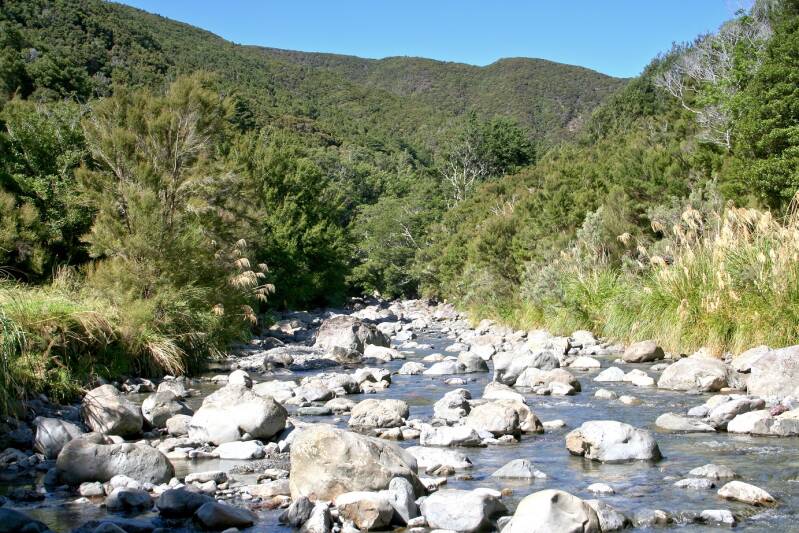
Our little girl grew up into an equally remarkable woman. Quick to learn, academically gifted and with a remarkable memory, she managed to combine that with a sensitive and empathetic nature. Schooling led to a degree in psychology at Massey University which she decided was not a career she wanted to pursue, so she switched to law prerequisites and enrolled in a law degree at Victoria University in Wellington. Successfully completing that led to a job with Chapman Tripp until she decided that, despite the many skills she had acquired, she wasn’t enjoying the rat race and wanted to return home, so she came back to work in a law firm in town. Quickly deciding that wasn’t a good fit either, she took a job working for the Employers and Manufacturers Association, where her interest in Human Resources blossomed. That led to a job with Fonterra, New Zealand’s largest company, which she enjoyed at a local level, but she was eventually pushed up their corporate ladder to a point where her HR values became incompatible with their corporate values. So, she left and joined PowerCo, an electricity supply company where she was able to build up a culture of inclusivity that she enjoys and thrives in. But even that succumbed to relentless commercial and political pressures and seeing the writing on the wall and her job in jeopardy, she has switched to a new government super ministry.
She grew up as a strong, independent, and intelligent woman, whom was patient and loving when she challenged my preconceptions and expectations about personal life. Her ability and determination to map out her own future is no better illustrated than by her marriage to a local partner and then having two fantastic sons, raised in a stable family unit which we have been able to be a part of. As a result, the most challenging aspects of raising children have become the most rewarding.
In September of 2008 we moved houses. Despite having reroofed the place in Maxwells Line, it was starting to show its age and was too big for just the two of us. It was cold, draughty and a bit damp in winter, and the grounds were getting too big to maintain properly for a couple whose recreational focus was elsewhere. It was going to need some major renovations soon. Sharon had her eye on a place just down the road off Maxwells Line that had been on the market for a while, that she used to walk past on her training walks around the racecourse. I couldn’t see much point to moving such a short distance, but we went and had a look, and it was difficult not to be impressed.
It was a relatively large 3-bedroom house on a small section, which was well planted out as the previous owner’s wife worked in a local nursery. It was also brick with a steel roof, so maintenance of the house and grounds would be significantly easier. It was built to catch the sun, with large windows and French doors allowing plenty of light and warmth in, while looking out over a courtyard. There was a spacious open-plan kitchen, dining and living area, and compared to Maxwells Line, the fittings and fixtures were of high-end hotel status. Piped gas fueled two heaters and an infinity hot water system, so not only was there an endless supply of hot water (to fill the spa bath in the main bathroom) but there would be no more sourcing and chopping firewood! The gas heaters were eventually replaced by a ducted central heating system that warms the whole house on even the coldest days.
Rose Place
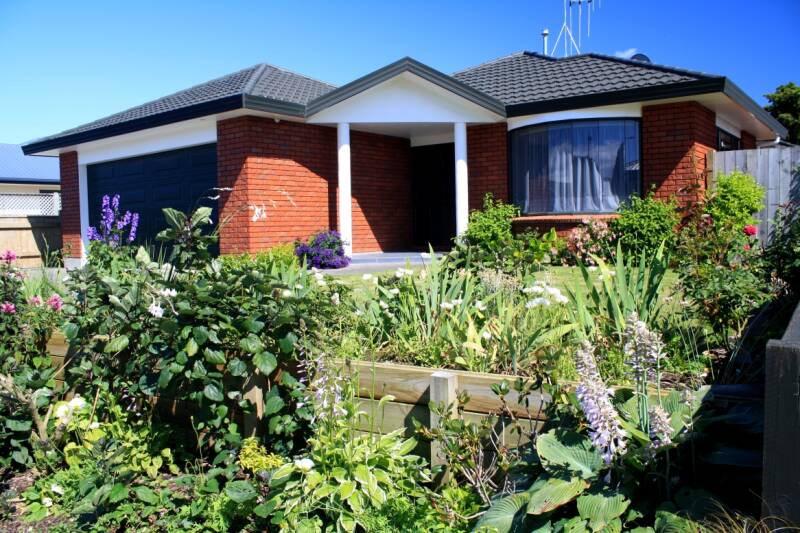
There was a built-in double garage with internal access, and unlike the grounds at Maxwells Line, it wasn’t going to flood in winter storms. It was an easy sell in the end, and thanks to Leile who had arrived back from Wellington with lots of negotiating skills particularly in real estate, we bought it at a reasonable price, which was far less than what it was on the market for.
That just left the small matter of dealing with 30 years of accumulated ‘stuff’ at Maxwells Line and trying to shoehorn what we wanted to keep into a much smaller space. It is amazing what you can accumulate in that time, and we had to be quite ruthless about discarding things (particularly me). Lots of stuff was sold, lots more went to the Red Cross, and for the rest we hired a large skip bin, and it went to the dump. And at least when we did move, there wasn’t far to go, unlike the move down from Hamilton.
It was gratifying to see that the old place on Maxwells Line was sold to a young builder, who did all the things that we would never have got around to. He completely gutted and remodeled the interior, cleared all the trees off the section, refenced the section and replaced all the drainage, bulldozed the garage and replaced it with a new one around the back, split off the orchard into a separate section and put a house on it, which his family lived in while he did up the other house, then sold off both as separate units. It is great to see that the old place is once again a family home.
Like my brother Tony, I have enjoyed photography and recording the landscapes I have visited or lived in. Today, there is so much to feel happy (and more importantly, contented) about, right here, right now. Just being here, in this moment, when many of my contemporaries haven’t made it, is a huge gift. Being at a stage in life where I don’t have to get up each morning to fulfil somebody else’s expectations and where my time is my own is hugely liberating. Being able to watch generations of my family grow and develop is another wonderful gift that wasn’t always a possibility and will never be taken for granted. Being able to live comfortably but not materialistically, is something not given to everyone and something to be thankful for. To still be curious, and more than any other generation to have the means and the time to pursue that curiosity is wonderful. To be able to live in the moment and celebrate the small gifts of the day, such as the warmth of the summer morning sun streaming through the kitchen window as I enjoy my morning coffee, or the gentle stillness of the sunset. To know that while things could always be better, and you could always have and do more, you and they are sufficient, just as they are.
If the weather is fine and my energy levels are good, there is always the lawns and gardens to contemplate and work on, or even better, a bike ride along the river trail at the end of the street. What a luxury and a pleasure that is. Once upon a time, I would have been up and away into the riversides fishing or exploring the countryside and beaches. While the medical conditions that have accompanied the advancing years may preclude that these days, a lifetime habit of photographing where I have been along with online access to those of others, means they can be revisited at will.
The end of the River Trail in Palmerston North, some 10km from home.
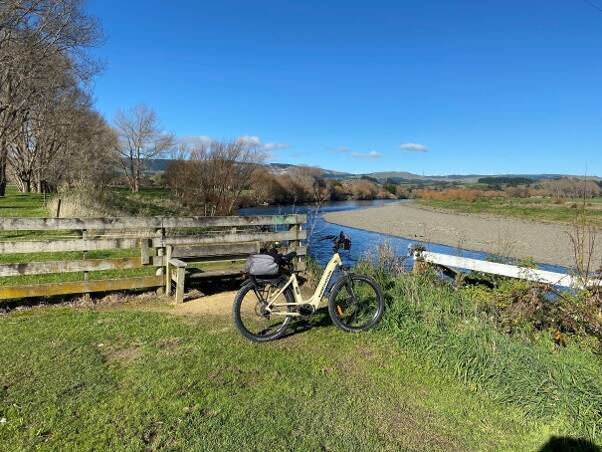
Arts and Science
Well, this is a surprising late addition, as it didn’t occur to me to include it as a separate chapter. It might be a short one, but it is important enough to warrant its own space. As they say, with age comes perspective. And with perspective comes the realization of how formative some of this was.
Science
From a young age I was always drawn toward the sciences and scientific methods. The factual basis of the world I observed around me was important. Facts could be established and pinned down like butterflies pinned to a board. They could be accumulated in the mind like riches, and best of all, they could be linked to other facts to make rich landscapes. Facts needed to be identified, separated, and tested. They then became truisms.
A love of animals and nature drew me into biology, to answer the many questions ‘why?’ Biology drew me into taxonomy, and the beginnings of seeing how individual species became part of interactive ecosystems and ecologies. From here it was a short hop to becoming fascinated with microbiology when I started working in a laboratory, and establishing how individual isolates were identified and classified, how they interacted with hosts to produce disease states, and how those disease states could be prevented or cured.
It was a similar situation with landscapes. The rural landscapes I loved to play in as a child started an interest in how they were formed, how they interacted, and how they changed and were changed. This stimulated an interest in hydrology, meteorology, geomorphology and geology and an understanding of how what was present in a landscape was a product of how it had been formed and transformed. It drove me to send the shells that I dug out of the clay banks of the local Mangatera stream to the Dominion Museum for identification, and to find that what was in the middle of the Island at 230 feet above sea level was once part of the seashore millions of years previously, when the land was lower and the seas higher.
When I think about it, a passion for freshwater angling (specifically in rivers) was a logical extension of marrying the biology of the fish with the hydrology of the water and the geomorphology of the land.
In these contexts, it is ironic that, as they say, the more you understand, the less you know. It took me decades to emerge from the yoke of Linnaean taxonomy and understand that individuals, or even individual populations, won’t necessarily conform to our established understanding of what defines them. Or that individuals within a population won’t always exhibit all the characteristics of what we use to define them as belonging to that particular population, subgroup or even species. That individuals exist on multiple intersecting spectrums, and furthermore the position on those spectrums can change over time and with differing circumstances.
This is equally true of something as rock-solid as the ground beneath us. In the last 20 years I have learnt much about planetary-wide forces that not only continue to shape our world, but which are increasingly changing it as we adversely influence their actions.
But as much as my understanding of science has changed, and as much as science itself has changed and progressed, it is the application of technology that has really shifted the landscape of human behaviour. And that is most strikingly evident with the development of artificial intelligence. This genie, promising both great benefits to mankind, and equally great threats, has been well and truly released from its lamp, with no sign (indeed, no way) of ever putting it back again. Today, it is everywhere, promising to enhance everything we do. But at what cost?
The real problem with ai is not its ubiquitous application everywhere, but the fact that it has become self-aware, self-learning and self-directing. For the first time in human history there is an entity that is faster, smarter and more capable than us. We made it, and we may very well not be able to control it.
The other recent phenomenon associated with science is the emergence of widespread and sometimes deliberately malicious denial. Nowhere is this more evident than in the field of public health, a subject dear to my heart, although it is by no means confined to that field. I will expand on this in my final chapter but suffice to say that it is manifest in several ways. The most striking is the deliberate underfunding of its applications, which in health has resulted in a winding down of hospitals and the health system, and the almost complete disintegration of the public health system through a denial of funds. Whole organizations devoted to the delivery of science-based public good, including public health have been disestablished, or worse, replaced with alternatives based on false ideologies that have been disproven for decades.
This has been accompanied by a concerted attack on intellectualism and the uncoupling of governance based on fact and expertise. In fact, intellectuals, experts and places of learning such as universities are now being openly criticized, attacked and ridiculed by politicians. This denial has been paralleled by a significant number of the general population who find it convenient to either deny factual evidence or just ignore it when it suits them. What is fascinating is that this has resulted in not just a lack of scientific knowledge and understanding in the general population, but an accompanying lack of compassion for others. It is hard to see this leading anywhere except to human misery, but it is also fascinating that at a time when knowledge is more accessible and available than ever before in human history, its acceptance and application are being denied for and by so many.
Music.
And now for something completely different. They say that there are two times in life when music is most important. Once when you are young, and once when you are old. Safe to say that when I was growing up music didn’t feature much on my radar. Firstly, because it was bland, controlled, safe, and generally very white. Secondly, the only exposure I had to it was either at school or on the radio/tv. It seemed to me that popular music consisted almost exclusively of songs from musicals or songs sung in harmonics. I really didn’t appreciate classical music at all. I have already written about singing at school. I would just add that it included a couple of musical productions put on by the high school and played publicly in the town theatre. I featured in the chorus, and it certainly didn’t spark any desire on my part to tread the boards further or even listen to vocal music as a form of relaxation.
Music started to change for me in the last few years before I left Dannevirke. The 1960’s changed popular music forever, and I was not immune to those changes. Apart from seeing early performances from bands like the Beatles on television and the rise of the folk ballad, the local church started to hold dances for teenagers on a Friday night where local bands introduced me to classic rock. Back then it seemed like a brutal rebellion against all that I had considered music to be.
By the time I arrived in Hamilton in the mid-1960’s and started working, music was definitely an important part of my life. Interestingly, it took two different turns. Perhaps as a follow-up from those Friday night dances, on Friday nights in Hamilton I went to the Hamilton Folk Music Club. I’m not even sure how that came about, but in an upstairs hall in Garden Place on a Friday night I got together with other folk song enthusiasts to listen to, and sing along with, musicians performing folk songs. You must remember that at the time, along with the emergence of rock music, folk ballads and songs had become the commentary and protest vehicle of societal changes being driven everywhere, but particularly in the USA.
So, I was introduced to Woody Guthrie and Pete Seegar, and from them to Joan Baez and Bob Dylan. And along the way there was Peter, Paul and Mary, Leonard Cohen, Joni Mitchell, Buffy Sainte-Marie, Scott Hamilton, Donovan, Gordon Lightfoot Mary Hopkins, and Ario Guthrie.
The folk-rock and folk-blues genres produced groups such as Jefferson Airplane, the Mamas and the Papas, Simon and Garfunkel, and the Moody Blues, to name but a few.
To put this in context, the 1960’s and 1970’s were times of major social change, and the music of the time reflected that. Musically, these changes tended to focus on the USA, but you could debate whether it was because the problems were greater there, or the music industry was centered there, or whether the media tended to focus there. But where America went, the rest of the world went also. My awareness, like many others, began with the 1960s counterculture movement, starting in the Haight-Ashbury District of San Francisco. This was a direct rebellion against the accepted expectation that young people would go to college, then either serve in the military or services, get a job, marry, have kids and repeat the cycle. And of course, if you weren’t Caucasian or were poor, then your access to this cycle was difficult to unlikely. The Hippie movement said ‘Nope, ain’t doing any of that. I’m not working for the man to make him rich; I’m certainly not going to fight in your dirty little wars, and I am going to love freely based on who, not what, somebody is. You can take your current society norms and stick them you know where’.
Of course, this was provocative, and I have covered this elsewhere, but San Francisco gave us genderless and inter-racial free love, flower-power, musicals like Hair and events like Woodstock. The songs and music of the times were anti-war, anti-establishment and full of love. There was so much pent-up resentment to societal control, compulsory recruitment for foreign wars and racial inequality that it held and spread. Society did change, and it was remarkable to see that change blossom. It is even more remarkable to see that change continuing to be dismantled today.
At the same time, music was being revolutionized in other ways, and it was impossible to ignore them, even if you wanted to. Rock music came of age, and for us it was a huge release from the demands of medical laboratory work, study and its relentless shift and call schedules. Once we started flatting, Saturday night was party night. Our lab parties were well attended and well lubricated. The emerging rock music featured prominently. One of the first LP records I bought myself (with my own money) was by the Cream. It was joined by Fleetwood Mac, Pink Floyd, the Who, the Beatles, and of course Jimi Hendrix.
Eventually our lifestyle and our music became less frenetic and softer. Perhaps as a counterbalance and an escape from the pressures of both work and peer lifestyles I bought a portable record player which I could keep in my bedroom in our flats and play my own music. And I discovered classical music. Not exclusively, but Tchaikovsky, Beethoven, Mozart, and Chopin were joined by more contemporary composers such as Gershwin as part of my recreational listening. This has persisted to this day, with access to music streamed from my computer including both orchestral and violin performances.
Of course, the rise and fall of human rights has been paralleled in New Zealand. The opposition to the Springbok Tour saw the legitimization of a major shift in race relations in the country which saw Māori culture start to flourish. Despite vociferous opposition from right-wing and conservative politics this continued until about 3 years ago. Then our human rights started to come under sustained attack, funded and organized partly by far-right organizations and money from the USA and Britain feeding into far-right politics and fringe organisations here. In terms of race relations, the inclusion Te Reo into the national language, the dawning realization of the depths of the effects of colonization and the move towards co-governance have sparked a massive pushback from both them and capitalist industries. In terms of gender equality, we have seen (along with Finland and Scotland) a woman Prime Minister widely regarded both here and overseas as one of the best, hounded from office by male toxicity. Coincidence? I think not. Like most of the rest of the world, we have seen a transition from acceptance and tolerance to a complete preoccupation with the self above everyone else. As the saying goes, ‘this will not end well.”
Interestingly, with the availability of almost unlimited music on demand electronically today, my tastes have become much more eclectic. While the roots described above form the backbone of my collection, I find that it has expanded to include strong male and female vocal singers such as Bocelli and Barbara Dickson, Sarah Brightman and Elaine Page, and classical violinists such as Steinbacher, Hahn and Fischer. There has even been a little bit of Country creeping in, with Artists such as Willie Nelson, Emmylou Harris and even Crystal Gayle, perhaps a nod back to the folk music where it all started.
But what is very interesting to me is that today, fifty or more years later, the young ones are rediscovering what are now regarded as the musical ‘classics’ that we cut our adolescent teeth on, supposedly hearing them for the first time (although how you could get to be an adolescent without hearing the likes of Jimi Hendrix is beyond me). The overriding impression they give (other than astonishment) is ‘They don’t make music like that anymore’. And the concept of producing or playing a rock song backed by a full orchestra and choir, rather than canned electronic computer-generated sound, just blows them away.
Then there is the tendency, particularly in America, to analyze it to death. Listening intently to the lyrics to ‘discover’ their meaning. Sometimes, there isn’t any. As Gary Brooker of Procol Harum once said of a Whiter Shade of Pale, “I wrote the lyrics, and I don’t know what they mean. I wrote them to evoke an emotional response’. Sometimes, analyzing a song or singer is interesting, but pausing it mid-song to give a ‘recon’ simply destroys it.
The other reaction I find interesting is a lack of contextualization. “Oh, it is an anti-war song. Yes, war is bad”. No, not the point. How could the youth of America be unaware, or have forgotten, that their grandparents who wrote and sung these songs lived at a time when, on any day, a letter could arrive telling them they were being drafted to fight and possibly die in a war in a far-off land that they had absolutely no connection with, and no right of refusal? The ‘protest’ was as much about their own leaders, who were organizing and supporting those wars, as it was about the war itself.
Literature
I grew up emersed in books. Back then, they didn’t have much competition. They were one of the few portals universally available to new ideas and different worlds. We would frequent libraries like we would sweet shops, with the added bonus that the contents were free.
Obviously, my tastes in and appreciation of literature have changed over the years. When I was young it was centered around action and adventure stories, although even back then reference books and scholarly writing featured in my selections on topics I was interested in. As my appreciation and love for nature matured, that was mirrored by favorite authors, such as Gerald Durrell. And as that interest broadened into landscapes, both natural and human, it led me to authors who understood, appreciated and portrayed those, such as Ernest Hemmingway and John Steinbeck.
Interestingly, as my science-based career developed so did my interest in pushing the limits of that, and I developed a taste for science fiction. It wasn’t a huge step from that to fantasy, particularly epics. But just as my interests and appreciation of music was broadening to include classical as well as contemporary artists, so my appreciation of literature broadened to include classical writing, not just English literature but also that from Greek, Roman and Asian sources. And that was just as likely (if not more so) to include poetry as prose.
But interestingly, the same phenomenon that has characterized science in the digital age is also affecting literature. Not only is it more accessible to more people than ever before, publishing your own books has become ridiculously easy, and everyone is doing it. And not only are there more books available than at any time in history, but you now have some of them being written by ai and not humans. Sorting out serious writing from the loads of rubbish has become a significant issue. At the same time, people have become so time-poor, and there are so many alternative distractions competing for what time they have, reading is a less attractive use of people’s time. Rather than reading and contemplating a written classic, they are much more likely to watch a film or video of someone’s interpretation of it. Which can become problematic.
Art
There has been such a seismic shift in my perception and appreciation of art during my lifetime. When I was young, I knew two things about art. Firstly, I was not exposed to much of it, but I liked it as a storytelling medium. Secondly, I was not very good at it. That didn’t stop me from scribbling away, as I started developing an interest in landscapes, by trying to reproduce what I saw and admired.
When I started work, I met and befriended a couple of laboratory workmates who were quite accomplished artists and photographers. Dennis was an enthusiastic and accomplished photographer, who was also a passable artist. Roger was simply an artist. What he was doing in a medical laboratory, I have no idea, although he was highly intelligent and capable. But he was a passionate and talented artist, who seemed to think quite differently than I did, and who was fixated on Salvador Dalí’s paintings at the time. That tied in quite nicely with the emergence of psychedelic rock during that period. But that exposure was about as far as it went back then, although lately I have come to see that there is a juxtaposition, or even a synergy between art and science, especially at a cellular level.
The fact that Roger had no difficulty bridging the gap between art and science is probably best exemplified by his hobby of making homemade fireworks. These became quite legendary. He would often turn up at parties and functions with containers of his chemical creations, entertaining everyone with dazzling multicoloured displays as they went off. This seemed to culminate at a Guy Fawkes party at Gus Schick’s house. Gus had recently married, and moved into a house in Melville, with a terraced garden out the back leading down a gully, with no houses on the other side. A perfect site for a Lab Guy Fawkes party! And so it proved. As a piece d’ resistance, Roger appeared with a long piece of bamboo, which must have been a good 8 cm in diameter, packed with who knows what. It was duly placed at the bottom of the garden and lit, providing a many coloured spectacle as it shot flames and sparks high into the air. As it burnt down to the end there was suddenly a huge explosion, the shock waves of which were enough to blow anyone standing close enough off their feet. I suspect that only the isolation of the site, and the date, prevented a visit by the local constabulary.
So, my continuing interest in art was confined to photography. In the pre-digital era this was slow, laborious and prohibitively expensive. Carrying the equipment around to take decent photographs in the landscapes I was interested in, such as tripods and large frame cameras, was simply impractical. And I lacked the patience and expertise to do my own developing, as Dennis and Roger did, that step that can turn photographs into art. That changed completely with the advent of digital photography. Although initially the cameras were large, expensive and clunky, and the software rudimentary, that has progressively changed until today most smart phones are capable of taking high quality, large file sized photographs and videos. Finally, I was able to wander round the country landscapes of my home and capture their essence in photos.
That same digital revolution also brough us the internet, and an exposure to art that I could have never imagined. Just as I could wander the landscapes of the world through the eyes of other photographers, I could also conjure up images of art from around the world and all through time as well. Obviously, landscape art became an abiding interest, but so did sculpture and portrait art. I suspect that the reason I hadn’t taken an interest in that previously was because I couldn’t draw figures for nuts. But that was about to change. Sophisticated software allowed anyone to reproduce landscapes, scenes and people with a detail, ease and accuracy that gave rise to a whole new genre. Making digital art was accessible to anyone, the only major limitation being the computer grunt necessary to produce it. The genie was finally allowed to escape completely from the lamp when overcoming this limitation became available online, coupled with artificial intelligence that meant that, if you could describe it, ai could produce it. While I don’t think that this genie is going back into the lamp anytime soon, it does have its downsides. Apart from the large amount of resources it requires, the combination of ai and digital image manipulation today means that there are no images that you can see, that you can assume are ‘real’. But the enthusiasm with which the whole world has embraced this technology suggests that this doesn’t matter.
The next step was logical, I guess. Anyone can now produce a stunningly realistic 3-dimensional image of anyone (or anything) they can imagine, turn it into a video, make it talk realistically and say anything they want it to, put it into any setting or scenario they want and post the resulting clip on social media. They are good enough to be indistinguishable from reality. The implications of this are as disturbing as they are fascinating.
I have been waiting for the holograms to become widely available, they seem to be taking their time, but it can’t be far off now. I suspect that it requires another level of computer grunt to achieve, so it is only a matter of time. In the meantime, the genie of ai, having been released from its lamp, is showing no signs of returning to it. It is ubiquitous and everywhere. Like its use in art, it promises great benefits and great dangers.
Just as the widespread ability to make artificial images indistinguishable from reality became popular as soon as it was available, there is a certain humanoid logic in now making artificial models (robots), which may also be indistinguishable from reality. Powered by ai, able to speak, move and react, capable of self-learning and even self-direction, the line between what is real and what is not becomes even more blurred.
The attraction is obvious, but so too are the dangers. For perhaps the first time ever, humans have created something that is faster, more powerful, more organized and smarter than themselves. Capable of learning, self-repairing and even building replicas, sentient machines blur the boundaries between objects and lifeforms and could already theoretically surpass human capabilities and the ability to control them. How do you put that genie back in its bottle?

Is it art? Is it photography? Is it either? This picture has been produced by a remote computer on the other side of the world. Even the subject isn’t real but is someone ‘imagined’ by the software in a machine. Does that make it ‘valid’ artistically, or not? And does it matter?
What probably does matter is that, unless you are told, there is no way of telling if this depicts anything real or not, apart from the idea that the computer was told to produce it.
Epilogue
I tossed up whether to include this as a finale to this or not, but I think that I must, because in spite of its disjointed nature, it is an accurate description of how my world got turned upside-down, and the belief systems and values that I cherished and thought were shared, were shattered. It is part of the landscapes of my life even if an unpalatable part.
Previous sections have described my love of nature, science, and evidence and fact-based values. I rejoiced in the natural landscapes that surrounded me. I had a science-based career in public health which I revelled in, despite its faults, even way back then. It was a time when the multifactorial nature of disease states was not only being recognised but addressed in a holistic fashion. There was a feeling of openness, inclusion and care for others.
Then in December of 2019, Chinese authorities notified the World Health Organisation of a cluster of infections by a novel coronavirus in Hubei Provence in China. It was not the first Sars Coronavirus to become pandemic, so the implications to human health were obvious. As a medical microbiologist who had watched epidemics of diphtheria and tuberculosis ravage communities, I was naturally fascinated as different countries health systems swung into action. But I was totally unprepared for what was to follow.
The virus has proved to be much more adept, subtle and adaptable than the human response to it. It was able to set up reservoirs in mammals other than humans and mutated into thousands of variants, each competing for dominance. Despite having what was acknowledged at the time as one of the best public health responses in the world, which saved hundreds of thousands of lives, people in New Zealand and around the world simply got tired of taking precautions and basically gave up. There was a surprising amount of resistance to even basic measures. Mass protests and civil disobedience were captured by groups and organisations with their own agendas and values, which have little, if anything, to do with public health. While this is not unique to this pandemic or this period of history, the sheer stupidity displayed is astounding in this age.
Six years on and half a million peer-reviewed scientific papers later, a strange duality has emerged. We probably know more about this virus, its structure, mode of actions, and disease producing capabilities, than just about any other virus on the planet. The virus itself has found much more success in not killing people suddenly and directly and now mostly does so slowly and surreptitiously. It not only evades our immune responses with ease, but it also actively attacks it. We know how it acts, we know why it is so successful, and we know exactly what the risks are.
We know that things such as ventilation, air filtration, CO2 measurements, social distancing, isolation when infectious, wearing high-quality masks, staying outdoors as much as possible, all work – regardless of the pathogen. We know that vaccines provide effective short-term measures against serious disease for a large percentage of people. We know that communicating up-to-date information about the virus helps people make informed decisions. So, are we doing all or any of that? Increasingly, the answer is no. This is surely an interesting phenomenon. The more we know what to do, the less the inclination to do any of it, politically, medically or socially. It is simply being ignored. I know that all this isn't new. Afterall, the plague (Black Death) persisted in parts of Europe for over 300 years, and this has only been six. Public Health actions to control and eliminate the scourges of typhus and tuberculosis weren't taken until well after their effectiveness was known. Previous campaigns to vaccinate against diphtheria and smallpox were also met with viciferous and equally illogical opposition.
And yet, after all these years, and informed by international experts in their fields, some things are becoming clearer. The human race, and indeed the world is facing two existential crises.
The first, a novel coronavirus, has fragmented into thousands of variants that are diverging and recombining endlessly, and it has got a whole lot smarter. They no longer produce such acute initial symptoms that they kill people outright. Most initial phases of infections are mild or asymptomatic. But the new variants still infect most parts of the body by colonising blood vessel endothelial cells, setting up chronic inflammation of vital organs that can cripple or kill months or years later. These new variants can not only escape the body’s natural defences, but they also actively attack and invade them. Not only do they cause delayed sudden death or chronic, permanent disability, they cause cognitive impairment and infertility. And there are so many variants that any post-infection immunity to one can simply result in reinfection with another. The ongoing destruction of people’s immune response is resulting in the resurgence of diseases (such as Tb, measles and even polio) that have hitherto been held in check, and the increase in severity of others. Winter surges of respiratory disease severe enough to overwhelm hospital resourses are now taken as ordinary and expected. It is fascinating (as a horror film is fascinating) to watch and know that we could actually prevent this and chose not to.
So, as a species, we are getting sicker, dumber, and less fertile. We know this, and yet our response is to remove all protections from individuals, gather in large crowds, and party or go on holiday. We abandon the sick and expose our children to these threats with enthusiasm. A few years ago, I would have thought this implausible, and yet, here we are.
The second existential threat is even more bizarre. Again, both the causes and cures are well known. As a species, we have heated the earth’s atmosphere so much by burning fossil fuels that the ecological boundaries necessary for the continuation of life as we know it have been breached. Breaking these tipping points is setting off global feedback loops that are changing the world’s climate, atmosphere, and oceans with breathtaking rapidity. We know how this would end (in the immediate, not distant future), and yet our response globally has been to actually increase the drivers of these changes. Such an irrational response would again seem implausible when it is so unnecessary, yet that is what we are faced with.
Faced with increasingly frequent and severe ‘natural’ disasters our response as a species is simply to rebuild and carry on. Again, and again. Nothing changed. Nothing learnt. A response that is as bizarre as it is illogical. There would seem to be only one inevitable conclusion. In 1925, T S Elliot wrote a poem called the Hollow Men, which contained the line “This is the way the world ends. Not with a bang but a whimper.” With the global and local landscape looking increasingly hot and barren; with the so-called dominant species on earth unable or unwilling to do anything to ensure its own survival (even though it knows how); it suddenly seems quite conceivable that this could well describe the fate of our species.
Echoes of the past:
Stories of the
- SIMS/WATSON,
- FALLENI,
- FRENCH,
- MILLERS,
- and THEIR
- ASSOCIATED FAMILIES
and their migration to New Zealand,
collected by Ken Sims.
Global connections: cities beyond our shores
Our family story isn't confined to New Zealand; it stretches across oceans and continents. Many of our ancestors hailed from distant lands, bringing with them traditions and memories from cities far removed from our current home. This section explores the European cities and other global locations that were once home to our pioneering family members, illustrating the remarkable journeys they undertook to forge a new life.
Explore the family stories that research into the family trees has thrown up about our family history earlier than that written in Early Arrivals.