

Scott family ancestral stories
Exploring the earliest recorded origins of the Scott lineage, alongside the intertwined Bremner, Havill, and Chillcott branches. Delve into the historic landscapes, ancient parish settlements, and archival records that shaped our forebears before their stories travelled to New Zealand.
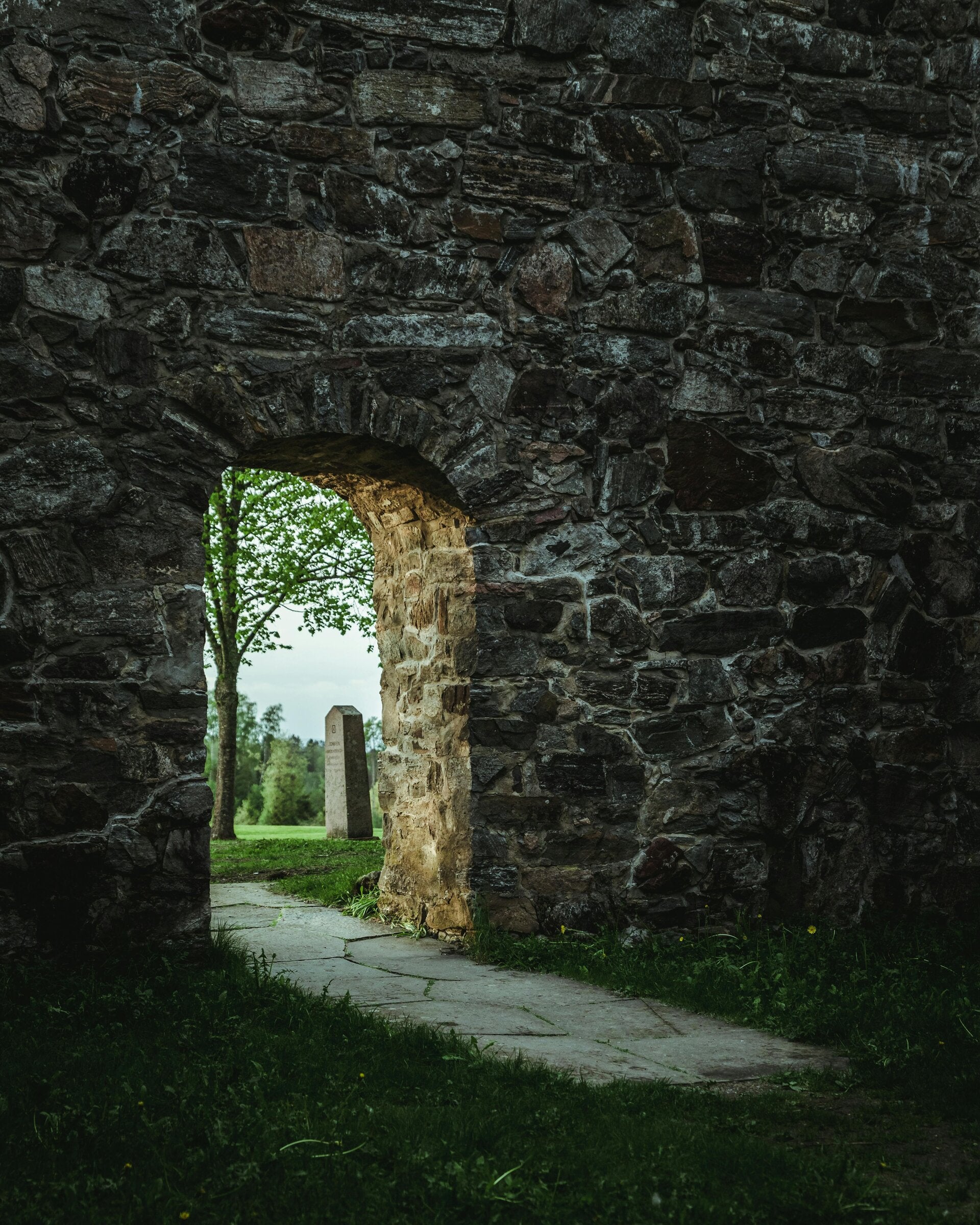
The Scott and Bremner roots
Long predating early photographic records, the initial footprints of the Scott and Bremner lineages are preserved in regional parish books, land surveys, and family charts. Tracing backwards as far as documentation survives, these records offer an evocative look into their remote rural settlements and the demanding realities of their everyday lives.

The Havill family connections
Interwoven into the broader Scott family tapestry, the Havill branch provides a distinctive thread of heritage. Rather than following a strictly linear timeline, their legacy emerges through scattered archival notes, regional records, and genealogical charts that capture their place in history across generations.
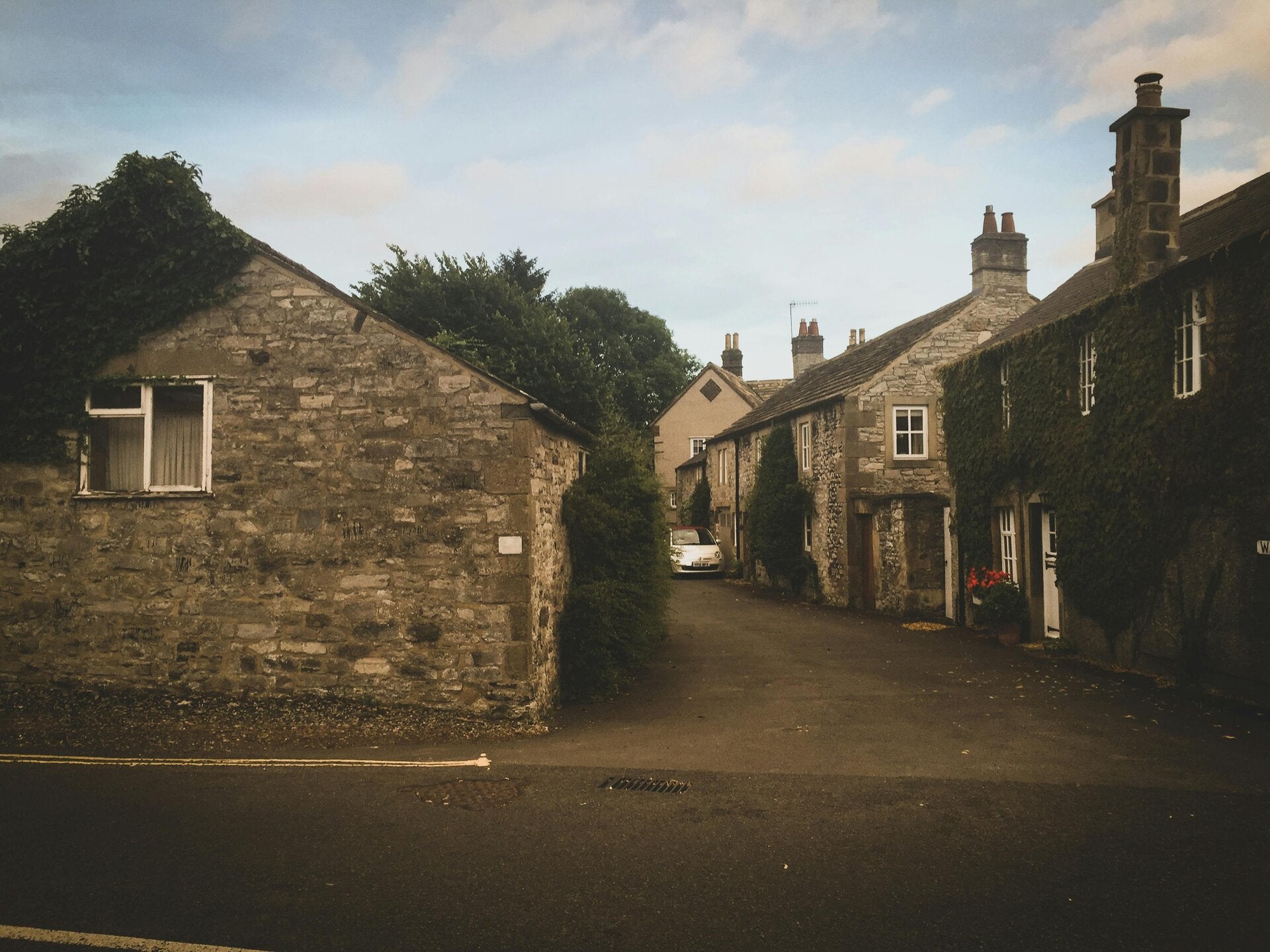
The Chillcott lineage and heritage
The Chillcott ancestors complete this foundational chapter of our family tree. By examining the villages where they lived and worked, we gain a genuine insight into the social landscapes and eras that shaped their decisions, values, and eventual paths forward.
The Curious Case of the Scottish Covenanters
Looking back into the early history of the Scott family, I knew that there had to be an interesting story there, and so there was. But to make any sense of it, I had to learn a lot more about the history of Scotland than I had bargained for.
A covenant in the biblical sense is a solemn binding agreement, primarily between a person and his God, but also between a person and human representatives of that God. The former is characterized by sacrifice (either actual, ritual or implied), while the latter is characterized by oaths and mutual promises.
Background.
In 1637 disaffected nobles led the Scottish political community and wider society in opposing the government of Charles I. In 1680 the radical cleric Richard Cameron declared war on Charles’s son and heir, Charles II, and guided protest against the political community and wider society. While vastly different events, both were justified by appeals to ‘the Covenants’ – the National Covenant of 1638 and the Solemn League and Covenant of 1643.
The promulgation and widespread subscription of the National Covenant in 1638 was an event of enduring significance. A reaction against the style and substance of government under Charles I, the Covenant consolidated protests which had been triggered by the unconstitutional imposition of the Book of Common Prayer in Scotland. The prayer book proved to be the tipping point for grievances which had their origins in the reign of Charles’s father, James VI, who had become James I of England (and Ireland) from 1603. Religious controversy was supplemented by aristocratic fears of being sidelined from their traditional role in the political process.
After the riots and petitioning which had greeted the prayer book in the summer of 1637, opposition to government policy was formalised through the creation of the ‘Tables’ – an unauthorised convention of the Scottish Estates and Presbyterian clergy who marshalled resistance to the king. It was this body who launched the National Covenant on 28 February 1638 as a vehicle to confront royal authority while galvanising Scottish society against the prerogative rule of absentee Britannic monarchy. With momentum on their side, the Covenanting movement wrought a Presbyterian reformation of the Kirk in defiance of the Crown at a General Assembly in November.
The political ineptitude of the king saw his military campaign against the Covenanters defeated during the Bishops’ Wars of 1639-40, and, as a result, he had accepted the reality of Covenanting hegemony in Scotland by the autumn of 1641. However, the crisis in his ‘ancient kingdome’ was also replicated south of the border. Forced to call the English Parliament in response to the Covenanting dynamic, Charles was unable to prevent an accord of the aggrieved from each kingdom.
An alliance of Scottish Covenanters and English Parliamentarians was duly consummated by the Solemn League and Covenant on 25 September 1643. At the same time, the alliance ruptured the Covenanted coalition in Scotland and gave rise to a Royalist faction fronted by the formerly enthusiastic Covenanter, James Graham, fifth Earl (later first Marquess) of Montrose.
In a Scottish context the idea of covenanting arose from a late medieval and early modern culture of subscription which was marked by oath-taking and written bonds. In particular, it can be traced to the 1550s when the practice of banding for mutual defence was given a divine makeover by Scotland’s premier Protestant reformer, John Knox. Knox’s Biblical legalism had seen him look to Old Testament Israel rather than the Scottish past for antecedents to the Protestant cause – unlike Scotland’s foremost Renaissance humanist, George Buchanan, who fabricated an early history of the Kirk free from Catholic ‘corruption’. As a result, Knox drew on the Biblical tradition of covenanting and viewed the Scots as divinely sanctioned successors of the Israelites as the ‘chosen people’ of God. Thus, by styling these ostensibly religious but undoubtedly political arrangements as ‘covenants’ the Lords of the Congregation (the magisterial proponents of Protestant reform) were imbued with the sense that they had associated together to lead the ‘cause of God’ against the French-dominated government of the Queen Mother, Mary of Guise. At the same time, Knox characterised ‘official’ reformations as the date when entire nations had covenanted with God. Consequently, Scotland became a covenanted nation – in defiance of the Crown – during the ‘Reformation Parliament’ of August 1560.
By 1660 the British Civil Wars had been brought to a fortuitously bloodless close with the restoration of Stuart monarchy in the three kingdoms. With the Covenants largely abandoned by a political community opting to appease the restored king in the hope of recovering their respective fortunes, the statutory basis of Covenanting was dismantled by the Scottish Parliament in 1661. But while the constitutional settlement attempted to turn the clock back to 1633, it could not undo the social and economic dislocation occasioned by warfare, nor erase the memory of political and religious upheaval across the previous two decades. To the chagrin of Restoration officials, the Covenants lived on.
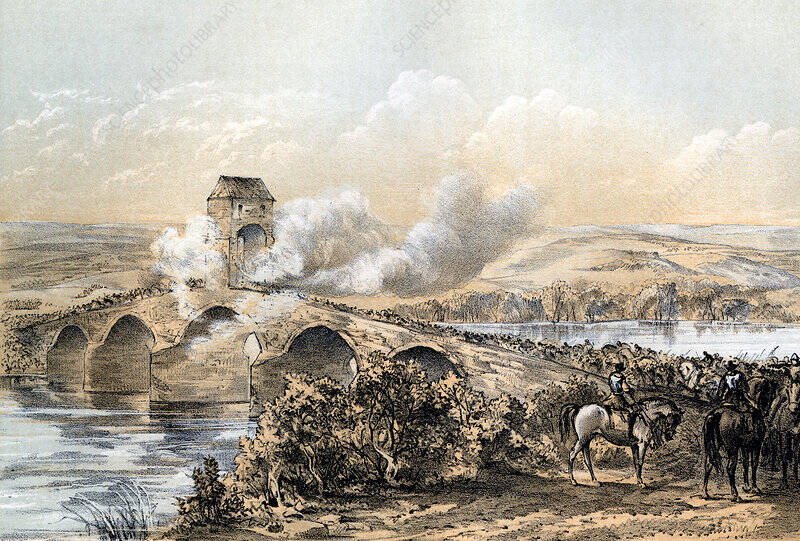
From 1674, Scottish Presbyterian covenanters showed that they were very deft at organising and militarising not just the Scottish nobility, but the general population in opposing British rule and any religion other than their own. This gradually escalated both philosophically and physically until it culminated in the Battle of Bothwell Bridge on June 22nd, 1679, between 5000 Government troops lead by King Charles' son James, Duke of Monmouth who had been sent north to take command, and 6000 covenants camped on the south bank of the Clyde, north of Hamilton. They were however poorly disciplined, deeply divided by religious disagreements and had few competent commanders.
The battle centred on the narrow bridge across the Clyde, the passage of which Monmouth was required to force in order to come at the Covenanters. They led a spirited defence of the bridge and had some initial success in the initial skirmishes at the bridge itself. But their men lacked artillery and ammunition and were forced to withdraw after around an hour. Once Monmouth's men were across the bridge, the Covenanters were quickly routed. Many fled into the parks of nearby Hamilton Palace, seat of Duchess Anne, who was sympathetic to the Presbyterian cause, and it was in this area that the final engagements took place. The numbers of covenanters who were killed varies widely with estimates ranging from 7 - 700 according to the Scottish Battles Gazetteer. Around 1200 were taken prisoner.
The Battle of Bothwell Bridge
The prisoners were taken to Edinburgh and held on land beside Greyfriars Kirkyard, an area now known as the Covenanters' Prison. Many remained there for several months, until the last of them were transported to the colonies in November. However, a later shipwreck allowed 48 of the 257 prisoners to escape. All those who had taken part on the Covenanter side of the battle were declared rebels and traitors, and the repression during this period has become known as "the Killing Time" in Covenanter histories. A core of hard-line rebels remained in arms and became known as the Cameroonians after Richard Cameron their leader. Cameron was killed in a skirmish at Airds Moss the next year, but his followers were eventually pardoned on the accession of William and Mary in 1689.
A Personal Connection.
One of the covenanters’ taken prisoner was George James Scott, Laird of Pitlochie, who was born in Perth, Perthshire, Scotland on October 4th, 1635, the son of Sir John Gilmour Scott of Scotstarvet, Fife, Scotland. George James Scott was a direct ancestor of mine, 10 generations ago. What follows is an account of his fate following his capture.
In 1685, George Scot, Laird of Pitlochie, was given his liberty in Scotland provided he transported to East Jersey many of the Covenanters who had refused to take the oath of allegiance to a tyrannical and profligate ruler. The Province of East Jersey, along with the Province of West Jersey, between 1674 and 1702 in accordance with the Quintipartite Deed, were two distinct political divisions of the Province of New Jersey, which became the U.S. state of New Jersey. The two provinces were amalgamated in 1702. In 1682, the Governor and other Scottish proprietors began the development of Perth Amboy as the capital of the province. In 1687, James II permitted ships to be cleared at Perth Amboy.
Thus authorized, George Scott proceeded to gather his company from those confined in the tolbooth of Leith. He had to give security to land them there prior to September 1686, and the penalty was to be five hundred merks in case of failure in any instance. In May 1685, Scot chartered the Henry and Francis of New Castle, a ship of three hundred and fifty tons and twenty great guns, with Richard Hutton as master.
On the eve of their banishment, twenty-eight of them signed the following conjunct testimony, bearing:
"That, now to leave their own native and Covenanted land by an unjust sentence of banishment for owning truth and. standing by duty, studying to keep their Covenants engagements and baptismal vows, whereby they stand obliged to resist and testify against all that is contrary to the Word of God and their Covenants; and that their sentence of banishment ran chiefly because they refused the oath of allegiance which in conscience they could not take, because in so doing they thought utterly declined the Lord Jesus Christ from having any power in His own house, and practically would; by taking it, sat, "He was not King and Head of His Church and over them consciences. And, on the contrary, this was to take and put in His room a man whose breath is in his nostrils; yea, a man who is a sworn enemy to religion; an avowed papist, whom, by our Covenants; we are bound to withstand and disown, and that agreeably to Scripture: When thou art come unto the land which the Lord thy God giveth thee, and shalt possess it, and shalt dwell therein, and shalt say, I will set a King over me, like as all the nations that are about me, thou shalt in any wise set him King over thee, whom the Lord thy God shalt choose: one from among thy brethren shalt thou set King over thee: thou mayest not set a stranger over thee, which is not thy brother. Deut. 17: 14-15.”
They then bore their testimony against the defections of the day, and for preaching in the fields and homes, and then signed their names.
Names
1 Adam, Robert 2 Aisdale, William Rev. 3 Arbuckle, John 4 Athernie, Lady 5 Black, John 6 Bovan, Katharine 7 Brown, George 8 Campbell, Daivd 9 Campbell, John 10 Campbell, Robert 11 Campbell, William 12 Casson, John 13 Cavie, Christian 14 Corbet, Andrew 15 Corbet, John 16 Corhead, Agnes 17 Cowan, Barbara 18 Cowan, Marjory 19 Crichton, John 20 Cuningham, Patrick 21 Cunningham, William 22 Douglas, Charles 23 Douglas, William 24 Durie, Isabel 25 Ferguson, Elspeth 26 Ferguson, Janet 27 Ferret, Mary 28 Finlater, Thomas 29 Ford, John 30 Foreman, John 31 Forsythe, James 32 Frazer, John 33 Gamble, Grisel 34 Ged, William 35 Gilchrist, Robert 36 Gilfillan, John 37 Gordon, Annabel 38 Gordon, Bessie 39 Graham, Thomas 40 Gray, John 41 Gray, Thomas 42 Grier, Fergus 43 Grier, James 44 Harris, John 45 Harvie, John 46 Henderson, John 47 Hodge, John 48 Honyall, Charles 49 Hood, Adam 50 Hutchinson, John 51 Jackson, Thomas 52 Jackson, William 53 Johnston, George 54 Johnstone, John 55 Junk, James 56 Kellie, John 57 Kellie, Katherine 58 Kennie, John 59 Kincaid, John 60 King, John 61 Kippan, John 62 Kirkwood, James 63 Kirkwood, John 64 Leslie, Margaret 65 Linthron, Janet 66 Lockhart, Gawen 67 Marshall, John 68 Marshall, Michael 69 Martin, John 70 MccCalmont, William 71 McEwen, John 72 McEwen, Robert 73 McEwen, Walter 74 McGhie, John 75 McKenman, John 76 McLellan, Andrew 77 McLellan, Margaret 78 McLellan, Robert 79 McMillan, William 80 McQueen, John 81 Miller, Margaret 82 Moffat, Jean 83 Monorg, Gilbert 84 Muir, George 85 Muirhead, James 86 Muirhead, John 87 Nevin, William 88 Oliphant, William 89 Patterson, Andrew 90 Pollock, John 91 Ramn, John 92 Rennie, Marian 93 Renwick, John 94 Reston, James 95 Riddell, Archibald 96 Riddell, Archibald Rev. 97 Rigg, William 98 Russell, Peter 99 Russell, Thomas 100 Scot, Eupham
101 Scot, George 102 Scot, Margaret
103 Seton, John 104 Shelston, Thomas 105 Sittingtown, James 106 Smith, John 107 Sprat, William 108 Sproull, William 109 Stevens, Agnes 110 Strang, Christian 111 Swinton, John 112 Symington, Janet 113 Targat, John 114 Turnbull, William 115 Turpine, John 116 Urie, Patrick 117 Vernor, John 118 Vernor, Mrs. 119 Walker, Patrick 120 Wardrope, James 121 Watt, John 122 Whitelaw, Elizabeth 123 Wilson, William 124 Witherspoon, Grizel 125 Young, Robert
The Voyage & History
The ship "Henry and Francis" of New Castle, departed from the port of Leith, September 5, 1685, and arrived at Perth Amboy, New Jersey, in the middle of December 1685.
The charge for transportation was five pounds sterling for each adult and to each of those who were unable to pay for their passage was promised twenty-five acres of land and a suit of new clothes on the completion of four years of service; for children under twelve years of age, fifty shillings; sucking children free; one ton of goods, forty shillings. These have been known in American History as "Redemptioners." Many of these passengers had endured much suffering. After some delay, the ship had sailed from the town of Leith on September 5, 1685. We hear of no untoward event until after they had turned the Land's End," when a fever began to prevail with virulence, particularly among the prisoners who had been confined in the great vault of Dunnotter. Many were sick when they came aboard, and the health of the others was endangered by the condition of the provisions laid in by the Captain.
The meat began to putrefy and was not eatable, In a month the fever assumed a malignant type. Few escaped its ravages, and three or four bodies were cast overboard every day. Most of the ship's crew, except the Captain and boatswain, died. Pitlochie, who had freighted the ship, with his lady, died likewise, and so enjoyed nothing of the gain of nearly one hundred prisoners gifted him by the Council, and upwards of seventy persons died at sea.
Death and unwholesome food were not the only evils the unfortunate Covenanters had to encounter; the master of the ship was most cruel to the prisoners. Those who were placed under deck were not allowed to go about worship, and when they attempted it, the Captain would throw down great planks of timber to disturb them and endanger their lives. The ship sprang a leak twice, and frequent storms added to their anxiety, After the death of Pitlochie, the prisoners fell into the hands of John Johnstone, his son-in-law. Captain Hutton began to tamper with Mr. Johnstone and urged him to carry the prisoners to Virginia or Jamaica, either places presenting better opportunity for disposing of them than New Jersey and offered as an inducement to charge himself with the disposal of the prisoners and to account to him for them in the productions of the country. But the wind changed, and they were forced to sail straight for New Jersey. They landed at Perth Amboy, New Jersey, in the middle of December 1685, having been about fifteen weeks at sea. Before going ashore, Johnstone endeavoured to stop them by urging them to sign an agreement to serve four years at that place in consideration of the expense incurred by the departed Scot. This they would not agree to but joined in another protest against their banishment and recounted their harsh treatment during the voyage.
When they came ashore, the people who lived on the coast and had not the gospel preached to them, were inhospitable and showed them no kindness. A little way up in the country, however, there was a town (supposed to be Woodbridge), and a minister settled, and the inhabitants were very kind to them. When they learned who the prisoners were and their circumstances, they invited all who were able to travel to come and live with them, and sent horses for the rest, and entertained them freely and liberally that winter.
In the following spring, John Johnstone pursued them and had them all cited before a legal tribunal of the Province. Alter hearing both sides, the Governor called a jury to sit and cognise upon the affair, who found that the pannels had not of their own accord come to that ship, nor bargained with Pitlochie for money or service, and therefore, according to the laws of the country, they were assoiled. Those who had so agreed had their suits come before the Court of Common Rights, and Captain Hutton was remunerated. The prisoners then scattered throughout Eastern Pennsylvania, New York and Connecticut, where they were kindly entertained and found employment according to their different trades. At different times the persecuted Covenanters were banished to New Jersey, Delaware and South Carolina, but in the latter part of the seventeenth century this cruelty ceased. At this time no organized society of Covenanters has an existence in New Jersey.
So, my ancestor paid a high price for his pardon, as both he and his wife, Mary Margaret Monpenny Scott, had perished of fever during the voyage. However, several of their children survived to establish the Scott line in the USA, including Euphemia (who had previously married John Johnstone), Captain John Baliol Scott, and James Scott, all of whom ultimately settled in Virginia.
Ken Sims
7 October 2024
Ashbourne Hall
Nestled in the rolling hills and valleys of Derbyshire, just below the Peak District and next to the River Dove, the Ashbourne of my family history would have been surrounded by extensive woodlands and forests of oak, beech, ash and yew, as well as birch, alder, hazel, blackthorn cypress, and walnut. In them would have been found red, fallow and roe deer, foxes, badgers, beavers, otters, rabbits, squirrels, hedgehogs as well as rats, mice shrew’s moles and bats.
The rivers and lakes would have held salmon, trout, pike, carp, perch, roach, bream along with tench, eels, lamprey and chub.
The fertile valleys would have been dominated by agricultural fields growing wheat, barley, oats, and peas, with open hill country used for common grazing. Manor houses such as Ashbourne Hall, belonging to local lords or nobles, would have been surrounded by small villages and hamlets with simple stone-built structures such as cottages, and churches. Such manors and villages were connected by rudimentary roads, mainly dirt tracks and paths. The social structure was hierarchical, with a feudal system in place. The local lord or noble would have held authority over the land, and peasants would work the land in exchange for protection and a share of the crops.
Ashbourne Hall is in Ashbourne Manor, Hatley, Derbyshire, England.
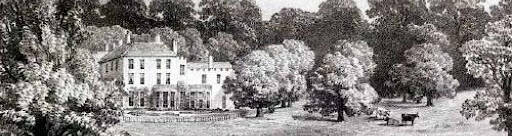
The history of the hall starts with the Cokayne family who are first recorded in Ashbourne in 1150 – they were a branch of a family that lived at Hedingham Castle near Alresford in Essex from the reign of William the Conqueror having come over from Normandy with the De Veres at the time of the conquest. They may have built the Hall or taken over an existing structure when they were put in charge of the Manor of Ashbourne which they held for the next 500 years through the reigns of 22 monarchs.
Hedingham Castle
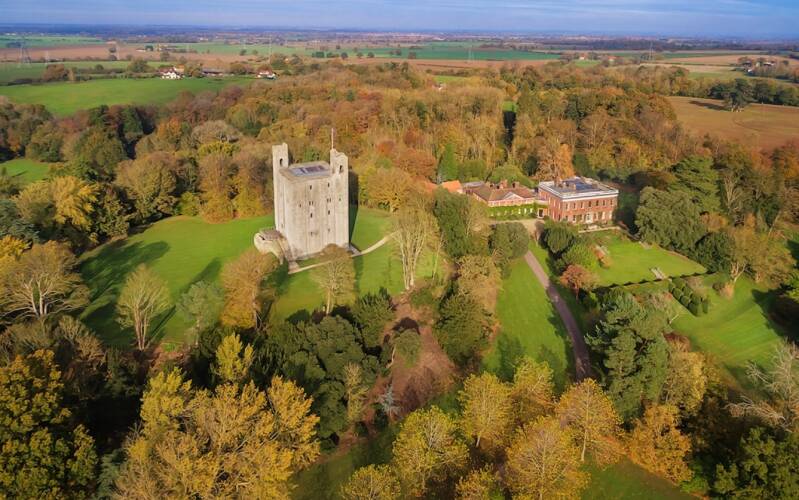
From the latter part of the 1200s the manor of Ashbourne belonged to the Earls and Dukes of Lancaster. In 1326 their bailiff was William Cokayne. The Cokayne family gradually assumed more and more responsibilities and became de facto Lords of the Manor while serving their master’s which included John of Gaunt and then the Lancastrian Kings of England.
Drawings of 1547 show a rambling gabled timber framed range of buildings built around a courtyard with a castellated brick gatehouse and possibly a ‘great hall’. This had clearly grown over the years, having been changed and added to with each generation, and by the Hearth Tax returns of 1662 the house had 21 chimneys making it one of the largest private homes in Derbyshire.
The last descendent of the Cokaynes to own the Hall was the poet Sir Aston Cockayne (1607 – 1683), as a Catholic and supporter of King Charles I during the Civil War, he ran up serious debts. He managed to end up in Marshalsea Prison for debt. He ended his days living in lodgings in Derby having joined with his son in selling Ashbourne Hall to the Boothby family and other estates in 1671.
In 1745 Bonnie Prince Charlie declared his father to be King James III in Ashbourne Marketplace during his ill-fated attempt to overthrow the Hanoverian Kings. On his journey from Scotland, he stayed at Ashbourne Hall and his troops camped in the Hall grounds (now the Town Park) before marching onto Derby. After 3 days in Derby, his generals persuaded him that they would not be successful and he reluctantly agreed to return to Scotland despite the fact that his Dragoons had captured Swarkeston Bridge over the River Trent, the last major obstacle before London.
The retreating Army looted on their return, and the landlord of the Royal Oak, an Inn by Hanging Bridge over the River Dove which still exists, was shot for failing to hand over his horse. Some stragglers were captured and hung either from or close to Hanging Bridge on the road to Leek. Not all locals were hostile, though. One Scottish soldier who had broken his ankle was sheltered by a local farmer who arranged for some Scottish drovers to take him home once he had recovered.
Legend has it that Bonnie Prince Charlie visited Hartington Hall (now a youth hostel), where he seduced a young girl promising that he would return for her. He never did and her ghost still wanders the rooms looking for her lost love.
Sir John Cokayne was born about 1360 at Ashbourne, he was the younger son of John Cokayne (died 1372), of Ashbourne in Derbyshire, Chief Steward for the northern half of the Duchy of Lancaster, and his wife Cecily, daughter of Sir William Vernon, of Haddon and Harlaston.
Early in the 1380s he married a social superior, Edith (AKA Ida), youngest daughter of Reginald Grey, 2nd Baron Grey de Ruthyn, and his wife Eleanor Lestrange. Of their children, six survived him. Three of Henry VIII’s wives, Catherine Howard, Jane Seymour and Ann Boleyn were all great, great, great granddaughters of Sir John Cockayne of Ashbourne.
By 1394 he had become Recorder of London, holding the post until 1398, and in 1396 was made a serjeant-at-law. From 1398 to 1400 he followed his father as Chief Steward of the Duchy north of the Trent, an appointment by John of Gaunt who named Cokayne as one of the executors of his will.
In 1400 he was made a Chief Baron of the Exchequer and in addition, in 1405, a Justice of the Common Pleas. He gave up the Exchequer post in 1413.
He made his will on 10 February 1428, asking to be buried beside his wife in the church of St John at Bury Hatley, and died on 22 May 1429, his will being proved in August. His monument in the church has since been destroyed.
The proceeds of his judicial offices allowed him to acquire country estates, first buying land at Bearwardcote in Derbyshire and then a life interest in manors at St Ippolyts and Radwell in Hertfordshire. What became his principal residence was the manor of Bury Hatley in Bedfordshire, bought in 1417 for 1,000 marks and later renamed Cokayne Hatley.
Lady Edith died on June 1st, 1426, at Cokayne Hatley, aged 56, and Sir John died on May 22nd, 1429, at Ashbourne, aged 59.
Sir John Cokayne (often written Cockayne) is my direct ancestor, 20 generations ago.
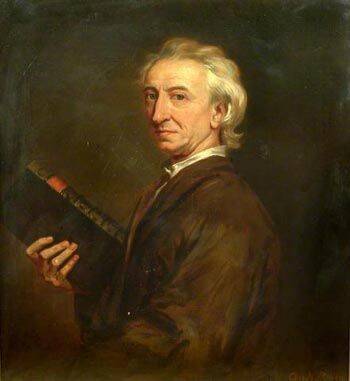
The Scott's of Scot’s Hall
A Kentish family story of land, marriage, service and legacy.
The surname Scott is one of the most prevalent and storied names in the English-speaking world. It is an ethnonym—a name derived from the ethnicity or origin of the original bearer.
Thanks to a succession of distinguished and famous members, I can trace the Scott lineage in my family tree back to around 1390, and the birth of William Scotte, Esq., of Scot's Hall.
A House Rising in Kent
At the turn of the fifteenth century, when England’s old feudal order was slowly giving way to a world of rents, trade and ready money, the Scott family was putting down firm roots in the green country around Brabourne. Their story emerges from the records in 1402, when a settlement by Peter de Coumbe transferred the manor of Combe, or Coumbe, to the family. From that point, the Scotts began to turn scattered holdings and useful alliances into a lasting estate.
At the centre of the story stood William Scotte, born about 1390 at Scot’s Hall, near Smeeth and Ashford. He was the son of John Scot of Brabourne and Matilda—also recorded as Mathilda—de Cumbe, heiress of Cumbe. William inherited more than land. He inherited opportunity: the chance to enlarge the family’s place in Kent through purchase, inheritance, public service and carefully chosen marriages.
Marriage, Land and a Name to Remember
Before 1409, William married Joan, daughter of Sir John de Orlestone. The marriage brought the manor and church of Orlestone into his orbit, tying the family to another corner of Kent. After Joan’s death, he married Isabella Herbert, whose name also appears as Isabel Herbert or Finche. Born about 1407, she was the daughter of Vincent Herbert, alias Finch, of Netherfield in Sussex, and belonged to the ancestry later associated with the Earls of Winchilsea.
These marriages were personal bonds, but in the world of the medieval gentry they were also part of the architecture of a dynasty. Land could be gained, divided or lost through inheritance, and Kent’s custom of gavelkind often divided property among sons rather than passing everything to a single heir. Families therefore negotiated, purchased and married with care. William proved adept at the game. He expanded the family holdings and is credited with building the manor house that became known as Scot’s Hall—a home designed not merely for comfort, but to proclaim that the Scotts had arrived.
Kent, Crown and Parliament
William’s ambitions reached beyond his own fields. During the reigns of Henry V and Henry VI, he served as a Member of Parliament for East Kent, or Knight of the Shire, carrying local concerns into national politics at a time when Kent mattered greatly to England’s defence and trade. Family lineages also describe him as a knight and sword-bearer to Henry V during the era of the Agincourt campaign. That tradition should be read as a family claim rather than an uncontested fact, but it captures how later generations remembered him: close to power, useful to the Crown and at home in the demanding world of public duty.
For a man of William’s standing, service was rarely ceremonial. Kentish gentlemen helped assess taxes, administer local justice, maintain roads and bridges, and muster archers when the king required them. Parliament, court service and estate management belonged to the same web of obligation. A family rose not only by possessing land, but by being seen to govern it—and the surrounding county—competently.
Scot’s Hall
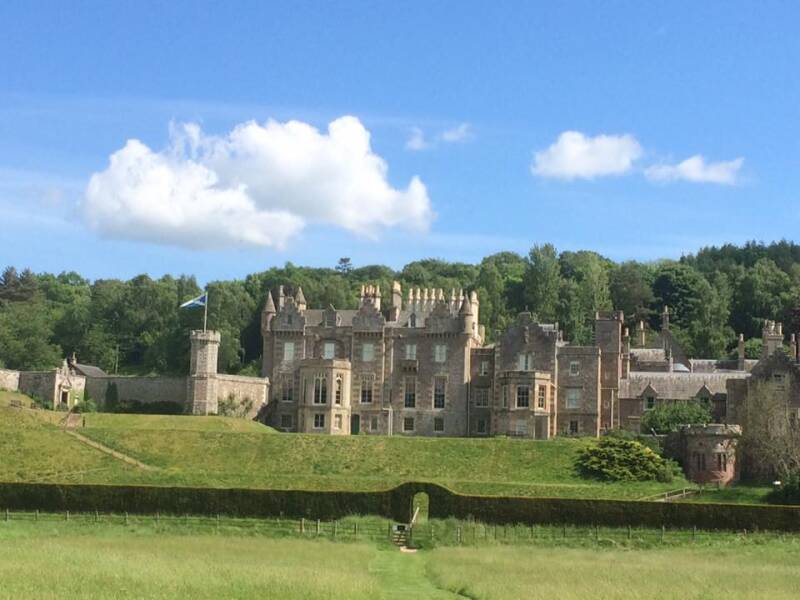
Inside Scot’s Hall
The early Scot’s Hall would have stood between two ages. It was no longer simply a defensive stronghold, yet it was far from a quiet country house. Its great hall was the social heart of the estate: an open-roofed room warmed by a central hearth, where smoke drifted towards roof vents and family, servants and tenants gathered according to rank. At one end, private chambers known as solars offered William and his household a measure of privacy. Outside lay the working world of the manor—barns, stables, bakehouse, brew-house, smithy and dovecote—busy from dawn and essential to the estate’s survival.
The household itself was part family, part office and part training ground. Bailiffs, stewards and clerks kept accounts and enforced decisions; cooks, maids and stable hands sustained daily life; falconers supported a pastime that supplied both sport and game. Some servants were the younger children of neighbouring families, sent to learn manners, administration and the habits expected of the gentry.
Meals made rank visible. The family might eat white bread, roasted meat, fish and strong spiced wine, while poorer households relied more heavily on coarse bread and pottage. Food was served on wooden boards or trenchers and eaten with knives and fingers. Clothing spoke just as loudly: fine wool, fur-lined cloaks, pointed shoes and elaborate headwear displayed prosperity, though sumptuary laws attempted to keep every rank dressed within its appointed bounds.
The Work Behind the Grandeur
Scot’s Hall may have looked imposing, but its prosperity depended on relentless attention. Wheat, barley and oats had to be sown, harvested and accounted for. Sheep had to be managed, the wool clip supervised and merchants bargained with. Kent’s position—close to London and connected to ports such as Dover and Sandwich—gave landowners unusual access to markets, but opportunity created paperwork. Manorial rolls recorded rents, labour, harvests, disputes and debts, and a poor season could make even a substantial household feel precarious.
Leisure also served practical ends. Deer parks, rabbit warrens and falconry provided recreation while adding fresh meat to the larder. Religion, meanwhile, ordered the calendar and shaped the family’s idea of remembrance. Supporting the parish church through gifts, glass, chapels or prayers was an act of faith, a public statement of status and an investment in how the family would be remembered.
The Chapel and the Children
William died on 5 February 1433, although some accounts give the year as 1434. He asked to be buried in the church at Brabourne, where he had been responsible for rebuilding the Perpendicular-style Chapel of the Holy Trinity, south of the chancel. In time it became known simply as the Scott Chapel. Stone, prayer and family memory met there: the estate-builder had secured a place not only in the soil of Kent, but in its sacred landscape.
Isabella survived him and later married Sir Gervase Clifton, treasurer of Henry VI’s household, who resided at Brabourne. William’s own line continued in two notable branches. His son and heir, Sir John Scott, maintained the principal family at Scot’s Hall. Another son, William Scott, who died in 1491, became lord of the manor of Woolstan and founded the Scotts of Chigwell in Essex.
The family story is therefore larger than the career of one man. It is the story of a manor assembled through inheritance and alliance; of a household sustained by wool, grain, service and record-keeping; and of descendants who carried the name into new places. William Scotte’s world has disappeared, but its outline remains—in old manorial traditions, in the church at Brabourne and in the memory of a Kentish family that learned how to turn land into legacy.
The Old English Roots of the Scott’s Name
The name originates from the Old English word scotti, which was originally used by the Romans (Scoti) to describe Gaelic-speaking raiders from Ireland who settled in what is now Scotland.
- Derivation: It comes from the Late Latin Scottus, meaning a "Scot" or "Gaelic speaker."
- The Irony of the Name: Interestingly, the name was rarely used by people living deep within Scotland to describe themselves. Instead, it was a label given by English speakers to people of Scottish descent who moved south of the border, or by people living in the Scottish Borders to distinguish those of specific clan lineages.
The Border Reivers
The history of the name is inextricably linked to the Scottish Borders (the frontier between Scotland and England). The Scotts were one of the most powerful and "notorious" clans of Border Reivers.
- The Reiving Lifestyle: From the 13th to the 17th centuries, the Scotts were a "riding clan" involved in constant cross-border raids, cattle rustling, and feuding.
- The Clan Chief: The primary branch of the family was the Scotts of Buccleuch. Over time, they transitioned from fierce warriors to high-ranking nobility. The current Duke of Buccleuch remains the hereditary chief of Clan Scott.
Historical Significance
The name carries a heavy weight in literary and political history:
- Sir Walter Scott: Perhaps the most famous bearer of the name, this 19th-century novelist and poet is credited with "inventing" the modern image of Scotland (including the popularization of tartans and kilts) through works like Ivanhoe and Rob Roy.
- Spread and Variation: As people migrated, the name became common throughout Northern England, Ireland (particularly Ulster), and eventually the United States, Canada, and Australia.
The Lewknor family join the Scott line when Dame Sybilla Scott, Lord Warden of the Cinque Ports (born Lewknor), married Sir William Scott, Sheriff of Kent, Constable of Dover Castle.
Sir William Scott (1459–1524) was a prominent English nobleman, courtier, and landowner from Scot’s Hall in Smeeth, Kent. He occupied a position of substantial regional and national influence during the reigns of the first two Tudor monarchs, Henry VII and Henry VIII.
From Sussex Forests to the Tudor Court
A family journey through castles, court politics and the changing fortunes of medieval England
The Sussex Beginning
Long before the family story reached the glittering court of the Tudors, it ran through the wooded ridges and old villages of Sussex. One of those places was Horsted Keynes, whose name preserves two layers of English history. “Horsted” comes from Old English and means a place where horses were kept; “Keynes” recalls the Norman de Cahaignes family who held the manor after the Conquest. The settlement was recorded in the Domesday Book of 1086, but its story was already older than the record.
Centuries later, the Lewknors became closely associated with this part of Sussex. Around the turn of the fifteenth century, Sir Thomas Lewknor married Philippa Dallingridge, joining two established local families. The surviving genealogies do not agree on every date or detail of Philippa’s early life, but they do agree on the important point: through her, the Lewknors were connected to the Dallingridges, a family of landowners, forest officials and soldiers whose name reaches back into medieval Sussex.
A Castle in the Family Story
The most famous Dallingridge was Sir Edward Dalyngrigge, a soldier and royal servant who received permission from Richard II in 1385 to fortify his manor at Bodiam. The result was Bodiam Castle, rising square and battlemented from its broad moat. It was built in an age when a great house had to do two jobs at once: discourage enemies and impress visitors. Even today, its towers provide a vivid backdrop to this branch of the family story.
Thomas and Philippa’s son, Sir Roger Lewknor, carried the family into the troubled fifteenth century. He became a knight, represented Sussex, served more than once as Sheriff of Surrey and Sussex, and helped oversee the temporal affairs of the Archbishopric of Canterbury. His lands and responsibilities linked places including Broadhurst, Trotton and Dedisham. These were the years of the Wars of the Roses, when loyalties could be dangerous and public office demanded both judgement and resilience.
Roger married three times. His first wife, Eleanor Camoys, brought connections and claims to estates including parts of Didling, Elsted and Trotton, and their household grew into a large family. Later marriages to Mary West and Katherine Chidiock tied the Lewknors to still more prominent families. When Roger died on 4 August 1478, his will carefully distributed property among his sons. The names, estates and alliances he left behind would shape the next generation.
Sibyl Lewknor and the Scott Connection
From this Sussex network came Sibyl—or Sybilla—Lewknor. She was the daughter of Sir Thomas Lewknor of Trotton and Katherine Pelham, and her marriage to Sir William Scott joined the Lewknor story to one of Kent’s most influential families. In family memory, this is the bridge between two worlds: the Lewknors of Sussex and the Scotts of Scot’s Hall.
William, born in 1459 to Sir John Scott and Agnes Beaufitz, inherited a strong local name, but he made his own fortune by recognising the new political order. When Henry VII seized the throne in 1485, William attached himself to the Tudor cause. It proved a decisive choice. He entered the Privy Council, became Comptroller of the Royal Household and, in 1489, was made a Knight of the Bath at the same great ceremony as the young Prince Arthur.
Sibyl’s own role is less fully recorded, as is often the case for women of her period, yet the marriage was central to the continuation of both family lines. The couple had sons and daughters, including Sir John Scott and Edward Scott, and their descendants carried the family’s Kent and Sussex connections forward.
A Kentish Knight at the Tudor Court
Sir William’s career moved between county business, royal service and the defence of England’s south-eastern gateway. He served as Marshal of Calais in 1490–1491, as Constable of Dover Castle, and as Lord Warden of the Cinque Ports in 1492–1493. He was also High Sheriff of Kent in 1491, 1501 and 1510. The offices sound ceremonial now, but they involved real authority over soldiers, ships, ports, taxes and justice.
His importance did not end with Henry VII. Under Henry VIII, William remained close enough to power to witness two of the great spectacles of the age. In 1520 he attended the Field of the Cloth of Gold, where Henry VIII and Francis I of France tried to outshine one another with tents, tournaments, feasts and fountains. Two years later, when the Holy Roman Emperor Charles V landed at Dover, William was among the official party sent to receive him.
Behind these public honours stood a formidable private base. William inherited the manor of Brabourne in 1495 and rebuilt Scot’s Hall at Smeeth on a grand scale. Later generations remembered it as one of Kent’s finest houses. The estate became the visible heart of the Scott family: a place where land, influence and family history were gathered under one roof.
What They Left Behind
Sir William Scott died on 24 August 1524, aged about sixty-five, and was buried at St Mary’s Church in Brabourne. A memorial brass in the Scott chapel preserves his name, but the larger memorial is the trail left across the landscape: Trotton and Horsted Keynes in Sussex, Dover and Brabourne in Kent, the vanished grandeur of Scot’s Hall, and the enduring moat and towers of Bodiam.
Seen as a list, the family history is crowded with sheriffs, knights, marriages and estates. Seen as a story, it is about movement and survival. The family travelled from forest country and Sussex manors into royal households and international diplomacy. They married across county lines, endured dynastic upheaval, built homes meant to last and handed their names onward. Eighteen generations later, those scattered records can still be gathered into a single thread: a family journey from the place of horses to the court of kings.
The surname Lewknor (often spelled Lewkenor) is a classic English locational surname with deep Anglo-Saxon roots. It belongs to the category of toponymic surnames, which were adopted by or assigned to families based on the specific plot of land they held or the village that they left behind.
The surname is derived entirely from the village and civil parish of Lewknor in Oxfordshire, England, situated at the foot of the Chiltern Hills.
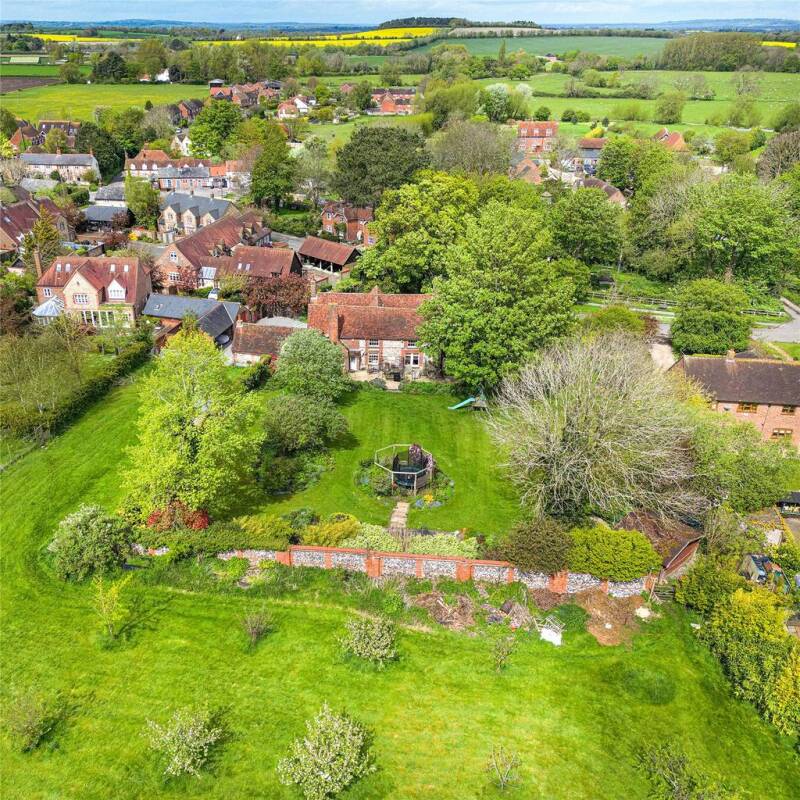
The name of the village evolves through old legal and ecclesiastical records, providing a clear map of its linguistic roots:
- 994 AD: Leofecanoran (Saxon Diplomatic Codex)
- 1086 AD: Levec(h)anole (Domesday Book)
- c. 1160 AD: Leovechenora
The Old English Core
The name is a compound of two distinct Old English components:
- Leofeca: A pre-7th-century Anglo-Saxon personal given name. It is a diminutive or affectionate derivative of the name Leofa, which literally translates to "dear" or "beloved."
- Ora: An Old English topographical term meaning a "bank," "shore," or "hill slope."
Literal Meaning: Taken together, Lewknor translates directly to "Leofeca's slope," referring to a specific hill slope along the Chilterns belonging to an early Saxon landowner.
History of the Surname and Gentry
The transition from a place name to a hereditary family surname began in the generations following the Norman Conquest, when the land-owning gentry tied their identities directly to their manors.
Early Records
- 1211 AD: The earliest administrative mention of the surname appears with a Henry de Leucnore, who held estates in Oxfordshire.
- 1273 AD: The Hundred Rolls of Oxfordshire record Geoffrey de Leweknore during the reign of King Edward I. The "de" (meaning "of") was later dropped as the language shifted from Anglo-Norman French to Middle English.
Rise of the Sussex and East Anglian Branches
While originating in Oxfordshire, the Lewknor family expanded its influence significantly into the southeastern counties of England, particularly Sussex and later Suffolk, establishing themselves as highly influential members of the landed gentry.
- Medieval Knights & Sheriffs: By the 15th century, the family was deeply embedded in regional governance. As seen (above) Sir Roger Lewknor served as the High Sheriff of Sussex multiple times during the turbulent reign of King Henry VI and the Wars of the Roses. The family intermarried with major noble houses, including the Camoys family.
- The Elizabethan & Jacobean Court: By the late 16th and early 17th centuries, the family split into prominent political and literary branches:
- Sir Lewis Lewkenor (c. 1560–1626) was a prominent courtier under James I, serving as the Master of the Ceremonies. He was an accomplished translator whose 1599 English translation of The Commonwealth and Government of Venice is widely believed by scholars to have been a key source text used by William Shakespeare when writing Othello.
- Sir Edward Lewknor (1542–1605) established a powerful seat at Denham Hall in Suffolk. He became a fiery leader of the Puritan gentry within the English Parliament, aggressively advocating for religious reform and pushing back against episcopal authority.
- Spelling Variations
Because surnames developed long before standardized spelling, phonetic variations are incredibly common in parish registers. As family lines drifted from Oxfordshire to Sussex, Kent, Surrey, and London, regional dialects fractured the name into several variants:
- Lewknore and Lewkner
- Leuknor and Leukner
- Lackner and Leakner
- Lucknor and Lockner
- Lackney and Lockney (further corruption found in later parish records)
Today, the surname in its original spelling remains exceptionally rare, retaining its stark historical footprint tied to that single Anglo-Saxon hillside in Oxfordshire.
The surname Dallingridge
The surname Dallingridge (historically also spelled Dalyngrigge) is of English locational origin, derived from a specific geographic feature and minor place name native to the county of Sussex.
Derivation and Etymology
- Geographic Origin: The family and name originated from the manor or area of Dalling Ridge (or Dalingridge), located in the parish of West Hoathly and near East Grinstead in West Sussex.
- Etymological Structure: The name merges a locational or habitational base with the Old English suffix or element ridge (referating to a long, narrow hilltop or elevated stretch of land). The "Dalling" portion points to an early settlement or family grouping associated with that ridge, rooted in Old English nomenclature. As feudal surnames developed in medieval England, landowners and prominent local families frequently adopted the specific name of their ancestral manor, estate, or geographic holding as their surname.
Historical Background
The Dallingridge family established themselves as notable landowners and gentry in Sussex from at least the 13th century, beginning with foresters of Ashdown Forest. Members of the family rose to regional prominence through military service, marriage alliances, and politics. Most famously, Philippa Dallingridge's great-uncle, Sir Edward Dalyngrigge, built the iconic Bodiam Castle in Sussex in the late 14th century after receiving a royal license to crenellate the property.
The Buist Family
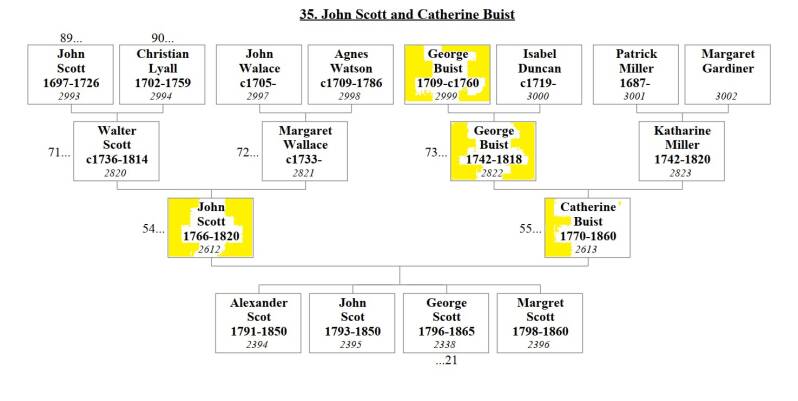
Every family has a doorway into the past. For the Scott family, one of those doors opened in Ceres, Fife, in 1789, when Catherine Buist married John Scott. With that marriage, the Buist name entered our story—a name already rooted for generations in the towns, farms and trading communities of eastern Scotland.
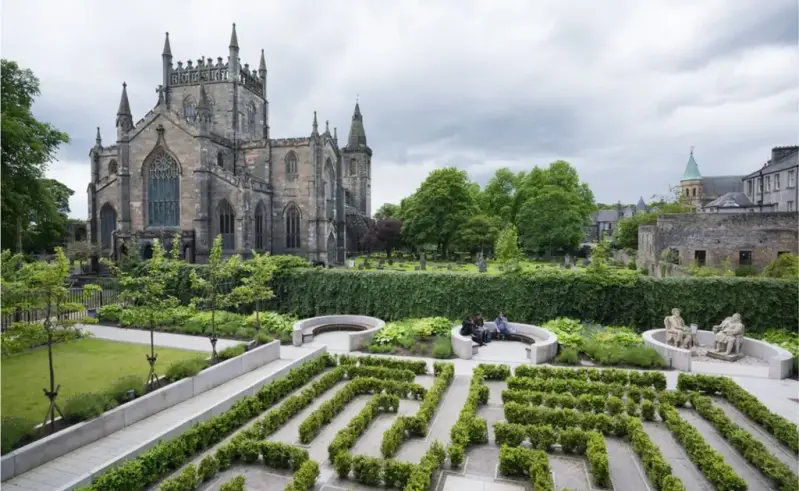
Our own trail reaches back to George Buist, born at Dunfermline on 3 April 1664. Imagine the world into which he arrived: Dunfermline was an old royal burgh, its abbey and palace recalling Scotland’s kings and queens, while the wider county of Fife looked across the North Sea to busy ports and foreign markets. The Buists belonged to this landscape long before Catherine carried the surname into the Scott line.
Dunfermline Abbey, Fife.
What Was in a Name?
The name itself keeps some of its secrets. One persuasive explanation links Buist with Boyce and the Old French bois, meaning “wood”—perhaps first describing someone who lived beside a forest. The name would have arrived in Scotland following the Norman Conquest of 1066.
Other suggestions point north to Norse or Viking influence, It may stem from the Old Norse personal name "Búi," which translates to "dweller" or "homestead." In this context, the name would essentially mean "someone from the homestead."
Some older sources suggest a derivation from the Gaelic word buas, meaning "boastful" or "proud," implying it began as a nickname for a confident or bold individual.
Interestingly, some historians point to the heavy trade between Fife and the Netherlands during the 1600s. The Dutch surname Buis or Buijs was common at the time, and because Fife ports like Dysart were known as "Little Holland," it is possible some "Buists" were originally Dutch merchants who settled on the Scottish coast.
No single theory has been proved for every branch, and that uncertainty is part of the charm: the name may carry echoes of conquest, woodland, homestead, workshop and harbour all at once.
A Name the Clerks Could Not Quite Pin Down
In the sixteenth and seventeenth centuries, spelling was flexible and a surname was often written as it sounded. Buist ancestors and their neighbours therefore appear in records as Boyst, Boist, Bust and other variations. One of the earliest well-known entries is Laurence Boyst, who served on an assize in Fife in 1521. A Cristine Bust was recorded in 1584; parish registers note the christening of Charles Buist at Dunfermline in 1568 and Andrew Buist there in 1608. These scattered lines are small, but together they show a family name taking firm root in Fife.
Marks on the Land
There is also a wonderfully practical Scots connection. A buist could be an owner’s mark placed on sheep or cattle, and a “buisting-iron” was used to apply it. This does not prove that the surname began as an occupation, but it gives us an irresistible picture of rural life: animals moving across a Fife field, each bearing the sign that told the neighbours exactly whose flock it was.
Buists Beyond Fife
In later generations, bearers of the name travelled far beyond Scotland. George Buist (1805–1860), a journalist and scientist, became editor of the Bombay Times, a predecessor of The Times of India. Robert Buist (1805–1880), a Scottish horticulturist who settled in Philadelphia, built a celebrated nursery business and helped make the poinsettia better known in the United States. They are not presented here as proven members of our direct line, but their lives show how widely the old Fife name eventually travelled.
And so the family story runs from George’s birth in seventeenth-century Dunfermline to Catherine’s wedding in Ceres in 1789, and onward into the Scott family. The surviving facts are brief—names, dates and places written by long-ago clerks—but read together they become something warmer: a story of deep local roots, changing spellings, open seas and a name carried from ancient generations down to my own.
The Dickson’s of Cameron:
A Fife Family Story
From Robert M. Dickson in the eighteenth century to Margaret Ann Dickson and George Scott
This account brings the known family facts together with the everyday world of eighteenth- and early-nineteenth-century Fife. Where records fall silent, the setting is presented as historical context rather than as a claim about a particular ancestor.
A Name in the Fife Countryside
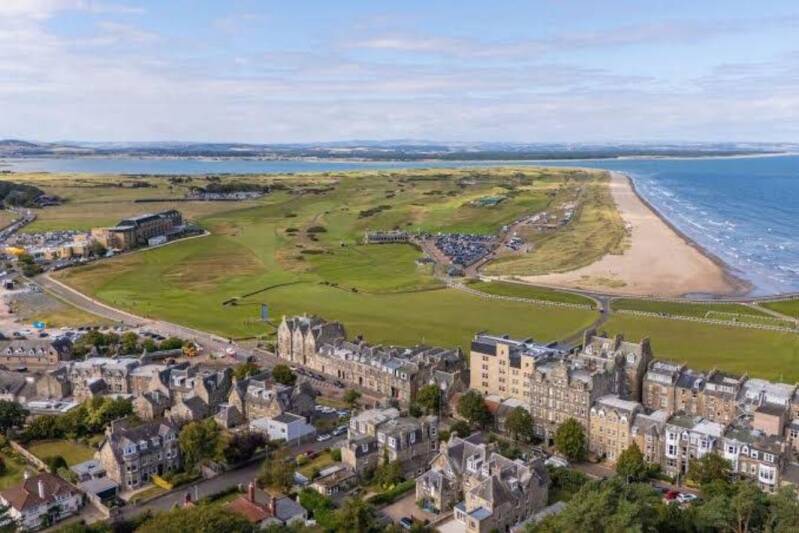
Our Dickson story begins around 1737 with Robert M. Dickson, born in Cameron, Fife. The surviving facts are spare—a name, an approximate year and a place—but the place itself gives the story colour. Cameron was a small rural parish a few miles south-west of St Andrews, set among rolling ground, burns, fields and scattered farming settlements. It is not a city, but rather a part of the larger Fife region, which is known for its rich history and beautiful coastal views. To the east lay the old university town and the coast; around Robert lay the practical world of Lowland farming.
In Robert’s childhood, the year was measured less by a calendar than by work: ploughing and sowing, lambing, cutting peat, bringing in oats and bere (a hardy form of barley), and small patches of peas or (later on) potatoes, and storing enough to survive the winter. Most families lived close to the soil, whether as tenant farmers, cotters or labourers. A poor harvest could be felt at every table, while a good one called neighbours together for the heavy work. In a small parish, people depended on one another, and news travelled quickly from farm to farm.
The Church of Scotland—the Kirk—stood near the centre of community life. Sunday worship marked the week, and the kirk session concerned itself not only with religion but also with schooling, poor relief and public conduct. Parish schools had spread across Scotland after the 1696 education legislation, so even in rural districts some children learned basic reading, writing and arithmetic, encouraged by the Presbyterian belief that people should be able to read the Bible for themselves.
Cameron, Fife, Scotland.
Robert’s Changing Scotland
Robert was still a boy when the Jacobite Rising of 1745 shook Scotland. The decisive fighting was elsewhere, and there is no evidence that Robert took part, but the rising and its defeat formed part of the atmosphere in which his generation grew up. Government authority tightened, old loyalties were tested, and Scotland entered a period of rapid political, intellectual and economic change.
As Robert moved into adulthood, the country associated with the Scottish Enlightenment was taking shape. Great ideas were being argued in Edinburgh and the universities, including nearby St Andrews, while change arrived more quietly in parishes such as Cameron. Traditional runrig fields gradually gave way to enclosed farms, crop rotation and new equipment. The transformation promised greater productivity, but it also altered leases, work and long-established patterns of village life. Robert’s lifetime may therefore have spanned two rural worlds: the old communal rhythms of his youth and the more commercial farming landscape of later decades.
What the Dickson Name Carried
The surname Dickson is a patronymic: it originally meant “son of Dick,” with Dick being a familiar medieval form of Richard. Richard itself comes from Germanic elements associated with power and strength, so the name carries an old echo of a “strong ruler.” The “-son” ending is characteristic of Lowland Scotland and northern England, where the name also appeared in forms such as Dixon, Dixson and, in some records, longer related spellings.
Family and clan traditions connect some Dicksons with Richard Keith and the medieval Keith family, and later with the riding families of the Scottish Borders. Those stories belong to the wider history of the surname rather than proving the ancestry of this particular Cameron branch. Even so, they offer a vivid backdrop: border country, shifting loyalties and names written differently by successive clerks. One early form of the surname appears in records associated with the Ragman Rolls of 1296. Centuries later, people identifying with the Dickson name also adopted the motto Fortes fortuna juvat—“Fortune favours the bold”—and heraldic imagery that includes a hand grasping a sword.
That martial heritage is dramatic, but Robert’s branch is easier to picture in the fields of Fife than on a raiding horse. Their endurance was likely expressed in ordinary ways: getting a crop through bad weather, keeping a household supplied, helping neighbours at harvest and preserving family ties from one generation to the next.
From Robert to Margaret Ann
From down that line came Margaret Ann Dickson of Clermont, St Andrews. Her surroundings joined country and town. St Andrews was already ancient, known for its university, and religious history, while the neighbouring parish lands remained thoroughly agricultural. Margaret Ann’s life would have been shaped by both worlds: the close relationships of rural Fife and the wider traffic of a historic town connected to the coast.
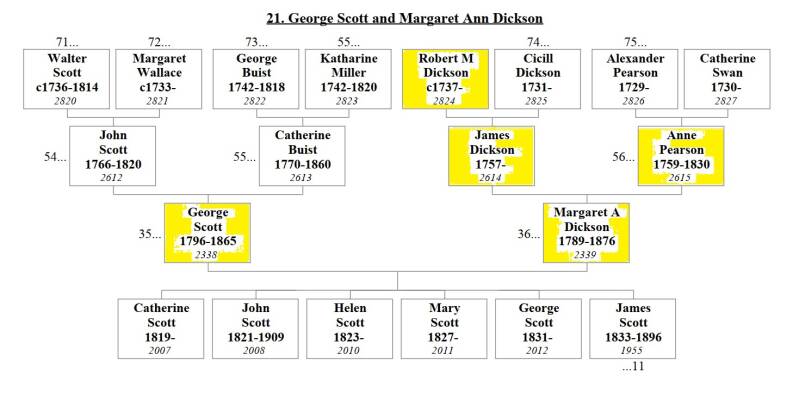
On 6 December 1818, at Cameron in Fife, Margaret Ann Dickson married George Scott. She was twenty-nine years old. George had been born on 24 January 1796 in Kilconquhar, another Fife parish to the south-west. Their marriage joined two families whose lives were rooted in the same compact corner of Scotland.
It is easy to imagine the winter setting, but the record gives us the most important facts: the place, the date and the couple themselves. However modest the ceremony may have been, it marked a decisive moment in the family story. George and Margaret Ann went on to have six children in Fife. With each birth, the names Scott and Dickson moved forward together into another generation.
The World Their Children Inherited
Their children entered a Scotland changing faster than the one Robert had known. Farms were more organised and commercially minded; roads and markets were improving; literacy was becoming increasingly useful; and towns were growing. Yet many older customs remained. Families still relied upon kin and neighbours, the seasons still governed rural work, and the kirk continued to record baptisms, marriages and burials.
Those parish records are precious to family historians, but they are not complete. Entries could be missed, damaged or written according to the habits of an individual minister or clerk. Spellings varied, ages were sometimes approximate, and not every event was registered. That uncertainty is part of the search. A change from Dickson to Dixon, or a slightly different date, may be a clerk’s choice rather than evidence of a different family.
The Thread That Remains
What survives is more than a chain of dates. Robert M. Dickson’s birth around 1737 places the family in Cameron before the last Jacobite Rising. Margaret Ann Dickson’s marriage in 1818 carries that line into the nineteenth century. George Scott’s birth at Kilconquhar adds another Fife parish to the map, and their six children turn two ancestral threads into a growing family.
The fields have changed, the farms have changed and the roads to St Andrews are no longer the roads Robert knew. Yet Cameron remains a real place: gently undulating country, burns running eastward and the old pull of St Andrews nearby. To follow the Dickson family back there is to recover not only names, but a landscape and a way of life.
And perhaps the old motto suits this quieter history after all. Fortune did not always arrive as glory. Sometimes it was a harvest safely gathered, a child entered in a parish register, a marriage remembered, or a family story carried far enough into the future for a descendant to tell it again.
Pearson: A Fife Family in Unsettled Times
We opened the account of the Scot family ancestors by describing and trying to understand the Curious Case of the Scottish Covenanters, and it was these turbulent events that, amongst others, would have shaped and influenced Jame’s life.
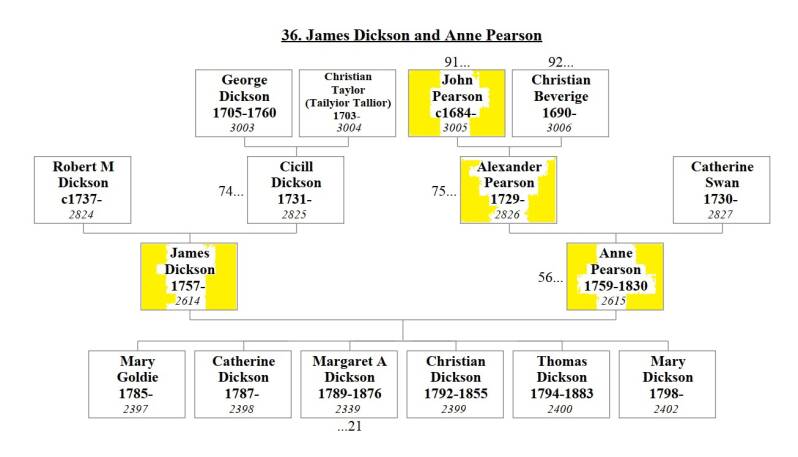
Every family history contains a doorway into another age. For our Pearson line, that doorway stands in the Lowland parish of Cameron, Fife, on 9 December 1786, when James Dickson married Ann Pearson. Through Ann, the family trail reaches back more than a century to James Pearson, born in Fife in 1666—into a Scotland of sermons and soldiers, hard harvests and stubborn convictions.
James arrived six years after the monarchy had been restored under Charles II. The celebrations were already fading. Bishops had returned to the Scottish church, unauthorised Presbyterian worship was forbidden, and people across the Lowlands were being forced to decide how openly they would defend their faith. We cannot know which choices the Pearson household made, but we can be certain that the question was never far away.
The struggle had begun long before his birth. In 1603 James VI of Scotland inherited the English throne, joined the two crowns and moved his court south. Edinburgh lost the daily bustle of royalty, but the old Border country gradually became safer. Farms and trade had room to recover—although royal government, now more distant, remained determined to shape the worship and loyalties of its northern kingdom.
In 1638, when Charles I tried to impose a new prayer book and greater religious uniformity, thousands of Scots answered with the National Covenant. They swore to defend Presbyterian church government against royal interference. The quarrel ignited the Bishops’ Wars and then merged into the wider Wars of the Three Kingdoms. Lowland parishes supplied men, money, horses and grain; ministers carried enormous authority; and ordinary families learned that arguments over bishops and kings could empty a byre as quickly as any bad winter.
By 1650 Oliver Cromwell’s New Model Army had invaded Scotland. Defeat at Dunbar, followed by defeat at Worcester in 1651, brought occupation and forced incorporation into the English Commonwealth. Marching troops requisitioned food and imposed taxes, yet the occupation also brought a measure of internal peace, more regular legal administration and freer trade with England. These were the contradictions into which James Pearson was born: order carried at sword-point, opportunity shadowed by loss.
As James grew from boy to young man, tension sharpened. Presbyterian field meetings—conventicles—were outlawed, and the most defiant Covenanters, including the Cameronians, faced military pursuit. The brutal repression of the 1680s became known as the “Killing Time.” Fife lay outside the south-western heartland of the fiercest persecution, but news travelled by market, kirk and roadside. A family did not need to witness an execution to understand the warning behind it.
Then, in 1688, the political weather turned. James VII of Scotland—James II of England—was deposed, and William and Mary took the throne. By 1690 the Scottish Parliament had abolished bishops and secured the Presbyterian Church of Scotland. For many Lowland families, decades of persecution seemed at last to have ended. For others, especially displaced Episcopalians and royal loyalists, a new grievance had begun.
Peace in the kirk did not put bread on the table. During the 1690s, cold, wet summers and punishing winters brought repeated crop failures remembered as the “Seven Ill Years.” Seed rotted, grain prices rose and hunger spread through a countryside already burdened by debt, feudal obligations and outdated farming methods. The crisis killed many Scots and drove others from their homes. James Pearson, now in his thirties, would have known that survival depended upon thrift, neighbours, weather—and luck.
That is the setting in which we should imagine him—not as a figure posed neatly in a family tree, but as a working Lowland Scot. His days would have been measured by daylight and season; his community by the kirk, the farm and the market; his security by the next harvest. Royal proclamations made in Edinburgh or London reached him eventually as taxes, rules, rumours, conscription or scarcity.
Even his surname carries an older journey. Pearson began as a patronymic: “son of Piers.” Piers was the Old French form of Peter, from the Greek petros, meaning “rock” or “stone.” Brought into wider use after the Norman Conquest, the name passed down through generations until a description became a hereditary surname.
Medieval clerks wrote the name as they heard it—Pierson, Peerson, Pyerson and other variants—before spelling settled. A Walter Pierson appears in the Sussex Subsidy Rolls of 1296, and the name later became especially common in northern England. Across the Anglo-Scottish borderlands, a country long associated with raiding families known as Border Reivers, it travelled north into Scotland and outward with migration to Ireland and the American colonies.
A century after James Pearson’s birth, the name reappears clearly in our own family record. On that December day in 1786, Ann Pearson stood with James Dickson in Cameron and joined two family lines. The entry is brief, but behind it stretches a much larger inheritance: the Crown and the Covenant, armies on the road, hunger in the fields, worship defended at great cost, and generations who endured long enough for their names to reach us.
The Pearson story is therefore more than a chain of dates. It is the story of ordinary people living through extraordinary change—people whose private choices were made beneath the pressure of public events. We may not know James Pearson’s voice, his occupation or the exact shape of his household, but the world around him allows us to see the courage his generation required. The old meaning of the name offers a fitting final image: a family line, like stone, weathered but still standing.
The Bremner's - a voyage into the past.
As described in ‘Early Arrivals’, Agnes Bremner (my great-great grandmother) married James Scott at the Church. of Scotland, Cameron, Fife, Scotland, on December 4th, 1857.
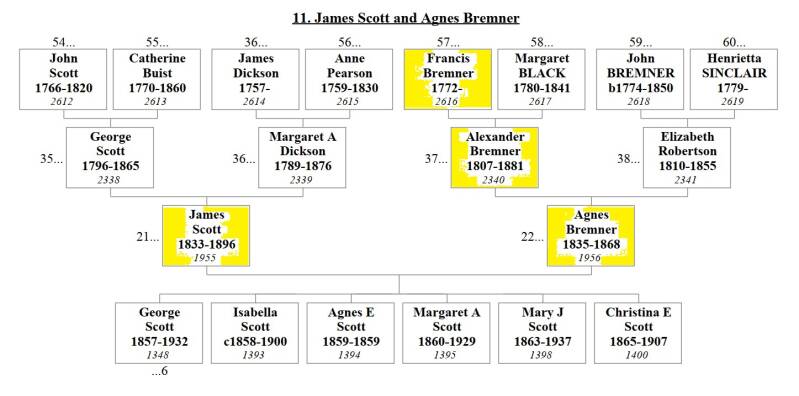
The Bremner story begins, as so many family stories do, with a marriage and a leap into the unknown. On 4 December 1857, Agnes Bremner—my great-great-grandmother—married James Scott at the Church of Scotland in Cameron, Fife. Less than two years later, the young couple packed up their lives and set out for New Zealand with their children: one-year-old George and seven-month-old Agnes Elspeth.
They sailed from Glasgow aboard the Sevilla on 19 August 1859. Ahead lay 103 days at sea, with no intervening port call and no quick way home. The voyage brought the family terrible sorrow: baby Agnes died aboard the ship on 4 October. When the Sevilla finally reached New Zealand on 2 December 1859, Agnes and James stepped ashore carrying both the hope of a new beginning and the memory of the daughter they had lost along the way.
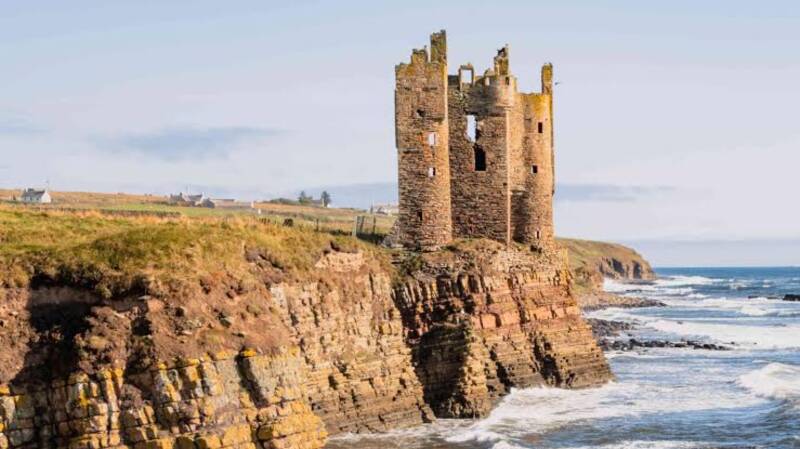
Agnes had been born in Leuchars, Fife, in 1836, but the family trail reaches much farther north. It can be followed back to John Bremner, born around 1630 at Wester, near Wick in Caithness. Wester was—and remains—a small rural place, about ten kilometres northwest of Wick, set in the broad farming country of Scotland’s far northeast.
It is easy to imagine the landscape John knew: open skies over flat coastal fields, the small freshwater Loch of Wester fed by the Burn of Lyth, and, not far away, Sinclair’s Bay and the restless North Sea. Local roads led south towards Wick and north towards Keiss and John o’ Groats. Beneath and around those fields lay traces of people who had lived there long before the Bremners—Neolithic burial places, later settlements and medieval strongholds standing above the sea cliffs.
Even the name Bremner carries a journey within it. Family-name histories connect it with Brabant, the former duchy in the Low Countries, now divided between Belgium and the Netherlands. The old term Brabanter meant a person from Brabant. Over generations, as speech and spelling changed, forms such as Brabener and Brabner appeared, eventually giving rise to the familiar northern Scottish name Bremner.
The name’s arrival in Scotland is associated with the medieval trading world that linked Scotland and the Low Countries. During the twelfth and thirteenth centuries, skilled weavers and other artisans from Brabant were encouraged to settle in Scotland and contribute to its growing textile trade. In time, related surnames appeared across the country, while the spelling Bremner became especially common in Caithness and Aberdeenshire. In the north, Bremner families were also associated with Clan Sinclair.
Old records rarely offer tidy, consistent spelling, so the family may appear as Brimner, Brymner, Bremar or Brabner. One early example is Walter Brabneir, recorded in Aberdeen in 1463. By the sixteenth and seventeenth centuries, Bremners were established as a recognisable family group in the Highlands, some serving as retainers to the Earls of Caithness.
Across the centuries, then, this is a story of movement: from Brabant to Scotland in the distant past, from Caithness to Fife, and finally from Glasgow to New Zealand. The surviving names and dates give us the outline, but the places supply the colour—the northern loch and windswept fields, the church in Fife, the long ocean crossing, and a young family beginning again on the other side of the world. Agnes and James’s courage, and the loss they endured on the way, remain at the heart of the Bremner family story.
The Black Family: A Thread Through Fife
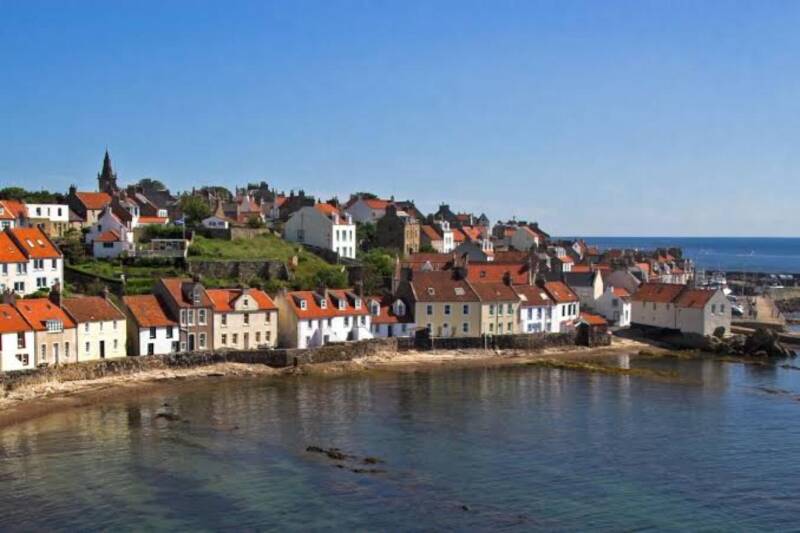
Every family history has a doorway. Ours opens on 24 November 1797 in Pittenweem, on the wind-brushed coast of Fife, where Margaret Black married Francis Bremner. That single entry in the record book leads us backwards through mothers and grandmothers, across neighbouring parishes, and into a Scotland of fishing boats, handlooms, kirk bells and names whose meanings have shifted with the centuries.
Imagine Pittenweem on Margaret’s wedding day: whitewashed houses huddling above the Firth of Forth, gulls circling over the harbour, and narrow wynds carrying the sharp smell of salt, rope and fish. This was no ornamental seaside resort but a working port, shaped by generations who made their living from the water. Its very name means, in essence, “the place of the cave”—a reminder of St Fillan’s Cave, tucked into the sandstone above the harbour and associated by tradition with an early Christian hermit.
Margaret had been born in 1774 at nearby Kilconquhar to Robert Black and May Scott. Kilconquhar lay a little inland, beside its loch, in a parish of fields, woods and small communities. In Margaret’s lifetime the district depended heavily on agriculture, while weaving also helped many local households earn their bread. A journey between Kilconquhar and Pittenweem was not far in miles, yet it carried Margaret from the inland world of the parish towards the bustle of the coast.
May Scott’s own story keeps us in Kilconquhar. Born there in 1751 to Alexander Scott and Rachel Rob, she remained connected to the place until her death in 1819. Through Alexander, the trail reaches back another generation to Mary Spowart, also recorded as Mary Patterson or Scott. Mary was born at Clackmannan on 29 August 1685, the daughter of Thomas Spowart and Mary Russell. With her, our path leaves the Black surname for a time and invites us to follow the Spowart line next.
What Was in the Name?
The name Black carries a small historical joke. In medieval English, similar-sounding words could point in opposite directions: blæc suggested someone dark-haired or dark-complexioned, while blāc could mean pale, bright or shining. As spellings drifted and surnames settled into fixed forms, the clues blurred. Our earliest Black ancestor may therefore have been notably dark—or notably fair. The name remembers a description, but has misplaced the portrait.
That uncertainty matters because Black did not begin with one founding family. It arose independently in different communities as a nickname and, in Gaelic-speaking areas, sometimes as an English rendering of dubh, meaning dark or black. Forms such as Black, Blacke and Blake could overlap in old records, and emigrant families sometimes adopted Black as the English equivalent of surnames with a similar meaning. A matching surname is a clue, not proof that two people share the same branch.
Scottish tradition associates some Black families with clans including Lamont and Maclean, but a clan connection cannot be established from the surname alone. For this family, the stronger evidence is more intimate: Margaret in Pittenweem, her parents in Kilconquhar, and the chain of baptisms, marriages and burials that links one household to the next.
A Name Carried Forward
Famous bearers would later give the name a wider glow—among them the eighteenth-century Scottish chemist Joseph Black, known for his work on carbon dioxide and latent heat—but our story is not a catalogue of celebrated strangers. Its interest lies in ordinary people moving through real places: a daughter born beside Kilconquhar Loch, a bride standing in Pittenweem, and a line of mothers carrying the family into the next century.
Stand at Pittenweem harbour today and the details help the years fold together: boats still shelter behind the harbour walls, the cave still waits above the shore, and the East Neuk’s villages still sit close enough for a family story to wander from one to another. The paper trail may twist, and the old spellings may argue among themselves, but the route is clear. From Margaret Black and Francis Bremner, through May Scott and Mary Spowart, this branch of the family leads us steadily deeper into Scotland—and into the next chapter.
The Spowarts: A Scottish Family Story
The Spowart name enters our family story in early eighteenth-century Clackmannan, a small Scottish town beneath the Ochil Hills. There, Mary Spowart (1685–1725) married John Scott in 1713. It was Mary’s second marriage; family records say that she had previously married Patrick Paterson in Clackmannan in 1706. Through Mary, a rare surname with deep roots in central and eastern Scotland became part of our family tree.
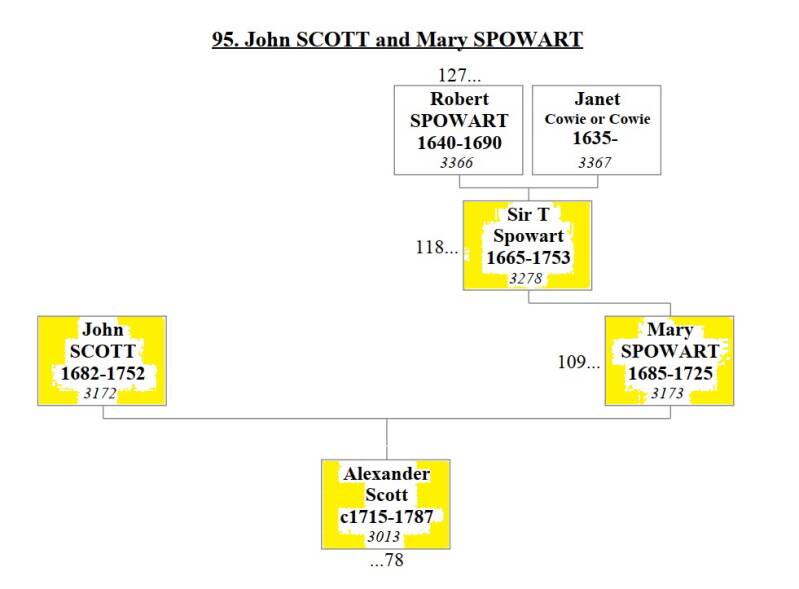
Spowart has never been a common name. Its strongest early associations are with Fife and neighbouring Clackmannanshire, where generations of Spowarts lived within a comparatively small area. The most widely accepted explanation is that the surname grew from the Older Scots word powart, meaning a tadpole, with an added “s” at the beginning. If that is right, the name probably began as a nickname—perhaps affectionate, teasing or simply descriptive—before settling into a hereditary surname.
Not everyone has been satisfied with so humble an origin. Because the name is unusual and appears near the Fife coast, older traditions imagined a sailor or merchant arriving from the Low Countries or Germany—perhaps even a survivor of a shipwreck—and leaving behind a name related to Spautz. Another theory linked Spowart with a maker of spurs, bridles or other horse tack. These are appealing stories, but neither has the linguistic support of the Older Scots derivation.
The surviving paper trail begins in the early seventeenth century. On 14 June 1614, William Spowart appeared as a witness at Kirkcaldy Church in Fife, one of the earliest known written records of the surname. In an age when spelling depended largely on the ear and habits of the clerk, the same family name could appear as Spoward, Spouert or even Pourit. Those shifting spellings can make genealogical research difficult, but they also preserve something of the voices and accents of the people who first recorded the family.
Our own Spowart line is traced to William Spowart, born in Clackmannan in 1610 and believed to have died there in 1680. In November 1635 he married Elizabeth Janet Condie. Their lives unfolded close to the family’s historic heartland, in a parish where names such as Spowart, Scott, Paterson and Condie recur through the old registers. A later bearer, Thomas Spowart, was born in Clackmannan in 1665; within another generation, Mary Spowart would carry the name into the Scott branch of our family.
Clackmannan Tower, Clackmannan.
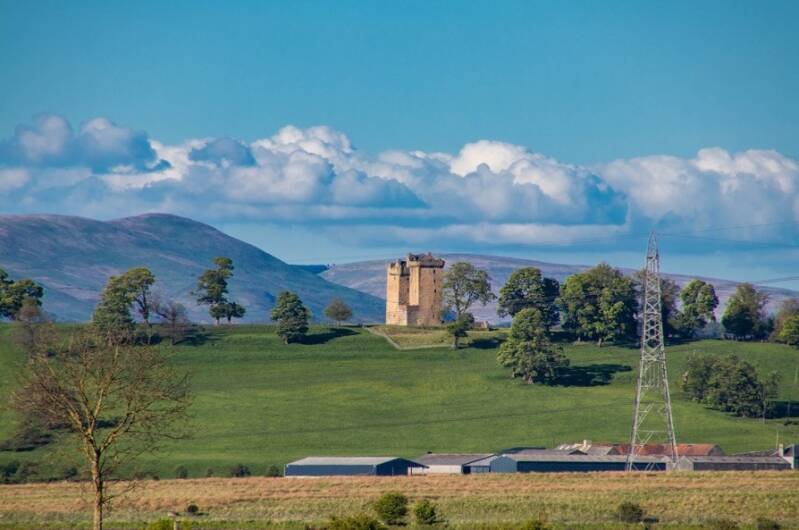
In later centuries, branches of the family moved beyond this compact Scottish homeland. One especially vivid chapter unfolded at Berwick-upon-Tweed, the border town where the River Tweed meets the North Sea. Brothers Robert and Philip Spowart became familiar local figures through the ferry service between Berwick and Spittal. They replaced the steam paddle ferry Susan with motor boats—the Border Chief in 1907, the Border Maid in 1909 and the Border Pride in 1912—and in 1923 added the “Red Buses,” creating an early integrated transport service for the town and surrounding district.
Philip Spowart also served his community in public life, becoming mayor of Berwick-upon-Tweed three times, in 1935, 1936 and 1937. His story is far removed from the sparse parish entries of seventeenth-century Clackmannan, yet both belong to the same unfolding family history: a rare Scottish name carried through marriages, migrations, changing occupations and changing times.
For us, the line leads back to William Spowart and Elizabeth Janet Condie, married in Clackmannan in 1635. The Spowart chapter begins with an uncommon name and several intriguing possibilities; the next chapter belongs to Elizabeth and the Condie family from which she came.
The Condies:
A Name Carried Through The Mists of Scotland
A family story of placenames, uncertain ancestors, and one very persistent Scottish surname
Where the Trail Begins
Every family history begins twice: once with the people who lived it, and again with the descendant who starts asking questions. The Condie story begins in that second way—with a name on a family tree, a cluster of Scottish places, and a man called Robert Condie, said to have been born near Alloa in Clackmannanshire around 1515.
The Condie’s join our family tree in 1635, when Elizabeth Janet Condie married William Spowart at Clackmannan, Clackmannanshire, Scotland. Elizabeth had been born there on the 12th of May 1612, to Patrick Condie and Margaret (nee Kirk).
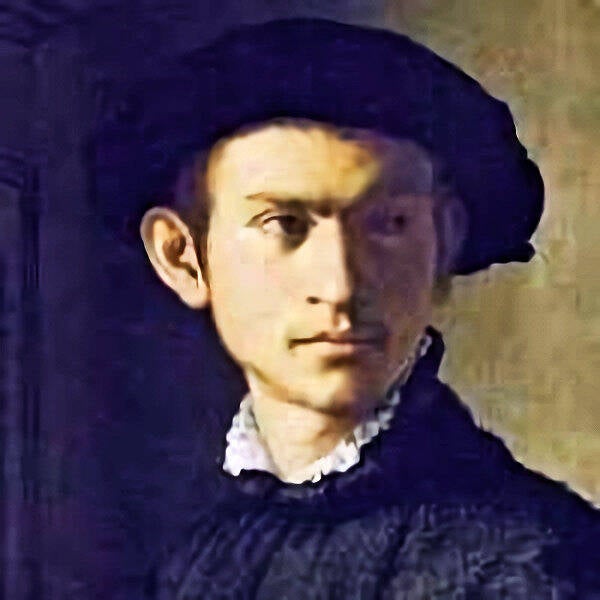
Five centuries later, we may be able to put a face to Robert, immortalised in a portrait. Online family trees commonly place his death around 1568, name his wife as Grace Christine Cumime or Cuming, and give them sons called George and Alexander. Yet no firm chain of contemporary records has so far stepped forward to confirm those details. That does not make Robert unimportant. It makes him a proper family-history mystery: close enough to invite us in, but distant enough to keep some of his secrets.
This account therefore has two threads. One is made of documented places, names and dates. The other is made of family tradition and later reconstruction. Where the threads meet, they create a vivid possibility—but not always proof. The pleasure lies in following both without pretending they are the same.
A Name from the Landscape
Long before family historians could search a database, a surname often answered a practical question: where are you from? The strongest explanation for Condie is a Scottish habitational one. The name points towards the lands of Condie in southern Perthshire, near Forgandenny and Forteviot. The old placename has not vanished entirely; it still echoes in the Path of Condie and Condie Wood.
Imagine a traveller leaving those lands in the Middle Ages. In the next settlement he might be known simply as the man “de Condie”—the man from Condie. In time, the little word de could fall away while the place remained attached to the family. Spelling, meanwhile, was wonderfully unruly. Clerks wrote what they heard, producing Condie, Condy, Cundie, Cundy and Conady, among other forms.
The paper trail offers a few tantalising stepping stones. A John de Conady appears in Perth in 1414. A John Condy was recorded as a tenant at Fruchy in Falkland in 1541. By 1572, a David Condie, described as an Edinburgh man, appears in Dunfermline records. These people cannot automatically be claimed as members of our branch, but they show that the name was alive in central Scotland before, during and after Robert’s supposed lifetime.
There are other possible origins, too. Some scholars connect Condy and similar names with the Old French and Middle English word for a conduit—a channel or pipe carrying water—so an early bearer may have lived near a notable watercourse. Another branch may reach back to places called Condé in northern France, whose name refers to a meeting of waters. The theories differ, but they share a fitting image: streams converging, separating and continuing onward, much like family lines themselves.
Robert of Clackmannanshire
If the family trees are broadly right, Robert Condie entered the world around 1515 in or near Alloa. He grew up beneath the broad presence of the Ochil Hills, in a county small in size but rich in traffic, farming and feudal loyalties. Stirling lay to the west; the River Forth carried people, goods and news; and Clackmannan Tower stood as a stone reminder of the Bruce family’s local power.
Robert’s Scotland was not a quiet backdrop. James V was king for much of his youth. The Reformation transformed the country during his middle years, and Mary, Queen of Scots, returned from France in 1561. We do not know what Robert thought of any of it. He may have farmed, traded, worked an estate or practised a craft. The surviving family tradition tells us far more about his place in a lineage than about the texture of his ordinary days.
Later genealogies give Robert a wife, Grace Christine Cumime—sometimes rendered Cuming—and sons named George and Alexander. The shifting spelling should not surprise us; names travelled by ear as often as by ink. Still, these relationships should be treated as clues awaiting documentary support rather than settled fact.
That distinction matters. It is tempting to fill an empty space in a pedigree with certainty, especially when an ancestor stands at the edge of the record. A more honest—and in many ways more compelling—picture leaves some mist on the hills. Robert can remain the earliest known figure in this family tradition while the search continues for parish, legal, estate or charter evidence that might bring him into sharper view.
The Baron in the Neighbourhood
The grandest claim attached to Robert is also the one that demands the most caution. Some online trees suggest that his father was Sir David Bruce, 7th Baron of Clackmannan. The geography makes the idea feel almost irresistible: Robert is placed in the same district, at roughly the right time, under the shadow of the Bruce barony.
Sir David himself is much better anchored in historical records. In September 1497, his father resigned the lands and Barony of Clackmannan in his favour, and a Crown charter confirmed the succession. He married Janet Blackadder, daughter of Sir Patrick Blackadder of Tulliallan. Their recorded family included John, Edward of Blairhall, David of Green, Robert and Patrick. Sir David’s position also brought local privileges, including authority for an annual fair at Clackmannan around the Feast of St Bartholomew.
Yet the records identify the baron as Sir David Bruce, not Condie-Bruce, and the commonly listed children do not establish Robert Condie as his son. Proximity is not parentage, and repeated online pedigrees are not independent evidence. The proposed link may prove true, partly true or simply the work of an enthusiastic compiler joining two nearby families.
For now, Sir David belongs in our story as an important neighbour and a possible connection—not as a proven father. That is not a disappointing conclusion. Good family history is not a parade of famous names; it is the patient art of discovering which stories the evidence can carry.
What the Name Carries
By the seventeenth and eighteenth centuries, the Condie name remained firmly associated with Perthshire, while other families and landholders—including the Oliphants of Condie—added new chapters to the district’s history. Individual Condies moved, married and made homes elsewhere, taking the name beyond the place that may have created it.
Our own story reaches back, with reasonable confidence, to early modern Scotland and, with family-tradition confidence, to Robert Condie around 1515. Beyond him, the path narrows. There are inviting signposts—a Perthshire placename, early Scottish records, Clackmannan’s Bruce family—but no bridge should be crossed merely because we wish it were there.
Perhaps that is the best inheritance this old name offers. The Condie story is not finished and sealed; it is an invitation. Somewhere in a charter, testament, kirk-session minute, sasine, rental book or estate paper, another small fact may be waiting. Until it is found, we can tell the story with warmth and imagination while keeping a clear line between what is recorded, what is reconstructed and what is still only possible.
A family tree is strongest not when every branch looks grand, but when every branch is honestly grown.
The Havills: From Devon to New Zealand
A family story carried across centuries and oceans
A Girl from Devon
Every family history has a moment when a name on a page suddenly becomes a person. In the Havill story, that person is my great-grandmother, Thirza Harriet Elizabeth Havill, born in Torquay, Devon, on 27 January 1862.
Thirza’s childhood began in England’s West Country, a landscape of green valleys, old churches and communities shaped by farming and the wool trade. Yet her future lay far beyond Devon. In 1874, when she was only twelve, she boarded the Corona with her widowed mother and three siblings. They were assisted emigrants, joining the great nineteenth-century movement of families who left Britain in search of opportunity on the other side of the world.
The voyage to Otago would have demanded patience, courage and a great deal of adjustment. For a twelve-year-old, the sea must have seemed endless. When the family arrived on 23 May 1874, New Zealand was not simply a new address; it was a new climate, a new landscape and the beginning of an entirely new branch of the family story.
A New Life in New Zealand
Six years after arriving, Thirza married George Scott, a clerk, in Dunedin on 20 October 1880. Together they raised nine children. Their household first took root in Dunedin before the family later moved to Wellington.
Thirza also left a small but significant mark on New Zealand’s public story. In 1893, she signed the women’s suffrage petition at Duncan Street in South Dunedin. That signature places her among the thousands of women whose names helped carry the country towards becoming the first self-governing nation in which women won the right to vote in parliamentary elections. It is an arresting thought: the girl who crossed the world at twelve grew into a woman prepared to put her name to change.
Thirza died in Wellington on 30 November 1927. George followed in 1930, and their ashes were interred at Karori Cemetery. Their journey together had stretched from Victorian Dunedin to the capital, but its greater legacy was the family of nine children—and the generations that followed.
Deep Roots beside the River Culm
The New Zealand chapter is only the newest part of a much older line. My family research traces the Havills back to William Havill, born at Uffculme, Devon, on 25 May 1545. He died there on 10 April 1584, aged thirty-eight.
Uffculme sits beside the River Culm in the Devon countryside. For centuries it was a market community, known for malting, brewing and especially woollen manufacture. By the sixteenth century, when William lived there, wool was already woven into the life of the district. Later generations would know the clatter of mills as well as the rhythms of farm work. The village’s surviving wills and inventories are especially valuable to family historians because many other Devon probate records were destroyed during the bombing of Exeter in the Second World War.
It is easy to imagine the Havills’ world: muddy lanes after rain, bells sounding across the parish, sheep in the surrounding fields and the River Culm moving steadily past. These were people whose lives were measured less by headlines than by harvests, baptisms, marriages and burials—but those quiet records have carried their names across nearly five centuries.
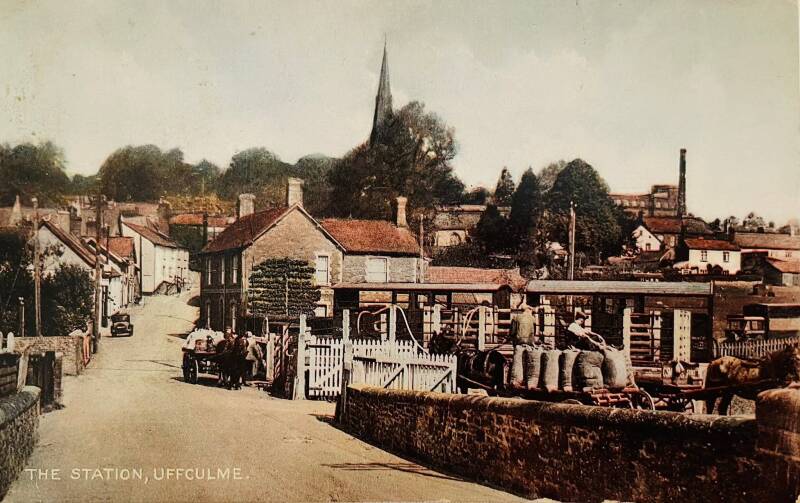
John Havill and an Important Marriage
William’s grandson, John Havill, brings another intriguing turn to the story. Born in 1595, John worked as an agricultural labourer. On 25 September 1626, at All Hallows in Goldsmith Street, Exeter, he married Ellinor Beaton Churchill.
That marriage joins the Havill line to Ellinor’s family and opens the door to another collection of histories and stories. For now, it stands as a reminder that a family tree is never really a single tree. Each marriage grafts one history onto another, bringing new places, occupations, loyalties and legends into the lives of later generations.
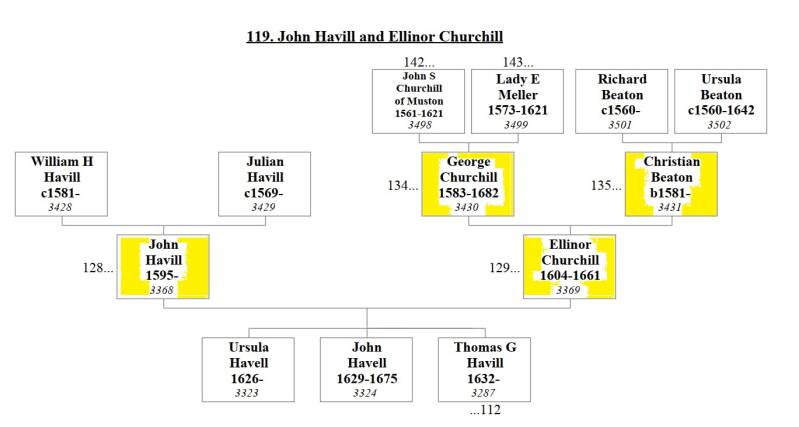
What Is in the Havill Name?
The surname itself is generally understood to be Anglo-Norman and habitational—originally identifying someone who came from a particular place. Name scholars connect it with places in Normandy such as Hauville in Eure and Hauteville-la-Guichard in Manche. Hauteville can be read as “high settlement” or “high estate.”
Over centuries, clerks wrote names as they heard them, and spelling was anything but fixed. The family name appears in forms including de Hauteville, Hauville, Havell, Hovell, Havile and Haville. The resemblance between these forms tells us something about the name’s long journey, although it does not by itself prove descent from any particular medieval noble family.
Historically, the name became strongly associated with the West Country, especially Devon. Centuries later it travelled with emigrants to North America and New Zealand. In our branch, that enormous movement can be told through one young passenger: Thirza Havill, leaving Devon aboard the Corona and stepping ashore in Otago.
The Thread That Connects Us
From William in sixteenth-century Uffculme, to John and Ellinor in seventeenth-century Exeter, to Thirza crossing the oceans in 1874, the Havill story is one of continuity through change. The settings shift from river valley to sailing ship, from Dunedin streets to Wellington, but the thread remains unbroken.
Perhaps that is the real gift of family history. It turns dates into departures, marriages into meetings, and signatures into acts of courage. It reminds us that our ancestors were not simply entries in a register. They were people making choices with no knowledge of us—yet those choices made our lives possible.
And so the Havill name, carried from Normandy into England, rooted in Devon and borne across the sea to New Zealand, continues its journey in the stories we remember and pass on.
George Robert Scott
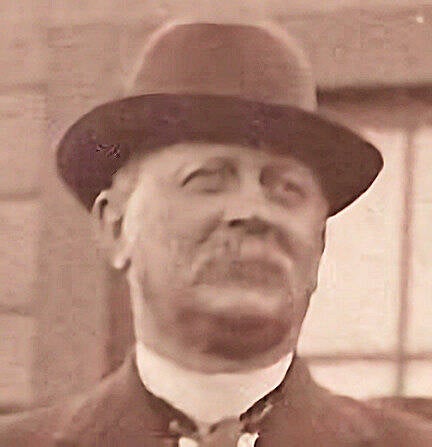
Thirza Harriet Elizabeth Havill
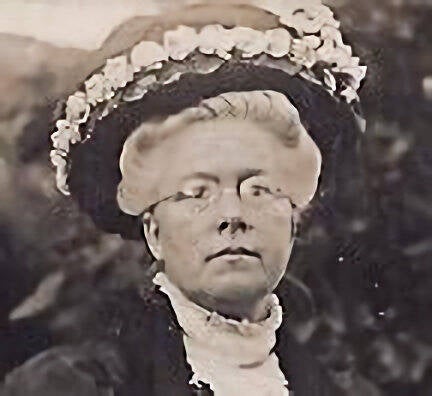
The Royston Thread
From a Devon manor to the ancient roads of Hertfordshire
I sometimes wonder why I spend so much time and effort doing this. The answer isn’t so difficult. It started with a simple enquiry ‘who am I and where did I come from?’ Trying to answer that has been incredibly rewarding. But it can also be incredibly frustrating.
It started by accessing the huge hive-minds of international databases. Much of the ‘who, when and where’ of family relationships have already been looked at by others, and you can build on that. But then comes the hard part. Is it fact, or just someone’s opinion? Can it be validated? The further back in history you go, the more likely that is to change from yes, to maybe, then to no. You are also at the mercy of the vagaries of misplaced, destroyed or completely absent records, non-standardised spelling, and even other languages and cultures.
But the ‘who, when and where’ are just the facts, and what makes this pursuit the more fascinating are the stories that are revealed from behind them. Stories that link you and your family to such facts. Stories of deprivation and hardship. Stories of a way of life far removed from your own. Stories of voyages across oceans to far distant and unknown lands. Stories that transform dates and places into actual people.
Stories are powerful, and they place people within times, places and environments. That has taken me from the rugged Scottish highlands and windswept Scottish coasts to the fertile rolling countryside of England and the beautiful, sunbaked, ancient farmlands of northern Italy. I have learnt history that I was completely unaware of, such as the powerful hold religious beliefs had over people’s lives, the aching, grinding poverty they endured regardless of the country of origin, and the loss of wasted lives and early deaths within families.
Sometimes those stories leave you with a dilemma, and this is one of those times. Sometimes the consensus of families and timelines within those huge databases have not or cannot be validated by records. Such as the case of Lieutenant Commander Willoughby Shortland, RN described in Early Arrivals. That doesn’t necessarily invalidate them. They just have to be seen as what they are – an unsubstantiated consensus of family histories. Beatrix of Portugal and Countess of Arundel, as described below is another example of this. It is another story that took me to a place, a time in history, and potential relatives that I had no idea of. And I might have just skipped over it, if it wasn’t for the fact that a tiny 1.2% of my DNA is deeply and firmly rooted in the Iberian Peninsula.
Every family tree has points where names and dates begin to gather into a story. In this branch, that point is Mary de Cruese, who was the wife of William Churchill and the mother of John Churchill. She was born in 1535 at Weycroft in Devon, to Richard Cruese and Thankful Royston. Through Thankful, the trail leads back into the Royston family and, beyond them, into a landscape of medieval roads, manor houses and shifting county boundaries.
A Devon Beginning
Mary’s birthplace appears to be the historic Weycroft Manor, near Axminster. It was a manor rather than a royal castle, but it was no ordinary farmhouse. Weycroft is recorded in the Domesday survey of 1086, and the surviving hall incorporates a great hall dating from about 1400, with later fifteenth-, sixteenth- and seventeenth-century work. Its stone walls, towered porch and long timbered hall offer a vivid setting for the world into which Mary was born.
Weycroft Hall
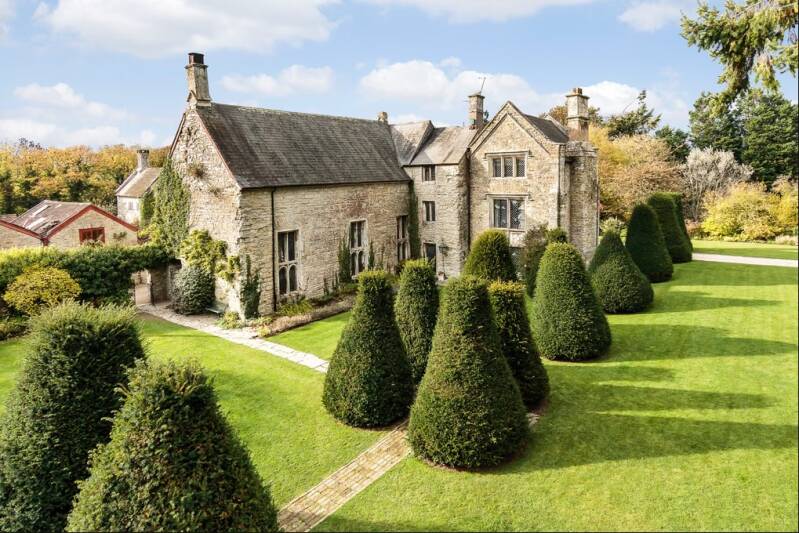
The Royston Line
The research follows Thankful Royston through John Royston, born about 1475, to an earlier John Royston of Torquay, who is recorded as marrying Elizabeth Taylour in 1474. This is the point at which the paper trail begins to thin. Spellings vary, dates sometimes overlap, and later family trees do not always agree. Even so, the names point consistently eastward, toward Cambridgeshire and Hertfordshire, where Royston was both a place and, increasingly, a surname.
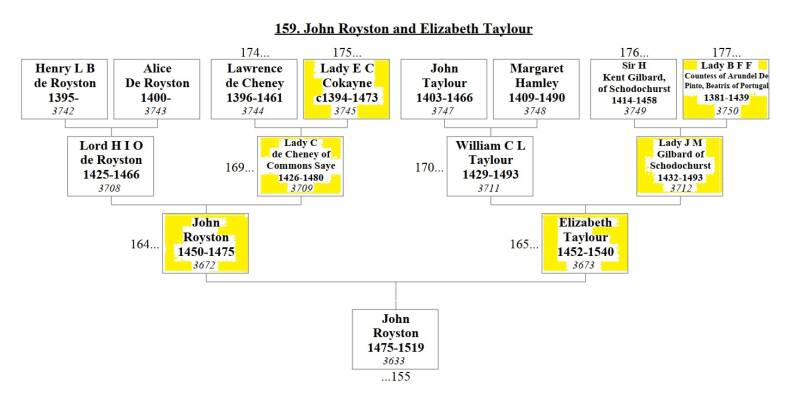
John’s father is identified in the family histories as Henry II of Barley de Royston—also written Henry Barlee or Barley of Albury and Walden—born about 1425 and dying in 1466. He married Catherine de Cheney, born at Fen Ditton in Cambridgeshire in 1426 and said to have died at Barley in 1480. Their story crosses a compact but historically busy region: Fen Ditton and Dry Drayton near Cambridge; Albury and Saffron Walden farther south; and Barley and Royston close to the old county line.
Catherine’s parents are given as Lawrence de Cheney (1396–1461) and Elizabeth Cokayne, who had previously been married to Philip Boteler. Through the maternal line and Elizabeth, the family tree returns to Sir John Cokayne of Ashbourne Hall and to Edith de Grey, born at Ruthin Castle in 1368, daughter of Reynold de Grey, second Baron Grey of Ruthin, and Alianore Le Strange. I have written about Sir John Cokayne and Ashbourne Hall (above).
It is an arresting chain of names, linking market towns and village manors to prominent medieval families,such as the de Cheney’s, Muschet’s, Pabenham’s, de Vernon’s, de Grey’s and le Strange’s, but it is also the kind of lineage that deserves to be treated as a clue until confirmed by contemporary evidence.
Elizabeth Taylour’s Unexpected Branch
Elizabeth Taylour, wife of John Royston, opens another door, and leads us on an even more unexpected journey, and again it is by following the maternal line. Her parents were William Calvin Linton Taylour and Lady Joane Marshall Taylor II (born Gilbard of Schodochurst). Her maternal grandparents were Sir Henry Gilbard, of Schodochurst, Kent, and Lady Beatrice Fitzalan Fettiplace Van Portugal Gilbard (born De Pinto, Beatrix of Portugal, Countess of Arundel). This extraordinary link will be explored next.
At the Crossroads
Royston grew where two ancient routes met: Ermine Street, the Roman road running north from London, and the Icknield Way, a much older track across the chalk country. A wayside cross once stood at this meeting place. Its origin is uncertain, although tradition associates it with a Norman noblewoman called Roisia or Rohesia. The district was known as Crux Roisiae—Roisia’s Cross—and by the early fourteenth century the name had evolved through “Roisia’s town” into Royston.
The surname probably began in the ordinary medieval way: a person who left the town could be identified as “of Royston.” Over time the description became hereditary, while spellings shifted with local speech and the habits of clerks. That helps explain forms such as Royston, de Royston and related variants, and it reminds us not to dismiss a record merely because its spelling differs from the modern name.
Barley: The Family Landscape
Barley lies only a few miles from Royston, on high ground near the routes between London, Cambridge and Saffron Walden. Its name does not refer to the crop. In the Domesday Book it appears as Berlei, this was the Norman version of an older name; pre-conquest it may have been known as Beora's Ley, meaning 'a woodland clearing owned by a Saxon Lord called Beora', or Beora sele, which in Old English simply means Beer or Feasting Hall. In 1086 it was already a substantial settlement, recorded in several holdings with about sixty households—large by Domesday standards.
The landscape is older still. Bronze Age and Iron Age activity has been found in the parish, and Romano-British communities later occupied the area. The village stands near the Icknield Way and not far from Ermine Street; its northern and eastern boundaries once lay near the frontier between the Anglo-Saxon kingdoms of Mercia and East Anglia. The church of St Margaret of Antioch retains a twelfth-century Norman tower, while the early Tudor Town House and seventeenth-century lock-up preserve later layers of village life.
What the Trail Tells Us
The value of this branch is not only in the possibility of noble or distant connections. Its real richness lies in the places that anchor it: a medieval hall above the River Axe, a stone cross at the meeting of ancient roads, and a Hertfordshire village whose fields have been worked for centuries. Mary de Cruese, Thankful Royston, the two John Roystons, Henry and Catherine, and Elizabeth Taylour form a chain across that landscape. Some links are firm, others remain provisional, but together they offer a compelling family story—one that invites both imagination and continued research.
The Kingdom of Portugal.
We return to Elizabeth Taylour’s extraordinary maternal ancestry, with the proviso noted earlier that this story, although compelling, is difficult to validate in places. But that little bit of Iberian DNA I have, had to come from somewhere.
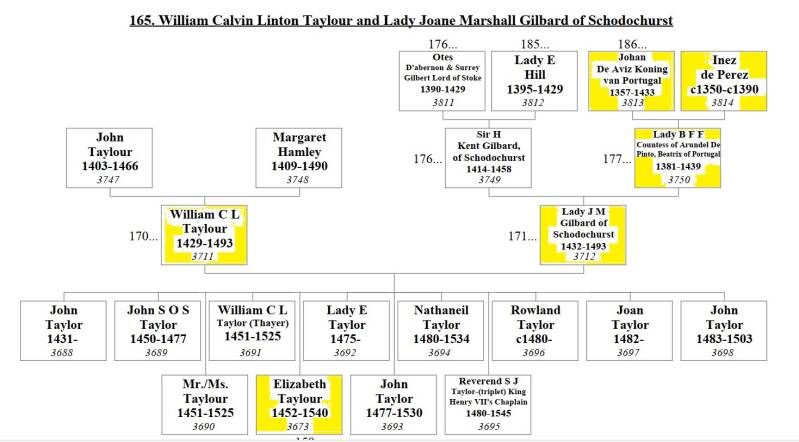
I wasn’t actually looking for this connection, so it was a bit of a surprise when I clicked on John of Aviz, and the software said he was a direct ancestor of mine. I was like ‘what, but he was Portuguese!’ But you just never know what climbing through the family tree is going to turn up!
I must confess, I know very little about Portugal, let alone those who used to rule it. I have never given it much thought, and then there is the language barrier. Like the language, its history seems complicated. But, like all histories, there are stories to be told. Here is one:
The Monarchs of Portugal ruled from the establishment of the Kingdom of Portugal, in 1139, to the deposition of the Portuguese monarchy and creation of the Portuguese Republic with the 5 October 1910 revolution. They all came from a single ancestor, Afonso I Henriques. Prior to the independence of Portugal, his house ruled the feudal County of Portugal, of the Kingdom of Galicia. When Afonso I Henriques declared the independence of Portugal, he turned the family from a comital house to royal house which would rule Portugal for over two centuries. When much later his successor Ferdinand I died in 1389, a succession crisis occurred, and Ferdinand's daughter Beatrice of Portugal was proclaimed queen and her husband John I of Castile proclaimed king by the right of his wife. But this was not to last.
Ferdinand I was the son of Pedro (Peter) 1 who ruled Portugal from 1357 to 1367 and died aged 46. Before he was made king he married Constance of Castile, a Castilian noblewoman on 24 August 1340 in Lisbon. Constance bought Inês de Castro to Portugal as her lady-in-waiting. Inês was the natural daughter of Pedro Fernández de Castro, Lord of Lemos and Sarria, and his noble Portuguese mistress Aldonça Lourenço de Valadares. Her family descended both from the Galician and Portuguese nobilities. She was also well connected to the Castilian royal family, by illegitimate descent.
The prince (Peter) fell in love with Inês and started to neglect his lawful wife, endangering the already feeble relations with Castile. Moreover, Peter's love for Inês brought the exiled Castilian nobility very close to power, with Inês's brothers becoming the prince's friends and trusted advisors. King Afonso IV of Portugal, Peter's father, disliked Inês's influence on his son and waited for their mutual infatuation to wear off, but it did not.
Constance of Castile died in 1345. Afonso IV tried several times to arrange for his son to be remarried, but Pedro refused to take a wife other than Inês, who was not deemed eligible to be queen. Peter's legitimate son, future King Ferdinand I of Portugal, was a frail child, whereas Peter and Inês's illegitimate children were thriving; this created even more discomfort among the Portuguese nobles, who feared the increasing Castilian influence over Peter. Afonso IV banished Inês from the court after Constance's death, but Peter remained with her declaring her as his true love. After several attempts to keep the lovers apart, Afonso IV ordered Inês's death. Pêro Coelho, Álvaro Gonçalves, and Diogo Lopes Pacheco went to the Monastery of Santa Clara-a-Velha in Coimbra, where Inês was detained, and killed her, decapitating her in front of her small child. When Peter heard of this, he sought out the killers and managed to capture two of them in 1361. He executed them publicly by ripping their hearts out, claiming they didn't have one after having pulverized his own heart.
Peter became king of Portugal in 1357 (Peter I of Portugal). He then stated that he had secretly married Inês, who was consequently the lawful queen, although his word was, and still is, the only proof of the marriage. Some sources say that after Peter became king of Portugal, he had Inês' body exhumed from her grave and forced the entire court to swear allegiance to their new queen: "The king [Peter] caused the body of his beloved Inês to be disinterred, and placed on a throne, adorned with the diadem and royal robes. and required all the nobility of the kingdom to approach and kiss the hem of her garment, rendering her when dead that homage which she had not received in her life..."
She was later buried at the Monastery of Alcobaça where her coffin can still be seen, opposite Peter's so that, according to the legend, at the Last Judgment Peter and Inês can look at each other as they rise from their graves. Both marble coffins are exquisitely sculpted with scenes from their lives and a promise by Peter that they would be together até ao fim do mundo (until the end of the world).
Whether (and how much of) this is fact and how much legend, the story has been immortalised in plays, poems, song and opera, in Portuguese, Spanish French and English, ever since.
Inês de Castro and Peter I had the following children, who were legitimized by Peter I on 19 March 1361:
- Afonso, died shortly after birth.
- Beatrice, married Sancho Alfonso, 1st Count of Alburquerque and was thereby the great-grandmother of Ferdinand II of Aragon.
- John, Duke of Valencia de Campos, claimant to the throne during the 1383–85 Crisis.
- Denis, Lord of Cifuentes, claimant to the throne during the 1383–1385 Crisis.
Just to confuse matters, enter João (John) I who was born on 11th April 1357, and who reigned as King of Portugal from April 6th, 1385, to 14th August, 1433. He was the illegitimate child of King Pedro (Peter) I of Portugal, and Teresa Lourenço, daughter of a Lisbon merchant. In 1364, at 7 years old, John was made Grand Master of the Order of Aviz, henceforth becoming known as John of Aviz. His reign was the result of the dynastic crisis following the 1383 death of Ferdinand I. Ferdinand's widow Leonor Telles was disliked by both the nobility and the commoners for having left her first husband and for having had their marriage annulled in order to marry King Ferdinand. Ferdinand's designated heir was their only surviving child Beatrice, married to John I of Castile who claimed the throne in the name of his wife, but under the Treaty of Salvaterra that had been the basis for John's marriage to Beatrice, the unpopular Leonor was left as Regent until such time as the son of Beatrice and John would be 14 years old.
In April 1385, amidst popular revolt and civil war, the Cortes of Coimbra declared John, Master of Aviz, as king John I of Portugal. John of Aviz's rule became established fact with the Portuguese victory in the Battle of Aljubarrota on 14 August 1385, where he defeated John I of Castile. A formal peace between Portugal and Castile would not be signed until 1411.
To mark his victory, John founded the Monastery of Santa Maria da Vitória, known as the "Batalha Monastery" ("Battle Monastery"), whose chapel became the burial place of the princes of the new dynasty of Aviz. The descendants of King John I were still also Masters of Aviz, though at times that title passed to one descendant of John and the Crown of Portugal to another. The title of Grand Master of the Order of Aviz was permanently incorporated into the Portuguese Crown toward the end of rule by the House of Aviz, in 1551.
The House of Aviz would rule Portugal until its fall in the 1580 to the Philippine Dynasty. This period of Portuguese history saw the ascent of Portugal to the status of a European and world power. The conquest of Ceuta in 1415 was its first venture in colonial expansion, followed by a great outpouring of national energy and capital investment in the exploration of Africa, Asia and Brazil with the founding of colonies to exploit their resources commercially.
To my utter astonishment, it seems that João (John) I, King of Portugal may have been my direct ancestor, 20 generations ago.
How so?
When John 1 of Castile fought John de Aviz for the Portuguese crown in the Battle of Aljubarrota , he naturally enlisted the help of the Spanish for his army. John de Aviz however, enlisted the help of the English for his, and prevailed. As was the custom back then, he cemented this alliance by marrying off Lady Beatrice Fitzalan Fettiplace Van Portugal Gilbard (born De Pinto, Beatrix of Portugal, Countess of Arundel) to Sir Henry Gilbard, of Schodochurst, Kent. That line continues down through the Taylour, Royston, Cruese and Churchill families to arrive at the Havills and ultimately the Scott’s, ending with my Grandmother Ethel Jackson Scott.
Ken Sims
17 December 2021
Mosteiro de Santa Maria da Vitória, Portugal.
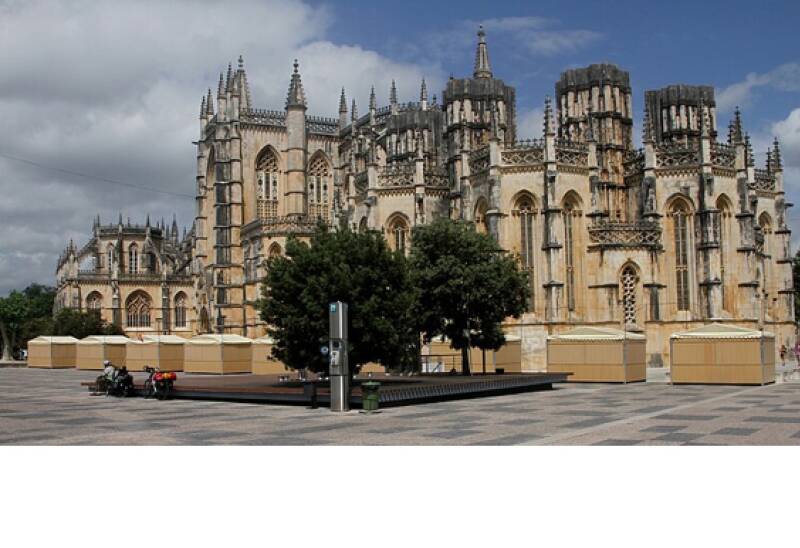
The Northam's of Devon.
The Northam family join the Havill family with the marriage of John Havill and Elizabeth Northam at St Sidwell, Exeter, Devon, England on April 16th, 1838. Elizabeth had been born around 1810 at Bow, Devon, England to Joseph Northam, a labourer, and Elizabeth Dunn.
I can trace the Northam family back as far as William Northam and his wife Mary. William was born in Uffculme, Devon, England around 1690, and offers us a fascinating glimpse into life there in those times.
As we have seen with the Havill family, Uffculme is a historic village and civil parish situated in Mid Devon, England. While its roots stretch back centuries, its evolution offers a unique glimpse into rural English life, industry, and landscape, particularly during the late 1600s.
Uffculme lies on the upper reaches of the River Culm, a gentle river whose valley cuts through the surrounding countryside. The name Uffculme itself is believed to derive from an early Anglo-Saxon adaptation referencing the calming, unhurried waters of the river mixed with Celtic terminology. Nestled on the edge of the Blackdown Hills (designated today as an Area of Outstanding Natural Beauty), the parish transitions from low-lying river meadows to rolling hills. It shares borders with neighboring agricultural parishes such as Culmstock, Hemyock, and Willand. In the late 17th century, its geography dictated isolation and challenge; roads were little more than muddy tracks, meaning heavy goods and woven cloths had to be transported via packhorse strings over difficult terrain toward major regional hubs like Exeter and Topsham.
Recorded in the Domesday Book of 1086 as Offecoma, the manor was originally held by Walter de Douay and later tied into the barony of Bampton. During the medieval period, it developed into a bustling rural settlement, surviving disruptions like the civil wars of the 12th century and outbreaks of disease such as the sweating sickness in the 16th century. By the late 1600s (the Stuart period / reign of Charles II and James II), Uffculme was no longer just a sleepy farming community. It was rapidly integrating into a massive regional economic engine. As noted by contemporary travelers like Celia Fiennes, the entire surrounding countryside of Devon was deeply embedded in the textile trade. Uffculme was transitioning into a notable manufacturing and cottage-industry hub centered around wool.
A crucial historical note for the late 17th century is that Uffculme was a "Peculiar" jurisdiction belonging to the Prebendary of Salisbury Cathedral rather than the Diocese of Exeter. Because of this administrative quirk, the local wills, inventories, and parish records of the late 1600s survived intact, being spared the tragic fate of Exeter's central probate records, and giving historians an unusually clear window into the daily lives, wealth, and probate inventories of Uffculme residents from this exact era.
Life in late 17th-century Uffculme revolved heavily around the "cottage industry" of cloth-making. While farmers raised sheep on the surrounding hills, households throughout the village were engaged in the multi-step process of turning raw fleece into marketable goods. Women and children predominantly spun yarn using distaffs and wheels, while men worked the looms or managed the physical prep work. This wool was eventually bought up by merchants and processed into serges and kerseys destined for broader English and European markets. Aside from spinning and weaving, agriculture remained the backbone of daily survival. Villagers laboured as smallholders, tenant farmers, or agricultural day labourers cultivating crops like wheat and barley, tending livestock, and managing local orchards.
Society was deeply stratified. At the top were landed gentry families—such as the Walronds of the magnificent nearby Bradfield Hall—whose timber-framed estate houses symbolized traditional authority. Conversely, ordinary weavers, labourers, and artisans lived in modest vernacular cottages. Probate inventories from the late 1600s often reveal humble interiors consisting of a main hall for cooking and living, a buttery or storage pantry, and low-ceilinged sleeping lofts above. Life was dictated by the seasons, church calendars, and local markets. Despite the looming presence of the law—such as the quirky burial acts passed under Charles II requiring bodies to be wrapped strictly in wool to protect the domestic textile market—daily existence was close-knit, highly localized, and deeply reliant on family networks embedded right along the Culm Valley.
The surname Northam is a classic example of an English topographic or habitational name. This means it originated from a specific geographic location where the original bearers lived or held land.
Derived from Old English elements, "North": simply means the cardinal direction north, while "Ham": comes from the Old English hām meaning a homestead, village, or manor or hamm (meaning an enclosure, water meadow, or land hemmed in by water. Combined, the name literally translates to "the northern homestead" or "the northern water meadow." Because the description "north homestead" is relatively common, it is not surprising that the name crops up independently in various smaller hamlets across the English countryside, including Northam, Devon: (This is perhaps the most prominent origin. Located near Bideford, it was recorded in the Domesday Book of 1086 as Northam.) and Northam, Southampton: (A district in Hampshire that shares the same Old English roots.)
The name began appearing in written records shortly after the Norman Conquest as people started adopting fixed hereditary surnames for taxation and legal purposes. One of the earliest recorded instances is William de Northam, appearing in the Subsidy Rolls of Sussex in 1296. The "de" (meaning "of") confirms its habitational origin. Over centuries, as literacy and standardized spelling evolved, you might find the name recorded as Northum, Northman, or Northem. While the name can be found globally today due to migration, it remains most densely concentrated in the South West of England, particularly in Devon and Somerset, tracing back to its primary roots near the coast.
The Chilcotts of Devon
Thirza Harriett Elizabeth Chilcott
Thirza Harriett Elizabeth Chilcott was my great-great-grandmother, a woman whose life stretched from the quiet villages and streets of nineteenth-century Devon to the young and developing city of Dunedin, New Zealand.
She was born in October 1839 in Exeter, Devon, England, the daughter of John Chilcott and Harriett Hoar. Exeter is an old and historic city, and for the first part of her life it was the centre of Thirza’s world. Exeter is a city on the River Exe and the county town of Devon. The city has been continuously inhabited since pre-Roman times. Once the been the centre of the Dumnonii tribe, it was conquered by the Romans and named Isca Dumnoriorum. The line of most of the Roma walls remains, incorporated within the mediæval city walls. The Saxons occupied the town from the 8th century, calling it Escanceaster. Rougemont Castle was built by William the Conqueror, following the rebellion of 1068. The founding of Exeter Cathedral, dedicated to Saint Peter, dates from 1050. The present building was complete by about 1410.
Exeter City on the River Exe
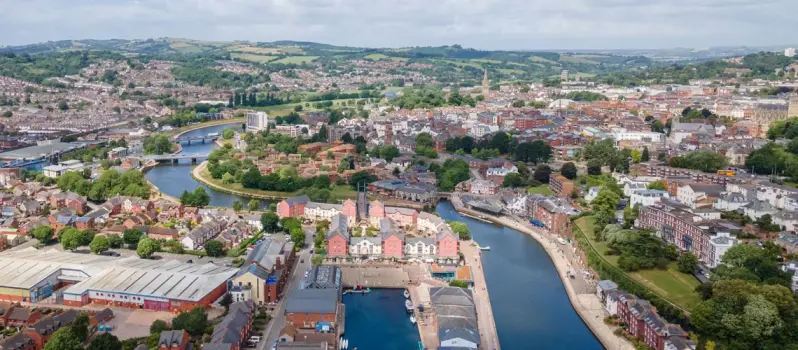
In June 1858, when she was just eighteen years old, Thirza married William Havill, a young plumber's apprentice. They were married at St Mary Arches Church, on Mary Arches Street in Exeter. Their marriage marked the beginning of a family life that, although it began in England, would eventually take them halfway around the world.
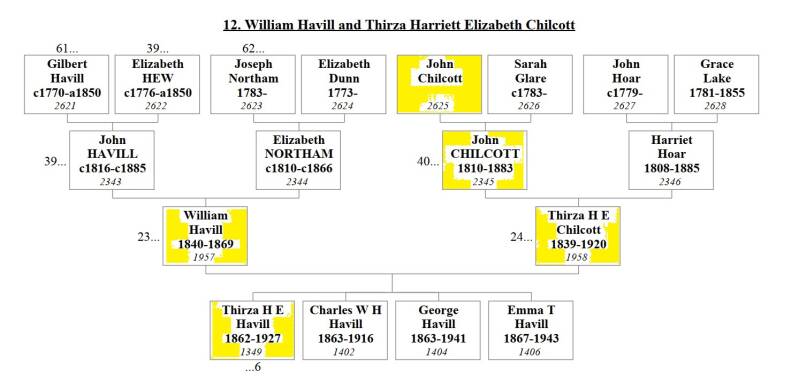
William and Thirza started a family, and by the late 1860s they had five children. William worked as a plumber, but tragedy struck the family in 1869 when William died. Thirza was only about thirty years old and was suddenly left to raise four children without her husband.
For a young widow in Victorian England, this must have been an extraordinarily difficult time. Whatever private struggles she faced are largely hidden from the records we have today, but we can see the circumstances she was living in. By 1871, Thirza and her children were living in Clyst St Lawrence, a small village northeast of Exeter.
Somehow, over the next few years, Thirza made the remarkable decision to begin a new life on the other side of the world.
A new beginning in New Zealand
In 1874, Thirza and her children became part of the great movement of people leaving Britain for a new life in New Zealand. They travelled under the assisted immigration scheme, which helped ordinary working families make the long journey to the colony.
Their ship was the Corona. The Corona left London on 22 May 1874 and arrived at Port Chalmers, near Dunedin, on 28 August 1874, after a voyage of about ninety-two days. Contemporary New Zealand government records describe the Corona as carrying hundreds of government-assisted immigrants. The official report recorded 388½ statute adults and noted that on the voyage they had been generally healthy, with the ship being found clean and well-ventilated on arrival.
For Thirza, however, this was far more than simply an entry in an immigration report. She was a widowed mother travelling with her children from everything familiar in Devon to a country thousands of miles away. The voyage itself must have been an extraordinary experience. The route from Britain to New Zealand took immigrants far out into the Atlantic, around the Cape of Good Hope and across the southern oceans. In 1874, such a journey meant weeks at sea, with no possibility of simply turning back or contacting family at home.
When the Corona finally reached Port Chalmers on 28 August, Thirza and her children had arrived in their new homeland. They were now New Zealanders in the making. The scale of immigration into Dunedin at this time can be glimpsed in contemporary newspaper reports. The Otago Daily Times reported that hundreds of immigrant families and single people were being accommodated in the Caversham Immigration Barracks after the arrival of ships including the Corona. Many quickly found employment or accommodation in Dunedin.
Life in Dunedin
Unfortunately, the surviving records tell us much less about Thirza's life in New Zealand than they do about the dramatic journey that brought her there.
At some point after her arrival, she was recorded as working as a machinist. This is an interesting glimpse into her life because it shows that Thirza was not simply dependent upon others. She was earning a living and contributing to her family's support.
In 1875, only a year after arriving in New Zealand, Thirza married again. Her second husband was William Hutchings, a contractor and carter who had been born in 1840 at Henley, in Suffolk, England. Thirza was about thirty-six years old at the time of their marriage. The couple had a daughter, Eva, who was born in 1875,
the same year they married.
And so, after the loss of her first husband, the upheaval of widowhood and the extraordinary journey from England to New Zealand, Thirza began another chapter of family life in Dunedin. There is something particularly striking about her story. Within the space of only a few years she had experienced marriage, motherhood, widowhood, international migration and remarriage. She had crossed an ocean and established herself in a completely new society.
The years that followed
William Hutchings died on 25 October 1891. Thirza lived for another nine years. She died in 1900, at about sixty years of age. By then, the young widow who had left Devon with five children had become part of a growing New Zealand family. The journey that began in Exeter had carried her descendants into a new country and a new generation.
We may never know exactly what Thirza thought as she stood on the deck of the Corona in 1874, watching England disappear behind her. We do not know what she hoped for, what she feared, or what she imagined life in New Zealand would be like. But the decision itself tells us something. She had already endured the loss of her first husband and the responsibility of caring for five children. Rather than remaining where life had become difficult, she took the enormous step of starting again in a distant land. Her story is therefore not only one of migration. It is a story of family, loss, courage, hard work and starting again. And because she made that journey, her story eventually became part of ours.
The Chilcott Name
The story of Thirza also takes us further back, into the history of the Chilcott family name. Chilcott is an English surname particularly associated with the West Country, especially Somerset, Devon and neighbouring counties. Historical surname research describes Chilcott as a variant of Chilcote, a habitational name connected with places called Chilcott or Chilcote. In other words, the name probably began as a way of identifying someone by the place they came from or were associated with.
Our family history traces the Chilcott’s back to a John Chilcott, born in Exeter, Devon sometime in the late 1700’s. He married Sarah Glare there in 1808 and they had two sons and a daughter, John born in Tiverton, Devon in 1809, Mary Ann born in Ashburton, Devon around 1810, and William, born in Plymouth, Devon in 1813.
The Oxford Dictionary of Family Names records Chilcott, Chilcot and Chilcote as related forms and shows that the surname was strongly concentrated in Somerset, Devon and Dorset in the nineteenth century. It also records early examples of the name, including Baldwin de Chillecota in 1169 and later forms such as John Chilcott in Somerset and Robert Chilcot in Devon in the seventeenth century.
The exact meaning of the original placename is less certain. One established interpretation derives Chilcote/Chilcott from Old English elements associated with cild and cot, broadly relating to a young person or dependent and a cottage or small dwelling. There are also older place-name theories, so it is probably safest to say that Chilcott is an ancient West Country placename surname
rather than assigning it one definite literal translation.
Over the centuries the name appeared in several forms, including: Chilcott, Chilcot, Chilcote, Chillcott, and Chylcote. This variation was quite normal before spelling became standardized. The different spellings do not necessarily represent different families; they can simply reflect the way a name was heard and recorded by different clerks at different times.
For our family, the name has a particularly appropriate history. It began in the English West Country, remained closely associated with Devon and Somerset, and was eventually carried across the world by people such as Thirza Harriett Elizabeth Chilcott. Her journey transformed the name from one rooted in the
villages and towns of Devon into a name that would become part of a New Zealand family.
Remembering Thirza
Today, we know only fragments of Thirza's life.
- We know when she was born.
- We know the names of her parents.
- We know that she married William Havill when she was eighteen.
- We know she became a mother to five children—Charles William Henry, Sarah, Thirza, George and Emma—and then a widow when they were still at different stages of their young lives.
- We know that, with five children to care for, she left England.
- We know that she sailed aboard the Corona and arrived at Port Chalmers in 1874.
- We know that she worked as a machinist.
- We know that she married William Hutchings and had another daughter, Eva.
- And we know that she died in 1900.
But between those facts lies a whole human life. There were probably ordinary mornings, difficult days, family celebrations, worries about money, friendships, work, illness and countless moments that were never written down. Perhaps that is what makes family history so compelling. The records give us the framework, but within that framework lived a real person.
Thirza was a young woman from Exeter who became a wife, a mother, a widow, a working woman, an emigrant and, eventually, a New Zealand wife and mother. Her life crossed an ocean, but more importantly, it connected generations. And every generation that followed became part of the story she began when she stepped aboard the Corona in 1874.
Thirza's story is especially remarkable because her journey to New Zealand was a family journey. She did not leave Devon alone. She carried with her the lives and futures of Charles William Henry, Sarah, Thirza, George and Emma, five children born in England who would become part of the next generation of her family's history in New Zealand. Her decision to emigrate therefore changed the course of not just her own life, but the lives of all five children who travelled with her. Perhaps that is what makes family history so compelling. The records give us the framework, but within that framework lived a real person.
The Hoars of Devon: A Family Story
The Hoar family enters our family story through Harriet Hoar, a young woman from Exeter, Devon, who in 1831 married John Chilcott and became part of the family line that would eventually lead to New Zealand.
Harriet was born in 1808 at St Paul, Exeter, Devon, the daughter of John Hoar and Grace Lake. She was about twenty-three years old when she married John Chilcott on 22 May 1831. At the time of their marriage, John’s occupations are recorded variously as a Market Toll Collector and a Policeman, giving us a small glimpse into the working world in which Harriet began her married life.
Although the surviving records tell us relatively little about Harriet herself, they allow us to place her within a Devon family whose roots reached back into the rural communities of the county.
Harriet's Parents
Harriet's father, John Hoar, was born around 1779 at Combpyne, Devon. We do not yet know when or where he died, nor do we have enough surviving records to tell us much about his occupation or daily life. His story therefore remains partly hidden from us, as is so often the case when we follow our ancestors back into the eighteenth century.
Harriet's mother was Grace Lake, born in Exeter in 1781. Grace lived through a period of enormous change in England, from the final years of the Georgian era into the Victorian age. She died at Bideford, Devon, on 4 June 1855, aged seventy-four.
We know these names and dates, but behind them were two people who lived ordinary lives in a changing Devon landscape. They married, established a household and raised their family, leaving behind only fragments of their lives for descendants more than two centuries later to discover.
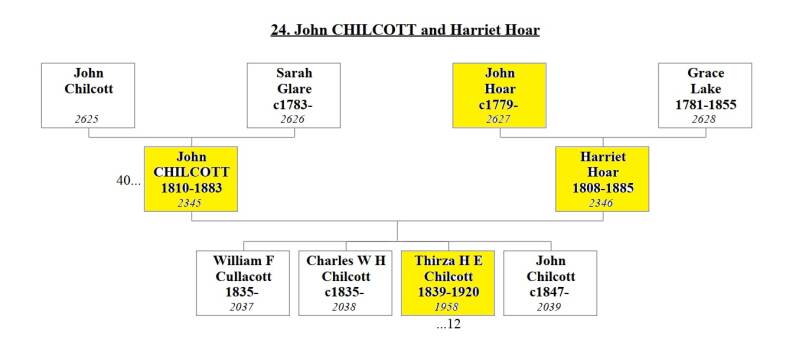
Combpyne — The Devon Home of the Hoars
John Hoar's connection with Combpyne gives the Hoar family a particularly evocative Devon setting.
Combpyne is a small village in East Devon, close to the River Axe and surrounded by the rolling countryside for which the county is famous. Today it is a quiet village of thatched cottages, old buildings and narrow country lanes, but its history reaches back many centuries.
At the heart of the village stands St Mary's Church, whose origins reach back to the medieval period. Combpyne's position near the Axe placed it within an old landscape of farming, local trade and movement between the villages and small towns of East Devon.
It is easy to imagine the Hoar family living within this landscape in the late eighteenth century: a rural community where people knew their neighbours, where work and family were closely intertwined, and where the surrounding countryside shaped everyday life.
Combpyne also lies within reach of the Jurassic Coast, now famous for its dramatic cliffs and coastline, and within the wider landscape of East Devon that has long attracted visitors for its natural beauty. For John Hoar, however, this was not a tourist destination. It was simply home — the landscape in which his early life unfolded.
The Hoar Name
The surname Hoar itself is an ancient English name. Its origins reach back to the Old English word har, meaning hoar, grey or white.
Like many early English surnames, it probably began as a descriptive nickname. In a time when surnames were not yet fixed and hereditary, people were often distinguished from one another by their appearance, occupation, location or parentage. A man with grey or white hair, or perhaps a distinctive silvery beard, might have become known as "the Hoar."
There is also another possible connection. The word hoar was associated with an ancient boundary stone or marker — a hoar-stone. In some cases, therefore, the name may have referred to someone who lived near such a landmark.
The name appears in medieval records in several forms. One early example is William le Hore, recorded in the Gloucestershire Pipe Rolls in 1188. The use of le, meaning "the", is particularly interesting because it suggests that the name was still functioning as a descriptive nickname: William the Hoar.
Over the centuries the spelling changed, as spelling was not yet standardized. Historical records may therefore contain forms such as Hoar, Hoare, Hore, Hoor and Hour. These variations can make genealogical research challenging, but they also remind us that our ancestors' names were not necessarily written in one fixed form.
Branches of families bearing the name also became established in Ireland during the medieval period, particularly in areas such as Wexford and Cork. The Irish Hoare families later became prominent in local history. Whether or not these branches were connected to our own Devon Hoars is something that would require further evidence, but it illustrates the long and geographically varied history of the surname.
The Missing Records
There is another reason why the Hoar family's story becomes difficult to follow as we move further back.
Like the Chilcott family records, the Hoar family's documentary trail may have been affected by the catastrophic loss of records in Exeter during the Second World War.
During the Exeter Blitz of 1942, the city's Probate Registry at Bedford Circus was destroyed by incendiary bombing. The building held a vast collection of historical documents, and the destruction resulted in the loss of virtually all of Devon's original pre-1858 probate records, including many wills and administrations.
For family historians, the loss was enormous. Wills and probate documents can be among the richest sources of information about ordinary families — naming husbands and wives, children, parents, brothers and sisters, describing property and possessions, and sometimes revealing relationships that cannot be found elsewhere.
For the Hoar family, those lost records may have contained precious clues about John Hoar, his parents, his family and the circumstances of his life and death.
And so, at least for now, our journey with the Hoars reaches a point where the records fall silent.
Harriet Hoar — The Link in Our Family
What we do know is that Harriet Hoar was born in Exeter in 1808, the daughter of John Hoar and Grace Lake. Twenty-three years later, on 22 May 1831, she married John Chilcott.
That marriage brought together two Devon families and created the link through which the Hoar name entered our direct family line.
Harriet would have been born into a world very different from the one we know today. When she was born, England was still in the Georgian period. The Industrial Revolution was transforming the country, but much of Devon remained rural. Roads and travel were slow by modern standards, and communities were still strongly centred on villages, churches, markets and local trades.
By the time Harriet married in 1831, William IV was king. Within a few years Queen Victoria would come to the throne, beginning the long Victorian era during which Harriet would spend much of her adult life.
Somewhere between the villages and towns of Devon, Harriet's life unfolded. We do not know what she looked like, what she dreamed of, what she thought about the changes taking place around her, or what stories she told her children about her own childhood.
But she left a lasting legacy.
Through her marriage to John Chilcott, the bloodline of John Hoar and Grace Lake continued into the generations that followed. The Hoar name itself may have disappeared from our direct family line, but Harriet carried her family's ancestry forward.
And that is how a young woman born at St Paul, Exeter, in 1808, became one of the links connecting an old Devon family to our own family story.
The records may tell us only fragments of Harriet's life. Yet those fragments are enough to place her firmly within the long history of Devon — a history of villages and churches, farms and markets, families and marriages — and, ultimately, within the story of our own family.